Mandala Yoga: Benefits, Poses & How to Start in 2026
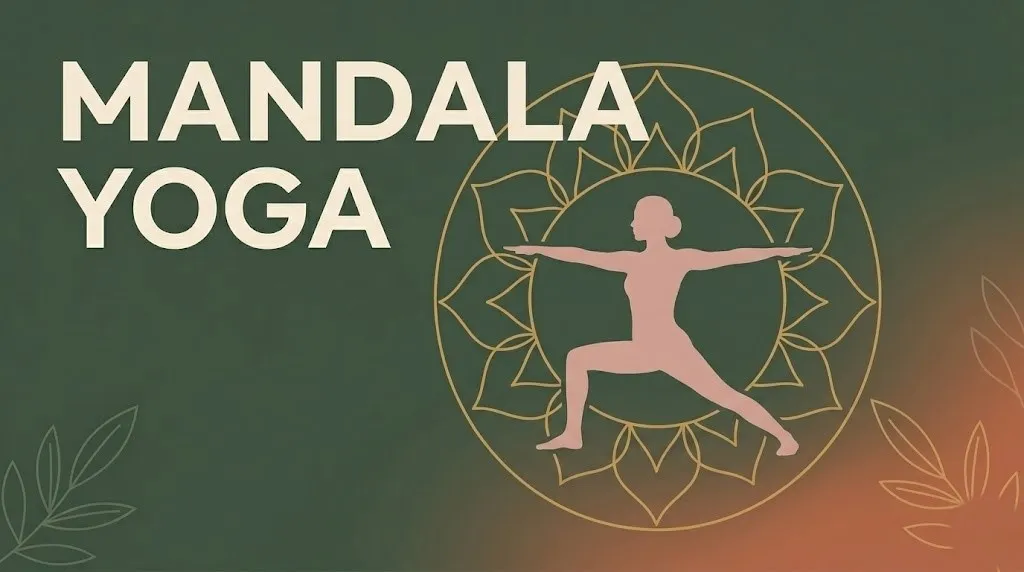
Mandala yoga is a circular movement practice that guides you through poses in a full 360-degree rotation around your mat. Unlike conventional yoga sequences that face one direction, mandala yoga treats the entire mat as a sacred wheel, building strength, mobility, and awareness from every angle.
This style has grown steadily in studios from New York to California. According to the National Center for Complementary and Integrative Health (NCCIH), yoga participation in the United States has increased by more than 50% over the past decade, and specialty styles like mandala flow are driving much of that growth among experienced practitioners seeking something new.
This article covers what mandala yoga actually is, how a sequence works step by step, what the research says about its physical benefits, and how to practice it safely whether you’re a complete beginner or a senior looking for a gentler circular flow. Modifications, props, and contraindications are all included.
What Is Mandala Yoga?
Mandala yoga is a style of yoga that structures poses and transitions in a circular pattern around the mat, moving through all four cardinal directions over the course of a single practice.
The word “mandala” comes from Sanskrit and means circle or sacred geometric form. In this practice, the mat becomes the mandala. You begin facing one direction, move through a sequence of poses, then rotate 90 degrees and repeat the pattern until you’ve completed a full circle.
This is not a separate yoga lineage like Ashtanga or Iyengar. Think of it more like a structural principle: a way of organizing any sequence, often drawn from Vinyasa or Hatha yoga, into a circular architecture. Some teachers blend it with Yin yoga elements for a slower, more meditative experience.
The circular format comes from the Hindu and Buddhist concept of the mandala as a symbol of wholeness and the cosmos. Using that geometry on the mat is intentional. Every direction you face challenges your body and nervous system slightly differently, even when you perform the same pose.
Key features of mandala yoga include:
- Movement through four or more directional orientations during one session
- Poses repeated symmetrically on each side as you rotate
- An emphasis on hip mobility, spinal rotation, and lower body strength
- A meditative quality created by the repetitive, rhythmic structure
Mandala Yoga Center and Where to Practice
Mandala yoga centers are specialty studios or yoga schools that offer circular-sequence classes, and several well-regarded mandala yoga programs operate along the East Coast, including in Amagansett, New York.
Finding a dedicated mandala yoga center is easier now than it was five years ago. The style has moved from niche workshop offering to regular class slot at many studios. A mandala yoga center typically offers this practice as either a stand-alone class or woven into a broader Vinyasa or Hatha schedule.
If you live near a yoga community hub like the Hamptons or similar coastal wellness communities, checking studio schedules for terms like “mandala flow,” “circular yoga,” or “around-the-mat practice” will surface relevant classes. Many centers also use the name to brand their overall philosophy, not just one class type.
For those who cannot access a physical mandala yoga center, online platforms have made this practice far more available. Yoga teachers who specialize in mandala sequences often teach via subscription platforms, and the format translates well to video because the pattern is visual and easy to follow even without an instructor present in the room.
| Practice Setting | What to Expect | Best For |
|---|---|---|
| Mandala yoga center or studio | Live teacher, group energy, guided sequence | Community, accountability, beginners |
| Online class or video | Self-paced, repeatable, flexible schedule | Home practitioners, rural locations |
| Private session | Customized sequence, detailed corrections | Injury management, seniors |
| Retreat setting | Immersive multi-day practice | Deepening practice, travel |
Mandala Flow Yoga Explained
Mandala flow yoga is the Vinyasa-based version of mandala yoga, linking breath to movement as the practitioner rotates through directional sequences around the mat.
The word “flow” here refers to the Vinyasa style, where each movement is synchronized with an inhale or exhale. In mandala flow, this breathwork is layered onto the circular structure. You move through a series of poses, breath by breath, and then rotate 90 degrees to repeat the pattern facing a new direction.
What makes mandala flow feel different from a standard Vinyasa class is the spatial experience. Most yoga sequences are linear: you face the front of the room, maybe turn sideways occasionally, and finish where you started. Mandala flow is omnidirectional. By the time class ends, you have faced every wall in the room, challenged your balance from multiple angles, and moved your hips through their full range of available rotation.
This full-circle approach is why many practitioners describe mandala flow as feeling like a “moving meditation.” The rhythm of the breath plus the predictable rotation creates a kind of sensory absorption that’s distinct from standard flow classes. Your mind has something specific to track, which tends to quiet mental noise naturally.
A 2021 review published in the International Journal of Yoga found that movement-based yoga practices involving rhythm and repetition were associated with measurable reductions in perceived stress and improvements in sustained attention.
Pose Tip:
- In mandala flow, keep your transitions slow at first so you can orient yourself to the new direction before the next pose
- Use a visual cue on each wall, like a window or a corner, to help your nervous system register the rotation
- Beginners can hold each pose for 5 full breaths rather than flowing quickly
Mandala Yoga Sequence Step by Step
A classic mandala yoga sequence moves through four rounds of poses, each round rotated 90 degrees from the last, using the full mat as a compass rose.
Here is a foundational mandala yoga sequence structured for one complete circle. Each round uses the same poses. You rotate 90 degrees clockwise at the start of each new round.
To practice a foundational mandala yoga sequence:
- Begin in Tadasana (Mountain Pose) at the top of your mat, facing the front wall. Stand tall. Breathe here for 3 cycles.
- Step your right foot back into Anjaneyasana (Low Lunge). Square your hips forward. Hold for 4 breaths.
- Straighten your back leg and open into Virabhadrasana II (Warrior II). Extend both arms parallel to the floor. Hold for 4 breaths.
- Shift into Utthita Parsvakonasana (Extended Side Angle Pose). Place your forearm on your front thigh or your hand to a block. Hold for 3 breaths.
- Return through Anjaneyasana (Low Lunge) and step to Adho Mukha Svanasana (Downward-Facing Dog). Hold for 3 breaths.
- Walk your hands back to standing. Rotate 90 degrees clockwise on your mat.
- Repeat steps 2 through 6 three more times, each round facing a new wall, until you return to your original direction.
- Close in Balasana (Child’s Pose) for 10 breaths, then rest in Savasana (Corpse Pose) for 5 minutes.
Modification for beginners: Hold each pose for longer, 5 to 8 breaths. Skip the full arm extension in Virabhadrasana II and keep hands on hips if shoulders tire.
Modification for knee sensitivity: Place a folded blanket under the back knee in Anjaneyasana (Low Lunge). Reduce your lunge depth so the front knee stays directly above the ankle.
Key Takeaway: Mandala yoga organizes familiar poses into a circular architecture that challenges your body from every direction, and even a simple four-round sequence offers a complete, full-body experience.
Mandala Yoga Benefits for the Body
Mandala yoga builds lower body strength, hip mobility, spinal rotation, and balance simultaneously because the circular format demands that every muscle group work from multiple angles.
Most yoga sequences are biomechanically front-loaded. You face the front wall, work primarily in the sagittal plane (forward and back), and rarely challenge lateral stability. Mandala yoga breaks that pattern. By rotating through multiple directions, you train your body to stabilize, move, and transition from unfamiliar orientations.
The American College of Sports Medicine notes that multi-directional movement training improves joint stability and functional balance more effectively than single-plane exercise alone. Mandala yoga satisfies this principle because no two rounds engage the muscles in exactly the same way, even when performing identical poses.
Documented physical benefits include:
- Improved hip flexor and hip rotator flexibility through repeated lunging and lateral opening across all four directions
- Increased thoracic (mid-back) rotation from directional transitions and twisted pose variations
- Stronger quadriceps, glutes, and hamstrings from sustained Virabhadrasana II (Warrior II) and Anjaneyasana (Low Lunge) holds
- Better ankle stability from standing and balancing on different sides of the mat, which subtly changes weight distribution
- Gradual improvement in cardiovascular endurance in the mandala flow (Vinyasa-based) version
Because each directional round takes approximately 8 to 12 minutes, a complete mandala sequence runs 35 to 50 minutes. That’s enough sustained movement to generate meaningful cardiovascular and muscular training stimulus, particularly for people who are new to regular physical activity.
Mandala Yoga and Spatial Awareness
Mandala yoga trains spatial awareness, the ability of the body and nervous system to accurately sense position and orientation in space, more directly than most yoga styles because it requires constant reorientation.
Spatial awareness is governed by the proprioceptive system, which uses signals from muscles, joints, and tendons, and the vestibular system, which tracks head position and movement. Both systems are challenged every time you rotate 90 degrees and re-establish your base in a new direction.
Think of this like recalibrating a compass mid-hike. Each time you turn and re-enter Virabhadrasana II (Warrior II) from a new orientation, your nervous system has to quickly map your limbs, your balance point, and your relationship to the floor. Done consistently over weeks of practice, this trains proprioceptive accuracy.
A 2019 study published in the Journal of Alternative and Complementary Medicine found that regular yoga practice was associated with measurable improvements in proprioceptive accuracy and postural control in adults aged 40 and older.
This has practical implications for fall prevention, athletic performance, and everyday movement quality. A person who practices mandala yoga regularly tends to move through space with more confidence and less hesitation than someone whose fitness practice is entirely linear.
| Population | Spatial Awareness Benefit |
|---|---|
| Older adults | Reduced fall risk, better postural recovery |
| Athletes | Improved court/field orientation, agility |
| Beginners | Increased body confidence, better balance |
| Desk workers | Counteracts single-plane sitting posture |
| Seniors | Safer navigation of stairs, slopes, uneven terrain |
Mandala Yoga and Hip Mobility
Mandala yoga is one of the most effective yoga styles for building hip mobility because each directional round opens the hip joint from a different angle, covering external rotation, internal rotation, flexion, and extension within one practice.
The hip joint is a ball-and-socket joint with an enormous theoretical range of motion. Most people, particularly those who sit for long periods, move their hips in only two directions: forward (flexion) and slightly back (extension). This creates tightness in the hip flexors (particularly the iliopsoas), the hip rotators (including the piriformis), and the inner thigh adductors.
Mandala yoga corrects this by moving through poses that challenge every plane of hip movement. Anjaneyasana (Low Lunge) lengthens the hip flexors. Virabhadrasana II (Warrior II) opens the adductors. Utthita Parsvakonasana (Extended Side Angle Pose) deepens hip flexion under a lateral load. Parivrtta Trikonasana (Revolved Triangle Pose) challenges internal rotation with spinal rotation added.
Because these poses are repeated four times in different orientations, the cumulative hip opening is substantial. Yoga teachers and physical therapists generally recommend at least three sessions per week of hip-focused practice to see lasting mobility gains, and a full mandala sequence addresses multiple hip movement patterns in a single class.
Modification for tight hips: Use a yoga block under the hand in all lateral poses. In Anjaneyasana (Low Lunge), keep the back knee on a blanket and avoid sinking the hips past the knee level of the front leg until flexibility improves.
Key Takeaway: The circular structure of mandala yoga doesn’t just feel different, it functionally trains the hips, proprioceptive system, and stabilizer muscles from multiple angles that most yoga styles never reach in one session.
Mandala Yoga for Beginners
Mandala yoga is accessible for beginners when the sequence is taught at a slow pace with clear directional cues, but the spatial complexity of rotating around the mat means true beginners benefit most from at least a few standard yoga classes first.
If you have never practiced yoga before, spending two to four weeks with a foundational Hatha or slow Vinyasa class will make your first mandala yoga experience significantly more productive. You’ll already know Adho Mukha Svanasana (Downward-Facing Dog), Virabhadrasana I (Warrior I), and Anjaneyasana (Low Lunge) by feel, so the only new variable is the directional rotation.
That said, many mandala yoga centers and online teachers offer beginner-specific mandala sequences that move more slowly, hold poses longer, and use fewer transitions. These are genuinely appropriate starting points for newer practitioners.
What beginners should expect:
- Mild spatial disorientation in the first one or two rounds, which is normal and fades quickly
- Muscle fatigue in the outer hips, inner thighs, and quadriceps after the second or third round
- Some asymmetry between sides: one direction will feel more comfortable than the other. That’s the practice working.
- A satisfying sense of completion at the end because the circular structure has a clear finish that linear sequences often lack
Yoga Alliance recommends that beginners inform their teacher of any joint injuries, surgeries within the past 12 months, or balance conditions before starting any new yoga style. This applies directly to mandala yoga given its multi-directional balance demands.
For complete beginners, start with just two rounds instead of four. Cover two directions (180 degrees) rather than the full circle. As your body adapts over two to three weeks, add the remaining rounds.
Mandala Yoga Modifications and Props
Mandala yoga can be modified extensively with props, making it accessible for people with limited mobility, joint sensitivity, or less yoga experience.
Props are not a crutch in yoga. They are precision tools. In mandala yoga, where transitions happen frequently and from multiple angles, using the right props at the right moments protects joints and allows you to focus on movement quality rather than survival.
| Prop | How It’s Used in Mandala Yoga | Who Benefits Most |
|---|---|---|
| Yoga block (2 recommended) | Under the hand in lunge and lateral poses to reduce wrist and hip strain | Beginners, people with tight hamstrings |
| Yoga strap | Extends reach in bound or arms-overhead positions | Tight shoulders, limited shoulder mobility |
| Folded blanket | Under back knee in Low Lunge, under hips in floor poses | Knee sensitivity, bony knees |
| Yoga bolster | Supports hips in seated transitions, replaces blocks in some restorative variations | Seniors, post-surgery recovery |
| Wall space | Used behind the back in warrior poses for balance support | Beginners, seniors, vestibular conditions |
| Non-slip mat | Prevents sliding during directional transitions | Everyone, especially on hardwood floors |
To use props effectively in mandala yoga:
- Set up two blocks on the medium-height setting at the top of your mat before you begin.
- Move blocks with you as you rotate through each directional round. Place one beside your front foot during lunge and side-angle poses.
- If the floor feels far away in Utthita Trikonasana (Triangle Pose), the block goes under your lower hand, not under your foot.
- Keep a blanket folded at the edge of your mat for immediate access when transitioning to the back knee.
- Never skip the non-slip mat, especially if you practice on tile or wood flooring.
Mandala Yoga for Seniors
Mandala yoga is well-suited for older adults when practiced at a slow pace with modifications, and its specific emphasis on hip mobility and multi-directional balance makes it particularly valuable for fall prevention.
Adults over 65 experience a gradual decline in proprioceptive sensitivity, which is a primary contributor to fall risk. The multi-directional balance challenges built into mandala yoga address this directly. Each time a senior practitioner rotates 90 degrees and reestablishes balance in a new orientation, they are actively training the neural pathways responsible for postural recovery.
According to the National Center for Complementary and Integrative Health (NCCIH), yoga practice in older adults has been associated with reduced fall frequency, improved balance scores, and better self-reported physical function in multiple controlled trials.
For seniors, the mandala structure works best when:
- Class pace is slowed significantly, with each pose held for 6 to 10 breaths rather than 3 to 4
- A chair is placed at the side of the mat for hand support during balance-challenging transitions
- Standing poses are performed with a slightly wider stance than standard alignment cues suggest
- Floor transitions are reduced or eliminated for those with difficulty rising and lowering
Seniors with osteoporosis should avoid poses that require deep spinal flexion or twisting at the end range. A yoga teacher with experience in therapeutic yoga or senior yoga should guide the first several sessions. If a senior has had a hip replacement within the past 12 months, they should get clearance from their orthopedic surgeon before practicing any lateral hip-opening sequence.
Key Takeaway: For seniors, mandala yoga’s greatest value is not flexibility but balance: the repeated, safe practice of reorienting from new directions trains exactly the neural systems that prevent falls.
Mandala Yoga Contraindications and Safety
Mandala yoga is not appropriate for everyone, and specific physical conditions require either modification or temporary avoidance of this style’s rotational and balance-intensive demands.
Knowing when to skip or adapt a practice is as important as knowing how to do it. Mandala yoga’s repeated floor-to-standing transitions, deep hip rotations, and multi-directional balancing create real demands on specific joints and systems.
Conditions that require caution or modification:
- Vertigo or vestibular disorders: The repeated 90-degree rotations can trigger dizziness. People with active vertigo should practice facing one direction only and move into full circular practice only after symptoms are managed with medical support.
- Severe knee instability or recent knee surgery: Deep lunges and sustained warrior poses place significant load on the knee joint. Practice should be modified with shorter stances, raised heels via blanket roll, and reduced range until the joint is stable.
- Hip replacement: Avoid any pose that requires the hip to cross the midline or rotate past the comfortable range. A surgeon’s clearance is necessary before returning to circular hip-opening sequences.
- Acute low back injury or disc herniation: Rotational poses like Parivrtta Trikonasana (Revolved Triangle Pose) create spinal rotation under load. These should be avoided during acute flare-ups.
- Wrist conditions including carpal tunnel syndrome: Weight-bearing on the wrists in Adho Mukha Svanasana (Downward-Facing Dog) should be modified to fists, forearms, or practiced with wrist wedges.
- Recent abdominal or pelvic surgery: Core engagement and deep hip flexion in lunging poses should be avoided until cleared by a surgeon, typically 6 to 12 weeks post-operation.
People who are pregnant should consult their obstetric provider before beginning mandala yoga, particularly in the second and third trimesters when balance changes significantly.
Mandala Yoga vs. Vinyasa Flow
Mandala yoga and Vinyasa flow both link breath to movement, but mandala yoga adds a directional architecture that Vinyasa does not require, making them meaningfully different in structure, challenge type, and what they train.
Vinyasa flow is a continuous, breath-synchronized practice that moves through sequences set by the teacher. Direction changes happen, but they are not systematic. You might face right for one sequence and left for another, but there is no deliberate rotation around the mat.
Mandala yoga uses Vinyasa-style flow as its engine but wraps it in a circular framework. Every directional rotation is intentional. The practice is designed to be spatially symmetrical, meaning by the end of class, you have faced every direction an equal number of times.
| Feature | Mandala Yoga | Vinyasa Flow |
|---|---|---|
| Mat orientation | Rotates through 360 degrees | Primarily faces front |
| Sequence structure | Circular, repeating rounds | Variable, teacher-directed |
| Primary training focus | Multi-directional balance, hip mobility | Cardiovascular endurance, strength |
| Spatial complexity | High | Moderate |
| Meditative quality | High, due to repetitive structure | Moderate |
| Best for | Balance, hip mobility, body awareness | Fitness, variety, heat building |
| Pace | Moderate to slow | Moderate to vigorous |
| Beginner accessibility | Moderate (after basic yoga) | Moderate (depends on teacher) |
Both styles benefit from the same foundational poses and breathwork. A strong Vinyasa background transfers directly to mandala yoga. The difference is that mandala adds a navigational dimension that Vinyasa alone does not train.
Mandala Yoga Breathing and Meditation
Mandala yoga pairs naturally with breath awareness because its repetitive circular structure creates the mental conditions for sustained focus, making it one of the more meditative physical yoga styles available.
The breath used most commonly in mandala flow is ujjayi pranayama, sometimes called “ocean breath” or “victorious breath.” This involves a slight constriction at the back of the throat during both inhale and exhale, creating an audible, wave-like sound. Ujjayi slows the breath, increases internal heat, and gives the practitioner something consistent to anchor attention to during directional transitions.
Three-part breath, known as dirgha pranayama in Sanskrit, is often used in the slower, more meditative versions of mandala yoga. It fills the belly first, then the rib cage, then the upper chest on each inhale, and empties in reverse on the exhale. This pattern directly activates the parasympathetic nervous system, which governs rest and recovery.
A 2020 study published in Complementary Therapies in Medicine found that yogic breathing practices, particularly those involving slow, extended exhalations, were associated with measurable reductions in cortisol levels and heart rate variability improvement in healthy adults.
Because the mandala sequence repeats the same poses four times, the mind has less to problem-solve with each round. By round three or four, many practitioners report a shift in mental state similar to meditation, where thoughts quiet and the body’s movement becomes the primary awareness. This is not accidental. It is built into the structure.
Key Takeaway: The combination of ujjayi breath and the mandala’s repetitive circular structure creates something genuinely meditative from what is also a physically demanding practice.
Mandala Yoga at Home
Practicing mandala yoga at home is completely feasible with a full-size yoga mat, two blocks, a blanket, and enough floor space to rotate freely in all four directions.
The first thing to check is your floor space. A standard yoga mat is 68 to 72 inches long and 24 inches wide. When you rotate 90 degrees during a mandala sequence, your body stays on or near the mat but your orientation changes. You need approximately 6 feet of clear space in every direction from the center of your mat. Most yoga rooms in homes or apartments have this if furniture is moved aside.
Set up your at-home mandala practice like this:
- Clear a 6-by-6-foot space with your mat at the center.
- Mark the four cardinal points of your mat using small pieces of tape or a folded cloth at each corner if visual cues help you orient.
- Place two blocks and a folded blanket within reach at the edge of the mat.
- Cue up an audio sequence or video instruction for your first few sessions. Trying to remember the sequence and manage the rotations simultaneously is challenging when you are new.
- Set a timer for each round rather than counting poses. 8 minutes per round for beginners covers four rounds in 32 minutes, which is a solid starting session.
- End every home practice with at least 5 minutes in Savasana (Corpse Pose). The nervous system benefits of mandala yoga are partly consolidated during this rest phase.
Modification for small spaces: Practice a two-direction mandala (180 degrees, two rounds) if your space does not allow full rotation. This still trains bilateral hip balance and provides most of the benefits of the full circle.
Yoga in Amagansett and Finding Mandala Yoga Classes
Amagansett yoga is a thriving local wellness culture on the eastern tip of Long Island, New York, and mandala yoga is part of the regular class offerings at studios in and around this community.
Amagansett sits in the Hamptons corridor, a region with a dense concentration of boutique wellness studios, retreat centers, and yoga teachers. The area’s yoga culture skews toward thoughtful, technique-focused instruction rather than the high-volume hot yoga chains found in urban centers. This makes it a natural home for specialty practices like mandala yoga.
Studios in Amagansett and the surrounding East Hampton communities typically offer mandala yoga as a weekly class or as part of seasonal retreat programming. Classes often blend mandala structure with Vinyasa, Yin, or Restorative elements depending on the teacher’s background and the season. Summer programming in Hamptons yoga communities often adds outdoor mandala sessions, which introduce an additional spatial element: practicing without a room’s walls as orientation anchors.
If you are visiting the area or relocating, searching for “mandala yoga center Amagansett” or “yoga Amagansett” will surface current studio schedules. Many Amagansett yoga studios also offer drop-in rates, which makes it practical to sample a mandala class before committing to a membership.
For those outside the Amagansett area, this same local yoga culture model exists in similar wellness communities. Look for independent boutique studios rather than chain gyms when searching for mandala yoga. Independent studios are far more likely to have teachers trained specifically in circular sequence practices.
| What to Ask a Studio Before Your First Mandala Class |
|---|
| Is this class appropriate for someone with [specific condition or injury]? |
| Do you provide props, or should I bring my own? |
| How much prior yoga experience does this class assume? |
| Is the sequence the same each week, or does it vary? |
| How much floor-to-standing transition work is involved? |
Frequently Asked Questions About Mandala Yoga
What is mandala yoga and how is it different from regular yoga?
Mandala yoga is a circular practice that guides you through yoga poses in a full 360-degree rotation around your mat, unlike most yoga styles that keep you facing one direction.
The circular structure trains spatial awareness, hip mobility, and balance from multiple angles that standard forward-facing sequences rarely address.
It is often built on Vinyasa or Hatha foundations, so the individual poses are familiar even if the orientation is new.
Is mandala yoga good for beginners with no experience?
Mandala yoga is accessible for beginners but works best after a few foundational yoga classes, since the rotational structure adds spatial complexity on top of learning new poses.
A beginner-specific mandala class, or a two-direction half-circle practice, reduces the complexity significantly.
Starting with slow holds of 6 to 8 breaths per pose makes the experience manageable without sacrificing the core benefits.
How long does a mandala yoga sequence take to complete?
A full four-round mandala sequence typically takes 35 to 55 minutes, depending on how long each pose is held and how many transitions are included.
Beginners can practice a two-round version in 20 to 25 minutes, which is a practical starting length.
Add a 5-minute Savasana (Corpse Pose) at the end regardless of sequence length, as it allows the nervous system to integrate the session’s benefits.
Can I practice mandala yoga at home without a teacher?
Yes, with a full-size mat, two blocks, a blanket, and sufficient floor space, mandala yoga can be practiced at home using a video or audio guide.
For your first several sessions, use a teacher-led recording rather than attempting to self-sequence. The directional tracking and breath cuing are easier to follow when you have external guidance.
Once the four-round structure becomes second nature, typically after 4 to 6 sessions, self-guided practice becomes much more natural.
Is mandala yoga safe for people with bad knees or hip problems?
Mandala yoga can be practiced safely with knee or hip conditions when appropriate modifications are used, but some conditions such as recent joint replacement or active joint inflammation require medical clearance first.
Use a folded blanket under the back knee in all lunge poses, shorten your stance width, and skip any pose that produces sharp or radiating pain.
A yoga teacher with therapeutic experience or a physical therapist familiar with yoga can help you adapt a mandala sequence specifically to your joint situation.
Start Simple, Then Let the Circle Expand
Pick one sequence and practice it twice this week. Two directional rounds, four core poses, a blanket under your back knee if you need it. That’s a complete mandala yoga practice.
The circular structure will feel slightly disorienting the first time. By the fourth session, it will start to feel like coming home from every direction. That shift in spatial confidence carries into how you move through the rest of your day.
Use the modifications. Use the blocks. Respect what your body reports. Mandala yoga works best as a consistent weekly practice, not an occasional intense session