Sun and Moon Yoga: Sequences, Benefits & How to Start
Sun and moon yoga pairs two complementary practice traditions, Surya Namaskar (Sun Salutation) and Chandra Namaskar (Moon Salutation), to balance active and receptive energy within a single practice. Understanding both sequences gives you a complete toolkit: one to build heat and momentum, one to slow down and recover.
The National Center for Complementary and Integrative Health reports that yoga is now practiced by more than 21 million Americans, yet most practitioners know only one or two sequences. Fewer still understand why certain sequences are designed for morning and others for evening, or what the sun-moon framework actually means in practice.
This article covers the philosophy behind sun and moon yoga, step-by-step instructions for both major sequences, side-by-side comparisons, beginner and senior adaptations, research on specific health benefits, and a guide to choosing classes in Arlington and Park Ridge. By the end, you’ll know exactly which sequence to practice and when.
What Is Sun and Moon Yoga?
Sun and moon yoga refers to a practice framework rooted in Hatha yoga that pairs energizing sequences, traditionally associated with solar energy, with calming sequences associated with lunar energy. The word Hatha itself is often translated from Sanskrit as “ha” meaning sun and “tha” meaning moon, reflecting the tradition’s foundational idea that physical yoga unites opposing forces.
In practical terms, the “sun” side of the practice is represented by Surya Namaskar (Sun Salutation), a flowing sequence of 12 linked poses that generates heat, builds cardiovascular rhythm, and activates the body’s energizing systems. The “moon” side is Chandra Namaskar (Moon Salutation), a slower, wider sequence that emphasizes lateral movement, hip opening, and nervous system calming.
Some modern yoga studios, including those using the name “Sun and Moon Yoga” in markets like Arlington and Park Ridge, use this phrase as both a brand identity and a teaching philosophy. They structure classes to include both energizing and restorative elements within a single session. Whether you’re looking at a named studio or a general practice approach, the underlying concept is the same: balance effort with ease.
Quick Summary:
- Sun = Surya Namaskar, active, heating, front-body focused
- Moon = Chandra Namaskar, cooling, lateral, hip-centered
- Together = a balanced practice addressing both the sympathetic and parasympathetic nervous systems
The Philosophy Behind Sun and Moon Yoga
Hatha yoga’s philosophical foundation treats the human body as a system of opposing energies that need conscious balancing. Surya, the Sanskrit word for sun, represents activity, heat, clarity, and outward movement. Chandra, meaning moon, represents receptivity, cooling, reflection, and inward movement.
This isn’t abstract mysticism. Physiologically, it maps onto the body’s two main branches of the autonomic nervous system. Activating sequences stimulate the sympathetic nervous system, increasing heart rate, breath rate, and muscular readiness. Cooling sequences activate the parasympathetic nervous system, slowing heart rate, deepening breath, and promoting recovery and sleep.
Classical Hatha yoga texts, including the Hatha Yoga Pradipika (a 15th-century foundational text), describe yoga practice as a method for balancing these two energy channels, the Ida (lunar, left-side) and Pingala (solar, right-side) nadis. While the nadi framework is traditional rather than anatomical in the Western sense, the physiological outcomes it points toward (energy balance, nervous system regulation) align with what modern research is now documenting.
Pose Tip:
- Practice sun sequences with Ujjayi breath (victorious breath) to build internal heat intentionally
- Practice moon sequences with Nadi Shodhana (alternate nostril breathing) to shift toward calm
- Neither approach works well if forced; match the sequence to your actual energy state that day
Sun and Moon Yoga Energy Balance: Surya vs. Chandra
The energy balance in sun and moon yoga is practical, not purely philosophical. Each sequence creates measurable changes in the body’s physiological state.
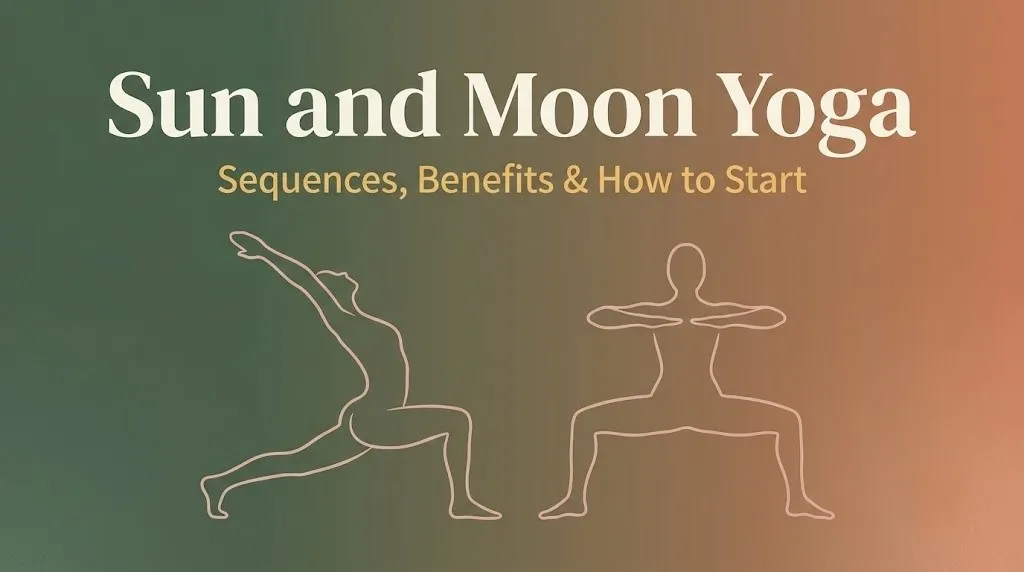
Surya-based practice raises core temperature, increases oxygen consumption, and activates the major muscle groups of the anterior and posterior chain. Think of the body like a car engine warming up; Surya Namaskar gets the oil circulating before you push into harder work.
Chandra-based practice works differently. It prioritizes hip abduction (lateral leg movement), lateral spinal flexion, and longer holds that allow connective tissue to respond. A 2019 study published in the International Journal of Yoga found that slower, parasympathetic-activating yoga sequences reduced perceived stress scores significantly more than fast-paced sequences in a group of healthy adults over eight weeks.
| Feature | Surya (Solar) Practice | Chandra (Lunar) Practice |
|---|---|---|
| Pace | Breath-linked, flowing | Slow, held longer |
| Primary movement plane | Sagittal (front to back) | Lateral (side to side) |
| Primary muscles | Quadriceps, spinal extensors, chest | Hip adductors, lateral core, inner thighs |
| Nervous system effect | Sympathetic activation | Parasympathetic activation |
| Best timing | Morning, early afternoon | Evening, before sleep |
| Temperature effect | Heating | Cooling |
| Breath pattern | Ujjayi, rhythmic | Nadi Shodhana, deep and slow |
Understanding this table changes how you plan your practice. You don’t always need both in one session. Some days call for pure Surya. Some days, particularly after high-stress events or poor sleep, pure Chandra is more appropriate.
Surya Namaskar (Sun Salutation) Step by Step
Surya Namaskar is a sequence of 12 poses performed in a continuous, breath-linked flow. One complete round includes both a right-side and left-side variation, making each full bilateral cycle 24 movements.
To practice Surya Namaskar:
- Begin in Tadasana (Mountain Pose): stand tall, feet together, palms at heart center.
- Inhale: sweep arms overhead into Urdhva Hastasana (Upward Salute); lengthen the spine, avoid crunching the lower back.
- Exhale: fold forward into Uttanasana (Standing Forward Fold); bend knees if hamstrings are tight.
- Inhale: lift halfway into Ardha Uttanasana (Half Standing Forward Fold); spine long, fingertips on shins or floor.
- Exhale: step or jump back to Chaturanga Dandasana (Four-Limbed Staff Pose); keep elbows close to ribs, lower with control.
- Inhale: press into Urdhva Mukha Svanasana (Upward Facing Dog) or Bhujangasana (Cobra Pose) for beginners; lift chest, keep thighs off the floor only if the lower back is comfortable.
- Exhale: lift hips into Adho Mukha Svanasana (Downward Facing Dog); hold for 3 to 5 breaths in beginner practice.
- Inhale: step the right foot forward between hands into Ashwa Sanchalanasana (Equestrian Pose/Low Lunge).
- Exhale: step left foot forward to join the right; return to Uttanasana.
- Inhale: sweep up through Ardha Uttanasana, then rise to Urdhva Hastasana.
- Exhale: return to Tadasana with palms at heart.
- Repeat on the left side to complete one full round.
Safety note: People with acute low back pain, wrist injuries, or high blood pressure should modify Chaturanga to knees-down or replace it with a gentle floor cobra. A physical therapist or qualified yoga teacher should be consulted if these conditions are ongoing.
Modification for beginners: Replace Chaturanga with a knees-chest-chin transition (Ashtanga Namaskara). Replace Upward Dog with low Bhujangasana with elbows bent.
Chandra Namaskar (Moon Salutation) Step by Step
Chandra Namaskar (Moon Salutation) is a lateral, cooling sequence that moves through wide-legged positions and side-opening poses. Unlike the front-to-back plane of Surya Namaskar, Chandra Namaskar works primarily in the frontal plane, targeting the inner thighs, lateral hips, and side body.
To practice Chandra Namaskar:
- Begin in Tadasana (Mountain Pose): stand at the top of your mat, feet together, palms at heart.
- Inhale: bring hands overhead, press palms together into Urdhva Hastasana (Upward Salute).
- Exhale: side bend to the right into a crescent shape; feel the left side body lengthen.
- Inhale: return to center.
- Exhale: side bend to the left; keep hips square and feet grounded.
- Inhale: return upright; step the right foot wide to the right edge of the mat.
- Exhale: bend the right knee into Utkata Konasana (Goddess Pose); knees track over second toes, thighs as parallel to the floor as comfortable.
- Inhale: straighten both legs; turn the right foot out 90 degrees.
- Exhale: bend into Parsvakonasana (Side Angle Pose) on the right; forearm to thigh or hand to a block.
- Inhale: straighten; transition through Virabhadrasana II (Warrior II) on the right.
- Exhale: straighten legs; turn to face the long edge of the mat; fold into Prasarita Padottanasana (Wide-Legged Standing Forward Fold).
- Inhale: rise; mirror the sequence on the left side.
- Return to Tadasana; close with three slow breaths.
Modification for beginners: Use a yoga block under the bottom hand in Side Angle Pose. Reduce the depth of Goddess Pose by bending knees only partway.
Safety note: Those with hip replacements, inner knee ligament injuries, or groin strains should avoid the deep lateral lunge positions. A chair placed beside the mat provides a stable option for Goddess Pose variations.
Key Takeaway: Surya Namaskar heats and activates the body through front-to-back movement, while Chandra Namaskar cools and opens it through lateral movement; knowing this distinction is the foundation of every sun and moon yoga practice.
Sun Salutation vs. Moon Salutation: Key Differences
Most people who search for this comparison have practiced one sequence and are curious about the other. The honest answer is that they are not interchangeable. They serve different physiological and energetic purposes.
The most visible difference is the movement plane. Surya Namaskar is almost entirely sagittal: forward folds, backbends, and vertical arm sweeps. Chandra Namaskar introduces lateral bending, wide-stance positions, and hip abduction patterns that Surya Namaskar rarely touches.
| Category | Surya Namaskar | Chandra Namaskar |
|---|---|---|
| Number of poses | 12 per half-round | Varies (typically 15 to 17) |
| Movement plane | Sagittal | Frontal/lateral |
| Primary joint focus | Spine, hips, shoulders | Hips, inner thighs, side body |
| Breath rhythm | 1 breath per movement | Longer, held breaths |
| Energy outcome | Energizing, heating | Calming, cooling |
| Best for | Morning activation | Evening wind-down |
| Difficulty level (beginner) | Moderate | Moderate to easier |
| Traditional time of practice | Sunrise | Moonrise or evening |
There’s also a traditional timing element. Surya Namaskar was historically practiced facing east at sunrise, as an act of gratitude toward the sun. Chandra Namaskar was practiced in the evening or under moonlight, as a quieter, introspective counterpart.
In practical 2026 home practice, those traditions translate simply: use the sequence that matches your current physiological need, not a rigid schedule.
How to Build a Sun and Moon Yoga Sequence at Home
A balanced sun and moon yoga home practice doesn’t require a studio membership or an expensive app subscription. You need a mat, about 20 to 45 minutes, and a basic framework.
The most effective home structure follows a three-part arc:
- Opening (5 minutes): Begin with 3 rounds of breath awareness in Sukhasana (Easy Pose) or seated on a blanket. Assess your energy. Decide whether today calls for Surya, Chandra, or a blend.
- Active or Cooling Main Practice (15 to 30 minutes): For morning energy, practice 3 to 6 rounds of Surya Namaskar at a moderate pace. For evening calming, practice 1 to 2 full rounds of Chandra Namaskar, holding each pose for 5 breaths. For a combined session, start with 3 rounds of Surya, then transition into Chandra.
- Closing (5 to 10 minutes): Always end with Savasana (Corpse Pose) for at least 5 minutes. The Harvard T.H. Chan School of Public Health’s mind-body medicine resources note that the rest phase following physical practice is when many of the parasympathetic benefits consolidate.
Weekly structure suggestion:
| Day | Practice Type | Duration |
|---|---|---|
| Monday | Surya Namaskar (energizing) | 25 minutes |
| Tuesday | Chandra Namaskar (cooling) | 30 minutes |
| Wednesday | Rest or Nadi Shodhana only | 10 minutes |
| Thursday | Surya Namaskar + standing poses | 35 minutes |
| Friday | Chandra Namaskar + Yin holds | 40 minutes |
| Saturday | Full sun and moon combined | 45 minutes |
| Sunday | Restorative only or full rest | 20 minutes |
Morning Yoga Routine: Using Sun Salutation to Start Your Day
A morning Surya Namaskar practice is one of the most studied yoga routines in the research literature. It works because it matches the body’s natural cortisol rhythm.
Cortisol levels peak in the first hour after waking, a phenomenon called the cortisol awakening response. Physical movement during this window supports the body’s natural energy regulation. According to the American College of Sports Medicine, moderate morning exercise enhances alertness and cognitive performance for several hours afterward. Yoga, as a form of moderate aerobic and neuromuscular activity, falls within this category.
For a practical 20-minute morning Surya Namaskar routine:
- Minutes 1 to 3: Stand in Tadasana. Practice 3 rounds of deep Ujjayi breath to warm the respiratory system.
- Minutes 4 to 14: Complete 4 slow rounds of Surya Namaskar, spending 5 breaths in Downward Dog each round.
- Minutes 15 to 18: Hold Virabhadrasana I (Warrior I) for 5 breaths per side after the final round.
- Minutes 19 to 20: Return to Tadasana. Pause. Three final breaths.
Modification for stiff mornings: Body temperature is lower immediately after waking. Keep knees bent generously in forward folds. Replace Chaturanga with knees-down entirely for the first two rounds. Add a brief neck and shoulder warm-up before starting the sequence.
People with morning stiffness related to arthritis should wait 30 minutes after rising before beginning any standing sequence. A physical therapist familiar with yoga adaptations can help design a gentler wake-up protocol.
Evening Yoga Routine: Using Moon Salutation to Wind Down
Chandra Namaskar is one of the most practical tools available for managing the transition between the active day and restful night. The sequence’s slower pace and lateral hip-opening focus make it physiologically appropriate for the evening hours.
As light diminishes, the body begins producing melatonin, the hormone that initiates sleep. High-intensity exercise within two to three hours of sleep can interfere with this process by temporarily elevating cortisol and core body temperature. Chandra Namaskar, practiced at a slow and meditative pace, does the opposite.
A practical 30-minute evening Chandra Namaskar routine:
- Minutes 1 to 5: Sit in Balasana (Child’s Pose). Practice Nadi Shodhana (alternate nostril breathing) for 5 full cycles. Let the exhale be twice as long as the inhale.
- Minutes 6 to 20: Move through 1 to 2 full rounds of Chandra Namaskar. Hold each lateral lunge and Goddess Pose for 6 to 8 breaths instead of rushing through.
- Minutes 21 to 25: Finish in Supta Baddha Konasana (Reclined Bound Angle Pose) with a bolster under the spine. This pose gently opens the chest and inner thighs while requiring no muscular effort.
- Minutes 26 to 30: Savasana with an eye pillow or folded blanket over the eyes to block light.
Key Takeaway: Morning practice aligns with the body’s natural cortisol peak and calls for Surya Namaskar, while evening practice supports melatonin onset and calls for the slower, cooler Chandra Namaskar; using each at its optimal time doubles your results.
Yoga for Energy and Relaxation: What the Research Says
The research base for yoga’s effects on energy and relaxation has grown substantially in recent years. The distinction between energizing and calming sequences is no longer just philosophical; it’s measurable.
A study published in the Journal of Alternative and Complementary Medicine found that a 12-week Surya Namaskar program improved cardiovascular endurance, muscular strength, and self-reported energy levels in healthy adult participants. The researchers measured oxygen uptake and found that regular sun salutation practice met the criteria for moderate aerobic exercise as defined by the American College of Sports Medicine.
On the relaxation side, a 2022 meta-analysis published in Complementary Therapies in Medicine reviewed 19 randomized controlled trials and found that slow-paced, parasympathetic-activating yoga practices, including those resembling Chandra Namaskar, produced measurable reductions in salivary cortisol, heart rate variability improvements, and reduced self-reported anxiety scores.
According to the National Center for Complementary and Integrative Health, yoga is among the most evidence-supported mind-body practices for stress reduction and sleep quality improvement. The NCCIH specifically notes that breath-focused yoga practices show consistent results across multiple research populations.
Key research findings summary:
- Surya Namaskar meets ACSM criteria for moderate aerobic exercise when performed at a continuous pace for 10 or more minutes
- Slow yoga sequences reduce salivary cortisol in as few as 4 to 8 weeks of regular practice, per Complementary Therapies in Medicine findings
- Yoga Alliance registered programs that include both energizing and restorative components report higher student retention and satisfaction than single-modality approaches
Yoga for Beginners: Starting a Sun and Moon Practice
Starting sun and moon yoga as a complete beginner is straightforward if you approach Surya Namaskar and Chandra Namaskar as learnable sequences rather than performances.
The single biggest mistake beginners make is treating sun salutation as a speed drill. Yoga teachers and physical therapists generally recommend that beginners practice each pose in the sequence individually before linking them. Spend two weeks simply learning the pose shapes: Tadasana, Uttanasana, Downward Dog, Cobra. Then link three or four poses at a time. Only then attempt a full round.
Beginner-friendly starting points:
- Week 1: Learn individual poses. Hold each for 5 breaths. No flow yet.
- Week 2: Link poses 1 through 6 of Surya Namaskar. Practice this half-sequence twice daily.
- Week 3: Complete full Surya Namaskar rounds slowly. 1 to 2 rounds per session.
- Week 4: Introduce the first 6 poses of Chandra Namaskar. Practice both sequences in one session.
Props that make beginner practice safer:
| Prop | Use in Sun/Moon Practice |
|---|---|
| Yoga blocks (2) | Support hands in forward folds; support forearm in Side Angle |
| Yoga strap | Help reach feet in seated forward folds after practice |
| Folded blanket | Cushion knees in low lunge positions |
| Non-slip mat | Prevent foot slipping in wide-stance Chandra Namaskar poses |
The International Journal of Yoga published findings in 2021 showing that beginners who received structured, progressive yoga instruction over 8 weeks showed greater improvement in flexibility, balance, and reported well-being compared to those given unstructured practice time.
Yoga for Seniors: Adapting Sun and Moon Sequences
Seniors can absolutely practice sun and moon yoga. Both sequences offer modifications that preserve the physiological benefits while reducing joint stress and fall risk.
The primary adaptations for older adults center on three areas: joint load management, balance support, and pace reduction. The American College of Sports Medicine recommends that exercise programs for adults over 65 include balance training, flexibility work, and low-impact aerobic activity. A modified sun and moon yoga practice covers all three.
Chair-supported Surya Namaskar adaptations:
- Replace Tadasana with seated upright posture in a sturdy chair
- Perform arm sweeps from seated position for Urdhva Hastasana
- Use chair arms for support in modified forward fold
- Skip Chaturanga entirely; replace with hands pressing into thighs
- Practice Cobra Pose on the floor or skip in favor of a gentle seated backbend
Chair-supported Chandra Namaskar adaptations:
- Stand beside the chair, one hand resting on the back for balance during side bends
- Reduce stance width in Goddess Pose to what feels stable, not what looks “correct”
- Replace deep lateral lunges with a half-squat variation, feet hip-width apart
According to the National Center for Complementary and Integrative Health, yoga-based movement programs for older adults show consistent benefits for balance, fear of falling, and lower body strength when practiced two to three times per week. For seniors with osteoporosis, deep forward folds should be replaced with a spine-neutral hinge; a yoga teacher certified in senior adaptations can demonstrate this safely.
Key Takeaway: Beginners and seniors both benefit most from learning individual poses before linking them into full sequences, and both groups should use props without hesitation because props improve alignment and reduce injury risk, not diminish the practice.
Yoga for Anxiety and Insomnia: How Moon Salutation Helps
Chandra Namaskar is particularly well-suited to people managing anxiety or sleep difficulties. The reason is physiological, not simply relaxational.
Anxiety is associated with sustained sympathetic nervous system activation: elevated cortisol, increased heart rate, and heightened muscle tension. A slow, breath-led practice like Chandra Namaskar interrupts this pattern by activating the vagus nerve, the primary nerve of the parasympathetic system, through slow exhalation and deliberate movement.
A 2020 study published in the International Journal of Yoga found that participants who practiced slow, parasympathetic-activating yoga sequences three times per week for six weeks showed statistically significant reductions in the Generalized Anxiety Disorder-7 (GAD-7) score, a validated clinical measure. Participants also reported improved sleep onset time.
Specific Chandra Namaskar elements that support anxiety reduction:
- Holding Utkata Konasana (Goddess Pose) for 8 breaths creates grounding proprioceptive pressure through the feet and lower body
- Lateral side bends release the intercostal muscles between the ribs, creating more space for full breathing
- Closing in Supta Baddha Konasana (Reclined Bound Angle Pose) activates the relaxation response through gentle chest opening and hip release
Safety note: People with severe anxiety disorders or PTSD should be aware that certain yoga poses, particularly those that feel exposing (open chest, supine positions) may feel uncomfortable initially. A trauma-sensitive yoga approach, as described by the Yoga Alliance in their trauma-informed teaching guidelines, allows practitioners to modify or skip any pose that increases rather than decreases distress.
Yoga Props for Sun and Moon Practice
Props are not training wheels. In both Surya Namaskar and Chandra Namaskar, well-chosen props improve alignment, reduce joint stress, and make the practice accessible across a wider range of bodies.
Yoga teachers and physical therapists generally recommend that practitioners keep at least two props within reach during any home practice session. The practice of always having props available removes the hesitation of stopping mid-sequence to retrieve them.
Core props for sun and moon yoga practice:
| Prop | Primary Use | Who Benefits Most |
|---|---|---|
| Yoga blocks (2) | Support hands in folds; elevate floor in Side Angle | Beginners, people with tight hamstrings |
| Yoga strap | Extend reach; maintain alignment in lunges | People with limited flexibility |
| Bolster | Support in Reclined Bound Angle; chest opening | Evening/restorative practice, seniors |
| Folded blanket | Cushion knees in low lunge; seated support | Knee sensitivity, seniors |
| Sturdy chair | Balance support; seated sequence modifications | Seniors, balance concerns, mobility limitations |
| Non-slip mat | Ground stability in wide-stance Chandra poses | All practitioners, especially on smooth floors |
Block positioning for Surya Namaskar: Place two blocks just outside the front foot in Low Lunge (Ashwa Sanchalanasana). This raises the “floor” and removes the hamstring strain that causes the lower back to round.
Strap use in Chandra Namaskar: Loop a strap around the back foot in standing lunge variations if balance is uncertain. The strap creates a physical connection that improves body awareness without requiring a high level of flexibility.
According to Yoga Alliance education standards, teachers in their registered programs are required to demonstrate prop use for common pose modifications. When evaluating a studio or class, look for teachers who actively offer and model prop use rather than treating it as optional.
Yoga Classes in Arlington and Park Ridge: What to Look For
Whether you’re searching for yoga classes in Arlington or Park Ridge yoga studios, the sun and moon yoga framework can help you evaluate whether a class will serve your actual needs.
Not every class labeled “yoga” uses both energizing and restorative elements. Many Vinyasa classes focus almost entirely on solar, active movement. Many Restorative or Yin yoga classes focus exclusively on the lunar, cooling side. A well-structured sun and moon yoga class integrates both within a single session, or explicitly labels which orientation each class serves.
What to ask before joining a yoga class in Arlington or Park Ridge:
- Does the class use both flowing sequences and slower held poses in the same session?
- Does the teacher offer modifications for beginners and people with injuries?
- Are props available and actively encouraged?
- Does the class schedule include both morning (energizing) and evening (calming) options?
- Is the teacher registered with the Yoga Alliance at the RYT-200 or RYT-500 level?
Class format comparison for sun and moon practice:
| Class Type | Solar Content | Lunar Content | Best For |
|---|---|---|---|
| Hatha | Moderate | Moderate | Balanced beginners |
| Vinyasa | High | Low | Active practitioners |
| Yin | None to low | Very high | Stress, flexibility focus |
| Restorative | None | Very high | Recovery, seniors, anxiety |
| Sun and Moon Hatha | High | High | Full balance seekers |
| Chair Yoga | Modified | High | Seniors, limited mobility |
Park Ridge yoga classes and Arlington yoga studios that explicitly teach Surya and Chandra Namaskar within the same curriculum give practitioners the most complete sun and moon yoga experience. When evaluating options, one class trial is usually enough to assess whether the teacher integrates both effectively.
Key Takeaway: When choosing yoga classes in Arlington or Park Ridge, look specifically for classes that include both Surya Namaskar and slower cooling sequences, and confirm that props are available and modifications are offered as a standard part of teaching, not as afterthoughts.
Frequently Asked Questions About Sun and Moon Yoga
What is the difference between sun salutation and moon salutation?
Sun salutation (Surya Namaskar) is a 12-pose flowing sequence that moves primarily through forward folds and backbends in a front-to-back plane, building heat and cardiovascular rhythm.
Moon salutation (Chandra Namaskar) moves laterally through wide-legged and side-bending positions, producing a cooling, calming physiological effect.
The two sequences target different muscle groups, movement planes, and nervous system states, making them complementary rather than interchangeable.
Can beginners do Chandra Namaskar (Moon Salutation)?
Yes, Chandra Namaskar is generally accessible to beginners and is often considered gentler on the wrists and shoulders than Surya Namaskar.
The wide-stance positions require some hip flexibility, but yoga blocks and a reduced stance width make it manageable from day one.
Start by learning each pose individually before flowing through the full sequence.
How many rounds of Surya Namaskar should I do each day?
Yoga teachers and physical therapists generally recommend 3 to 6 rounds for beginners, which translates to 6 to 12 bilateral sequences including both sides.
Research on Surya Namaskar as aerobic exercise, including studies published in the Journal of Alternative and Complementary Medicine, typically uses 12 or more continuous rounds as the therapeutic dose for cardiovascular benefit.
Begin with 2 to 3 rounds and add one round per week as your stamina and alignment improve.
Is sun and moon yoga a specific style or a general practice approach?
Sun and moon yoga is both a general practice philosophy rooted in Hatha yoga and a name used by specific studios as a brand.
As a philosophy, it describes the pairing of energizing and cooling sequences to achieve physiological and energetic balance.
As a studio concept, some schools, including studios in Arlington and Park Ridge, use the name to reflect a curriculum that teaches both Surya and Chandra Namaskar.
What is the best time of day to practice sun and moon yoga?
Practice Surya Namaskar in the morning, ideally within two hours of waking, to align with the body’s natural cortisol peak and support daytime energy.
Practice Chandra Namaskar in the evening, at least one hour before sleep, to support melatonin production and nervous system calming.
For a combined practice, structure it as Surya first, Chandra second, followed by Savasana.
Ready to Step onto the Mat
Sun and moon yoga gives you two complete tools, not one. Surya Namaskar builds the body up. Chandra Namaskar brings it back to calm. Used together, they create a practice that covers the full range of what your body needs across any given week.
Start with just three rounds of Surya Namaskar tomorrow morning. Pay attention to how your body feels before and after. Later this week, try a single round of Chandra Namaskar before bed, hold each pose for six slow breaths, and notice what changes.
The practice grows from there, one sequence at a time.