Mountain Yoga: Your Full Tadasana Practice Guide 2026
Mountain yoga refers to both Tadasana (Mountain Pose), the foundational standing posture in yoga, and the growing practice of taking yoga outdoors into natural mountain environments. Understanding both meanings gives you a richer, more grounded practice.
A 2019 study published in the International Journal of Yoga found that regular standing balance practice, including poses like Tadasana, produced measurable improvements in postural control and proprioceptive sensitivity within eight weeks. That is a notable result for a pose most practitioners dismiss as “just standing.”
This guide covers the biomechanics of Tadasana, its muscles, alignment cues, breathing technique, modifications, and how it anchors every standing pose you will ever practice. There is also a dedicated section on outdoor and hiking-specific yoga applications, which is where many practitioners are taking their mats in 2026.
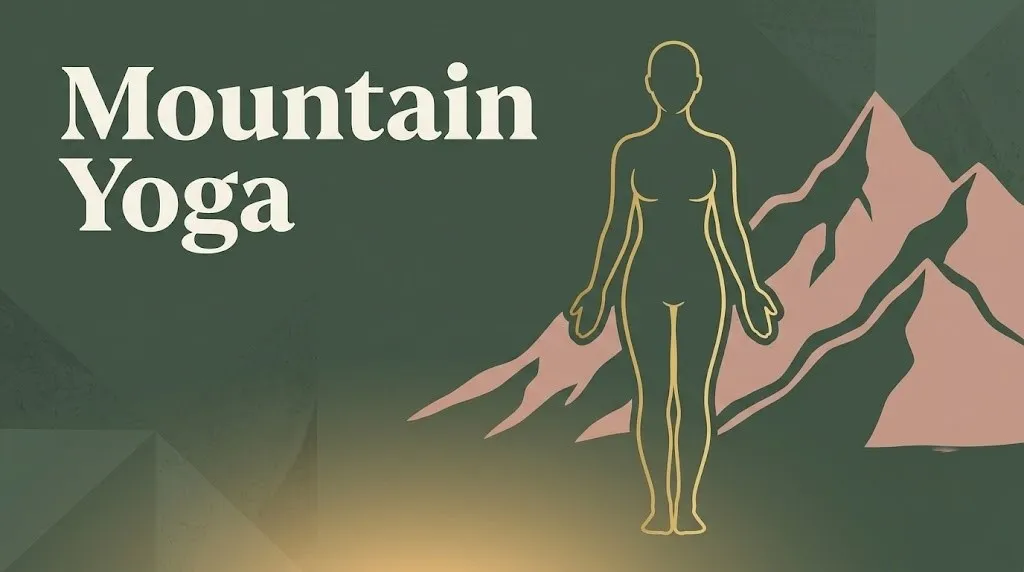
Mountain Yoga
Mountain yoga refers to two distinct but related practices: Tadasana (Mountain Pose) as the foundational posture of yoga, and the practice of performing yoga sequences outdoors in mountainous or natural terrain settings.
The term is worth clarifying because searches for “mountain yoga” pull results for both. Someone searching this term might want to perfect a foundational pose they keep seeing cued in class. Another person might want to know how to practice yoga on a rocky trail or at altitude before a climb.
Both meanings share a common thread: stability, grounding, and attentiveness to the body’s relationship with the earth beneath it. Mountain Pose is named for the quality of a mountain, not the shape of one. A mountain does not strain. It is steady, tall, and rooted. That is the internal quality Tadasana asks you to cultivate.
| Meaning of “Mountain Yoga” | Primary Focus | Who Practices It | Where It Takes Place |
|---|---|---|---|
| Tadasana (Mountain Pose) | Postural alignment, balance, breath | All yoga levels | Studio, home, mat |
| Outdoor mountain yoga | Nature-based practice, terrain adaptation | Hikers, adventurers, all levels | Trails, summits, meadows |
| Mountain yoga retreat | Immersive multi-day practice | Intermediate and advanced | Mountain resorts, retreat centers |
Both versions are addressed fully in this guide. Start with the pose. Then take it outside.
What Is Mountain Pose in Yoga
Tadasana (Mountain Pose) is the standing foundation of virtually every yoga practice. It is a full-body isometric engagement, not a passive rest, that trains postural alignment, balance, and proprioceptive awareness simultaneously.
The pose looks deceptively simple: stand upright with feet together or hip-width apart, arms alongside the body, gaze forward. What is actually happening inside the body is considerably more complex. Every joint from the ankle to the cervical spine is being cued to find and hold a specific relationship with gravity.
Tadasana is the starting position for all standing poses in Hatha, Vinyasa, and Iyengar yoga traditions. It appears at the beginning of a Sun Salutation (Surya Namaskar), between active standing poses to reset alignment, and as a standing meditation in its own right.
According to the National Center for Complementary and Integrative Health, yoga practices that include standing balance and postural awareness components are associated with reductions in fall risk and improvements in functional balance in adults across age groups.
The pose is appropriate for beginners, seniors, and experienced practitioners. What changes across levels is the depth of internal engagement, not the external shape. A beginner finds their feet. An experienced practitioner works the full kinetic chain from the soles of the feet to the crown of the head in a single breath cycle.
Tadasana Sanskrit Meaning and Yoga Tradition
Tadasana comes from two Sanskrit roots: “tada” meaning mountain and “asana” meaning seat or posture. The name translates directly to Mountain Pose, describing the quality of stillness and groundedness the practitioner aims to embody.
Sanskrit pose names carry information about the physical shape, the energetic quality, or the mythological reference of each posture. In Tadasana’s case, the mountain metaphor is instructional. Mountains do not lean, collapse, or fidget. They receive wind, rain, and pressure without changing shape.
In the Iyengar yoga tradition, Tadasana is considered one of the most important poses in the entire practice because it teaches the foundational alignment that every other pose builds on. B.K.S. Iyengar devoted extensive writing to its subtleties in his foundational text “Light on Yoga,” noting that the pose demands equal weight distribution across all four corners of each foot.
In Ashtanga yoga, the pose appears as Samasthiti (Equal Standing), which is its more precise name in that lineage. Samasthiti translates to “equal” or “balanced” standing and emphasizes symmetry between the left and right sides of the body rather than the mountain metaphor.
Pose Tip:
- “Tada” (mountain) emphasizes the quality of the pose, not the shape.
- Samasthiti is the Ashtanga lineage name for the same posture.
- Both names point to the same internal aim: equal, rooted, upright presence.
Understanding the tradition behind a pose name helps practitioners access its intended quality. When you remember you are embodying a mountain, subtle adjustments in your inner experience often improve your alignment without a single physical cue.
Key Takeaway: Tadasana is not a rest between poses. It is one of the most demanding postures in yoga when practiced with genuine internal engagement, and it is the alignment template for every standing posture you will ever learn.
Mountain Pose Benefits for Posture and Balance
Tadasana (Mountain Pose) improves postural alignment by training the neuromuscular system to maintain a neutral spine, level pelvis, and symmetrical weight distribution through sustained isometric co-contraction.
The benefits extend beyond simply “standing straighter.” Regular Tadasana practice retrains habitual posture patterns that develop from prolonged sitting, carrying bags on one side, or favoring a dominant leg. Think of your habitual posture like a groove worn into soft wood. Tadasana practice creates a new groove, slowly, breath by breath.
A study published in the Journal of Alternative and Complementary Medicine found that an eight-week yoga intervention that included standing posture training produced measurable reductions in thoracic kyphosis (upper back rounding) and improvements in self-reported back comfort. Tadasana was among the poses assessed.
Key benefits of consistent Tadasana practice include:
- Improved spinal alignment: Active engagement of the erector spinae and rhomboids draws the thoracic spine toward neutral.
- Reduced anterior pelvic tilt: Engaging the lower abdominals and releasing the hip flexors corrects the common “ribs-forward, low-back-compressed” posture pattern.
- Better balance: Training weight distribution across the tripod of each foot improves proprioceptive feedback from the ankle and foot.
- Stronger arches: Lifting and spreading the toes activates the intrinsic foot muscles that support the medial arch.
- Calmer nervous system: Sustained, attentive standing with breath awareness activates the parasympathetic nervous system, reducing arousal.
Practitioners with chronic low back pain who experience discomfort during prolonged standing should work with shorter hold times (3 to 5 breaths) and explore a slight softening of the knees rather than forcing a rigid straight leg.
What Muscles Does Mountain Pose Work
Tadasana (Mountain Pose) engages the quadriceps femoris, gluteus medius, transverse abdominis, erector spinae, rhomboids, lower trapezius, tibialis anterior, and intrinsic foot muscles in sustained isometric contraction throughout the pose.
This is the fact that most yoga content gets wrong. The pose is not passive. Every muscle listed above is actively working to maintain the shape against gravity. This is why holding Tadasana for one full minute with proper engagement feels noticeably more effortful than simply standing at a bus stop.
| Muscle Group | Role in Tadasana | Common Dysfunction When Absent |
|---|---|---|
| Quadriceps femoris | Lifts kneecaps, prevents hyperextension | Knees push back, joint stress |
| Gluteus medius | Stabilizes pelvis laterally | Hip hiking, uneven weight distribution |
| Transverse abdominis | Deep core stability, lumbar support | Ribs flare, lumbar compression |
| Erector spinae | Maintains thoracic extension | Upper back rounding, hyperkyphosis |
| Rhomboids | Draws shoulder blades toward spine | Shoulders roll forward |
| Tibialis anterior | Maintains foot arch lift | Arch collapse, inward ankle roll |
| Intrinsic foot muscles | Spreads and grounds the toes | Unstable base, balance impairment |
The American College of Sports Medicine notes that isometric muscle training at functional joint angles, precisely what Tadasana demands, improves both muscular endurance and joint stability over time.
Practitioners who feel no muscular engagement in Mountain Pose are likely practicing it passively. Actively lifting the kneecaps, drawing the lower belly gently inward, and spreading the toes changes the experience entirely.
How to Do Mountain Pose Step by Step
Tadasana (Mountain Pose) is practiced by establishing a rooted, symmetrical foot foundation and then building active alignment upward through every segment of the body, from the feet to the crown of the head.
This is the complete technical instruction. Read it once, then practice it in sections rather than trying to do everything simultaneously on your first attempt.
To practice Tadasana (Mountain Pose):
- Stand at the top of your mat with your big toes touching or feet hip-width apart. Both options are correct. Choose based on your balance and comfort.
- Spread all ten toes wide and then release them flat. Feel three points of contact under each foot: the base of the big toe, the base of the little toe, and the center of the heel. This is called the tripod foot.
- Engage your quadriceps by gently lifting your kneecaps upward. Do not lock or push the knees back.
- Draw your lower belly gently inward and upward. This activates the transverse abdominis without squeezing the breath.
- Stand your pelvis upright. Neither tuck the tailbone aggressively nor let it sway backward. Find neutral.
- Broaden the collarbones and let the shoulder blades move down your back, away from the ears.
- Let your arms hang alongside the body with palms facing forward, fingers long.
- Lift the crown of your head gently toward the ceiling. Your chin stays parallel to the floor.
- Inhale and feel length through the entire spine. Exhale and feel rooted through the feet.
- Hold for 5 to 10 breath cycles. Release on an exhale by softening the legs and releasing the arms.
Modification: Beginners or practitioners with balance challenges can stand with feet hip-width apart instead of together. Placing the back of the body against a wall helps establish what neutral alignment actually feels like before practicing free-standing.
Key Takeaway: Mountain Pose is built from the ground up. Establish your feet first, then your knees, then your pelvis, then your spine, then your arms and head. Rushing to “stand straight” before the feet are grounded skips the entire foundation.
Mountain Pose Alignment Cues
Mountain pose alignment cues address six key zones of the body in sequence: the feet, the knees, the pelvis, the ribcage, the shoulder girdle, and the head and neck.
Each zone has common alignment errors that compound upward through the kinetic chain. Fixing the feet often spontaneously improves the knees. Correcting the pelvis often reduces neck tension. The body is a connected system, not a stack of independent parts.
Six-zone alignment guide for Tadasana:
| Body Zone | Correct Alignment | Common Error | Cue to Correct |
|---|---|---|---|
| Feet | Tripod contact, arches lifted | Arches collapsed, toes gripping | “Spread and ground the toes” |
| Knees | Soft micro-bend, kneecaps lifted | Hyperextended (pushed back) | “Lift your kneecap toward your hip” |
| Pelvis | Neutral, ASIS and PSIS level | Anterior or posterior tilt | “Stack your hip bones over your ankle bones” |
| Ribcage | Ribs softened down | Ribs thrust forward and up | “Let the bottom ribs drop toward the hips” |
| Shoulders | Blades down and wide | Ears near shoulders, rolled forward | “Draw the shoulder blades apart and down” |
| Head and neck | Crown lifts, chin parallel | Chin lifted, cervical compression | “Lengthen the back of the neck” |
These cues are drawn from the Iyengar yoga tradition, which is the most anatomically precise lineage for standing pose instruction. They work equally well in Hatha and Vinyasa class contexts.
A useful self-check: stand sideways near a mirror. Your ear, shoulder, hip, knee, and ankle should form a roughly vertical line. If any zone is significantly in front of or behind this plumb line, that zone needs attention.
Pose Tip:
- Begin each Tadasana check from the floor upward, never from the head down.
- The pelvis is the central zone. Misalignment there affects every zone above and below.
- For seniors or practitioners with balance concerns, use wall contact at the back or fingertip contact on a chair for proprioceptive feedback without weight bearing on the support.
Mountain Pose Breathing Technique
The appropriate breathing technique in Tadasana (Mountain Pose) is slow, even, diaphragmatic breathing, often practiced as Sama Vrtti Pranayama (Equal Ratio Breathing), where the inhale and exhale are matched in length.
Breathing in Mountain Pose is not accidental. The breath is the primary mechanism through which the pose shifts from a static physical hold into a practice that actively regulates the nervous system. When you breathe slowly and evenly in an upright, aligned posture, you create the conditions for parasympathetic activation.
The diaphragm is the primary breathing muscle in yoga. In Tadasana, an aligned spine creates maximum space for the diaphragm to descend on inhale and recoil on exhale without restriction. When the ribcage is collapsed or the thoracic spine is rounded, the diaphragm’s range of motion is compressed, which shortens the breath and activates a mild stress response.
To practice Sama Vrtti breath in Tadasana:
- Establish your alignment first. Breath quality depends on structural integrity.
- Inhale slowly through the nose for a count of 4 seconds.
- Exhale slowly through the nose for a count of 4 seconds.
- Feel the lower ribs expand outward on the inhale and gently release on the exhale.
- Continue for 10 full cycles before moving to the next pose.
Research published in Complementary Therapies in Medicine found that slow diaphragmatic breathing at rates of 5 to 6 breaths per minute significantly lowered salivary cortisol levels and improved heart rate variability in yoga practitioners. A 4-count inhale and 4-count exhale achieves approximately this rate.
Modification: Practitioners with respiratory conditions limiting their breath length should start with a 2-count inhale and 2-count exhale, never forcing a longer breath than feels natural and comfortable.
Mountain Pose Common Mistakes to Avoid
The most damaging mistake in Tadasana (Mountain Pose) is hyperextending the knees, which compresses the posterior knee joint capsule, strains the ligaments, and shifts the body’s center of gravity backward in a way that increases lumbar compression.
Hyperextended knees are extremely common and often habitual. Practitioners with hypermobile joints frequently stand this way without noticing because it requires less muscular effort than a properly engaged straight knee. The fix is a micro-bend: enough knee softening to feel the quadriceps engage, without creating a visible bend.
Additional common errors and their corrections include:
- Chin lifted toward the ceiling: This compresses the cervical vertebrae and strains the posterior neck muscles. Cue: lengthen the back of the neck and allow the chin to drop slightly.
- Ribs thrusting forward: This indicates an anterior pelvic tilt combined with an extended lumbar spine. Cue: draw the lower ribs down and engage the lower abdomen gently.
- Feet turned outward in a “V” shape: This creates external hip rotation that prevents the inner thighs from engaging. Cue: bring the feet parallel with big toes touching or hip-width apart.
- Shoulders gripping upward toward ears: Upper trapezius engagement from unconscious tension. Cue: exhale fully and let the shoulders drop with the breath.
- Weight on the heels only: This is the most common loading error. Cue: spread the toes and press the balls of the feet down until you feel the arches lift.
According to the American College of Sports Medicine, habitual postural loading errors in standing positions, repeated for hours daily in everyday life, accumulate stress on spinal joints and intervertebral discs over time. Correcting these patterns in Tadasana trains the body to self-correct outside of yoga practice too.
Key Takeaway: Hyperextended knees and a forward-thrust ribcage are the two errors that undermine Tadasana most consistently. Fix those two things first and the rest of the alignment often follows.
Mountain Pose Modifications for Beginners and Seniors
Tadasana (Mountain Pose) modifications for beginners and seniors focus on improving balance confidence, reducing joint load, and making proper alignment achievable before strength and proprioception fully develop.
Beginners often struggle with one of two things: they cannot feel neutral pelvis, or they cannot balance comfortably with feet together. Both problems have simple, effective solutions that preserve the full educational value of the pose.
| Practitioner | Modification | Why It Helps | Props Needed |
|---|---|---|---|
| Beginners (balance) | Feet hip-width apart | Widens the base of support | None |
| Beginners (alignment) | Back against wall | Provides proprioceptive feedback | Wall |
| Seniors (balance) | Fingertip contact on chair | Reduces fall risk, maintains posture | Chair |
| Seniors (low blood pressure) | Hold 3 to 5 breaths maximum | Prevents orthostatic dizziness | None |
| Hypermobile practitioners | Micro-bend in knees | Prevents hyperextension, activates quads | None |
| Tight hip flexors | Slight forward lean from ankle | Reduces lumbar compression | None |
| Flat feet | Yoga block between inner thighs | Activates adductors and arch support | One block |
For seniors, the chair-contact modification is not a compromise. It is genuinely good practice. Physical therapists working with older adults generally recommend chair-assisted standing balance training as a tool for fall prevention, and Mountain Pose with fingertip chair support achieves the same goal within a yoga context.
Pose Tip:
- Wall practice is underused by beginners. Stand with your heels, glutes, and upper back all making contact with the wall. This map of correct alignment stays in your body long after you step away.
- Children practicing Tadasana benefit from the imagery more than the cues. “Stand like a mountain” works better for ages 5 to 10 than anatomical instruction.
Mountain Pose for Flat Feet and Scoliosis
Practitioners with flat feet (pes planus) or scoliosis can and should practice Tadasana with specific modifications that address their structural needs without forcing shapes their bodies cannot safely hold.
Flat feet change how Tadasana loads the ankle, knee, and hip. When the medial arch collapses, the ankle rolls inward (pronates), which internally rotates the tibia, which creates a valgus force at the knee. Over time, this chain affects the hip and lower back alignment. In Tadasana, this shows up as a tendency for the inner ankle to drop and the inner arch to lose contact with the floor.
For practitioners with flat feet:
- Place a yoga block lengthwise between the inner upper thighs. Squeeze it gently.
- This activates the adductor muscles, which lift the inner arch through the kinetic chain.
- Alternatively, place a rolled towel or thin wedge under the medial arch for direct support.
- Focus on pressing the base of the big toe firmly down while also lifting the inner ankle upward.
Scoliosis presents a different challenge. A lateral spinal curve means that “neutral spine” for a scoliotic practitioner is not symmetrical in the same way it is for someone without a curve. Forcing symmetry in Tadasana can increase discomfort rather than reduce it.
For practitioners with scoliosis:
- Work with a yoga therapist or physical therapist familiar with scoliosis before establishing a standing pose practice.
- In Tadasana, focus on even weight distribution through both feet rather than trying to make both sides of the torso look identical.
- Placing a folded blanket under one foot can help level the pelvis if leg length discrepancy is a factor.
Pose Tip:
- Never tell a scoliosis practitioner to “straighten” their spine in Tadasana. The instruction is unhelpful at best.
- Flat feet respond well to consistent Tadasana practice when arch-activation cues are used from the first session.
Mountain Pose Variations and Progressions
Mountain pose variations and progressions increase the balance demand, introduce arm movements, or add breath coordination to build on the foundational Tadasana alignment.
Once the basic pose is established, several variations deepen the practice without abandoning its foundational principles. Think of Tadasana as the root of a tree: variations are the branches that grow from the same stable base.
Common Tadasana variations include:
- Arms overhead Tadasana (Urdhva Hastasana / Upward Salute): Both arms extend overhead with palms facing each other or touching. This lengthens the lateral body and tests whether the ribs stay down as the arms rise. Hold for 5 breaths.
- Tadasana with block between thighs: A yoga block held between the upper inner thighs activates the adductors and medial arch simultaneously. Useful for practitioners with flat feet or wide-stance habits.
- Eyes-closed Tadasana: Removing visual input dramatically increases the proprioceptive and vestibular challenge of the pose. Hold for 3 to 5 breaths with eyes closed, then open.
- Tadasana to Vrksasana (Tree Pose) transition: Shifting weight to one leg and lifting the other into Vrksasana (Tree Pose) uses Tadasana as the balanced launch point for single-leg balance practice.
- Tadasana with arm flow: Coordinating arm movements (raising and lowering) with the breath introduces breath-movement coordination that transitions naturally into Vinyasa practice.
According to Yoga Alliance, progressive variations of foundational standing poses are among the most effective tools for maintaining practitioner engagement across beginner and intermediate levels, as they offer depth without requiring new pose learning.
Mountain Pose in a Vinyasa Flow Sequence
Tadasana (Mountain Pose) functions in a Vinyasa flow as both the starting and resetting posture, appearing at the top of the mat before Sun Salutations, between standing pose sequences, and as the closing standing posture before moving to the floor.
In a Vinyasa class, Tadasana is often practiced so briefly that practitioners do not notice its function. The teacher says “return to Mountain Pose” between sequences, and most students simply stand and wait. That waiting is a missed opportunity.
Tadasana’s roles in a Vinyasa sequence:
| Position in Sequence | Function | Recommended Hold |
|---|---|---|
| Opening of class | Sets alignment baseline, grounds attention | 8 to 10 breaths |
| Between standing poses | Resets alignment, allows breath recovery | 3 to 5 breaths |
| After backbends | Neutral spine reset, decompression check | 5 breaths |
| Before floor sequence | Final standing posture, transition marker | 3 breaths |
| End of standing practice | Integration, proprioceptive check | 5 to 8 breaths |
Between active standing poses, Tadasana gives the nervous system a reference point. When you hold it intentionally, you can feel which side of the body is more contracted, where the pelvis has shifted, or where tension has accumulated. That information guides the next pose adjustment.
Practitioners new to Vinyasa yoga often find the rapid transitions between poses disorienting. Using Tadasana as a consistent anchor between movements helps orient the body and reduces the sense of being “lost” in a fast flow.
Key Takeaway: Tadasana between active Vinyasa poses is not a break. It is a diagnostic tool. If you use it that way, you will learn more about your body in those 3 breaths than in the entire sequence that surrounds them.
Outdoor Mountain Yoga and Nature Practice
Outdoor mountain yoga combines the principles of foundational yoga practice with the physical and psychological benefits of practicing in natural outdoor environments, including mountain terrain, forest clearings, and open ridgelines.
The research on nature-based exercise is distinct from the research on yoga alone. A 2019 study published in Frontiers in Psychology found that physical activity performed in natural outdoor settings reduced self-reported anxiety and negative mood more than the same activity performed indoors. Combining yoga with outdoor natural settings adds a layer of mental health benefit that neither alone fully provides.
Practicing Tadasana outdoors on uneven ground changes the sensory experience of the pose entirely. Your proprioceptive system works harder because the surface is not flat. Your visual field is not a studio wall. Your breath encounters real air at varying temperatures and humidity levels.
Practical considerations for outdoor yoga practice:
- Surface choice: Grass is preferable to gravel or wet rock. Avoid slopes steeper than 5 degrees for standing poses without footwear.
- Footwear: Barefoot practice is ideal for proprioceptive connection but check the ground for sharp debris. Minimalist yoga shoes exist for outdoor use.
- Time of day: Early morning and late afternoon avoid the highest UV exposure. Sunscreen and hydration matter on exposed ridgelines.
- Mat alternatives: Outdoor yoga mats with textured, non-slip bases exist specifically for grass and soft-surface use. A regular mat on uneven ground can bunch and create a trip hazard.
Mountain environments at altitude (above 8,000 feet / 2,400 meters) affect breathing. The lower partial pressure of oxygen means pranayama practices feel different and breath holds should be avoided until acclimatization is complete.
Yoga for Hikers and Mountain Athletes
Yoga for hikers and mountain athletes uses poses that specifically address the muscular demands, joint wear patterns, and postural habits created by sustained uphill and downhill walking on uneven terrain.
Hikers typically develop tightness in the hip flexors (from repeated hip flexion during climbing), the calves and Achilles tendon (from sustained ankle plantarflexion on ascent), and the iliotibial band (from lateral knee stabilization on descent). They also develop weakness in the gluteus medius, which contributes to the knee tracking issues that cause many hiking-related knee injuries.
Mountain Pose is an ideal foundation for hikers because it trains the neuromuscular patterns most relevant to trail safety: even weight distribution, joint alignment under load, and single-leg balance awareness.
Best yoga poses for hikers:
- Tadasana (Mountain Pose): Establishes baseline alignment; trains proprioception relevant to trail footing.
- Virabhadrasana I (Warrior I): Stretches the hip flexors of the back leg; mimics the extended-hip position of uphill stepping.
- Virabhadrasana III (Warrior III): Single-leg balance with hip extension; directly trains the balance mechanics of stepping over obstacles.
- Parsvottanasana (Intense Side Stretch / Pyramid Pose): Stretches the hamstrings and calves; addresses post-hike tightness.
- Malasana (Garland Pose / Yogic Squat): Deep ankle and hip flexion; improves range of motion for steep downhill descent.
- Supta Padangusthasana (Reclined Hand-to-Big-Toe Pose): Passive hamstring stretch; reduces IT band tension through hip abduction variation.
Research suggests that yoga practiced two to three times per week as cross-training for hiking reduces lower extremity injury incidence by improving functional balance and joint proprioception. The NCCIH notes that yoga’s combination of flexibility, strength, and body awareness training is particularly relevant to activities that demand dynamic balance on unstable surfaces.
How Long Should You Hold Mountain Pose
Most yoga teachers recommend holding Tadasana (Mountain Pose) for 5 to 10 breath cycles, equivalent to approximately 30 to 60 seconds, for it to deliver its postural and proprioceptive training benefits.
Hold duration varies by context and intention. In a fast Vinyasa class, 3 breaths is often all that is offered between sequences. In Iyengar yoga, practitioners may hold Tadasana for 1 to 3 minutes while a teacher makes detailed adjustments. Both are appropriate within their respective traditions.
What matters more than a specific time is the quality of engagement during the hold. Thirty seconds of actively engaged Tadasana with full neuromuscular attention is more beneficial than 3 minutes of passive standing with a wandering mind.
| Practice Context | Recommended Hold Duration | Level | Purpose |
|---|---|---|---|
| Vinyasa flow (between poses) | 3 to 5 breaths (15 to 30 seconds) | All levels | Alignment reset |
| Beginner standalone practice | 5 to 8 breaths (30 to 45 seconds) | Beginner | Learning body awareness |
| Iyengar-style hold | 60 to 180 seconds (1 to 3 minutes) | Intermediate/Advanced | Deep proprioceptive training |
| Standing meditation | 3 to 10 minutes | Advanced, mindfulness focus | Meditative attention training |
| Seniors or low blood pressure | 3 to 5 breaths maximum | Modified | Prevents orthostatic dizziness |
Research published in the International Journal of Yoga found that postural awareness interventions held for at least 30 seconds per repetition produced greater improvements in balance than shorter, more frequent holds. This supports the Iyengar approach of deliberate, extended standing rather than brief transitional poses.
Beginners who feel lightheaded in Mountain Pose should reduce the hold time and ensure they are not holding their breath. Breath holding is a common unconscious response to concentration and it significantly reduces blood flow efficiency in upright postures.
Key Takeaway: Hold Mountain Pose long enough to actually feel what is happening in your body. Five conscious breaths beats thirty seconds of mind-wandering every time.
Frequently Asked Questions About Mountain Yoga
What is mountain yoga and is it the same as mountain pose?
Mountain yoga refers to both Tadasana (Mountain Pose) as a foundational yoga posture and the practice of doing yoga outdoors in natural mountain environments.
They are related but distinct. Tadasana is a specific pose practiced in studios and homes. Outdoor mountain yoga is a broader practice context that may include Tadasana along with many other poses.
Most searches for “mountain yoga” relate primarily to understanding and improving Tadasana.
Is mountain pose actually doing anything or is it just standing still?
Tadasana (Mountain Pose) is not passive standing. It requires active isometric engagement of at least seven distinct muscle groups simultaneously.
The quadriceps, gluteus medius, transverse abdominis, erector spinae, rhomboids, tibialis anterior, and intrinsic foot muscles all work continuously to hold the pose correctly.
Practiced with full engagement, holding Mountain Pose for 60 seconds is measurably more effortful than ordinary standing.
How long should you hold mountain pose for it to be effective?
Most yoga teachers recommend holding Tadasana for at least 5 breath cycles, approximately 30 seconds, to gain its postural training benefit.
A study published in the International Journal of Yoga found that standing balance holds of at least 30 seconds produced greater proprioceptive improvement than shorter, more frequent holds.
In Iyengar yoga, holds of 1 to 3 minutes are standard for this reason.
Can beginners do mountain pose if they have bad posture?
Yes, and it is one of the best poses for beginners with poor posture precisely because it teaches what neutral alignment feels like without asking for flexibility or strength.
Practicing with your back against a wall helps beginners identify the difference between their habitual posture and the aligned position the pose requires.
Short daily sessions of 3 to 5 minutes of attentive Tadasana practice, combined with breath awareness, are enough to begin retraining habitual postural patterns.
What poses come after mountain pose in a yoga sequence?
Tadasana (Mountain Pose) transitions naturally into Vrksasana (Tree Pose), Virabhadrasana I and II (Warrior I and II), Utthita Trikonasana (Extended Triangle Pose), and the beginning of a Sun Salutation (Surya Namaskar).
In a Vinyasa flow, Tadasana typically precedes the first forward fold that initiates the salutation sequence.
In a standing sequence, it serves as a reset posture between each active pose, making it appear more often than any other pose in a standard class.
The most useful thing you can take from this guide is also the simplest: practice Mountain Pose intentionally. Not as filler. Not as a pause. As a pose.
Stand at the top of your mat today for just 10 slow breaths. Set your feet, soften your knees, find your pelvis, drop your ribs, release your shoulders, and breathe. Do that three times this week before any other yoga practice begins.
Everything else you will ever do on the mat starts right there.