Puppy Yoga Miami: Guide, Prices and Tips for 2026
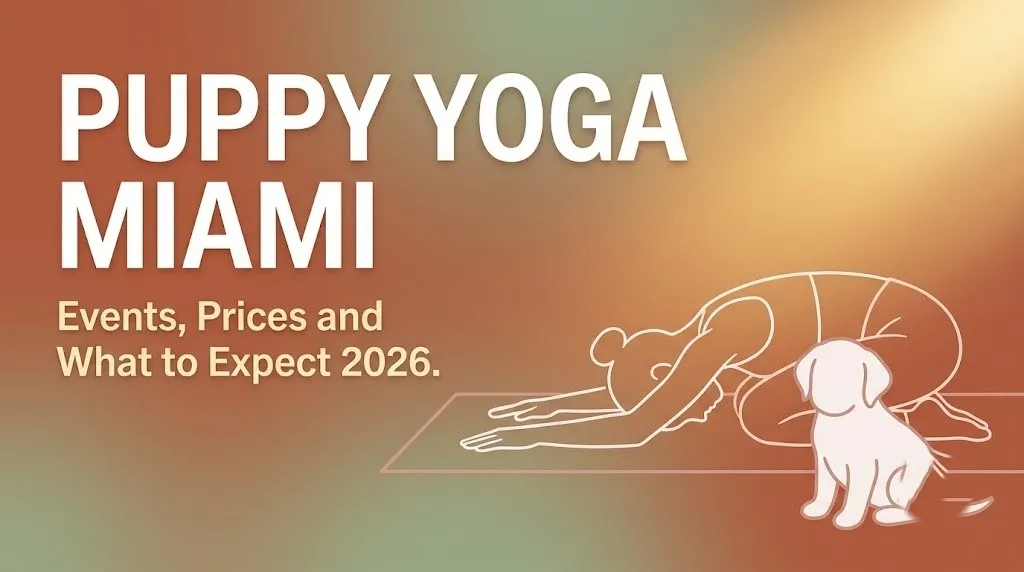
Puppy yoga Miami is a yoga class format where rescue or shelter puppies roam freely among students during practice, combining the physical benefits of gentle yoga with the documented stress-reducing effects of human-animal interaction. If you’ve been curious about booking a session in South Florida, this guide gives you everything the event listings leave out.
Research published in Anthrozoös, the peer-reviewed journal of human-animal studies, has found that brief, positive interactions with dogs measurably reduce salivary cortisol levels and increase perceived wellbeing in healthy adults. That’s not marketing language. It’s a documented physiological response that helps explain why puppy yoga sessions consistently receive some of the highest wellness experience ratings in the group fitness space.
This guide covers how Miami’s puppy yoga events are structured, what the classes cost, which neighborhoods host them, what poses to expect, how to prepare your body and your mat, what the animals’ welfare should look like at a responsible event, and everything in between.
Puppy Yoga Miami: What It Is and What to Expect in 2026
Puppy yoga Miami is a structured group wellness experience that combines a guided, beginner-accessible yoga class with the supervised presence of young puppies, typically from local rescue organizations or shelters, who move freely around participants throughout the session. The yoga component is real and taught by a qualified instructor. The puppies are not props.
Most Miami puppy yoga sessions run 60 minutes in total. The class typically begins with a brief orientation, moves through a gentle yoga sequence designed for all experience levels, and ends with open playtime where participants interact freely with the puppies while seated or lying on their mats.
The yoga style used is almost always Hatha or gentle Vinyasa, chosen because slower pacing allows participants to pause, interact with a puppy, laugh, and return to the pose without losing the thread of the practice. Fast-paced formats like power yoga or hot yoga are not appropriate for the puppy yoga setting.
What to realistically expect during a Miami puppy yoga class:
- Room setup: Mats are arranged with space between them so puppies can move freely. The room is clean and climate-controlled, which matters in Miami’s heat.
- Puppy behavior: Puppies are curious, unpredictable, and completely uninterested in your alignment cues. Expect interruptions, climbing, and licking.
- Teacher pacing: Instructors in puppy yoga classes move slowly and repeat cues frequently, accommodating participants who need to pause for puppy interactions.
- Session tone: Part yoga class, part social experience. The atmosphere is deliberately light and joyful rather than disciplined or meditative.
- Group size: Most Miami puppy yoga events cap attendance at 10 to 20 participants per session to ensure each person has adequate animal interaction time.
How to Find and Book Puppy Yoga Miami Events
Finding puppy yoga Miami events requires checking a combination of booking platforms, local event sites, and studio social media rather than relying on any single source. The format is event-based rather than schedule-based at most venues, which means sessions are added periodically rather than offered at fixed weekly times.
The most reliable places to find upcoming Miami puppy yoga events:
- Eventbrite: The most commonly used platform for Miami puppy yoga event listings, with filtering by date, neighborhood, and price.
- ClassPass: Some Miami studios list puppy yoga sessions here, particularly studios that run regular programming rather than one-off pop-up events.
- Instagram: Many Miami puppy yoga organizers announce new dates on Instagram before updating booking platforms. Searching location tags for Miami neighborhoods surfaces recent posts quickly.
- Mindbody: Established yoga studios that host recurring puppy yoga programs list sessions here alongside their regular class schedule.
- Facebook Events: Community-hosted and nonprofit-organized puppy yoga events often appear here first, particularly events tied to rescue organization fundraisers.
When booking, confirm these details before purchasing:
- Where the puppies come from: A legitimate event sources animals from a local rescue or shelter, not a breeder or commercial supplier.
- How many puppies per participant: 1 puppy per 2 to 3 participants is a reasonable ratio that ensures adequate interaction without overwhelming the animals.
- Refund policy: Weather, puppy illness, or organizer cancellations happen. Confirm the refund terms before booking.
Puppy Yoga Miami Price: What It Costs in 2026
Puppy yoga Miami typically costs between $25 and $55 per person for a standard 60-minute session, with pricing varying based on venue type, location within Miami, whether the event benefits a rescue organization, and whether additional perks (drinks, photos) are included.
Typical pricing breakdown for Miami puppy yoga in 2026:
| Event Type | Typical Price Range | What’s Included |
|---|---|---|
| Pop-up rescue fundraiser | $25 to $35 | Class, puppy playtime, donation to rescue |
| Studio-hosted regular session | $35 to $45 | Class, puppy playtime, mat rental |
| Premium venue (hotel, rooftop, outdoor) | $45 to $65 | Class, puppy playtime, refreshments, photos |
| Private group booking (10+ people) | $30 to $50 per person | Dedicated session, customized format |
| Bachelorette or corporate package | $45 to $75 per person | Private session, props, refreshments, swag |
Prices in Brickell and Miami Beach trend toward the higher end of these ranges. Wynwood and community-organized events tend to offer lower price points, often with the added benefit of proceeds going directly to a local animal rescue.
A practical tip: if you’re attending for the first time, a mid-range rescue fundraiser event in the $30 to $40 range gives you the full experience while supporting animal welfare. Reserve premium-venue events for special occasions or group bookings where the added amenities are worth the extra cost.
Key Takeaway: Puppy yoga Miami is a real, research-backed wellness experience combining gentle yoga with animal interaction. Events run 60 minutes, cost $25 to $55 typically, and are best found through Eventbrite, Instagram, and Mindbody rather than standard studio schedules.
Where to Do Puppy Yoga in Miami: Neighborhoods and Venues
Puppy yoga Miami events are hosted across multiple neighborhoods, with the specific location affecting the atmosphere, price, and type of experience you’ll get. Miami’s geography and culture mean that a puppy yoga session in Wynwood feels quite different from one in Brickell or on Miami Beach.
Miami neighborhood breakdown for puppy yoga events:
| Neighborhood | Venue Type | Atmosphere | Typical Price |
|---|---|---|---|
| Miami Beach / South Beach | Hotel lawns, boutique studios, beach-adjacent venues | Upscale, tourist-friendly, photogenic | $45 to $65 |
| Brickell | Corporate wellness spaces, fitness studios | Professional, often weekday lunch or after-work | $35 to $50 |
| Wynwood | Art space pop-ups, community studios, outdoor venues | Creative, community-focused, casual | $25 to $40 |
| Coral Gables | Yoga studios, country club wellness events | Residential, family-friendly, quieter | $30 to $45 |
| Little Havana | Community centers, nonprofit-organized events | Locally oriented, affordable, culturally rich | $20 to $35 |
| Coconut Grove | Outdoor parks, waterfront venues | Nature-adjacent, open-air, relaxed | $30 to $45 |
Outdoor venues in Miami require careful attention to scheduling. Miami’s heat and humidity from May through October can make outdoor events uncomfortable for both participants and puppies. Events held at outdoor venues during this period should confirm shade, water access, and temperature management protocols for the animals.
For first-time attendees, a climate-controlled indoor studio in Wynwood or Coral Gables offers the best balance of price, comfort, and genuine yoga instruction quality.
What to Bring to Puppy Yoga in Miami
Bringing the right items to puppy yoga Miami makes the difference between a seamless, enjoyable session and an uncomfortable one. The list is slightly different from a standard yoga class because of the animal presence and Miami’s climate.
Essential items:
- Yoga mat: Bring your own if possible. Puppy accidents happen occasionally, and having your own mat means you control the hygiene factor. A mat at least 68 inches long works for all participants.
- Mat cover or old towel: Place a thin towel over the surface of your mat. Puppies will walk, sit, and occasionally relieve themselves on mats. A towel protects your mat and washes easily.
- Water bottle: Miami’s warmth makes hydration important even in climate-controlled studios. Bring at least 20 ounces for a 60-minute session.
- Comfortable, fitted clothing: Loose fabric can catch on puppy claws. Fitted leggings and a fitted top are the most practical choice.
- Old or dark-colored clothing: Puppy paws leave marks. Wearing something you’re comfortable getting a little dirty makes the experience more relaxing.
What to leave at home or in your bag:
- Strong perfume or scented lotion. Puppies’ sense of smell is acute, and heavy scents can make them anxious or avoidant.
- Jewelry with sharp edges that could accidentally scratch a puppy.
- Food. Bringing snacks into a puppy yoga class invites chaos.
What the venue typically provides:
- Yoga blocks and straps for pose modifications
- Hand sanitizer stations
- Water for the puppies
- Basic mat rental if needed ($2 to $5)
What Actually Happens During a Puppy Yoga Class
A puppy yoga class follows a loose structure: brief orientation, guided yoga sequence, and open play. Each phase serves a different purpose, and knowing what to expect from each one helps first-timers relax into the experience rather than spend the first 20 minutes figuring out how it works.
Phase 1: Orientation (5 to 10 minutes)
The instructor briefly explains the class format, introduces the puppies and their handlers, and covers basic etiquette: how to approach the animals, what to do if a puppy becomes stressed, and how to signal for help from a handler. This is also when the teacher identifies any students who are new to yoga and offers a quick summary of the modifications available.
Phase 2: Yoga practice (40 to 45 minutes)
The yoga sequence begins. Puppies are released into the room and move freely among participants. The instructor leads the class through a gentle sequence of poses, pacing the transitions slowly enough to accommodate puppy interruptions. The practice typically includes floor-based poses, gentle standing sequences, and extended rest periods where animal interaction is most natural.
Phase 3: Open play (10 to 15 minutes)
After the formal yoga practice, mats are cleared to the edges of the room and participants sit or lie on the floor for unstructured puppy interaction. This is the phase most people come for. It’s also, according to research in Anthrozoös, the portion of the session most likely to produce measurable reductions in self-reported stress and increases in positive affect.
According to the NCCIH, structured animal-assisted activities, which includes supervised human-animal interaction during group wellness programs, are associated with reduced anxiety and improved mood in both clinical and community settings.
Key Takeaway: A puppy yoga class has three distinct phases: orientation, guided practice, and open play. The yoga portion is genuinely instructed by a qualified teacher. The open play phase at the end is where the strongest documented stress-relief effects occur.
Is Puppy Yoga Miami Good for Beginners
Puppy yoga Miami is one of the most beginner-friendly yoga formats available, because the presence of puppies fundamentally changes the social pressure of the room. No one is watching your alignment. No one is comparing your form to the person next to them. Everyone is distracted in the best possible way.
The yoga sequences used in puppy yoga classes are specifically chosen for their accessibility. Expect poses that can be modified with minimal instruction, held comfortably at multiple ability levels, and interrupted without safety consequence. The class does not build toward challenging peak poses or assume prior yoga knowledge.
According to a 2019 review published in the International Journal of Environmental Research and Public Health, participants in animal-assisted group wellness programs reported lower performance anxiety and higher session enjoyment than participants in equivalent programs without animal involvement. For yoga beginners who feel self-conscious in a standard studio environment, the animal presence effectively reduces that barrier.
Practical guidance for beginners at puppy yoga Miami:
- Tell your teacher you’re new before class starts. They will keep an eye on your positioning during the formal practice phase.
- Don’t worry about matching what others are doing. Focus on how the poses feel in your body.
- Use blocks freely. Placing a yoga block under your hand in standing poses and under your sitting bones in seated poses makes every pose more accessible without changing its therapeutic effect.
- Take Balasana (Child’s Pose) whenever you need a break. It’s also one of the best puppy-magnet positions in the entire practice.
Modification for true beginners: In any standing pose that feels unstable, move your mat next to a wall and use it for balance support. This is always appropriate and never awkward in a puppy yoga setting where improvisation is the norm.
Puppy Yoga Poses: What Yoga Moves Work Best with Puppies
The yoga poses that work best in a puppy yoga setting are low-to-the-ground, stable, and forgiving of interruption. These are not necessarily the most advanced or physically demanding poses. They are the ones that allow the practice to continue safely and joyfully when a 10-pound puppy decides to sit on your lower back.
The most puppy-compatible yoga poses:
| Pose | Why It Works with Puppies | Modification |
|---|---|---|
| Balasana (Child’s Pose) | Low and open, invites approach, safe to hold indefinitely | Bolster under the torso; knees wider apart |
| Bitilasana-Marjaryasana (Cow-Cat Pose) | Ground level, slow movement, naturally attracts puppies | Reduce spinal range in both directions |
| Virabhadrasana II (Warrior II) | Standing, stable, no floor contact for puppies to interrupt | Shorten stance width; use wall for balance |
| Sukhasana (Easy Seated Pose) | Floor level, crossed legs create a lap space for puppies | Sit on a block to reduce hip and lumbar strain |
| Savasana (Corpse Pose) | The ultimate puppy magnet position | Place a blanket over the body for warmth and puppy comfort |
| Uttanasana (Standing Forward Fold) | Brings the face close to puppy level | Bend knees generously; place hands on blocks |
To practice Balasana (Child’s Pose) in a puppy yoga setting:
- Begin on hands and knees in a tabletop position.
- Widen the knees slightly wider than hip-width to create space for a puppy to approach from the front.
- Sink the hips back toward the heels. If the hips don’t reach the heels, place a folded blanket between the thighs and calves.
- Rest the forehead on the mat or on stacked fists if the floor feels too far.
- Extend the arms forward or rest them alongside the body.
- Hold for 8 to 10 breaths or as long as feels comfortable.
Safety note: If a puppy climbs onto your lower back during this pose, remain still and signal a handler if the weight feels uncomfortable. Never twist abruptly to remove an animal while in a spinal flexion position.
The Science Behind Puppy Yoga: Why It Actually Helps
Puppy yoga works because it combines two independently documented wellness mechanisms: the physiological benefits of yoga practice and the stress-reducing effects of positive human-animal interaction. Together, they create a compounding effect that neither produces alone with the same consistency.
On the yoga side, Hatha and gentle yoga styles activate the parasympathetic nervous system through breath-linked movement and sustained posture holds. This reduces activity in the hypothalamic-pituitary-adrenal (HPA) axis, the system responsible for the body’s cortisol stress response.
On the animal interaction side, research published in Anthrozoös has consistently found that brief, positive contact with dogs produces measurable increases in plasma oxytocin (the bonding hormone), along with reductions in salivary cortisol, in both the human and the dog. This response occurs within minutes of the interaction beginning and does not require prior familiarity with the specific animal.
A 2019 study published in AERA Open (a peer-reviewed journal affiliated with the American Educational Research Association) found that university students who had brief, structured contact with therapy dogs before a stressful exam showed lower cortisol levels and higher self-reported wellbeing than students who did not. The cortisol effect was measurable and statistically consistent.
The combined effect in a puppy yoga class means that the yoga component lowers baseline stress reactivity through breathing and movement, and the animal interaction adds a simultaneous oxytocin and cortisol effect on top of that foundation. The result is a measurably more complete stress-response reduction than either activity produces separately.
Puppy Yoga for Anxiety and Stress Relief
Puppy yoga addresses anxiety through three simultaneous mechanisms: controlled breathing, mindful movement, and animal-assisted emotional regulation. Each mechanism targets a different part of the stress response, which is why the experience feels qualitatively different from either a standard yoga class or simply spending time with a dog.
Controlled breathing in yoga directly activates the vagus nerve, the primary pathway of the parasympathetic nervous system. Ujjayi pranayama (ocean breath), used in most gentle and Hatha yoga classes, has been shown in research published in the Journal of Alternative and Complementary Medicine to reduce anxiety scores measurably in both clinical and community populations after 8 weeks of twice-weekly practice.
Animal-assisted emotional regulation works differently. The presence of a puppy requires the practitioner to be present, attentive, and behaviorally regulated. You cannot ruminate about tomorrow’s meetings while a puppy is licking your ear. This forced present-moment engagement is a behavioral analog to mindfulness meditation, without requiring any meditation training.
The NCCIH notes that animal-assisted interventions show preliminary but consistent evidence for reducing anxiety in both clinical populations and generally healthy adults seeking wellness benefits. Puppy yoga is not a clinical intervention, but it operates within the same documented pathway.
For people managing generalized anxiety in Miami’s high-stimulus, high-pace environment, puppy yoga offers a low-barrier, socially acceptable, genuinely pleasurable entry point into a more consistent mindfulness-and-movement practice. Starting once per month and building toward a standard yoga practice from there is a pattern many puppy yoga participants report naturally following.
Key Takeaway: Puppy yoga produces documented stress and anxiety reduction through three simultaneous mechanisms: yoga breathing (vagus nerve activation), gentle movement (HPA axis regulation), and animal interaction (oxytocin release and cortisol reduction). The science supports the experience.
Animal Welfare at Miami Puppy Yoga Events: What to Look For
Animal welfare is the most underreported consideration in puppy yoga coverage, and it matters both ethically and practically. A poorly run puppy yoga event that prioritizes entertainment over animal wellbeing is not only ethically problematic. It also produces stressed, avoidant, or unwell animals whose presence does not generate the positive interaction effects the science documents.
The American Veterinary Medical Association (AVMA) provides guidelines for animal-assisted activities that include limits on session duration, rest requirements between interactions, handler oversight ratios, and participant behavior protocols. Not every puppy yoga organizer follows these guidelines. The ones that do produce consistently better experiences for both the people and the animals.
What to look for when evaluating a Miami puppy yoga event’s animal welfare standards:
- Session length for the puppies: Puppies should not be in active interaction for more than 60 to 90 minutes per session, with rest periods between events. Ask whether puppies work multiple sessions per day.
- Handler presence: At least one handler per 2 to 3 puppies should be present throughout the class, not just during orientation.
- Puppy sourcing: Animals should come from a licensed rescue organization or shelter. Ask directly. Legitimate organizers are proud to name their rescue partners.
- Stress signal awareness: Handlers should actively monitor puppies for stress signals: yawning, lip licking, tail tucking, hiding. If a puppy is showing stress, it should be removed immediately.
- Hygiene protocols: Fresh water, clean bedding, and access to a puppy-only rest area away from participants are non-negotiable standards.
A red flag: any event where the organizer cannot or will not name the rescue organization the puppies come from. A responsible event always has that answer ready.
Puppy Yoga Miami for Groups: Bachelorette Parties and Corporate Events
Puppy yoga Miami has become one of the most requested group wellness activity formats in South Florida, with particular demand from bachelorette parties, corporate team outings, birthday groups, and nonprofit fundraiser events. The format scales well for groups of 10 to 30 people and requires minimal logistical complexity compared to other group activities.
For bachelorette parties specifically, puppy yoga Miami offers an alternative to bar-based itineraries that is genuinely memorable, Instagram-worthy, and inclusive of participants who don’t drink. The 60-minute format fits neatly into a day-of itinerary and generates natural social bonding through shared laughter.
What a private group puppy yoga booking in Miami typically includes:
- A dedicated, private session not open to the general public
- A customized yoga sequence adjusted to the group’s collective ability level
- Direct access to a puppy handler throughout the session for any animal questions
- Photography-friendly room setup in most premium venues
- Options for add-ons: welcome drinks, branded props, extended playtime after the yoga portion
According to research published in Complementary Therapies in Medicine, group-based yoga and mindfulness activities produce greater improvements in social connectedness and team cohesion compared to individual wellness activities. The animal presence in puppy yoga amplifies this effect by creating shared experiences that participants reference and discuss for weeks after the event.
Corporate organizers should confirm with the venue that the puppy yoga session qualifies for any corporate wellness reimbursement programs their company operates. Several Miami employers actively support animal-assisted wellness programming as part of mental health benefit packages.
Puppy Yoga vs Goat Yoga: Which Is Better in Miami
Both puppy yoga and goat yoga are available in and around Miami, and both produce real wellness benefits through animal-assisted interaction. The right choice depends on what experience you’re looking for, not on which format is objectively superior.
| Feature | Puppy Yoga Miami | Goat Yoga Miami |
|---|---|---|
| Animal size | Small (4 to 15 pounds typically) | Medium to large (20 to 80 pounds) |
| Animal predictability | Low: puppies are chaotic and curious | Moderate: goats are curious but less frantic |
| Venue type | Indoor studios, hotel spaces, urban venues | Outdoor farms, agricultural spaces, parks |
| Climate consideration | Climate-controlled; comfortable year-round | Outdoor; Miami heat from May through October is a real factor |
| Pose compatibility | Best for floor and low poses | Goats often climb on participants during all poses |
| Adoption opportunity | Yes, rescue puppies are often available for adoption | No adoption component typically |
| Group suitability | Excellent; flexible venue options across Miami | Good for larger rural-adjacent groups; requires travel |
| Animal welfare monitoring | High at legitimate events; AVMA guidelines applicable | Variable; less regulated than therapy-dog programs |
For Miami residents who want an urban, year-round, adoption-friendly experience, puppy yoga is the more practical choice. Goat yoga offers a novelty that is genuinely delightful but requires planning for outdoor heat and usually a longer travel distance from central Miami neighborhoods.
Neither is better in an absolute sense. They are different experiences with different trade-offs. If you’re choosing for a group, puppy yoga’s venue flexibility and adoption angle give it a practical edge in the Miami context.
Puppy Yoga Etiquette: How to Behave in Class
Puppy yoga etiquette is the set of behavioral guidelines that protects both the animals and other participants’ experience. Most of these rules are explained during orientation, but knowing them in advance makes the session smoother and the animals calmer.
Around the puppies:
- Always let a puppy approach you first. Do not chase or corner an animal to force interaction.
- Pet the puppies gently on the back and sides. Avoid reaching over their head, which can feel threatening to an animal that doesn’t know you.
- If a puppy shows a stress signal (yawning, lip licking, hiding, tucking its tail), give it space and alert a handler.
- Do not pick up a puppy without handler permission. Falls from arms during yoga poses can injure a young animal.
- Wash your hands before and after handling any animals.
During the yoga practice:
- Keep the conversation with your mat neighbor minimal during the formal yoga phase. The instructor is guiding a real class.
- If a puppy interrupts your pose in a way that affects your balance, lower to a seated or kneeling position before redirecting the animal.
- Do not feed treats to the puppies. This disrupts the handlers’ behavioral management system.
General event etiquette:
- Arrive on time. Late arrivals during orientation disrupt the puppy introduction process.
- Keep your phone on silent. Flash photography can startle the animals.
- Follow the photographer’s guidance if professional photos are being taken. Most venues coordinate a photo window so participants can get good images without disrupting the practice.
Pose Tip:
- Take Balasana (Child’s Pose) when a puppy interaction requires both hands. It’s the most stable floor position for reaching and petting simultaneously.
- Use Savasana (Corpse Pose) at the end of every session. It’s when the most relaxed puppy interactions naturally happen.
Puppy Yoga Miami Age Requirements and Who Can Attend
Most puppy yoga Miami events set a minimum age of 8 to 12 years old for participants, with the specific requirement varying by organizer and venue. The age restriction exists to protect both the puppies and younger children, because the unpredictable energy of young children can stress the animals, and the chaotic nature of puppies can overwhelm very young children.
Age and participant guidelines for Miami puppy yoga:
| Participant Type | Typical Age Requirement | Notes |
|---|---|---|
| Adults | No maximum age; open to all adults | Seniors should confirm floor-level pose comfort |
| Teenagers (13 to 17) | Permitted at most events | Some events require a parent or guardian present |
| Children (8 to 12) | Permitted at family-friendly events | Must be accompanied by an adult; not all events are family-friendly |
| Children under 8 | Rarely permitted | Organizer discretion; specifically designed family events may allow younger ages |
| Pregnant participants | Generally permitted | Consult with an OB-GYN first if past the first trimester; floor-level poses require modification |
| Seniors | Fully welcome | Floor-level poses can be modified or done in a chair alongside the mat |
For seniors attending a Miami puppy yoga event, the primary practical consideration is getting up and down from the floor. If floor-to-standing transitions are uncomfortable, inform the organizer in advance. Most venues can provide a chair for seated participation during floor poses, which maintains full participation without the floor transition demand.
Pregnant participants past the first trimester should modify poses that involve lying flat on the back, deep hip flexion, and prone positions. Seated variations and standing poses remain accessible throughout most of pregnancy when practiced with appropriate modifications.
Key Takeaway: Puppy yoga Miami is inclusive across most age groups, welcomes complete yoga beginners, and can be adapted for seniors and pregnant participants with simple modifications. The one genuine restriction is for very young children, primarily to protect the puppies from overstimulation.
Frequently Asked Questions About Puppy Yoga Miami
What is puppy yoga in Miami and how does it work?
Puppy yoga Miami is a guided yoga class where rescue or shelter puppies roam freely among participants during practice.
A qualified yoga instructor leads a gentle, beginner-accessible session while puppy handlers supervise the animals throughout.
Sessions typically run 60 minutes and end with open playtime where participants interact freely with the puppies on the mat.
How much does puppy yoga in Miami cost?
Puppy yoga Miami typically costs between $25 and $55 per person for a standard 60-minute class.
Rescue fundraiser events at community venues tend to run $25 to $35, while premium venue sessions with added amenities range from $45 to $65.
Private group bookings for bachelorette parties or corporate events generally fall between $30 and $75 per person depending on what is included.
Is puppy yoga good for beginners with no yoga experience?
Yes, puppy yoga is one of the most beginner-friendly yoga formats available because the animal presence reduces self-consciousness and the sequences are designed for all experience levels.
The instructor always offers modifications, and the pace is slow enough that beginners can follow along without prior yoga knowledge.
Bring a yoga block and tell your teacher before class that you’re new so they can offer relevant guidance during the practice.
Are the puppies at Miami puppy yoga classes rescue dogs?
At responsible Miami puppy yoga events, the animals come from local rescue organizations or shelters, not breeders.
Always ask the organizer to name their rescue partner before booking. A legitimate event always has a direct answer to this question.
Many Miami puppy yoga events include an adoption component, giving participants the opportunity to adopt a puppy they meet during class.
What should I wear and bring to a puppy yoga class in Miami?
Wear fitted, dark-colored, moisture-wicking clothing that you’re comfortable getting puppy paw prints on.
Bring your own yoga mat with a thin towel laid on top to protect it, a water bottle with at least 20 ounces, and skip the strong perfume or jewelry with sharp edges.
A mat rental is usually available at the venue for $2 to $5 if you don’t own a mat yet.
Puppy yoga Miami is worth booking. The experience is genuinely fun, the wellness benefits are real and documented, and when the event is run responsibly, the puppies are happy too.
Start by booking a rescue fundraiser event in Wynwood or Coral Gables for your first session. Bring your own mat with a towel on top, arrive 10 minutes early, and tell the teacher you’re new. Take Balasana (Child’s Pose) whenever you need a break. Stay for the full open play at the end.
That’s the complete beginner’s action plan. The puppies will handle the rest.