Soho Yoga: Your 2026 Guide to NYC’s Best Practice
Soho yoga refers to the yoga studios, classes, and wellness culture concentrated in the SoHo neighborhood of Lower Manhattan, one of New York City’s most active hubs for yoga and movement practice. Whether you are a Manhattan resident looking for a regular studio, a visitor wanting to drop into a class, or a beginner trying to make sense of the options, this guide gives you the practical information every other SoHo yoga guide leaves out.
The National Center for Complementary and Integrative Health (NCCIH) identifies yoga as one of the most practiced complementary health approaches in the United States, with documented benefits for stress, anxiety, sleep, and chronic pain that are particularly relevant for urban populations dealing with high daily demands. New York City, with its density, noise, and pace, is precisely the environment where consistent yoga practice produces the most measurable stress-regulation outcomes.
This guide covers what SoHo yoga actually offers in terms of styles, what to look for in a teacher, how to prepare for your first class, what specific styles like Vinyasa and Yin deliver for your body, how yoga addresses the specific stressors of NYC life, and how to build a home practice that keeps your progress going between studio visits.
Soho Yoga: What It Is and What the Neighborhood Offers
Soho yoga refers to the concentration of yoga studios, drop-in classes, boutique wellness spaces, and experienced teachers operating in the SoHo district of Manhattan, bounded roughly by Houston Street to the north, Canal Street to the south, Lafayette Street to the east, and Sixth Avenue to the west.
SoHo has historically attracted creative and wellness-forward businesses alongside its art galleries and fashion industry presence. The neighborhood’s yoga culture reflects that mix: studios range from intimate, teacher-owned spaces offering traditional methods to modern boutique studios with booking apps, curated playlists, and multiple style offerings under one roof.
The yoga options in SoHo are more varied than in most other Manhattan neighborhoods. You will find dedicated Yin yoga and Restorative yoga studios, Vinyasa yoga studios with multiple daily class times, heated yoga offerings, Kundalini yoga centers, and Hatha yoga classes appropriate for beginners alongside advanced workshops.
The neighborhood’s density means most studios are within a short walk of each other. That concentration gives practitioners the ability to try several different teaching styles and formats before committing to a membership or ongoing class schedule.
| SoHo Yoga Environment | What It Typically Offers |
|---|---|
| Boutique studios (independent) | Intimate class sizes, teacher-student relationships, specific style focus |
| Multi-style wellness centers | Multiple styles, larger class capacity, app-based booking |
| Heated yoga studios | Hot yoga, warm Vinyasa, infrared-heated rooms |
| Traditional method studios | Ashtanga, Iyengar, or Kundalini with lineage-trained instructors |
| Drop-in friendly studios | No membership required, flexible scheduling, beginner-welcoming |
Best Yoga Studios in SoHo NYC: What to Look for in 2026
The best yoga studios in SoHo NYC in 2026 are identified not by brand recognition but by instructor credentials, class size, style clarity, and whether the studio actively supports beginners alongside advanced practitioners.
Finding the right studio is a process, not a single decision. The most important variables are not a studio’s aesthetics or social media presence. They are the teaching credentials of the instructors, the maximum class size (which directly affects how much individual attention you receive), and whether the studio is transparent about what each class style actually involves.
What to evaluate before choosing a SoHo yoga studio:
- Teacher credentials: Look for Yoga Alliance RYT 200 as a minimum. RYT 500 indicates advanced training. Specialized certifications in therapeutic yoga, prenatal yoga, or specific styles like Iyengar or Ashtanga indicate deeper expertise.
- Class size: Smaller classes (under 15 students) allow teachers to observe and adjust individual alignment. Larger classes (25 or more) may be motivating but provide less personal attention.
- Style accuracy: A studio that correctly describes the difference between Vinyasa yoga and Hatha yoga in its class descriptions demonstrates genuine yoga knowledge. Vague descriptions like “dynamic flow” or “mindful movement” without style specificity are a warning sign.
- Beginner offerings: A studio with a dedicated beginners’ series or fundamentals class alongside its regular schedule indicates it genuinely welcomes new practitioners.
- Trial options: Most quality SoHo studios offer a first class free or a reduced-rate introductory week. Use this to assess the teaching quality before committing to a membership.
- Cancellation and booking policies: Rigid 24-hour cancellation fees are common in NYC studios. Know the policy before you book, particularly for early morning classes you may need to skip due to work demands.
Yoga Styles in SoHo: Vinyasa, Yin, Hot, and Restorative Explained
Yoga styles in SoHo NYC span the full range of modern yoga practice, from vigorous breath-linked Vinyasa sequences to slow, passive Yin classes, and understanding what each style involves helps you choose the class that matches your body’s actual needs.
The confusion between yoga styles is one of the most common reasons people end up in the wrong class for their body or goals. Arriving at a heated power yoga class when you expected a gentle restorative session is a jarring and avoidable experience. Each style has a distinct physical demand, pace, temperature environment, and intended effect on the body and nervous system.
| Yoga Style | Pace | Temperature | Best For | Not Recommended For |
|---|---|---|---|---|
| Hatha yoga | Slow to moderate | Room temperature | All levels, beginners, foundational poses | Those wanting vigorous cardio |
| Vinyasa yoga | Moderate to vigorous | Slightly warm | Active practitioners, cardiovascular fitness | Complete beginners without guidance |
| Ashtanga yoga | Moderate, fixed sequence | Room temperature | Committed daily practice, discipline | Those wanting variety or gentle practice |
| Yin yoga | Very slow, passive | Room temperature or cool | Connective tissue, flexibility, stress relief | Those uncomfortable with stillness |
| Restorative yoga | Completely passive | Room temperature | Recovery, nervous system rest, chronic stress | Those seeking physical activity |
| Hot yoga (Bikram/26&2) | Moderate, fixed | 95 to 105 degrees F | Heat tolerance, detoxification goals | Cardiovascular conditions, heat sensitivity |
| Kundalini yoga | Variable with breathwork | Room temperature | Spiritual practice, energy work, breathwork | Those seeking only physical yoga |
Modification for beginners across all styles: Any style is appropriate for beginners with one condition: the teacher must know it is your first class. Tell your teacher before the session begins. Most SoHo yoga teachers will provide verbal modifications throughout; knowing you are new means they will watch your practice more closely.
Key Takeaway: Yoga style choice determines your physical experience, temperature, and nervous system effect. Getting the style right matters more than getting the studio right, so identify what your body needs before you book.
Soho Yoga for Beginners: How to Find and Prepare for Your First Class
Soho yoga for beginners starts with choosing a studio that offers a dedicated beginners’ class or fundamentals series rather than walking into a general mixed-level class without prior instruction.
The mixed-level drop-in class is the standard format in most SoHo studios, and it is not always the best entry point for a complete beginner. In a mixed-level class, the teacher assumes some baseline familiarity with common poses and transitions. A beginner without that foundation may spend more energy watching and guessing than actually practicing with awareness.
A beginner-specific class, or a “Yoga 101” or “Foundations” class, teaches the mechanics of common poses, introduces basic breathing techniques, and gives you a vocabulary for understanding teacher cues before you enter a general class. Most quality SoHo studios offer at least one beginner-oriented class per week.
How to prepare your body for a first yoga class:
- Arrive at the studio 10 to 15 minutes early. This time is used to sign waivers, meet the teacher, and disclose any relevant injuries or physical limitations.
- Tell the teacher what limitations you have before class begins. Lower back sensitivity, wrist pain, or knee issues all have specific modifications that a good teacher will offer throughout.
- Eat lightly or not at all for at least two hours before class. Yoga involves compression and inversion of the torso, which is uncomfortable on a full stomach.
- Wear fitted clothing that does not shift in forward bends or inversions. Loose pants and baggy tops obscure alignment for both you and your teacher.
- Bring your own mat if possible. Studio rental mats are functional but less grippy than a new mat, which matters in standing and balance poses.
- Expect to not do everything in the class. Resting in Balasana (Child’s Pose) at any point is always an option and is never a failure in yoga.
What to Bring to Your First SoHo Yoga Class
Your first SoHo yoga class requires a non-slip yoga mat, comfortable fitted clothing, a small towel, and a water bottle carried in a bag you can leave at the studio’s entrance or storage area.
SoHo studios typically have shoe storage and cubbies near the entrance. Most do not allow shoes or bags in the practice room. Arriving organized matters more than arriving with expensive gear.
Complete first class packing list for SoHo yoga:
- Yoga mat: bring your own if you have one; studio rental mats cost approximately $2 to $5 per class and are available at the front desk
- Small hand towel: for sweat in heated classes or face-down poses; useful even in non-heated classes
- Water bottle: filled before arrival; many SoHo studios prohibit water breaks during certain class formats but allow them at the edges of the session
- Fitted clothing: form-fitting athletic wear that stays in place in inversions and forward folds; avoid baggy shorts or loose tops
- Socks: remove them before entering the practice room; bring them for after class when floors can be cold
- Cash or card: most SoHo studios accept card payments for drop-in classes; having cash is useful as a backup
- A willingness to rest: Balasana (Child’s Pose) is always available; use it whenever you need a break without waiting for instruction
What not to bring: perfume or scented products. SoHo yoga studios, like most yoga spaces, ask practitioners to arrive scent-free because strong fragrances in enclosed spaces affect the breathing quality of everyone in the room.
Soho Yoga Schedule and Pricing: What to Expect in 2026
Soho yoga studio pricing in 2026 typically ranges from $25 to $40 per drop-in class, with monthly unlimited memberships ranging from $150 to $300 depending on studio tier and class format.
New York City yoga pricing reflects the neighborhood’s real estate and operating costs. SoHo studios sit in one of Manhattan’s most expensive commercial districts, and that cost is reflected in class prices. That said, the range is wide and most studios offer options that make regular practice financially accessible.
Common SoHo yoga pricing structures in 2026:
- Drop-in single class: $25 to $40, depending on class format and studio
- Class packs: typically 5 or 10 classes at a reduced per-class rate; useful for irregular schedules
- Monthly unlimited membership: $150 to $300; best value for practitioners attending three or more classes per week
- Intro offers: most studios offer a first week unlimited for $30 to $50 or a first class free
- Early morning classes: some studios discount early morning sessions to $20 or less to fill lower-demand time slots
- Workshops and specialty classes: $35 to $75 for specialty workshops including arm balances, backbend intensives, or pranayama workshops
ClassPass and similar multi-studio platforms are widely used in SoHo and offer access to multiple studios at a reduced rate compared to individual studio memberships. For practitioners who want variety across multiple studios rather than committing to one, these platforms offer practical cost savings.
Key Takeaway: SoHo yoga drop-in classes run $25 to $40, but intro offers, early morning discounts, and multi-studio apps make regular practice financially accessible even at Manhattan prices.
Vinyasa Yoga in SoHo: What It Involves and Who It Suits
Vinyasa yoga is the most widely offered yoga style in SoHo NYC, and it involves linking breath with movement through a continuously flowing sequence of poses without holding any single position for an extended time.
The word “Vinyasa” means “to place in a special way” in Sanskrit. In practice, it describes a yoga class format where each inhale and exhale corresponds to a specific movement or transition. A Vinyasa class in SoHo typically begins with a warm-up including Surya Namaskara A (Sun Salutation A), moves through standing and balancing poses, incorporates hip openers and twists, and closes with a backbend and Savasana (Corpse Pose).
Vinyasa is well-suited for practitioners who want cardiovascular challenge alongside flexibility and strength training. A 60-minute Vinyasa class produces meaningful aerobic effort. The American College of Sports Medicine notes that yoga practiced at moderate-to-vigorous intensity, which includes most Vinyasa formats, contributes to the recommended weekly physical activity targets for cardiovascular health.
Vinyasa is not equally accessible to everyone as a starting point. The continuous movement format assumes familiarity with basic pose names and transitions. A complete beginner in a Vinyasa class may spend more time looking around the room than practicing with awareness.
What to expect in a standard SoHo Vinyasa class:
- Opening: 3 to 5 minutes seated breathing, setting intention
- Sun Salutations: 5 to 10 rounds of Surya Namaskara A and B as the primary warm-up
- Standing sequence: 20 to 25 minutes of standing poses linked by breath
- Peak pose or series: the most demanding section, often an arm balance or deep backbend
- Cool-down: forward folds, hip openers, supine poses
- Savasana: final rest, minimum 5 minutes
Modification for beginners in Vinyasa: Lower the knees in Chaturanga Dandasana (Four-Limbed Staff Pose) rather than holding the full pose. This is the most common and most necessary modification for anyone new to Vinyasa practice.
Yin Yoga in SoHo NYC: The Slower Practice and Its Benefits
Yin yoga is a slow, passive practice in which poses are held for three to seven minutes with the muscles intentionally relaxed, targeting the connective tissue, fascia, and joints rather than the muscular system.
Yin yoga is the direct counterpart to the active, muscular Vinyasa classes that dominate most SoHo studio schedules. Where Vinyasa works the muscles through repeated contraction and engagement, Yin deliberately bypasses muscular effort and applies slow, sustained loading to the ligaments, joint capsules, and fascial networks of the body. Think of it as the difference between squeezing a sponge repeatedly and simply letting the sponge rest in water and absorb.
A study published in the Journal of Alternative and Complementary Medicine found that Yin yoga practice produced statistically notable improvements in flexibility and range of motion in the hip joints after six weeks, with additional reductions in perceived stress and anxiety across the study population. The passive hold duration is the mechanism: connective tissue responds to time under gentle load rather than to repetition or force.
For SoHo practitioners dealing with high daily stress loads, chronic muscle tension from desk work, or residual soreness from active yoga or other exercise, Yin yoga provides something a vigorous practice cannot: genuine nervous system downregulation through long, quiet, supported stillness.
Common poses in a SoHo Yin yoga class:
- Supta Baddha Konasana (Reclining Bound Angle Pose): opens inner groins and hip flexors; held 3 to 5 minutes
- Melting Heart Pose (Anahatasana): opens the thoracic spine and shoulders; held 3 to 5 minutes
- Sleeping Swan (a Yin variation of Eka Pada Rajakapotasana, Pigeon Pose): deep hip external rotation; held 3 to 7 minutes per side
- Caterpillar (Yin version of Uttanasana, Seated Forward Fold): releases the entire posterior chain; held 3 to 5 minutes
Modification for tight hips in Yin: Place a folded blanket or bolster under the hips in Sleeping Swan to reduce the intensity of the hip joint stretch and prevent the sacroiliac joint from being loaded asymmetrically.
Hot Yoga in SoHo: What Heated Classes Involve
Hot yoga in SoHo refers to yoga classes practiced in a room heated to between 85 and 105 degrees Fahrenheit, with the most traditional heated format being Bikram/26&2 yoga, which uses a fixed sequence of 26 poses and two breathing exercises.
Hot yoga studios are present throughout SoHo, and the format has expanded beyond the traditional Bikram fixed sequence to include heated Vinyasa, infrared-heated gentle classes, and warm barre-yoga hybrid formats. The heat level varies significantly across formats, and knowing what you are signing up for matters.
The physiological effects of heat on yoga practice are real and documented. According to Harvard T.H. Chan School of Public Health research on heat and exercise, practicing in elevated temperatures increases heart rate and caloric expenditure relative to the same activity in a cooler environment. The heat also temporarily increases tissue flexibility, which can make poses feel more accessible.
The accessibility increase from heat is partly illusory. Tissues stretched while hot that are not yet genuinely flexible may be overstretched beyond their structural capacity. This is why hot yoga classes carry a higher injury risk for beginners than room-temperature classes, and why gradual acclimatization to the heat format matters.
Safety notes for hot yoga in SoHo:
- Hydrate thoroughly in the hours before class, not just immediately before entering the heated room
- Exit the room or lie down in Savasana (Corpse Pose) immediately if you feel dizzy, nauseous, or lightheaded
- Begin with shorter class durations or less intense heated formats (85 to 90 degrees) before attempting full 105-degree classes
- People with cardiovascular conditions should discuss heated yoga participation with a cardiologist before attending, as the heat load combined with exercise intensity creates a specific cardiovascular demand
Key Takeaway: Hot yoga increases perceived flexibility and caloric expenditure but also raises injury risk if beginners overstretch into the heat-assisted range of motion. Acclimatize gradually and listen to your body’s cooling signals.
Yoga for Stress and Urban Wellness in New York City
Yoga is one of the most evidence-supported non-pharmacological interventions for the chronic stress that characterizes life in a high-density urban environment like New York City.
Manhattan residents experience measurably higher ambient noise levels, commute stress, workplace pressure, and social density than the national average. These factors drive chronic activation of the sympathetic nervous system, the fight-or-flight system, maintaining elevated cortisol levels that research consistently links to sleep disruption, immune suppression, cardiovascular risk, and cognitive impairment over time.
The NCCIH, citing multiple large reviews of yoga research, identifies yoga as having “good evidence” for reducing anxiety, perceived stress, and cortisol levels. The mechanism is physiological, not philosophical: slow, breath-coordinated movement activates the vagus nerve and the parasympathetic nervous system, directly counteracting the stress response at a hormonal and neurological level.
For NYC practitioners specifically, the most stress-relevant yoga elements are:
- Extended exhales: exhaling longer than the inhale activates the parasympathetic brake on the stress system; this is built into most yoga breathing techniques including Ujjayi Pranayama
- Grounding poses: Tadasana (Mountain Pose) and Balasana (Child’s Pose) provide proprioceptive feedback that anchors the nervous system in the present moment
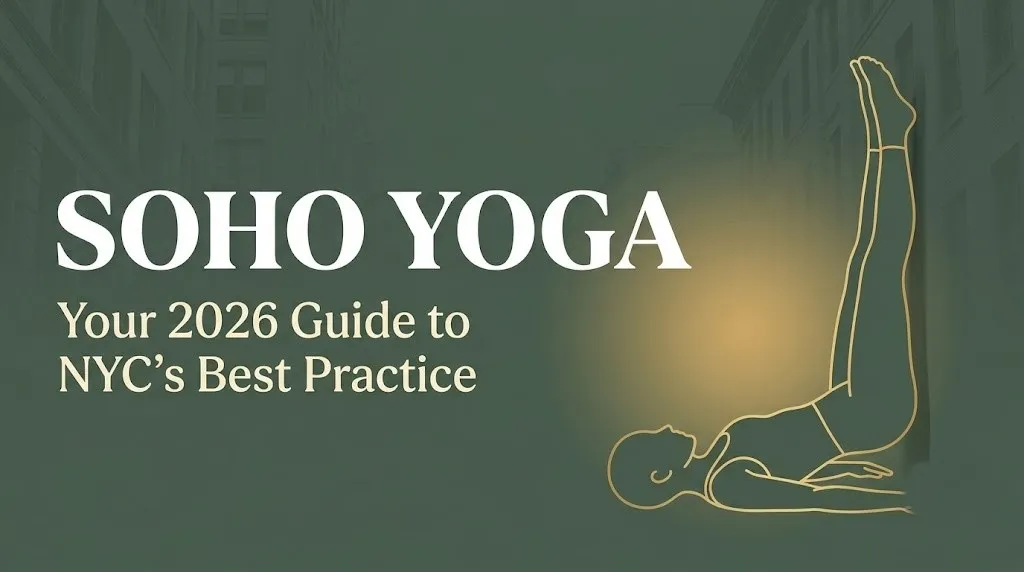
- Inversions: Viparita Karani (Legs-Up-the-Wall Pose) is a particularly effective nervous system reset after a demanding urban day; five minutes in this pose consistently reduces resting heart rate
- Savasana: the five to ten minutes of complete stillness at the end of class is neurologically distinct from sleep and distinct from waking activity; it is a documented entry point into the parasympathetic state
Soho Yoga and Mindfulness: Meditation and Breathwork in Class
Soho yoga classes increasingly integrate meditation and breathwork, known as Pranayama, alongside physical poses, reflecting the growing body of research showing that these elements produce measurably greater stress-reduction and mental health benefits than physical poses practiced alone.
Most SoHo yoga classes include at least a brief meditation or breathwork component at the session’s opening or closing. Higher-end studios and specialty classes offer extended Pranayama workshops, Kundalini yoga sessions centered primarily on breathwork and mantra, and meditation-focused classes where asana is minimal.
A 2020 meta-analysis published in Frontiers in Psychology reviewed yoga interventions across anxiety and depression outcomes and found that yoga practices combining physical poses with explicit breathwork and meditation components showed the largest effect sizes for psychological benefit, significantly outperforming physical-only yoga.
Common breathwork techniques offered in SoHo yoga classes:
- Ujjayi Pranayama (Victorious Breath): a constricted-throat nasal breath creating an ocean sound; used throughout Vinyasa and Ashtanga classes to maintain focus and regulate the pace of movement
- Nadi Shodhana (Alternate Nostril Breathing): alternates breath between left and right nostrils; balances the nervous system; often practiced at the opening of a class
- Kapalabhati (Skull-Shining Breath): rapid, forceful exhalations with passive inhalations; energizing and cleansing; common in Kundalini yoga classes
Modification for breathwork beginners: Practice Nadi Shodhana without the breath retention component. Simply alternate nostrils on the inhale and exhale without holding the breath between phases. This version provides the balancing benefit without the intensity of full Kumbhaka (breath retention) practice.
Yoga for Busy Professionals in NYC: Making Practice Work
Yoga for busy professionals in New York City is most effective when it is treated as a scheduled, non-negotiable appointment rather than an optional wellness add-on that gets dropped when work demands escalate.
The research on yoga adherence consistently shows that frequency matters more than session duration for building lasting physiological and psychological benefits. The American College of Sports Medicine notes that three sessions per week of structured yoga produces measurable improvements in stress biomarkers, flexibility, and cardiovascular indicators. Two long sessions per week produces less consistent benefit than three shorter ones.
For NYC professionals specifically, the session timing also matters. Morning yoga, practiced before the workday begins, has the advantage of eliminating the “I’ll go after work” cancellation that fills most busy people’s weeks. SoHo studios typically offer early morning classes beginning at 6:00 or 6:30 am, precisely for this demographic.
Practical strategies for maintaining a yoga practice in a busy NYC schedule:
- Book classes in advance and treat them as meetings: canceling a meeting requires a specific reason; apply the same standard to your yoga class
- Use drop-in classes to supplement a studio membership during unusually busy weeks rather than stopping practice entirely
- Keep a yoga mat rolled out in your home space: the visual cue increases practice follow-through by approximately 40 percent, according to behavioral habit research
- Practice a 10 to 15-minute home sequence on days when studio attendance is impossible: Marjaryasana-Bitilasana (Cat-Cow Pose), Adho Mukha Svanasana (Downward-Facing Dog), and Viparita Karani (Legs-Up-the-Wall) is a complete and effective short practice
- Prioritize the closing Savasana even in abbreviated home sessions: five minutes of genuine stillness produces nervous system benefits regardless of how brief the preceding movement was
Key Takeaway: For busy NYC professionals, three shorter yoga sessions per week consistently outperform one or two longer sessions for stress regulation, flexibility, and long-term practice adherence.
Soho Yoga Teachers: What to Look for in an Instructor
The quality of your soho yoga teacher matters more than the quality of the studio’s interior design, class booking technology, or playlist curation, because the teacher’s ability to observe your body, offer appropriate modifications, and create a safe practice environment directly determines your experience and safety.
Yoga teaching credentials in the United States are registered through the Yoga Alliance, which sets minimum standards for training hours and curriculum. An RYT 200 indicates 200 hours of teacher training. An RYT 500 indicates 500 hours, typically including advanced study in a specific area such as anatomy, therapeutic applications, or a particular yoga lineage.
These credentials are a floor, not a ceiling. A teacher with 200 hours of training who has been teaching daily for five years has far more practical expertise than a newly certified RYT 500 who has not yet worked extensively with real students in varied body types and conditions.
What to observe in your first class with any teacher:
- Do they walk the room during class, or do they remain at the front?
- Do they offer verbal modifications unprompted, or only when asked?
- Do they use both Sanskrit and English pose names, demonstrating genuine yoga education?
- Do they check in with new students before class begins?
- Do they avoid physical adjustments without asking permission first?
- Do they create space for rest in Balasana (Child’s Pose) without requiring a reason?
A teacher who checks all of these boxes is worth returning to. Studio prestige does not replace teaching skill. Some of the best yoga teaching in SoHo happens in smaller, quieter studios with less brand recognition than the boutique flagships.
Home Yoga Practice for SoHo and NYC Residents
Home yoga practice for SoHo and NYC residents is both more necessary and more challenging than in most other cities, because the combination of small living spaces and high daily demands creates a specific set of obstacles that a purposeful home practice setup can address.
The good news is that yoga requires very little space. A standard yoga mat measures approximately 68 by 24 inches. That is the footprint you need, and nothing else. Balasana (Child’s Pose), Adho Mukha Svanasana (Downward-Facing Dog), Viparita Karani (Legs-Up-the-Wall), and Savasana (Corpse Pose) can all be practiced comfortably in a New York City studio apartment with a single clear floor space.
The challenge is mental rather than spatial. Most NYC apartments are also workspaces, social spaces, and recovery spaces. Creating a mental transition into practice mode requires a consistent ritual that signals “practice time” to the nervous system: rolling out the mat in the same spot, taking three slow breaths before moving, and setting a single intention for the session.
A complete 20-minute home practice for NYC residents:
- Sit in Sukhasana (Easy Seated Pose) for three minutes. Eyes closed. Three slow breaths through the nose. Set a single intention.
- Move to Marjaryasana-Bitilasana (Cat-Cow Pose) on hands and knees. Eight rounds linking breath to movement.
- Press back to Balasana (Child’s Pose). Hold for eight breaths.
- Walk to Adho Mukha Svanasana (Downward-Facing Dog). Bend knees generously. Hold for five breaths. Pedal the heels gently.
- Walk feet to hands and rise to Tadasana (Mountain Pose). Stand still for eight breaths.
- Come to the floor for Viparita Karani (Legs-Up-the-Wall). Hips close to the wall, legs extended up. Hold for five minutes with steady, slow breathing.
- Lower to Savasana (Corpse Pose). Remain still for three to five minutes.
Modification for limited space: If a full Downward Dog is not possible in your space, substitute with a standing forward fold against the wall or an extended Child’s Pose instead.
Yoga Benefits for City Dwellers: What Research Supports
Yoga produces specific, research-documented benefits that are particularly relevant for people living and working in dense, high-stress urban environments like lower Manhattan.
The connection between yoga practice and urban stress management is not circumstantial. The physiological mechanisms are well-understood and well-documented. Urban environments are characterized by chronic low-level sensory overload: noise, crowding, visual complexity, and unpredictable social demands. These inputs maintain the sympathetic nervous system in a low-grade alert state across the entire day, which accumulates into measurable health consequences over months and years.
A study published in the International Journal of Yoga found that eight weeks of yoga practice produced significant reductions in cortisol awakening response, a reliable physiological marker of chronic stress load, in urban adults with elevated baseline stress. The reductions were comparable to those seen in mindfulness-based stress reduction (MBSR) programs.
Documented yoga benefits most relevant to urban practitioners:
- Reduced cortisol and stress hormone levels (International Journal of Yoga, NCCIH)
- Improved sleep onset and sleep quality, particularly in people with anxiety-driven insomnia (Journal of Alternative and Complementary Medicine)
- Reduced lower back pain from desk work and commuting-related posture patterns (Spine Journal reviews)
- Improved proprioception and balance, which reduces fall risk and improves physical confidence in navigating urban environments
- Reduced symptoms of anxiety and mild depression (Frontiers in Psychology meta-analysis, 2020)
- Improved thoracic spine mobility reduced by long hours at desks or in transit
These outcomes build over consistent practice rather than appearing after a single session. Research generally uses eight to twelve weeks of twice-weekly practice as the threshold for measuring meaningful physiological change.
Frequently Asked Questions About Soho Yoga
What yoga studios are in SoHo NYC?
SoHo has a dense concentration of yoga studios ranging from traditional single-style spaces to multi-format boutique wellness centers.
Studio offerings in the neighborhood include Vinyasa, Yin, Restorative, hot yoga, Ashtanga, Kundalini, and Iyengar formats, making SoHo one of Manhattan’s most varied yoga neighborhoods.
The best way to identify current studio options is to search by specific style preference and check for intro offers before committing to a membership.
Is soho yoga good for beginners?
Soho yoga is accessible for beginners when you choose a studio that offers a dedicated beginners’ class or fundamentals series rather than starting with a general mixed-level drop-in.
Tell the teacher it is your first class before every session for the first month; this single step changes how much individual attention and modification guidance you receive.
Hatha yoga and gentle Restorative yoga classes are the most appropriate style entry points for complete beginners in any SoHo studio.
How much does a yoga class in SoHo New York cost?
A single drop-in yoga class in SoHo typically costs between $25 and $40 in 2026, depending on the studio and class format.
Monthly unlimited memberships range from approximately $150 to $300, with introductory offers of a first week unlimited for $30 to $50 available at most studios.
Multi-studio subscription platforms like ClassPass provide access to multiple SoHo studios at a reduced per-class rate compared to individual studio memberships.
What yoga styles are most popular in SoHo?
Vinyasa yoga is the most widely offered style in SoHo NYC, available at nearly every studio in the neighborhood with multiple daily class times.
Yin yoga, Restorative yoga, and hot yoga formats including Bikram/26&2 are also widely available and growing in popularity among SoHo practitioners seeking stress relief and recovery alongside active practice.
Ashtanga, Kundalini, and Iyengar yoga are available at dedicated specialty studios within or near the SoHo neighborhood.
Can I practice yoga at home between SoHo studio sessions?
Yes, a consistent home practice between studio sessions accelerates progress and maintains the nervous system benefits of yoga even during weeks when studio attendance is limited.
A 20-minute sequence including Cat-Cow, Downward-Facing Dog, Legs-Up-the-Wall, and Savasana requires only a yoga mat and a wall, making it practical in any NYC apartment size.
Three studio sessions supplemented by two short home sessions per week produces more consistent physiological benefit than studio sessions alone.
Roll Out the Mat
The best thing about yoga in SoHo is that the options are genuinely good. Find one studio that fits your schedule, try its beginner or introductory offer, and commit to three sessions before making any judgment about whether the style or teacher is right for you.
Between those sessions, practice Viparita Karani (Legs-Up-the-Wall) for five minutes at the end of your workday. That single pose, practiced consistently, will do more for your stress levels than any studio membership you never actually use.
The mat is the practice. Everything else is logistics.