Samatone Yoga for Beginners: Poses, Benefits, and Safety
Samatone yoga is a yoga-based practice designed to build balanced muscle tone, improve posture, and restore symmetry throughout the body using deliberate pose holds, breath integration, and targeted movement sequences. Unlike general fitness yoga, samatone yoga emphasizes equal engagement on both sides of the body to correct muscular imbalances that develop from repetitive daily movement patterns.
According to the National Center for Complementary and Integrative Health (NCCIH), yoga practices that combine strength, flexibility, and breath awareness show consistent results for improving physical function and reducing musculoskeletal discomfort in adults across age groups. Muscle imbalance is one of the most commonly overlooked contributors to chronic pain and postural breakdown in adults over 30.
This article covers everything a new or returning practitioner needs: how samatone yoga works, the science behind its toning effects, step-by-step beginner poses, breathing methods, senior-friendly modifications, prop recommendations, safety notes, and how to build a consistent home practice in 2026.
What Is Samatone Yoga?
Samatone yoga is a structured yoga practice that combines isometric holds, bilateral symmetry work, and breath-linked movement to build even, functional muscle tone across the entire body.
The word “sama” comes from Sanskrit and means equal, balanced, or same. “Tone” refers to the resting tension in muscles that supports posture, joint stability, and movement efficiency. Together, the practice targets what physical therapists call neuromuscular balance: the ability of both sides of the body to engage muscles with equal strength and timing.
Most people walk, sit, sleep, and carry things asymmetrically. Over years, this creates dominant and underactive muscle patterns. Samatone yoga addresses this directly by requiring the practitioner to pause in poses, breathe, and consciously activate the weaker or less-engaged side before moving on.
This approach draws from the structural alignment principles of Iyengar yoga, the breath-movement coordination of Hatha yoga, and the mindful muscle engagement found in Restorative yoga. It is not a fast-flow practice. It is a precision practice.
Quick Summary:
- Focus: Balanced bilateral muscle tone
- Pace: Slow to moderate, with intentional holds
- Best for: Postural correction, toning, chronic imbalance, beginners seeking structure
- Roots: Iyengar alignment principles + Hatha breath work + Restorative awareness
Samatone Yoga Benefits
Samatone yoga offers measurable benefits for muscle tone, postural alignment, joint stability, and mental focus, with improvements typically visible within six to eight weeks of consistent practice.
According to a study published in the International Journal of Yoga, yoga practices that incorporate sustained isometric contractions, those where you hold a muscle engagement without moving, produce measurable improvements in muscle endurance, spinal stability, and body composition in participants who practiced three or more sessions per week over eight weeks.
Because samatone yoga requires bilateral attention, practitioners also develop sharper proprioceptive awareness. Think of proprioception like your body’s internal GPS. When that GPS is miscalibrated from years of asymmetrical movement, balance suffers, joints absorb uneven load, and injury risk increases. Samatone yoga recalibrates that system.
Key documented benefits of this type of structured yoga practice include:
- Improved postural alignment in the thoracic and lumbar spine
- Increased activation of underused muscle groups, particularly the glutes, spinal erectors, and rotator cuff
- Reduced resting tension in overworked muscles like the hip flexors and upper trapezius
- Enhanced joint stability in the knees, hips, and shoulders
- Improved breath capacity through diaphragmatic engagement
- Increased body awareness and movement confidence
How Samatone Yoga Builds Muscle Tone
Samatone yoga builds muscle tone through isometric contraction, eccentric loading, and sustained engagement under breath control rather than through repetitive movement alone.
Muscle tone is not the same as muscle size. Resting muscle tone refers to the low-level background tension that keeps your muscles ready to move and your joints supported between active movements. Low resting tone feels like floppiness or instability. High resting tone causes stiffness and restricted range of motion. The goal is calibrated tone: muscles that are appropriately engaged and balanced.
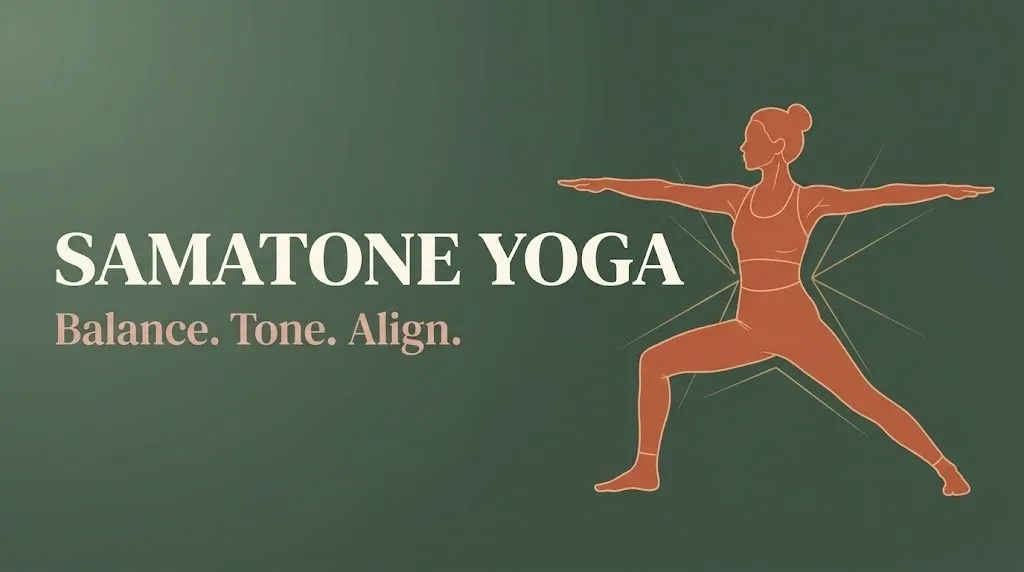
When you hold Utkatasana (Chair Pose) for five breath cycles, your quadriceps, glutes, and spinal erectors sustain isometric contractions. When you lower slowly from a standing pose, your muscles engage eccentrically, which the American College of Sports Medicine notes produces greater strength adaptation per unit of effort than concentric (lifting) movements alone.
The breath element is not decorative. Exhaling during peak effort increases intra-abdominal pressure, which supports the lumbar spine and allows deeper muscle engagement without compensatory bracing in the neck or shoulders.
| Muscle Engagement Type | How It Works in Samatone Yoga | Primary Benefit |
|---|---|---|
| Isometric contraction | Holding a pose still for 3 to 8 breath cycles | Endurance and stability |
| Eccentric loading | Slowly lowering out of a pose | Strength and injury resistance |
| Bilateral activation | Cueing both sides to engage equally | Symmetry and imbalance correction |
| Breath-linked engagement | Contracting on exhale, releasing on inhale | Spinal support and core activation |
Key Takeaway: Samatone yoga works by combining isometric holds, eccentric loading, and conscious bilateral muscle engagement to build functional tone and correct postural imbalance, not by moving faster but by engaging more precisely.
Samatone Yoga Poses for Beginners
The best beginner samatone yoga poses are standing and floor-based holds that teach symmetrical muscle engagement without requiring prior flexibility or strength.
Starting with standing poses is intentional. They require the practitioner to sense gravity, weight distribution, and muscular imbalance without the confusion of being inverted or deeply folded. Once you can feel evenness in a standing position, you carry that awareness into every other pose.
Pose: Tadasana (Mountain Pose)
Do not underestimate this pose. Tadasana is the postural baseline for the entire practice. Every samatone principle begins here.
To practice Tadasana:
- Stand with feet hip-width apart, second toes pointing forward.
- Press evenly through the four corners of each foot.
- Engage your quadriceps by lifting the kneecaps slightly.
- Draw the lower belly in gently without holding the breath.
- Roll your shoulders back and down, letting your arms hang with palms facing forward.
- Lengthen the back of the neck, chin parallel to the floor.
- Hold for 8 to 10 breath cycles, breathing slowly through the nose.
Modification for beginners: Stand with your back lightly touching a wall to feel spinal length without guessing.
Pose: Utkatasana (Chair Pose)
To practice Utkatasana:
- Begin in Tadasana. Feet together or hip-width apart.
- Inhale. On the exhale, bend the knees and lower the hips as if sitting toward a chair.
- Keep your knees tracking directly over the second and third toes.
- Raise arms forward or overhead, keeping the shoulders away from the ears.
- Hold for 4 to 6 breath cycles.
- Inhale to rise, straightening the legs on the breath.
Modification: Keep the depth shallow if you have knee sensitivity. A folded blanket under the heels helps if ankles are tight.
Pose Tip:
- In Chair Pose, do not let the knees travel past the toes if you feel knee joint pressure.
- Keep both sides of the waist equally long.
- If arms overhead causes shoulder strain, keep them parallel to the floor instead.
Samatone Yoga Breathing Techniques
Breath is the engine of samatone yoga, not an afterthought, and the specific way you breathe determines whether your muscles engage productively or brace compensatorily.
The primary breathing technique used in samatone yoga is ujjayi pranayama, often called Victorious Breath or Ocean Breath. It involves a slight constriction at the back of the throat, creating a soft sound on both the inhale and exhale. This sound serves as a biofeedback tool: if the breath goes silent during a challenging pose, the practitioner has likely held or compromised it.
According to research published in Complementary Therapies in Medicine, controlled breathing techniques in yoga, particularly those with a lengthened exhale, activate the parasympathetic nervous system. This reduces cortisol output, lowers baseline muscle tension, and improves the practitioner’s ability to hold demanding positions without gripping or bracing unnecessarily.
In samatone yoga, the breath pattern follows a simple structure:
- Inhale: lengthen, create space, prepare
- Exhale: engage, deepen, stabilize
To practice ujjayi pranayama before your session:
- Sit comfortably with the spine tall.
- Breathe in through the nose for a count of 4.
- Exhale through the nose for a count of 6, creating a gentle “haah” sound at the back of the throat.
- Continue for 10 cycles before beginning poses.
Modification for beginners: If ujjayi feels forced, simply lengthen the exhale to be two counts longer than the inhale. The sound will develop naturally with practice.
Samatone Yoga Sequences
A samatone yoga sequence is organized around a specific postural or muscular theme, such as the posterior chain, the hip-shoulder relationship, or the lateral body, rather than flowing through unrelated poses.
This thematic structure is what separates samatone yoga from a general Hatha or Vinyasa class. Each session has an anatomical intention. The practitioner builds through warm-up awareness, primary activation, bilateral balancing, and a cooling integration period.
Beginner Samatone Sequence: Posterior Chain Tone (30 Minutes)
| Stage | Pose | Hold Duration | Primary Target |
|---|---|---|---|
| Warm-Up | Tadasana (Mountain Pose) | 10 breaths | Postural baseline |
| Warm-Up | Balasana (Child’s Pose) | 8 breaths | Spinal decompression |
| Activation | Virabhadrasana I (Warrior I) | 5 breaths each side | Glutes, hip flexors, shoulders |
| Activation | Virabhadrasana II (Warrior II) | 5 breaths each side | Hip abductors, quadriceps |
| Primary | Utkatasana (Chair Pose) | 6 breaths x 3 sets | Quadriceps, glutes, core |
| Primary | Setu Bandha Sarvangasana (Bridge Pose) | 8 breaths x 3 sets | Glutes, spinal erectors, hamstrings |
| Balance | Vrksasana (Tree Pose) | 6 breaths each side | Single-leg stability, hip abductors |
| Cool-Down | Adho Mukha Svanasana (Downward-Facing Dog) | 8 breaths | Full posterior chain stretch |
| Integration | Savasana (Corpse Pose) | 5 minutes | Nervous system integration |
Rotate through two or three different themed sequences per week. Repeating the same sequence builds familiarity and allows you to measure progress in form and ease.
Key Takeaway: The most effective samatone yoga breathing technique is ujjayi pranayama, with an extended exhale. This activates the parasympathetic nervous system and allows deeper, safer muscle engagement during held poses.
Samatone Yoga for Flexibility
Samatone yoga builds flexibility differently than passive stretching does. It uses active flexibility, where the muscles surrounding a joint both stretch and engage simultaneously.
Passive flexibility, the kind you develop by pushing into a stretch, increases range of motion without necessarily making that range usable under load. Active flexibility, by contrast, trains muscles to control a joint through its full range. This is the type physical therapists prioritize for injury prevention and functional movement.
In samatone yoga, Utthita Trikonasana (Extended Triangle Pose) is a clear example of active flexibility in practice. The hamstrings lengthen on the front leg while the inner thigh and hip rotator muscles actively stabilize the pelvis. Neither side is passive.
A 2022 review in the Journal of Alternative and Complementary Medicine found that yoga-based active flexibility training produced greater functional improvement in daily movement tasks than static stretching alone, with effects sustained longer after the training period ended.
Key areas samatone yoga targets for active flexibility include:
- Hamstrings and hip flexors: opposing muscle groups that directly affect pelvic tilt and lower back comfort
- Thoracic spine rotators: the mid-back muscles that govern shoulder mobility and breathing depth
- Hip external rotators: including the piriformis, which affects sciatic nerve health
- Shoulder girdle: the rotator cuff and serratus anterior, which control arm and neck tension
Modification: If hip tightness limits standing pose depth, place a yoga block under the hand in Triangle Pose. This allows full spine length without compromising joint alignment.
Samatone Yoga for Posture and Alignment
Samatone yoga directly corrects the three most common postural patterns that develop from sedentary modern life: forward head posture, rounded shoulders, and anterior pelvic tilt.
These three patterns are connected. When the hip flexors shorten from prolonged sitting, the pelvis tips forward, pulling the lumbar spine into exaggerated extension. To compensate, the thoracic spine rounds. To see forward, the head juts out in front of the shoulders. The whole chain shifts from its natural stack.
Samatone yoga addresses this systematically. Every session cues the practitioner to:
- Lengthen the back of the neck
- Draw the lower ribs toward the pelvis
- Activate the lower trapezius to draw the shoulder blades down and back
- Engage the transverse abdominis without holding the breath
- Ground through all four corners of the feet to balance hip loading
Harvard T.H. Chan School of Public Health research on musculoskeletal health notes that posture-based interventions that include both strengthening and awareness training produce more lasting results than either approach alone. Samatone yoga delivers both within every session.
Pose Tip:
- In every standing pose, check that both sides of the waist are equally long before adding arm work.
- Imagine a thread pulling the crown of the head toward the ceiling.
- Beginners: place fingertips on a wall during balancing poses to build postural habit before removing support.
Samatone Yoga for Back Pain
Samatone yoga can reduce the frequency and intensity of chronic low back pain by strengthening the deep spinal stabilizers and reducing compression on lumbar discs, but it should be approached carefully and individually.
The most effective samatone poses for back pain are those that build spinal erector and multifidus strength (the deep muscles that run alongside the spine) without placing the lumbar spine in extremes of flexion or extension. Research published in Spine Journal found that yoga-based programs targeting deep spinal stabilizers reduced chronic low back pain scores by an average of 30% over twelve weeks compared to education-only control groups.
The most appropriate samatone poses for back pain management include:
- Setu Bandha Sarvangasana (Bridge Pose): Builds glute and spinal erector strength without spinal loading
- Balasana (Child’s Pose): Gently decompresses the lumbar spine with gravity assistance
- Phalakasana (Plank Pose): Develops core stabilization that reduces lumbar shear force
- Virabhadrasana I (Warrior I): Builds hip and glute strength that takes load off the lower back
People with herniated discs or spinal stenosis should work with a physical therapist before starting any yoga practice. Deep forward folds and full backbends are typically avoided until a baseline level of spinal stability is established.
Modification: For acute low back pain, perform Bridge Pose with feet elevated on a chair seat and hips resting on a folded blanket. This reduces the range of motion and keeps spinal loading minimal.
Key Takeaway: Samatone yoga corrects forward head posture, rounded shoulders, and anterior pelvic tilt by building the specific muscles that support the natural spinal stack. This is where its postural and back pain benefits come from.
Samatone Yoga for Seniors
Samatone yoga is well-suited for adults over 60 because it prioritizes slow, deliberate engagement over speed, supports joint health without high impact, and can be practiced seated or with a chair for additional stability.
Muscle tone naturally decreases with age through a process called sarcopenia, the progressive loss of skeletal muscle mass and strength. The American College of Sports Medicine notes that adults lose approximately 3% to 8% of muscle mass per decade after age 30, with the rate accelerating after 60. Yoga-based practices that include isometric holds and deliberate muscle engagement can meaningfully slow this decline.
Balance is the other critical area. According to the National Center for Complementary and Integrative Health (NCCIH), yoga-based balance training in older adults has shown statistically reliable improvements in single-leg standing time and reduced self-reported fear of falling in multiple clinical trials.
| Pose | Senior-Friendly Modification | Primary Benefit |
|---|---|---|
| Vrksasana (Tree Pose) | Hold a chair back with one hand | Single-leg balance training |
| Utkatasana (Chair Pose) | Sit and rise from a chair slowly | Quadriceps and glute strength |
| Virabhadrasana II (Warrior II) | Use a wall for rear hand support | Hip stability and endurance |
| Setu Bandha Sarvangasana (Bridge Pose) | Reduce height, use blanket under hips | Glute and spinal erector activation |
| Tadasana (Mountain Pose) | Stand with heels near a wall | Postural awareness baseline |
Seniors with osteoporosis should avoid deep spinal flexion poses like seated forward folds. A certified yoga instructor with experience in senior populations or therapeutic yoga can help design a safe individual sequence.
Samatone Yoga Modifications
Samatone yoga modifications allow practitioners at any level of fitness, flexibility, or physical limitation to practice safely and effectively without compromising the core principles of the method.
Modifications are not shortcuts. They are precision tools. A well-chosen modification often delivers a more accurate muscular result than a full expression of a pose done with poor alignment. A shallow Chair Pose with a tall spine will do more for your quadriceps and posture than a deep Chair Pose where the lower back rounds and the heels lift.
Common modification categories and options:
- Range of motion modifications: Reduce the depth of a pose to work within a pain-free range. Knees slightly bent in Triangle Pose allows hamstring length without pelvic strain.
- Support modifications: Use a wall, chair back, or a yoga block for contact. These options add proprioceptive input and reduce balance demand.
- Load modifications: Perform Bridge Pose with feet on the floor and hips low before progressing to a higher lift.
- Duration modifications: Hold poses for 2 to 3 breath cycles instead of 6 to 8 while building capacity.
- Bilateral awareness modification: If one side feels significantly weaker, hold that side for one or two additional breath cycles to build toward symmetry without forcing it.
Pose Tip:
- Never push into pain. Discomfort from muscle effort is normal. Discomfort in a joint is not.
- Use modifications consistently until form is stable, then gradually reduce support.
- Progress one variable at a time: first depth, then duration, then reduced support.
Samatone Yoga Equipment and Props
The equipment needed for samatone yoga is minimal, but specific props make a measurable difference in alignment quality and practice safety, especially for beginners and those with limited mobility.
A high-quality yoga mat is the first requirement. Look for 4 to 6mm thickness for cushioning in kneeling poses, with a textured surface to prevent slipping in standing holds. Thin travel mats (1 to 2mm) are not appropriate for sustained holds, as they offer insufficient joint protection.
| Prop | Primary Use in Samatone Yoga | Who Benefits Most |
|---|---|---|
| Yoga blocks (2 recommended) | Brings the floor closer in Triangle, Bridge, and seated poses | Beginners, limited hip flexibility |
| Yoga strap | Maintains limb position when flexibility limits reach | Tight hamstrings, shoulder restriction |
| Bolster | Supports the body in restorative holds and seated poses | Seniors, back pain, postpartum |
| Folded blanket | Cushions under knees, hips, or heels | Knee sensitivity, ankle tightness |
| Folding chair | Enables standing poses without full weight-bearing | Seniors, balance challenges, rehabilitation |
| Non-slip yoga mat | Provides stable base for all held poses | All practitioners |
You do not need all of these items at once. Start with a mat and two blocks. Add a strap if hamstring tightness limits your reach in forward-facing poses. A chair becomes relevant as the practice expands to include senior-specific or therapeutic sequences.
Key Takeaway: Modifications and props in samatone yoga are not signs of limitation. They are tools for accuracy. The practitioner using a block in Triangle Pose is often achieving better muscle engagement than the one reaching the floor with a collapsed spine.
Samatone Yoga vs. Other Yoga Styles
Samatone yoga occupies a specific niche between alignment-focused Iyengar yoga and strength-oriented Hatha yoga, distinguished by its emphasis on bilateral symmetry and toning rather than flexibility alone or spiritual development.
Understanding where samatone yoga sits among the broader yoga spectrum helps practitioners choose it intentionally rather than by accident.
| Style | Primary Focus | Pace | Holds | Best For |
|---|---|---|---|---|
| Samatone Yoga | Bilateral muscle tone and symmetry | Slow to moderate | Long (6 to 10 breaths) | Postural correction, toning, balance |
| Hatha Yoga | General pose introduction and breath | Slow | Moderate (3 to 5 breaths) | Beginners, foundational skill-building |
| Iyengar Yoga | Precise structural alignment with props | Very slow | Very long (up to 5 minutes) | Injury recovery, alignment refinement |
| Vinyasa Yoga | Breath-linked flowing movement | Moderate to fast | Short (1 to 2 breaths) | Cardiovascular fitness, variety |
| Yin Yoga | Passive connective tissue release | Very slow | Very long (3 to 5 minutes) | Deep flexibility, stress release |
| Restorative Yoga | Full support and nervous system rest | Still | Very long (5 to 20 minutes) | Recovery, chronic stress, illness |
Samatone yoga borrows elements from Iyengar (prop use, alignment precision), Hatha (breath-pose synchronization), and Restorative (conscious relaxation of overactive muscles). It applies these within a toning and symmetry framework that none of the other styles addresses as a primary goal.
How Often Should You Do Samatone Yoga?
Most yoga teachers and physical therapists recommend practicing samatone yoga three to four times per week for eight to twelve weeks to see consistent improvements in muscle tone, posture, and balance.
This frequency recommendation aligns with the ACSM’s guidelines for muscle-endurance training, which specify that two to four sessions per week with at least 48 hours of rest between sessions targeting the same muscle groups provides optimal stimulus for adaptation without overtraining.
Daily practice is possible and can be beneficial if sessions alternate focus areas. For example:
- Monday, Wednesday, Friday: Posterior chain sequences (glutes, hamstrings, spinal erectors)
- Tuesday, Thursday: Lateral body and shoulder sequences
- Saturday: Full-body integration sequence
- Sunday: Restorative or breath-only session
Session length does not need to be long. A 25 to 35 minute session three times per week is more effective than a single two-hour session on the weekend. Consistency of stimulus matters more than occasional intensity.
Beginners should start with two sessions per week and build from there. If muscle soreness persists beyond 48 hours after a session, reduce frequency or session intensity until recovery improves.
Samatone Yoga Safety and Contraindications
Samatone yoga is safe for most healthy adults when practiced with correct alignment and appropriate modifications, but certain conditions require medical clearance or supervised guidance before beginning.
This is a YMYL-relevant distinction: yoga is not universally appropriate without consideration of individual health factors. The following conditions warrant extra caution:
- Osteoporosis: Avoid deep spinal flexion and high-impact transitions. Work with a teacher trained in yoga for bone health.
- Hypermobility disorders (including EDS): Avoid pushing into end-range positions. The goal in samatone yoga is tone and stability, not maximum range. This actually makes it more appropriate than deep-stretch practices, but requires cues focused on engaging rather than releasing.
- Recent joint surgery (hip, knee, shoulder): Clearance from an orthopedic surgeon or physical therapist is needed before starting any sustained-hold yoga practice.
- Acute disc herniation: Avoid spinal flexion poses until pain and neurological symptoms have resolved under medical supervision.
- Uncontrolled hypertension: Avoid inverted poses and prolonged isometric holds above the heart. Check with a cardiologist or your treating physician before starting an isometric-hold-based practice.
- Pregnancy: Many samatone poses can be adapted for pregnancy, but twists, prone poses, and supine flat-back positions require modification. A certified prenatal yoga teacher should guide any pregnancy-specific practice.
If you experience sharp joint pain, neurological symptoms (numbness, tingling, weakness), or dizziness during a session, stop immediately and seek appropriate medical evaluation.
Key Takeaway: Samatone yoga is safe for most people when practiced with modifications, but conditions like osteoporosis, hypermobility, recent surgery, and uncontrolled hypertension require either medical clearance or individualized professional guidance before starting.
Building a Samatone Yoga Home Practice
A sustainable samatone yoga home practice starts with consistency over complexity: two to three sessions per week, a defined space, and a rotating sequence structure that builds on itself week by week.
The biggest obstacle to home yoga practice is not motivation. It is structure. Without a teacher calling cues, the mind wanders, holds shorten, and the practice becomes a loose stretch session rather than a focused toning workout. Building structure into your home practice prevents this drift.
Four-Week Samatone Yoga Home Practice Plan:
| Week | Sessions/Week | Session Length | Focus |
|---|---|---|---|
| Week 1 | 2 | 20 minutes | Tadasana, Chair Pose, Bridge Pose. Learn breath and alignment basics. |
| Week 2 | 2 to 3 | 25 minutes | Add Warrior I, Warrior II, Tree Pose. Introduce bilateral work. |
| Week 3 | 3 | 30 minutes | Add Triangle Pose, Plank Pose, Downward Dog. Build endurance. |
| Week 4 | 3 to 4 | 35 minutes | Full posterior chain sequence. Extend holds. Introduce theme rotation. |
Set your mat in the same location every session. A consistent physical space builds a conditioned response: the moment you step onto that mat, your nervous system shifts toward focus.
Use a timer on your phone for pose holds rather than counting breaths. This removes the mental load of counting and allows you to attend fully to alignment and sensation.
End every session, even a short one, with at least five minutes of Savasana (Corpse Pose). This is when the nervous system integrates the session’s muscular work. Skipping it is like leaving bread in the oven and walking away before it finishes baking.
Frequently Asked Questions About Samatone Yoga
What is samatone yoga and how is it different from regular yoga?
Samatone yoga is a yoga-based practice focused on building balanced muscle tone and correcting postural asymmetry through isometric holds, bilateral engagement, and breath-linked movement.
It differs from general yoga by its deliberate emphasis on muscular symmetry between the left and right sides of the body, rather than flexibility or spirituality as the primary outcome.
Most yoga classes blend several goals; samatone yoga has a specific structural and toning focus that makes it closer to therapeutic or corrective yoga than fitness yoga.
Can beginners start samatone yoga without any prior experience?
Yes, beginners can start samatone yoga with no prior experience, as its slow pace and emphasis on foundational poses makes it one of the more accessible yoga approaches available.
The key beginner advantage is that holds are done in basic poses like Mountain Pose and Chair Pose before progressing to more complex positions.
Starting with two sessions per week and using props like blocks and a wall allows beginners to build form before increasing difficulty.
How long does it take to see results from samatone yoga?
Most practitioners notice improved postural awareness and reduced muscle tension within two to three weeks of consistent practice.
Visible improvements in muscle tone and balance typically develop over six to eight weeks, based on studies examining isometric yoga-style training published in the International Journal of Yoga.
Results are faster when sessions are consistent and when practitioners actively engage muscles during holds rather than passively waiting out the time.
What equipment do you need for samatone yoga at home?
The minimum equipment needed is a quality non-slip yoga mat (4 to 6mm thick) and two yoga blocks.
A yoga strap is helpful if hamstring or shoulder tightness limits your reach in key poses, and a folded blanket adds knee and joint cushioning.
A sturdy chair is optional but adds significant value for seniors or those managing balance challenges.
Is samatone yoga safe for people with back pain?
Samatone yoga can be safe and beneficial for many people with chronic low back pain, particularly through poses like Bridge Pose, Child’s Pose, and Plank Pose that build deep spinal stabilizers.
However, people with acute disc injuries, spinal stenosis, or recent surgery should have an assessment from a physical therapist or their treating orthopedic specialist before starting any yoga practice.
Begin with the lowest range of motion available and build gradually, using props to reduce joint load in every session.
Start Where You Are
Samatone yoga works best as a regular practice, not a dramatic overhaul. Pick two or three of the beginner poses from this article and hold them with good alignment and deliberate breath three times this week. That is a complete starting point.
Notice which side of your body engages more easily. Notice where your breath shortens. Those observations are your practice, and they will guide everything that comes after.
Return to the sequences in this article as your form improves. Add a pose each week. Increase hold time gradually. Your body adapts at its own pace, and the goal is precision over time, not perfection on day one.