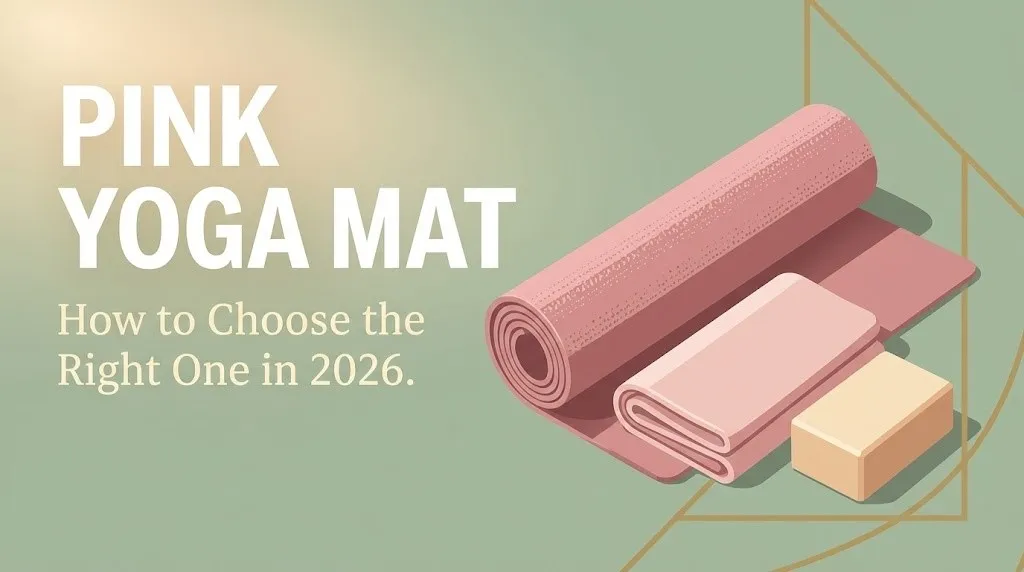
Pink Yoga Mat: How to Choose the Right One in 2026
A pink yoga mat is a fully functional yoga practice surface that performs exactly as any quality mat does in its material and thickness category: the color is a personal choice that affects motivation and aesthetics but does not inherently compromise or improve grip, cushioning, or durability. What matters is choosing the right thickness, material, and grip surface for your specific practice style and the floors you practice on.
Mat choice affects more than most people realize. According to the American College of Sports Medicine, practicing on surfaces with inadequate cushioning increases compressive load on weight-bearing joints during floor-based exercise. A thin pink mat on a hotel room hardwood floor creates the same joint-load concerns as any other thin mat on the same surface. The color is irrelevant. The specifications are not.
This guide covers what makes a pink yoga mat genuinely good for practice, the real research on color psychology in yoga and fitness environments, how to match thickness and material to your yoga style and body, and how to keep a pink mat looking and performing its best over time.
Pink Yoga Mat
A pink yoga mat is a yoga practice mat produced in any shade of pink, from pale blush to vivid magenta, using the same materials and constructions as yoga mats in any other color. Natural rubber, TPE, PVC, and microfiber constructions are all available in pink colorways.
The functional performance of a pink yoga mat is determined entirely by its material, thickness, and surface texture, not by its color. A 4mm natural rubber pink mat performs identically to a 4mm natural rubber mat in any other color from the same manufacturer. The pink colorway is achieved through dye added to the material or applied to the surface layer during manufacturing.
Pink has become one of the most popular yoga mat color options globally, reflecting a broader consumer preference for color in personal fitness equipment. The yoga mat market has responded with an expanding range of pink shades, from dusty rose and blush to coral and hot pink, available across all price points and material categories.
Key facts about pink yoga mats in 2026:
- Available in all major mat materials: natural rubber, TPE, PVC, microfiber, cork
- Available in all standard thicknesses: 1.5mm travel through 6mm premium cushion
- Available in standard (61 x 172cm) and extended (61 x 183cm and 61 x 200cm) sizes
- Pink dyes in quality mats are colorfast and do not transfer to clothing or floors under normal practice conditions
- Price range mirrors the full yoga mat market: budget options at under 20 dollars through premium options above 100 dollars
Modification for practitioners new to yoga mat selection: Begin with a 4mm mat in any material for your first mat. This thickness works on most home floors without being excessively heavy for travel or storage.
Does Yoga Mat Color Matter for Practice
Yoga mat color does not directly affect grip, cushioning, durability, or any other functional performance specification, but it does influence motivation, mood, and the practitioner’s emotional relationship with their practice space in ways that are documented by color psychology research.
The functional argument that color matters for practice is weak. The same grip compound, the same foam density, the same rubber base layer performs identically regardless of the color applied to its surface. Any claim that a specific color makes a mat perform better functionally is marketing language, not materials science.
The psychological argument is more nuanced and more interesting. The color of your practice environment, including your mat, affects how you feel before and during practice. Research in the Journal of Environmental Psychology has examined how environmental color affects perceived effort, arousal, and mood in physical activity settings. These effects are modest but real. They are also highly individual.
What color actually influences in a yoga context:
- Motivation to begin practice: A mat in a color you find visually appealing is more likely to be unrolled consistently. This is not trivial. Consistency is the single variable that most determines yoga’s documented health benefits.
- Mood during Savasana (Corpse Pose): A calming color in your direct visual field during rest may marginally support relaxation response. Cooler, softer shades (pale pink, lavender, soft blue) are more consistently associated with calm than bright, saturated versions.
- Practice space aesthetics: A mat that looks good in your practice space reduces the friction between intention and beginning practice.
Quick Summary:
- Color does not affect mat performance specifications
- Color does affect motivation, mood, and practice consistency
- Choose a shade you genuinely like, then choose specifications that suit your practice
Psychology of Pink in Yoga and Wellness
The psychology of pink in yoga and wellness environments is grounded in documented research on color and emotional response, though the effects are more subtle and context-dependent than popular wellness culture often suggests.
The most famous research on pink and physical behavior comes from studies on Baker-Miller pink, a specific shade of pink (also called Drunk Tank Pink) that was found in the 1970s to reduce aggressive behavior in detention facilities when used as an environmental color. Later research confirmed short-term calming and muscle-relaxation effects under Baker-Miller pink exposure, though these effects diminish with prolonged exposure as the nervous system adapts.
Research published in the Journal of Environmental Psychology found that colors in the red-pink spectrum can influence perceived physical exertion and arousal levels in exercise settings. Warmer, brighter pinks tend to produce mild increases in perceived energy and alertness. Softer, cooler pinks tend to produce a mild calming effect, making them more appropriate for Restorative yoga and Yin yoga practice environments.
According to the National Center for Complementary and Integrative Health, environmental factors including visual stimuli affect the quality of mindfulness and relaxation responses during yoga and meditation practice. A practice environment that feels personally meaningful and aesthetically aligned with intention supports deeper relaxation and focus.
Practical implications for pink yoga mat choice:
- Pale blush or soft rose: Best suited to Restorative, Yin, and meditation-focused practice. Subtle visual cue for calm.
- Medium pink or dusty rose: Versatile. Works across practice styles. Visually grounding without being stimulating.
- Hot pink or magenta: Better suited to energetic Vinyasa, power yoga, or high-intensity practice where the stimulating quality of the color aligns with the practice’s energy.
Key Takeaway: Pink yoga mats’ performance is entirely determined by material and specifications, not color. But the shade of pink you choose can subtly support the mood of your specific practice style, and that alignment with intention is worth considering.
Best Pink Yoga Mat for Beginners
The best pink yoga mat for beginners prioritizes grip, cushioning, and stability over minimum weight or maximum portability, because new practitioners need a surface that forgives alignment exploration and protects joints during the adjustment period of learning new movement patterns.
Beginners move differently on a yoga mat than experienced practitioners. They shift weight, adjust foot placement, and redistribute load repeatedly as they learn poses. A mat that slides during these exploratory movements creates immediate frustration and reduces practice confidence. A mat that lacks cushioning produces joint discomfort that beginners may incorrectly attribute to the pose rather than the mat.
For beginner home practice on hardwood or tile floors, a 4 to 5mm thickness with a textured non-slip surface provides the most forgiving practice environment. On carpeted floors, 3mm is adequate since the carpet adds effective cushioning beneath the mat.
Yoga Alliance recommends that beginners focus on consistent practice and comfort above all other variables in their early months. A mat that you return to repeatedly because it feels good to practice on is more valuable than a technically superior mat that feels uninviting.
Beginner pink yoga mat checklist:
- Thickness: 4 to 5mm minimum for hard floors; 3mm acceptable on carpet
- Grip: Textured or polyurethane surface that holds under dry and mildly damp conditions
- Size: Standard 61 x 172cm or extended 61 x 183cm for taller practitioners
- Base layer: Rubber or textured TPE bottom that does not slide on smooth floors
- Weight: 1 to 1.5 kg (heavier mats in this range provide better floor grip and stability)
- Price: Mid-range 30 to 60 dollars provides quality without excessive expenditure for a practice you are just beginning
Modification for senior beginners: Seniors new to yoga should choose a 5 to 6mm mat regardless of floor type, because thicker cushioning at the knees in Balasana (Child’s Pose) and at the hips in seated poses significantly reduces discomfort during the early weeks of practice.
Light Pink Yoga Mat vs Hot Pink Yoga Mat
Light pink yoga mats and hot pink yoga mats differ in color saturation and the psychological associations they carry, but they are otherwise functionally equivalent if made from the same materials at the same thickness. The choice between them comes down to personal aesthetic preference and, to a lesser extent, how each shade suits your practice context.
Light pink and blush mats use pastel or muted colorways that tend to photograph well, blend into calm home interiors, and visually reinforce the quiet, focused mood that Yin yoga, Restorative yoga, and meditation practice support. They are the most popular pink option in the mat market and available across all material and price categories.
Hot pink and magenta mats use saturated, vivid colorways that stand out visually and align more naturally with energetic practice styles. Vinyasa yoga, power yoga, and high-intensity flows feel more naturally paired with an assertive color than a pastel. There is nothing functionally superior about either shade for any style of practice.
One practical consideration: light pink mats show dirt, sweat staining, and wear more visibly than hot pink mats. Light pink mats require more frequent cleaning to maintain their appearance. Hot pink mats, being more saturated, conceal surface wear and light staining better between cleaning sessions.
| Feature | Light Pink / Blush | Hot Pink / Magenta |
|---|---|---|
| Color psychology | Calming, soft | Energizing, assertive |
| Best practice style | Yin, Restorative, meditation | Vinyasa, power, hot yoga |
| Stain visibility | Higher | Lower |
| Interior compatibility | Broad | More specific |
| Availability | Very wide | Wide |
| Photogenic for social | Very high | High |
Pink Yoga Mat Thickness Guide
Pink yoga mat thickness is the most functionally important specification for any practice, determining joint protection, tactile feedback, mat weight, and portability across all practice environments.
Standard thickness options for pink yoga mats in 2026:
| Thickness | Weight Range | Best Floor Type | Best Practice Style | Joint Protection |
|---|---|---|---|---|
| 1.5 to 2mm | 500 to 900g | Carpet, studio floor | Travel, Yin on soft surfaces | Low |
| 3mm | 900 to 1,100g | Carpet, wood | Hatha, Yin, Restorative | Moderate |
| 4mm | 1,100 to 1,400g | Wood, tile, concrete | All yoga styles | Moderate to high |
| 5mm | 1,300 to 1,600g | All surfaces | Beginners, joint-sensitive | High |
| 6mm | 1,500 to 2,000g | All surfaces | Joint-sensitive, Restorative | Highest |
The 4mm thickness is the most versatile option for a first pink yoga mat. It provides adequate cushioning for hard floors in most poses, remains light enough to carry and store easily, and is available in the widest range of pink colorways and materials.
Think of mat thickness like the difference between walking barefoot on a wooden floor versus walking on a rubber gym mat. Both are safe for normal walking. The difference becomes meaningful when you add repeated impact or sustained pressure through a small surface area, like kneeling repeatedly on a hardwood floor during Anjaneyasana (Low Lunge Pose).
According to the American College of Sports Medicine, impact-absorbing surfaces reduce peak force on joints during sustained floor contact exercises. This principle applies directly to yoga mat selection for practitioners who practice on hard floors in kneeling or prone positions.
Modification: If you own or prefer a thinner pink mat, fold the far end of the mat under your knees during all kneeling poses. This creates doubled cushioning at the knee contact point without requiring a separate mat or prop.
Key Takeaway: For a pink yoga mat on hard home floors, 4mm is the most practical starting point. Go thicker (5 to 6mm) if you have knee or wrist sensitivity. Go thinner (3mm) only if you practice primarily on carpet or need the mat to double as a travel mat.
Pink Yoga Mat Non-Slip Grip
A pink yoga mat’s non-slip grip is determined by its surface texture and material composition, not its color, and choosing a mat with adequate grip for your specific practice style is one of the two most important functional decisions you will make (alongside thickness).
Grip in a yoga mat operates through two distinct mechanisms: the grip between your hands and feet and the mat surface (top grip), and the grip between the mat’s base and your floor (bottom grip). A non-slip pink mat needs both to perform safely.
Top grip failure is the most common problem practitioners encounter mid-practice. As sweat builds on the hands during a Vinyasa yoga flow or any heated practice, a standard foam or PVC surface becomes noticeably slippery. Polyurethane and microfiber top surfaces solve this specifically because moisture activates their grip rather than reducing it.
Bottom grip depends on the base layer material and the floor surface. Natural rubber bases provide excellent grip on smooth wood and tile. TPE bases with textured surfaces also perform well on most floors. Smooth foam bases (common on very budget-priced mats) slide on polished surfaces under dynamic movement, which is a genuine safety issue during transitional poses like Utthita Trikonasana (Extended Triangle Pose).
Non-slip surface performance by material:
- Natural rubber base: Excellent floor grip; best for smooth wood and tile
- TPE textured base: Good floor grip; moisture-resistant and lighter than rubber
- PVC textured base: Moderate floor grip; less reliable on polished surfaces
- Smooth foam base: Poor floor grip; slides on tile and polished wood
Safety note: Always test grip on your specific floor surface before beginning practice. Place the mat, press firmly in several areas, then attempt Tadasana (Mountain Pose) and a forward fold before moving to dynamic poses.
Pink Yoga Mat for Hot Yoga
A pink yoga mat for hot yoga requires a surface that improves grip when wet with sweat, because hot yoga studios operate at 95 to 105 degrees Fahrenheit and sweat output during a 90-minute session can saturate standard foam and PVC surfaces within 20 to 30 minutes.
Most standard foam and PVC pink mats, regardless of their dry-grip performance, become unreliable in high-sweat conditions. The moisture forms a lubricating layer between the skin and the mat surface. For hot yoga practice, the mat material must either repel that moisture layer (closed-cell surfaces that don’t absorb sweat) or turn it into a grip advantage (polyurethane and microfiber surfaces that grip harder when wet).
The most practical solution for hot yoga with a pink mat is a microfiber or polyurethane-topped pink mat or a standard pink mat plus a pink yoga mat towel placed over the surface. Pink microfiber mat towels are widely available and turn any mat into a hot-yoga-suitable surface by providing moisture-activated grip over whatever mat is underneath.
A study published in the International Journal of Yoga found that stable physical support throughout heated yoga sessions is associated with better pose maintenance and reduced compensatory muscle tension. A mat or towel surface that loses grip mid-class requires the practitioner to engage additional stabilizing muscles throughout, which diverts from the intended practice focus.
For hot yoga, a pink mat should have:
- Polyurethane or microfiber top layer (or a mat towel over any top layer)
- Closed-cell or rubber base that resists moisture absorption
- Minimum 3mm thickness on hard studio floors
- Easy-clean surface that handles frequent washing
Modification for occasional hot yoga on a standard pink mat: Mist the mat surface lightly with water using a spray bottle before class. This activates the grip-when-wet properties of many mat surfaces and mimics the performance of moisture-specific materials.
Pink Yoga Mat for Yin and Restorative Yoga
A pink yoga mat for Yin yoga and Restorative yoga should prioritize cushioning, surface stability during long holds, and a color shade that supports a calm, inward-focused practice state, making soft pink and blush tones particularly well-suited to these styles.
Yin yoga involves holding poses for two to five minutes in a passive state, targeting connective tissue rather than muscle. Restorative yoga uses fully supported positions held for five to ten minutes or longer. Both styles require the mat to provide consistent support under sustained, relatively still body weight rather than dynamic multi-directional movement.
The grip and dynamic traction demands of Yin and Restorative practice are lower than in Vinyasa or hot yoga. The cushioning demands are higher, because poses like Baddha Konasana (Bound Angle Pose), Supta Baddha Konasana (Reclined Bound Angle Pose), and Savasana (Corpse Pose) involve prolonged contact of bony prominences with the mat surface.
A 5 to 6mm pink mat in any material provides the most comfortable long-hold experience in Yin and Restorative practice. The extra thickness distributes the pressure of the sacrum, iliac crest, and thoracic spine during reclined poses more evenly than thinner mats, reducing the sensation of the hard floor that interrupts relaxation.
According to research published in Complementary Therapies in Medicine, Restorative yoga practiced consistently reduces perceived stress and improves sleep quality. The physical environment of practice, including surface comfort, influences how deeply practitioners can access the relaxation response during these slower styles.
Soft pink and blush mats align visually with the inward, restful quality of Yin and Restorative practice. The color choice in this context is not frivolous. It is an intentional environmental cue that supports the practice’s intention.
Modification for Yin practice on a thin pink mat: Supplement with a folded blanket under the hips in seated poses and under the sacrum in reclined poses. This adds targeted cushioning at the highest-pressure contact points without requiring a thicker mat.
Key Takeaway: For Yin and Restorative yoga, a soft pink 5 to 6mm mat provides the most comfortable long-hold practice surface, and the blush or pale pink color choice genuinely aligns with the calm, inward mood these styles cultivate.
Pink Yoga Mat Materials Compared
Pink yoga mat materials determine grip performance, weight, durability, environmental impact, and the specific pink shades achievable through the dyeing process. The four primary materials available in 2026 are natural rubber, TPE, PVC, and microfiber or polyurethane-coated fabric constructions.
| Material | Pink Shade Options | Weight | Dry Grip | Wet Grip | Eco-Friendly | Best Practice Style |
|---|---|---|---|---|---|---|
| Natural rubber | Blush, rose, dusty pink | Heavy | Excellent | Good | Yes | All styles; not for latex allergy |
| TPE | Wide range including hot pink | Light to moderate | Good | Moderate | Partially | General practice, travel |
| PVC | Full range, vibrant saturation | Light | Moderate | Poor | No | Budget practice, low-sweat styles |
| Polyurethane over fabric | Blush, rose, coral | Very light | Good | Excellent | Partially | Hot yoga, Vinyasa |
| Cork over rubber | Limited (natural with pink accent) | Moderate | Good | Excellent | Yes | Eco-conscious, hot conditions |
Natural rubber produces the deepest, richest pink tones and the best overall grip performance in dry conditions. The trade-off is weight (typically 1.3 to 1.8 kg for a standard mat), susceptibility to UV degradation, and incompatibility with practitioners who have latex allergies.
TPE is the most practical choice for practitioners who want a pink mat that is lighter than rubber, more eco-conscious than PVC, and available in a wide range of pink shades including vivid hot pink options. TPE handles temperature variation better than rubber, making it more suitable for outdoor practice.
PVC offers the most vibrant and color-stable pink options at the lowest price point. Its grip and sustainability profile are its primary limitations. For practitioners who practice in low-sweat environments and prioritize color vibrancy at an accessible price, PVC delivers.
Eco-Friendly Pink Yoga Mat
An eco-friendly pink yoga mat uses materials and manufacturing processes that minimize environmental impact without compromising the pink colorway, with natural rubber, TPE, and cork as the primary sustainable options in the 2026 market.
Natural rubber is the most established eco-friendly yoga mat material. It is derived from the Hevea brasiliensis tree, a renewable resource, and biodegrades at end of life faster than synthetic alternatives. Pink natural rubber mats use natural dyes or low-impact synthetic dyes to achieve their color. The limitation is weight and the latex allergy concern noted above.
TPE (thermoplastic elastomer) is a partially synthetic material that is PVC-free, free from toxic plasticizers, and recyclable in some municipal programs. It is lighter than rubber and achieves the broadest range of pink shades, including vivid and pastel options. Most TPE mats are manufactured without heavy metals or carcinogenic compounds, making them safer to handle and to dispose of responsibly.
PVC mats are not eco-friendly. PVC (polyvinyl chloride) production involves chlorine-based chemistry and requires petroleum inputs. PVC mats do not biodegrade and release toxic compounds when incinerated. If environmental impact matters to your purchase decision, PVC is the option to avoid regardless of price.
Cork-surfaced pink yoga mats combine a cork top layer with a natural rubber base. The cork provides natural antimicrobial properties and excellent wet grip. The pink colorway in cork mats is typically limited to the rubber base layer visible at the mat edges, with the cork surface remaining its natural tan color.
Eco-friendly pink mat care note: Low-impact dyes used in natural rubber and some TPE pink mats are more susceptible to fading from harsh cleaning agents than conventional synthetic dyes. Mild soap and water or a diluted natural mat spray preserves both the pink color and the eco-friendly dye chemistry.
Pink Yoga Mat for Bad Knees and Wrist Pain
A pink yoga mat for bad knees and wrist pain requires a minimum of 4 to 5mm thickness on hard surfaces, a dense foam or rubber construction that distributes rather than concentrates pressure, and a non-slip grip surface that reduces compensatory muscle tension in the wrists and knees during weight-bearing poses.
The knee joint and the wrist joint are the two structures most affected by mat thickness and grip in yoga practice. In kneeling poses like Anjaneyasana (Low Lunge Pose) and Marjaryasana-Bitilasana (Cat-Cow), the patella and the tibial tuberosity bear weight through the mat against the floor. The quality of cushioning at that contact point is the primary variable affecting knee comfort.
In weight-bearing arm poses like Adho Mukha Svanasana (Downward-Facing Dog) and Phalakasana (Plank Pose), the carpal bones of the wrist bear load through the heel of the hand. A slippery mat surface in these poses increases the force required from the wrist flexor tendons to prevent sliding, which amplifies the load through the carpal tunnel. Non-slip grip reduces this compensatory loading directly.
Yoga teachers and physical therapists generally recommend practitioners with knee or wrist conditions use yoga blocks to reduce joint loading in weight-bearing poses, regardless of mat thickness:
- In Adho Mukha Svanasana (Downward-Facing Dog): place blocks flat under the hands to shorten the lever arm of wrist extension
- In kneeling poses: fold the mat end under the knees for doubled cushioning at the patella
- In Phalakasana (Plank Pose): practice with forearms on the mat instead of hands if wrist extension is painful
Safety note: Persistent sharp pain in the knee or wrist during yoga poses is not a mat problem to solve with a thicker mat. Sharp pain during practice is a signal to reduce load and range of motion, and to discuss the specific movement with a physical therapist who understands yoga mechanics.
Pink Yoga Mat for Kids and Family Yoga
A pink yoga mat for kids and family yoga should prioritize smaller dimensions (to suit children’s bodies), bright or appealing colors (pink works well for many children), non-toxic materials (since children are closer to the mat surface and more likely to touch it to their faces), and easy cleaning after enthusiastic use.
Kids’ yoga mats typically measure 60 x 120cm to 60 x 150cm, compared to the standard adult 61 x 172cm. A full-size pink mat works for most children over eight years old, but younger children practice more comfortably and safely on a mat proportionally sized to their body. A mat that is too large creates a tendency to wander off the designated practice space during flowing sequences.
According to research published in the International Journal of Yoga, children who practice yoga regularly show improvements in attention, self-regulation, and stress management. Family yoga practice, where children and parents practice together, adds the benefit of shared physical activity and intentional connection time.
For family yoga, a non-toxic pink mat is a non-negotiable. Natural rubber and TPE mats consistently outperform PVC in safety testing for volatile organic compound (VOC) emissions. Children who kneel, crawl, and press their faces close to the mat surface during poses like Balasana (Child’s Pose) and Adho Mukha Svanasana (Downward-Facing Dog) are exposed to any off-gassing from the mat material more directly than adults in standard practice.
Kid-friendly pink yoga poses to try on their mat:
- Vrikshasana (Tree Pose): Balance and focus; kids love the imagery
- Balasana (Child’s Pose): Accessible rest position; teaches self-regulation
- Marjaryasana-Bitilasana (Cat-Cow): Spine mobility; fun spinal movement for children
- Virabhadrasana I (Warrior I): Strength and confidence; the hero imagery appeals to children
Modification for very young children (under 5 years): Formal yoga poses are not developmentally appropriate for toddlers. Use a soft pink mat as a designated movement space for imaginative play that incorporates yoga-inspired body shapes rather than structured asana instruction.
Key Takeaway: For kids and family yoga, non-toxic natural rubber or TPE pink mats are the right choice, not PVC, since children practice in closer physical proximity to the mat surface than adults and are more affected by any material off-gassing.
How to Clean and Care for a Pink Yoga Mat
Cleaning a pink yoga mat correctly preserves its color, maintains its grip performance, prevents bacterial and fungal growth, and extends the mat’s lifespan through years of regular practice.
Pink yoga mats require one additional consideration beyond standard mat care: the pink dye. Harsh cleaning agents, bleach, and very hot water can fade or alter pink dyes in rubber and TPE mats, particularly mats using natural or low-impact dyes. Using a pH-neutral cleaning solution is both better for the mat material and better for preserving the pink color.
Cleaning guide by pink mat material:
| Material | Cleaning Method | Frequency | Avoid |
|---|---|---|---|
| Natural rubber pink | Damp cloth, mild natural soap; air dry flat | After every sweaty session | Bleach; direct sunlight drying; submerging |
| TPE pink | Damp cloth or diluted mild soap; air dry | After every session | Harsh detergents; hot water |
| PVC pink | Mat spray or diluted soap; wipe dry | Weekly or as needed | Bleach; high heat |
| Microfiber pink | Spot clean; machine wash monthly on cold | After every sweaty session | Machine dryer; fabric softener |
| Cork pink base | Damp cloth only; air dry | After every session | Soap on cork surface; submerging |
For a travel-practical cleaning routine, a small spray bottle containing diluted castile soap and water (1 part soap to 20 parts water) with a drop of tea tree oil cleans and deodorizes any pink mat in under a minute. Tea tree oil provides mild antimicrobial action. It does not fade standard mat dyes at this dilution.
After outdoor use on grass or dirt, shake the mat clean outside before bringing it indoors, then wipe with a damp cloth. Never pack a dirty mat. Grit embedded in mat fibers acts as an abrasive that damages the surface texture and grip with each subsequent use.
Color preservation note: Store pink yoga mats rolled or folded away from direct sunlight. UV exposure is the primary cause of pink dye fading in both natural rubber and TPE mats. A mat stored in a sunny corner of a room will fade visibly within months of regular sun exposure.
Frequently Asked Questions About Pink Yoga Mats
What thickness should I get for a pink yoga mat?
For most practitioners on hard home floors like hardwood or tile, a 4mm pink yoga mat provides the best balance of cushioning and portability.
Practitioners with knee pain, wrist sensitivity, or those practicing primarily on concrete or cold floors should choose 5 to 6mm for additional joint protection.
For carpet-based practice or travel use, 3mm is adequate since the floor surface provides supplemental cushioning.
Are pink yoga mats as good as other colors for grip and performance?
Yes, pink yoga mats perform identically to yoga mats in any other color when made from the same materials at the same thickness.
Grip, cushioning, durability, and all functional specifications are determined by material and construction, not by the dye color applied to the surface.
The choice between pink and any other color is entirely personal and has no measurable effect on practice safety or performance.
What is the best material for a pink yoga mat?
Natural rubber is the best material for overall grip performance in a pink yoga mat, offering excellent traction on dry floors and a range of blush and rose colorways.
TPE is the best choice for practitioners who want a lighter, eco-friendlier option with a wider range of pink shades, including vivid hot pink options unavailable in natural rubber.
PVC offers the most vibrant pink colors at the lowest cost but provides the weakest grip performance in wet conditions and has the highest environmental impact of the three.
Can I use a pink yoga mat for hot yoga?
Yes, a pink yoga mat can work for hot yoga if it has a polyurethane or microfiber top surface that grips better when wet, or if you use a pink yoga mat towel over a standard mat surface.
Standard foam and PVC pink mats become slippery in high-sweat conditions within 20 to 30 minutes of a heated session, so surface material matters more for hot yoga than for any other yoga style.
Misting the mat surface lightly with water before a heated practice activates the grip-when-wet properties of many mat surfaces as a practical alternative to purchasing a new mat.
How do I clean a pink yoga mat without fading the color?
Clean a pink yoga mat with a damp cloth and a mild, pH-neutral soap or a yoga mat spray rather than bleach or harsh detergents, which fade dyes in both rubber and TPE mats.
Air-dry the mat flat away from direct sunlight, since UV exposure is the primary cause of pink dye fading in rubber and TPE materials.
For deep cleaning of a microfiber pink mat, machine wash on a cold, gentle cycle without fabric softener, and always air-dry rather than using a dryer.
Your pink yoga mat’s color will keep you coming back to practice. Its specifications will keep your body safe and comfortable when you get there.
Start with thickness matched to your floor type: 4mm for hard surfaces, 3mm for carpet. Test grip by pressing firmly on the mat before your first session on any new floor.
Unroll it. Step on it. The rest follows from showing up