Yoga Poses for 2 People: Best Beginner Partner Poses 2026
The best yoga poses for 2 people are ones that feel good for both bodies, require no prior yoga experience, and build enough trust that both partners can relax into the stretch rather than white-knuckling through it. This guide gives you exactly those poses, with step-by-step instructions and the anatomy behind why they work.
A study published in the Journal of Alternative and Complementary Medicine found that partnered exercise increases motivation and adherence compared to solo practice. Partner yoga adds a layer of accountability and play that solo practice rarely matches.
You will find beginner poses with full instructions, tips for practicing when you and your partner have different flexibility levels, a warm-up sequence, and guidance on the communication that makes partner yoga safe and enjoyable. No props required for most poses, though a yoga mat each helps.
Yoga Poses for 2 People
Yoga poses for 2 people are modified or partner-specific yoga postures where two practitioners use each other’s body weight, grip, or proximity to deepen stretches, improve balance, or build shared strength.
The fundamental principle is mutual support. One person’s resistance or weight creates the stretch in the other. Think of it like a counterbalance: when you both lean back holding hands, you each create the tension that lets the other person open their chest and stretch their spine.
Most two-person yoga poses work on the floor or standing and require no equipment beyond enough floor space for two mats placed side by side. A clear six-by-ten-foot area is sufficient for most beginner poses.
| Pose Category | Space Needed | Difficulty | Good For |
|---|---|---|---|
| Seated floor poses | 6 x 6 feet | Beginner | Flexibility, connection |
| Standing balance poses | 6 x 6 feet | Beginner to intermediate | Balance, trust |
| Back-to-back poses | 4 x 6 feet | Beginner | Spinal support, strength |
| Forward-fold assists | 6 x 4 feet | Beginner | Hamstring opening |
| Acrobatic bases | 10 x 10 feet | Advanced | Strength, coordination |
Starting with floor-based, seated poses makes the most sense for beginners. The ground eliminates fall risk and lets both partners focus on breath and sensation rather than balance.
What Is Partner Yoga
Partner yoga is a shared yoga practice where two people support, counterbalance, or assist each other through postures, using physical contact and synchronized movement to achieve positions neither might reach alone.
Partner yoga differs from acro yoga, which involves one person lifting or supporting the other in the air. In most beginner partner yoga, both practitioners remain fully grounded. The partnership provides gentle resistance, assistance into deeper range, and psychological safety through shared effort.
The practice draws from Hatha yoga traditions but has no single founding system. Various yoga teachers developed partner sequences beginning in the 1970s, particularly within Iyengar yoga’s prop-based tradition, where a partner serves a similar function to a wall or strap.
What makes partner yoga distinct from solo practice:
- Physical assistance deepens stretches beyond what a solo practitioner can access
- Synchronized breathing creates shared rhythm and focus
- The social element introduces accountability and levity
- Touch and eye contact activate the nervous system differently than solitary movement
- Communication requirements build trust quickly between partners
According to the National Center for Complementary and Integrative Health, yoga’s benefits for stress reduction and flexibility are well-documented in individual practice. Partner formats add a social dimension that research in Social Cognitive and Affective Neuroscience suggests amplifies the calming effect through co-regulation of the nervous system.
Benefits of Partner Yoga
Partner yoga benefits include improved flexibility through assisted stretching, enhanced proprioception from stability challenges, reduced stress through synchronized breath, and stronger interpersonal connection between practitioners.
The flexibility benefit is mechanically straightforward. Your partner’s gentle resistance or weight allows you to access a deeper range of motion than you can achieve alone. This works the same way a yoga strap does, but with the added dimension of real-time feedback through another person’s touch.
Balance poses practiced with a partner improve proprioception more than solo versions. When you press your palm against your partner’s palm during Vrksasana (Tree Pose), the lateral input sharpens your nervous system’s position awareness through the ankle, hip, and shoulder simultaneously.
Documented benefits of partnered yoga practice:
- Assisted stretching increases hamstring and hip flexor range more than unassisted versions, per physical therapy research
- Shared breathwork activates the parasympathetic nervous system in both practitioners
- Physical touch during coordinated movement releases oxytocin, supporting emotional bonding
- Novelty of partner work increases mental engagement compared to solo routine practice
- Accountability to a partner improves session completion rates
A 2019 study published in the International Journal of Yoga found that group and partnered yoga practices produced greater reductions in perceived stress than equivalent solo practice over an eight-week period.
Key Takeaway: Partner yoga creates physical benefits that exceed what solo practice achieves because one partner’s body provides resistance and assistance that no prop can fully replicate.
Yoga Poses for 2 Beginners
The best yoga poses for 2 beginners are back-to-back seated poses, seated forward fold assists, and double tree pose, because all three keep both partners fully grounded with low injury risk and immediate tangible benefit.
Beginners often worry about being flexible enough or strong enough for partner yoga. The reality is that the poses work precisely because they accommodate different body types and ranges of motion. You do not need to be flexible. The partner assist gently brings you toward flexibility over time.
Start with the three poses below before attempting anything standing or weight-bearing. These build the breath synchronization and physical communication skills that make everything else safer.
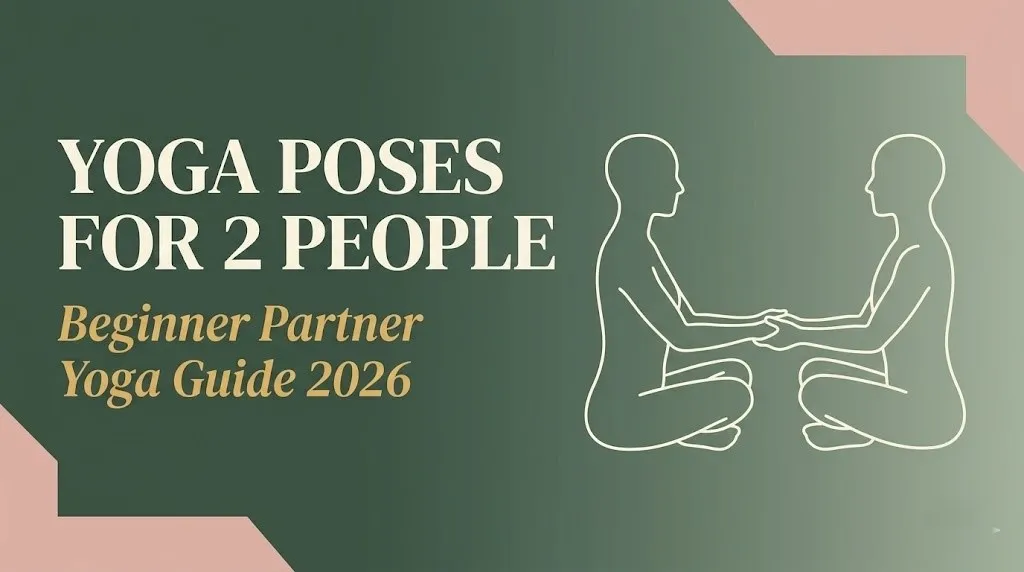
Three ideal beginner starting points:
- Back-to-Back Sukhasana (Easy Seated Pose): Both partners sit cross-legged, spines touching, and breathe together. Simple, intimate, and grounding. Hold for 10 to 15 breaths.
- Seated Forward Fold Assist (Paschimottanasana with partner): One partner folds forward, the other applies gentle pressure to the upper back to deepen the hamstring stretch. Switch after 5 to 8 breaths.
- Partner Utkatasana (Chair Pose) back-to-back: Both partners press backs together and slide down to a seated position in the air, supporting each other. Hold for 5 to 10 breaths.
Modification for beginners with knee concerns: In the back-to-back Chair Pose, do not descend below 90 degrees. A shallower angle, around 120 degrees, provides the strengthening benefit without joint strain.
Easy 2 Person Yoga Poses
The easiest two-person yoga poses are those where both partners stay seated or standing flat-footed, require no lifting, and use only gentle pulling or pressing as the contact between bodies.
“Easy” is relative to your body and your partner’s. A pose that feels accessible to a regular exerciser may challenge someone with tight hamstrings or limited shoulder mobility. Always calibrate to the less mobile partner rather than pushing toward the more flexible one.
Partner Seated Forward Fold:
To practice this pose:
- Both partners sit on the floor facing each other, legs extended straight
- Touch the soles of your feet to your partner’s soles
- Each partner holds the other’s forearms or wrists
- Partner A inhales to lengthen the spine, exhales to fold forward from the hips
- Partner B sits tall and gently draws backward, creating traction for Partner A
- Hold for 5 to 8 breaths, then switch roles
- Release slowly; avoid rounding your own spine as you pull
Muscles engaged: Hamstrings, lumbar erector spinae, thoracic extensors, hip flexors in the sitting partner.
Modification for tight hamstrings: Bend both knees generously. Place a folded blanket under both partners’ sitting bones to tilt the pelvis forward and reduce lumbar rounding.
Safety note: Never yank or pull sharply. The assist should feel like a steady, gentle pressure. If your partner winces or gasps, immediately reduce traction.
Seated Partner Yoga Poses
Seated partner yoga poses are the safest and most accessible category for beginners because both partners remain fully supported by the floor throughout the practice.
The seated position eliminates fall risk entirely. It also makes it easier to maintain eye contact and verbal communication, which are both important in partner work. Most seated poses address the posterior chain: hamstrings, lumbar spine, and thoracic back muscles.
Double Baddha Konasana (Butterfly Pose):
To practice this pose:
- Both partners sit back-to-back with knees bent and soles of feet together
- Press your backs firmly against each other along the full length of the spine
- Both partners inhale to lengthen, then exhale to let knees drop toward the floor
- The taller or heavier partner can apply gentle downward pressure on thighs
- Hold for 8 to 10 breaths
- Release by lifting knees gently back to center
Seated Spinal Twist with Partner:
To practice this pose:
- Both sit cross-legged, facing opposite directions, hips touching
- Each partner places their right hand on the other’s left knee
- Both inhale to lengthen; exhale to rotate in opposite directions
- Hold for 5 breaths, then switch sides
- Use your partner’s knee as gentle resistance, not as a lever to force rotation
Modification for anyone with sacroiliac joint sensitivity: Sit on a folded blanket to elevate the hips. This reduces compression through the SI joint during rotation.
Key Takeaway: Seated partner poses are the right starting point for every beginner pair, regardless of age or fitness level, because they remove fall risk and allow full focus on breath and communication.
Standing 2 Person Yoga Poses
Standing two-person yoga poses use a partner’s grip or body weight to improve balance, open the chest, and build strength in the legs and core while both practitioners remain on the ground.
Standing poses introduce the element of balance, which raises the engagement of the nervous system considerably. Think of your balance system like a dimmer switch: the more unpredictable the surface or the stance, the brighter the nervous system lights up to compensate. A partner’s lateral support keeps that brightness in a productive range rather than tipping into the stress of imminent falling.
Double Vrksasana (Partner Tree Pose):
To practice this pose:
- Stand side by side, about hip-width apart from each other
- Both partners press their inside palms together at shoulder height
- Each partner shifts weight to the outside foot
- Bend the inside knee and place the inside foot on the inner calf or inner thigh (never the knee joint)
- Press lightly against your partner’s hand for lateral stability
- Hold for 5 to 8 breaths, then switch sides
- Lower the raised foot slowly before releasing hand contact
Muscles engaged: Glutes, hip abductors, core stabilizers, tibialis anterior in the standing ankle.
Modification for balance challenges: Both partners can keep their inside foot’s toes lightly touching the floor as a “kickstand” while still pressing palms together. This provides the stability benefit with minimal fall risk.
2 Person Yoga Poses With Names
Two-person yoga poses are named either by adapting a traditional Sanskrit pose name with a “partner” prefix or by their descriptive English function, and knowing the names helps practitioners communicate clearly during practice.
Most partner yoga poses derive directly from solo asanas. The partner version simply adds an assist, a counterbalance, or a shared element. Knowing the solo pose name helps you understand the body position. The partner element is then layered on.
| English Name | Sanskrit Base | Partner Element | Difficulty |
|---|---|---|---|
| Partner Forward Fold | Paschimottanasana | Foot-to-foot, wrist pull | Beginner |
| Partner Tree Pose | Vrksasana | Side-by-side palm press | Beginner |
| Partner Chair Pose | Utkatasana | Back-to-back press | Beginner |
| Partner Butterfly | Baddha Konasana | Back-to-back, thigh assist | Beginner |
| Partner Downward Dog | Adho Mukha Svanasana | One partner’s hands on partner’s sacrum | Intermediate |
| Partner Warrior II | Virabhadrasana II | Side-by-side, arm extension | Intermediate |
| Double Boat Pose | Navasana | Foot-to-foot, hands clasped | Intermediate |
| Flying Whale | Base from Dandasana | Flyer sits on base’s feet | Advanced |
Learning the names serves a practical purpose: you can give and receive instructions clearly without describing shapes mid-pose when your balance is already engaged.
BFF Yoga Poses for 2
BFF yoga poses for 2 are beginner-friendly partner poses that prioritize fun, laughter, and connection over technical precision, making them ideal for friends who want to try yoga together without taking it too seriously.
The “BFF” framing matters because it signals permission to be imperfect. The best friend yoga session is the one where both people laugh when they fall out of Tree Pose and immediately try again. Removing performance pressure from yoga is itself a health benefit, documented by research on play and psychological recovery.
Three BFF-friendly starter poses:
- Double Child’s Pose (Balasana): Both partners kneel facing opposite directions. Each partner folds forward while resting their torso lightly on the other’s back. Both rest. Breathe together for 10 breaths. This is the lowest-effort, highest-comfort pose in partner yoga.
- Back-to-Back Forward Fold: Both partners stand back-to-back, reach overhead, and each slowly folds forward while the other does the same. Your combined weight creates mutual traction for the hamstrings and lumbar spine. Hold for 5 to 8 breaths.
- Mirrored Warrior II (Virabhadrasana II): Stand facing each other with a mat’s width between you. Both step right foot back into Warrior II. Extend arms toward each other. Touch fingertips if close enough. Hold for 5 breaths then switch sides.
Modification note: In Back-to-Back Forward Fold, if one partner is significantly taller, bend both knees until the back contact feels comfortable. Height difference does not prevent this pose; it just requires adjustment.
Key Takeaway: The best BFF yoga poses remove pressure and add laughter. Imperfect practice done consistently beats perfect practice that never happens.
Yoga Poses for Couples
Yoga poses for couples emphasize physical closeness, synchronized breath, and mutual support, with research suggesting that shared physical activity increases relational satisfaction and reduces interpersonal conflict.
Partner yoga activates touch between partners in a context that is intentional and non-pressured. Research published in Social Cognitive and Affective Neuroscience has documented that synchronized physical activity increases feelings of closeness and cooperative behavior between participants.
For couples, the most meaningful poses are often the quietest ones. Back-to-back breathing feels more intimate than any acrobatic shape because it requires genuine stillness and receptivity to your partner’s body.
Couples-specific poses that emphasize connection:
- Partner Savasana (Corpse Pose): Both lie down with heads close, feet pointing opposite directions. Place one hand on your partner’s sternum. Breathe together for 5 to 10 minutes. Feel the rise and fall.
- Facing Seated Meditation: Sit cross-legged facing each other, knees touching. Hold each other’s hands in your laps. Close eyes. Breathe in unison for 3 to 5 minutes.
- Assisted Reclined Butterfly: One partner lies on their back in supported Baddha Konasana (Butterfly). The other partner sits alongside and places gentle hands on each inner thigh. Hold for 8 to 10 breaths, then switch.
Modification for couples where one partner has limited floor mobility: The Assisted Reclined Butterfly works equally well with the reclined partner on a low couch or bed rather than the floor.
2 Person Yoga Poses for Kids
Two-person yoga poses for kids work best when they involve play, storytelling, and short holds of 3 to 5 breaths, keeping young bodies engaged without demanding the sustained concentration that adults can access.
Children’s skeletal systems are still developing, which means deep forward folds with partner resistance and any pose that loads the cervical spine should be avoided entirely. The safest partner yoga for kids stays upright, uses light contact, and keeps both children fully supported by the floor.
Safe and engaging partner poses for children:
- Partner Tree Pose: Two children stand side by side. Each lifts one foot to the inner calf. They press palms together for balance. Sway gently like trees in wind. This becomes a game naturally.
- See-Saw Forward Fold: Both children sit facing each other with knees bent and feet touching. They hold hands and gently take turns leaning back while the other leans forward. Light rocking motion, 5 to 6 repetitions each direction.
- Turtle Shell (Double Child’s Pose): Both kneel, one child folds forward into Balasana (Child’s Pose). The other leans back over their back in a supported backbend. Both breathe quietly for 3 to 5 breaths. Switch.
Safety note for kids: Never have children assist each other into deep spinal rotation, forward folds under load, or any inverted pose. Keep all poses bilateral and fully grounded. Adult supervision is appropriate for any partner yoga involving children.
Key Takeaway: Kids’ partner yoga works when it feels like a game. Short holds, light contact, and storytelling framing keep children engaged and safe.
Partner Yoga When Partners Have Different Flexibility
Partner yoga works well between people of different flexibility levels when the less flexible partner sets the pace and the more flexible partner provides support rather than pulling for depth.
This is the most common practical concern in partner yoga and the one no competitor addresses. The answer is actually simple: the range of motion you work within is always dictated by the less flexible partner. The more flexible partner’s job is to provide steady, supportive resistance, not to drag the other person deeper.
Body size differences require a different adjustment. In back-to-back Chair Pose, if one partner is significantly heavier, the lighter partner provides lateral support while the heavier partner manages more of their own body weight. The pose still works; it just requires honest communication about what each body needs.
Adjustment strategies by difference type:
| Difference | Adjustment |
|---|---|
| One partner has tight hamstrings | Both bend knees in forward fold poses |
| Height difference greater than 8 inches | Use blocks or folded blankets to equalize seated height |
| Weight difference greater than 50 pounds | Avoid counterbalance poses requiring equal weight |
| One partner has back pain | Remove lumbar rotation poses; focus on supported extension |
| One partner has knee issues | Eliminate deep squats; use chair-height variation |
| Significant strength difference | The stronger partner stabilizes; the other receives assist |
Yoga teachers and physical therapists generally recommend that both partners verbally check in before adding any additional weight or pressure. A simple “does this feel okay?” before deepening a stretch prevents injury.
Partner Yoga Safety and Communication
Partner yoga safety depends entirely on clear verbal communication before, during, and after each pose, and establishing a shared language for “stop” and “more” before you begin is the single most important preparation step.
Physical contact in yoga carries more responsibility than solo practice. You are responsible for another person’s comfort and safety, not just your own. The minimum communication framework involves two agreements: a word or signal that means “release immediately” and a word or signal that means “you can go a little further.”
Core safety guidelines for partner yoga:
- Establish a “stop” word or signal before starting (common choice: “ease off”)
- Never apply pressure suddenly; increase contact slowly and incrementally
- Ask before touching any area of the body, especially the lumbar spine and neck
- If your partner holds their breath, they have gone past their edge; back off immediately
- Avoid cranking or torquing; all pressure should feel like steady weight, not force
- Both partners should be sober and physically present; this is not casual contact
Physical safety rules by pose type:
- Forward fold assists: hands on upper back only, never the neck or cervical spine
- Hip-opening assists: outer hip or thigh only, never the inner knee
- Spinal twists: gentle suggestion, not a lever; partner does their own rotation
- Balance assists: light palm contact, prepared to step away quickly
A note on consent between friends or new partners: Before class or session, confirm both parties are comfortable with physical contact. What feels natural between long-term partners may need explicit discussion between friends or acquaintances.
How to Warm Up for Partner Yoga
A good warm-up for partner yoga begins with 5 to 8 minutes of individual movement to raise tissue temperature, followed by 3 to 5 minutes of synchronized breathwork to establish shared rhythm before any partner contact begins.
Warm tissue stretches with less resistance and more range than cold tissue. This is not metaphor. Connective tissue viscosity literally decreases as temperature rises, and muscle spindle sensitivity adjusts to allow greater elongation. Starting partner assists on a cold body creates unnecessary discomfort and risks strain.
Partner yoga warm-up sequence (12 to 15 minutes total):
- Each partner individually: Cat-Cow (Marjaryasana-Bitilasana) for 8 rounds, warming the spinal extensors and hip flexors
- Each partner individually: Seated forward fold reaching for shins, held for 5 breaths, three times
- Each partner individually: Gentle neck rolls, 3 circles each direction
- Together: Back-to-back seated breathing, matching inhale and exhale for 10 breaths
- Together: Light palm-to-palm standing press, feeling each other’s body weight and breath
- Together: Gentle back-to-back shoulder rolls, moving in the same direction simultaneously
Modification for warm-up when time is short: Skip steps 1 through 3 but never skip the synchronized breathing step. Breath synchronization is the physical and psychological foundation of safe partner practice.
Acro Yoga vs Partner Yoga
Acro yoga involves one partner lifting, supporting, or balancing the other in the air, while partner yoga keeps both practitioners fully grounded throughout the practice.
This distinction matters enormously for safety and accessibility. Partner yoga is designed for beginners with no prior training. Acro yoga requires progressive skill development, specific spotting techniques, and an understanding of weight distribution and structural load that takes months to learn safely.
The poses in this article are all partner yoga. None are acro yoga. The confusion between the two is common on social media, where “2 person yoga poses” searches often return acro yoga images that look dramatic but carry substantial injury risk for untrained practitioners.
| Feature | Partner Yoga | Acro Yoga |
|---|---|---|
| Both feet on ground | Always | Rarely for the flyer |
| Prerequisite training | None | Recommended 10 to 20 hours minimum |
| Injury risk for beginners | Low | Moderate to high without training |
| Spotting required | No | Yes, strongly recommended |
| Weight bearing on a partner | No | Yes (base supports flyer’s full weight) |
| Appropriate for first session | Yes | No |
| Available at home | Yes | Not recommended without training |
If you are drawn to the visual drama of acro yoga after building a partner yoga practice, seek an in-person acro yoga fundamentals workshop rather than attempting it from online instruction alone.
Key Takeaway: Acro yoga and partner yoga look similar online but carry completely different skill and safety requirements. Start with grounded partner yoga and only advance to acro with in-person instruction.
2 Person Yoga Sequence for Beginners
A complete beginner two-person yoga sequence runs 30 to 45 minutes and moves from synchronized breathwork through seated poses, standing poses, and a shared final rest.
This sequence introduces all the key movements in a logical order that warms the body progressively, builds trust incrementally, and ends with genuine rest. Both partners can complete it in a living room with two yoga mats.
Complete beginner partner yoga sequence:
- Back-to-back seated breathing: 10 breaths together to synchronize
- Back-to-back Cat-Cow: Seated, hands on knees, spines in contact, 6 rounds
- Seated Butterfly (Baddha Konasana) with assist: 8 breaths per partner
- Seated Forward Fold with partner pull (Paschimottanasana): 5 to 8 breaths each
- Seated Spinal Twist together: 5 breaths each side
- Standing back-to-back Chair Pose (Utkatasana): 5 to 10 breath hold
- Partner Tree Pose (Vrksasana): 5 to 8 breaths each side
- Partner Warrior II (Virabhadrasana II): 5 breaths each side
- Back-to-back Forward Fold standing: 5 to 8 breaths
- Double Child’s Pose (Balasana) back-to-back: 10 breaths
- Partner Savasana (Corpse Pose): 5 to 10 minutes
Hold each pose for the breaths noted. Never rush between poses. The transition is part of the practice.
Modification for seniors or those with joint limitations: Replace standing poses (steps 6 through 9) with additional seated variations. The sequence remains complete and beneficial without any floor-to-standing transitions.
Frequently Asked Questions About Yoga Poses for 2 People
What are the easiest yoga poses for 2 people with no experience?
The easiest two-person yoga poses are back-to-back seated breathing, the seated forward fold with a gentle partner pull, and back-to-back Chair Pose.
All three keep both partners fully on the ground, require no prior yoga experience, and produce immediate physical benefit.
Start with 10 minutes of these three poses before attempting anything standing or more complex.
Do both people need to be flexible to do partner yoga?
Neither person needs to be flexible to practice partner yoga for 2.
The poses work precisely because your partner’s gentle resistance gradually increases your range of motion over time.
Always move within the range of the less flexible partner and never force deeper into a stretch.
How much space do you need for 2 person yoga at home?
A clear floor area of approximately 6 feet by 10 feet is sufficient for most beginner two-person yoga poses.
Two yoga mats placed side by side take up approximately 4 by 12 feet, so a small living room or bedroom floor works well.
Remove furniture with sharp corners from the practice area before starting.
Can kids and adults do partner yoga together?
Yes, adults and children can practice partner yoga together when poses are age-appropriate and fully grounded.
Avoid any pose where the adult applies body weight or strong resistance to the child’s spine or joints.
Seated forward folds with light guidance, Partner Tree Pose, and breathing exercises are safe and engaging for most children over age five.
How long should a beginner partner yoga session last?
A beginner partner yoga session of 20 to 30 minutes is appropriate for a first session.
As both partners become comfortable with the poses and communication, sessions can extend to 45 to 60 minutes.
Shorter, more frequent sessions build skill faster than occasional long ones.
Try One Pose Today
Partner yoga does not require a special occasion or a full hour. Start with back-to-back seated breathing. Sit down, press your spines together, and breathe together for ten rounds. That is a complete practice in itself.
Once that feels natural, add the seated forward fold assist. Then back-to-back Chair Pose. Build the sequence one pose at a time over several sessions.
The best partner is one who communicates openly and moves at your pace. The best session is the one you actually complete.