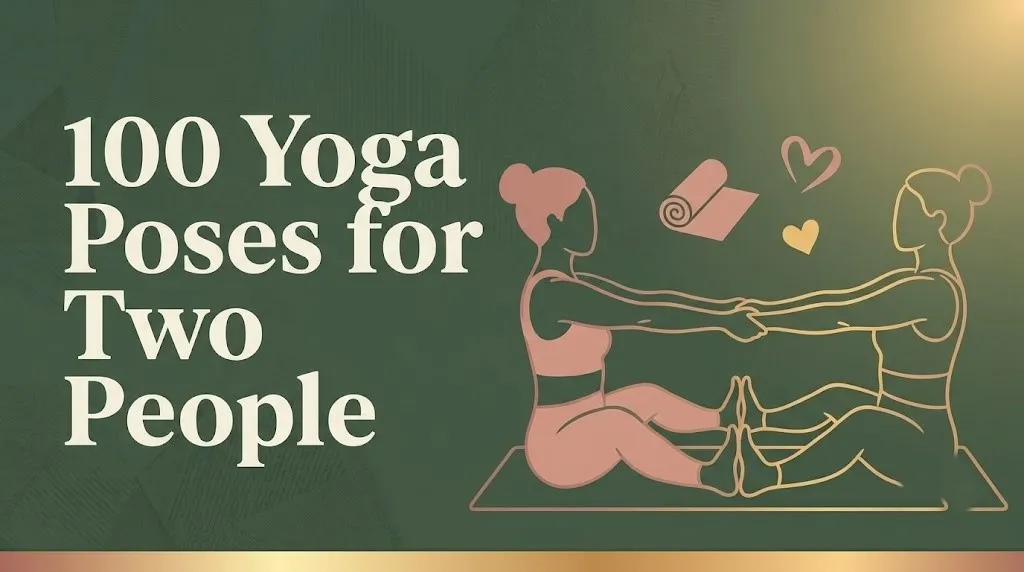
100 Yoga Poses for Two People: The 2026 Partner Guide
Practicing 100 yoga poses for two people is genuinely achievable for couples, friends, and families at any experience level. This guide gives you the actual instruction, not just the names.
A 2018 study published in the Journal of Alternative and Complementary Medicine found that partner-based physical activity increased feelings of social connection and reduced perceived stress more than solo exercise in the same time period. Partner yoga builds on this effect by combining movement, breath synchronization, and physical touch in a structured practice.
You will find poses organized by difficulty, purpose, and body need here. There is also a section on communication and trust, which most partner yoga guides skip entirely despite it being the foundation of safe practice. Beginners, seniors, families, and experienced practitioners all have dedicated sections.
100 Yoga Poses for Two People
One hundred yoga poses for two people encompass everything from simple back-to-back seated breathing exercises to standing counterbalance holds, deep hip-opening assists, and advanced Acroyoga flying sequences.
The number 100 is not arbitrary. Across Hatha, Vinyasa, Yin, Restorative, and Acroyoga traditions, there are well over 100 documented partner adaptations of classical poses. When you add mirrored variations, reversed positions, and supported modifications, the count expands further.
Two categories define the practice. In assisted partner yoga, one person provides light contact to help the other deepen a stretch or hold alignment. In counterbalance partner yoga, both partners contribute equal opposing force to create a shared shape that neither could hold alone.
| Practice Type | How It Works | Best For | Example Pose |
|---|---|---|---|
| Assisted partner yoga | One partner adds light pressure or support | All levels, therapeutic use | Assisted Paschimottanasana (Seated Forward Fold) |
| Counterbalance yoga | Both partners create opposing force | Beginners and intermediate | Back-to-back Utkatasana (Chair Pose) |
| Weight-sharing yoga | One partner supports another’s body weight | Intermediate to advanced | Supported Virabhadrasana III (Warrior III) |
| Acroyoga | Full body weight on a base partner | Advanced practitioners | Throne or Bird pose variations |
Start with assisted and counterbalance poses. They require the least trust, least strength, and least coordination. They also let you learn each other’s bodies without risk.
What Is Partner Yoga and How Does It Work
Partner yoga is a practice where two people work together to explore yoga poses, using each other’s body weight, presence, and touch as tools for deepening postures and building trust.
Unlike solo practice, where you work against gravity and your own muscular limits, partner yoga introduces a second physical variable: another person’s mass, intention, and movement. This changes the proprioceptive experience significantly. Your nervous system has to track your own body and respond to your partner’s simultaneously.
The mechanics work in two directions. When your partner presses gently on your back in a seated forward fold, the added weight helps release the spinal erectors and hamstrings more than gravity alone. When you sit back-to-back in Dandasana (Staff Pose) and push your spines together, both of you receive thoracic extension and spinal decompression from the shared pressure.
According to the National Center for Complementary and Integrative Health, yoga practices that incorporate physical touch and synchronized breathing activate the parasympathetic nervous system more effectively than solo movement-only practice. This is why partner yoga often feels more calming than a solo session of equal intensity.
Partner yoga works best when both participants agree on a pace, communicate openly about sensation levels, and treat the practice as a conversation rather than a performance. Neither person is a prop. Both are active practitioners.
Beginners can modify almost any partner pose by reducing range of motion, sitting on a folded blanket for extra hip height, or placing a yoga block between partners to create adjustable distance.
Partner Yoga vs Acro Yoga: What Is the Difference
Partner yoga and Acroyoga are related but distinct practices. Partner yoga keeps both practitioners’ feet on or near the ground. Acroyoga involves one person (the flyer) fully leaving the ground while the other (the base) supports their body weight with feet, hands, or both.
In partner yoga, assistance is complementary. Neither person bears the full weight of the other. The contact points are usually hands on shoulders, gentle pressure on the back, or interlaced hands for counterbalance. This is accessible to almost any two adults in reasonable health.
Acroyoga is a distinct discipline that blends yoga, acrobatics, and Thai massage. The base lies on their back and uses their legs as a platform. The flyer balances on the base’s feet or hands in inverted or elevated shapes. A spotter (a third person watching and catching) is considered standard practice for all beginner Acroyoga sessions.
| Feature | Partner Yoga | Acroyoga |
|---|---|---|
| Feet leave the ground | No | Yes (flyer) |
| Body weight shared | Partial | Full (on base) |
| Spotter needed | Optional | Strongly recommended |
| Injury risk level | Low to moderate | Moderate to high |
| Appropriate experience level | All levels | Intermediate to advanced |
| Yoga styles it draws from | Hatha, Yin, Restorative | Acrobatics, Thai massage, Hatha |
The two practices overlap in one important way: trust. Both require clear communication, agreed pacing, and the ability to exit a pose immediately if either person needs to. That communication framework applies regardless of whether your feet stay on the ground.
Key Takeaway: Partner yoga and Acroyoga are not the same thing. Start with grounded counterbalance and assisted poses before attempting any lifted or inverted Acroyoga shapes.
Benefits of Partner Yoga for Couples and Friends
Partner yoga benefits include deeper stretching through assisted resistance, improved balance and proprioception, and measurable positive effects on relationship trust and stress reduction.
The physical benefits extend what solo yoga can achieve. When your partner adds gentle traction to a spinal twist, the rotational depth increases because external pressure can override the protective guarding your nervous system naturally applies. Think of it like having a door handle versus pushing on the door itself: the handle gives you mechanical advantage.
Research published in Frontiers in Psychology has found that synchronized physical activity between two people increases oxytocin levels, a hormone linked to bonding and stress reduction. Partner yoga’s combination of touch, synchronized breath, and eye contact creates particularly strong conditions for this effect.
The mental benefits matter as much as the physical ones. A 2020 study published in Complementary Therapies in Medicine found that couples who practiced yoga together reported higher relationship satisfaction scores than those who exercised alongside each other without the shared breath and touch components.
Key benefits of regular partner yoga practice include:
- Increased hamstring and hip flexor length through partner-assisted passive stretching
- Improved spinal mobility through gentle traction and counterbalance
- Enhanced balance because the challenge of coordinating with a partner trains proprioceptive response
- Reduced cortisol linked to synchronized breathing and parasympathetic activation
- Stronger interpersonal trust built through consistent physical communication and shared vulnerability
Partner yoga is not a couples-only activity. Friends, siblings, parents and adult children, and classmates all benefit equally. The relational benefits come from the practice structure, not the relationship type.
Easy Yoga Poses for Two People at Home
The easiest yoga poses for two people at home are back-to-back Tadasana (Mountain Pose), seated spine-to-spine breathing, and a simple double Vrksasana (Tree Pose) with hands joined for balance support.
These three poses require no props, no prior experience, and no flexibility. They are starting points, not limitations. From these foundations, most pairs can progress to counterbalance poses within two to three sessions.
To practice back-to-back Tadasana:
- Stand back-to-back with your partner, heels a few inches apart.
- Press your spines together gently from tailbone to shoulder blades.
- Both partners inhale and grow tall. Exhale and soften the shoulders down.
- Hold for 5 to 8 slow breaths, staying aware of where your spines meet.
- Step apart on an exhale and shake out the legs before moving on.
For a double Vrksasana (Tree Pose), stand side-by-side. Each partner raises their outer foot and places it above or below the knee on the inner standing leg. Join inside hands for balance. Hold for 5 breaths per side.
Pose Tip:
- Do not place the raised foot against the knee joint itself. Place it above or below the knee to protect the joint.
- If balance is unsteady, stand near a wall so either partner can place a free hand on it.
- Beginners can keep the raised foot only at ankle height (kickstand position) to reduce balance demand.
Practice barefoot on a yoga mat or non-slip surface. Socked feet on hardwood floors create a fall risk for single-leg balance poses.
Beginner Seated Partner Yoga Poses
Beginner seated partner yoga poses are the safest category for new practitioners because both partners remain low to the ground with a stable base, reducing fall risk while allowing meaningful stretch depth.
Seated poses also allow easy, natural verbal communication because both partners can see each other’s face or speak without effort. You can check in, ask for more or less pressure, and exit any position without coordination challenges.
The three most accessible beginner seated partner poses are:
Assisted Paschimottanasana (Seated Forward Fold):
- Partner A sits with legs extended straight in Dandasana (Staff Pose).
- Partner B sits facing them, feet flat against Partner A’s feet or thighs.
- Both partners reach forward and hold each other’s wrists or forearms.
- Partner A gently leans back, providing mild traction that helps Partner B fold forward.
- Hold for 5 to 10 breaths, then switch roles.
Double Navasana (Boat Pose):
- Sit facing each other with knees bent and feet flat on the floor.
- Both partners reach forward and clasp each other’s hands or wrists.
- Lift one foot at a time and press the soles of your feet together at the same height.
- Lean back slightly until both partners find their balance point.
- Straighten the legs only if the lower back stays flat. Hold for 5 breaths.
Pose Tip:
- In Assisted Paschimottanasana, never pull your partner forward. The traction comes from a gentle lean backward, not a forward yank.
- For anyone with hamstring injuries or lumbar disc issues, keep the knees bent throughout the fold.
- In double Navasana, keep knees bent if the lower back rounds significantly. A rounded lumbar spine under load increases disc pressure.
According to the American College of Sports Medicine, passive stretching assisted by a partner produces greater range-of-motion gains than unassisted static stretching when applied consistently over six weeks.
Standing Partner Yoga Poses for Intermediate Practitioners
Standing partner yoga poses for intermediate practitioners include counterbalance squats, double Virabhadrasana II (Warrior II), and facing Virabhadrasana III (Warrior III) with hand contact for stability.
These poses require more coordination, communication, and core engagement than seated work. Both partners must commit to the shape simultaneously or the counterbalance fails. This is the point where partner yoga starts to require genuine negotiation in real time.
To practice a counterbalance squat (double Utkatasana / Chair Pose):
- Stand facing each other about arm’s length apart.
- Both partners reach forward and grip each other’s wrists or forearms firmly.
- Simultaneously, both partners lean back and lower into a squat position.
- Use your partner’s weight as an anchor. Lean away from each other to maintain balance.
- Hold for 5 breaths. Rise together on an inhale, keeping the grip until both are standing.
For double Virabhadrasana II (Warrior II), stand back-to-back with a slight gap. Both partners step wide into Warrior II with front legs facing opposite directions. Reach back and clasp the upper arms of your partner for stability. Hold for 5 breaths per side.
Pose Tip:
- In counterbalance squats, both partners must lean back with equal force. If one person weighs significantly more than the other, adjust by having the heavier partner keep their squat shallower.
- Anyone with knee pain or patellar tracking issues should keep their squat above 90 degrees of knee flexion.
- For first attempts, position yourselves near a wall so either partner can quickly reach it.
Key Takeaway: Counterbalance poses require equal commitment from both partners simultaneously. Hesitation from one partner immediately destabilizes both of you, so agree before you move.
Partner Yoga Warm-Up Sequence for Two
A partner yoga warm-up sequence for two should last 8 to 12 minutes and progress from light spinal mobilization and joint rotation to mild counterbalance stretches before any deep pose work begins.
Warming up with a partner differs from solo warm-ups. You are preparing two nervous systems, two sets of joints, and two bodies with different histories of stiffness, injury, and readiness. A good partner warm-up creates a shared rhythm before asking for coordinated movement.
A 10-minute partner warm-up sequence:
- Stand back-to-back in Tadasana (Mountain Pose) for 10 breaths. Match your breath to your partner’s audible exhales.
- Both partners roll the shoulders backward 5 times, then forward 5 times, feeling the shared spinal contact.
- Both partners take a gentle seated Sukhasana (Easy Pose) cross-legged, back-to-back. Hold 5 breaths.
- Both partners inhale and grow tall. Exhale and twist right simultaneously. Hold 3 breaths. Repeat left.
- Move to facing Baddha Konasana (Bound Angle Pose): sit facing each other, soles of feet together. Reach and hold each other’s ankles. Hold 5 to 8 breaths.
- One partner gently presses their palms on the other’s outer knees to encourage hip opening. Switch roles.
- Both partners come to hands and knees. One partner enters Balasana (Child’s Pose). The other sits lightly on their lower back as a supported spinal weight. Hold 5 breaths. Switch.
The last step is a gentle compression, not a bodyweight crush. The partner sitting on top should keep their feet on the floor and use their hands to control exactly how much weight they apply.
Advanced Two Person Yoga Poses
Advanced two-person yoga poses include standing inversions with partner support, full Virabhadrasana III (Warrior III) with hand-to-hip contact, and seated spinal extensions where one partner acts as a backbend support.
These poses demand existing flexibility, core strength, and a well-established communication practice between partners. They should never be attempted in a first session or without a thorough warm-up.
Supported Backbend (Partner as Spine Support):
- Partner A sits with legs extended or crossed.
- Partner B stands straddling Partner A’s legs, facing the same direction.
- Partner B places their hands on Partner A’s shoulder blades.
- Partner A begins to arch backward, using Partner B’s gentle support as a guide.
- Partner B controls the depth by moving their hands slowly, never pushing or forcing.
- Hold for 3 to 5 breaths. Exit slowly, returning upright on an inhale.
Safety note: This pose is contraindicated for anyone with recent thoracic vertebra fractures, disc herniations in the mid or upper spine, or shoulder impingement. Both partners should communicate clearly at every stage. Exit the pose at the first sign of sharp pain, numbness, or breath holding.
The general principle in all advanced partner poses is this: the supporting partner moves slowly and checks in verbally. The receiving partner never holds their breath, because breath holding is usually the first sign that the stretch has exceeded safe range.
A study published in the International Journal of Yoga found that breath awareness training in group yoga settings reduced injury incidence by improving participants’ ability to recognize their own physical limits in real time.
Acro Yoga Poses for Beginners
Beginner Acroyoga poses keep the flyer low, close to the ground, and always within easy, controlled dismounting distance, with a spotter present for every session until both partners are well trained.
The most appropriate entry point into Acroyoga is the Throne position. The base lies on their back with knees bent and feet flat on the floor. The flyer sits on the base’s feet, facing forward. The base raises their feet to lift the flyer just slightly off the ground, with both partners maintaining hand contact throughout.
To practice the Throne (beginner Acroyoga starting point):
- Base lies flat on their back. Knees are bent at 90 degrees, feet flexed and parallel.
- Flyer stands at the base’s feet and places their hip bones onto the base’s soles.
- Flyer holds the base’s hands and begins to shift weight forward.
- Base slowly straightens their legs while flyer leans forward until they find balance.
- Both partners hold for 3 to 5 breaths, maintaining continuous hand contact.
- Base bends knees to lower flyer back toward standing. Both partners exit the pose together.
A spotter stands beside the base and flyer throughout. The spotter’s job is to catch the flyer’s upper body if balance is lost. This is not optional in beginner sessions.
Pose Tip:
- The base must keep their core engaged and their lower back pressed into the floor throughout.
- Flyers should avoid looking down sharply, as this shifts weight forward unpredictably.
- Anyone with wrist, elbow, shoulder, or lower back issues should not base until cleared by a physical therapist familiar with yoga.
Key Takeaway: Acroyoga requires a spotter for every beginner session, no exceptions. The most common beginner injury is a wrist or elbow strain on the base, not a fall by the flyer.
Partner Yoga Communication and Trust Building
Partner yoga communication means establishing a clear, agreed-upon system for signaling comfort levels, requesting adjustments, and exiting poses before any hands-on practice begins.
This is the section most yoga resources skip. It is also the section that makes the difference between a practice that strengthens connection and one that creates tension or injury. Experienced yoga teachers who specialize in partner work consider the communication framework as important as the poses themselves.
Before your first session, agree on three things:
- A comfort signal: A word or touch pattern that means “I’m good, continue.”
- An adjustment signal: A word or touch pattern that means “less pressure” or “different angle.”
- An exit signal: A word or touch pattern that means “stop immediately and release.”
Many partner yoga teachers use a simple green, yellow, red verbal system. Green means continue. Yellow means slow down or reduce intensity. Red means release now, no questions asked.
Research published in Frontiers in Psychology has found that establishing explicit verbal consent protocols in shared physical activities increases participant trust and willingness to explore greater range of motion. When people know they can exit safely, they often move more freely and breathe more deeply.
Apply this framework to every session, even after months of practice together. Bodies change daily. What felt comfortable last week may not feel the same today.
Quick Summary:
- Agree on signals before touching, not during the pose.
- The receiving partner always leads the pace. The supporting partner follows.
- Neither person should feel obligated to go deeper to avoid disappointing their partner.
Yoga for Two People with Limited Flexibility
Yoga for two people with limited flexibility works best when both partners focus on counterbalance poses and breath-synchronized seated work rather than deep stretching or weight-bearing shapes.
Limited flexibility does not limit partner yoga. It actually makes certain counterbalance poses more effective, because the physical resistance created by two stiff bodies working against each other provides structural support. Think of two bricks leaning against each other: they hold each other up precisely because they are rigid.
The most accessible poses for low-flexibility pairs include:
- Back-to-back Sukhasana (Easy Pose): Both partners sit cross-legged, spine-to-spine. The mutual back pressure encourages upright spinal alignment without demanding hip opening.
- Seated wrist-hold forward fold: Both partners sit with straight legs in front. They reach and hold wrists. Each person folds only as far as their body allows naturally.
- Standing back-to-back lateral bend: Both partners stand back-to-back. Each partner lifts one arm and takes a gentle side bend. The shared spinal contact provides feedback without forcing range.
- **Double *Balasana* (Child’s Pose) facing each other**: Both partners fold into Child’s Pose with arms reaching forward. Touch fingertips in the middle. Hold *8 breaths* and breathe into the shared stillness.
Pose Tip:
- Never force range of motion in the service of matching a more flexible partner.
- Yoga straps can extend reach when two partners cannot comfortably grip each other’s wrists.
- A folded blanket under the hips in any seated pose immediately reduces hamstring demand for tight practitioners.
Family Yoga Poses for Adults and Kids Together
Family yoga poses for adults and kids work best when the child’s size, attention span, and energy level shape the sequence rather than the adult’s practice preferences.
Children aged 5 to 12 respond well to partner poses that feel like games. Naming a pose after an animal, a vehicle, or a character from their world increases engagement dramatically. The yoga is real. The framing is playful.
Family-appropriate poses include:
| Pose | Sanskrit Name | How Adult and Child Work Together | Minimum Age |
|---|---|---|---|
| Double Tree | Vrksasana | Stand side by side, join hands, each raise outer foot | 5+ |
| Boat Pose | Navasana | Sit facing, press soles of feet together, hold wrists | 6+ |
| Seesaw Forward Fold | Paschimottanasana | Sit facing with straight legs, hold hands, take turns folding | 5+ |
| Back-to-back Mountain | Tadasana | Stand spine-to-spine, breathe together | 4+ |
| Child’s Pose Stack | Balasana | Child folds into Child’s Pose; adult gently sits on their lower back | 7+ |
Keep children’s hold times short. Three to five breaths is ideal for most children. Exceeding this often leads to fidgeting, which can disrupt a partner pose and cause minor strain.
Pose Tip:
- Adults should always receive the child’s body weight on their lap or lower back, never the other way.
- Skip any pose where the child’s neck or spine is compressed. Child’s Pose with an adult sitting on the lower back is safe when done gently with adult weight mostly on their own feet.
- Let the child lead the exit. A child who says “done” mid-pose is protecting their body correctly.
Key Takeaway: Family yoga sessions should follow the child’s pace and hold time, not the adult’s. Three to five breaths per pose keeps kids engaged and prevents frustration on both sides.
Restorative Partner Yoga for Seniors
Restorative partner yoga for seniors uses long-held, fully supported poses where one partner provides gentle, stable contact rather than dynamic movement or weight-bearing assistance.
For practitioners over 60, the priorities in partner yoga shift. Speed, depth, and complexity matter less. What matters is joint safety, breath awareness, and the neurological benefit of sustained physical contact in a calm, supported environment. Restorative yoga already serves these goals well. Adding a partner deepens them.
The most appropriate restorative partner poses for seniors:
- **Supported *Supta Baddha Konasana* (Reclined Bound Angle Pose)**: One partner reclines with soles of feet together. Bolsters support the outer knees and thighs. The other partner sits nearby and places a warm hand on their partner’s sternum to encourage diaphragmatic breathing. Hold *3 to 5 minutes*.
- Seated back-to-back support: Both partners sit cross-legged (or in chairs). They lean into each other back-to-back and breathe together for 10 slow cycles. Neither partner applies pressure. The contact is a resting presence.
- **Gentle assisted *Supta Matsyendrasana* (Supine Spinal Twist)**: One partner lies on their back and brings one knee across the body. The other partner kneels beside them and places a hand lightly on the crossed knee, applying no pressure unless invited.
Safety note: Seniors with osteoporosis should avoid any pose where a partner applies pressure to the spine or ribcage, since compression on fragile bone structures can cause fractures. A partner’s hand resting on a bolster near the body is safe. Direct spinal compression is not.
According to the NCCIH, restorative yoga practices have been associated with reductions in inflammatory markers and improvements in sleep quality in adults over 60.
Breathwork for Two People During Partner Yoga
Synchronized breathwork between two partners means both practitioners consciously align their inhale and exhale rhythms, creating a shared physiological rhythm that amplifies the calming effect of yoga on the nervous system.
This is one of the least-discussed tools in partner yoga, and one of the most effective. When two people breathe together, their heart rate variability patterns begin to synchronize. This physiological mirroring is associated with increased feelings of closeness and reduced anxiety.
Three partner breathwork techniques:
- Spine-to-Spine Dirga (Three-Part Breath): Sit back-to-back in Sukhasana (Easy Pose). Both partners practice three-part Dirga Pranayama, expanding the belly, then the ribs, then the upper chest on each inhale. Feel your partner’s breath moving their spine against yours. Match your rhythm to theirs over 10 cycles.
- Facing Alternate Nostril Synchronization: Sit facing each other in a comfortable cross-legged position. Both partners practice Nadi Shodhana (Alternate Nostril Breathing) simultaneously, making eye contact and matching pace. This requires intermediate pranayama experience.
- Whispered Exhale Timing: In any partner pose, one partner sets the pace of the exhale by whispering “out” at the start of their exhale. The other partner follows. This is especially useful in counterbalance poses where simultaneous movement is needed.
Pose Tip:
- Start with a simple audible exhale rather than full Dirga or Nadi Shodhana for first sessions.
- If one partner has respiratory conditions affecting breath capacity, never impose a breathing rate on them. Let them set the pace.
- Synchronized breathing works best at the beginning and end of a session, not during physically demanding holds where natural breath patterns need freedom.
How to Build a Complete Partner Yoga Sequence
A complete partner yoga sequence for two people should include a warm-up phase, a building phase, a peak pose or two, and a closing cooling phase, structured across 45 to 75 minutes of total practice time.
Think of building a partner yoga sequence like co-writing a piece of music. The warm-up is the introduction: quiet, establishing a shared key. The building phase introduces themes and complexity. The peak pose is the main movement. The cool-down resolves everything back to stillness.
A sample 60-minute partner yoga sequence structure:
| Phase | Duration | Sample Poses | Purpose |
|---|---|---|---|
| Warm-up | 10 to 12 minutes | Back-to-back Mountain, seated twist, Bound Angle | Sync breath, mobilize spine |
| Building: seated | 12 to 15 minutes | Double Boat, Assisted Forward Fold, Seesaw Fold | Hamstrings, hip flexors, trust |
| Building: standing | 12 to 15 minutes | Counterbalance squat, Double Warrior II, Double Tree | Legs, balance, coordination |
| Peak pose | 8 to 10 minutes | Supported Backbend, Warrior III with contact, or Throne | Maximum joint range |
| Cool-down | 10 to 12 minutes | Gentle Spinal Twist with hand on knee, Child’s Pose weight | Parasympathetic, recovery |
| Closing breathwork | 5 minutes | Spine-to-spine Dirga, shared Savasana | Integration, nervous system |
Never rush from peak poses to savasana. A 5 to 10 minute cool-down phase allows the nervous system to shift from activation back to rest. Skipping this phase is the most common structural error in home practice.
Repeat the full sequence two to three times per week for best results. The International Journal of Yoga has published evidence showing that twice-weekly partner-based yoga improved both physical flexibility measures and self-reported psychological wellbeing after eight weeks.
Key Takeaway: A complete partner yoga session needs a closing breathwork phase, not just a cool-down stretch. That last five minutes of shared breath is where the nervous system integration actually happens.
Frequently Asked Questions About 100 Yoga Poses for Two People
What are the easiest yoga poses for two people who are complete beginners?
The easiest poses for two complete beginners are back-to-back Tadasana (Mountain Pose), seated spine-to-spine breathing, and the wrist-hold seated forward fold.
These three poses require no prior yoga experience, no props, and no significant flexibility.
Practice them for two to three sessions before moving on to counterbalance or standing partner work.
Is partner yoga good for couples who have different flexibility levels?
Yes, partner yoga works well for couples with different flexibility levels because most poses involve one partner assisting the other, not both reaching the same depth.
The more flexible partner often takes the supported role while the less flexible partner provides gentle resistance or traction.
Counterbalance poses specifically benefit from slight differences in body weight and flexibility because the opposing forces naturally equalize each other.
What is the difference between partner yoga and acro yoga?
Partner yoga keeps both practitioners on or near the ground, using each other for balance support and assisted stretching.
Acroyoga involves one partner (the flyer) being fully lifted off the ground by the other (the base), requiring significantly more strength, coordination, and a spotter for safe practice.
Beginners should practice grounded partner yoga for at least several months before attempting any Acroyoga lifting.
How do you communicate with your partner during yoga poses?
Agree on simple verbal signals before any hands-on practice: one word or phrase for “continue,” one for “reduce pressure,” and one for “release immediately.”
Many partner yoga teachers use a green, yellow, red system where each color communicates a different comfort level.
The receiving partner always leads the depth and pace. The supporting partner’s job is to follow, not to push.
How many yoga poses can two people realistically do in one session?
Most partner yoga sessions cover 8 to 15 poses in 45 to 60 minutes, including warm-up and cool-down.
Moving through dozens of poses quickly sacrifices alignment quality, breath awareness, and the relational benefits that make partner yoga worth doing.
Depth and attention per pose matter far more than quantity.
Start with three poses this week. Just three: back-to-back Mountain, a seated forward fold with wrist hold, and a counterbalance squat. Practice them together twice before adding anything new.
Partner yoga builds on itself slowly. The communication you practice in a simple seated fold carries directly into every more complex shape you try later. Get the foundation right and the rest follows naturally.
Your mat is more interesting with two people on it.