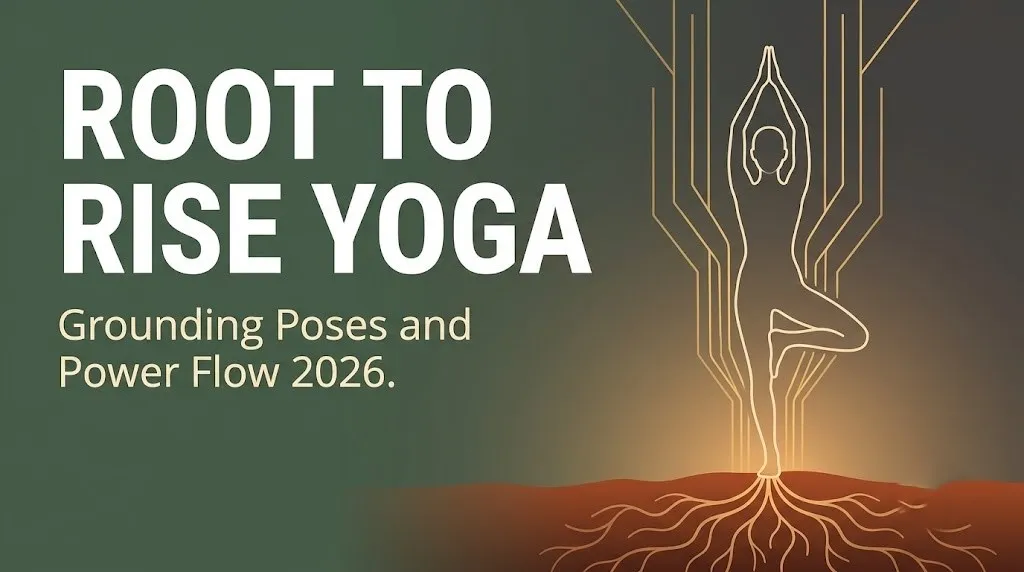
Root to Rise Yoga 2026: Grounding Poses and Power Flow
Root to rise yoga is a practice built on a single biomechanical truth: the more firmly you press into the ground, the more lift, length, and stability your body can generate upward. Whether you encounter this as a philosophical principle, a specific power yoga format, or a teacher’s alignment cue in a standing pose, the root-to-rise concept describes how foundational stability creates the conditions for everything that builds above it.
The physical basis for this principle is well-established in movement science. According to the Journal of Bodywork and Movement Therapies, ground reaction forces generated through the feet directly activate the lower kinetic chain, including the gluteal muscles, quadriceps, and spinal extensors, creating postural length and stability through a bottom-up activation sequence. Your yoga teacher learned this, even if they explained it differently.
This guide covers everything the phrase “root to rise” actually means in practice. You’ll find the biomechanics explained clearly, the philosophical tradition placed in honest context, a complete power yoga sequence, and specific modifications for beginners, seniors, and people managing lower back pain.
Root to Rise Yoga: What It Is and Why It Matters
Root to rise yoga refers to both a specific practice philosophy and, in many studios, a branded yoga format that structures classes around the principle of building upward stability from a grounded foundation.
As a philosophy, it applies to every yoga pose: the deeper the body roots into its contact surface (feet, hands, sitting bones), the more the surrounding musculature can engage to support height, length, and expansion. As a studio format, root to rise yoga classes typically combine grounding floor work with progressively dynamic standing poses and balance sequences.
The concept is not abstract wellness language. It describes a concrete physiological process. When the foot presses into the floor with intention, the arch lifts, the ankle stabilizers engage, the knee aligns over the foot, the hip stabilizers (primarily the gluteus medius) activate, and the spinal extensors respond by lifting the torso. This chain reaction happens from ground to crown.
| Dimension | What It Means | How It Shows Up in Practice |
|---|---|---|
| Philosophical | Stability as the foundation of freedom | Grounding intention before each pose |
| Biomechanical | Ground-pressing activates the kinetic chain | Active foot engagement in every standing pose |
| Power Yoga Format | Dynamic sequences built on grounding principles | Studio class combining strength and flow |
| Therapeutic | Grounding reduces anxiety; stability reduces pain | Prescribed for back pain, balance issues, stress |
What Does Root to Rise Mean in Yoga
In yoga, “root to rise” means pressing actively into your contact surface, whether the floor, a block, or a wall, to create the muscular engagement that supports postural length and structural stability throughout the body above that contact point.
The phrase is most commonly heard in standing poses, where a teacher might cue “root through your feet to rise through your crown.” This is not metaphor. It describes the actual biomechanical sequence: active foot pressing engages the lower leg muscles, which stabilizes the knee, which allows the hip stabilizers to engage more efficiently, which lifts and lengthens the spine.
In seated poses, the same principle applies through the sitting bones. In poses on all fours like Adho Mukha Svanasana (Downward-Facing Dog), the hands root into the mat as the hips rise. The rooting surface changes. The principle stays the same.
The American College of Sports Medicine (ACSM) notes that conscious proprioceptive engagement during exercise, specifically the intentional pressing of a limb into a stable surface, improves force transmission through the kinetic chain and reduces injury risk in weight-bearing positions. The yoga cue “root to rise” operationalizes this principle in accessible language.
Root to rise applies across these contact surfaces:
- Feet in standing poses: the primary root surface in most yoga classes
- Sitting bones in seated poses: grounding through the pelvis in seated forward folds and twists
- Hands in arm-bearing poses: pressing through the palms in Downward-Facing Dog and plank
- Forearms in forearm balance: rooting into forearms to create lift in Pincha Mayurasana (Forearm Balance)
Root to Rise Yoga Philosophy and Tradition
The root to rise philosophy in yoga draws from multiple traditional frameworks, including the concept of Muladhara (the root chakra in traditional yogic anatomy), the idea of Pada Bandha (foot lock), and the broader yogic teaching that inner stillness and outer expansion are inseparable.
In traditional yoga philosophy, the body’s energy system includes chakras, which are described as energy centers aligned along the spine. Muladhara, located at the base of the spine, is associated with groundedness, safety, and physical security. When this center is balanced, the practitioner feels stable enough to expand upward. When it is dysregulated, anxiety, restlessness, and lack of focus are the traditional descriptions.
It is worth being clear about the distinction between these traditional frameworks and evidence-based physiology. The chakra system is a traditional Indian philosophical framework, not a biological structure. The biomechanical effects of grounding, specifically muscle activation and postural alignment, are measurable and well-documented. Both can be held simultaneously: the traditional philosophy provides meaningful context, and the physiology explains what actually changes in the body.
Pada Bandha (foot lock) is a traditional yoga technique involving the intentional lifting of the arch and spreading of the toes while pressing the four corners of the foot into the ground. This engagement is precisely what produces the kinetic chain activation that the root to rise cue describes. Traditional teachers named it thousands of years before the term “kinetic chain” entered sports science.
Key principles from the root to rise tradition:
- Grounding is active, not passive. Pressing is an action, not relaxation.
- Stability at the base supports freedom at the periphery.
- Expansion requires a secure foundation; height without depth collapses.
- The same principle extends off the mat: emotional stability supports creative expansion.
Key Takeaway: Root to rise yoga is simultaneously a biomechanical principle, a traditional philosophical framework, and a studio practice format. Understanding all three dimensions makes the cue far more than a motivational phrase.
Root to Rise Biomechanics: How Grounding Creates Lift
The biomechanical basis of root to rise yoga is the lower kinetic chain activation sequence: pressing into the floor through the feet creates a ground reaction force that travels upward through the ankle, knee, hip, and spine, engaging stabilizing muscles at each joint along the way.
Think of the body like a suspension bridge. The towers (legs and spine) can only support the deck (torso, arms, and head) if they are anchored at the base. Remove the anchoring, and the structure collapses inward. Add intentional pressure at the foundation, and the whole structure organizes upward with tension and lift rather than compression and collapse.
In Tadasana (Mountain Pose), the foundational standing posture of most yoga styles, this sequence unfolds as follows: the toes spread and the four corners of the foot press into the mat (big toe mound, little toe mound, inner heel, outer heel). This activates the foot intrinsics, which lift the arch. The arch lift sends a signal through the tibialis anterior and peroneals that stabilizes the ankle. The stabilized ankle allows the quadriceps to engage without the knee collapsing inward. Engaged quadriceps transfer force to the gluteus maximus and gluteus medius, which stabilize the pelvis. A stable pelvis allows the erector spinae to lengthen the spine upward without the lumbar collapsing into extension.
A 2019 study published in the International Journal of Yoga found that practitioners who engaged active foot grounding cues during standing poses demonstrated measurably improved spinal alignment and reduced lumbar lordosis compared to practitioners who were given no specific foot engagement instruction.
This bottom-up sequence is the physical reality behind every root to rise cue. It is not mystical. It is applied anatomy.
Root to Rise Yoga Benefits
Root to rise yoga produces specific, measurable benefits across physical stability, postural health, mental focus, and nervous system regulation, all arising from the consistent practice of intentional grounding in standing and floor-based postures.
Physical benefits accumulate through regular practice. The consistent engagement of the lower kinetic chain in standing poses builds functional strength in the foot intrinsics, ankle stabilizers, and hip abductors over weeks. These are the same muscle groups targeted in fall prevention programs for older adults. The National Center for Complementary and Integrative Health (NCCIH) reports that yoga practices that emphasize balance and stability have demonstrated measurable reductions in fall risk in adults over 60 in multiple controlled studies.
Mental and nervous system benefits come partly from the proprioceptive engagement itself. Research in Frontiers in Psychology has linked intentional proprioceptive training (exercises that require conscious awareness of body position and pressure) with improved executive function and attention regulation. Grounding practices in yoga activate this same system.
The anxiety-reducing dimension of root to rise practice is physiologically grounded. Pressing the feet into the floor and consciously feeling that contact activates sensory receptors in the soles of the feet that send signals to the brainstem. This sensory input is associated with reduced arousal in the sympathetic nervous system. Experienced yoga teachers often recommend grounding poses specifically for anxious practitioners for exactly this reason.
Key documented benefits of root to rise yoga practice:
- Improved lower-body strength: foot intrinsics, ankle stabilizers, hip abductors
- Enhanced postural alignment and reduced lumbar hyperextension
- Measurably improved balance and proprioception
- Reduced fall risk in older adults with consistent practice
- Decreased anxiety symptoms through sensory grounding
- Improved spinal health through active engagement rather than passive standing
Root to Rise Power Yoga
Root to rise power yoga is a dynamic, strength-focused yoga format that applies the grounding-creates-lift principle to sequences of progressively challenging standing poses, balance work, and transitional flows at a pace that builds cardiovascular and muscular endurance.
Power yoga as a category refers to physically demanding yoga classes that prioritize strength, cardiovascular fitness, and full-body conditioning within a yoga framework. Power yoga is not a single codified system like Ashtanga yoga or Bikram/26&2 yoga. Different teachers and studios structure it differently. A root to rise power yoga class distinguishes itself by its explicit grounding focus: every dynamic pose is cued with an active foundation before the upward expression is attempted.
This makes the root to rise power yoga format structurally different from generic power yoga. In a standard power flow class, speed and transition often take precedence over foundation. In a root to rise power class, the teacher returns the practitioner to the ground activation principle at each new pose before building the dynamic expression. This produces strength gains that are more structurally supported and reduces the injury risk from moving fast without a stable base.
| Feature | Generic Power Yoga | Root to Rise Power Yoga |
|---|---|---|
| Pace | Fast, transition-focused | Dynamic with grounding pauses |
| Cueing priority | Movement and breath | Foundation first, then expression |
| Strength emphasis | Full body, cardio-driven | Lower kinetic chain foundation |
| Injury risk | Moderate to higher | Reduced with grounding cues |
| Best for | Fit, experienced practitioners | All levels with strong cueing |
| Philosophical layer | Minimal | Integrated grounding principle |
Modification note: Root to rise power yoga classes are not beginners’ classes by default. If you are new to yoga, look for a “root to rise fundamentals” or “grounding flow” class first. Power formats assume working familiarity with the foundational poses in the sequence.
Root to Rise Yoga Sequence for Beginners
A beginner root to rise yoga sequence focuses on learning the active foot-pressing principle in simple, stable poses before introducing balance challenges or dynamic transitions.
The most common beginner error in root to rise yoga is treating grounding as passive: simply placing the feet on the mat and letting the body follow. Active grounding requires deliberate muscle engagement that must be learned and practiced. Beginners need time in simple poses like Tadasana (Mountain Pose) to feel what the foot activation actually produces before they can apply it under the added challenge of a balance pose.
A foundational beginner sequence for root to rise yoga:
- Tadasana (Mountain Pose): Stand with feet hip-width apart. Spread all ten toes. Press through the four corners of each foot. Feel the arch lift. Draw the quadriceps up. Lengthen the spine. Hold for 10 slow breaths.
- Utkatasana (Chair Pose): From Tadasana, bend the knees as if sitting into a chair. Keep the weight in the heels. Press the heels down to rise the spine tall. Arms reach forward or overhead. Hold for 5 breaths.
- Virabhadrasana I (Warrior I): Step the right foot forward, left foot back at a 45-degree angle. Press both feet down firmly. Feel the back foot anchor before lifting the arms overhead. Hold 5 breaths each side.
- Vrksasana (Tree Pose): Return to Tadasana. Shift weight to the right foot. Press it firmly into the floor. Bring the left foot to the right ankle (toes touching the floor for stability). Hold 5 breaths each side.
- Uttanasana (Standing Forward Fold): From Tadasana, hinge from the hips with a flat back. Let the crown reach toward the floor. Press through the feet to feel the hamstrings engage. Hold 8 breaths.
- Balasana (Child’s Pose): Kneel and sit back toward the heels. Arms extended forward or alongside the body. Rest and breathe for 10 breaths.
- Savasana (Corpse Pose): Lie on your back. Feet fall open. Arms slightly away from the body. Rest for 3 to 5 minutes.
Modification for beginners in Utkatasana: Place a chair behind you and practice lowering toward the seat without fully sitting. This teaches the movement pattern with a safety net and reduces knee strain.
Key Takeaway: Grounding in root to rise yoga is an active muscle engagement, not a passive placement. The biggest beginner breakthrough is feeling the difference between standing on your feet and actively pressing through them.
Root to Rise Standing Poses
Root to rise standing poses are the core of this practice style, using the lower kinetic chain activation sequence to support structural integrity and height in poses that challenge balance, strength, and spinal extension simultaneously.
Standing poses generate the clearest expression of the root to rise principle because the mechanics are immediately felt. A well-grounded Virabhadrasana II (Warrior II) with active foot pressing and engaged quadriceps feels stable and effortless. The same pose practiced with passive feet and collapsed arches produces knee strain, hip instability, and spinal compression.
Key standing poses in a root to rise practice and their grounding cues:
| Pose (Sanskrit + English) | Primary Ground Contact | Root-to-Rise Cue | Primary Muscles |
|---|---|---|---|
| Tadasana (Mountain Pose) | Four corners of both feet | Press all four corners; lift arches; lengthen spine | Foot intrinsics, quadriceps, glutes, spinal extensors |
| Virabhadrasana I (Warrior I) | Both feet, especially back heel | Ground back heel; use that resistance to lift chest | Hip flexors, glutes, quadriceps, deltoids |
| Virabhadrasana II (Warrior II) | Four corners of both feet | Root outer edge of back foot; rise through torso | Adductors, glutes, deltoids |
| Utthita Trikonasana (Extended Triangle Pose) | Both feet, pressing wide | Ground both feet to extend arms in opposite directions | Adductors, hamstrings, obliques |
| Vrksasana (Tree Pose) | Four corners of standing foot | More root through standing foot, more lift in spine | Gluteus medius, quadriceps, foot intrinsics |
| Utkatasana (Chair Pose) | Both heels | Press heels down to lift spine upright | Quadriceps, glutes, spinal extensors |
Modification note: In all standing poses, practitioners with knee hyperextension should maintain a micro-bend in the knee rather than locking it straight. This protects the joint and actually improves kinetic chain activation by keeping the quadriceps engaged rather than passive.
Root to Rise Grounding Poses
Root to rise grounding poses are lower-to-the-ground postures, including seated, kneeling, and supine positions, that build the foundation of the practice by teaching the body what active, conscious grounding actually feels like before the challenges of standing are introduced.
Grounding poses serve a different function than standing poses. They slow the nervous system, reduce the cardiovascular demand, and allow the practitioner to feel the contact surface with more sensory precision. A practitioner who has spent five minutes in Malasana (Garland Pose) pressing the feet firmly into the floor has primed the foot intrinsics and ankle stabilizers for everything that comes in the standing sequence.
A study published in the Journal of Alternative and Complementary Medicine found that floor-based, grounding-focused yoga postures practiced before standing sequences produced measurably improved balance performance in standing poses compared to beginning standing poses without a prior grounding sequence. The preparation makes the standing work more effective.
Core grounding poses for root to rise practice:
- Malasana (Garland Pose): Deep squat with feet hip-width apart. Press the soles firmly into the floor. Use elbows to gently open the knees. Activates the foot intrinsics, ankles, and hip external rotators powerfully.
- Balasana (Child’s Pose): Forehead resting on the mat. Pressing the top of the feet and the shins into the mat develops a sense of grounding through dorsal contact as well as the soles.
- Dandasana (Staff Pose): Seated with legs extended. Pressing the sitting bones and backs of thighs firmly into the floor. Roots the pelvis to lift the spine.
- Sukhasana (Easy Seated Pose): Cross-legged seated position. Pressing the sitting bones down to lengthen the spine up. The simplest expression of the root to rise principle in a seated position.
Modification for Malasana: If the heels do not reach the floor, place a folded blanket under both heels. This support allows the full benefits of the pose without the Achilles tendon and ankle strain that come from forcing the heels down.
Muladhara and the Root to Rise Principle
Muladhara, the first of the seven chakras in traditional yogic philosophy, is located at the base of the spine and is described as the energy center governing groundedness, physical security, and the foundation upon which all other energy centers build.
The root to rise principle maps directly onto the Muladhara framework. A balanced Muladhara is associated in traditional yoga with the ability to feel settled, secure, and supported, qualities that allow the practitioner to expand upward through the body and outward into life without anxiety or collapse. An imbalanced Muladhara is associated with restlessness, fear, and the inability to feel stable in the body or in one’s circumstances.
From a physiological standpoint, the qualities associated with Muladhara balance overlap meaningfully with what the nervous system research describes as parasympathetic tone: a resting state of felt safety and physiological calm. Grounding practices in yoga, whether framed as Muladhara work or simply as proprioceptive training, consistently produce documented reductions in anxiety and nervous system arousal.
The traditional practices associated with Muladhara activation include:
- Standing poses with active foot engagement (Tadasana, Virabhadrasana I and II)
- Mula Bandha (root lock): a gentle inward and upward contraction of the pelvic floor muscles, held during pranayama or asana
- Earthing practices: direct contact with natural ground, studied in environmental psychology for its documented effect on cortisol and inflammatory markers
- Red color visualization and root chakra meditation (traditional, not evidence-based, but widely used)
Note on Mula Bandha: The pelvic floor contraction involved in Mula Bandha should be subtle, like a gentle internal lift, not a forceful squeeze. Overly forceful Mula Bandha can increase intra-abdominal pressure and is not recommended for practitioners with pelvic floor dysfunction without guidance from a pelvic floor physical therapist.
Key Takeaway: Muladhara and the biomechanical kinetic chain activation sequence describe the same phenomenon through different languages. Traditional yoga philosophy named the experience; modern movement science explains the mechanism. Both are useful.
Root to Rise Yoga Breathwork
Root to rise yoga breathwork uses breath patterns that reinforce the grounding-and-rising principle physically, specifically techniques that draw the breath down into the lower body before allowing it to expand upward through the chest.
The primary breath used in root to rise yoga is Ujjayi Pranayama (often called “ocean breath”), produced by a slight constriction at the throat during both inhale and exhale. The audible nature of Ujjayi breath gives the practitioner continuous feedback on breath pace and volume, which is particularly useful in dynamic standing sequences where breath regulation is easy to lose.
In root to rise practice specifically, the inhale is cued to travel downward into the belly and lower ribcage before expanding upward. This cue has physiological logic. Diaphragmatic breathing, where the diaphragm descends on inhale and the belly expands outward before the chest lifts, is associated with greater tidal volume, more efficient gas exchange, and parasympathetic nervous system activation.
To practice root-to-rise breath in Tadasana (Mountain Pose):
- Stand in Tadasana with active foot grounding established.
- Close the mouth. Breathe through the nose only.
- Create a slight throat constriction to begin Ujjayi breath.
- Inhale: feel the breath descend first into the belly (belly expands outward). Then feel the lower ribs expand laterally. Finally feel the chest lift.
- Exhale: let the chest release first, then the ribs, then the belly draws gently inward.
- As the belly fills on inhale, maintain the foot pressing down. As the chest rises on inhale, feel the spine lengthen upward.
- Practice 8 to 10 breath cycles before beginning any standing sequence.
Modification for breath sensitivity: Practitioners who find Ujjayi breath uncomfortable can use natural nasal breathing with the same downward-first, upward-second inhale pattern. The anatomical sequencing of the breath matters more than the throat technique.
Root to Rise Yoga for Lower Back Pain
Root to rise yoga supports lower back pain management by strengthening the muscles that stabilize the pelvis and lumbar spine from below, specifically the gluteal muscles, deep abdominals, and hip stabilizers, rather than treating the lower back itself as the primary focus.
Lower back pain is frequently a consequence of insufficient pelvic and hip stability rather than a problem originating in the back itself. When the gluteus medius (which stabilizes the pelvis laterally) and the deep hip external rotators are weak, the pelvis tilts and rotates under load, creating compensatory strain in the lumbar spine. Root to rise yoga addresses this directly by training pelvic stability through grounded standing poses.
The Journal of Bodywork and Movement Therapies has published research finding that yoga interventions focusing on lower extremity strengthening and pelvic stability produced measurable reductions in chronic low back pain over 8-week practice periods. These results are consistent with the physical therapy literature on lumbopelvic stability training.
Appropriate root to rise poses for practitioners managing lower back pain:
- Tadasana: Active foot pressing and gluteal engagement reduces lumbar lordosis passively
- Virabhadrasana I: Builds hip flexor length and gluteal strength simultaneously
- Utkatasana: Strengthens the gluteus maximus and quadriceps, reducing lumbar load in daily movement
- Setu Bandha Sarvangasana (Bridge Pose): Directly activates glutes and hamstrings; decompresses the lumbar in the supine position
Safety note: Practitioners with acute lumbar disc herniation or spinal stenosis should avoid deep forward folds, full squats, and any pose that produces radiating leg pain. A physical therapist familiar with yoga can advise on appropriate modifications before starting this practice.
Root to Rise Yoga for Seniors
Root to rise yoga for seniors is especially valuable because the practice directly targets the physical systems most affected by aging: lower-body strength, proprioception, balance, and postural stability, all through manageable, low-impact movements that can be fully modified with props and chair support.
Falls are the leading cause of injury-related hospital visits in adults over 65. The physical factors most commonly cited in fall research are reduced proprioception, weakened hip abductors (particularly gluteus medius), and decreased ankle stability. Root to rise yoga addresses all three through its foundational emphasis on active foot engagement and intentional ground pressing.
According to the NCCIH, yoga interventions in adults over 60 consistently demonstrate improvements in balance, reduced fall risk, and improved self-reported confidence in movement. The grounding focus of root to rise yoga aligns particularly well with these outcomes because the practice trains the practitioner to feel the ground actively rather than simply stand on it.
Seniors should prioritize the following adaptations:
| Pose | Standard Version | Senior Modification |
|---|---|---|
| Tadasana | Free-standing, arms at sides | Near a wall, fingertips touching wall for reassurance |
| Vrksasana (Tree Pose) | Foot on inner thigh or calf | Foot at ankle, both hands on chair back |
| Virabhadrasana I | Full warrior stance | Shortened stride, chair alongside for balance |
| Utkatasana (Chair Pose) | Full depth bend | Partial bend; sit down to a chair and stand up (functional movement) |
| Malasana | Full deep squat | Sit on the edge of a firm chair; press feet to rise standing |
Modification note for seniors with osteoporosis: Avoid deep spinal rounding in forward folds. Practice a flat-back hinge from the hips rather than a rounded forward fold to protect vertebral integrity. A yoga teacher experienced with osteoporosis will provide this cue proactively.
Key Takeaway: Root to rise yoga for seniors is not a simplified version of the practice. The grounding principle is the practice. The hip and ankle strengthening it produces directly reduces fall risk through the exact mechanisms fall prevention programs target.
Root to Rise Yoga Modifications and Props
Props in root to rise yoga serve a specific function: they bring the ground closer to the practitioner when the practitioner cannot bring themselves fully to the ground, maintaining the integrity of the root-to-rise principle regardless of flexibility or mobility limitations.
This is an important reframe. Using a block under the hand in Utthita Trikonasana (Extended Triangle Pose) is not a concession. The block becomes the ground. The practitioner still roots through it. The activation sequence still travels upward through the kinetic chain. The pose is not diminished; the root surface is simply elevated.
Think of it like a table with adjustable legs. The surface height changes, but the structural principle remains the same: root into the surface, rise through the structure above it.
Key props and their root to rise applications:
| Prop | Use in Root to Rise Yoga | Who Benefits |
|---|---|---|
| Yoga block (at lowest height) | Under hand in Triangle or side angle; brings the ground to the hand | Limited hamstring flexibility, shoulder tightness |
| Yoga block (at medium height) | Under sitting bones in seated poses; lifts pelvis for better rooting | Tight hips, limited hip flexor range |
| Folded blanket | Under heels in deep squat (Malasana); under knees in kneeling poses | Limited ankle dorsiflexion, knee sensitivity |
| Chair | As a balance anchor in standing poses; seat for modified Utkatasana | Seniors, balance impairment, post-surgery practitioners |
| Wall | As a balance reference in Tree Pose and Warrior III | Beginners, vestibular sensitivity, high anxiety |
| Yoga strap | In seated forward folds; loops around the foot to maintain active leg engagement | Limited hamstring length, shoulder restrictions |
For beginners: Start with two blocks and a strap in every session. Using props from the first class removes the frustration of feeling unable to access a pose and replaces it with the correct sensation of the active engagement the pose is actually teaching.
Root to Rise Yoga Morning Practice
A root to rise yoga morning practice is designed to transition the body from the low-tone, high-parasympathetic state of sleep into an alert, grounded readiness for the day, using progressive kinetic chain activation rather than sudden intensity.
The body wakes with naturally reduced muscle tone after hours of horizontal rest. The ankle stabilizers are relatively quiet. The foot intrinsics have not been challenged since the previous day. A root to rise morning practice starts with the ground and builds upward systematically, waking each layer of the kinetic chain in sequence before standing poses are introduced.
This mirrors the way a well-designed physical therapy warm-up works. Activating from the ground up gives the nervous system time to re-register proprioceptive signals from the feet and re-establish the muscle firing patterns that maintain postural stability during an upright day.
A practical 25-minute morning root to rise sequence:
- Sukhasana (Easy Seated Pose): Sit cross-legged. Press sitting bones firmly into the mat. Take 5 deep Ujjayi breaths, feeling the breath descend before rising.
- Dandasana (Staff Pose): Extend legs forward. Press sitting bones and backs of thighs into the mat. Flex the feet actively. Hold 5 breaths.
- Adho Mukha Svanasana (Downward-Facing Dog): From hands and knees, press palms firmly, lift hips, press heels toward the floor. Hold 8 breaths.
- Tadasana (Mountain Pose): Walk feet to hands. Slowly roll up to standing. Take 10 active grounding breaths in Tadasana.
- Utkatasana (Chair Pose): Bend knees, press heels, lift arms. Hold 5 breaths. Repeat twice.
- Virabhadrasana I (Warrior I): Step right foot forward. Press both feet. Lift arms. 5 breaths each side.
- Vrksasana (Tree Pose): Return to Tadasana. Balance on right foot. Press firmly. 8 breaths each side.
- Uttanasana (Standing Forward Fold): Hinge forward. Let the crown hang. Press through both feet. 8 breaths.
- Savasana (Corpse Pose): Lie flat. Feet relaxed. Eyes closed. 3 to 5 minutes.
Modification for morning stiffness: In the early minutes of the sequence, keep Downward Dog with bent knees and Warrior I with a shorter stride. Morning tissue is less extensible than midday tissue. Reduce the range of motion by 20 to 30 percent in the first five minutes and increase it gradually as the body warms.
Frequently Asked Questions About Root to Rise Yoga
What does root to rise mean in yoga?
“Root to rise” in yoga means actively pressing into your contact surface, usually the floor through the feet, to engage the lower kinetic chain and create upward length and stability through the body above that contact point.
The phrase describes a real biomechanical sequence: foot pressing activates the ankle stabilizers, which engage the quadriceps, which stabilize the pelvis, which allows the spine to lengthen upward.
It applies in every yoga pose and every yoga style, from standing poses in Vinyasa to seated poses in Yin yoga.
What is root to rise power yoga and how is it different from regular yoga?
Root to rise power yoga is a physically demanding class format that applies the grounding-creates-lift principle to dynamic standing sequences, balance poses, and strength-building flows at a pace that builds cardiovascular and muscular endurance.
It differs from generic yoga in two ways: the physical intensity is higher than most Hatha or Yin classes, and every dynamic pose is cued with an active grounding foundation before the upward expression is attempted.
Beginners should start with a fundamentals or grounding flow class before attending a power yoga format, as these classes assume working familiarity with standing poses like Warrior I and II.
What are the best root to rise yoga poses for beginners?
The best root to rise poses for beginners are Tadasana (Mountain Pose), Utkatasana (Chair Pose), and Virabhadrasana I (Warrior I), because they clearly demonstrate the ground-pressing mechanism and its effect on spinal length.
Practice Tadasana first for 10 breaths, focusing entirely on the active pressing of the feet before anything else, as this establishes the root-to-rise sensation in its simplest context.
Use a wall or chair for balance support in all standing poses until the foot grounding pattern feels automatic.
Can root to rise yoga help with lower back pain?
Root to rise yoga can support lower back pain management by strengthening the gluteal muscles and pelvic stabilizers that reduce lumbar strain in daily movement, based on research in the Journal of Bodywork and Movement Therapies linking yoga-based lumbopelvic stability training to reduced chronic low back pain.
The key is choosing appropriate poses: Tadasana, Warrior I, Chair Pose, and Bridge Pose are all suitable for most people with non-acute lower back pain.
Anyone experiencing radiating leg pain, numbness, or pain that worsens with yoga poses should work with a physical therapist to identify which specific movements are appropriate before continuing.
How do I practice the root to rise principle in standing poses?
Practice root to rise in standing poses by spreading all ten toes, pressing the four corners of each foot (big toe mound, little toe mound, inner heel, outer heel) into the floor, and feeling the arch lift in response before doing anything else with the body.
Hold that active foot engagement throughout the pose, including during transitions, rather than releasing it when the pose becomes demanding.
A reliable self-check: if your knees are collapsing inward or your arches are rolling in during a pose, the foot grounding has been lost, and re-pressing through the four corners will realign the knee and hip in one cue.
Press Down to Go Up
Every root to rise yoga class starts with the same invitation: press into the earth before you ask anything of what’s above it. That principle is not limited to the mat.
This week, practice active foot pressing in three poses: Tadasana, Warrior I, and Tree Pose. Give each pose ten full breaths with your complete attention on the four corners of the feet. Notice what changes above the feet when you do. Notice what collapses when you stop.
The root to rise practice builds from that small, deliberate act of pressing down. Everything that rises from there follows.