Best BFF 2 Person Yoga Poses to Try With Friends 2026
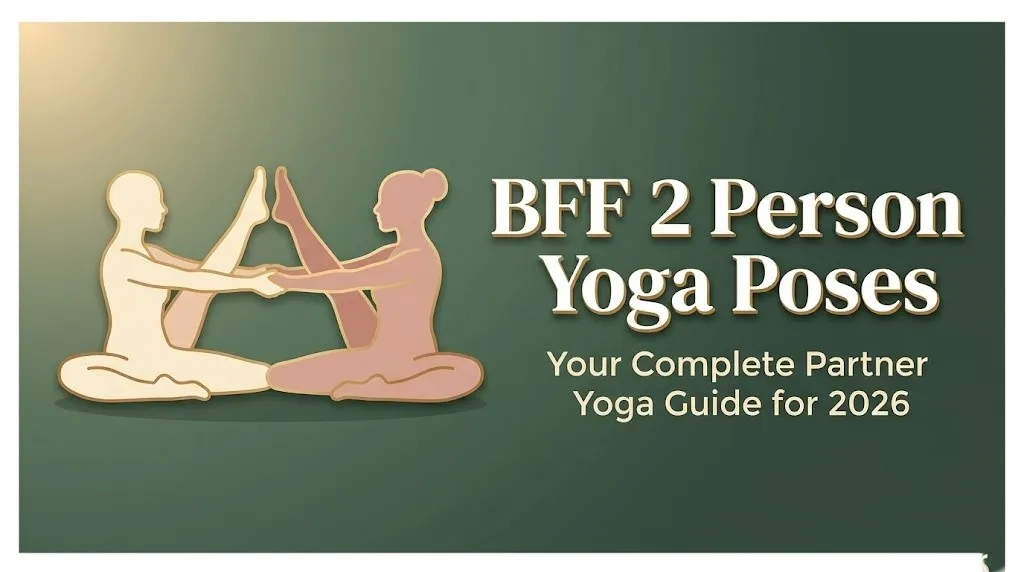
BFF 2 person yoga poses are shared postures where two people use each other’s weight, balance, and support to stretch further, hold longer, and connect more deeply than solo practice allows. Whether you and your best friend have never stepped on a mat before or you’ve both been practicing for years, partner yoga has a version that fits you.
Research published in Frontiers in Psychology found that synchronized physical activity between two people strengthens interpersonal trust and increases feelings of social bonding, even between people who already know each other well. Partner yoga is one of the most direct ways to get that effect.
This guide covers everything from the safest entry points for absolute beginners to genuinely challenging advanced poses, including step-by-step instructions, real Sanskrit pose names, safety notes, and modifications for different bodies and fitness levels.
BFF 2 Person Yoga Poses: What You Actually Need to Know
BFF 2 person yoga poses involve two people working as a single system, using counterbalance, weight sharing, and physical contact to achieve shapes neither person could hold as easily alone. This is not just a social activity. It is a structured physical practice with specific mechanics that require attention to alignment, breath, and communication.
Unlike solo yoga, where you are only responsible for your own body, partner yoga adds a second variable. Your partner’s weight, flexibility, and balance all directly affect your experience of a pose. A pose that feels stable solo can feel completely different when someone else’s hands are on your back or their feet are in your hip flexors.
The good news is that most bff 2 person yoga poses for beginners are genuinely accessible. You don’t need expensive equipment. You need two yoga mats, a clean floor surface, and a willingness to laugh when things don’t go perfectly the first time.
Pose Tip:
- Clear at least a 6-foot by 10-foot floor space before you start.
- Non-slip surfaces matter more in partner yoga than in solo practice.
- Wear fitted clothing so your partner can see your alignment clearly.
- Communicate before, during, and after every pose attempt.
What Is Partner Yoga?
Partner yoga is a practice where two people work together through shared poses, often using each other as a prop, counterweight, or source of resistance. It draws from multiple yoga traditions, most commonly Hatha yoga and Vinyasa yoga, and shares some overlap with the more acrobatic practice of acro yoga.
The defining feature of partner yoga is interdependence. Each person’s body supports and responds to the other. This creates a feedback loop that improves proprioception, which is the body’s ability to sense its own position in space. Working with a partner forces small, real-time adjustments that solo practice often doesn’t require.
Yoga Alliance describes partner yoga as a relational practice that extends the principles of traditional yoga, including breath awareness, mindful alignment, and present-moment attention, into a shared experience. It is practiced in studios, therapy settings, and increasingly at home between friends, family members, and couples.
| Practice Type | Solo or Partner | Acrobatic | Best For |
|---|---|---|---|
| Hatha Yoga | Primarily solo | No | Alignment, fundamentals |
| Vinyasa Yoga | Primarily solo | No | Flow, breath-movement |
| Partner Yoga | Two people | Minimal | Connection, assisted stretch |
| Acro Yoga | Two or three people | Yes | Strength, balance, trust |
| Restorative Yoga | Solo or assisted | No | Recovery, nervous system |
Benefits of Doing Yoga With a Friend
Practicing yoga with a friend offers physical, psychological, and social benefits that go beyond what you’d get from practicing alone. The physical gains include deeper stretching ranges, improved balance, and enhanced core activation through shared load. The social gains are just as real.
According to the National Center for Complementary and Integrative Health (NCCIH), yoga practiced regularly can reduce cortisol levels, lower blood pressure, and support improvements in mood and anxiety symptoms. When that practice happens with another person, the social component adds a layer of accountability and motivation that research consistently links to better long-term exercise adherence.
A study published in the International Journal of Yoga found that group and partnered yoga practices produced greater reductions in perceived stress compared to solo practice over an 8-week period. The researchers noted that the interpersonal synchrony of breathing and movement may play a role in those outcomes.
Key benefits of partner yoga include:
- Deeper passive stretching through gentle partner-assisted resistance
- Improved balance and proprioceptive feedback from shared weight
- Increased core engagement required by counterbalance poses
- Stronger communication skills between partners
- Greater accountability and enjoyment, which supports consistency
- Activation of the parasympathetic nervous system through cooperative touch
Key Takeaway: Partner yoga delivers measurable physical and psychological benefits beyond solo practice, largely because of the social synchrony and shared load it requires.
How to Do Partner Yoga Safely
Safe partner yoga requires clear, ongoing verbal communication before and during every pose. This single rule prevents more injuries than any alignment cue. Neither person should push, pull, or press further without asking first and receiving a clear yes.
Establish a simple signal system before your first pose. Agree on a word that means “ease off” and a word that means “deeper.” Many partner yoga teachers use “more,” “hold,” and “release” as their three essential signals. When your partner says “release,” you return to neutral immediately, without discussion.
The American College of Sports Medicine recommends that any loaded or balance-dependent activity begin with a proper warm-up to reduce injury risk and increase joint mobility before demanding holds. This applies directly to partner yoga, where the weight and leverage involved can be greater than typical solo poses.
Safety rules for every partner yoga session:
- Never force your partner deeper into a stretch. Apply gentle, consistent pressure only.
- Always support your own body weight unless the pose explicitly calls for full weight transfer.
- Check in verbally every 30 seconds during longer holds.
- Stop immediately if either person feels sharp, shooting, or joint-specific pain.
- People with acute back injuries, recent surgeries, or severe joint instability should check with a physical therapist before attempting partner poses.
How to Warm Up Before Partner Yoga
A 5 to 10 minute warm-up before partner yoga prepares the joints, warms the connective tissue, and gets both people tuned into their bodies before any shared load begins. This step is non-negotiable when poses involve counterbalance, forward folds, or back extension.
Think of your connective tissue like cold taffy. Cold taffy snaps. Warm taffy stretches. Warming up your hips, spine, wrists, and ankles before partner yoga is the difference between a session that feels good and one that leaves someone sore for three days.
Do this warm-up sequence together:
- Stand in Tadasana (Mountain Pose) side by side. Take 10 slow, synchronized breaths.
- Roll your shoulders backward 5 times each, then forward 5 times.
- Do 5 slow neck circles in each direction.
- Move through 5 rounds of Marjaryasana-Bitilasana (Cat-Cow Pose) on all fours, coordinating your breath.
- Hold Adho Mukha Svanasana (Downward-Facing Dog) independently for 5 breaths.
- Pedal your heels gently for 10 slow cycles.
- Come to a seated position and do 5 slow spinal twists in each direction.
- Shake out your wrists for 15 seconds before any pose involving hand contact.
Modification: If either partner has wrist sensitivity, substitute dolphin pose (forearms on the floor) for Downward-Facing Dog in the warm-up sequence.
Easy 2 Person Yoga Poses for Beginners
The easiest 2 person yoga poses for beginners are seated and standing poses that use light counterbalance rather than any lifting or weight stacking. These poses build trust, improve communication, and deliver a real stretch without requiring balance or strength beyond what most people already have.
Start here if neither of you has practiced yoga before. These poses teach you the fundamental mechanics of partner work: how to lean into each other, how to create resistance without forcing, and how to breathe together.
Partner Seated Forward Fold (Partner Paschimottanasana)
To practice this pose:
- Sit facing each other with legs extended straight in front of you in Dandasana (Staff Pose).
- Press the soles of your feet together, or place your feet alongside your partner’s feet if your legs are different lengths.
- Both reach forward and hold each other’s wrists or forearms.
- One partner gently leans back while the other folds forward. The leaning partner becomes the anchor.
- Hold for 5 to 8 breaths. Inhale to lengthen the spine. Exhale to deepen the fold.
- Release slowly and switch roles.
Muscles engaged: hamstrings, spinal erectors, latissimus dorsi, hip flexors
Modification: If either person has tight hamstrings or a rounded lumbar spine, bend both knees slightly. Sitting on a folded blanket tilts the pelvis forward and reduces strain on the lower back.
Safety note: Do not pull your partner sharply. Gentle, sustained traction only.
Seated Partner Yoga Poses
Seated partner yoga poses are the most accessible starting point for any two people because they eliminate balance demands and reduce injury risk while still offering real stretching and core benefits. The ground provides stability that standing and balance poses cannot.
Most seated partner poses work by using one partner’s grounded weight as resistance while the other partner opens into a stretch. This is called passive assisted stretching, and research published in the Journal of Alternative and Complementary Medicine notes it produces greater range-of-motion improvements than unassisted static stretching over time.
Partner Twist (Seated Parivrtta Variation)
To practice this pose:
- Sit back-to-back in Sukhasana (Easy Pose) or with legs crossed comfortably.
- Both partners sit tall and take one full breath to lengthen the spine.
- Both twist to the right simultaneously. Your right hand goes to your partner’s left knee. Your left hand goes to your own right knee.
- Hold for 5 breaths. Let each exhale deepen the rotation slightly.
- Unwind together on an inhale. Pause in center for one breath. Twist left.
Muscles engaged: obliques, thoracic rotators, spinal erectors, hip abductors
| Seated Pose | Stretch Target | Hold Duration | Beginner Friendly |
|---|---|---|---|
| Partner Forward Fold | Hamstrings, low back | 5 to 8 breaths | Yes |
| Partner Seated Twist | Thoracic spine, obliques | 5 breaths per side | Yes |
| Partner Butterfly (Baddha Konasana) | Inner groin, hip flexors | 6 to 10 breaths | Yes |
| Partner Wide-Leg Fold (Upavistha Konasana) | Inner thighs, adductors | 5 to 8 breaths | Moderate |
Standing Partner Yoga Poses
Standing partner yoga poses build on counterbalance mechanics, where both partners lean away from each other at matching angles to create shared stability that neither person could hold independently. These poses strengthen the legs, open the shoulders, and train the core to maintain alignment under lateral load.
The physics are simple: two people leaning away from each other at equal angles cancel each other’s instability. But that balance depends on both people being honest about their edge. Leaning too far too fast is the most common mistake in standing partner work.
Partner Standing Forward Fold (Partner Uttanasana)
To practice this pose:
- Stand back-to-back with about 6 inches of space between you.
- Both fold forward into Uttanasana (Standing Forward Fold).
- Reach your arms back and up. Find your partner’s hands or forearms.
- Gently walk your feet forward until you feel a sustainable stretch in the hamstrings and shoulder girdle.
- Hold for 5 to 8 breaths. Let gravity do the work.
- To release, bend your knees, walk your feet back, and rise slowly.
Muscles engaged: hamstrings, calves, deltoids, trapezius, spinal extensors
Modification: Keep a significant bend in both knees throughout if either partner has tight hamstrings or a history of lower back strain. Do not straighten the legs if it causes the lumbar spine to round aggressively.
Safety note: People with glaucoma, high blood pressure, or recent head injuries should avoid inverted forward folds. Modify by keeping the head above the heart throughout.
Key Takeaway: Standing partner poses use counterbalance physics to create stability. Both partners have to be honest about their edge for the mechanics to work.
Two Person Yoga Balance Poses
Two person yoga balance poses train proprioception, ankle stability, and core coordination simultaneously, because balancing with a partner creates instability that forces both people to adapt in real time. This is more neurologically demanding than solo balance work.
Solo balance poses like Vrikshasana (Tree Pose) already challenge your vestibular system and your ankle stabilizers. Add a second person to the equation and you’re now also processing your partner’s micro-shifts in weight and adjusting your own body accordingly. Research from the Frontiers in Psychology journal suggests that shared balance tasks may enhance interoceptive awareness, your ability to sense your own body’s internal state, even more effectively than solo balance training.
Twin Trees Pose (Double Vrikshasana)
To practice this pose:
- Stand side by side in Tadasana (Mountain Pose), close enough to touch.
- Press your inside hips together gently for shared stability.
- Both shift weight to your outside foot.
- Both bend your inside knee and place the sole of your inside foot against your inner calf or inner thigh. Never press against the knee joint itself.
- Reach your outside arm overhead. Press your inside palms together at heart height for balance support.
- Hold for 5 to 8 breaths. Keep your gaze (drishti) fixed on a point that does not move.
- Release together. Pause. Switch sides.
Muscles engaged: gluteus medius, hip abductors, tibialis anterior, core stabilizers, shoulder girdle
Modification: Keep the raised foot at the ankle rather than the calf or thigh if balance is limited. Use a wall behind both partners for additional support during the first few attempts.
Double Plank and Core Partner Yoga Poses
Core partner yoga poses use one person’s body as a moving or stationary load, which forces the supporting partner’s deep abdominal muscles, spinal stabilizers, and shoulder girdle to engage more intensely than solo core work typically demands. The result is a genuinely effective core training experience disguised as a fun partner challenge.
The double plank is the clearest example. One partner holds a strong Phalakasana (Plank Pose) while the other places their hands on the first partner’s ankles and their feet on the first partner’s lower back or hips, creating a second plank stacked above the first. This is intermediate to advanced and requires strong wrist and shoulder stability from both partners.
Partner Navasana (Double Boat Pose)
To practice this pose:
- Sit facing each other with knees bent and feet flat on the floor.
- Reach forward and hold each other’s wrists or forearms firmly.
- Both press the soles of your feet together, toes pointing upward.
- Lean back simultaneously, keeping the spine long and the chest lifted.
- Straighten your legs if your hamstrings allow. Keep knees bent if they don’t.
- Hold for 3 to 5 breaths. Lower slowly and rest.
Muscles engaged: hip flexors, rectus abdominis, transverse abdominis, spinal erectors, quadriceps
Modification: Keep knees significantly bent throughout. Bend one leg at a time if extending both creates sharp lower back discomfort. People with lumbar disc issues should work with a physical therapist before adding this pose.
Advanced Partner Yoga Poses
Advanced partner yoga poses involve full or significant weight transfer between partners, demanding strong individual yoga foundations, excellent communication, and usually prior experience with intermediate partner work. These are not poses to attempt in a first session.
Before attempting any advanced pose, both partners should be comfortable with the intermediate versions and able to hold solo poses like Virabhadrasana III (Warrior III) and Phalakasana (Plank Pose) steadily for at least 30 seconds. Rushing into advanced partner poses is the most common route to a preventable injury in partner yoga.
Flying Warrior (Partner Virabhadrasana III)
To practice this pose:
- The base partner stands in Tadasana (Mountain Pose) with a strong, stable stance.
- The flyer stands behind, placing their hands on the base’s shoulders.
- The base hinges forward at the hips, keeping their spine parallel to the floor.
- The flyer places both hands on the base’s hips and leans their torso forward.
- The base and flyer make eye contact and confirm readiness aloud.
- The flyer slowly lifts one leg behind them into Virabhadrasana III (Warrior III), using the base’s support for balance.
- Hold for 3 to 5 breaths. Both return to standing on the same exhale.
Muscles engaged: glutes, hamstrings, core stabilizers, spinal erectors, shoulder girdle, hip flexors
Safety caution: Neither partner should lock their standing knee. A microbend protects the joint under load. The base partner must communicate if they feel any strain in the lower back, and the flyer must keep their core engaged throughout.
Key Takeaway: Advanced partner poses require both people to have solid solo yoga foundations first. No amount of enthusiasm compensates for missing core or balance fundamentals.
Acro Yoga Poses for Two
Acro yoga combines traditional yoga, acrobatics, and Thai massage into a practice where one person acts as the base (usually lying on their back), a second person acts as the flyer (elevated in the air), and optionally a third person acts as a spotter. It is a distinct practice from partner yoga, and the distinction matters for safety.
In standard partner yoga, both people remain in contact with the ground. In acro yoga, the flyer is fully elevated, with their entire body weight supported by the base’s hands or feet. This changes the risk profile considerably. A 2019 review in the Journal of Alternative and Complementary Medicine noted that acro yoga injuries most commonly involve the wrists and shoulders of base practitioners and the lower back of flyers, particularly in unsupervised settings.
Beginner Acro: Bird Pose (L-Base)
To practice this pose:
- The base partner lies on their back, spine neutral, knees bent to 90 degrees.
- The flyer stands at the base’s feet, facing the base’s head.
- The base places both feet on the flyer’s hip bones (ASIS), not the soft belly tissue.
- Both reach and hold each other’s wrists firmly.
- The base straightens their legs slowly, lifting the flyer.
- The flyer extends their body into a straight line, arms wide for balance.
- Hold for 3 to 5 breaths. Bend the base’s knees slowly to descend.
Safety caution: A trained spotter is strongly recommended for any acro yoga lift until both partners have practiced the entry and exit 10 or more times. Do not attempt this on a hard floor without mats stacked underneath the flyer’s landing zone.
Partner Yoga for Different Body Types
Partner yoga works for two people of different heights, weights, and flexibility levels, but it requires choosing poses that match the actual mechanics of your specific pairing rather than assuming any pose will work the same way for everyone. One of the biggest myths in the partner yoga world is that counterbalance poses require matched body sizes.
In reality, the physics of counterbalance depend on angle and effort, not on identical bodies. A heavier partner leaning at a shallower angle and a lighter partner leaning at a deeper angle can achieve the same counterbalance equilibrium. The adjustment requires some experimentation, but it is absolutely achievable.
Where significant height or weight differences do matter is in any pose involving one person supporting the other’s body weight off the ground. These poses require the base to be strong enough to manage the load safely. That is a genuine physical requirement, not a body-shaming one.
| Body Type Pairing | Best Pose Category | Poses to Modify | Poses to Avoid Initially |
|---|---|---|---|
| Similar height and weight | All categories | Minimal | None if foundations are solid |
| Different heights, similar weight | Seated and standing | Standing forward fold (adjust stance) | Stacked plank |
| Similar height, significant weight difference | Seated and counterbalance | Flying poses (base must confirm capacity) | Any full lift |
| Very different height and weight | Seated and gentle stretching | Most standing balance poses | All acro lifts |
Modifications for Partner Yoga Beginners
Modifications for partner yoga beginners focus on reducing load, shortening range of motion, and adding props or ground contact until both partners build enough body awareness to attempt fuller expressions of a pose. The goal is always a version of the pose that feels genuinely productive, not a symbolic attempt at the full shape.
Yoga blocks are the single most useful prop for partner yoga beginners. A block under the sitting bones in seated poses reduces hamstring strain. A block under each hand in forward-bending poses keeps the wrists at a more neutral angle. A block between two partners can serve as a spacer that limits how far a partner can push into your stretch.
A yoga strap allows two partners to connect for a forward fold or seated stretch without needing to reach far enough to hold hands directly, which is a common limitation in beginner sessions where one partner is significantly less flexible.
Beginner modification options:
- Bend your knees in any forward fold if the lumbar spine rounds excessively.
- Use a folded blanket under the sitting bones in any seated pose to tilt the pelvis forward.
- Hold a strap between you instead of clasping hands directly when flexibility limits the connection.
- Stay lower in counterbalance poses. A 30-degree lean is a valid version. Ninety degrees is not required.
- Keep one hand on the wall during balance poses until both partners feel stable.
- Skip any pose that creates discomfort in a joint. Move to the next one without self-judgment.
Key Takeaway: Using props is not a shortcut. A block or strap that puts you in the correct alignment is more valuable than a prop-free version of the pose that hurts your back.
Partner Yoga for Seniors and Limited Mobility
Partner yoga is particularly well-suited for seniors and people with limited mobility because another person can provide the support, counterbalance, and gentle resistance that makes safe stretching possible without requiring the practitioner to get down on the floor or hold a pose independently. This changes the access equation considerably.
According to the National Center for Complementary and Integrative Health, yoga practiced by adults over 60 has been associated with improved balance, reduced fall risk, and better self-reported quality of life in multiple controlled studies. Partner yoga extends these benefits by adding a source of external stability that reduces the fear of falling, which is one of the primary reasons older adults avoid balance activities.
Chair-supported partner yoga is the most accessible entry point for seniors. Both partners sit in sturdy chairs facing each other. Seated twists, gentle shoulder stretches with interlaced fingers, and simple breathing synchronization exercises are excellent starting points.
Partner poses that work well for seniors and limited mobility:
- Seated Chair Twist: Both partners sit in chairs back-to-back. Twist toward each other and hold each other’s chair backs for a supported thoracic rotation.
- Supported Standing Forward Fold: One partner holds the back of a chair or a wall while the other provides gentle hand pressure on the upper back.
- Seated Butterfly with Partner Assist (Baddha Konasana variation): One partner sits in Baddha Konasana while the other applies gentle downward pressure on the outer thighs. Both must agree on the pressure level before and during the hold.
- Synchronized Breathing: Both partners sit comfortably and match breath pace. This activates the parasympathetic nervous system and is beneficial for people managing chronic pain or anxiety.
Safety note: Seniors with osteoporosis should avoid poses that involve spinal rotation under load or any forward fold deeper than 45 degrees without a physical therapist’s clearance.
Frequently Asked Questions About BFF 2 Person Yoga Poses
What are the easiest 2 person yoga poses for complete beginners?
The easiest 2 person yoga poses for beginners are the Partner Seated Forward Fold and the Partner Seated Twist, both performed on the floor with no balance demands.
These poses require only that both partners sit facing or back-to-back and use gentle pressure or counterweight to create a deeper stretch.
Start with 3 to 5 breath holds and focus on communication rather than depth.
Do you need to be flexible to do partner yoga with a friend?
You do not need to be flexible to start partner yoga. Most beginner partner poses work at whatever range of motion you currently have.
Flexibility improves gradually through consistent practice. Partner yoga actually accelerates flexibility gains because your partner can provide gentle assisted resistance.
The only requirement is honesty about your edge and willingness to communicate when a stretch is too intense.
How do you communicate with your partner during a yoga pose?
Agree on simple signal words before you begin: “more,” “hold,” and “release” cover most situations in partner yoga.
Use these words in real time throughout the pose. Don’t wait until something feels uncomfortable to speak up.
The best partner yoga sessions feel like a two-way conversation, not a silent competition to see how far you can push.
What is the difference between partner yoga and acro yoga?
Partner yoga keeps both people in contact with the ground at all times. Acro yoga involves one person (the flyer) being elevated off the ground entirely, supported by the other person (the base).
Acro yoga is significantly more demanding in terms of strength, balance, and skill. It typically requires instruction from a certified teacher before attempting lifts safely.
Partner yoga is appropriate for most beginners. Acro yoga is best approached after you have built a solid solo yoga practice and some experience with grounded partner poses.
Can two people with different body types do yoga poses together?
Yes. Seated poses, gentle counterbalance stretches, and breathing exercises work well for almost any pairing regardless of height or weight differences.
Some poses, particularly those involving one person supporting the other’s full body weight, require the base to have sufficient strength for the load involved. This is a physical requirement, not a body-type exclusion.
Start with grounded poses, build trust and body awareness together, and progress only when both partners feel genuinely ready.
Partner yoga does not require perfection. It requires two people willing to breathe together, listen to each other, and move with enough care that both of them walk away feeling better than when they started.
Pick one pose from this guide today. The Partner Seated Forward Fold is a strong starting point: no equipment, no experience needed, and you’ll feel the stretch in your hamstrings within the first breath. Practice it three times per week, add one new pose per session, and you’ll have a genuine shared practice within a month.
Your mat does not care how advanced you are. It cares that you show up.