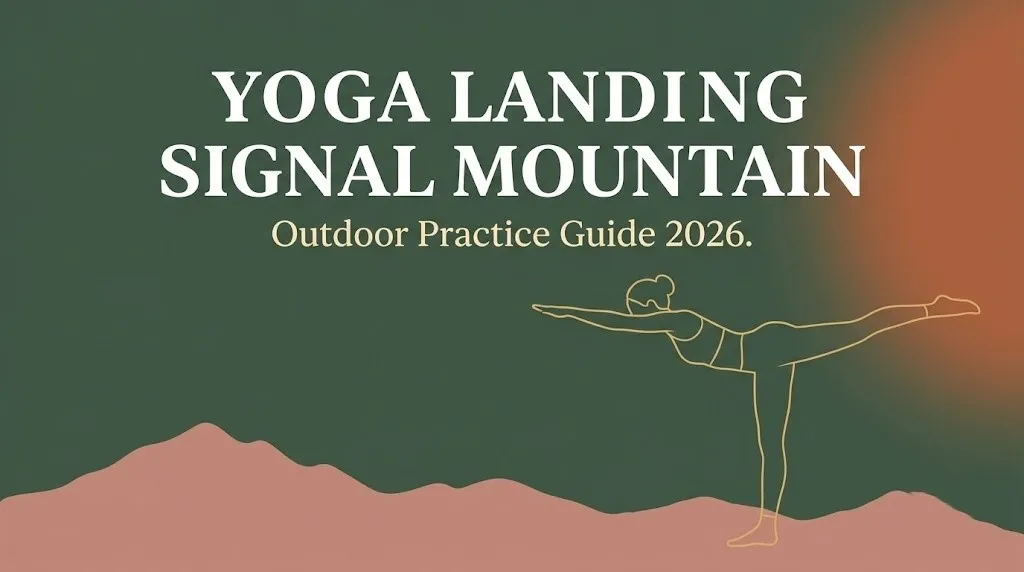
Yoga Landing Signal Mountain: Outdoor Practice Guide 2026
Yoga landing signal mountain refers to the intersection of outdoor yoga practice, safe pose transition technique, and the specific terrain and community of Signal Mountain, Tennessee. Whether you are looking for local classes near Chattanooga or learning how to practice yoga safely on mountain ground, this guide covers both with real instructional depth.
The National Center for Complementary and Integrative Health (NCCIH) reports that over 21 million Americans practice yoga regularly, and outdoor practice in natural settings is among the fastest-growing segments of that population. The demand for guidance on how to adapt yoga safely for trail and mountain environments has grown with it.
Here you will find everything from how to land safely in yoga pose transitions to which balance poses work best on outdoor terrain, how altitude changes your breath, and what Signal Mountain’s yoga community offers in 2026.
Yoga Landing Signal Mountain: What This Practice Actually Means
Yoga landing signal mountain describes the practice of bringing yoga to the specific environment of Signal Mountain, Tennessee, with particular attention to safe landing mechanics in pose transitions on outdoor terrain.
Signal Mountain is an incorporated town in Hamilton County, Tennessee, situated on a plateau overlooking the Tennessee River gorge and the Chattanooga valley. Its elevation, forested trails, and proximity to outdoor recreation areas make it a natural setting for outdoor yoga practice. Residents and visitors increasingly seek ways to combine their trail and hiking culture with yoga movement practice.
“Landing” in a yoga context refers to how the body contacts the ground during pose transitions. This includes how the foot makes contact during a step-forward from Adho Mukha Svanasana (Downward-Facing Dog), how the feet absorb load in Utkatasana (Chair Pose), and how the body drops into squats, lunges, or seated poses from standing. On mountain terrain, these mechanics matter more than they do in a flat studio.
Key concepts this guide addresses:
- Safe yoga pose landing technique on outdoor and uneven surfaces
- Local yoga resources on and near Signal Mountain, Tennessee
- Outdoor yoga adaptations for hikers, trail runners, and nature enthusiasts
- Breathwork modifications at elevation
- Specific balance and strength poses suited to mountain practice
Yoga Signal Mountain Tennessee: Finding Local Practice Options
Yoga near Signal Mountain, Tennessee is accessible through a combination of independent studio classes, community programs in the Chattanooga area, and outdoor group sessions that use the plateau’s parks and natural spaces as their studio.
The Chattanooga metropolitan area, which serves as the primary urban center for Signal Mountain residents, hosts multiple established yoga studios offering Hatha yoga, Vinyasa yoga, Yin yoga, and Restorative yoga formats. Studios within a ten to twenty minute drive of Signal Mountain’s peak are the most practical options for daily or weekly practice.
Community-based yoga classes on Signal Mountain itself tend to appear seasonally, particularly in warmer months. Local parks departments and community organizations occasionally host outdoor sessions on the bluff overlooks or in shaded picnic areas. These sessions are typically beginner-friendly and work well as a supplement to studio practice.
For residents who cannot make the drive to Chattanooga frequently, a home or outdoor practice is a realistic and research-supported option. According to research published in Complementary Therapies in Medicine, practice frequency predicts improvement more reliably than class format or setting. A consistent three-times-per-week home or outdoor session produces measurable gains in flexibility, balance, and stress reduction.
What to look for in a Signal Mountain area yoga class:
- Teacher credentials of RYT-200 or higher from Yoga Alliance
- Beginner-specific sessions or foundations series
- Props provided or clearly communicated in advance
- Teacher awareness of any student injuries or conditions
Outdoor Yoga Practice on a Mountain: What You Need to Know First
Outdoor yoga practice on a mountain requires more preparation than rolling out a mat in a studio. The variables of terrain, weather, surface stability, and sun exposure each affect how safely and effectively you can practice.
The first thing to establish is your surface. A grassy plateau or flat rock ledge offers more stability than a slope or a surface covered in loose soil or dry leaves. Think of your yoga mat on outdoor terrain the way you would think of a rug on ice: it provides grip against itself, but not against a surface that moves beneath it. A natural rubber mat with a textured underside performs better on outdoor surfaces than a standard PVC mat, which can slide on grass or compacted dirt.
Weather is the second consideration. Morning practice on Signal Mountain offers cooler temperatures and calmer wind conditions than afternoon sessions, which can see stronger thermal currents rising from the valley below. Direct sun exposure during outdoor practice increases fluid loss. Research suggests that even mild dehydration of two percent of body weight impairs physical coordination, balance, and cognitive focus, all three of which matter in yoga.
Essential preparation for outdoor mountain yoga:
- Check terrain for stability before placing your mat
- Bring water and drink before, not only after, practice
- Dress in layers you can remove as you warm up
- Avoid practicing on sloped surfaces for balance-intensive poses
- Let someone know your location if practicing alone in a remote area
Safety Caution: If thunderstorms are possible, do not practice on open ridges or elevated overlooks. Signal Mountain’s exposed bluff areas are unsuitable for outdoor practice during electrical storms.
Key Takeaway: The most important preparation for outdoor yoga on Signal Mountain is surface selection. A stable, flat surface makes every pose safer and every balance challenge more productive.
Yoga for Hikers and Outdoor Athletes: Why It Works
Yoga is one of the most targeted recovery and performance tools available to hikers and trail athletes, and the reason is anatomical specificity. Hiking loads the body in predictable ways: the hip flexors shorten from sustained uphill effort, the iliotibial band tightens from lateral stabilization on uneven ground, and the erector spinae fatigue from load-bearing posture over long distances.
Yoga addresses each of these systematically. Poses like Anjaneyasana (Low Lunge) directly counter the shortening of the hip flexors that accumulates during uphill hiking. Think of those muscles like a rubber band held in a shortened position for two hours. They need deliberate, sustained lengthening before the next effort, not just rest.
According to the American College of Sports Medicine, flexibility training combined with balance work reduces musculoskeletal injury risk in outdoor athletes. Yoga delivers both in a single session, making it particularly time-efficient for hikers who have limited recovery time between outings.
Benefits specific to hikers and trail users:
- Hip flexor lengthening through low lunges and standing backbends
- Ankle stability training through balance poses like Vrksasana (Tree Pose)
- Thoracic spine mobility to counteract forward-hunched pack-carrying posture
- Hamstring recovery through gentle forward folds after descents
- Gluteus medius strengthening to improve lateral stability on uneven ground
- Breath regulation to improve efficiency on sustained uphill efforts
Even two sessions per week of targeted post-hike yoga produces measurable improvements in flexibility and recovery speed, based on research patterns documented in the International Journal of Yoga.
Yoga Pose Landing Technique: The Mechanics That Keep You Safe
Landing technique in yoga refers to the way the body decelerates and makes contact with the ground during any movement that involves stepping, jumping, or lowering from one position to another. Done poorly, it creates repetitive stress in the knees, ankles, and lumbar spine. Done well, it distributes load efficiently and reduces injury risk.
The most common landing in yoga is the step-forward: moving the front foot from a kneeling or downward dog position to a lunge position. Many practitioners slam the foot down heavily, creating a sharp compressive force through the ankle and knee. The better approach is a controlled, deliberate placement.
The tibialis anterior (the muscle running along the shin) controls dorsiflexion and acts as the first brake in any foot landing. Engaging it consciously by pulling the toes back slightly before foot contact softens the landing and protects the ankle joint. The gluteus maximus and quadriceps should be engaged before foot contact, not after, to pre-load the joint system for absorption.
In jump-based transitions in Vinyasa yoga or Ashtanga yoga, the mechanics are the same but amplified. Landing with bent knees, soft feet, and active thighs is the standard cue for good reason: it distributes ground reaction force across the entire lower limb rather than concentrating it at the knee or ankle.
Pose Tip:
- Always land through the whole foot: heel, arch, ball, toes in sequence.
- Keep a micro-bend in the knee at the moment of foot contact.
- Engage the quadriceps before you land, not after the impact.
- On outdoor terrain, test the surface with one foot before committing your weight.
Modification: Beginners and people with knee or ankle concerns should avoid jump transitions entirely and always use slow, controlled steps instead.
Safe Landing in Yoga Transitions: Step-by-Step Guidance
Safe landing in yoga transitions is a teachable skill that improves with deliberate practice. Most beginners land passively. Experienced practitioners land actively, meaning they pre-engage the muscles responsible for deceleration before the foot contacts the ground.
The step-forward transition from Adho Mukha Svanasana (Downward-Facing Dog) to Anjaneyasana (Low Lunge) is the most commonly practiced landing in beginner yoga. It is also the most commonly performed incorrectly.
To practice the step-forward landing safely:
- From Downward-Facing Dog, take one breath to prepare.
- On the exhale, lift the right foot and draw the right knee toward the chest.
- Pause with the knee high. Engage the right quadriceps and gluteus maximus before moving forward.
- Slowly place the right foot between the hands, landing through the outer edge of the foot first, then rolling to the full foot.
- Check that the front knee is directly above the ankle, not beyond it.
- The back knee may lower to the ground. If so, place a folded blanket underneath for cushioning on hard or rough outdoor surfaces.
- Hold Anjaneyasana (Low Lunge) for five breath cycles before returning.
To practice a safe squat landing from standing:
- Stand in Tadasana (Mountain Pose) with feet hip-width apart.
- On the inhale, reach arms forward as a counterbalance.
- On the exhale, bend knees slowly, sitting back as if lowering onto a low seat.
- Keep heels grounded throughout the descent.
- Stop at whatever depth the knees and hips allow without pain.
- Hold for three to five breath cycles, then press through the heels to return.
Modification: For people with knee replacements or chronic knee pain, skip the squat descent below ninety degrees. For outdoor practice, stand near a tree or use trekking poles for support during any descent transition.
Key Takeaway: Landing in yoga is an active skill, not a passive event. Pre-engage your quadriceps and glutes before foot contact and you will protect your knees on any surface, indoors or outdoors.
Yoga on Uneven Terrain: How to Adapt Every Pose
Yoga on uneven terrain demands a recalibration of every pose you already know. The flat studio floor provides a predictable feedback surface. Mountain ground does not. Every time the surface shifts, your nervous system has to work harder to maintain balance, which is actually the training benefit.
Proprioception is your body’s ability to sense its position in space without looking. It is primarily managed by receptors in the muscles, tendons, and joints of the feet and ankles. Practicing yoga on slightly uneven ground, such as grass, packed dirt, or a gentle slope, actively trains proprioception in ways a flat floor cannot replicate.
Research published in the Journal of Alternative and Complementary Medicine supports the finding that balance and proprioceptive training through yoga significantly improves functional stability in adults, with effects measurable in as few as eight weeks of regular practice.
Adaptations for common poses on uneven terrain:
| Pose | Studio Version | Outdoor Terrain Modification |
|---|---|---|
| Tadasana (Mountain Pose) | Feet parallel, flat surface | Slight knee bend, weight evenly distributed |
| Vrksasana (Tree Pose) | Free balance | One hand touching tree or wall nearby |
| Virabhadrasana III (Warrior III) | Free balance, arms extended | Arms out to sides for counterbalance |
| Utkatasana (Chair Pose) | Heels flat | Reduce depth, wider stance for stability |
| Adho Mukha Svanasana (Downward Dog) | Flat hands and feet | Bend knees more, focus on arm stability |
| Anjaneyasana (Low Lunge) | Back knee may lower | Pad back knee with folded mat or blanket |
The key principle: reduce depth and reduce height. On uneven ground, a shallower lunge, a lower arm reach, and a wider stance all improve stability without reducing the benefit of the pose.
Yoga Balance Poses for Outdoor Practice: The Essential Five
Balance poses are the most directly transferable yoga skills for outdoor practice on Signal Mountain. Every trail walk requires single-leg stability. Every step over a root or rock is a single-leg balance moment. Training these shapes on a yoga mat, or better yet on outdoor ground, builds exactly the neuromuscular capacity that keeps you upright on the trail.
The five balance poses most useful for outdoor practitioners:
1. Vrksasana (Tree Pose)
Targets: gluteus medius, ankle stabilizers, hip external rotators.
Stand on one foot. Place the other foot on the inner calf or inner thigh, never directly on the knee. Bring hands to heart center or reach overhead.
Modification: Keep the toes of the lifted foot on the ground as a kickstand. Or stand with one hand touching a tree.
2. Virabhadrasana III (Warrior III)
Targets: hamstrings, gluteus maximus, erector spinae.
Hinge forward from a standing position, extending one leg back until the body forms a T-shape. Arms reach forward or out to sides.
Modification: Keep the hands on a tree, wall, or trekking poles.
3. Garudasana (Eagle Pose)
Targets: gluteus medius, ankle stabilizers, shoulder rotators.
Cross one thigh over the other. Wrap the arms. Sink slightly through the standing leg.
Modification: Skip the arm wrap. Keep arms out for balance.
4. Utkatasana (Chair Pose)
Targets: quadriceps, gluteus maximus, erector spinae.
Feet hip-width, bend knees as if sitting back. Arms overhead or hands at heart.
Modification: Reduce depth. Hold only three breath cycles initially.
5. Tadasana (Mountain Pose)
Targets: Deep core stabilizers, ankle proprioceptors.
The most underrated balance pose. Standing still on uneven ground with full body awareness is genuine proprioceptive training.
Modification: Perform with eyes closed on flat ground to intensify the proprioceptive challenge safely.
Key Takeaway: Balance poses are the single most practical yoga investment for anyone hiking or spending time on Signal Mountain trails. Practice them three times per week and your ankle stability will show measurable improvement within six to eight weeks.
Mountain Yoga Sequences for Beginners: Where to Start
A beginner mountain yoga sequence requires three qualities: simplicity, stability, and short hold times that allow the nervous system to adapt to outdoor conditions before demanding longer effort. Trying to replicate a studio Vinyasa class on your first outdoor mountain session is the fastest route to frustration.
Start standing. The ground beneath you is already doing more work than a studio floor. A standing-centered sequence respects that reality. It also keeps you ready to respond if conditions shift.
A beginner mountain yoga sequence (30 to 35 minutes):
- Tadasana (Mountain Pose): stand with feet hip-width, eyes soft, three minutes of natural breathing.
- Utkatasana (Chair Pose): five breath holds, two rounds.
- Anjaneyasana (Low Lunge): right leg forward, five breaths each side.
- Uttanasana (Standing Forward Fold): knees generously bent, five to eight breaths.
- Adho Mukha Svanasana (Downward-Facing Dog): five to eight breaths, knees bent as needed.
- Vrksasana (Tree Pose): five breaths each side, hand on tree if needed.
- Virabhadrasana III (Warrior III): three breaths each side, using tree support.
- Malasana (Garland Pose/Squat): five to eight breaths, heels on folded mat if they lift.
- Balasana (Child’s Pose): five to ten breaths as a reset.
- Savasana (Corpse Pose): five minutes on your mat, jacket over you if cool.
Modification: On days when the terrain feels particularly unstable, replace Virabhadrasana III with Virabhadrasana II (Warrior II) for a wider, lower base of support. Replace the squat with a seated cross-legged rest if the ankles resist dorsiflexion on uneven ground.
Yoga Breathwork at Altitude: Why Your Breath Changes
At higher elevations, the air contains the same percentage of oxygen as at sea level, but the lower atmospheric pressure means each breath delivers fewer oxygen molecules to the lungs. Signal Mountain’s elevation sits at approximately 2,100 feet above sea level, which is mild compared to high-altitude mountain destinations. Still, the change from Chattanooga’s valley floor is perceptible during vigorous activity.
Most practitioners notice that yoga feels slightly more effortful at elevation than at sea level, particularly in dynamic sequences. The respiratory rate tends to increase as the body compensates for reduced oxygen delivery per breath. This is a normal physiological response, not a sign of poor fitness.
Ujjayi breath (Ocean Breath) is particularly well-suited to outdoor yoga at elevation because it regulates pace and maximizes breath efficiency through a conscious elongation of the exhale. According to research patterns documented in the International Journal of Yoga, breath regulation techniques including Ujjayi practice reduce perceived exertion during yoga sequences by improving parasympathetic activation.
To practice Ujjayi outdoors at elevation:
- Breathe in through the nose for a count of four.
- On the exhale, gently constrict the back of the throat, producing a soft internal “hhhh” sound.
- Exhale for a count of six, extending it one count longer than the inhale.
- This extended exhale is the key mechanism for calming the nervous system.
- Continue for three to five minutes before beginning active poses.
Modification: If any breath technique produces dizziness at elevation, return to natural breathing immediately and rest in Balasana (Child’s Pose) until comfortable. Breath retention practices should be avoided at any elevation by people with cardiovascular conditions.
How Altitude Affects Yoga and Breathing: The Science Explained
Altitude affects yoga practice through a specific physiological cascade. Lower barometric pressure at elevation means the driving force that pushes oxygen across the lung membranes into the bloodstream is reduced. The body responds by breathing faster, increasing red blood cell production over time, and prioritizing oxygen delivery to vital organs.
At Signal Mountain’s modest elevation of approximately 2,100 feet, these effects are subtle but present for people who normally practice at much lower altitudes. The impact becomes more noticeable for visitors coming from sea-level cities who begin vigorous yoga practice immediately upon arrival.
The diaphragm does more work per breath at elevation to maintain adequate oxygen saturation. In yoga terms, this means poses that compress the diaphragm, such as deep twists, strong forward folds with the belly pressed against the thigh, or prone backbends compressing the abdomen, can feel noticeably more restrictive at altitude than in a valley studio.
Research published in Complementary Therapies in Medicine suggests that pranayama training over several weeks improves the efficiency of respiratory mechanics, allowing practitioners to extract more benefit from each breath regardless of elevation. Consistent breath practice at Signal Mountain altitude, even for a few minutes per session, builds adaptive respiratory capacity.
Practical adjustments for yoga at Signal Mountain elevation:
- Reduce the pace of any dynamic sequence by twenty to thirty percent on your first outdoor session.
- Allow longer rest intervals between standing balance poses.
- Prioritize breath over depth in every pose: a shallower pose with full breath beats a deep pose with held breath.
- Drink water before, during, and after outdoor practice since respiratory moisture loss increases at elevation.
Key Takeaway: At Signal Mountain’s elevation, your diaphragm works harder than it does at valley level. Slow your sequence, extend your exhale, and drink more water than you think you need.
Yoga for Physical Endurance and Hiking: What Research Shows
Yoga builds the specific physical capacities that translate most directly to hiking endurance: leg strength, hip mobility, ankle stability, and controlled breathing under sustained effort. These are not side benefits. They are the primary training outputs of a well-designed yoga practice.
A 2016 study published in the International Journal of Yoga found that twelve weeks of yoga practice produced measurable improvements in both aerobic capacity and muscular endurance in previously sedentary adults. The implication for hikers is direct: yoga does not just stretch you out after a trail. It builds the capacity to go farther and recover faster.
Utkatasana (Chair Pose) held for five breath cycles builds exactly the quadriceps endurance that makes sustained descent on steep trails manageable. Virabhadrasana III (Warrior III) trains the gluteus maximus and hamstrings in a single-leg loaded position that mirrors the mechanics of stepping over obstacles on a trail. These are not accidental benefits.
Specific yoga contributions to hiking performance:
- Quadriceps endurance: Utkatasana (Chair Pose), held sequences
- Hip flexor length: Anjaneyasana (Low Lunge), standing backbends
- Ankle stability: Vrksasana (Tree Pose), Garudasana (Eagle Pose)
- Breathing efficiency: Ujjayi pranayama, diaphragmatic breathing drills
- Spinal mobility: Bitilasana Marjaryasana (Cat-Cow Pose), supine twists
- Recovery speed: Yin yoga holds for connective tissue, Restorative yoga for nervous system reset
The American College of Sports Medicine identifies flexibility and balance training as essential components of injury prevention in recreational athletes. Yoga addresses both simultaneously.
Yoga Props for Outdoor Practice: What to Bring and Why
Outdoor yoga requires a different prop strategy than studio practice. Studio props are heavy, permanent, and abundant. Outdoor props need to be portable, weather-tolerant, and multi-purpose.
The most important item for outdoor yoga on Signal Mountain is a mat with genuine grip. Standard PVC mats become slippery on grass and shift on uneven ground. A natural rubber mat, or a cork-surface mat, performs significantly better on outdoor surfaces. Both provide more grip against natural ground than synthetic materials.
Beyond the mat, two items cover the vast majority of prop needs for outdoor practice:
| Prop | What It Does Outdoors | Substitute If Not Available |
|---|---|---|
| Yoga block (cork or foam) | Brings the floor up for tight hamstrings, supports the hand in lunges | Sturdy flat rock, backpack |
| Yoga strap or towel | Extends reach in hamstring and shoulder stretches | Bandana, belt, hiking belt |
| Folded blanket | Pads the back knee in lunges, provides warmth in Savasana | Rolled jacket, hiking pad |
| Trekking pole | Supports balance poses when hands need a prop | Tree trunk, sturdy branch |
A lightweight travel mat (under two kilograms) with a carry strap is the most practical investment for anyone planning regular outdoor yoga on Signal Mountain trails or overlooks.
Safety Note: Never place your mat on a surface you have not first checked by foot. Loose rock, wet leaves, and sloped ground covered by grass present real fall risks that a mat will not eliminate.
Yoga Modifications for Uneven Ground: Every Pose Has an Option
Every yoga pose can be adapted for uneven ground. The key principle is to reduce height, increase base width, and add a stability anchor wherever possible. Outdoor terrain is not a reason to skip yoga. It is a reason to practice smarter.
The modifications that apply most broadly to outdoor mountain yoga:
- Widen your stance in any standing pose. A wider base of support lowers your center of gravity and increases stability on unpredictable surfaces.
- Reduce your height in balance poses. A lower Vrksasana (Tree Pose) with the foot at the calf rather than the inner thigh is more stable and just as effective for training balance.
- Use a natural anchor. A tree, large rock, or trekking pole is a legitimate yoga prop outdoors. There is no virtue in avoiding support when the terrain demands it.
- Skip inversions outdoors. Headstands, shoulder stands, and handstands require precise surface stability that outdoor terrain rarely provides. Save these for a studio floor.
- Shorten hold times in balance poses on windy days. Wind creates an unpredictable external load on the body during single-leg poses. Three breath holds outdoors in wind equals five breath holds in a calm studio.
Modification guide by terrain type:
| Terrain | Key Adjustment | Best Pose Choices |
|---|---|---|
| Flat grass | Wider stance, grip mat | Full sequence safe |
| Packed dirt trail | Test surface first, wider stance | Standing poses, seated poses |
| Rock overlook | Footwear for grip, no inversions | Standing, seated, supine |
| Gentle slope | Face uphill for standing poses | Tadasana, seated breathwork |
| Deep soft ground | Narrow mat placement, no jumps | Seated, supine, gentle standing |
Key Takeaway: On uneven ground, width beats height in every pose. A wider, lower stance is not a beginner modification. It is the correct technique for the terrain.
Yoga Safety Tips for Outdoor Practice: Non-Negotiable Basics
Outdoor yoga on Signal Mountain is safe when approached with the same preparation you would bring to any outdoor activity at elevation. The risks are real but manageable with basic awareness.
The five non-negotiable safety practices for outdoor yoga:
- Tell someone where you are practicing. Solo outdoor yoga in remote areas carries the same basic safety requirement as solo hiking.
- Hydrate before your session begins. Thirst is a late signal. Begin drinking water thirty minutes before you start.
- Check weather before you leave. Signal Mountain’s exposed overlooks can become dangerous quickly if afternoon thunderstorms develop. The National Weather Service forecasts for Hamilton County cover Signal Mountain specifically.
- Wear appropriate footwear to and from your practice site. Practice barefoot or in grip socks on your mat, but use proper trail footwear for any walking to reach your outdoor practice spot.
- Do not practice alone near cliff edges. Signal Mountain’s bluff overlooks are spectacular. They are not appropriate surfaces for yoga practice, particularly balance poses or any movement that might involve an unexpected fall.
According to the NCCIH, yoga-related injuries most commonly involve the musculoskeletal system, with the lower back, shoulder, and knee as the most frequent sites. Outdoor practice adds terrain-related risk to this baseline. Most injuries are preventable with surface selection, appropriate modifications, and willingness to reduce ambition when conditions are not ideal.
Safety Caution: If you experience dizziness, shortness of breath beyond normal exertion, or chest discomfort during outdoor yoga at elevation, stop the session immediately and move to a flat, shaded area. These symptoms warrant evaluation by a healthcare provider familiar with exertion at altitude.
Frequently Asked Questions About Yoga Landing Signal Mountain
What is yoga landing technique and why does it matter?
Yoga landing technique refers to how the body makes controlled contact with the ground during pose transitions, including steps, lunges, and jumps.
Poor landing mechanics concentrate force in the knees and ankles, increasing the risk of repetitive stress injuries over time.
Pre-engaging the quadriceps and gluteus maximus before foot contact distributes load across the entire lower limb and protects the joints.
Is it safe to practice yoga outdoors on Signal Mountain?
Yes, outdoor yoga on Signal Mountain is safe when practiced on a stable flat surface away from cliff edges.
Choose grassy areas, flat rock ledges, or packed dirt trails with no significant slope for your mat placement.
Avoid exposed overlooks during afternoon hours when weather can change quickly, and always carry water.
How do I adapt yoga poses for uneven mountain terrain?
Widen your stance and reduce your height in every standing pose to lower your center of gravity on uneven ground.
Use a natural anchor such as a tree or trekking pole for any balance pose that feels unstable.
Skip inversions and jump transitions entirely on outdoor terrain; use slow, controlled steps instead.
Does altitude affect how hard yoga feels?
Yes, yoga feels noticeably more effortful at elevation because lower atmospheric pressure reduces the oxygen delivered per breath.
Signal Mountain sits at approximately 2,100 feet, which produces mild but real effects, especially for visitors from lower elevations.
Slowing your sequence pace by twenty to thirty percent and extending your exhale helps the body adapt to the reduced oxygen pressure.
What yoga poses are best for hikers and people who walk on trails?
Anjaneyasana (Low Lunge) is the most directly useful pose for hikers, counteracting hip flexor shortening from sustained uphill effort.
Vrksasana (Tree Pose) and Virabhadrasana III (Warrior III) build the ankle stability and gluteus medius strength that keep you upright on uneven trails.
Uttanasana (Standing Forward Fold) with bent knees releases accumulated tension in the hamstrings and calves after long descents.
Take Your Practice Outdoors, One Pose at a Time
Signal Mountain gives you something no studio can: real ground, real air, and real terrain that trains your body in ways a flat floor never will.
Start with Tadasana (Mountain Pose) on the grass and stay there for three minutes. Feel your feet respond to the surface. That proprioceptive conversation between your feet and the ground is already training you.
From there, add one balance pose per session. Practice three times per week. Bring water. Check the weather. Your body, your breath, and your balance will all improve, and the mountain is a better teacher than you might expect.