What Is Somatic Yoga? Benefits, Poses & Techniques 2026
Somatic yoga is a body-centered practice that blends yoga postures with somatic movement principles. It focuses on internal sensation rather than the external shape of any pose. The result is a slower, more introspective approach than most yoga styles you know.
The National Center for Complementary and Integrative Health reports that mind-body practices measurably reduce cortisol and support nervous system regulation. Chronic stress and habitual movement patterns cause muscles to stay contracted involuntarily. Thomas Hanna, who coined the term “somatics” in 1976, named this locked-muscle pattern sensorimotor amnesia. Somatic yoga addresses that pattern through slow, attentive movement and guided breath work.
This guide covers the definition, techniques, key poses, and beginner sequences for somatic yoga. You’ll find numbered instructions, comparison tables, and practical modifications for all levels. Specific sections address somatic yoga for chronic pain, stress, and sustainable daily home practice.
What Is Somatic Yoga?
Somatic yoga combines yoga postures with somatic movement principles to train internal body awareness. The practice asks you to pay attention to how your body actually feels as it moves, not to match an external shape or standard set by a teacher or a mirror.
The practice grew from the broader field of somatics, which studies how the body learns, holds tension, and can re-learn through mindful movement. Moshe Feldenkrais and Thomas Hanna are the two figures most responsible for building that field. Their research established that much of the chronic tension people carry is a learned neurological pattern, not a permanent structural limitation.
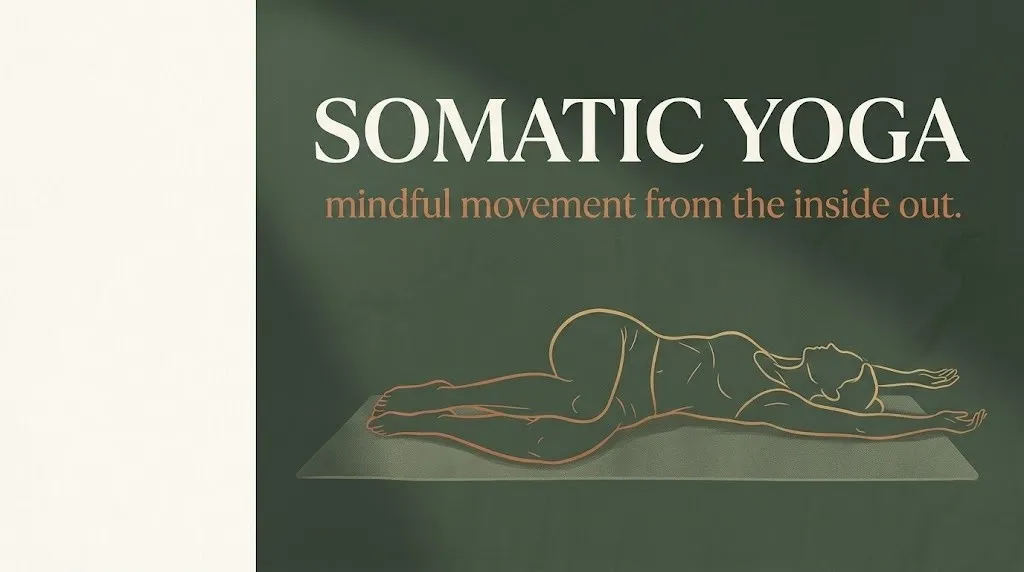
Somatic yoga is not a single trademarked style like Ashtanga or Iyengar yoga. Think of it as a methodology applied on top of traditional yoga structures. You could bring somatic principles into a Hatha yoga sequence or a Restorative yoga class. What changes is the quality of attention, not the list of poses.
According to the NCCIH, yoga practices that emphasize internal awareness and slow deliberate movement produce measurable effects on the nervous system, including reduced activation of the stress response and improved parasympathetic tone.
| Feature | How Somatic Yoga Applies It |
|---|---|
| Primary focus | Internal sensation, not external form |
| Pace | Slow and deliberate, with built-in pauses |
| Core method | Noticing sensation before trying to change it |
| Breath role | Sensory anchor, not a timing tool |
| Typical session length | 20 to 60 minutes |
| Equipment needed | Mat; optional bolster, blanket, or block |
Modification note: Every somatic yoga practice can be adapted to a chair. If floor work is uncomfortable, seated versions preserve the full neurological benefit of the practice without any loss of core function.
Somatic Yoga Definition: The Meaning of “Somatic”
The word “somatic” comes from the Greek soma, meaning the living body as experienced from within. In somatic yoga, that word signals a practice organized around internal bodily experience rather than external performance or appearance.
Thomas Hanna first used “somatics” as a field name in 1976, describing the study of the body-mind relationship as observed from the inside. His core insight: the body and the nervous system are not separate systems. They form one integrated process, and that process can be retrained through attentive movement.
Somatic yoga carries that insight directly into yoga practice. When you practice somatic yoga, you are not performing for a teacher or performing for a mirror. You are gathering sensory information and using it to guide how you move next. That self-directed loop is the mechanism that separates somatic yoga from most other forms of exercise.
Understanding the core vocabulary helps you get more from each session:
| Term | What It Means in Practice |
|---|---|
| Soma | The living body as experienced from the inside |
| Somatics | The study of body-mind processes through internal awareness |
| Sensorimotor amnesia | Muscles that have lost their ability to fully relax due to chronic stress or habit |
| Pandiculation | Contracting a muscle deliberately, then releasing it slowly to reset its resting tone |
| Interoception | The ability to perceive sensation arising from inside the body |
| Proprioception | The sense of body position and movement in space |
These are not abstract concepts. Each one describes a specific mechanism that makes somatic yoga function differently from conventional stretching. When you pandiculate rather than stretch, you re-engage the motor cortex, which holds direct authority over muscle tension levels. Stretching acts on tissue mechanically. Pandiculation acts neurologically. That distinction explains why some people find somatic yoga resolves tension that years of stretching never did.
How Somatic Yoga Differs from Traditional Yoga
Somatic yoga differs from traditional yoga in one foundational way: it measures success by quality of internal attention, not by reaching a specific pose shape. Traditional yoga styles define progress through physical benchmarks: deeper forward folds, longer balances, more difficult transitions.
In a standard Vinyasa yoga class, you move through sequences at a teacher-directed pace, matching breath to movement and working toward recognizable postures. In a somatic yoga session, you might spend five minutes in one position, making almost imperceptible movements and simply observing sensation. The value is in the noticing, not the achieving.
This difference shows up most clearly in how teachers give instruction. A Vinyasa teacher might cue: “Square your hips.” A somatic yoga teacher is more likely to ask: “Does your right hip feel higher or lower than your left?” One is a directive. The other is an inquiry. Both approaches are valuable. They develop different aspects of physical skill and body understanding.
| Feature | Somatic Yoga | Traditional Hatha/Vinyasa |
|---|---|---|
| Primary goal | Nervous system awareness and reset | Strength, flexibility, alignment |
| Instruction style | Observation and inquiry | Direction and correction |
| Pace | Slow, often paused | Rhythmic, breath-coordinated |
| Success criteria | Increased sensory awareness | Reaching or maintaining a pose shape |
| Muscle engagement | Deliberate contraction-release cycles | Sustained engagement or passive stretch |
| Suitability for chronic pain | Strong fit with proper guidance | Depends heavily on teacher training |
| Typical mood | Quiet and reflective | Energizing or deeply calming |
One clarification worth making: somatic yoga does not replace traditional yoga. Many practitioners combine both. Somatic yoga develops body literacy. Traditional yoga builds strength, range of motion, and cardiovascular conditioning. The two approaches address different needs and work well alongside each other.
Safety note: If you are transitioning from a fast-paced style, the slowness of somatic yoga can feel unfamiliar or even frustrating at first. That discomfort is normal. It usually eases within two to three sessions as your nervous system adjusts to gathering information rather than performing movement.
Key Takeaway: Somatic yoga works through internal attention and deliberate nervous system retraining, not through stretching harder, holding longer, or perfecting external pose shapes.
What Is Somatic Yoga Therapy?
Somatic yoga therapy is the clinical application of somatic yoga principles to address specific physical or psychological health conditions. It adapts somatic movement tools for people managing chronic pain, anxiety, trauma responses, or postural dysfunction, and it goes well beyond general wellness practice.
Somatic yoga therapists typically hold a 500-hour Yoga Alliance credential or a C-IAYT certification from the International Association of Yoga Therapists. Some physical therapists also integrate somatic movement principles into rehabilitation sessions. Clinical somatic yoga sessions are usually one-on-one, highly individualized, and grounded in structured assessment of the client’s specific movement patterns and symptoms.
A separate distinction matters here: somatic yoga therapy is not the same as somatic experiencing, the trauma therapy developed by Peter Levine in the late 1970s. Somatic experiencing is a licensed clinical mental health treatment. Somatic yoga therapy is a movement-based wellness intervention. Both work with the body’s stored stress responses, but through different mechanisms and within completely different professional frameworks.
Somatic yoga therapy is used to address:
- Chronic lower back pain driven by sustained muscle guarding and ingrained movement avoidance
- Shoulder and neck tension related to desk work, stress responses, or past injury
- Anxiety and stress through specific nervous system down-regulation practices
- Trauma-related tension held in the body’s musculature, addressed indirectly through guided movement
- Postural dysfunction including anterior pelvic tilt, thoracic rounding, and forward head positioning
- Fibromyalgia and widespread musculoskeletal discomfort
- Chronic fatigue associated with nervous system dysregulation
If you are managing a trauma history or a diagnosed mental health condition, a qualified somatic yoga therapist will be better equipped to support your practice than a general group class. Ask any potential teacher about their clinical training and relevant certifications before beginning.
Somatic Yoga Benefits
Somatic yoga produces benefits across the nervous system, musculoskeletal system, and psychological health. The practice works incrementally rather than producing immediate dramatic results, which is part of why it suits long-term pain management and stress reduction so well.
A 2021 meta-analysis published in Complementary Therapies in Medicine found that yoga-based interventions reduced anxiety symptoms across multiple adult populations, with slow mindful movement showing particular effectiveness in people experiencing chronic stress.
The benefits span multiple body systems:
| Body System | Benefit | Mechanism |
|---|---|---|
| Nervous system | Reduced cortisol; increased parasympathetic tone | Slow movement and breath activate vagal pathways |
| Musculoskeletal | Reduced chronic muscle tension; improved range of motion | Pandiculation resets resting muscle tone neurologically |
| Proprioceptive | Better position awareness; improved balance | Slow movement trains sensorimotor feedback loops |
| Respiratory | More efficient diaphragmatic breathing | Somatic breath awareness reduces upper-chest breathing patterns |
| Psychological | Reduced anxiety; improved sense of body safety | Interoceptive training builds trust in physical sensation |
| Cognitive | Improved present-moment attention | Sustained internal focus develops concentration over time |
People who benefit most from somatic yoga include those managing:
- Chronic back, hip, or shoulder pain
- Stress-related muscle tension in the shoulders, jaw, or diaphragm
- Anxiety and physical hypervigilance
- Post-injury rehabilitation requiring gentle movement retraining
- Age-related stiffness or reduced proprioceptive accuracy
- Poor coordination following a neurological event
Benefits build progressively. Somatic yoga teachers and physical therapists who work with somatic movement generally report that noticeable changes in resting muscle tension emerge over three to eight weeks of consistent practice. This timeline aligns with what neuroscience research shows about motor learning and neuroplasticity.
Somatic Yoga for Beginners: Where to Start
Somatic yoga is one of the most accessible starting points in all of yoga because it requires no flexibility, no fitness baseline, and no prior yoga experience. What it requires is the ability to slow down and pay attention, which is something most people can learn within the first session.
Your first somatic yoga session will likely feel unlike anything you expect from yoga. The movements are small. The pauses are long. Nothing will feel like a workout in the conventional sense. That unfamiliarity is part of the design, not a sign you are doing it wrong.
To set up your first somatic yoga session at home:
- Find a quiet space where you will not be interrupted for 20 to 30 minutes.
- Place a yoga mat or a soft rug on the floor. Add a folded blanket under your head for support.
- Wear loose, non-restrictive clothing. Nothing tight around the hips or chest.
- Turn off phone notifications. Somatic yoga depends on sustained internal attention.
- Begin lying on your back in Constructive Rest position: knees bent, feet hip-width apart, arms relaxed at your sides.
- Close your eyes. Spend five minutes noticing which parts of your back touch the floor and which float above it. Notice without trying to change anything.
- That body scan is your starting point. Everything in somatic yoga builds from there.
Quick Summary:
- No flexibility or fitness level required to begin
- Most movements take place lying on the floor
- A single 20-minute session is enough to notice the practice’s effects
- Props recommended: folded blanket under the head, optional bolster under the knees
- Skip any movement that produces sharp or shooting pain; mild unfamiliar sensation is normal
Modification for limited floor mobility: Somatic yoga can be practiced entirely in a firm chair. Sit toward the front edge of the seat and apply the same quality of slow internal attention to seated movements. The neurological benefit is identical.
Key Takeaway: Somatic yoga therapy addresses specific clinical conditions through one-on-one adapted practice; beginners can start at home with just a mat, a blanket, and 20 minutes of uninterrupted quiet.
Somatic Yoga Techniques: The Core Methods
Somatic yoga uses three specific techniques that set it apart from conventional yoga: pandiculation, body scanning, and somatic breath awareness. Understanding how each works makes the practice significantly more effective.
Pandiculation is the most distinctive and least understood. Think of the full-body stretch a cat makes upon waking: it contracts along its entire spine, yawns deeply, then slowly releases everything back to neutral. That action is pandiculation. Your body uses this same mechanism instinctively every morning. Somatic yoga applies it deliberately to muscles stuck in chronic contraction.
To practice pandiculation on the lower back:
- Lie on your back with knees bent, feet flat, arms resting at your sides.
- Slowly arch your lower back away from the floor, contracting the lumbar muscles. Use roughly 50% of your available effort. Do not force or grip.
- Hold the contraction for three to five seconds. Breathe normally throughout.
- Begin releasing the contraction extremely slowly, aiming to take twice as long to release as you took to contract.
- Let the lower back return to a neutral or slightly flattened resting position.
- Rest for ten to fifteen seconds. Notice any change in sensation, weight distribution, or contact with the floor.
- Repeat the full cycle two more times before moving to a different area of the body.
Body scanning directs attention systematically through the body, starting at the feet and moving upward. The goal is not relaxation. The goal is accurate information: where tension is held, where the body feels heavy or light, where floor contact is even or asymmetrical. You observe first. Movement comes after.
Somatic breath awareness is different from pranayama. Rather than controlling the breath, you observe how it moves. Does the breath reach your lower belly? Does one side of the ribcage expand more than the other? These observations guide the practice without imposing force.
Modification for acute pain: Reduce pandiculation effort to 20% or skip the affected area entirely if any contraction produces sharp pain. Work on the surrounding musculature and return to the painful area after the surrounding tissue has released.
Somatic Yoga Exercises You Should Know
Somatic yoga exercises are neurologically focused, not mechanically focused. They work by re-engaging the motor cortex’s authority over muscle tone. That is something passive stretching cannot do, because stretching acts only on the tissue itself.
The five foundational exercises are:
- Pelvic Clock (supine position): Lying with knees bent and feet flat, imagine a clock face on your pelvis. 12 o’clock sits at your navel; 6 o’clock sits at your tailbone. Slowly tilt the pelvis to each clock position, pausing at each one to notice sensation. Move through the full face over two to three minutes. This separates lumbar-pelvic movement from full spinal bracing and directly addresses chronic lower back tension. It draws from the Feldenkrais Method and is widely used in somatic yoga contexts.
- Somatic Marjaryasana/Bitilasana (Cat-Cow variation): On hands and knees, move through spinal flexion and extension at one-third your usual speed. Stop at any point in the range and breathe. Notice which vertebral areas move freely and which feel absent or stuck. The somatic version maps sensation, not a visual image of the pose.
- Side-Lying Leg Swing: Lying on your side with hips stacked and knees gently bent, slowly swing the top leg forward and back with minimal effort. Let it travel only as far as it naturally wants to go. This retrains the hip flexors and extensors through their natural range without overriding the nervous system’s protective limits.
- Supine Arm Reach: Lying on your back, slowly raise one arm toward the ceiling and notice how the shoulder blade responds. Does it stay flat against the floor or does it lift? Does the ribcage rotate? Return the arm slowly and compare sides. This trains shoulder girdle proprioception.
- Floor Spinal Wave: From a supine position, initiate a slow rolling wave from the tailbone upward through each vertebral level to the top of the head. One full cycle can take two to three minutes. Each spinal segment contracts and releases in turn, systematically resetting the muscles along the entire spine.
Modification for all exercises: Every exercise above can be adapted to a reclined chair or a supported seated position if lying on the floor is not accessible. The neurological learning transfers identically.
Somatic Yoga Poses: The Essential Six
Somatic yoga draws directly from the traditional yoga pose library but applies those poses differently. The shape of the pose provides context. The quality of internal attention during the pose is the practice itself.
The six poses most commonly used in somatic yoga, with their Sanskrit names, muscle targets, somatic instruction, and modifications:
| Pose (Sanskrit) | English Name | Primary Muscles | Somatic Instruction | Modification |
|---|---|---|---|---|
| Balasana | Child’s Pose | Hip flexors, spinal extensors, latissimus dorsi | Notice where the spine rounds most and least | Bolster between thighs and chest for support |
| Marjaryasana/Bitilasana | Cat-Cow Pose | Erector spinae, rectus abdominis, diaphragm | Sequence one vertebra at a time, not as one motion | Reduce range; stay in comfortable mid-range only |
| Supta Matsyendrasana | Supine Spinal Twist | Thoracic rotators, piriformis, IT band | Notice which ribs stay fixed and which rotate freely | Blanket under knees; use minimal rotation |
| Setu Bandha Sarvangasana | Bridge Pose | Gluteus maximus, hamstrings, spinal extensors | Peel the spine off the floor one vertebra at a time | Keep the lift low; focus on segmentation, not height |
| Apanasana | Knees-to-Chest Pose | Hip flexors, lumbar extensors | Rock gently side to side; notice the lower back softening | Hold one knee at a time to reduce hip flexor load |
| Viparita Karani | Legs-Up-the-Wall Pose | Hamstrings, calves, diaphragm | Notice the belly softening with each exhale | Folded blanket under the sacrum for support |
Pose Tip:
- In every somatic yoga pose, less effort produces more neurological feedback
- Slower movement always provides richer sensory information
- Pause in each pose for at least five full breath cycles before transitioning
- Observe before adjusting: notice the sensation, then respond to what you actually feel
Safety note for Supta Matsyendrasana (Supine Spinal Twist): People with acute disc herniation should avoid this pose or limit rotation to a very small range until they have consulted with a spine specialist or physical therapist.
Key Takeaway: The somatic version of every yoga pose is defined by slower movement, reduced effort, and the quality of internal attention, not by reaching a deeper or more impressive shape.
How to Build a Somatic Yoga Routine
A somatic yoga routine does not need to be long to be effective. Research on motor learning consistently shows that short, frequent practice sessions build new neurological patterns faster than infrequent long ones.
Every effective somatic yoga routine follows the same arc: a body scan to orient your attention inward, movement exploration to gather sensory information, then stillness at the end to allow the nervous system time to consolidate the changes that occurred during practice.
| Time Available | Routine Structure | What to Include |
|---|---|---|
| 15 minutes | Short daily tune-up | Body scan (3 min), 2 somatic exercises (10 min), rest (2 min) |
| 30 minutes | Standard home practice | Body scan (5 min), 3 to 4 poses with somatic instruction (20 min), Savasana scan (5 min) |
| 45 to 60 minutes | Full session | Body scan (5 min), warm-up movement (10 min), 5 to 6 poses (25 min), floor sequence (10 min), Savasana (10 min) |
Morning is an excellent time for somatic yoga because sensorimotor patterns from sleep carry directly into your waking movement. Practicing first thing gives you clear feedback on which areas hold overnight tension. An evening practice also works well, as it signals the nervous system toward rest and supports people managing stress-related insomnia.
Practice frequency matters more than session length. Somatic yoga teachers and physical therapists generally recommend three to five sessions per week. A daily 15-minute practice builds patterns faster than one long weekly session, because nervous system retraining depends on repeated exposure.
Modification for scheduling: A five-minute body scan on waking counts as a somatic yoga practice. If 15 minutes feels like too much to start, begin with five and allow the duration to extend naturally as the habit forms.
A Somatic Yoga Sequence for Daily Practice
This 30-minute somatic yoga sequence is designed for home practice without any props beyond a mat and a blanket. Each pose is held longer and approached more slowly than in a standard class. Sense what you actually feel, not what you think you should feel.
To practice this full sequence:
- Constructive Rest / Body Scan (5 minutes): Lie on your back, knees bent, feet hip-width apart, arms relaxed at your sides. Close your eyes. Notice which parts of your back contact the floor and which float above it. Scan from feet to head. Do not try to change anything.
- Apanasana, Knees-to-Chest Pose (2 minutes): Draw both knees gently toward your chest. Hold loosely. Rock from side to side slowly. Notice how your lumbar spine softens against the floor with each rock.
- Pelvic Clock (3 minutes): Feet flat, knees bent. Slowly tilt the pelvis through its full clock range, pausing at any position where you sense asymmetry or restriction. Notice, then move on.
- Marjaryasana/Bitilasana, Cat-Cow (4 minutes): On hands and knees. Move at half your usual speed. Pause at each end of the range for two full breaths. Notice which vertebral segments move least.
- Balasana, Child’s Pose (3 minutes): Rest in Child’s Pose. Breathe into the back body. With each inhale, notice how the ribcage expands. With each exhale, allow the spine to lengthen.
- Setu Bandha Sarvangasana, Bridge Pose (4 minutes): Lift the spine one vertebra at a time, not as a single solid movement. Hold at the top for three breath cycles. Descend even more slowly than you rose.
- Supta Matsyendrasana, Supine Spinal Twist (3 minutes per side): Rotate gently into the twist. Let the legs rest into the position rather than pressing them toward the floor. Notice where rotation wants to stop naturally.
- Viparita Karani, Legs-Up-the-Wall Pose (5 minutes): Rest legs against a wall or on the seat of a chair. Let the belly go completely soft. Breathe slowly without directing the breath.
- Savasana with body scan (3 minutes): Return to flat lying. Repeat the opening body scan and notice what has changed: which areas now rest more fully on the floor, where the breath moves more freely.
Modification for the full sequence: Any pose can be skipped or replaced with its chair equivalent. The sequence works whether you practice three poses or nine, as long as the quality of attention remains consistent throughout.
Somatic Movement Yoga and the Mind-Body Connection
Somatic movement yoga is the application of movement neuroscience to yoga practice. It draws on research in motor learning, interoception, and body schema to explain why slow attentive movement produces lasting physical change.
The brain and the muscles are in constant two-way communication. The motor cortex sends contraction signals. The sensory cortex receives feedback about the result. In people with chronic muscle tension, this feedback loop becomes degraded over time. Muscles stay contracted because the nervous system has lost accurate information about what the body is actually doing at rest. The cortex continues issuing a contraction command out of habit, even when the original stressor is gone.
A 2020 review published in Frontiers in Psychiatry found that somatic-based movement interventions, including mindful yoga practices, produced measurable improvements in interoceptive awareness and reduced somatic symptom burden in people with trauma histories and chronic stress.
Three concepts form the foundation of somatic movement yoga:
- Sensorimotor amnesia: The neurological pattern in which chronically stressed or overused muscles lose their ability to return to a resting state. Named by Thomas Hanna. Not a structural problem; a learned pattern that can be unlearned.
- Motor learning: The nervous system’s capacity to form new, more efficient movement patterns through repeated attentive practice. The slower and more deliberate the practice, the more precise the motor pattern formed.
- Body schema: The brain’s internal map of the body’s position, shape, and movement capacity. Somatic yoga consistently updates and refines that map through sensory attention, improving coordination, proprioception, and pain processing over time.
Somatic movement yoga is not a replacement for physical therapy or medical care. It works most effectively as a complement, helping the nervous system consolidate and maintain the improvements made through clinical treatment.
Key Takeaway: Somatic movement yoga works by refining the nervous system’s internal map of the body, not by increasing tissue flexibility or building more muscle strength.
Somatic Yoga for Back Pain and Chronic Pain
Somatic yoga addresses back pain and chronic pain through a neurological approach: the goal is to retrain the motor cortex’s hold on muscles that have become stuck in chronic involuntary contraction.
Most chronic back pain does not stem from structural damage alone. The Spine Journal and related peer-reviewed literature have documented that muscle guarding, where surrounding muscles contract protectively around an injured area, commonly persists long after the original injury has resolved. That persisting contraction is sensorimotor amnesia in action. Somatic yoga targets that specific pattern rather than the tissue mechanics.
A 2018 systematic review published in the Journal of Alternative and Complementary Medicine found that yoga-based interventions reduced chronic lower back pain intensity and improved functional mobility in adults, with the most consistent effects seen in practices emphasizing slow, body-aware movement over strength or flexibility training.
Key somatic yoga practices for back pain include:
- Pelvic Clock exercise: Isolates movement through the lumbar-pelvic region, interrupting the full-spine bracing reflex that drives much chronic low-back tension
- Somatic Setu Bandha Sarvangasana (Bridge Pose): Retrains the gluteus maximus and hamstrings to share the load more evenly with the lumbar extensors
- Apanasana (Knees-to-Chest Pose): Delivers feedback about lumbar tension without adding compressive force to the discs
- Constructive Rest with body scan: Teaches lumbar muscles to release protective contraction while in a fully supported, gravity-neutral position
Safety guidance: If back pain radiates down the leg, causes numbness or tingling, or is accompanied by changes in bladder or bowel function, stop practice and see a spine specialist before continuing. Those symptoms can indicate nerve compression that requires medical evaluation first. Somatic yoga can support recovery after that evaluation, but it should not substitute for it.
Modification: During acute lower back pain flares, limit practice to body scanning and constructive rest. Avoid spinal flexion movements (Cat pose) with an acute disc herniation until working with a physical therapist or spine-informed yoga therapist.
Somatic Yoga for Anxiety and Stress
Somatic yoga addresses anxiety and stress by working directly with the nervous system, specifically by activating the parasympathetic branch and building a person’s capacity to remain present with physical sensation without escalating.
Anxiety creates a reinforcing cycle. The body tightens, the breath shortens, and the nervous system reads those physical signals as evidence of ongoing threat. Somatic yoga interrupts that cycle by training the body to stay present with sensation rather than treating it as an alarm. Over time, that retraining changes the default threshold at which the stress response fires.
According to the NCCIH, yoga practices that emphasize slow movement, breath awareness, and body-focused attention have been shown in multiple randomized controlled trials to reduce biological markers of stress, including cortisol and inflammatory cytokines.
Somatic yoga techniques particularly effective for anxiety include:
- Extended exhale breathing during body scan: An exhale longer than the inhale activates the vagal brake, a mechanism of the parasympathetic nervous system that directly reduces heart rate and anxiety-related arousal
- Viparita Karani (Legs-Up-the-Wall Pose): Passive inversion calms the nervous system and reduces sympathetic activation without any muscular effort
- Slow somatic Marjaryasana/Bitilasana (Cat-Cow): Rhythmic spinal movement at a slow pace promotes sensory grounding and reduces cortisol according to NCCIH-reviewed research
- Yielding practice: Lying fully supported on the floor and allowing gravity to take your full weight is one of the most direct somatic interventions for hypervigilance, because the body receives clear sensory information that it is held, supported, and not in danger
People managing panic disorder, generalized anxiety disorder, or post-traumatic stress will benefit from working with a qualified somatic yoga therapist rather than attending a general group class. A trained therapist will adjust intensity, pacing, and which sensations to attend to based on each person’s specific nervous system patterns.
Modification: If internal body awareness exercises increase anxiety rather than reduce it, start with external sensory anchors instead. Noticing the feeling of feet on the floor or hands on the thighs is less activating than full internal body scans for people with high baseline anxiety. Build inward from there gradually.
Free Somatic Yoga Exercises to Try at Home
Free somatic yoga exercises require only a floor, a blanket, and your attention. No subscriptions, no special equipment, and no prior yoga experience are needed to begin today.
These five exercises form a complete 15-minute home practice:
- Constructive Rest Body Scan (5 minutes): Lie on your back, knees bent, feet hip-width apart, arms resting at your sides. Close your eyes. Notice which parts of your back contact the floor and which float above it. Slowly move attention from feet to head. Do not try to relax. Simply observe. This is the foundation of all somatic yoga practice. Modification: If lying flat is uncomfortable, elevate the upper body with a folded blanket or practice this exercise seated in a firm chair.
- Pelvic Tilt Exploration (3 minutes): From Constructive Rest, very slowly arch your lower back away from the floor, then gently press it toward the floor. Move at one-quarter your usual pace. Notice whether one direction feels easier or more familiar than the other. Do not force either end of the range. Modification: Reduce the movement to the smallest detectable tilt if you have acute lower back pain.
- Somatic Shoulder Blade Flattening (3 minutes): Still lying on your back, slowly slide one arm along the floor until it reaches a comfortable position overhead. Notice whether the shoulder blade lifts off the floor or stays flat. Return the arm slowly. Repeat on the other side and compare. Modification: Keep the arm at a lower angle if shoulder mobility is limited.
- Somatic Hip Rocking (2 minutes): With knees drawn up and feet flat, slowly let both knees fall to one side. Notice the rotation through the lower back and the natural stopping point of the hip. Do not press the knees toward the floor. Let them rest wherever they land. Return and switch sides slowly. This is a gentle entry into Supta Matsyendrasana (Supine Spinal Twist). Modification: Place a folded blanket between the knees and the floor to reduce hip strain.
- Closing Body Scan Rest (2 minutes): Return to Constructive Rest. Repeat the opening body scan slowly, from feet to head. Notice what has changed: which areas now contact the floor more fully, where the breath moves more easily, which spots still hold some residual tension. No action is needed. Noticing is the practice.
Short daily practice builds neurological patterns faster than occasional longer sessions. The NCCIH and motor learning research both support this model of frequent, brief, attentive practice over less frequent intensive effort.
Key Takeaway: Somatic yoga’s most effective home exercises cost nothing and take as little as 15 minutes, but their impact on chronic tension depends on consistency, not on intensity or duration.
Frequently Asked Questions About Somatic Yoga
What is the difference between somatic yoga and regular yoga?
Somatic yoga prioritizes internal sensation and nervous system retraining over the external appearance of any pose. Regular yoga typically guides practitioners toward specific shapes or alignment benchmarks, with success measured by reaching those targets. The core difference is the direction of attention: somatic yoga turns it inward; most yoga styles direct it outward toward form.
Is somatic yoga good for beginners with no yoga experience?
Somatic yoga is one of the most beginner-accessible practices available because it requires no flexibility, strength, or prior movement experience. The learning curve is perceptual rather than physical: you are learning to pay attention to sensation, not to perform any particular action. Most practitioners notice a meaningful shift in body awareness within two to three sessions.
How often should you do somatic yoga to notice results?
Somatic yoga teachers and physical therapists generally recommend three to five sessions per week to produce noticeable nervous system changes. A 15-minute daily practice builds new movement patterns faster than a single 90-minute weekly session, because neurological retraining depends on repetition. Start with whatever frequency you can sustain consistently, even a five-minute morning body scan, and build from there.
Can somatic yoga help with chronic pain?
Research reviewed in the Journal of Alternative and Complementary Medicine supports yoga-based practices for chronic pain, particularly when they emphasize slow, body-aware movement over physical intensity. Somatic yoga specifically addresses the neurological component of chronic pain, targeting the muscle guarding and sensorimotor amnesia that persist after the original injury has healed. For pain accompanied by neurological symptoms such as radiating pain or numbness, work with a physical therapist or spine specialist alongside any somatic yoga practice.
What should I expect in a somatic yoga session?
A somatic yoga session typically begins with a lying-down body scan, moves through slow floor-based movement, and ends in a supported rest position with a final scan. Nothing will feel like an intense workout. Movements are small and slow, designed to generate sensory information rather than physical effort. Most people report feeling measurably lighter, less tense, and more physically present after even a single session.
Closing
Start with one exercise today. The Constructive Rest body scan takes five minutes and requires nothing beyond a mat and a quiet room. That is enough to begin building the internal attention somatic yoga depends on.
Aim for three sessions a week as your baseline. Practice before you stretch. Notice before you adjust. Let what you actually feel guide the movement, rather than forcing the body toward a shape it is not ready for today.
Somatic yoga changes slowly and durably. The nervous system learns through repetition, not through intensity. Begin small, stay consistent, and give your body time to do what it already knows how to do.