Third Eye Yoga: Poses, Benefits & Safety Guide 2026
Third eye yoga refers to yoga poses, breathing practices, and meditations that target the Ajna chakra, the sixth energy center located between the eyebrows, to sharpen focus, reduce mental chatter, and improve mind-body awareness. This isn’t purely mystical territory: many of the practices associated with third eye yoga have documented neurological and physiological effects that modern research is actively investigating.
The National Center for Complementary and Integrative Health reports that yoga and meditation practices consistently show measurable effects on attention, stress response, and sleep quality across dozens of peer-reviewed studies. A 2019 review published in Frontiers in Psychology found that mindfulness-based yoga reduced anxiety and improved attentional control in both novice and experienced practitioners.
This guide covers what the third eye chakra is anatomically and energetically, which specific poses and breathing techniques are associated with it, how to practice them safely, who should modify or skip certain practices, and how to build a complete sequence from scratch. Whether you are entirely new to chakra-based yoga or looking to refine an established practice, you’ll find something practical and evidence-informed here.
Third Eye Yoga
Third eye yoga is a branch of yoga practice that intentionally directs awareness, physical posture, and breath to the region of the forehead and prefrontal cortex, combining physical poses with focused meditation and pranayama.
The term “third eye yoga” covers a wide range of practices. At the physical level, it includes forward folds, inversions, and specific seated postures that bring the forehead toward the floor or increase blood flow to the brain. At the energetic level, it draws on the traditional chakra system of classical Hatha and Kundalini yoga, where Ajna is described as the center of higher perception, inner vision, and mental integration.
What makes third eye yoga distinct from general yoga is the deliberate internal focus. Practitioners are often cued to draw their Drishti (focused gaze point) toward the eyebrow center, hold specific mudras (hand or eye gestures), and pair breath retention with inward attention.
This practice sits at the intersection of ancient tradition and modern neuroscience. Research on interoception, the body’s ability to sense its own internal state, suggests that practices emphasizing internal focus activate brain regions associated with self-regulation and emotional processing, as noted in a 2021 paper in Complementary Therapies in Medicine.
Beginner tip: You don’t need to believe in chakras to benefit from third eye yoga. The attention-focusing techniques, the pranayama, and the forward fold postures all have independently documented benefits, regardless of your philosophical framework.
Ajna Chakra Yoga
Ajna chakra yoga is the traditional yogic system from which most third eye yoga practices originate, centering on the sixth chakra as the seat of intuition, clarity, and integrated perception.
In classical Sanskrit, “Ajna” translates roughly as “command” or “perceive.” The Ajna chakra is described in traditional texts including the Shat Chakra Nirupana (a 16th-century Sanskrit text) as residing at the point between the eyebrows, corresponding physically to the space behind the forehead where the brain’s prefrontal lobe sits.
Kundalini yoga tradition describes Ajna as the point where the three main nadis (energy channels): Ida, Pingala, and Sushumna converge. This convergence is symbolically represented as the union of analytical thinking (left brain, Pingala) and creative perception (right brain, Ida) into unified awareness.
Physically, Ajna chakra yoga practices ask the practitioner to hold awareness at the eyebrow center while practicing poses, breathing, or meditation. This sustained attentional focus trains the prefrontal cortex in ways consistent with mindfulness research findings published in Frontiers in Psychology.
| Chakra | Sanskrit Name | Location | Associated Function | Traditional Color |
|---|---|---|---|---|
| Sixth | Ajna | Between eyebrows | Intuition, focus, clarity | Indigo |
| Fifth | Vishuddha | Throat | Communication | Sky blue |
| Fourth | Anahata | Heart center | Compassion | Green |
| Seventh | Sahasrara | Crown of head | Transcendence | Violet or white |
What Is the Third Eye Chakra in Yoga?
The third eye chakra, or Ajna, is the sixth of the seven main chakras in the yogic energy system, positioned at the center of the forehead and associated with perception, insight, and the integration of sensory information.
In yoga philosophy, each chakra corresponds to specific psychological qualities, physical areas of the body, and sets of practices. Ajna is traditionally linked to the mind’s capacity to see beyond surface appearances, to think clearly, and to access intuitive understanding. When this chakra is described as “balanced,” practitioners typically report improved concentration, reduced mental fogginess, and a stronger sense of inner direction.
Physically, the third eye chakra region includes the forehead, eyes, sinuses, and the brain’s frontal lobe. Some yoga teachers and anatomists note that practices targeting this area, particularly Balasana (Child’s Pose) with the forehead grounded, create a mild acupressure-like effect on the ajna marma point, a sensitive anatomical location recognized in Ayurvedic medicine.
Signs that the Ajna chakra may be out of balance, according to yoga teacher training curricula recognized by Yoga Alliance, include:
- Persistent mental fog or difficulty making decisions
- Headaches concentrated at the forehead or temples
- Difficulty with visualization or creative thinking
- Overanalyzing or an inability to trust perception
- Disturbed sleep patterns, particularly difficulty with vivid dreaming
These are not diagnostic criteria. If you experience persistent headaches or cognitive difficulties, working with a qualified healthcare provider is the appropriate first step alongside yoga practice.
Key Takeaway: Third eye yoga, Ajna chakra yoga, and sixth chakra practices are all describing the same tradition: yoga that uses poses, breath, and attention techniques to sharpen focus, reduce mental noise, and develop clearer perception, with documented neurological overlap in modern research.
Yoga and the Pineal Gland
The pineal gland is a small endocrine gland deep in the brain that produces melatonin, and its historical association with the “third eye” has been noted in both yogic tradition and comparative anatomy since the 19th century.
The philosopher René Descartes famously called the pineal gland the “seat of the soul.” Long before that, yogic texts referenced a mysterious inner light organ between the brows. Modern anatomy confirms that the pineal gland, while not literally an eye, is light-sensitive and regulates circadian rhythm through melatonin production, which is suppressed by light and released in darkness.
Some yoga researchers have proposed that inversion poses and specific pranayama practices may influence pineal gland function by altering blood flow and neurochemical environment. A study published in the International Journal of Yoga in 2016 found that Yoga Nidra (yogic sleep) significantly increased melatonin levels in participants, suggesting that deep inward-focused practices affect pineal activity.
This doesn’t mean yoga “activates” the pineal gland in a magical sense. What it suggests is that practices requiring sustained internal attention, reduced sensory stimulation, and altered breath patterns create neurochemical conditions that align with the gland’s function.
| Practice | Potential Pineal/Neurological Effect | Research Status |
|---|---|---|
| Yoga Nidra | Increased melatonin production | Studied (IJY 2016) |
| Nadi Shodhana | Reduced sympathetic activation | Studied (IJY 2013) |
| Trataka (gazing) | Improved attentional focus | Preliminary research |
| Inversions | Increased cerebral blood flow | Physiologically documented |
| Meditation (general) | Prefrontal cortex thickening | Well-researched (Harvard, 2011) |
Third Eye Yoga Benefits
Third eye yoga offers a specific set of benefits that extend beyond general yoga practice, including improved attentional control, reduced anxiety, better sleep quality, and enhanced self-awareness.
According to the National Center for Complementary and Integrative Health, meditation-based yoga practices consistently demonstrate improvements in cognitive function, stress biomarkers (including cortisol reduction), and sleep quality in clinical studies. These effects align directly with what third eye yoga practices are traditionally described as producing.
More specifically, the benefits that practitioners and researchers associate with Ajna-focused yoga include:
- Improved sustained attention: Practices like Trataka and Shambhavi Mudra train the visual and attentional systems in ways that research links to prefrontal cortex activation.
- Reduced anxiety: Pranayama practices, particularly Nadi Shodhana, activate the parasympathetic nervous system, reducing the physiological stress response.
- Better sleep quality: Yoga Nidra and restorative third eye practices increase melatonin, as documented in the International Journal of Yoga.
- Enhanced interoception: Third eye yoga develops the practitioner’s ability to notice subtle internal states, which researchers connect to emotional regulation.
- Reduced headaches: Some practitioners report that regular Balasana and forward fold practice reduces tension headaches, likely through cervical decompression and parasympathetic activation.
- Improved creativity and problem-solving: While more difficult to measure, studies in Frontiers in Psychology suggest that mindfulness practices improve divergent thinking, which overlaps with what yogic tradition attributes to Ajna balance.
These are not guaranteed outcomes. Individual results depend on consistency, correct technique, and overall lifestyle factors.
Yoga Poses for the Third Eye Chakra
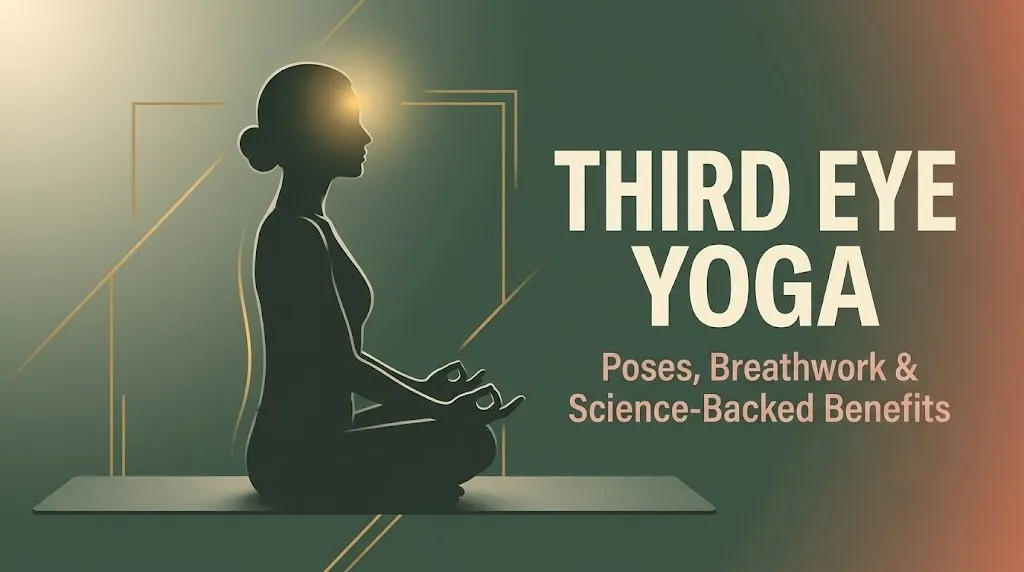
The yoga poses most associated with the third eye chakra are those that bring the forehead toward the ground, increase blood flow to the head, or ask the practitioner to sustain an inward or upward focused gaze.
Forward folds are the backbone of third eye yoga pose work. When the forehead contacts the floor or rests on a block, there is both a physiological calming effect (the vagus nerve can be gently stimulated by pressure near the forehead) and a symbolic directing of attention inward. Inversions, where the head drops below the heart, increase cerebral blood flow and shift perspective in ways that experienced teachers describe as mentally clarifying.
| Pose (English) | Sanskrit Name | Third Eye Connection | Difficulty Level |
|---|---|---|---|
| Child’s Pose | Balasana | Forehead grounding, inward focus | Beginner |
| Downward Facing Dog | Adho Mukha Svanasana | Mild inversion, forward fold | Beginner |
| Standing Forward Fold | Uttanasana | Head below heart, inward gaze | Beginner-Intermediate |
| Wide-Legged Forward Fold | Prasarita Padottanasana | Crown or forehead to floor | Intermediate |
| Headstand | Sirsasana | Full inversion, cerebral blood flow | Advanced |
| Shoulderstand | Sarvangasana | Inversion, throat and head engagement | Intermediate-Advanced |
| Legs Up the Wall | Viparita Karani | Gentle inversion, restorative | Beginner-All levels |
| Seated Forward Fold | Paschimottanasana | Forehead toward shins, inward focus | Beginner-Intermediate |
Modification for beginners: Any pose involving the forehead to the floor can use a yoga block or folded blanket under the forehead. This maintains the energetic connection while removing strain from tight hips, knees, or a stiff spine.
Key Takeaway: The most research-supported benefits of third eye yoga, including reduced anxiety, improved focus, and better sleep, come from the combination of forward folds, inversions, and Ajna-focused pranayama practiced consistently, not from any single pose or session.
How to Do Third Eye Yoga for Beginners
Beginners can start third eye yoga safely with three simple practices: a grounded Balasana (Child’s Pose), Nadi Shodhana pranayama, and a five-minute seated meditation with the gaze softened at the eyebrow center.
You don’t need to do headstands or know Sanskrit to practice third eye yoga. The most accessible entry point is a consistent combination of a forward fold, alternate nostril breathing, and quiet inward attention. Even three sessions per week produces measurable improvements in attention and stress response, according to studies reviewed by the NCCIH.
Here is a straightforward beginner’s starting sequence:
- Begin seated in a comfortable cross-legged position or on a folded blanket to elevate the hips.
- Close the eyes and bring gentle awareness to the space between the eyebrows. No strain. No squinting.
- Take five slow, even breaths through the nose. Exhale fully before each inhale.
- Move into Balasana (Child’s Pose): kneel, sit hips back toward heels, extend arms forward, and lower the forehead to the mat or a block. Hold for 8 to 10 breaths.
- Return to seated and practice Nadi Shodhana (Alternate Nostril Breathing) for 5 complete rounds: close right nostril with right thumb, inhale left, close left nostril with right ring finger, exhale right. Inhale right, close right, exhale left. That is one round.
- Return to stillness. Sit with eyes closed for 3 to 5 minutes. Let awareness rest gently at the forehead center.
Modification for seniors or those with knee sensitivity: Practice Child’s Pose with a bolster under the torso and a rolled blanket under the knees. This eliminates knee compression entirely while maintaining the forehead contact.
Inversions for Third Eye Activation
Inversions are the most potent physical tools in third eye yoga, bringing the head below the heart to increase cerebral blood flow, shift autonomic nervous system tone, and create a natural shift in perception that practitioners describe as mentally clarifying.
Not all inversions are equal in difficulty or safety. There is a broad spectrum, from the gentle Viparita Karani (Legs Up the Wall) to the demanding Sirsasana (Headstand). Beginners should always start at the gentle end of the spectrum and progress only with instruction.
Physiologically, inversions temporarily reverse the hydrostatic pressure gradient in the vascular system, increasing blood flow to the brain. Some physical therapists note that gentle inversions may also relieve compression in the cervical spine. However, these effects are temporary and should not be treated as therapeutic interventions for specific conditions without professional guidance.
| Inversion | Difficulty | Key Benefits | Key Cautions |
|---|---|---|---|
| Viparita Karani (Legs Up the Wall) | Beginner | Parasympathetic activation, mild blood shift | Low risk; avoid with glaucoma |
| Adho Mukha Svanasana (Downward Dog) | Beginner | Gentle head-below-heart, spinal lengthening | Avoid with wrist injuries |
| Prasarita Padottanasana (Wide-Legged Forward Fold) | Intermediate | Crown or forehead to floor | Avoid with unmanaged hypertension |
| Sarvangasana (Shoulderstand) | Intermediate-Advanced | Full inversion, gentle neck flexion | Contraindicated with neck injuries |
| Sirsasana (Headstand) | Advanced | Full cerebral blood shift | Multiple contraindications, see safety section |
Safety caution: Anyone with glaucoma, high blood pressure, cervical spine injury, detached retina, active sinusitis, or a history of vertigo should skip full inversions. Work with Viparita Karani instead. It delivers much of the restorative benefit without the risk.
Balasana and the Third Eye
Balasana (Child’s Pose) is arguably the most accessible and most therapeutically relevant pose in third eye yoga practice, because it directly places the forehead on the earth, creating a grounding pressure on the Ajna marma point.
When the forehead rests on the mat in Balasana, the gentle pressure stimulates the vagal branch of the nervous system running near the forehead, supporting a parasympathetic (rest-and-digest) response. This isn’t speculative: research on acupressure and vagal stimulation published in the Journal of Alternative and Complementary Medicine supports the general principle that gentle pressure at specific facial and cranial points can reduce heart rate and promote relaxation.
The physical mechanics of Balasana also matter. The pose requires:
- Hip flexors and gluteus maximus to allow the hips to settle toward the heels
- Spinal extensors to lengthen and decompress under gentle traction
- Shoulder and chest muscles to release into a passive stretch when arms are extended forward
To practice Balasana for third eye focus:
- Kneel on the mat with big toes touching and knees hip-width apart or slightly wider.
- Sit the hips back toward the heels as far as comfortable. Place a folded blanket between thighs and calves if knees are uncomfortable.
- Walk the hands forward and lower the torso between the thighs.
- Rest the forehead gently on the mat or on a yoga block set to the height that allows complete relaxation.
- Relax the jaw, the eyes, and the muscles of the forehead.
- Breathe slowly into the back of the rib cage for 8 to 15 breaths. Let each exhale be slightly longer than each inhale.
- To release, walk the hands back and roll up slowly.
Modification for tight hips or knee pain: Place a bolster horizontally across the calves and thighs and let the entire torso rest on it. The forehead can rest on stacked fists or a block.
Key Takeaway: Balasana is the most beginner-accessible third eye yoga pose, and it works not just energetically but physiologically: forehead pressure at the Ajna marma point activates the parasympathetic nervous system in ways that are consistent with vagal stimulation research.
Pranayama for Third Eye Chakra
Pranayama for the third eye chakra refers to breath control practices that shift the nervous system toward parasympathetic dominance, increase oxygenation of the brain, and focus attention inward to the eyebrow center.
Breath is the fastest tool for changing your neurological state. While a yoga pose might take minutes to begin shifting your body’s chemistry, a single round of controlled breathing can produce measurable changes in heart rate variability within 60 to 90 seconds, as noted in research published in the International Journal of Yoga in 2013.
For Ajna chakra specifically, yoga tradition recommends pranayamas that emphasize equal or extended exhales, nasal breathing, and internal attention. These features collectively:
- Activate the parasympathetic nervous system through extended exhale
- Stimulate nasal receptors connected to frontal brain regions
- Create the attentional conditions associated with prefrontal cortex engagement
The most commonly recommended pranayamas for third eye work include:
| Pranayama | Sanskrit Name | Technique | Primary Effect |
|---|---|---|---|
| Alternate Nostril Breathing | Nadi Shodhana | Alternate left and right nostril | Balances nervous system, improves focus |
| Humming Bee Breath | Bhramari | Humming on exhale, ears covered | Reduces anxiety, promotes inward focus |
| Skull-Shining Breath | Kapalabhati | Short sharp exhales, passive inhales | Energizes, clears mental fog |
| Equal Ratio Breathing | Sama Vritti | 4-count inhale, 4-count exhale | Calms and centers |
| Victorious Breath | Ujjayi | Slight glottal constriction on both breaths | Deepens focus, heats the body |
Safety note: Kapalabhati is contraindicated during pregnancy, with high blood pressure, and during active anxiety episodes. Begin with Nadi Shodhana if you are new to pranayama.
Nadi Shodhana for Mental Clarity
Nadi Shodhana (Alternate Nostril Breathing) is the most researched pranayama in the context of cognitive function and mental clarity, making it the first breath practice most teachers recommend for third eye yoga work.
A 2013 study published in the International Journal of Yoga found that Nadi Shodhana significantly improved spatial memory and sustained attention scores compared to a control group. The same study noted reduced sympathetic nervous system activation, suggesting the practice is both mentally stimulating and physically calming at the same time.
The mechanics of Nadi Shodhana work through alternating nasal stimulation. The left nostril is associated neurologically with the right hemisphere; the right nostril connects to left-hemisphere processing. Alternating between them appears to promote cross-hemisphere communication and executive function, which maps directly onto the traditional description of Ajna as the chakra of integrated perception.
To practice Nadi Shodhana for mental clarity:
- Sit comfortably with the spine upright. Use a blanket under the hips if the lower back strains.
- Rest the left hand on the left knee, palm open.
- Bring the right hand to Vishnu Mudra: fold the index and middle fingers toward the palm, leaving the thumb, ring finger, and pinky extended.
- Close the right nostril with the right thumb. Inhale through the left nostril for a count of 4.
- Close both nostrils. Pause briefly (1 to 2 counts only, no breath retention for beginners).
- Release the right nostril. Exhale through the right for a count of 4 to 6.
- Inhale through the right nostril for a count of 4.
- Close both nostrils. Brief pause.
- Release the left nostril. Exhale for a count of 4 to 6. That is one complete round.
- Practice 5 to 10 rounds. End by exhaling through the left nostril.
Modification for anyone with nasal congestion or asthma: Practice the visualization of Nadi Shodhana without physical nostril closure, simply imagining the breath alternating sides. The attentional focus still provides a neurological calming effect.
Shanmukhi Mudra and Shambhavi Mudra
Shanmukhi Mudra and Shambhavi Mudra are the two primary hand and eye gestures used specifically in third eye yoga practice, each directing awareness inward through sensory withdrawal or focused internal gaze.
Shanmukhi Mudra translates as “six-gate mudra” or “closing the six gates.” It involves using the fingers to gently close the eyes, ears, nose, and lips, withdrawing from all external sensory input simultaneously. This is a form of Pratyahara (sensory withdrawal), the fifth limb of Patanjali’s eight-limbed yoga path. The effect is an almost immediate shift of attention from the external world to internal experience.
To practice Shanmukhi Mudra:
- Sit comfortably with the spine tall.
- Bring both hands to the face.
- Place the thumbs lightly over the ear cartilage (not into the ear canal).
- Rest the index fingers gently over closed eyelids.
- Place the middle fingers at the sides of the nose.
- Rest the ring fingers above the lips and the pinky fingers below.
- Apply only the lightest pressure. There should be no discomfort.
- Breathe slowly for 5 to 10 breath cycles while holding inner awareness at the eyebrow center.
Shambhavi Mudra is fundamentally different. The eyes are partially open, and the gaze is directed upward toward the eyebrow center (not into the eyes). This creates a soft internal gaze called the “Bhrumadhya Drishti.” Research published in Frontiers in Psychology suggests that voluntary upward gaze combined with breath retention activates specific regions of the frontal lobe associated with attention regulation.
Safety note for Shambhavi Mudra: Force no strain in the eye muscles. If the upward gaze causes discomfort, simply close the eyes and visualize the eyebrow center instead.
Key Takeaway: Shanmukhi Mudra withdraws the senses completely inward, while Shambhavi Mudra redirects the gaze internally; both are practical, low-risk techniques for deepening third eye yoga focus that any seated practitioner can try today.
Trataka Meditation in Yoga Practice
Trataka (pronounced trah-TAH-kah) is a traditional Hatha yoga cleansing practice and meditation technique that involves sustained, unblinking gaze at a single point, most commonly a candle flame, used to develop one-pointed concentration and third eye awareness.
Trataka appears in the Hatha Yoga Pradipika, one of the classical texts of Hatha yoga, as one of the Shatkarmas (six purification practices). It is considered both a physical exercise for the eyes and a method for training the mind’s capacity for sustained focus. The practice essentially trains the same mental “muscle” that modern neuroscience calls sustained attention or vigilance.
Preliminary research on Trataka is encouraging. A 2014 study published in the Journal of Applied Physiology and Pharmacology found that Trataka practice improved cognitive performance and reduced anxiety scores in healthy college students over a six-week period. Larger and more rigorous studies are needed, but the directional findings align with traditional claims.
To practice Trataka:
- Sit in a comfortable position with a candle placed at eye level, about 50 to 75 centimeters (roughly arm’s length) away.
- Make sure the room is dimly lit and free from drafts.
- Gaze at the tip of the flame without blinking for as long as possible. The goal is sustained, relaxed focus, not strained effort.
- When the eyes water or blink, gently close them and visualize the flame at the eyebrow center.
- When the internal image fades, open the eyes and resume external gazing.
- Begin with 3 to 5 minutes. Gradually extend to 10 to 15 minutes over several weeks.
Safety note: Trataka is generally safe for most practitioners. Avoid if you have active eye inflammation, conjunctivitis, or a condition affecting the optic nerve. Anyone with anxiety-driven eye strain should begin with closed-eye visualization rather than open-eye gazing.
Third Eye Yoga for Anxiety and Focus
Third eye yoga is particularly effective for anxiety and concentration difficulties because the specific combination of forward folds, pranayama, and inward-focused meditation addresses the physiological roots of both conditions simultaneously.
Anxiety is, at its neurological base, an overactivated threat-detection system. The amygdala fires frequently; the prefrontal cortex, which regulates emotional responses, gets drowned out. Third eye yoga practices work by specifically engaging the prefrontal cortex through focused attention while simultaneously reducing sympathetic nervous system activation through pranayama and forward folds.
According to a 2021 review in Complementary Therapies in Medicine, yoga-based interventions that combined breathwork, physical posture, and meditation reduced clinically measured anxiety scores more effectively than posture-only or breathwork-only interventions. The combination matters.
For practitioners using third eye yoga specifically to manage anxiety:
- Prioritize Nadi Shodhana over Kapalabhati. The former calms; the latter energizes. In high-anxiety states, energizing practices can backfire.
- Extend the exhale. A 4-count inhale with a 6 to 8 count exhale activates the parasympathetic nervous system more effectively than equal-ratio breathing.
- Use Balasana as a reset pose. When anxiety spikes during practice, returning to Child’s Pose with a grounded forehead is both physiologically and psychologically settling.
- Keep the Trataka flame gaze gentle. Forced staring can increase eye tension and inadvertently heighten anxiety.
- End every session lying in Savasana (Corpse Pose) for at least 5 minutes. This is not optional filler: it is when the neurological integration of the practice actually occurs.
Modification for high-anxiety practitioners: If floor-based forward folds feel vulnerable, practice seated forward folds over a bolster, keeping the spine supported and the breath easy.
Third Eye Yoga Contraindications and Safety
Third eye yoga is generally safe for most adults, but specific practices, particularly inversions and strong pranayama, carry real contraindications that must be understood before practice.
Safety in third eye yoga means knowing which practices to skip entirely and which to modify. The spiritual framing of chakra yoga can sometimes obscure the fact that you are working with a real body that has real limits. Inversions compress the cervical spine. Pranayama with breath retention changes blood oxygen and carbon dioxide levels. These are physiological facts, not metaphors.
Specific contraindications by practice:
Full inversions (Sirsasana/Headstand, Sarvangasana/Shoulderstand):
- Glaucoma or increased intraocular pressure
- Unmanaged high blood pressure
- Cervical spine injury or herniated cervical disc
- Detached retina
- Active ear infection or vertigo
- Beginners without wall support and qualified instruction
Strong pranayama (Kapalabhati, Bhastrika, extended breath retention):
- Pregnancy
- High blood pressure
- Epilepsy or seizure history
- Active anxiety disorder or panic disorder
- Heart conditions
Trataka (candle gazing):
- Active eye infections
- Conditions affecting the optic nerve
- Anyone experiencing photophobia
Who benefits most with zero modification needed:
| Practitioner Type | Safest Third Eye Practices |
|---|---|
| Healthy adults, all levels | Full range, progress gradually |
| Seniors with no joint issues | Balasana, Viparita Karani, Nadi Shodhana |
| People with anxiety | Nadi Shodhana, Bhramari, Balasana |
| People with hypertension | Viparita Karani, Balasana, Nadi Shodhana (no retention) |
| Beginners | Seated meditation, Nadi Shodhana, Balasana, Trataka |
| People with neck issues | Skip inversions; use Uttanasana with bent knees only |
If you are managing a specific health condition and want to include third eye yoga in your care routine, talking with a yoga therapist credentialed through the International Association of Yoga Therapists (IAYT) is far more useful than a general caution to “check with your doctor.”
Key Takeaway: The most common third eye yoga safety error is rushing into full inversions before building the foundational strength and body awareness needed to do them safely; Viparita Karani (Legs Up the Wall) gives you 80% of the neurological benefit with a fraction of the risk.
Third Eye Yoga Sequence for All Levels
A well-structured third eye yoga sequence moves from physical grounding to forward folds, to pranayama, and finally to seated meditation, building inward focus progressively across each layer.
The structure below is designed to be adapted. Beginners complete it at the foundational level. Intermediate and advanced practitioners add the variations listed. The entire sequence takes 35 to 50 minutes.
Complete Third Eye Yoga Sequence:
- Seated centering (3 to 5 minutes): Sit comfortably. Close the eyes. Practice Sama Vritti (equal ratio breathing): 4-count inhale, 4-count exhale. Bring awareness to the eyebrow center without straining.
- Balasana (Child’s Pose), 8 to 10 breaths: Forehead to mat or block. Arms extended forward. Full relaxation of the face. Breathe into the back body.
- Adho Mukha Svanasana (Downward Facing Dog), 5 to 8 breaths: Heels pressing toward the floor. Shoulder blades broad. Head hanging freely between the arms. Pedal the feet gently. Advanced: Hold the gaze at the navel point (Nabi Chakra Drishti).
- Uttanasana (Standing Forward Fold), 8 breaths: Feet hip-width apart. Knees soft. Forehead heavy. Let the crown of the head drop toward the earth. Modification: Hands on blocks.
- Prasarita Padottanasana (Wide-Legged Standing Forward Fold), 8 breaths: Feet wide. Hands to the floor or blocks. Top of the head reaches toward the mat. Advanced: Crown of head touches the floor.
- Viparita Karani (Legs Up the Wall), 5 to 7 minutes: Scoot the hips close to the wall. Legs extend up. Arms rest at sides, palms up. Eye pillow optional. Breathe freely.
- Nadi Shodhana (Alternate Nostril Breathing), 10 rounds: Follow the instructions detailed in the Nadi Shodhana section above. Exhale should be slightly longer than inhale.
- Shanmukhi Mudra, 5 breaths: Close the six gates. Rest awareness at the forehead. Listen to internal sound (Nada).
- Trataka or Shambhavi Mudra, 3 to 5 minutes: Choose one: open-eye flame gazing (Trataka) or soft upward internal gaze at the eyebrow center (Shambhavi). Maintain slow, nasal breathing.
- Savasana (Corpse Pose), 5 to 10 minutes: Full release. No directive. Body completely still. Let the practice integrate.
| Sequence Element | Beginner Version | Intermediate Version | Advanced Version |
|---|---|---|---|
| Balasana | Bolster under torso, block under forehead | Standard | Extended arms in Anjali Mudra |
| Downward Dog | Knees bent, focus on spine length | Standard | Three-legged dog, then forward fold |
| Forward Fold | Hands on blocks | Hands clasped behind back | Fingertips to floor |
| Pranayama | Nadi Shodhana, no retention | Nadi Shodhana with 2-count pause | Nadi Shodhana with 4-count Kumbhaka |
| Meditation | 3 minutes, eyes closed | 7 minutes with Trataka | 15 minutes, Shambhavi Mudra |
Frequently Asked Questions About Third Eye Yoga
What yoga poses open the third eye chakra?
The poses most associated with opening or balancing the third eye chakra are those that ground the forehead or bring the head below the heart.
Balasana (Child’s Pose), Uttanasana (Standing Forward Fold), Prasarita Padottanasana (Wide-Legged Forward Fold), and Viparita Karani (Legs Up the Wall) are the most accessible.
Full inversions like Sirsasana (Headstand) are also traditional but require significant preparation and are not appropriate for all practitioners.
Is third eye yoga real or just spiritual?
Third eye yoga has both a spiritual framework rooted in classical yogic philosophy and a set of practices with documented physiological effects.
The forward folds, pranayama, and meditation techniques associated with Ajna chakra yoga all have independently researched benefits for attention, anxiety reduction, and nervous system regulation.
You don’t need to accept the chakra model to benefit from the practices: the physical and neurological effects stand on their own.
How long does it take to feel the effects of third eye yoga?
Many practitioners report a noticeable shift in mental clarity and calm within a single session of Nadi Shodhana and Balasana combined.
For more lasting changes in focus and anxiety patterns, research reviewed by the NCCIH suggests that consistent practice over 6 to 8 weeks produces measurable improvements in attention and stress biomarkers.
Daily practice of even 15 to 20 minutes produces results faster than weekly longer sessions.
Can beginners do third eye yoga safely?
Most third eye yoga practices are highly beginner-friendly, including Balasana, Nadi Shodhana, Trataka, and Viparita Karani.
Beginners should skip full inversions like Sirsasana (Headstand) until they have built sufficient shoulder and core strength and ideally worked with a qualified teacher.
Starting with the seated meditation and pranayama practices, then adding gentle forward folds, is a safe and effective approach for anyone new to this style.
What is the difference between third eye yoga and regular meditation?
Regular meditation typically focuses on breath, body scan, or mantra without the accompanying physical postures and specific mudras of third eye yoga.
Third eye yoga integrates physical poses (particularly forward folds and inversions), specialized pranayama, eye and hand mudras, and often includes Trataka or Shambhavi Mudra as tools for directing awareness to the Ajna chakra.
The physical component of third eye yoga prepares the nervous system for deeper meditation by reducing muscular tension and activating the parasympathetic response before the seated practice begins.
Start with one thing. Take five minutes today: practice Balasana with your forehead on a block and follow it with five rounds of Nadi Shodhana. That combination alone addresses the nervous system, the attentional system, and the traditional Ajna chakra practice all at once.
From there, add Viparita Karani at the end of your next session. Then bring in Trataka once a week. Build the sequence piece by piece rather than trying to absorb everything at once.
Third eye yoga rewards patience and consistency far more than intensity. The practices that move the needle most, the pranayama, the forward folds, the quiet internal attention, are simple enough for anyone to start today and deep enough to practice for a lifetime.