Yoga Shop Buying Guide: Top Picks for Every Level 2026
A yoga shop sells far more than mats and leggings. It is the starting point for building a practice that actually works for your body, your health, and your home.
Knowing what to buy, and why, makes the difference between props that collect dust and equipment that supports your practice every single day. According to the National Center for Complementary and Integrative Health (NCCIH), yoga is one of the most widely practiced complementary health approaches in the United States, with an estimated 21 million adults practicing regularly as of the most recent national health survey data.
This guide covers every major product category you will encounter at a yoga shop. You will learn what each prop does for the body, which items are worth the investment, how to match equipment to your specific practice style, and what modifications matter most if you are a beginner, a senior, or managing a health condition.
What Is a Yoga Shop and What Does It Actually Sell?
A yoga shop is a retail or online store that carries the physical equipment, props, and apparel used to support a yoga practice across all styles and experience levels.
The inventory goes well beyond the basic mat. Most shops carry a layered range of products, from entry-level foam blocks to professional-grade cork props, from thin travel mats to thick therapeutic padding. The range can feel overwhelming without a framework.
Here is the core product landscape in any full-service yoga shop:
| Category | Common Products | Who Uses It Most |
|---|---|---|
| Mats | Sticky mats, travel mats, thick mats | All practitioners |
| Blocks | Foam blocks, cork blocks, wood blocks | Beginners, Iyengar students, therapeutics |
| Straps | Cotton straps, nylon straps, D-ring straps | Beginners, tight hamstrings, seniors |
| Bolsters | Round bolsters, rectangular bolsters | Restorative, Yin, prenatal, seniors |
| Blankets | Wool blankets, Mexican blankets | All styles, especially Restorative |
| Specialty Props | Wheels, sandbags, eye pillows, chairs | Advanced students, therapeutic yoga |
| Apparel | Leggings, tops, grip socks | All practitioners |
Understanding these categories upfront stops you from buying things you do not need and skipping things you genuinely will.
What Yoga Equipment Do Beginners Actually Need?
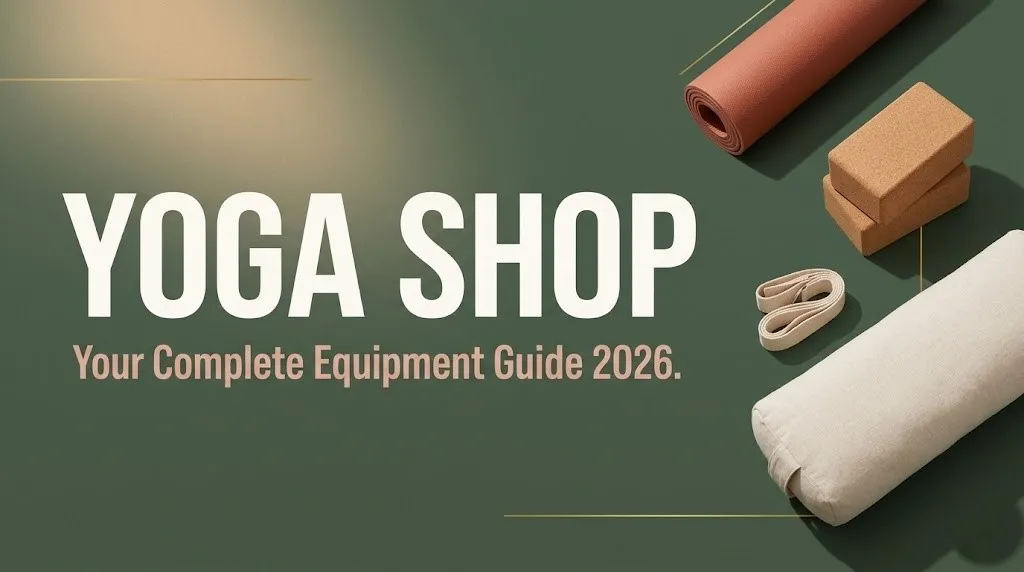
A beginner starting a yoga shop purchase from scratch needs three items before anything else: a mat, one or two blocks, and a strap.
That is the honest three-item starter kit most experienced teachers recommend. Everything else can wait until you understand your practice better and know what feels limiting.
The reasoning is straightforward. A mat provides grip and cushioning. Blocks let you bring the floor up to you when your flexibility does not yet allow full range. A strap extends your reach in seated and standing poses without straining your shoulders or hamstrings.
Here is what to prioritize, in order:
- Yoga mat (6mm thickness): Enough cushioning for joints without destabilizing balance poses
- Two yoga blocks (foam for beginners): Foam is lighter, cheaper, and gentler on the hands than cork at this stage
- One yoga strap (6-foot cotton): Covers most beginner modifications in forward folds and shoulder openers
- Yoga blanket (optional but useful): Adds padding for knees and ankles in seated poses
Resist buying a bolster, wheel, or specialty props until you have practiced consistently for at least six to eight weeks. Your body will tell you what it needs once it has some experience on the mat.
Pose Tip:
- In Balasana (Child’s Pose), place a folded blanket between your thighs and calves if your hips do not reach your heels
- Two blocks under your hands in Adho Mukha Svanasana (Downward-Facing Dog) reduce wrist pressure for beginners
- A strap looped around the feet in Paschimottanasana (Seated Forward Fold) protects the lower back from rounding aggressively
How to Choose the Right Yoga Mat
The right yoga mat depends on three factors: mat thickness, surface texture, and material, and none of these are one-size-fits-all decisions.
Thickness affects both cushioning and stability. A 4mm mat gives enough padding for most active practices like Vinyasa or Hatha while keeping you close enough to the floor to feel stable in balance poses. A 6mm mat is better for beginners and anyone with sensitive knees or wrists. Mats thicker than 6mm (sometimes called “extra thick” or “therapeutic mats”) are designed for Restorative yoga or low-impact practices, not standing sequences, because they compress under foot and reduce proprioceptive feedback.
Surface texture determines grip. Smooth PVC mats grip better when dry but become slippery with sweat. Open-cell natural rubber and polyurethane surfaces grip better when slightly damp, making them the preferred choice for any heated or flow-based practice.
| Mat Material | Best For | Grip | Eco Credentials | Price Range |
|---|---|---|---|---|
| PVC (standard) | Beginners, budget buyers | Good when dry | Low | $ |
| Natural rubber | Vinyasa, hot yoga | Excellent damp | High | $$$ |
| TPE (thermoplastic elastomer) | Eco-conscious buyers | Good | Moderate | $$ |
| Cork surface | Hot yoga, sweaty hands | Excellent | High | $$-$$$ |
| Jute/natural fiber | Light practice, travel | Moderate | High | $$ |
Weight also matters for home practitioners who need to store and move their mat regularly. Travel mats are typically 1.5mm to 2mm and fold flat. They are not suitable as a primary mat for anyone with joint sensitivity.
Key Takeaway: A beginner needs three things from a yoga shop: a 6mm mat, two foam blocks, and a 6-foot cotton strap. Everything else becomes relevant once you know your practice.
Yoga Blocks: What They Are and How to Use Them
Yoga blocks are rectangular props, typically 9 inches by 6 inches by 4 inches, used to shorten the distance between your body and the floor so that you can maintain correct alignment without straining.
Think of a yoga block like a step stool for your hands or hips. When your hamstrings are tight and your hands cannot reach the floor in Trikonasana (Triangle Pose), a block placed at the correct height gives your hand a stable landing without collapsing your spine.
Blocks come in three materials, each with distinct advantages:
- Foam blocks: Lightweight, affordable, and easy on the wrists and hands. Best choice for beginners and anyone who prefers lighter props.
- Cork blocks: Denser and more stable. Better for anyone who needs confident support in balance poses or seated poses. Cork is also naturally antimicrobial.
- Wood blocks: The firmest option. Used most in Iyengar yoga, where precise prop placement matters. Not recommended as a beginner’s first block because of the unforgiving hardness.
Blocks have three usable heights: lying flat (lowest, about 3.5 inches), on their side (medium, about 4 inches), and standing upright (tallest, about 9 inches). Most teachers start beginners on medium height.
Modification note: Anyone with wrist pain or carpal tunnel syndrome should place a foam block under their palms in poses like Adho Mukha Svanasana (Downward-Facing Dog) to reduce wrist extension. Seniors and people with osteoporosis in the wrists should use foam over cork for this reason.
Yoga Straps: Who Needs Them and Why
A yoga strap is a long, flat band, usually 6 to 10 feet in length, used to extend your effective reach in poses where tight hamstrings, limited shoulder mobility, or short arms create a barrier to safe alignment.
The strap is arguably the most underused prop in beginner yoga. Most beginners skip it because it looks passive or remedial. The reality is the opposite: a strap lets you hold correct spinal alignment in a forward fold while your hamstrings catch up. Without it, the default response is to round the lower back, which over time creates exactly the kind of lumbar stress that discourages people from continuing.
Straps are sold in cotton (most common, affordable, comfortable grip), nylon (more durable, slightly stiffer), and microfiber. The D-ring metal buckle style allows easy loop adjustment mid-pose. Cinch-buckle versions are simpler but less adjustable.
Common uses for a yoga strap:
- Paschimottanasana (Seated Forward Fold): Loop around the arches of the feet to hold the fold without rounding the spine
- Gomukhasana (Cow Face Pose) arm bind: Hold the strap between both hands behind the back when hands cannot yet clasp
- Natarajasana (Dancer’s Pose): Hold the strap looped around the raised foot for less flexible practitioners
- Shoulder openers: Hold the strap at shoulder width behind the back to open the chest and anterior shoulder girdle
Modification note: A 6-foot strap covers most beginner needs. Taller practitioners (over 6 feet) or those with very tight hamstrings benefit from a 10-foot strap.
Yoga Bolsters: The Prop Most Beginners Overlook
A yoga bolster is a firm, cylindrical or rectangular cushion used to support the body in passive, held, or restorative poses where complete muscular release is the goal.
Most beginners skip bolsters entirely. This is a mistake, especially for anyone managing fatigue, stress, lower back pain, or recovering from injury. The bolster does something blocks and straps cannot: it allows the body to fully let go of muscular effort, which is the entire physiological point of Restorative yoga.
There are two main bolster shapes. A round bolster is used for backbend support, placed under the thoracic spine in poses like supported fish. A rectangular bolster is flatter and more versatile, used under the knees in Savasana (Corpse Pose), under the hips in Supta Baddha Konasana (Reclining Bound Angle Pose), and between the thighs in side-lying poses.
| Bolster Type | Shape | Best Poses | Best For |
|---|---|---|---|
| Round bolster | Cylindrical | Supported backbends, restorative inversions | Thoracic spine opening, chest openers |
| Rectangular bolster | Flat rectangle | Savasana, Supta Baddha Konasana, Yin holds | Knee support, hip support, prenatal |
| Zafu (meditation cushion) | Round, small | Seated meditation, pranayama | Meditation practitioners |
Modification note: A firmly folded blanket can substitute for a bolster in most poses if budget is a constraint. Stack two or three blankets to approximate rectangular bolster height. This is a legitimate and widely used modification in class settings.
Key Takeaway: Blocks, straps, and bolsters each solve a specific problem. Blocks bring the floor up, straps extend your reach, and bolsters allow full muscular surrender. You need at least one of each for a complete home practice.
Yoga Wheels, Sandbags, and Specialty Props Explained
A yoga wheel is a circular, hollow ring (typically 12 to 13 inches in diameter) used to support and deepen backbends, improve spinal mobility, and challenge balance. It is not a beginner prop.
The wheel is most useful for practitioners who already have consistent backbend practice and want to safely increase thoracic extension. Placing the wheel at the mid-back in a supported backbend allows a controlled, gradual opening of the thoracic spine without compressing the lumbar region. Physical therapists and yoga teachers working with hypermobility, however, generally advise against wheel-assisted deep backbends without direct supervision.
Yoga sandbags serve a completely different function. They are heavy fabric bags, typically 10 to 25 pounds, placed on the body during Yin or Restorative poses to add gentle, sustained compression or traction. In Supta Baddha Konasana (Reclining Bound Angle Pose), a sandbag placed on the lower abdomen encourages the hip adductors and pelvic floor to release more completely. In Viparita Karani (Legs-Up-the-Wall Pose), a sandbag on the soles of the feet adds calming proprioceptive weight.
Other specialty props worth knowing:
- Yoga eye pillow: Filled with flax seeds or lavender, placed over the eyes in Savasana to activate the parasympathetic nervous system through gentle pressure on the ocular-vagal reflex
- Yoga chair: A metal folding chair used in Iyengar yoga to support poses for people who cannot lower to the floor safely
- Yoga wedge: A foam or cork wedge placed under the heels or wrists to reduce joint stress in standing poses and planks
Safety note: Anyone with osteoporosis, a history of spinal fractures, or severe disc issues should skip the yoga wheel entirely and consult a physical therapist with yoga training before using sandbags on the torso.
How to Match Your Yoga Equipment to Your Practice Style
Your yoga style is the single most useful filter for deciding what to buy from a yoga shop.
Each major yoga style has a distinct relationship with props, intensity, and physical demand. Buying equipment without knowing your practice style is like buying running shoes without knowing whether you run trails or roads.
| Yoga Style | Primary Equipment Needed | Mat Thickness | Key Props |
|---|---|---|---|
| Hatha | Mat, 2 blocks, strap, blanket | 5-6mm | Blocks for standing poses, strap for seated folds |
| Vinyasa / Flow | Mat, blocks optional | 4mm (grip priority) | Non-slip surface, sweat-resistance key |
| Ashtanga | Mat only (traditionally) | 4mm | Cotton Mysore rug over mat optional |
| Iyengar | Mat, blocks, strap, chair, bolster, blanket | 4-5mm | Precision props; quality matters more than quantity |
| Yin | Mat, bolsters, blocks, blankets | 6mm+ | Maximum passive support, sandbag optional |
| Restorative | Mat, 2 bolsters, blankets, eye pillow, blocks | 6mm+ | Full prop support system |
| Kundalini | Mat, blanket | 4-5mm | Sheepskin or wool seated covering traditional |
Vinyasa practitioners prioritize mat grip above all else. A mat that slips in downward dog is not just annoying; it creates shoulder and wrist instability. Iyengar practitioners invest in the highest-quality blocks and straps because alignment precision depends on prop consistency. Restorative and Yin practitioners need the most props overall.
If you are still exploring and have not settled on a style, start with a 5mm to 6mm non-slip mat, two foam blocks, and a strap. That covers eight out of ten class types.
Best Yoga Props for People With Back Pain
For people managing back pain, a yoga shop is not just a place to buy equipment. The right props make the difference between a practice that helps and one that causes harm.
The lumbar spine is the region most commonly affected by yoga-related back issues, and it is also the area where props provide the most support. A study published in the Spine Journal noted that modified yoga with appropriate prop use reduced chronic low back pain intensity in participants over a 12-week period, with the most benefit seen in participants who used blocks and bolsters consistently.
Recommended props for back pain:
- Rectangular bolster: Place under the knees in Savasana (Corpse Pose) to flatten the lumbar curve and reduce pressure on the discs
- Two blocks (cork or foam): Use under the hands in standing poses to prevent overreaching and lumbar rotation
- Yoga strap: Prevents the habitual forward-rounding collapse in seated forward folds that stresses the lumbar discs
- Folded blanket: Place under the hips in seated poses to tilt the pelvis forward slightly, reducing strain on the sacroiliac joint
- Yoga chair: For people who cannot safely lower to or rise from the floor, a yoga chair allows participation in standing and seated pose sequences without lumbar loading
Safety note: People with herniated lumbar discs should avoid deep forward folds, even with a strap, until they have been evaluated by a physical therapist with yoga experience. Props support good movement patterns; they do not correct structural issues.
Key Takeaway: If you are managing back pain, a rectangular bolster under your knees and two blocks under your hands in standing poses are the two most immediately useful purchases from any yoga shop.
Yoga Equipment for Seniors and Limited Mobility
Seniors need many of the same yoga props as beginners but with specific adjustments for balance confidence, joint protection, and floor accessibility.
The American College of Sports Medicine recommends that adults over 65 engage in balance and flexibility training two or more days per week. Yoga is one of the few activities that addresses both simultaneously, but only when the equipment genuinely supports the body rather than demands things the body cannot safely do.
The highest-priority purchase for seniors is a yoga chair. This is not a limitation. It is a gateway. Chair yoga allows full participation in modified versions of standing, forward-bending, and gentle twisting poses without requiring floor transitions that are risky for people with hip replacements, knee replacements, or significant balance impairment.
Equipment list for senior and limited-mobility practitioners:
- Thick yoga mat (6mm+): Extra cushioning for knee joints in any kneeling sequence
- Cork or foam blocks (two): Stable handholds for standing balance poses near a wall
- Yoga chair (sturdy metal folding chair): Allows seated versions of forward folds, twists, and backbends
- Round bolster: Supports the thoracic spine in gentle backbends without compressing the lumbar
- Yoga blanket: Pads the knees in any low position and provides warmth during Savasana, which matters for practitioners who cool quickly
- Non-slip socks or grip socks: Reduces slip risk on smooth mat surfaces for those with neuropathy or balance concerns
Modification note: Seniors with osteoporosis should avoid all extreme forward folds and spinal twists that compress the thoracic vertebrae. A yoga teacher or physical therapist familiar with bone density concerns should guide their initial prop selection.
Home Yoga Shop Setup: What to Buy and in What Order
Building a home yoga shop means buying strategically, not all at once, so each purchase supports your actual practice at the stage you are in.
Most people overbuy at the start and under-use what they have. A single high-quality mat and two blocks will serve a beginner better than six props that never get touched.
Here is a sensible purchase sequence:
Stage 1 (Week 1 to 4): The Foundation
- One 5mm to 6mm non-slip yoga mat
- Two foam blocks
- One 6-foot cotton yoga strap
Stage 2 (Week 4 to 8): Add Comfort
- One yoga blanket (Mexican style or wool)
- One rectangular bolster (if practicing Restorative or Yin)
Stage 3 (Month 2 to 6): Refine for Your Style
- Upgrade to cork blocks if you want more stability
- Add a round bolster for backbend support
- Consider a sandbag if Yin is your primary practice
- Add grip socks if your mat surface is challenging
Stage 4 (Month 6+): Specialty Investment
- Yoga wheel (if backbend progression is a goal)
- Yoga chair (for chair yoga or Iyengar-style exploration)
- Travel mat (if you want to practice away from home)
Storage tip: Keep your mat, blocks, and strap in one designated spot. Yoga teachers consistently report that accessibility is the single biggest factor in whether home practitioners actually get on the mat daily.
Yoga Apparel and What Actually Matters When You Practice
Yoga apparel matters less than prop quality but more than most people realize, specifically because the wrong clothing actively restricts movement or creates safety issues.
The two functional requirements for yoga clothing are freedom of movement and sweat management. A cotton T-shirt looks fine until you attempt Adho Mukha Svanasana (Downward-Facing Dog) and it falls over your face. A loose waistband slides during inversions. These are not vanity concerns. They affect your ability to hold alignment cues and listen to your body in a pose.
What matters when buying yoga apparel:
- Moisture-wicking fabric: Essential for any heated or flow practice. Synthetic blends (polyester-spandex) or bamboo fabric wick sweat effectively.
- Four-way stretch: Allows the hip and shoulder range of motion yoga demands without restriction
- Secure waistband: Wide, flat, non-rolling waistbands stay in place during forward folds, inversions, and hip-openers
- Fitted but not compressive: Yoga tops should stay put without restricting diaphragmatic breathing during pranayama (breath practice)
- Grip socks (optional): Useful on smooth mat surfaces or for practitioners with reduced foot sensation
What does not matter: brand name, matching sets, or premium price tags. A 20-dollar pair of flexible leggings from a sporting goods store performs the same function as a 120-dollar brand-name pair if the stretch and waistband hold up.
Note for seniors: Looser-fit clothing that is still moisture-wicking works better for many seniors in chair yoga or gentle classes, where tight compression can feel restrictive.
Key Takeaway: Your home yoga shop setup should grow in stages. Start with mat, two blocks, and a strap. Add a bolster and blanket in month two. Specialty props come later, once your practice tells you what it needs.
How to Evaluate Yoga Mat Quality and Durability
A quality yoga mat is not necessarily the most expensive one. It is the one that holds its grip, maintains its structure, and does not off-gas harmful chemicals over time.
The four indicators of genuine mat quality are grip retention, density, material safety, and durability under regular use.
Grip retention is how well the mat maintains its non-slip surface after sweat exposure and repeated washing. PVC mats lose grip over time. Natural rubber and polyurethane mats generally maintain grip longer, though they require hand-washing rather than machine washing.
Density refers to how much the mat compresses under weight. A mat that compresses more than 1mm to 2mm under body weight in standing poses loses its stability function. Hold a mat by its ends and try to fold it. A quality mat resists easy folding. A cheap mat collapses with minimal pressure.
Material safety matters because some PVC mats contain phthalates and heavy metals. Yoga Alliance recommends that practitioners, especially those who practice daily, look for mats certified PVC-free or made with natural materials if skin-to-mat contact is prolonged.
Durability markers to check:
- No visible peeling or flaking at the edges after 30 days of regular use
- Grip surface intact after 10 or more hand-washes
- Consistent thickness across the entire mat surface (not thinner at the center from compression)
- No strong chemical odor after 48 hours of airing out
A mid-range mat from a reputable brand at 50 to 80 dollars typically outlasts a 20-dollar budget mat by two to four years under regular use.
Yoga Props for Restorative and Yin Yoga Practice
Restorative and Yin yoga require the most props of any style, because the entire therapeutic function of these practices depends on the body being fully supported in passive holds lasting three to twenty minutes.
Restorative yoga, developed largely through the work of B.K.S. Iyengar and later popularized by Judith Hanson Lasater, uses props to hold the body in complete stillness so the nervous system can shift from sympathetic (stress-response) activation to parasympathetic (rest-and-digest) activity. Yin yoga uses props similarly but with slightly less support, allowing mild sustained tension in the connective tissues of the hips, pelvis, and spine.
| Pose | Style | Props Needed | Hold Duration |
|---|---|---|---|
| Supta Baddha Konasana (Reclining Bound Angle) | Restorative | Bolster along spine, blocks under thighs, blanket over body | 5 to 20 minutes |
| Viparita Karani (Legs-Up-the-Wall) | Restorative / Yin | Bolster under hips, blanket for warmth, eye pillow | 5 to 15 minutes |
| Supported Balasana (Child’s Pose) | Restorative | Bolster between thighs, blanket under ankles | 3 to 10 minutes |
| Dragon Pose (Low Lunge variation) | Yin | Block under front hand, blanket under back knee | 3 to 5 minutes |
| Butterfly (seated Baddha Konasana) | Yin | Bolster under forehead on forward fold, blocks under knees | 3 to 5 minutes |
Safety note for Yin: The sustained holds in Yin yoga target fascia and ligaments, not muscle. This means the feedback from the body is subtler. People with hypermobility, connective tissue disorders like Ehlers-Danlos syndrome, or recent ligament injuries should approach Yin with caution and seek guidance from a teacher familiar with these conditions before practicing deeply supported long holds.
What the Research Says About Yoga Props and Injury Prevention
Research on yoga props and safety is a relatively young field, but the findings that exist are consistent in one direction: props reduce injury risk and improve access for populations who would otherwise avoid yoga entirely.
According to a study published in the Journal of Alternative and Complementary Medicine, prop-assisted yoga significantly improved balance and flexibility outcomes in older adults compared to non-prop yoga practice over an 8-week period. The researchers noted that block use in standing balance poses reduced fear-of-falling responses, which itself has measurable effects on willingness to continue practicing.
The National Center for Complementary and Integrative Health (NCCIH) has consistently noted in its yoga safety guidance that most yoga-related injuries occur in the lower back, shoulders, and knees, and that these injuries are disproportionately associated with attempting poses beyond current flexibility range without prop modification.
What this means practically:
- A block under the hand in Trikonasana (Triangle Pose) is not a beginner shortcut. It is the biomechanically correct alignment tool that prevents lateral lumbar flexion under load.
- A strap in Paschimottanasana (Seated Forward Fold) prevents the posterior disc loading that occurs when practitioners force a forward fold past their hamstring range.
- A bolster in Savasana (Corpse Pose) under the knees reduces lumbar disc pressure during the one pose every practitioner holds in every single class.
Research published in Complementary Therapies in Medicine found that an 8-week Iyengar yoga intervention, which relies heavily on props, produced measurable reductions in chronic low back pain intensity and disability scores compared to a control group. Prop use was central to the protocol.
The bottom line from the evidence: Props are not training wheels. They are precision tools. Using them consistently and correctly is the hallmark of a serious practitioner, not a beginner crutch.
Key Takeaway: Research consistently supports prop use for injury prevention, balance improvement, and pain management. A well-stocked yoga shop is not a luxury. It is a therapeutic resource backed by evidence.
Frequently Asked Questions About the Yoga Shop
What do I need to buy from a yoga shop as a complete beginner?
A complete beginner needs three items: a 5mm to 6mm non-slip mat, two foam blocks, and one 6-foot cotton strap.
These three props cover the modifications needed in over 80 percent of beginner class sequences.
Add a blanket in your second month and a bolster once you understand whether Restorative or Yin yoga appeals to you.
Is a yoga block necessary or just a nice extra?
A yoga block is a functional tool, not an optional accessory, especially for beginners and anyone with tight hamstrings or limited shoulder mobility.
Without blocks, most beginners compensate with spinal rounding or shoulder collapse in standing poses, which creates cumulative joint stress.
Two foam blocks cost under 20 dollars and prevent the most common beginner alignment errors.
How thick should my yoga mat be?
Most yoga teachers recommend a 5mm to 6mm mat for beginners and anyone with sensitive knees or wrists.
A 4mm mat suits active Vinyasa or Ashtanga practice, where being closer to the floor improves stability in balance poses.
Mats over 6mm are best reserved for Restorative yoga, seated meditation, or practitioners who practice exclusively on their back.
What yoga props do I need for back pain?
The most useful props for back pain are a rectangular bolster (under the knees in Savasana), two blocks (for standing poses), and a strap (to protect the lumbar spine in forward folds).
A folded blanket under the sitting bones in seated poses also reduces sacroiliac joint compression.
People with herniated lumbar discs should speak with a physical therapist with yoga training before selecting or using props independently.
Can seniors use the same yoga equipment as younger practitioners?
Seniors can use all the same basic props but benefit most from a yoga chair, thick mat, grip socks, and a bolster.
The yoga chair is the single most accessible addition for anyone managing balance issues, hip or knee replacements, or limited floor mobility.
Cork or foam blocks should be the stable, non-rolling variety because stability during balance poses matters more as proprioception decreases with age.
Building Your Practice, One Prop at a Time
Walking into a yoga shop, or browsing one online, does not have to feel overwhelming. Start with the three-item foundation: mat, blocks, strap. Practice with those for six to eight weeks and let your body tell you what feels limited.
From there, add a blanket and a bolster when passive or Restorative poses begin calling to you. Consider a yoga chair if floor transitions are a barrier. Think about a cork block upgrade when foam no longer feels stable enough.
Every great yoga practice is built on good equipment choices made at the right time. Buy what supports you now. The rest will become clear.