Charleston Power Yoga: Complete Beginner’s Guide 2026
Charleston power yoga is a physically demanding, heat-optional yoga practice that builds full-body strength, cardiovascular endurance, and flexibility through continuous flowing sequences. Whether you’re brand new to yoga or looking to upgrade your practice, Charleston’s growing studio scene offers options that match every starting point.
The National Center for Complementary and Integrative Health (NCCIH) notes that yoga is among the most widely used complementary health practices in the United States, with participation rates rising steadily across age groups. Power yoga specifically has seen surging interest as more people seek a practice that combines the mindfulness of yoga with a real fitness challenge.
This guide covers what power yoga actually is, how it differs from hot yoga and other styles, what beginner poses look like, what research says about benefits, and how to stay safe in Charleston’s heat and humidity. You’ll walk away knowing exactly what to expect on day one.
What Is Charleston Power Yoga and How Does It Work
Charleston power yoga is a vigorous, fitness-oriented yoga practice that uses continuous movement through strength-based sequences to build muscular endurance, cardiovascular fitness, and body awareness simultaneously.
The term “power yoga” was popularized in the 1990s by American yoga teachers Beryl Bender Birch and Bryan Kest, who adapted the structured sequences of Ashtanga yoga into a less rigidly fixed format. Baptiste power yoga, developed by Baron Baptiste, became one of the most widely recognized systems and is the lineage many Charleston studios follow.
Unlike slower styles such as Yin yoga or Restorative yoga, power yoga keeps the body moving through sequences that link poses with breath. Sessions typically run 60 to 75 minutes. The pace is moderate to fast. Expect to sweat.
What makes power yoga distinct from a general fitness class:
- Every movement is breath-driven. The inhale initiates certain movements; the exhale drives others.
- Sequences are intentionally structured to balance opposing muscle groups across the session.
- The practice ends with Savasana (Corpse Pose), a non-negotiable rest that integrates the physical work.
- Mindfulness and body awareness are woven into every pose transition, not treated as add-ons.
Power yoga classes in Charleston range from unheated rooms to studios heated to 90 to 105 degrees Fahrenheit. The temperature depends on the studio’s format and is separate from the yoga style itself.
Power Yoga vs Hot Yoga: Understanding the Difference
Power yoga and hot yoga are not the same thing, though many Charleston studios offer both or combine them. The distinction is straightforward and matters practically.
Power yoga describes the movement methodology: a vigorous, flowing sequence of poses performed with breath synchronization and an emphasis on strength and endurance. It is a yoga style.
Hot yoga describes the environmental condition: yoga practiced in a room heated to roughly 90 to 105 degrees Fahrenheit, sometimes with elevated humidity. Hot yoga is not a yoga style on its own. It is a thermal context applied to various yoga styles.
| Feature | Power Yoga | Hot Yoga |
|---|---|---|
| What it refers to | Movement style | Room temperature |
| Typical room temp | Ambient or heated | 90 to 105 degrees F |
| Pace | Moderate to vigorous | Varies by style in the room |
| Sweat level | High | Very high |
| Humidity | Normal | Often elevated to 40 to 60% |
| Can they combine? | Yes | Yes: “hot power yoga” |
| Primary demand | Muscular and cardiovascular | Muscular, cardiovascular, and thermoregulatory |
A class labeled “hot power yoga” means you are doing a vigorous flow-based sequence inside a heated room. Both demands apply simultaneously. This is one reason heat-specific safety preparation matters before your first class.
Beginners should consider attending an unheated power yoga class first. This allows you to learn the poses and pace before adding the physiological stress of heat.
How Power Yoga Differs from Vinyasa, Ashtanga, and Bikram
Power yoga is frequently confused with three other styles because of visual and structural similarities. The differences are real and affect which practice suits your goals.
Vinyasa yoga is the closest relative. Like power yoga, Vinyasa links poses with breath in flowing sequences. The key difference is structure. Vinyasa sequences vary entirely by teacher. Power yoga, especially Baptiste-style, follows a more consistent framework with predictable peak poses and specific sequencing principles.
Ashtanga yoga is the direct ancestor of power yoga. It uses a fixed sequence of poses performed in the same order every session. The Primary Series always begins with sun salutations and follows a prescribed progression. Power yoga adapted Ashtanga’s format but removed the fixed sequence, giving teachers more creative latitude.
Bikram yoga (now more commonly called 26&2 yoga) is fundamentally different. It consists of exactly 26 poses and 2 breathing exercises performed in a room heated to 105 degrees Fahrenheit with 40% humidity. The sequence never changes. There is no creative variation. It is not “hot power yoga.”
| Style | Sequence | Heat | Pace | Structure |
|---|---|---|---|---|
| Power Yoga | Varied by lineage | Optional | Vigorous | Moderate framework |
| Vinyasa | Fully teacher-created | Optional | Moderate to vigorous | Open |
| Ashtanga | Fixed always | Not typically | Vigorous | Strict |
| Bikram/26&2 | Always identical | 105 degrees F required | Moderate | Rigid |
| Hatha | Teacher-varied | Not typically | Slow to moderate | Open |
According to the Yoga Alliance, power yoga is among the most commonly taught styles in U.S. studios. Its flexibility in sequencing is a large part of why it adapted so successfully to the American fitness market.
Key Takeaway: “Power yoga” names the movement style; “hot yoga” names the room temperature. They can overlap, but knowing the difference helps you choose the right class for where your body is right now.
What to Expect in Your First Power Yoga Class in Charleston
Your first power yoga class in Charleston will likely open with a brief seated or standing centering, followed immediately by sun salutations. The warm-up is not gentle. It begins building heat in the body from the first minute.
A standard 60-minute power yoga class structure:
- Centering and breath awareness (2 to 3 minutes)
- Surya Namaskar A (Sun Salutation A): Three to five rounds to warm the whole body (8 to 10 minutes)
- Surya Namaskar B (Sun Salutation B): Adds Utkatasana (Chair Pose) and Virabhadrasana I (Warrior I) (8 to 10 minutes)
- Standing pose sequence: Warrior variations, balancing poses, hip openers (20 to 25 minutes)
- Floor sequence: Core work, back strengthening, forward folds, twists (12 to 15 minutes)
- Savasana (Corpse Pose) (5 to 7 minutes)
Most people feel surprised by three things after their first class. The pace is faster than expected. The transitions between poses, especially Chaturanga Dandasana (Four-Limbed Staff Pose), are harder than they look. And the final Savasana feels more necessary and satisfying than any rest they’ve taken in a long time.
Arrive 10 to 15 minutes early. Introduce yourself to the teacher. Mention any injuries to the shoulder, wrist, or lower back specifically, because power yoga places real demands on all three. A good teacher will show you modifications during the class when needed poses arise.
Essential Power Yoga Poses Every Beginner Should Learn
Knowing the five core power yoga poses before your first class reduces confusion, prevents injury, and lets you focus on breath and form rather than watching other students for cues.
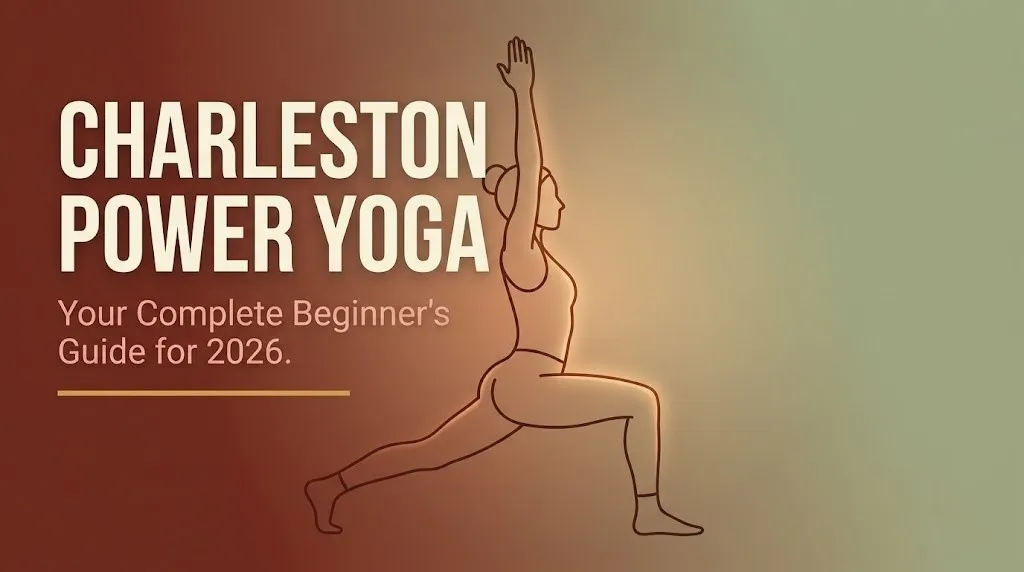
Phalakasana (Plank Pose): A straight-arm plank with hands under shoulders, body in one line from heels to crown. Activates transverse abdominis, serratus anterior, and deltoids. This is the transition pose that connects most sequences. Modification: drop knees to the floor while maintaining a neutral spine.
Chaturanga Dandasana (Four-Limbed Staff Pose): From Plank, lower halfway toward the floor keeping elbows at 45 degrees. The most technically demanding transition in power yoga. Safety caution: elbows splaying past 45 degrees causes impingement of the shoulder joint. Modification: lower knees first, then descend with control.
Adho Mukha Svanasana (Downward-Facing Dog): Hips lifted high, heels pressing toward the floor, arms pressing the mat away. Lengthens hamstrings, calves, and the entire posterior chain. Modification: generous knee bend if lower back rounds.
Utkatasana (Chair Pose): Feet together or hip-distance, hips lowered as if sitting into a chair, arms raised overhead. Builds quadriceps, gluteus maximus, and spinal extensors. Modification: keep torso more upright and reduce the depth of the squat for knee sensitivity.
Virabhadrasana III (Warrior III): Standing balance with the torso and lifted leg parallel to the floor. Works gluteus medius, hamstrings, and all stabilizing muscles of the standing leg. Modification: hands on blocks on the floor for balance support.
Pose Tip:
- Master Plank before attempting full Chaturanga
- Use bent knees in Downward Dog until hamstrings open over weeks of practice
- Keep both hip points square in all Warrior poses
Power Yoga Sequence: A Step-by-Step Flow for Beginners
A structured beginner power yoga sequence should take 25 to 35 minutes and move at a pace you can maintain without losing form. Speed is irrelevant. Breath continuity is everything.
To practice this beginner power yoga flow:
- Start in Tadasana (Mountain Pose): Feet hip-distance, arms at sides, spine long. Take five slow Ujjayi breaths to establish the breath pattern before moving.
- Urdhva Hastasana (Upward Salute): Inhale, sweep both arms overhead. Lengthen the spine upward without compressing the lower back.
- Uttanasana (Standing Forward Fold): Exhale, hinge at the hips and lower the torso toward the thighs. Bend knees generously. Let the head hang heavy.
- Ardha Uttanasana (Halfway Lift): Inhale, place fingertips on shins, lift the chest parallel to the floor. Spine long.
- Phalakasana (Plank Pose): Step or jump feet back. Hold for three breaths. Engage the core. Do not let hips sag.
- Modified Chaturanga: Lower knees, then lower chest toward the floor with elbows at 45 degrees.
- Bhujangasana (Cobra Pose): Inhale, press into the floor with hands under shoulders, lift the chest. Keep elbows slightly bent. Hold two breaths.
- Adho Mukha Svanasana (Downward-Facing Dog): Exhale, tuck toes and lift hips high. Hold five breaths.
- Virabhadrasana I (Warrior I): Step right foot forward between hands. Back heel down at 45 degrees. Raise arms. Five breaths. Repeat on left.
- Utkatasana (Chair Pose): Feet together, lower hips, raise arms. Hold five breaths.
- Return to Uttanasana, then Tadasana.
- Navasana (Boat Pose): Sit, lift feet off the floor, extend arms forward. Knees bent for beginners. Five breaths. Three rounds.
- Setu Bandha Sarvangasana (Bridge Pose): Lie on back, feet flat, press hips up. Five breaths.
- Savasana (Corpse Pose): Lie flat, arms slightly away from body. Minimum five minutes. Do not skip this.
Modification: For any standing balance pose, keep one hand on a wall or place blocks under the hands for stability.
Hot Yoga Benefits: What Research Actually Says
Hot yoga produces measurable physical and mental health benefits, but the research also clarifies which claims are well-supported and which are overstated. The heat amplifies some effects and adds new physiological demands.
According to a 2018 study published in the International Journal of Yoga, participants who completed an eight-week hot yoga program showed measurable improvements in lower body strength, flexibility of the lower back and hamstrings, and self-reported stress reduction compared to a control group. The heat condition was associated with greater perceived flexibility gains early in the program.
A 2015 pilot study published in Complementary Therapies in Medicine found that hot yoga practiced at 95 degrees Fahrenheit for 90 minutes produced modest cardiovascular improvements in sedentary adults, including reduced resting heart rate and improved perceived exertion during subsequent exercise.
What the research does not support: the popular claim that hot yoga “detoxifies” the body through sweat. The liver and kidneys manage detoxification. Sweat removes water, electrolytes, and trace amounts of metabolic waste, not accumulated toxins. This claim is not evidence-based and should be treated as marketing language, not physiology.
Well-supported hot yoga benefits include:
- Improved active and passive flexibility, particularly in the hips and spine
- Modest cardiovascular conditioning in previously sedentary populations
- Reduced perceived stress and improved mood through post-exercise endorphin response
- Improved body awareness and proprioception from practicing under physical challenge
- Better sleep quality, documented across multiple yoga style studies by the NCCIH
Key Takeaway: Hot yoga’s flexibility and cardiovascular benefits are real and documented. The detox narrative is not supported by physiology. Focus on what the research actually confirms.
Power Yoga for Strength and Core Conditioning
Power yoga builds genuine functional strength, particularly in the upper body, core, and legs, through repeated bodyweight loading across a 60-minute session.
Think of a single power yoga class as performing dozens of modified push-ups (Chaturanga), dozens of squats (Chair Pose, Warrior sequences), and sustained isometric holds (Plank, Boat Pose) all within one hour. The cumulative muscular demand is real.
The core, specifically the transverse abdominis and multifidus, is engaged in nearly every power yoga pose. These are the deep stabilizing muscles that protect the lumbar spine. Strengthening them through yoga is one of the practice’s most functionally valuable outcomes.
Core-intensive power yoga poses and their primary targets:
- Navasana (Boat Pose): Hip flexors, rectus abdominis, transverse abdominis
- Phalakasana (Plank Pose): Transverse abdominis, serratus anterior, shoulder stabilizers
- Vasisthasana (Side Plank Pose): Obliques, gluteus medius, shoulder stabilizers
- Virabhadrasana III (Warrior III): Gluteus maximus, hamstrings, all spinal extensors
- Chaturanga Dandasana (Four-Limbed Staff Pose): Triceps, pectoralis major, full core
The American College of Sports Medicine notes that muscular endurance training, defined as moderate loads performed for higher repetitions, produces functional strength gains applicable to daily movement patterns. Power yoga fits this profile precisely because the bodyweight loads are repeated across 60 to 75 minutes.
Modification for beginners building upper body strength: perform Plank on knees, lower with knee-supported Chaturanga, and replace Side Plank with a knee-down variation until the standard version becomes accessible.
Power Yoga for Weight Loss: Realistic Expectations
Power yoga can contribute to weight management as part of a consistent exercise and nutrition approach, but it works differently than most people expect.
A 60-minute power yoga session burns approximately 300 to 460 calories for a 150-pound person, based on metabolic equivalents (METs) for vigorous yoga reported by the American College of Sports Medicine. Hot power yoga increases this range modestly because of the added thermoregulatory demand. These are honest estimates, not guarantees.
The more durable weight management benefit from power yoga comes from changes in body composition over time. Regular practice builds lean muscle mass, which increases resting metabolic rate. A person with more muscle burns more calories at rest, 24 hours a day, not just during class.
Research published in Complementary Therapies in Medicine found that consistent yoga practice over 12 weeks was associated with reduced waist circumference and body fat percentage in overweight adults, independent of caloric restriction. The effect was attributed to combined increases in physical activity and measurable reductions in cortisol, the stress hormone linked to abdominal fat accumulation.
Realistic timeline for body composition changes from power yoga:
| Timeframe | What to Expect |
|---|---|
| Week 1 to 2 | Muscle soreness, improved energy, better sleep |
| Week 3 to 4 | Noticeable strength in upper body and core |
| Week 5 to 8 | Visible muscle tone, improved cardiovascular endurance |
| Month 3 to 6 | Measurable changes in body composition with consistent practice |
Power yoga alone, without attention to nutrition, produces limited weight loss. The combination is where the results compound.
Hot Yoga Safety: Who Should and Should Not Practice
Hot yoga is safe for most healthy adults, but specific medical conditions create real contraindications that no amount of enthusiasm can override. This matters particularly in Charleston’s climate, where heat exposure is already significant for much of the year.
Safety caution: certain medical conditions make hot yoga inappropriate. Anyone with the following conditions should discuss hot yoga with their cardiologist, physician, or specialist before attending any heated class:
- Cardiovascular disease or history of heart attack: The heat elevates heart rate and cardiac output significantly. A study in the Journal of Alternative and Complementary Medicine noted heart rate increases of 50 to 90 beats per minute above resting in hot yoga sessions.
- Uncontrolled hypertension: Heat causes peripheral vasodilation. For people on blood pressure medications, this can produce unpredictable responses.
- Pregnancy: The American Congress of Obstetricians and Gynecologists advises pregnant women to avoid core body temperature elevation above 102.2 degrees Fahrenheit. Hot yoga rooms at 100 to 105 degrees Fahrenheit create conditions where this threshold can be reached.
- Multiple sclerosis: Heat sensitivity is a well-documented feature of MS. Elevated body temperature can temporarily worsen neurological symptoms.
- Thermoregulatory disorders: Any condition impairing the body’s ability to sweat or dissipate heat makes hot yoga genuinely dangerous.
- Recent illness or dehydration: Entering a hot room while already fluid-depleted accelerates the path to heat exhaustion.
People on diuretics, antihistamines, beta-blockers, or certain antidepressants should speak with the prescribing provider about heat tolerance before starting hot yoga, because these drug classes can impair sweating or cardiovascular response to heat.
Key Takeaway: Hot yoga is a real physiological challenge, not just sweaty stretching. Specific medical conditions make it genuinely contraindicated, and Charleston’s outdoor heat compounds the total daily heat load your body manages.
Hot Yoga in Charleston, SC: Heat, Humidity, and Hydration
Practicing hot yoga in Charleston, SC, carries a specific environmental consideration that most national hot yoga guides ignore entirely. Charleston’s subtropical climate means the body is already managing significant ambient heat and humidity before stepping into a heated studio.
Charleston averages summer temperatures in the low to mid-90s Fahrenheit with relative humidity frequently above 80%. On a July afternoon, the outdoor heat index regularly exceeds 100 degrees Fahrenheit. Adding a studio environment heated to 95 to 105 degrees Fahrenheit creates a cumulative thermal load that differs meaningfully from hot yoga in a climate-controlled northern city.
Practical heat management for Charleston hot yoga practitioners:
- Pre-hydrate. Drink at least 16 to 20 ounces of water two hours before class.
- Include electrolytes, specifically sodium and potassium, not just plain water. Sweat losses in a 90-minute heated class can exceed one liter. Replacing volume without electrolytes creates a dilution effect.
- Avoid outdoor exercise within two hours of a hot yoga class on days when the heat index is above 95 degrees Fahrenheit. The combined thermal exposure exceeds what most bodies manage safely.
- Plan your travel. Walking or cycling to a studio in full Charleston summer heat before a hot yoga class is not ideal preparation.
- Exit the room and sit in a cool area immediately if you experience dizziness, nausea, cessation of sweating, or a feeling of sudden intense cold. These are signs of heat exhaustion or early heat stroke.
The American College of Sports Medicine recommends acclimatizing to heated exercise environments gradually over seven to fourteen days when beginning any heat-based exercise program.
Power Yoga Breathing: How Ujjayi Breath Changes Everything
Ujjayi pranayama (ocean breath) is the primary breath technique used in power yoga. It is not decorative. It is functional, and it changes the physiological experience of every pose in the practice.
Ujjayi breath is produced by breathing slowly and deeply through the nose while gently constricting the muscles at the back of the throat, creating a soft oceanic sound on both the inhale and exhale. The sound helps you regulate pace, signals to the teacher that you are working, and serves as an internal biofeedback mechanism.
The functional benefits of Ujjayi in power yoga:
- Pace regulation: The breath sets the tempo of movement. If you lose the breath, the pace is too fast.
- Internal heat generation: The constriction slightly increases airway resistance, which generates warmth within the body. In Baptiste-style power yoga, this internal heat is considered as important as any external room temperature.
- Nervous system modulation: Slow nasal breathing activates the parasympathetic nervous system, partially counterbalancing the sympathetic activation from vigorous movement. This is why power yoga feels simultaneously demanding and calming.
- Focus anchor: When the mind wanders during a challenging pose, returning attention to the sound of the breath re-establishes concentration.
To practice Ujjayi:
- Sit comfortably in Sukhasana (Easy Seat).
- Open your mouth and exhale with an “haaah” sound, like fogging a mirror.
- Close your mouth and reproduce that same throat constriction on both the inhale and exhale through the nose.
- Aim for a four to six count inhale and a four to six count exhale.
- Practice five minutes before your first power yoga class so the breath is familiar before movement begins.
Modification: If Ujjayi causes dizziness, return to normal nasal breathing. The throat constriction is subtle. It should never restrict airflow to the point of discomfort.
What to Bring to a Hot Yoga Class in Charleston
Coming to a hot yoga class in Charleston unprepared makes the experience genuinely unpleasant. The right gear addresses the heat, the sweat, and the grip challenges that a heated room creates.
The six essentials for hot yoga in Charleston:
- High-grip yoga mat: Standard mats become dangerously slippery when wet. A mat specifically designed for hot yoga, often featuring a natural rubber or polyurethane top layer, maintains grip even when saturated with sweat.
- Full-size microfiber hot yoga towel: Covers the entire mat. Prevents slipping and adds an extra grip surface. Machine washable. This is non-negotiable for heated classes.
- Water bottle (large): Minimum 32 ounces, ideally with an electrolyte tablet or powder. Do not bring sugary sports drinks. Plain water with a sodium-potassium electrolyte supplement works best.
- Change of clothes: You will be completely soaked. Pack a dry set for the drive home.
- Light, moisture-wicking clothing: Avoid cotton. It holds sweat and becomes heavy. Synthetic or bamboo fabrics wick moisture and dry quickly during class.
- Small hand towel: For wiping the face during standing sequences when sweat obscures your vision.
| Item | Why It Matters | Charleston-Specific Note |
|---|---|---|
| Hot yoga mat | Grip in wet conditions | Essential year-round; summer classes are intensely sweaty |
| Microfiber towel | Prevents slipping on mat | Full-mat size recommended |
| Electrolyte water | Replaces minerals lost in sweat | Pre-hydrate two hours before class |
| Moisture-wicking clothes | Comfort and temperature regulation | Lightweight; minimal fabric coverage |
| Dry change of clothes | Post-class comfort | Charleston humidity means nothing dries quickly outside |
Leave jewelry at home. Rings and bracelets become uncomfortable when hands swell slightly in heat. Hair tied back is not optional in heated power classes.
Key Takeaway: The right gear for hot yoga in Charleston is not about aesthetics. A proper high-grip mat and electrolyte hydration are practical safety items in a city where summer ambient temperatures already stress the body before you enter a heated studio.
Power Yoga Modifications for Beginners and People with Injuries
Power yoga is adaptable far more than it appears from the outside. The modifications exist precisely because the practice was designed for sustainable, long-term participation, not one impressive session followed by injury.
Upper body and shoulder injuries: Replace Chaturanga Dandasana (Four-Limbed Staff Pose) with lowering knees first, then descending slowly. Replace Phalakasana (Plank Pose) with a forearm plank on the elbows. Avoid weight-bearing on the affected wrist by using fists instead of open palms.
Lower back pain: Reduce the depth of Utkatasana (Chair Pose) to a shallow squat. Bend knees generously in Uttanasana (Standing Forward Fold). Avoid Navasana (Boat Pose) if lumbar rounding is unavoidable. Substitute Setu Bandha Sarvangasana (Bridge Pose) for unsupported backbends.
Knee injuries: Pad the knee with a folded blanket in any kneeling pose. Use a shallower lunge depth in all Warrior poses. Avoid locking the standing knee during balance poses like Virabhadrasana III (Warrior III).
| Injury Area | Poses to Modify | Recommended Modification |
|---|---|---|
| Wrist/carpal tunnel | Plank, Chaturanga, Downward Dog | Fists or forearms instead of open palms |
| Shoulder impingement | Chaturanga, any overhead reach | Knee-lowered Chaturanga; no overhead if painful |
| Lower back | Boat Pose, deep backbends | Knees bent in Boat; supported Bridge instead |
| Knee pain | Warrior I, II, Chair Pose | Shallower stance; blanket padding for kneeling |
| Neck tension | Any inverted position | Look forward rather than down in Downward Dog |
Always tell your teacher about injuries before class begins. A qualified power yoga instructor will provide verbal modifications as specific poses arise during the sequence.
Building a Consistent Power Yoga Practice in Charleston
A consistent power yoga practice in Charleston means attending class frequently enough to see real progress, recovering smartly between sessions, and supplementing studio classes with shorter home practices.
Three studio classes per week is the standard recommendation for beginners who want to build strength and flexibility over a 60 to 90 day window. Two classes maintain your current level without much forward progress. One class per week keeps the practice in your life without producing significant physical adaptation.
Between studio sessions, a 15 to 20 minute home practice reinforces what you learn in class and keeps connective tissue from tightening between sessions. Charleston’s year-round warmth makes home practice feasible outdoors on a covered porch or in a backyard during the cooler months.
Structuring your week as a beginner in Charleston:
- Monday: Studio power yoga class, 60 minutes
- Wednesday: 20-minute home flow using the sequence in this guide
- Friday: Studio class or a Yin yoga session for recovery and flexibility
- Saturday or Sunday: Optional gentle walk, swim, or rest day
Recovery between power yoga sessions matters as much as the sessions themselves. The American College of Sports Medicine recommends 48 hours of recovery between sessions of vigorous exercise for untrained individuals. Beginners should not attend power yoga on consecutive days in the first four weeks.
Progress tracking helps sustain motivation. Note which poses feel more accessible after four weeks. Measure hold times in Plank or note how many breath cycles you sustain in Utkatasana (Chair Pose) before the form breaks down. These concrete markers are more reliable than how you feel on any given day.
Common Power Yoga Mistakes and How to Correct Them
The most common power yoga mistakes are not about flexibility or strength. They are about timing, alignment, and attitude toward difficulty.
Skipping the breath: This is the most universal beginner error. When a pose gets hard, most people hold their breath and muscle through it. Breath holding activates the sympathetic nervous system and increases muscle tension. The correction: exhale audibly when the pose becomes challenging. The exhale releases gripping and allows the body to settle.
Collapsing in Chaturanga Dandasana: The Four-Limbed Staff Pose transition is consistently the most abused pose in power yoga. Chest dropping to the floor, elbows flaring to 90 degrees, and hips sagging all signal that the upper body strength is not yet sufficient for the full version. Safety caution: collapsed Chaturanga is the leading cause of rotator cuff strain in power yoga students. Use the knee-lowered modification until the movement is controlled.
Forcing flexibility with speed: Moving through poses quickly masks lack of range of motion but does not develop it. Slowing each transition by one full breath cycle adds time and removes the illusion of competence. Genuine flexibility develops under slow, attentive tension, not rushed momentum.
Leaving before Savasana: Post-practice rest is not optional. Research published in Complementary Therapies in Medicine has documented that the recovery period after vigorous yoga is when the parasympathetic nervous system consolidates the stress-reduction response from the session. Leaving five minutes early eliminates a measurable portion of the benefit.
Additional mistakes to avoid:
- Wearing loose clothing that shifts during inversions and distracts from alignment focus
- Comparing your pose depth to more experienced practitioners in the room
- Attending a hot class on the first visit without acclimatizing to the heat first
- Practicing on a full stomach within 90 minutes of a meal
Frequently Asked Questions About Charleston Power Yoga
Is power yoga good for beginners with no yoga experience?
Power yoga is accessible to complete beginners when the teacher provides clear modifications and the student arrives with realistic expectations.
The pace is faster than beginner Hatha classes, but every pose in a power yoga sequence has a modified version that reduces the physical demand.
Starting with two to three beginner-specific power yoga classes before attending open-level classes gives you the foundational pose knowledge to follow along safely.
How hot is a hot yoga room in Charleston?
Most hot yoga studios in Charleston heat their rooms to between 90 and 105 degrees Fahrenheit, with humidity levels typically set between 40 and 60 percent.
The temperature varies by studio and class type: gentle hot yoga classes often use 90 to 95 degrees, while more vigorous formats may use 100 to 105 degrees.
Your first hot yoga class should ideally be at the lower end of this range so your body can adapt to the heat before experiencing a more intense thermal environment.
Can you lose weight doing power yoga or hot yoga?
Power yoga and hot yoga can contribute to weight management when practiced consistently alongside appropriate nutrition, but neither produces dramatic weight loss on its own.
A 60-minute hot power yoga session burns approximately 300 to 460 calories for a 150-pound person, based on American College of Sports Medicine metabolic equivalent data for vigorous yoga.
The more sustainable benefit is improved body composition over time, as increased muscle mass from regular practice raises resting metabolic rate.
Is hot yoga safe if you have high blood pressure?
Hot yoga may not be safe for people with uncontrolled hypertension, and anyone managing blood pressure with medication should discuss it with their prescribing physician before starting heated classes.
Heat causes the blood vessels to dilate, which changes how the cardiovascular system responds, and certain blood pressure medications can produce unpredictable reactions under heat stress.
People with well-controlled, monitored hypertension may be able to practice gentle hot yoga at lower temperatures, but this requires individual medical guidance rather than a general recommendation.
What should I eat and drink before a hot yoga class?
Drink at least 16 to 20 ounces of water with electrolytes two hours before a hot yoga class, and avoid eating a full meal within 90 minutes of practice.
Light, easily digestible foods such as a banana, a small handful of nuts, or half a rice cake work well as pre-practice fuel if you need something.
Arriving to a heated class dehydrated or with a full stomach significantly increases the likelihood of nausea, dizziness, and poor performance in the room.
Show Up, Sweat Honestly, and Build From There
The foundation of a good Charleston power yoga practice is simpler than it looks from the outside. Learn the six foundational poses. Breathe through difficulty instead of holding your breath. Hydrate before you enter the room.
Start with one class this week. Tell the teacher it’s your first time. Use every modification offered. Stay for Savasana.
The practice gets clearer and stronger with each session. The heat becomes less overwhelming. The breath becomes more natural. And three months from now, you’ll have built something real.