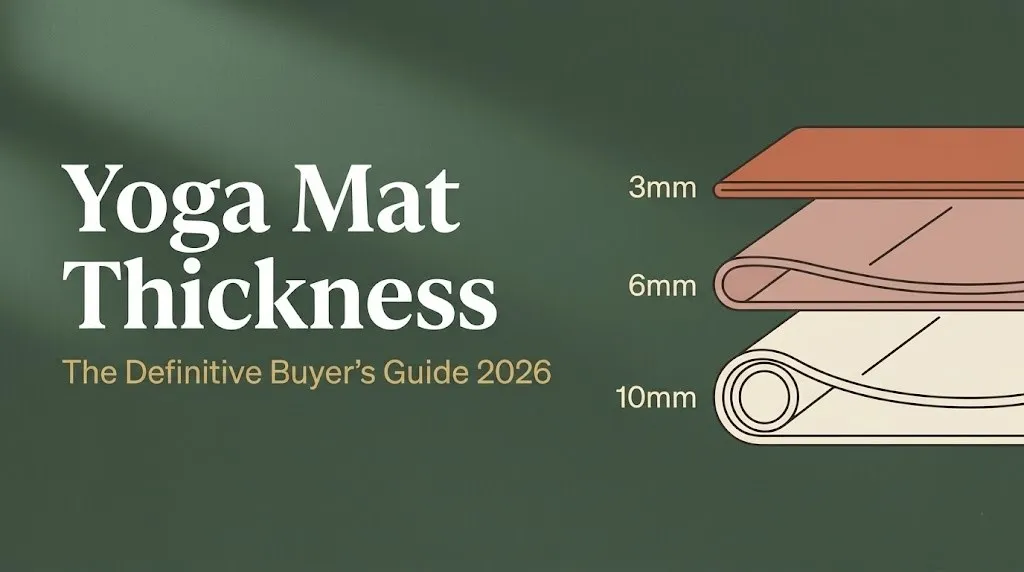
Yoga Mat Thickness: The Definitive Buyer’s Guide 2026
Yoga mat thickness ranges from 1.5mm to 10mm, and the right choice depends on your yoga style, joint health, and whether you value cushioning or stability more. There is no single best thickness. There is only the best thickness for your specific body and practice.
This matters more than most people realize when buying a mat. The American Council on Exercise (ACE) identifies surface instability as a direct factor in balance training outcomes. A mat that compresses too much underfoot can reduce proprioceptive accuracy in standing poses, which affects both performance and injury risk. The wrong thickness isn’t just uncomfortable. It can work against the physical goals of your practice.
This guide covers every thickness range from the ultra-thin travel mat to the extra-thick therapeutic pad, explains the biomechanical trade-offs in plain terms, and gives you specific recommendations by yoga style, joint condition, age, and floor surface. You’ll know exactly which mat to buy before you finish reading.
Yoga Mat Thickness
Yoga mat thickness is measured in millimeters and determines how much cushioning exists between your body and the floor during practice.
The measurement applies to the mat at rest, before any body weight compresses it. This distinction matters because different mat materials compress at different rates. A 6mm open-cell foam mat may compress to effectively 3mm under full body weight, while a 6mm dense natural rubber mat retains close to its stated thickness. The stated millimeter figure tells you the starting point, not necessarily the in-use experience.
Most yoga mats on the market fall into four thickness categories. Each category creates a different physical relationship between the practitioner’s body and the floor surface, affecting grip, stability, cushioning, and how well proprioceptive signals travel from the feet and hands to the brain.
Yoga mat thickness categories:
| Category | Thickness Range | Primary Characteristic | Best General Use |
|---|---|---|---|
| Ultra-thin | 1.5mm to 2mm | Minimal cushioning, maximum floor feel | Travel, hot yoga, advanced balance |
| Standard | 3mm to 4mm | Balanced cushioning and stability | Most yoga styles, most practitioners |
| Mid-thick | 5mm to 6mm | Increased cushioning, moderate stability | Beginners, joint sensitivity, Hatha |
| Extra-thick | 8mm to 10mm | Maximum cushioning, reduced stability | Therapeutic use, Restorative, seniors |
How Thick Are Yoga Mats?
Most yoga mats are between 3mm and 6mm thick, with 4mm being the most common thickness sold and considered the industry standard for general practice.
The range across all available mats extends from 1.5mm at the thinnest end, used by travelers and hot yoga practitioners who prioritize packability and floor contact, to 10mm at the thickest end, used primarily for therapeutic, Restorative, or senior-specific practice. Specialty therapeutic floor mats marketed as yoga mats can reach even greater thickness, but these are more accurately exercise padding than yoga mats in the traditional sense.
Understanding the full range helps practitioners contextualize what they’re comparing when they see thickness listed on a product label.
Full yoga mat thickness range:
| Thickness | Common Name | Weight Range | Who Typically Uses It |
|---|---|---|---|
| 1.5mm to 2mm | Ultra-thin, travel mat | 1 to 2 lbs | Travelers, hot yoga, experienced practitioners |
| 3mm | Thin standard | 2 to 3 lbs | Active flow, Ashtanga, Bikram |
| 4mm | Standard | 3 to 5 lbs | Most styles, most practitioners |
| 5mm | Mid-thick | 4 to 6 lbs | Beginners, Hatha, home practice |
| 6mm | Thick standard | 5 to 7 lbs | Joint sensitivity, beginners, Yin |
| 8mm | Extra-thick | 7 to 9 lbs | Seniors, knee/hip conditions, Restorative |
| 10mm | Therapeutic thick | 9 to 12 lbs | Therapeutic, chair yoga, extreme joint sensitivity |
Standard Yoga Mat Thickness
The standard yoga mat thickness is 4mm, which represents the most widely sold and most versatile option for general yoga practice across most styles and body types.
The 4mm standard emerged from decades of yoga equipment development as the thickness that best balances two competing demands: enough cushioning to protect joints during floor contact poses, and enough firmness to maintain stable proprioceptive feedback during standing and balance poses. It’s not a perfect compromise for every situation, but it’s the most functional default for practitioners who haven’t yet identified specific needs that pull them toward a thinner or thicker option.
Yoga Alliance’s training documentation, used across thousands of registered teacher training programs globally, treats 4mm as the assumed mat thickness in foundational instruction. Most studio-supplied mats fall in the 3mm to 5mm range for the same reason.
Why 4mm became the standard:
- Sufficient cushioning for Balasana (Child’s Pose) knee contact in most practitioners
- Firm enough to maintain ground feel in Tadasana (Mountain Pose) and standing balance poses
- Light enough (typically 3 to 5 lbs) for regular transport to studios
- Compatible with most mat materials: PVC, natural rubber, TPE, and cork all work at 4mm
- Wide enough availability that nearly every major brand produces a quality 4mm option
Key Takeaway: If you don’t have a specific joint condition, yoga style, or floor surface driving your decision, start with a 4mm mat. It’s the standard for a reason and works well across the vast majority of practice situations.
What Thickness Yoga Mat Is Best?
The best yoga mat thickness is 4mm to 6mm for most practitioners, with the ideal point within that range determined by your joint sensitivity, yoga style, and how much you value cushioning versus ground-feel stability.
This is the part where most guides say “it depends” and leave you no better informed than before. Here’s a more useful frame: choose your thickness based on which physical demand is your primary concern. If your primary concern is joint protection, go thicker, toward 6mm. If your primary concern is balance precision and floor feedback, go thinner, toward 3mm to 4mm. If you genuinely don’t know yet, 4mm is the correct starting point.
The American College of Sports Medicine (ACSM) notes that proprioception, the body’s sensory system for detecting position and movement, depends on mechanoreceptor signals from the feet and hands. A highly compressible surface reduces the clarity of those signals. This is why experienced practitioners frequently prefer thinner mats despite having the joint awareness to appreciate cushioning.
Thickness decision guide:
| Your Primary Concern | Recommended Thickness | Reasoning |
|---|---|---|
| Balanced general practice | 4mm | Best compromise of cushion and stability |
| Joint pain or sensitivity | 5mm to 6mm | More cushion at contact points |
| Balance precision | 3mm to 4mm | Better proprioceptive floor feedback |
| Heavy floor-based practice (Restorative, Yin) | 6mm to 8mm | Extended floor contact demands more cushion |
| Active flow with frequent transitions | 3mm to 4mm | Stability in rapid weight shifts |
| Therapeutic or senior use | 8mm to 10mm | Maximum joint protection priority |
Thick vs Thin Yoga Mat
The core difference between a thick and thin yoga mat is the trade-off between cushioning and stability: thick mats protect joints more but reduce balance precision, while thin mats provide better floor feedback but offer less joint protection.
Think of it like the difference between running shoes with maximum cushioning and minimalist running shoes. Maximum cushioning protects the joints during impact but reduces the ground-feel signals that your nervous system uses to calibrate gait and balance. Minimalist footwear gives your feet precise feedback but removes the protective buffer. Neither is universally superior. The right choice depends on your specific physical priorities.
In yoga terms, this trade-off appears most clearly in standing balance poses. Vriksasana (Tree Pose) requires the foot’s mechanoreceptors to send constant, precise position signals to maintain balance on one leg. On a 1.5mm mat over a firm floor, those signals are clear and strong. On a 10mm foam mat, the foot sinks slightly with every micro-adjustment, creating a continuously shifting base that demands more muscular effort for the same balance result.
Thick vs thin yoga mat comparison:
| Factor | Thin Mat (1.5mm to 3mm) | Thick Mat (6mm to 10mm) |
|---|---|---|
| Joint cushioning | Low | High |
| Balance stability | High | Lower |
| Proprioceptive feedback | Strong and clear | Reduced |
| Floor feel | Direct | Buffered |
| Weight and portability | Light, easy to fold | Heavy, less portable |
| Best for | Active flow, balance, hot yoga | Restorative, seniors, joint conditions |
| Worst for | Practitioners needing joint protection | Practitioners needing balance precision |
Are Thicker Yoga Mats Better?
Thicker yoga mats are better for joint protection and floor-based comfort, but they are not better for balance-focused poses, active flow sequences, or any practice where proprioceptive feedback from the floor matters.
The word “better” creates the confusion here. Thicker is objectively better for one specific outcome: reducing pressure and impact load at the points where your body contacts the floor. Knees in Balasana (Child’s Pose), wrists in Adho Mukha Svanasana (Downward-Facing Dog), and hips in seated postures all experience less point pressure on a thicker mat.
Thicker is not better, and is sometimes worse, for maintaining balance, for feeling the floor actively through the soles of the feet, and for the rapid weight-shifting transitions common in Vinyasa and Ashtanga sequences. A thick, soft mat during a flow practice is like trying to do precise footwork on a memory foam mattress.
Where thick mats genuinely win:
- Extended kneeling poses: Reduced patellar and tibial pressure during Anahatasana (Extended Puppy Pose) or low lunges
- Savasana (Corpse Pose): Full spinal contact with the floor is more comfortable on a thicker surface
- Restorative holds: When the body is still for 5 to 20 minutes, a firmer, thinner mat becomes genuinely uncomfortable
- Wrist-sensitive practitioners: More cushion under the carpal bones during weight-bearing poses
- Cold, hard floors: Thick mats provide thermal insulation as well as physical cushioning
Key Takeaway: Thicker mats protect your joints better, but thinner mats support your balance better. The right answer depends on which of those two needs is more urgent for your specific practice and body.
Does Yoga Mat Thickness Affect Balance?
Yes, yoga mat thickness directly affects balance in standing poses. Thicker, softer mats compress under the planted foot, creating a less stable base and reducing proprioceptive feedback from the floor.
This is the most counter-intuitive fact about yoga mat thickness, and the one most often missed by buyers choosing a thick mat for their first practice. The assumption is that more cushioning means more support. In seated and supine poses, that’s true. In standing balance poses, it’s the opposite.
Proprioception refers to the body’s ability to sense its own position in space. It depends on mechanoreceptors in the feet, ankles, and lower legs, which detect pressure, movement, and surface angle. When the mat under your foot compresses unevenly as your weight shifts during Ardha Chandrasana (Half Moon Pose), those mechanoreceptors receive a noisier, less precise signal. Your cerebellum has to work harder to maintain balance, and the result is more wobbling, not less.
Research in sports science and physical therapy broadly supports the principle that unstable or highly compressible surfaces increase the muscular demand for balance tasks without necessarily improving proprioceptive training outcomes.
How thickness affects balance by pose type:
| Pose Type | Balance Demand | Ideal Thickness |
|---|---|---|
| Single-leg standing (Vriksasana, Natarajasana) | Very high | 3mm to 4mm |
| Two-leg standing (Tadasana, Virabhadrasana II) | Moderate | 4mm to 5mm |
| Wide-stance standing (Prasarita Padottanasana) | Moderate-low | 4mm to 6mm |
| Floor-based kneeling (low lunges, Balasana) | Low | 5mm to 8mm |
| Fully supine (Savasana, Supta poses) | None | 6mm to 10mm |
Modification note: Practitioners who need joint protection but also need balance support can use a thinner mat (4mm) with a folded blanket placed specifically under the knees or hips during floor work, rather than using an overall thick mat that compromises standing poses.
Yoga Mat Thickness for Beginners
The best yoga mat thickness for beginners is 5mm to 6mm, which provides enough joint cushioning to reduce early discomfort without being so thick that balance poses become unnecessarily difficult.
Beginners experience more joint discomfort during yoga than experienced practitioners for a straightforward reason: their bodies haven’t yet developed the muscle conditioning around the joints that buffers impact and pressure. The knee during a held low lunge, the wrist during a long Downward-Facing Dog, and the hip during seated poses all feel raw contact with the floor more acutely when the surrounding musculature is still developing.
A 5mm to 6mm mat gives beginners the protection they need to practice comfortably long enough to develop that conditioning. Once the body adapts over several months of practice, many experienced practitioners step down to a 4mm mat because they no longer need the extra cushioning and they’ve started to value balance feedback more.
Beginner thickness guide:
| Beginner Situation | Recommended Thickness | Reasoning |
|---|---|---|
| Average healthy beginner | 5mm | Protection without excessive instability |
| Beginner with knee sensitivity | 6mm | More patellar cushioning in kneeling poses |
| Beginner planning primarily floor-based styles (Yin, Restorative) | 6mm to 8mm | Extended floor contact demands more cushion |
| Beginner planning active flow classes (Vinyasa) | 4mm to 5mm | Stability needed for rapid transitions |
| Beginner who has never done any exercise | 6mm | More time on the floor at lower intensity initially |
According to Yoga Alliance, beginner practitioners benefit most from practicing at a consistent frequency, and physical discomfort is one of the primary reasons beginners stop practicing. A mat that eliminates unnecessary discomfort supports the consistency that produces actual results.
Yoga Mat Thickness for Bad Knees
For practitioners with knee pain, knee replacement, or conditions affecting the knee joint, a yoga mat of 6mm to 8mm thickness is the standard recommendation from yoga teachers and physical therapists.
The knee is one of the most frequently cited pain points for yoga practitioners. The patellar tendon, medial and lateral menisci, and the tibial plateau are all vulnerable to sustained point pressure during kneeling poses. On a 3mm mat over a hardwood floor, that pressure is almost fully transmitted to the joint surface. On a 6mm to 8mm mat, the mat absorbs a meaningful portion of that load before it reaches the tissue.
For practitioners who have had knee replacement surgery or who manage knee osteoarthritis, physical therapists generally recommend additional padding even beyond what the mat provides. A folded yoga blanket placed under the knee in kneeling poses adds approximately 10mm to 20mm of additional cushioning precisely where it’s needed, without requiring you to sacrifice standing balance quality for the rest of the practice.
Knee-focused thickness recommendations:
- Mild knee sensitivity: 6mm mat, no additional props needed for most poses
- Chronic knee pain or osteoarthritis: 6mm to 8mm mat plus folded blanket under knees in all kneeling poses
- Post knee replacement (cleared for yoga by orthopedic surgeon): 8mm mat plus two folded blankets under the affected knee, avoid full kneeling until cleared for weight-bearing in that position
- Patellar tendinitis: 6mm mat, avoid sustained kneeling; use seated alternatives to kneeling poses during flare-ups
Safety caution: Practitioners who have had knee surgery and are returning to yoga should confirm which positions and weight-bearing postures are appropriate with their orthopedic surgeon or physiotherapist before choosing a thickness, as the mat is only one factor in knee protection during practice.
Key Takeaway: For any joint pain concern, especially knees, move toward 6mm to 8mm thickness. Add a folded blanket under the specific contact point during kneeling poses rather than relying on overall mat thickness alone to solve all joint pressure issues.
Yoga Mat Thickness for Seniors
Senior practitioners benefit from yoga mats in the 6mm to 8mm range, because this thickness addresses the joint sensitivity, reduced tissue padding, and balance considerations that are common physical factors in older bodies.
Adults over 60 typically have reduced subcutaneous fat padding over bony prominences including the knees, hips, sacrum, and ankles. This means that mat-to-body contact during floor poses feels sharper and more uncomfortable at the same mat thickness that works fine for a 35-year-old. The NCCIH notes that yoga is associated with improved balance and reduced fall risk in older adults, making appropriate mat setup a genuine safety consideration, not just a comfort preference.
The balance paradox applies to seniors as well. While more joint protection is needed, excessive mat softness can create an unstable base for standing poses. A 6mm dense natural rubber mat is generally better than a 6mm soft foam mat for senior practitioners, because the rubber maintains its thickness under load while the foam compresses significantly.
Senior yoga mat thickness guidance:
| Senior Condition | Recommended Thickness | Additional Props |
|---|---|---|
| Healthy, active senior | 6mm natural rubber | Folded blanket for Savasana |
| Reduced joint padding, bone sensitivity | 6mm to 8mm | Blanket under knees and hips |
| Balance concerns, mild | 5mm to 6mm firm rubber | Wall or chair for standing poses |
| Osteoporosis (cleared for yoga) | 6mm to 8mm | Avoid poses with spinal flexion as guided by physician |
| Chair yoga practitioner | 8mm to 10mm floor pad | Chair with non-slip feet on top of mat |
For senior practitioners doing primarily chair yoga, a 8mm to 10mm mat under the chair feet prevents sliding on smooth floors and provides a defined practice boundary, even if the practitioner never gets on the floor.
Yoga Mat Thickness by Yoga Style
The optimal yoga mat thickness varies by yoga style because each style creates a different pattern of floor contact, movement speed, joint loading, and temperature that affects what the mat needs to do.
This is the dimension entirely missing from every competitor’s coverage of this topic. Recommending a single thickness for “yoga” makes about as much sense as recommending a single shoe for “sport.” Ashtanga and Restorative yoga place completely different physical demands on a mat, and the best thickness for one is genuinely counterproductive for the other.
Vinyasa and Ashtanga both involve rapid transitions between poses, frequent weight-shifting between hands and feet, and sustained heat generation. A 3mm to 4mm mat in a grippy, dense material serves these styles best. The firm surface provides stable ground feel during quick transitions and doesn’t impede the speed of movement.
Yin and Restorative yoga involve long holds, often 3 to 20 minutes, in floor-based shapes. A 6mm to 8mm mat provides the sustained comfort these extended holds require.
Yoga mat thickness by style:
| Yoga Style | Optimal Thickness | Key Reason |
|---|---|---|
| Ashtanga | 3mm to 4mm | Rapid transitions, stability priority |
| Vinyasa | 3mm to 5mm | Active flow, frequent weight shifts |
| Hatha | 4mm to 5mm | Moderate pace, balanced needs |
| Iyengar | 4mm to 5mm | Precision alignment, props supplement |
| Bikram/26&2 | 1.5mm to 3mm | Heat, sweat, minimal cushion needed |
| Yin | 5mm to 8mm | Long floor holds, joint comfort priority |
| Restorative | 6mm to 8mm | Extended passive holds |
| Kundalini | 4mm to 6mm | Floor and seated work balanced |
Yoga Mat Thickness for Hot Yoga
For hot yoga and Bikram/26&2 practice, the ideal mat thickness is 1.5mm to 3mm, prioritizing grip and floor contact over cushioning.
Hot yoga studios are maintained at 95 to 105 degrees Fahrenheit with elevated humidity. The primary challenge is not joint cushioning. It’s grip in the presence of heavy perspiration. A thicker, softer mat absorbs sweat and becomes slippery. A thinner, denser mat, particularly one made from closed-cell natural rubber or a grippy synthetic, maintains surface traction better under wet conditions.
The heat in a hot yoga class also warms muscles significantly more than a room-temperature class. Muscles that are thoroughly warmed are more supple and place less demand on the mat for joint protection. The biomechanical argument for cushioning is weaker in a hot environment precisely because the body’s own thermoregulation creates the tissue compliance that cooler muscles need a mat to provide.
Hot yoga mat thickness recommendations:
- 1.5mm to 2mm: Best for practitioners with good joint health who prioritize maximum grip and floor feel
- 3mm: Best compromise for hot yoga practitioners with some wrist or knee sensitivity
- 4mm: Acceptable if you use a full-length microfiber hot yoga towel on top; the towel handles grip and the mat handles moderate cushioning
Quick Summary for hot yoga:
- Always use a microfiber hot yoga towel over any mat in a hot yoga class
- The towel activates (becomes grippier) when wet, regardless of the mat thickness underneath
- Avoid thick foam mats in hot yoga: they absorb sweat, become unsanitary, and reduce grip
- Safety caution: If you’re new to hot yoga, prioritize acclimatization over equipment optimization for the first several sessions
Key Takeaway: Hot yoga is one situation where going thinner is genuinely better for safety, not just personal preference. A grippy thin mat plus a microfiber towel outperforms a thick mat in a hot, sweaty environment every time.
Yoga Mat Thickness for Yin Yoga
For Yin yoga, a mat thickness of 5mm to 8mm provides the sustained floor comfort needed for holds lasting 3 to 5 minutes in each pose.
Yin yoga is distinct from all active yoga styles in one specific way: the body stays in a single position for an extended period, often three to five minutes, with the goal of targeting deep connective tissue rather than muscles. During that extended hold, any point of discomfort from a hard floor surface becomes increasingly distracting and can prevent the nervous system from settling into the passive release that Yin is designed to create.
Think of the difference between sitting on a wooden chair for thirty seconds versus sitting on it for five minutes. The discomfort that’s manageable briefly becomes genuinely limiting over time. The same principle applies to a thin mat during a Yin hold: what feels acceptable in the first minute of Supta Baddha Konasana (Reclining Bound Angle Pose) can become uncomfortable by minute four.
Yin yoga mat considerations:
| Yin Pose Type | Floor Contact Points | Ideal Mat Thickness |
|---|---|---|
| Supine hip openers (Supta Baddha Konasana) | Sacrum, shoulder blades, heels | 6mm to 8mm |
| Prone back bends (Bhujangasana) | Pubic bone, lower ribs, tops of feet | 5mm to 6mm |
| Seated folds (Paschimottanasana) | Sit bones, backs of thighs | 5mm to 6mm |
| Dragon pose (low lunge) | Back knee, shin | 6mm to 8mm plus blanket |
| Caterpillar (seated forward fold with rounded spine) | Sit bones, coccyx | 5mm to 6mm |
Modification for Yin on any mat: A folded yoga blanket placed under specific contact points, the sacrum, knees, or ankles, supplements any mat thickness for particularly sensitive areas without requiring a purchase of a thicker mat.
Yoga Mat Thickness for Travel
For travel, a yoga mat thickness of 1.5mm to 2mm is the practical choice, providing a non-slip surface marker and basic floor hygiene without adding meaningful weight to a bag.
A travel yoga mat is not meant to replace your home practice mat. It is meant to give you a defined, personal practice surface in hotel rooms, airport terminals, vacation rentals, and outdoor spaces where you have no mat available. The thickness compromise is the direct result of the portability requirement: a 1.5mm travel mat folds or rolls to the size of a large umbrella and weighs under two pounds.
The joint protection sacrifice is real but manageable. Hotel carpets, wooden floors, and grass all provide more natural cushioning than a bare concrete floor. A 1.5mm mat in a furnished room is a functional practice surface. The same mat over bare hotel bathroom tile is less ideal for extended floor work.
Travel yoga mat thickness options:
| Travel Mat Type | Thickness | Weight | Fold or Roll | Best Use |
|---|---|---|---|---|
| Foldable travel mat | 1.5mm | 1 to 2 lbs | Folds flat | Carry-on luggage |
| Thin rollable mat | 2mm to 3mm | 2 to 3 lbs | Rolls compactly | Checked bag or large carry-on |
| Standard rollable mat | 4mm | 3 to 5 lbs | Standard roll | Road trips, not air travel |
Practical travel tip: Bring a yoga mat carrying strap rather than a full mat bag for a travel mat. Straps weigh nothing and let you carry the rolled mat on your shoulder without a bag.
Safety note: On hotel floors, always place your travel mat directly over the hard floor surface, not over a rug or carpet, to prevent slipping during standing poses.
Yoga Mat Thickness for Hardwood Floors
For hardwood floors, a yoga mat thickness of 4mm to 6mm in a dense natural rubber material provides the best combination of grip, cushioning, and thermal comfort for home practice.
Hardwood floors present two challenges that concrete, tile, and carpet do not: they are acoustically resonant (your mat and body make more noise, which some practitioners find distracting) and they are thermally cool, which can make extended floor contact in Savasana (Corpse Pose) or Yin holds feel physically cold against the body.
A 4mm natural rubber mat on hardwood solves the grip problem entirely: natural rubber has high static friction against wood surfaces and doesn’t require the mat underside to be tacky the way PVC mats do. The 4mm to 6mm thickness addresses the acoustic dampening and thermal insulation aspects without compromising standing pose stability.
Hardwood floor yoga mat guide:
| Concern on Hardwood | Solution | Recommended Thickness |
|---|---|---|
| Mat slipping on floor | Natural rubber backing | 4mm to 6mm rubber |
| Wrist discomfort at contact | More cushion at pressure points | 5mm to 6mm |
| Cold floor during Savasana | Thermal insulation from mat | 6mm plus blanket layer |
| Noise during transitions | Dense rubber dampens impact | 4mm to 6mm rubber |
| Knee discomfort kneeling | Adequate mat density | 5mm to 6mm or add blanket |
One option to avoid: Open-cell foam mats on hardwood floors. They compress fully under body weight (negating thickness benefits), absorb floor moisture and dust, and degrade faster when used repeatedly on hard surfaces without carpet beneath them.
Key Takeaway: For hardwood floors specifically, the mat material matters as much as the thickness. A 4mm natural rubber mat outperforms a 6mm foam mat in both grip and durability on wood surfaces.
Frequently Asked Questions About Yoga Mat Thickness
What is the best thickness for a yoga mat for beginners?
The best yoga mat thickness for beginners is 5mm to 6mm, providing enough cushioning to protect joints during early practice without creating excessive instability in standing poses.
As your body conditioning improves over months of regular practice, many practitioners step down to a 4mm mat because they value balance feedback more as their skills develop.
If your first classes will be primarily floor-based (Yin or Restorative), start at 6mm to 8mm.
Is a 6mm yoga mat too thick for balance poses?
A 6mm mat is moderately challenging for narrow single-leg balance poses like Vriksasana (Tree Pose), particularly if the mat material is soft or highly compressible.
A 6mm dense natural rubber mat retains more of its thickness under load and performs noticeably better for balance than a 6mm soft foam mat of the same stated thickness.
If balance precision matters to your practice, choose a 4mm mat and supplement with a folded blanket under the knees during floor work.
What yoga mat thickness is best for bad knees?
A 6mm to 8mm mat is the recommended thickness for practitioners with knee pain, knee osteoarthritis, or post-surgical knee sensitivity.
For additional protection in kneeling poses, place a folded yoga blanket directly under the affected knee regardless of the mat thickness you’re using.
Practitioners cleared to return to yoga following knee replacement surgery should confirm load-bearing positions with their physiotherapist before beginning any kneeling postures.
How thick should a yoga mat be for hardwood floors?
A 4mm to 6mm natural rubber mat is the best choice for hardwood floors, providing grip, cushioning, and thermal insulation in the right balance.
Natural rubber creates strong static friction against wood without requiring adhesive backing or anti-slip pads.
Avoid placing open-cell foam mats directly on hardwood floors: they compress fully under body weight and degrade faster on hard surfaces.
Are thicker yoga mats better for your joints?
Thicker yoga mats are better for joints during floor contact poses like kneeling, supine, and seated postures, where cushioning directly reduces point pressure on vulnerable tissue.
They are not better for standing balance poses, where the compressibility of thick soft mats reduces proprioceptive floor feedback and can make balance harder to maintain.
The best approach for joint protection without sacrificing balance is a 5mm to 6mm dense rubber mat with targeted blanket supplementation under specific pressure points during floor work.
One Number Changes Everything
The difference between a mat that frustrates your practice and one that supports it is often just a few millimeters. Your knees, wrists, and balance all respond to that number, even when you can’t feel the difference with your hands.
Start with a 4mm mat if you’re unsure. Add a folded blanket under your knees for floor work. That setup serves the widest range of practices and budgets without any trade-offs worth worrying about.
If you have knee pain, specific joint conditions, or you’re practicing Restorative yoga primarily, move to 6mm. That’s all the decision-making this topic actually requires.