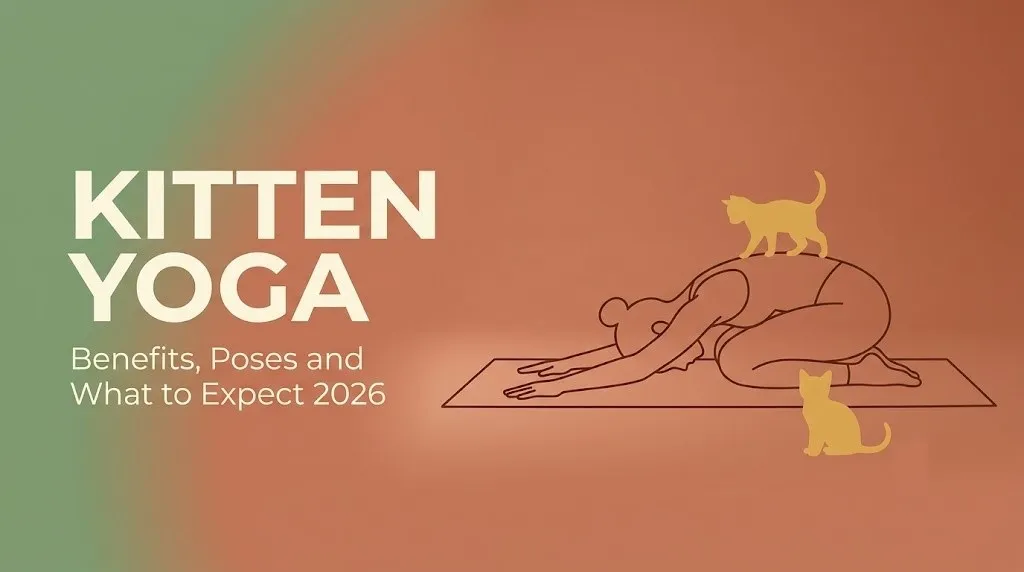
Kitten Yoga: Benefits, Poses & What to Expect 2026
Kitten yoga is a structured yoga session held in the company of adoptable foster kittens, combining the physical and mental benefits of a gentle yoga practice with the documented stress-reducing effects of human-animal interaction. It’s not just a cute social media trend: there is real physiological science behind why practicing yoga alongside animals makes people feel meaningfully better.
Research matters here. The Human Animal Bond Research Institute (HABRI) has documented that interacting with animals triggers oxytocin release and reduces cortisol output in humans, with effects measurable within minutes of positive contact. Combined with the parasympathetic-activating effects of yoga itself, the two experiences reinforce each other in ways a solo mat session cannot replicate.
This guide covers what kitten yoga actually is, the research behind its benefits, which poses work best in a kitten environment, what to expect from your first class, and how to recreate the experience at home with your own cat. Safety considerations, allergy guidance, and finding classes near you are all addressed.
What Is Kitten Yoga
Kitten yoga is a yoga class format in which participants practice gentle or restorative yoga poses on mats while adoptable foster kittens freely roam, climb, and interact with practitioners throughout the session.
The format originated as a creative collaboration between yoga studios and animal rescue organizations. Shelters and foster networks bring a small group of socialized kittens to a studio. Practitioners pay a class fee, and a portion of the proceeds typically supports the rescue organization. Some of the kittens present in these classes are available for adoption, making kitten yoga an unusual intersection of wellness and animal welfare.
The yoga itself is always gentle. You will not find a 90-minute Bikram/26&2 class with kittens roaming the floor. Sessions are typically structured as Hatha or Restorative yoga, with poses held long enough to allow practitioners to remain settled while a kitten decides whether to sit on them.
What makes kitten yoga distinct from a standard yoga class is the unpredictable, sensory-rich presence of animals. A kitten may climb onto your back during Balasana (Child’s Pose), walk across your mat during a transition, or settle on your chest in Savasana (Corpse Pose). That unpredictability is a feature, not a bug. It teaches present-moment awareness in a way that a regular class does not.
Key defining features of a kitten yoga session:
- Gentle or restorative yoga format, typically 45 to 60 minutes
- 6 to 12 foster kittens present in the room, supervised by a handler
- Class fees often partially or fully benefit a partnering animal rescue
- Kittens are available for adoption in many cases
- Participants are encouraged to interact gently during and after class
How Does a Kitten Yoga Class Work
A kitten yoga class works by pairing a guided gentle yoga session led by a certified yoga teacher with the free-roaming presence of foster kittens, supervised by an animal handler who manages the kittens’ welfare throughout.
The session structure is straightforward. Students arrive, set up mats in the studio space, and the kittens are brought in after everyone is settled. The yoga teacher leads the class through a sequence of accessible, low-intensity poses while the kittens explore the room at their own pace.
Most kitten yoga classes run between 45 and 75 minutes. The first 30 to 40 minutes are typically structured yoga practice. The remaining time is often unstructured, allowing participants to interact directly with the kittens, take photos, and spend time with any they’re interested in adopting.
The animal handler plays a specific role. That person is not the yoga teacher. Their job is to monitor the kittens for stress or overstimulation and to remove any kitten that appears uncomfortable. Reputable kitten yoga events prioritize the animals’ welfare as much as the participants’ experience.
| Session Component | Typical Duration | What Happens |
|---|---|---|
| Arrival and setup | 10 to 15 minutes | Students settle mats, meet kittens informally |
| Guided yoga practice | 30 to 45 minutes | Teacher-led gentle or restorative sequence |
| Savasana | 5 to 10 minutes | Final rest, kittens often settle on practitioners |
| Open kitten time | 10 to 20 minutes | Free interaction, adoption conversations, photos |
| Total session | 60 to 75 minutes | Complete experience |
Class sizes are usually capped at 10 to 20 participants to maintain a calm environment for the animals and ensure everyone has adequate mat space.
Kitten Yoga Benefits for Body and Mind
Kitten yoga produces benefits through two parallel mechanisms: the physical and mental effects of the yoga practice itself, and the physiological effects of positive human-animal interaction, both of which are independently documented in peer-reviewed research.
The yoga component delivers the benefits you’d expect from a gentle Hatha or Restorative yoga class: improved flexibility, reduced muscular tension, slower breathing, and activation of the parasympathetic nervous system. The animal component adds a layer of neurochemical response that deepens the calming effect.
Documented benefits that apply specifically to kitten yoga as a combined experience:
- Oxytocin release: Positive physical contact with animals triggers the release of oxytocin, the bonding hormone. Higher oxytocin is associated with reduced anxiety, improved mood, and lower blood pressure.
- Cortisol reduction: The Human Animal Bond Research Institute (HABRI) has documented that interacting with animals reduces cortisol, the primary stress hormone, within minutes of contact.
- Improved focus and presence: The unpredictability of kittens demands present-moment attention in a way that supports mindfulness more immediately than abstract meditation instruction.
- Respiratory slowing: Both yoga breathwork and the calming effect of animal presence have been independently shown to slow resting respiratory rate.
- Social connection: Group kitten yoga classes also provide a social element, which itself has documented effects on mood and perceived wellbeing.
Modification note: practitioners seeking the physical yoga benefits alone without animal interaction should attend a standard Restorative yoga class. Kitten yoga is the right choice when you specifically want the combined sensory and social experience.
Key Takeaway: Kitten yoga works because it stacks two independently documented stress-reduction mechanisms, gentle yoga and positive animal contact, creating a combined physiological effect that neither experience delivers as fully on its own.
The Science Behind Animal-Assisted Yoga
Animal-assisted yoga is a specific application of animal-assisted intervention (AAI), which is the broader research-supported practice of incorporating animals into therapeutic and wellness contexts to improve physical, emotional, and social outcomes.
The research base for animal-assisted intervention is more established than most people realize. According to the Human Animal Bond Research Institute, studies across healthcare, education, and workplace settings consistently document that structured animal interaction reduces self-reported stress, lowers blood pressure, and improves mood in healthy adults.
The specific physiological mechanism centers on two hormones. Positive contact with animals triggers oxytocin release in humans. Simultaneously, the same contact has been shown to reduce cortisol output. These two effects together shift the body’s neurochemical balance toward calm and connection.
A study published in Anthrozoös, a peer-reviewed journal focused on human-animal interactions, found that brief contact with a friendly dog or cat before a stressful task significantly reduced participants’ anxiety responses compared to a control group without animal contact. While this specific study used dogs, the oxytocin and cortisol mechanisms are consistent across species.
The yoga component adds a separate but compatible layer. According to the National Center for Complementary and Integrative Health, yoga practices combining gentle movement with breath regulation produce measurable reductions in sympathetic nervous system activity. When practiced alongside animals that independently trigger parasympathetic activation, the combined effect is additive.
Cat purring adds an additional, often overlooked dimension. Domestic cat purring occurs at frequencies between 25 and 150 Hz. Research in bioacoustics suggests that vibrations in this frequency range may promote bone density and tissue healing, though more controlled human studies are needed before strong conclusions can be drawn from this finding.
Kitten Yoga and Stress Relief
Kitten yoga reduces stress through a combination of slow, breath-linked movement, sensory grounding through animal contact, and the parasympathetic nervous system activation that both yoga and positive human-animal interaction independently produce.
Stress relief is the most commonly cited reason people try kitten yoga, and the claim has more scientific backing than most lifestyle wellness trends. The stress response is mediated primarily by the hypothalamic-pituitary-adrenal (HPA) axis, which regulates cortisol output. Both yoga and animal interaction have been shown to reduce HPA axis activity through different but complementary pathways.
Think of your nervous system’s stress response like a fire alarm that has gotten stuck in the “on” position. Yoga breathwork and gentle movement manually trigger the reset mechanism. Animal contact adds a separate signal, through oxytocin release and tactile stimulation, that helps complete the reset. Together, they work faster than either alone.
A study published in the International Journal of Environmental Research and Public Health found that brief structured interactions with animals in a group wellness setting produced statistically meaningful reductions in self-reported stress scores, with effects lasting for several hours after the interaction ended.
For the yoga teacher’s perspective: the stress-relief benefit in kitten yoga is not primarily about the poses themselves. A class that includes Balasana (Child’s Pose), Supta Baddha Konasana (Reclined Bound Angle Pose), and Savasana (Corpse Pose) already delivers substantial stress relief. The kittens amplify that effect by creating an environment of warmth, sensory engagement, and gentle surprise that keeps the mind from spiraling into familiar worry patterns.
Modification for high-stress practitioners: if you find animal unpredictability anxiety-provoking rather than calming, seat yourself toward the edge of the mat arrangement where you’ll have slightly more space. Start with a standard Restorative yoga class before trying kitten yoga.
Kitten Yoga for Anxiety and Mental Health
Kitten yoga supports anxiety management by combining the evidence-based anxiety-reducing effects of gentle yoga practice with the documented mood-elevating neurochemical effects of positive human-animal contact.
Anxiety, at its physiological root, is driven by an overactive sympathetic nervous system and elevated cortisol and adrenaline. Kitten yoga addresses this through three distinct channels: slow breath linked to movement (yoga), oxytocin release through animal contact, and present-moment sensory focus through kitten interaction.
According to the Journal of Alternative and Complementary Medicine, yoga interventions of 60 minutes or less, practiced regularly at a minimum of twice per week, show measurable improvements in self-reported anxiety symptoms in adults with generalized anxiety. Adding animal contact to those sessions compounds the benefit through a different neurochemical mechanism.
The present-moment attention demanded by kittens is particularly valuable for anxiety management. Anxiety typically lives in the future: what might happen, what could go wrong. A kitten sitting unexpectedly on your stomach during Supta Baddha Konasana (Reclined Bound Angle Pose) brings you back to right now immediately. That’s not incidental. It’s one of the most effective anxiety interruption mechanisms available.
Mental health benefits supported by the animal-yoga combination:
- Reduced rumination: sensory focus on the animal disrupts repetitive anxious thought patterns
- Elevated mood: oxytocin release has direct antidepressant-adjacent effects on brain chemistry
- Increased social connection: group class environment reduces isolation, which is a known anxiety amplifier
- Improved emotional regulation: combined yoga and animal contact activates the vagus nerve, which governs emotional self-regulation
Safety note: kitten yoga is a complementary wellness activity. Practitioners managing clinical anxiety disorders, panic disorder, or trauma-related conditions should continue working with their mental health treatment team. Kitten yoga can support, but does not replace, professional care.
Key Takeaway: Kitten yoga addresses anxiety through three simultaneous mechanisms (breath regulation, oxytocin release, and present-moment sensory grounding), which is why practitioners consistently report feeling calmer after a session than they expected.
What Yoga Poses Are Used in Kitten Yoga
Kitten yoga classes use primarily Hatha yoga or Restorative yoga poses that keep the practitioner close to the floor, hold positions for multiple breaths, and allow easy engagement with kittens without abrupt transitions.
The logic is simple. Fast-moving Vinyasa sequences with frequent standing transitions are not compatible with kittens on the mat. Flowing between Adho Mukha Svanasana (Downward-Facing Dog) and Virabhadrasana I (Warrior I) repeatedly would be both kitten-unfriendly and pose a fall risk if a kitten moves underfoot. Kitten yoga sequences prioritize stability and slowness.
| Pose | Sanskrit Name | Why It Works in Kitten Yoga | Hold Time |
|---|---|---|---|
| Cat-Cow | Marjaryasana-Bitilasana | Floor-based, slow, kitten-safe movement | 8 to 10 rounds |
| Child’s Pose | Balasana | Low to ground, inviting for kittens to climb | 5 to 8 breaths |
| Reclined Bound Angle | Supta Baddha Konasana | Fully supine, calm, creates “lap” for kittens | 2 to 3 minutes |
| Legs Up the Wall | Viparita Karani | Gentle inversion, stationary | 3 to 5 minutes |
| Bridge Pose | Setu Bandha Sarvangasana | Grounded, kitten-safe, engages glutes | 5 breaths, x2 |
| Seated Twist | Sukhasana with rotation | Low, slow, non-startling for nearby kittens | 4 to 5 breaths |
| Corpse Pose | Savasana | Fully still, often where kittens settle | 5 to 10 minutes |
Marjaryasana-Bitilasana (Cat-Cow Pose) is practically mandatory in a kitten yoga class, both for its spinal mobilization benefits and for the obvious thematic connection.
Modification for practitioners with wrist sensitivity: in Marjaryasana-Bitilasana (Cat-Cow Pose), lower to forearms instead of extended wrists. Place a folded blanket under the knees for additional cushioning on hard studio floors.
A Kitten Yoga Sequence You Can Try at Home
A kitten yoga sequence for home practice uses the same floor-based, slow-paced poses found in a studio kitten yoga class, adapted for a home environment where your own cat (or cats) are invited to participate freely.
This sequence runs approximately 30 to 35 minutes. Hold each pose for the breath count noted. Your cat may or may not participate. Both outcomes are fine.
To practice a home kitten yoga session:
- Seated centering in Sukhasana (Easy Seated Pose): 3 minutes of natural breath awareness. Allow your cat to settle nearby.
- Marjaryasana-Bitilasana (Cat-Cow Pose): 10 slow rounds on hands and knees. Link each movement to an inhale or exhale.
- Balasana (Child’s Pose): 8 breaths. Arms extended forward. Allow your cat to approach if they wish. Do not force interaction.
- Adho Mukha Svanasana (Downward-Facing Dog): 5 breaths. Hold steady; avoid walking the feet if your cat is nearby.
- Return to the floor. Setu Bandha Sarvangasana (Bridge Pose): 5 breaths, lower slowly, repeat twice.
- Supta Matsyendrasana (Supine Spinal Twist): 5 breaths per side. Stay slow and steady.
- Supta Baddha Konasana (Reclined Bound Angle Pose): 3 minutes. Place your hands on your belly. Breathe slowly. This is where cats tend to settle if they’re going to.
- Viparita Karani (Legs-Up-the-Wall Pose): 4 minutes. Place a folded blanket under the hips for comfort.
- Savasana (Corpse Pose): 5 to 8 minutes. Complete stillness.
Modification for practitioners without cats: practice the sequence alone. The physiological benefits of the yoga are fully intact. You’re simply removing the animal component, which is optional even in a studio setting.
Key Takeaway: You don’t need to book a studio class to experience kitten yoga: the same floor-based, slow-paced sequence practiced at home with your own cat delivers the core yoga benefits, and your cat’s participation is entirely on their terms.
What to Expect at Your First Kitten Yoga Class
At your first kitten yoga class, expect a relaxed, social atmosphere, a gentle yoga sequence led by a certified teacher, and the delightful unpredictability of small animals doing exactly what they want.
First-timers are often surprised by how much the environment feels like a normal yoga class. You arrive, set up your mat, and begin warming up. The kittens are usually brought in after everyone is settled to avoid overstimulation at the start. A yoga teacher leads the class through poses. An animal handler manages the kittens’ welfare throughout.
What’s different from a regular class: the room has more ambient sound. Kittens meow, play, and occasionally knock things over. Your classmates may whisper and smile at kitten activity mid-pose. That ambient warmth is part of the experience. You don’t need to maintain the silence of a traditional studio session.
Expect that kittens may not interact with you directly. They’re animals, not employees. Some classes you’ll have a kitten on your mat in the first five minutes. Other sessions the kittens may cluster at one end of the room and mostly explore each other. Both experiences are normal and valid.
What first-timers should know before arriving:
- Arrive 5 to 10 minutes early to secure mat placement and settle before kittens are introduced
- Photo policies vary: some studios allow photos throughout, others ask you to wait until open time
- Kittens are not toys: gentle, calm interaction is expected and enforced
- You may leave with adoption paperwork if you fall in love with a particular kitten
- The yoga instruction is genuine: show up with the intention to practice, not just to play with kittens
Kitten Yoga Etiquette: Dos and Don’ts
Kitten yoga etiquette requires practitioners to prioritize the animals’ wellbeing above personal interaction preferences, which means reading kitten body language, moving slowly, and following the animal handler’s guidance throughout.
This is the section most competitors skip entirely, and it’s genuinely important. Kittens in a yoga class environment are experiencing an unusual amount of sensory input. Responsible participation means making that experience safe and positive for the animals, not just enjoyable for yourself.
Dos and don’ts for kitten yoga participants:
Dos:
- Move slowly and predictably at all times, even between poses
- Allow kittens to approach you; do not reach out and grab them
- Follow the animal handler’s instructions immediately if they redirect your interaction
- Wash your hands before and after the session
- Stay calm and speak quietly throughout the class
- Signal the handler if a kitten seems distressed, injured, or overstimulated
Don’ts:
- Do not pick up a kitten unless explicitly invited by the handler
- Do not use flash photography, which startles animals
- Do not bring your own pets: the kittens in the class have been specifically prepared for this environment
- Do not attempt poses that involve jumping, fast transitions, or loud exhales (like Kapalabhati breath) during active kitten interaction
- Do not share food or outside treats with the kittens
The animal handler is the most important person in the room from a welfare perspective. Their role supersedes the yoga instruction in the event of any animal distress. Respect that authority immediately and without discussion.
Kitten Yoga Allergy and Safety Considerations
Practitioners with cat allergies should take specific preparation steps before attending kitten yoga, and some individuals with severe allergic responses may need to avoid the class format entirely based on the advice of their allergist.
Cat allergies are caused primarily by Fel d 1, a protein found in cat saliva, skin, and fur. In an enclosed studio with multiple kittens, Fel d 1 levels in the air can be elevated compared to a private home environment. Practitioners with mild cat allergies may manage the session comfortably with antihistamine medication taken 30 to 60 minutes before class. Those with moderate to severe reactions, including asthma triggered by cat allergen, should discuss participation with their allergist before booking, as the enclosed group environment increases exposure compared to brief individual cat contact.
General allergy and safety checklist for kitten yoga:
- Consult your allergist before attending if you have a documented cat allergy with respiratory symptoms
- Take a non-drowsy antihistamine 30 to 60 minutes before class if your allergist approves
- Choose a studio that ventilates well or uses HEPA filtration in the class space
- Bring and use hand sanitizer before touching your face during or after class
- Wear clothes that cover your arms and legs if your skin reacts to cat contact
According to the Centers for Disease Control and Prevention, cat scratches can occasionally transmit Bartonella henselae, the bacterium responsible for cat scratch disease. Foster kittens used in reputable kitten yoga events are typically veterinarian-checked, but any scratch should be washed thoroughly with soap and water immediately. Practitioners who are immunocompromised should seek specific guidance from their physician before participating.
Zoonotic hygiene is simple: wash hands thoroughly after the session before eating or touching your face.
Key Takeaway: Cat allergies and scratch hygiene are the two real safety considerations in kitten yoga, and both are manageable with preparation: antihistamine for allergen-sensitive practitioners and thorough handwashing after class for everyone.
What to Wear and Bring to Kitten Yoga
Wear comfortable, form-fitting yoga clothes that cover your arms and legs, and bring your own mat, water, and any personal allergy medication, since most kitten yoga studios do not provide mat rentals in the same way standard studios do.
Clothing choice matters more in kitten yoga than in a regular class. Loose, flowy fabrics are impractical because kittens will investigate, cling to, and occasionally become tangled in them. Form-fitting leggings and a fitted top give kittens less fabric to interact with and protect your skin from scratches during close contact.
Cover your arms if your skin is sensitive to scratches. A long-sleeved fitted layer provides protection without overheating in what is usually a climate-controlled, lower-intensity class environment.
What to bring to a kitten yoga class:
- Your own yoga mat (personal mat, not borrowed from the studio)
- A water bottle (closed top, not open glass)
- Hand sanitizer or plan to use the studio’s handwashing facilities
- Non-drowsy antihistamine if you have mild cat sensitivity
- A small hair tie if you have long hair (kittens are fascinated by loose hair)
- Your ID and any adoption documentation interest if you’re open to adopting
What to leave at home:
- Your own pets
- Strongly scented perfumes or lotions, which can irritate kittens’ sensitive noses
- Jangling jewelry that creates noise or could catch a kitten’s claw
- Open-toe shoes for the walk in (kittens underfoot on arrival are common)
Class fees for kitten yoga typically range from $20 to $45 per person, with a portion of proceeds usually going to the partnering rescue organization.
Kitten Yoga Denver and Finding Classes Near You
Kitten yoga classes in Denver and other major cities are typically organized through local yoga studios in partnership with animal rescue organizations or humane societies, and the best way to find current events is to search your city name alongside “kitten yoga” on local event platforms.
Denver has an active animal rescue community and a well-established yoga studio network, making it one of the cities where kitten yoga events appear regularly throughout the year. Studios in the Denver metro area partner with local rescue organizations to host 4 to 8 kitten yoga events per month during peak adoption seasons, typically spring and early fall when foster kitten populations are highest.
How to find kitten yoga classes near you in 2026:
- Search “[your city] kitten yoga 2026” on Google Events, Eventbrite, and local Facebook community groups
- Contact local humane societies and animal rescue organizations directly, as they often host or co-host these events
- Follow yoga studios in your area on social media, as kitten yoga events are frequently announced there first
- Check Meetup groups in larger cities, where kitten yoga appears as a recurring social wellness event
| Platform | What to Search | Best For |
|---|---|---|
| Google Events | “kitten yoga [city name]” | Broad event discovery |
| Eventbrite | “kitten yoga” + location | Booking and payment |
| Facebook Events | “kitten yoga near me” | Local community announcements |
| Humane Society websites | “adoption events” | Rescue-organized classes |
| Local yoga studio websites | “special events” | Studio-organized classes |
Class availability varies by region. Smaller cities may have monthly or quarterly events rather than weekly ones. Signing up for email alerts from local rescue organizations is the most reliable way to stay informed about upcoming classes.
Kitten Yoga for Beginners and Seniors
Kitten yoga is one of the most beginner-friendly and senior-accessible yoga formats available because the sequence is always gentle, the atmosphere is relaxed, and there is no expectation of physical achievement beyond showing up and breathing.
For complete beginners, kitten yoga removes the self-consciousness that often accompanies a first yoga class. The kittens shift social attention away from anyone’s pose technique. Nobody is watching whether you can touch your toes. That low-stakes environment allows beginners to focus on breath and basic alignment without performance pressure.
For seniors, the Hatha and Restorative yoga formats used in kitten yoga are ideal because they emphasize long holds, supported positions, and slow movement, all of which are appropriate for older bodies managing joint sensitivity, balance concerns, or reduced flexibility.
| Practitioner Type | Specific Benefit in Kitten Yoga | Modification Needed |
|---|---|---|
| Complete beginner | Low-pressure social atmosphere; gentle sequence | None required; standard beginner guidance applies |
| Senior (65+) | Restorative format; seated and supine poses dominate | Chair support for any standing pose; blanket under knees |
| Practitioner with anxiety | Animal contact reduces pre-class anxiety rapidly | Edge mat placement for more personal space |
| Practitioner with mobility limitations | Floor-based sequence requires minimal transitions | Bolster or blanket under hips in all floor poses |
| Child (with parental guidance) | Animal interaction is naturally engaging | Shorter session; adult must accompany |
According to the National Center for Complementary and Integrative Health, gentle yoga practice in adults over 65 is associated with improved balance, reduced fall risk, and better self-reported quality of life. Kitten yoga’s restorative format is fully consistent with those benefits.
Seniors with osteoporosis should avoid deep forward folds and aggressive spinal rotation. The typical kitten yoga sequence already minimizes these movements, but practitioners should inform the teacher of any spinal health concerns before the session begins.
Kitten Yoga vs. Goat Yoga: How They Compare
Kitten yoga and goat yoga are both animal-assisted yoga formats, but they differ meaningfully in setting, yoga style, physical demands, and the nature of the animal interaction, making each suited to different practitioners and preferences.
Goat yoga, which originated on farms in the United States around 2016, is practiced outdoors or in farm settings with baby goats roaming the class. The goats are larger, louder, and more physically assertive than kittens. They climb on practitioners’ backs during poses like Balasana (Child’s Pose), which is charming but requires more core stability and physical tolerance than kitten interaction.
| Feature | Kitten Yoga | Goat Yoga |
|---|---|---|
| Setting | Indoor yoga studio | Outdoor farm or barn |
| Animal size | Small, lightweight kittens | Baby goats, 5 to 15 lbs |
| Yoga style | Hatha or Restorative | Hatha or informal flow |
| Physical demand | Low | Low to moderate |
| Animal behavior | Gentle, exploratory | More assertive, climb on backs |
| Allergy concern | Cat allergen (Fel d 1) | Hay, grass, animal dander |
| Season dependency | Year-round, indoor | Often seasonal, outdoor |
| Adoption element | Common | Rare |
| Noise level | Quiet meowing | More audible (bleating) |
| Best for | Anxious beginners, seniors, city dwellers | Animal lovers, outdoor enthusiasts |
Both formats share the core benefit: positive human-animal interaction layered onto a gentle yoga practice. The choice between them comes down to environment preference, physical comfort, and animal affinity. Practitioners who are drawn to a calm, indoor, low-stimulation environment tend to prefer kitten yoga. Those who enjoy an outdoor, farm-fresh, slightly chaotic atmosphere often prefer goat yoga.
Neither format is a substitute for a serious yoga practice. Both are excellent introductions to yoga for people who might not otherwise try it.
Key Takeaway: Kitten yoga is the better choice for practitioners who want a calm, indoor, allergy-manageable, senior-friendly format; goat yoga suits those who want a more outdoorsy, physically engaging, higher-energy animal experience.
Frequently Asked Questions About Kitten Yoga
What is kitten yoga and how does it work?
Kitten yoga is a guided gentle yoga class held in a studio while adoptable foster kittens roam freely among practitioners throughout the session.
A certified yoga teacher leads a Hatha or Restorative yoga sequence while an animal handler supervises the kittens’ welfare and manages the group.
Sessions typically run 60 to 75 minutes, with the final portion reserved for open interaction with the kittens and, in many cases, adoption conversations.
Is kitten yoga good for anxiety and stress?
Yes. Kitten yoga reduces anxiety through two complementary mechanisms: the parasympathetic nervous system activation produced by gentle yoga and breath regulation, and the cortisol-reducing, oxytocin-releasing effects of positive animal contact.
The Human Animal Bond Research Institute has documented that interacting with animals produces measurable reductions in stress hormone output within minutes of contact.
For practitioners with clinical anxiety, kitten yoga is a useful complementary activity alongside professional mental health care, not a replacement for it.
What should I bring to a kitten yoga class?
Bring your own yoga mat, a closed water bottle, hand sanitizer, and any personal allergy medication if you have mild cat sensitivity.
Wear form-fitting, arm-covering yoga clothes to minimize scratch risk and reduce the fabric surface area that kittens can catch with their claws.
Leave strongly scented perfumes, open-toe shoes for arrival, and jangling jewelry at home to avoid startling or irritating the animals.
Can I do kitten yoga if I’m allergic to cats?
Practitioners with mild cat allergies may attend kitten yoga comfortably by taking a non-drowsy antihistamine 30 to 60 minutes before class, provided their allergist has confirmed this approach is appropriate for their allergy severity.
Those with moderate to severe allergic responses, including cat-triggered asthma, should discuss participation with their allergist before booking, as the enclosed group environment concentrates Fel d 1 (cat allergen) more than brief outdoor cat contact would.
Practitioners with severe anaphylactic cat allergy should not attend.
What kind of yoga is practiced in kitten yoga classes?
Kitten yoga classes use Hatha yoga or Restorative yoga sequences composed primarily of floor-based, slow-paced poses held for multiple breaths.
Dynamic styles like Vinyasa or Ashtanga are not compatible with kittens on the mat, as fast transitions and frequent standing poses create fall risks and stress the animals.
Expect poses like Marjaryasana-Bitilasana (Cat-Cow), Balasana (Child’s Pose), Supta Baddha Konasana (Reclined Bound Angle Pose), and an extended Savasana (Corpse Pose) as the core of most kitten yoga sequences.
The most practical thing you can take from this guide is this: kitten yoga is a real yoga class with real physiological benefits, not just a photo opportunity. Show up with the intention to practice, dress appropriately, and let the kittens do whatever they want.
If you have a cat at home, roll out your mat tonight and try the 30-minute sequence in this guide. Practice three times this week before booking a studio class. You’ll arrive already knowing the poses, which means you can focus entirely on the experience when a kitten decides your mat is theirs.