Session Yoga Guide: Structure, Benefits & 2026 Tips
A session yoga practice is a structured, intentional block of movement, breathing, and rest designed to deliver specific physical and mental benefits. Whether you practice for 20 minutes at home or 75 minutes in a studio, the core architecture of a well-built session stays consistent.
Yoga’s reach as a health tool is not trivial. The National Center for Complementary and Integrative Health reports that more than 21 million adults in the United States practice yoga, with a growing portion using it to manage musculoskeletal pain, stress, and sleep problems. That number has continued rising through 2025 into 2026.
This guide covers how yoga sessions are structured, how long they should last, how often you should practice, and how to design a session that fits your body and your life. You’ll also find guidance specific to beginners, seniors, and people managing back pain or anxiety.
What Is a Session Yoga Practice
A session yoga practice is a defined period of intentional movement, breath, and stillness organized around a physical or mental goal. It differs from casual stretching because it follows a deliberate sequence, uses breath as a guiding tool, and ends with conscious rest.
The word “session” matters here. Unlike an open-ended fitness workout, a yoga session has a clear start, a middle arc, and a closing phase. That structure is part of what makes the practice therapeutically effective, not just physically challenging.
Yoga Alliance, the largest international registry of yoga teachers and schools, defines a yoga session as a practice that integrates asana (physical posture), pranayama (breath regulation), and dharana (focused attention). All three elements interact. When you remove one, you change the nature of the experience.
A single session can last anywhere from 15 minutes to 90 minutes. The style, the teacher’s approach, the student’s experience level, and the intended outcome all influence duration and content.
Quick Summary:
| Session Element | Purpose | Example |
|---|---|---|
| Asana (postures) | Build strength, flexibility, balance | Warrior sequence, forward folds |
| Pranayama (breath) | Regulate nervous system, improve focus | Ujjayi breath, Nadi Shodhana |
| Dharana (attention) | Develop concentration, reduce mental noise | Drishti gaze point, body scan |
| Savasana (final rest) | Integrate physical and neurological change | Lying still for 5 to 10 minutes |
Yoga Session Structure: What Every Practice Includes
A complete yoga session follows a three-part arc: opening, active body, and closing rest. Skipping any phase reduces the session’s effectiveness and increases injury risk.
The opening phase settles the nervous system and prepares the joints. It typically includes gentle movement, seated breathwork, or a body scan lasting 5 to 10 minutes. Think of cold dough. You cannot stretch it without tearing it. The opening phase warms the tissues before you ask anything demanding of them.
The active body phase is where the asana work happens. This is the longest portion, running 30 to 50 minutes in a standard class. It usually moves from standing poses to floor poses, or from a flow sequence into a peak pose.
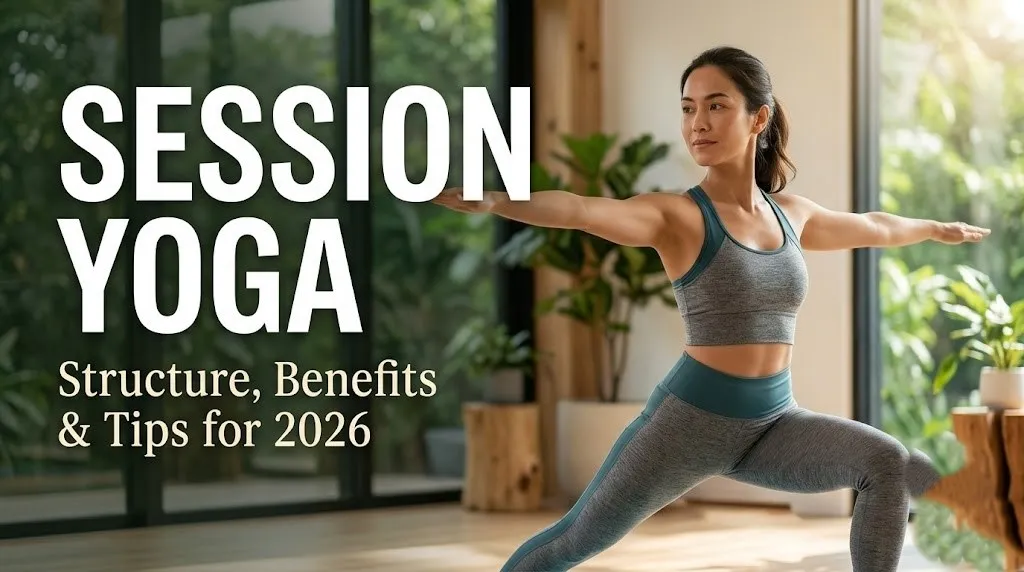
The closing phase is non-negotiable in a well-structured session. It includes counter-poses, spinal releases, and Savasana (Corpse Pose), held for a minimum of 5 minutes. Research published in the International Journal of Yoga has found that the parasympathetic nervous system response, the physiological rest-and-digest shift that gives yoga much of its stress-reducing effect, is most pronounced during and immediately after Savasana.
A standard 60-minute session breakdown:
| Phase | Duration | What Happens |
|---|---|---|
| Opening | 8 to 10 min | Breath settling, gentle warm-up |
| Standing work | 20 to 25 min | Strength, balance, flow |
| Floor work | 15 to 18 min | Hip openers, forward folds, backbends |
| Closing and Savasana | 7 to 10 min | Counter-poses, final rest |
How Long Should a Yoga Session Be
The right session length depends on your experience level, your goal, and your available time. There is no single correct duration.
For complete beginners, yoga teachers and physical therapists generally recommend starting with 20 to 30-minute sessions. That window is long enough to move through a meaningful sequence without overwhelming the body or the attention span. Trying to push through 90 minutes in your first week often results in soreness, frustration, or technique breakdown.
For people with an established practice, 45 to 75 minutes hits the sweet spot for most styles. A 2022 review published in Complementary Therapies in Medicine found that sessions between 45 and 60 minutes produced the most consistent self-reported improvements in flexibility, mood, and perceived stress across varied adult populations.
Short sessions are not inferior. A focused 20-minute practice done consistently three times per week outperforms an occasional 90-minute session done once every two weeks. Regularity beats duration in almost every research comparison on yoga outcomes.
Session length guide by goal:
| Goal | Recommended Duration | Frequency |
|---|---|---|
| Stress relief | 20 to 30 min | 4 to 5 times per week |
| Flexibility gains | 45 to 60 min | 3 to 4 times per week |
| Strength building | 60 to 75 min | 3 times per week |
| Chronic pain management | 30 to 45 min | 3 to 5 times per week |
| Deep relaxation (Yin or Restorative) | 60 to 90 min | 1 to 2 times per week |
Key Takeaway: The structure, length, and content of a yoga session each serve a specific physiological purpose. Skipping the warm-up or cutting Savasana short are not just inconveniences; they reduce the measurable benefit of the practice.
How Many Yoga Sessions Per Week Does Research Recommend
Three sessions per week is the most commonly supported frequency for producing measurable improvements in flexibility, strength, and mental wellbeing. That said, the research is nuanced.
The National Center for Complementary and Integrative Health cites evidence that two to three yoga sessions per week over eight to twelve weeks is sufficient to produce clinically meaningful reductions in chronic lower back pain. For stress and anxiety outcomes, some studies suggest that four or more sessions per week accelerates neurological adaptation, particularly the reduction of cortisol reactivity.
The American College of Sports Medicine notes that like any physical discipline, yoga benefits from progressive overload over time. That means gradually increasing session frequency, duration, or intensity rather than starting at maximum volume. Jumping from zero to seven sessions per week increases injury risk, particularly at the shoulders, wrists, and lumbar spine.
Rest between sessions matters. Your connective tissue, including tendons and fascia, adapts more slowly than muscle. A full day of rest between vigorous sessions (Vinyasa, Ashtanga) is genuinely useful. Yin or Restorative sessions can be practiced on consecutive days without the same recovery concern.
Frequency recommendations by level:
| Experience Level | Minimum Sessions/Week | Optimal Sessions/Week |
|---|---|---|
| Beginner | 2 | 3 |
| Intermediate | 3 | 4 to 5 |
| Experienced | 4 | 5 to 6 |
| Seniors (gentle practice) | 2 | 3 to 4 |
| Chronic condition management | 3 | 3 to 5 (with rest days) |
Yoga Session for Beginners: What to Expect
A beginner yoga session is a guided sequence of accessible poses organized to build body awareness, basic strength, and breath connection. You do not need flexibility to begin. That is one of the most persistent myths in yoga.
Your first several sessions will likely feel unfamiliar and sometimes awkward. That is normal and expected. You are learning a new movement vocabulary. The body needs repetition to coordinate breath with position. Research from the Journal of Alternative and Complementary Medicine indicates that most people report a significant improvement in comfort and coordination between their fourth and eighth sessions, not their first.
What you’ll encounter in a beginner session:
- Tadasana (Mountain Pose): Standing alignment and body awareness
- Marjaryasana-Bitilasana (Cat-Cow Pose): Spinal mobility warm-up
- Balasana (Child’s Pose): Resting pose and hip opener
- Adho Mukha Svanasana (Downward-Facing Dog): Full-body extension
- Setu Bandha Sarvangasana (Bridge Pose): Glute and spinal strengthening
- Savasana (Corpse Pose): Final rest and integration
Modification note: If Adho Mukha Svanasana creates wrist pain, lower to the forearms for Dolphin Pose. If Balasana compresses the knees, place a rolled blanket between the back of the thighs and the calves. Every pose has a safer entry point.
People with high blood pressure should let their instructor know before class. Inversions and certain forward folds temporarily increase intracranial pressure. Your teacher needs that information to guide your session safely.
Yoga Session at Home: How to Set Up and Start
A home yoga session is a fully valid practice format. You do not need a studio, a mirror, or a group class to get meaningful results. You need a clear space, a few basic tools, and a structure to follow.
The space itself matters more than people expect. Yoga requires focus, and visual clutter competes with attention. Clear an area that is at least 6 feet by 4 feet. That is enough for a standard mat with arm extension room. Natural light and fresh air help, but they are preferences, not requirements.
To set up your home practice:
- Clear a flat, non-slip surface of at least 6 by 4 feet.
- Place your mat away from furniture edges that could catch a limb during a wide stance.
- Keep one yoga block, one strap, and one folded blanket within reach before you start.
- Choose your session type and duration before you begin, not mid-practice.
- Use a timer rather than watching a clock. It keeps attention on the practice.
- Begin seated. Take three full breaths before your first movement.
- Follow a structured sequence, not random poses. Sequencing matters for joint safety.
One practical note: room temperature affects tissue readiness. In a cool room, extend your warm-up by 3 to 5 minutes. In a warm room, you can move into active poses slightly sooner, but still do not skip the opening phase.
Key Takeaway: Beginners do not need flexibility, a studio, or special equipment to start a yoga session. They need a clear space, a structured sequence, and the willingness to modify every pose until their body adapts.
Hatha, Vinyasa, Yin, and Restorative: How Each Session Type Differs
Each yoga style creates a completely different session experience, targets different physiological systems, and serves different goals. Choosing the wrong style for your body or goal is one of the most common reasons people quit yoga after a few sessions.
Hatha yoga sessions move at a moderate pace. Poses are held for several breaths, with clear instruction between each. It is well-suited for beginners and anyone building foundational body awareness. A typical Hatha session runs 60 minutes.
Vinyasa yoga links movement to breath in continuous sequences called flows. The pace is faster. The cardiovascular demand is higher. Sessions typically run 60 to 75 minutes, and you will sweat. This style builds strength and endurance alongside flexibility.
Yin yoga involves long, passive holds of 3 to 5 minutes in floor-based poses. It targets connective tissue (fascia, ligaments, tendons) rather than muscle. A Yin session is quiet, still, and sometimes uncomfortable in a different way: the challenge is patience, not exertion.
Restorative yoga uses props to support the body completely in passive poses. Sessions run 60 to 90 minutes, with as few as five to seven poses. The goal is nervous system deactivation. It is specifically effective for recovery, burnout, and chronic stress.
Style comparison at a glance:
| Style | Pace | Primary Target | Session Length | Best For |
|---|---|---|---|---|
| Hatha | Slow to moderate | Muscle, alignment | 60 min | Beginners, all ages |
| Vinyasa | Moderate to fast | Strength, cardio, flow | 60 to 75 min | Active adults, intermediate+ |
| Yin | Very slow, still | Connective tissue, fascia | 60 to 90 min | Flexibility, joint health |
| Restorative | Passive, no effort | Nervous system | 60 to 90 min | Stress, recovery, illness |
Yoga Session Benefits for Body and Mind
A well-structured yoga session produces measurable effects across multiple body systems, not just the musculoskeletal. The evidence for yoga’s multi-system benefits has strengthened considerably through peer-reviewed research published between 2020 and 2025.
According to the National Center for Complementary and Integrative Health, yoga practice is associated with improvements in flexibility, muscle strength, balance, and pain reduction. These are not just subjective reports. Studies using objective measurement tools like goniometers for range of motion and validated pain scales have documented these changes across diverse adult populations.
Research-supported benefits of regular yoga sessions:
- Increased hamstring and hip flexor flexibility (measurable changes noted after 8 weeks of consistent practice)
- Reduced lumbar spine pain in adults with chronic lower back pain
- Improved balance and reduced fall risk in adults over 65
- Reduced self-reported anxiety and depression scores
- Lowered resting heart rate in regular practitioners
- Improved sleep quality, documented in studies from the Journal of Alternative and Complementary Medicine
- Decreased levels of salivary cortisol (a stress hormone marker) after sessions
No yoga style produces all of these outcomes equally. Vinyasa sessions do more for cardiovascular fitness. Yin sessions do more for connective tissue. Restorative sessions are more directly effective for the autonomic nervous system. The benefit depends on the session type.
Yoga Session for Stress and Anxiety Relief
A yoga session directly affects the autonomic nervous system, which governs the stress response. This is the physiological mechanism behind yoga’s well-documented calming effect. It is not placebo and it is not metaphor.
During a stressful event, your sympathetic nervous system activates: heart rate rises, breathing shallows, cortisol is released. Slow, controlled breathing during yoga, particularly extended exhale techniques, stimulates the vagus nerve and activates the parasympathetic branch of the autonomic nervous system. That shift is measurable within a single session.
A 2023 study published in the International Journal of Yoga found that participants who completed an 8-week yoga program showed statistically lower scores on the Perceived Stress Scale compared to controls. Notably, even single sessions produced acute reductions in state anxiety scores immediately post-practice.
Poses particularly effective for stress relief:
- Supta Baddha Konasana (Reclined Bound Angle Pose): Opens the chest and hips passively. Supported with a bolster under the spine.
- Uttanasana (Standing Forward Fold): Reduces blood pressure and quiets the mind through gentle inversion.
- Balasana (Child’s Pose): Activates the parasympathetic response through gentle hip compression and forward fold.
- Viparita Karani (Legs-Up-the-Wall Pose): Mild inversion that reduces lower limb fatigue and calms the nervous system.
Modification note: For anyone with anxiety that includes chest tightness or breathing difficulty, avoid deep pranayama breath retention techniques until they have worked with a qualified yoga therapist who understands the condition.
Key Takeaway: Yoga sessions reduce stress not just through relaxation but through a documented physiological mechanism: vagal nerve stimulation that shifts the nervous system from sympathetic to parasympathetic dominance.
Yoga Session for Back Pain and Flexibility
Yoga sessions are one of the most evidence-supported non-pharmacological interventions for chronic lower back pain. The Spine Journal published a 2017 meta-analysis confirming yoga’s effectiveness for reducing pain intensity and improving function in adults with chronic non-specific low back pain, findings that subsequent studies have continued to support.
The key is session design. A yoga session for back pain is not a general fitness class that happens to include some stretching. It is a targeted sequence that strengthens the deep spinal stabilizers, releases the hip flexors, and improves thoracic mobility. All three of those elements contribute to lumbar health.
Poses that specifically address back pain:
- Marjaryasana-Bitilasana (Cat-Cow Pose): Rhythmic spinal flexion and extension. Warms the erector spinae and multifidus.
- Setu Bandha Sarvangasana (Bridge Pose): Activates gluteus maximus and hamstrings while gently extending the lumbar spine. Keep feet hip-width apart, toes pointing forward.
- Supta Matsyendrasana (Supine Spinal Twist): Releases the thoracic and lumbar rotators. Hold 5 to 8 breaths per side.
- Adho Mukha Svanasana (Downward-Facing Dog): Lengthens the entire posterior chain. Bend the knees generously if hamstrings are tight.
Modification note: People with a diagnosed herniated disc should avoid deep forward folds and strong lumbar flexion. A physical therapist or yoga therapist familiar with spinal conditions should review the sequence before beginning. That is not a throwaway caution. Disc herniations respond differently to flexion versus extension, and one size does not fit all spines.
Flexibility gains from yoga are real but gradual. Research suggests consistent practitioners see measurable range-of-motion improvements in the hamstrings, hip flexors, and thoracic spine after 8 to 12 weeks of practice at least three times per week.
Yoga Session for Seniors and Limited Mobility
Yoga sessions are among the most accessible forms of movement for older adults, but they need to be adapted, not just scaled down. A senior-specific yoga session addresses balance, joint mobility, bone health, and fall prevention with intentional design.
The Harvard T.H. Chan School of Public Health has highlighted yoga’s particular value for older adults, citing improvements in balance, gait stability, and fear of falling as documented outcomes of regular practice. For adults over 70, even two sessions per week of gentle or chair yoga produces measurable improvements in functional movement.
Chair yoga is a fully legitimate practice format. It is not a lesser version of “real yoga.” It is a distinct adaptation that allows people with limited standing balance, hip replacements, or severe arthritis to access the full range of yoga’s benefits while seated or using a chair for support.
Recommended poses for seniors:
- Tadasana (Mountain Pose) with wall support: builds postural awareness without fall risk
- Virabhadrasana II (Warrior II) with chair assist: builds leg strength and hip mobility
- **Seated *Marjaryasana-Bitilasana (Cat-Cow)*: warms the spine without floor-based movements
- Setu Bandha Sarvangasana (Bridge Pose): can be done with feet on the floor and reduced range of motion
Safety note: Seniors with osteoporosis should avoid extreme spinal flexion, including deep forward folds and rounding of the thoracic spine under load. Lateral bends and twists performed with care are generally safer. Anyone with a recent joint replacement should confirm appropriate post-surgical timing with their orthopedic surgeon before beginning any yoga sequence involving that joint.
Key Takeaway: Senior yoga sessions work best when they are specifically designed for that population, not simply slowed-down versions of general classes. Chair support, balance aids, and modified ranges of motion are not limitations; they are correct adaptations.
Yoga Session Warm-Up: How to Prepare Your Body
A yoga session warm-up raises tissue temperature, lubricates the joints, and prepares the nervous system for coordinated movement. Skipping it is the single fastest way to get injured in yoga, particularly at the shoulders, hamstrings, and lower back.
Think of cold muscle tissue like refrigerated bread dough. It resists deformation. Push too hard and it tears rather than stretches. A 5 to 10-minute warm-up raises internal tissue temperature enough to make the muscle and connective tissue pliable before demanding poses are introduced.
A practical yoga warm-up sequence (5 to 8 minutes):
- Sit comfortably. Take 5 slow, complete breaths to settle the nervous system.
- Begin Marjaryasana-Bitilasana (Cat-Cow Pose): 8 to 10 rounds, moving with the breath.
- Move into Balasana (Child’s Pose): hold 5 breaths, walking arms wide for a side body stretch.
- Come to hands and knees. Circle each wrist 5 times in each direction.
- Thread the needle: cross one arm under the opposite shoulder. Hold 4 breaths each side.
- Rise to Tadasana (Mountain Pose): take 3 full breaths, grounding through the feet.
- Gently roll the shoulders back 5 times. Circle the neck slowly side to side (not full circles).
Modification note: For people with wrist sensitivity, substitute fists for open palms in hands-and-knees positions, or come to forearms instead. All Cat-Cow variations can also be done seated in a chair.
Yoga Session Cool-Down: Why the Ending Matters
The cool-down phase of a yoga session is where much of the neurological integration happens. It is not optional, and it is not just about stretching tired muscles.
During the active portion of a session, your sympathetic nervous system is partially engaged. Even a moderate Hatha class elevates heart rate and activates the musculoskeletal system. The cool-down, culminating in Savasana (Corpse Pose), is the signal to the nervous system that the effort is complete. Research published in the International Journal of Yoga found that the post-session recovery period, particularly Savasana, is when measurable parasympathetic rebound (the rest response) is most pronounced.
An effective cool-down sequence (8 to 12 minutes):
- Supta Matsyendrasana (Supine Spinal Twist): 6 to 8 breaths each side, releasing spinal rotators.
- Supta Baddha Konasana (Reclined Bound Angle Pose): 1 to 2 minutes, hips releasing toward the floor.
- Uttanasana (Standing Forward Fold) or seated forward fold: 1 minute, knees soft.
- Viparita Karani (Legs-Up-the-Wall Pose) if available: 2 to 3 minutes.
- Savasana (Corpse Pose): minimum 5 minutes. Eyes closed. Arms slightly away from body. Complete stillness.
Modification note: People who cannot lie flat due to lumbar discomfort should bend the knees during Savasana, place a bolster under the knees, or remain in a comfortable reclined position with support. The posture matters less than the quality of stillness.
Key Takeaway: Savasana is not a reward at the end of a yoga session. It is a physiologically active phase where the nervous system consolidates the session’s effects. Cutting it short consistently reduces the cumulative benefit of your practice.
Yoga Session Props and Equipment You Actually Need
You do not need to own anything to begin a session yoga practice, but a few specific props meaningfully improve alignment, safety, and accessibility. The key word is “specific.” Most of what is marketed as yoga equipment is unnecessary.
The three genuinely useful props are a yoga mat, yoga blocks, and a yoga strap. A bolster and blanket become important if you add Yin or Restorative sessions. Everything else is optional.
Props and their actual uses:
| Prop | Why It Matters | Who Needs It Most |
|---|---|---|
| Yoga mat | Non-slip surface, joint cushioning | Everyone |
| Yoga block (2 recommended) | Brings the floor closer; supports alignment | Beginners, seniors, limited flexibility |
| Yoga strap | Extends reach in forward folds and binds | Tight hamstrings, shoulder limitations |
| Bolster | Supports passive holds in Yin and Restorative | Anyone doing Yin or Restorative sessions |
| Blanket | Cushions knees, wrists; supports Savasana | Knee sensitivity, cool environments |
| Chair | Full support for chair yoga variations | Seniors, people with balance issues |
| Wall | No cost; supports balances and inversions | Beginners, seniors, all levels |
Mat thickness matters more than most people realize. A 4mm mat suits most practices. A 6mm mat offers more cushioning for people with sensitive knees or wrists. Anything thicker than 6mm reduces stability in standing poses.
Blocks are not just for beginners. Experienced Iyengar practitioners use them routinely for precise alignment work. If you own only one prop, make it two blocks.
Yoga Breathing Techniques That Improve Every Session
Breath is not an accessory to a yoga session. It is the organizing principle. Pose transitions, hold durations, nervous system state, and muscular engagement are all governed by how you breathe.
The most foundational breath technique in yoga is Ujjayi pranayama, also called “ocean breath” or “victorious breath.” It involves a slight constriction at the back of the throat that creates an audible, wave-like sound on both the inhale and exhale. Ujjayi breath slows the breath rate, increases internal heat, and provides an audible reference point for staying in the present moment during a session.
Ujjayi breath: how to practice it:
- Sit comfortably with a tall spine.
- Inhale through the nose normally.
- Exhale through an open mouth as if fogging a mirror. Notice the throat constriction.
- Close the mouth. Recreate that same throat constriction on both inhale and exhale.
- The breath should be audible to you but not to someone across the room.
- Maintain this breath through all active poses in a Hatha or Vinyasa session.
Nadi Shodhana (Alternate Nostril Breathing) is best suited to the opening or closing of a session. Research from the Journal of Alternative and Complementary Medicine found that Nadi Shodhana practiced for 5 minutes before a session significantly reduced pre-practice anxiety scores and improved attention during the practice.
Dirga pranayama (Three-Part Breath) is the simplest entry-point breath for beginners. It fills the belly, then the ribcage, then the upper chest on the inhale and reverses on the exhale. It is taught in nearly every beginner Hatha class and can be practiced lying down before sleep.
Modification note: People with asthma or other respiratory conditions should approach breath retention techniques (Kumbhaka) with caution and guidance from a yoga therapist familiar with pulmonary health.
Key Takeaway: Learning one breath technique before your first yoga session changes the entire experience. Ujjayi breath is the most practical starting point: it is used in almost every active yoga style and immediately improves the quality of focus and effort during poses.
Frequently Asked Questions About Session Yoga
How long should a beginner yoga session last?
Most yoga teachers and physical therapists recommend that beginner yoga sessions last 20 to 30 minutes.
That duration is long enough to move through a meaningful sequence without overwhelming tissue that is new to the demands of yoga.
As comfort and stamina improve, extend sessions gradually toward 45 to 60 minutes over the first two to three months.
How many times a week should you do a yoga session?
Three sessions per week is the most consistently supported frequency for producing measurable physical and mental benefits.
The National Center for Complementary and Integrative Health cites two to three sessions per week over eight to twelve weeks as sufficient to produce meaningful reductions in pain and stress.
More frequent practice is beneficial, but two sessions per week still produces real results, particularly for beginners.
What should I do before a yoga session?
Avoid eating a heavy meal within 90 minutes of your session, as inversions and forward folds are uncomfortable on a full stomach.
Hydrate well beforehand, wear clothing that does not restrict movement, and gather any props you need before you begin.
Spend the first 5 to 8 minutes of every session in a structured warm-up rather than jumping into active poses.
Can a 20-minute yoga session be effective?
Yes. A 20-minute yoga session is genuinely effective when it is well-structured with a warm-up, a focused active sequence, and a brief cool-down.
Research comparing short daily sessions to longer infrequent ones consistently favors consistency over duration for flexibility, mood, and stress outcomes.
A 20-minute daily practice produces better long-term results than a 90-minute session done once per week.
What is the best type of yoga session for back pain?
A Hatha or therapeutic yoga session specifically designed for lumbar health is the most evidence-supported option for chronic lower back pain.
The Spine Journal published evidence confirming yoga’s effectiveness for reducing pain intensity and improving function in adults with chronic non-specific low back pain.
Avoid styles that involve rapid, high-impact transitions or deep unsupported forward folds until a qualified teacher has reviewed your specific condition.
Start Where You Are
Pick one session type, set a timer for 20 minutes, and get on the mat today. That is the entire instruction. The research, the structure, the props, and the breathwork all matter over time. But none of it matters more than showing up.
Three sessions per week, any style, any duration you can sustain, will produce real changes in your body and your nervous system within eight weeks. You do not need to be flexible to start. You do not need a studio. You need a clear space and a consistent decision.
The session is the practice. Everything else is preparation.