Stray Dog Yoga Wexford: Classes, Poses & Beginner Guide 2026
Stray Dog Yoga is a community yoga studio in Wexford, Ireland, offering classes in Hatha yoga, Vinyasa yoga, and meditation for all experience levels, from people who have never stepped on a mat to regular practitioners deepening their skills. If you’re trying to figure out what these classes actually involve, what your body will do, and whether it’s right for you, this guide gives you everything you need before you walk through the door.
Yoga is one of the most widely practiced complementary health approaches in the world. According to the National Center for Complementary and Integrative Health (NCCIH), more than 21 million adults in the United States alone practice yoga regularly, with participation growing each year. In Ireland, interest in community yoga studios has grown measurably since 2020, driven by increased awareness of mental health and stress management.
This guide covers the specific yoga styles taught at community studios like Stray Dog Yoga, the poses beginners will encounter, the science behind yoga’s health benefits, practical preparation tips, and how to build a practice that actually sticks. You’ll come away knowing exactly what to expect.
What Is Stray Dog Yoga and Where Is It in Wexford?
Stray Dog Yoga is a yoga studio based in Wexford, Ireland, offering accessible, community-focused yoga classes for all fitness levels and ages.
The studio’s name reflects a friendly, non-intimidating philosophy. It is not an elite or specialist performance space. The emphasis is on making yoga available to people who might feel uncertain or out of place in a more formal or athletically-oriented environment. That matters, because one of the biggest barriers to starting yoga is not physical fitness. It is the fear of being the person who doesn’t know what they’re doing.
Community yoga studios like Stray Dog Yoga typically operate small class sizes, which allows teachers to offer individual attention and modifications that a larger gym class cannot. This is a practical advantage for beginners and for anyone practicing with a specific physical consideration like a recovering injury or limited joint mobility.
What Stray Dog Yoga typically offers:
- Hatha yoga classes: steady-paced, foundational pose work with breath integration
- Vinyasa yoga classes: movement-linked-to-breath sequences with more dynamic flow
- Meditation and mindfulness sessions
- Beginner-specific sessions with props provided and no prior experience required
- Workshops on specific themes such as restorative practice, breathwork, or seasonal wellness
Yoga Classes in Wexford: What Styles Are on Offer?
Yoga studios in Wexford, including Stray Dog Yoga, typically offer Hatha yoga, Vinyasa yoga, restorative yoga, and meditation, each serving a different purpose and suiting a different type of practitioner.
Choosing the wrong class for your current body and energy level is one of the most common beginner mistakes. Someone who sits at a desk all day and has tight hip flexors and a compressed lumbar spine will have a very different experience in a Vinyasa flow class versus a slow Hatha class. Both are valuable. They are not interchangeable.
Yoga styles comparison:
| Style | Pace | Best For | Heat Level | Props Common? |
|---|---|---|---|---|
| Hatha | Slow to moderate | Beginners, all ages | Room temperature | Yes |
| Vinyasa | Moderate to dynamic | Some experience helps | Room temperature | Sometimes |
| Yin | Very slow, long holds | Flexibility, stress relief | Room temperature | Yes |
| Restorative | Extremely gentle | Recovery, anxiety, injury | Room temperature | Always |
| Meditation | Non-physical | Stress, mental clarity | Any | Bolster, blanket |
Most Wexford community studios recommend new students start with Hatha or a labeled beginner class before moving into Vinyasa. That sequence builds foundational alignment awareness before adding the breath-movement coordination that Vinyasa requires.
Hatha Yoga Explained: What It Is and Who It Suits
Hatha yoga is a traditional style of yoga that uses physical postures, breath control, and stillness to build strength, flexibility, and mental calm at a pace that allows careful attention to alignment and form.
The word “Hatha” comes from Sanskrit roots: “ha” meaning sun and “tha” meaning moon. The style balances opposing qualities, effort and ease, strength and flexibility, steadiness and openness. In a practical class setting, this means poses are held for several breath cycles rather than flowed through quickly. That holding time gives the nervous system a chance to integrate each position.
According to the International Journal of Yoga, Hatha yoga is among the most thoroughly researched yoga styles for physical health outcomes, with strong evidence supporting its role in improving spinal flexibility, reducing low back pain, and enhancing balance in adults across all age groups.
Hatha is well-suited to beginners, older adults, people returning from injury, and anyone who prefers a methodical approach over a fast-paced workout. It is also the foundation from which most other modern yoga styles derive their postures.
Pose Tip for Hatha beginners:
- In Tadasana (Mountain Pose), the starting point of most Hatha sequences, press the four corners of each foot into the mat. Lift the arches slightly without gripping the toes.
- Micro-bend the knees rather than locking them. This protects the knee joint and keeps the quadriceps actively engaged.
- Modification for those with balance issues: stand with the back of a chair at arm’s length for support.
Key Takeaway: Stray Dog Yoga offers a non-intimidating entry into yoga practice in Wexford. Hatha yoga is the most beginner-friendly starting point, and its benefits are well-supported by research, making it a practical choice for anyone new to the practice.
Vinyasa Yoga Explained: What to Expect From a Flow Class
Vinyasa yoga is a style of yoga that links breath to movement in a continuous flowing sequence, with each inhale or exhale cuing a specific transition or pose.
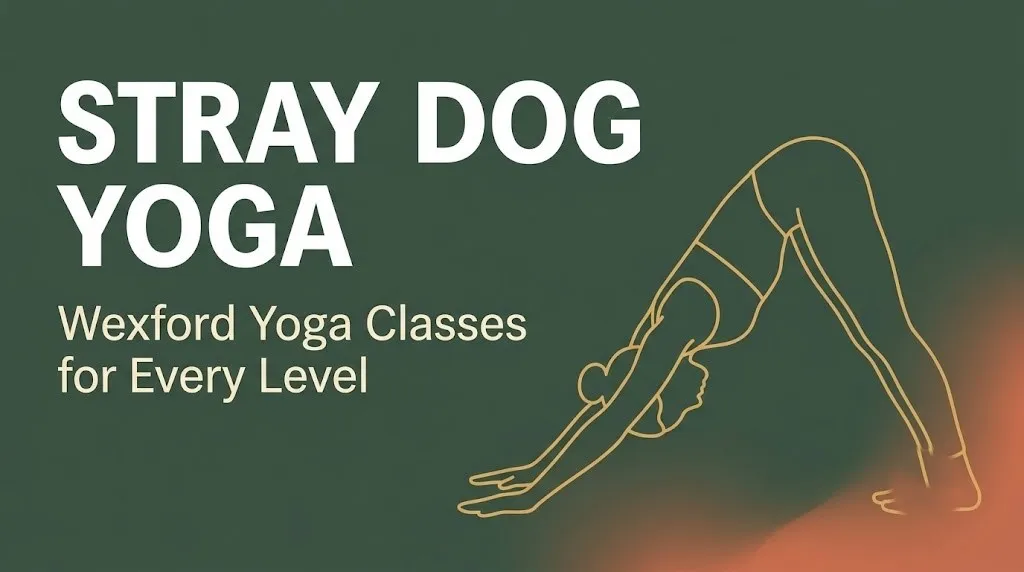
The word “Vinyasa” means “to place in a special way” in Sanskrit. In a class setting, this translates to a rhythmic practice where standing still and holding is less common than in Hatha yoga. Sequences move through poses like Virabhadrasana I (Warrior I), Trikonasana (Triangle Pose), and Adho Mukha Svanasana (Downward-Facing Dog Pose) in linked patterns that build cardiovascular endurance alongside flexibility and strength.
Think of Vinyasa like learning to dance rather than learning individual steps. You need some basic step knowledge first. Once you have it, the rhythm of putting steps together becomes the practice.
A 2019 review in Complementary Therapies in Medicine found that Vinyasa-style yoga practice three times per week for eight weeks produced measurable improvements in cardiovascular fitness, muscular endurance, and self-reported energy levels in previously sedentary adults.
What beginners should know before a Vinyasa class:
- Transitions between poses happen faster than in Hatha. Following the breath is more important than getting the pose perfect.
- You will encounter Chaturanga Dandasana (Four-Limbed Staff Pose) or a modified version. This requires shoulder and triceps strength. Dropping to the knees is a completely appropriate modification.
- Blocks and straps are useful in Vinyasa even though the pace is faster. A teacher who discourages their use in a beginner-facing flow class is not creating a safe learning environment.
What to Expect at Your First Yoga Class
At your first yoga class, you will be guided through a sequence of poses with breath cues, given options to modify, and encouraged to rest whenever your body needs it.
The gap between what people imagine yoga class will be and what it actually is tends to be large in both directions. Some people expect something gentle and leave surprised by how physically demanding even basic poses are. Others expect something athletic and discover that staying still in a pose for five breaths is genuinely challenging in a different way.
Most beginner yoga classes at a community studio like Stray Dog Yoga last 60 minutes. They typically begin with 5 to 10 minutes of centering and breath awareness, move through a sequence of standing, seated, and floor poses, and close with Savasana (Corpse Pose), a period of complete relaxation lying on the mat. Savasana is not optional. It is when the nervous system processes and integrates the physical work done during class.
What typically happens in a beginner class:
| Phase | Duration | What You’ll Do |
|---|---|---|
| Opening | 5 to 10 minutes | Breath awareness, centering, gentle warm-up |
| Standing poses | 15 to 20 minutes | Balance, strength, alignment foundations |
| Seated and floor poses | 15 to 20 minutes | Flexibility, hip opening, spinal work |
| Cool-down | 5 to 10 minutes | Forward folds, twists, restorative positions |
| Savasana | 5 to 10 minutes | Complete rest, nervous system integration |
Tell the teacher about any injuries, surgeries, or health conditions before class starts. A qualified teacher will offer specific modifications. This is not an inconvenience to them. It is exactly what trained yoga teachers expect and prepare for.
Beginner Yoga Poses: The Foundations You Will Learn
Beginner yoga classes build around a core set of foundational poses that teach body awareness, breath integration, and postural alignment before introducing more complex sequences.
These are the poses most likely to appear in your first few Stray Dog Yoga classes, with their Sanskrit names, the muscles they engage, and one key alignment point for each:
- Tadasana (Mountain Pose): Engages the tibialis anterior, core stabilizers, and postural muscles. Key point: ground the feet fully before lifting the chest.
- Marjaryasana-Bitilasana (Cat-Cow Pose): Mobilizes the entire spine through flexion and extension. Engages erector spinae and rectus abdominis alternately. Key point: move one vertebra at a time if possible.
- Adho Mukha Svanasana (Downward-Facing Dog Pose): Stretches the hamstrings, calves, and thoracic spine. Strengthens deltoids and triceps. Key point: press the mat away through the palms, not just the fingertips.
- Virabhadrasana I (Warrior I): Strengthens the quadriceps, hip flexors, and shoulder girdle. Key point: keep the front knee tracking over the second toe, not collapsing inward.
- Setu Bandhasana (Bridge Pose): Activates the gluteus maximus, hamstrings, and erector spinae. Key point: do not squeeze the knees together; keep them hip-width apart.
- Balasana (Child’s Pose): A rest position that gently stretches the hip flexors and gluteals. Key point: you can return to this pose at any time during class if you need to rest.
- Savasana (Corpse Pose): Complete supine relaxation. Engages no muscles actively. Key point: stay for the full duration. Leaving early defeats the physiological purpose of the pose.
Key Takeaway: The poses in a beginner yoga class are simple in description but genuinely challenging in execution. Learning them at a community studio with a qualified teacher who can see and cue your alignment is worth considerably more than following video instructions alone.
Yoga Sequences for Beginners: How a Class Is Structured
A beginner yoga class is structured as a deliberate arc from warming and mobilizing the body, through strengthening and stretching, to cooling and integrating, with each section preparing the body for the next.
Understanding this arc changes how you experience class. The early poses are not the “easy” ones you wait through to get to the real work. They are the foundation that makes the later poses accessible and safe. Marjaryasana-Bitilasana (Cat-Cow Pose), for example, warms the spinal facet joints and engages the multifidus muscles before any weight-bearing standing poses are attempted. Skipping this step and moving straight to Virabhadrasana I (Warrior I) puts a cold, unprepared lumbar spine under load.
Think of the class structure like a conversation. The opening poses set the topic. The middle poses develop it. The closing poses and Savasana bring it to a considered close. Each part only makes sense in relation to the others.
A sample beginner Hatha sequence structure:
- Seated breath awareness, 3 to 5 minutes
- Marjaryasana-Bitilasana (Cat-Cow Pose), 8 to 10 rounds
- Adho Mukha Svanasana (Downward-Facing Dog Pose), 5 breaths, twice
- Tadasana (Mountain Pose), 5 breaths
- Virabhadrasana I (Warrior I), 5 breaths each side
- Trikonasana (Triangle Pose), 5 breaths each side
- Setu Bandhasana (Bridge Pose), 5 breaths, twice
- Supine twist, 5 breaths each side
- Balasana (Child’s Pose), 5 to 8 breaths
- Savasana (Corpse Pose), 5 to 10 minutes
Modification for anyone with limited floor mobility: steps 7 through 9 can be performed in a chair or using a bolster to elevate the hips. A good teacher will already offer these alternatives without being asked.
Yoga Breathing Techniques Used in Class
Yoga uses specific breath techniques called Pranayama to regulate the nervous system, direct attention inward, and sustain physical effort during demanding poses.
The breath is not decoration in a yoga class. It is the primary tool. Holding the breath during a challenging pose is the single most common beginner error, and it directly undermines the physiological benefits the pose is trying to create.
The most commonly taught breath technique in beginner yoga is Ujjayi Pranayama, sometimes called “ocean breath” or “victorious breath.” You breathe through the nose, creating a gentle constriction at the back of the throat. The resulting sound is soft and steady. This technique slows the breath rate, activates the parasympathetic nervous system, and maintains internal heat during practice.
A study published in the International Journal of Yoga found that Ujjayi breathing reduced heart rate and self-reported effort levels during physically demanding yoga sequences, making poses feel more manageable for longer periods.
A second technique commonly introduced in beginner classes is Nadi Shodhana Pranayama (alternate nostril breathing). This technique involves breathing through one nostril at a time using the thumb and ring finger to alternate closure. Research suggests it has a balancing effect on the autonomic nervous system and can reduce anxiety scores measurably.
Breathing guidelines for beginners:
- Always breathe through the nose. Mouth breathing during yoga increases perceived effort and reduces the calming effect.
- If you lose the breath, stop the pose. Rest in Balasana (Child’s Pose) and re-establish rhythm before continuing.
- Inhale to expand, exhale to deepen. Most poses lengthen on the inhale and release further into the position on the exhale.
Key Takeaway: Breath technique is the skill that separates a yoga session from a stretching session. Learning Ujjayi breathing in your first few classes at Stray Dog Yoga will make every subsequent class physically easier and mentally calmer.
Benefits of Yoga for Beginners Backed by Research
Yoga produces measurable physical and mental health benefits from the very first weeks of practice, with some of the strongest research evidence pointing to improvements in flexibility, balance, sleep quality, and psychological well-being.
The National Center for Complementary and Integrative Health (NCCIH) identifies yoga as one of the most evidence-supported complementary health practices currently available, with particular strength of evidence for low back pain management, anxiety reduction, and improved sleep.
A 2016 systematic review published in the Journal of Alternative and Complementary Medicine analyzed 37 randomized controlled trials of yoga’s effects on healthy adults and found consistent improvements across flexibility, balance, muscular endurance, and self-reported quality of life. Improvements were detectable within four to eight weeks of regular practice, at a frequency of two to three sessions per week.
Beginners sometimes expect that they need to be flexible before starting yoga. Research says the opposite is true: the flexibility comes from the practice, not before it. Starting with limited range of motion does not reduce the benefits. It simply means the early gains are larger and more quickly noticeable.
Research-backed benefits of starting yoga:
- Improved hamstring flexibility and hip joint range of motion
- Reduced self-reported stress and anxiety
- Lower resting heart rate with consistent practice
- Improved balance and fall-prevention measures in adults over 50
- Better sleep quality and sleep onset latency
- Reduced low back pain intensity and frequency
- Improved proprioception (the body’s sense of its own position in space)
Yoga for Stress and Anxiety: What the Science Says
Yoga reduces stress and anxiety by activating the parasympathetic nervous system, lowering circulating cortisol levels, and increasing production of BDNF (brain-derived neurotrophic factor), which supports mood regulation and cognitive clarity.
A 2017 study published in Complementary Therapies in Medicine tracked adults with generalized anxiety who attended twice-weekly yoga classes for eight weeks. Participants showed measurably lower scores on standardized anxiety measures (the Hamilton Anxiety Rating Scale) compared to a waitlist control group. The effect was present by week four.
The mechanism is not purely about the physical release of muscle tension, though that is a genuine component. The breath-synchronized nature of yoga practice directly engages the vagus nerve, the primary pathway of the parasympathetic nervous system. Sustained nasal breathing during yoga class, particularly using Ujjayi Pranayama, stimulates vagal tone in ways that are measurable via heart rate variability data.
For people managing workplace stress, social anxiety, or the low-level chronic tension that builds from sedentary modern routines, two yoga classes per week at a community studio like Stray Dog Yoga represents a genuinely evidence-based intervention. Not a vague wellness gesture. An actual physiological tool.
Poses particularly effective for stress reduction:
- Balasana (Child’s Pose): Creates internal focus and reduces sensory input. The forward fold position is naturally calming to the nervous system.
- Setu Bandhasana (Bridge Pose): Mild inversion effect calms the nervous system. The chest-opening aspect counteracts postural patterns associated with anxiety.
- Savasana (Corpse Pose): The most researched relaxation pose in yoga. Sustained stillness activates the rest-and-digest response measurably.
Yoga for Back Pain and Flexibility
Yoga reduces chronic low back pain by strengthening the deep spinal stabilizers, mobilizing stiff spinal segments, and releasing chronically shortened hip flexors and hamstrings that contribute to postural compression.
This is one of the best-supported claims in yoga research. The NCCIH cites low back pain management as the area with the most consistent and highest-quality evidence for yoga’s effectiveness, noting that yoga is now included in clinical guidelines for non-specific low back pain management in several countries.
The poses most directly relevant to back pain in a beginner class are Marjaryasana-Bitilasana (Cat-Cow Pose), which mobilizes the spinal facet joints; Setu Bandhasana (Bridge Pose), which strengthens the gluteus maximus and erector spinae; and Adho Mukha Svanasana (Downward-Facing Dog Pose), which decompresses the lumbar spine by lengthening the posterior chain.
Think of the lumbar spine like a hinge that has been stuck at the same angle for hours. The cat-cow movement is specifically designed to restore that hinge’s full range of motion in a loaded but controlled way.
Safety note for back pain: Anyone with a diagnosed disc herniation, spinal stenosis, or recent spinal surgery should get clearance from their physiotherapist before attending a yoga class. Inform the teacher of any spinal history before class begins so they can offer specific modifications. Forward folds in particular require adjustment for disc-related conditions.
Modification for limited flexibility:
In Adho Mukha Svanasana (Downward-Facing Dog Pose), bend the knees generously. A straight-legged Downward Dog with a rounded spine is less beneficial and riskier than a bent-knee version with a flat back.
Key Takeaway: Yoga’s evidence for reducing low back pain is strong enough that it appears in clinical guidelines. Two sessions per week with a qualified teacher and clear modification guidance is a practical, research-grounded approach for anyone managing back discomfort.
Yoga Modifications for Beginners and People With Limited Mobility
Every yoga pose has a modification that makes it accessible without compromising the purpose of the pose, and using modifications is not a beginner’s shortcut but a sign of good body awareness and intelligent practice.
The most common mistake beginners make is forcing a pose to its full expression before their body is ready. This is especially common in poses like Trikonasana (Triangle Pose), where reaching the hand all the way to the floor with a rounded spine looks similar to the full pose but produces none of its intended effects on the hamstrings, obliques, and thoracic spine.
A yoga block placed at the appropriate height solves this immediately. The hand rests on the block, the spine stays long, the side body opens fully, and the pose does what it is supposed to do. This is the correct version for that body at that stage of practice.
Common modifications by pose:
| Pose | Beginner Modification | Limited Mobility Modification |
|---|---|---|
| Adho Mukha Svanasana (Downward Dog) | Bend knees generously | Hands on chair, hips pushing back |
| Virabhadrasana I (Warrior I) | Shorten stance, lower arms | Seated version, chair, arms at heart height |
| Trikonasana (Triangle Pose) | Hand on block at shin height | Side stretch in chair, arm overhead |
| Setu Bandhasana (Bridge Pose) | Lower height, feet closer to hips | Bolster under sacrum for supported version |
| Balasana (Child’s Pose) | Blanket between thighs and calves | Seated forward fold in chair |
| Savasana (Corpse Pose) | Knees bent, feet flat if low back is tight | Fully supported with bolster under knees |
Props are not optional extras. They are part of the practice. A yoga block, yoga strap, and folded yoga blanket are the three most useful tools a beginner can bring to class. Most studios provide them, but checking in advance saves any first-class awkwardness.
Yoga for Seniors: Adapting Your Practice as You Age
Yoga is one of the most appropriate forms of physical activity for adults over 60, offering balance training, joint mobility, strength work, and nervous system regulation in a low-impact format that can be adapted to almost any level of physical capacity.
The American College of Sports Medicine recommends that adults over 65 engage in balance exercises at least three times per week, given that falls are the leading cause of injury-related death in this age group. Yoga, practiced consistently, addresses balance through virtually every standing pose in the sequence.
A systematic review published in the Journal of Alternative and Complementary Medicine found that yoga practice in adults over 60 produced measurable improvements in static balance, dynamic balance, hip flexibility, and self-reported confidence in daily movement over an 8 to 12 week period.
Seniors attending classes at a studio like Stray Dog Yoga should look specifically for Hatha classes, restorative sessions, or classes labeled as “gentle yoga” or “yoga for all.” Vinyasa flow classes with fast transitions between standing poses are more demanding and carry a higher fall risk for practitioners with reduced proprioception or joint stability.
Practical adaptations for seniors:
- Use a chair near the mat for balance support during standing poses. This is not a modification that limits the pose. It makes the pose safe enough to actually build balance.
- Choose a yoga blanket for extra knee padding during floor poses. Bony or sensitive knees on a thin mat is a comfort issue that prevents consistent practice.
- In Setu Bandhasana (Bridge Pose), place a bolster under the sacrum for a supported, passive version that delivers the chest-opening and hip-flexor-releasing benefits without requiring muscular effort to sustain.
What to Bring to Yoga Class: The Complete Checklist
For your first yoga class at a studio like Stray Dog Yoga, bring a yoga mat, water bottle, comfortable clothing that allows free movement of the hips and shoulders, and a small towel.
Most community yoga studios provide yoga blocks, straps, and bolsters as part of the class. It is worth calling ahead to confirm this so you are not caught without a prop you need during class. If the studio does not provide mats, a good-quality yoga mat with a non-slip surface is worth purchasing before your first session. Borrowed or shared mats at some studios can be worn and slippery, which creates a balance hazard during standing poses.
Complete first-class checklist:
- Yoga mat: Non-slip, at least 4mm thick. Thicker mats (6mm) are more comfortable for floor poses if you have sensitive knees or hips.
- Water bottle: Sip before and after class. Drinking large amounts during practice interrupts the nervous system regulation the class is designed to produce.
- Comfortable clothing: Fitted enough not to fall over your face in forward folds, but not so tight that it restricts hip movement. Layers help for the cool-down and Savasana.
- Small towel: For wiping hands during class or placing under the forehead in prone poses.
- Socks: Remove before class. Yoga is always practiced barefoot for grip and proprioceptive feedback.
- An open attitude about props: Using a block or strap is not a sign of being less capable. It is a sign of being a careful student.
Arrive 5 to 10 minutes early. Introduce yourself to the teacher. Mention any injuries or physical conditions. This brief conversation changes the quality of your class experience.
Key Takeaway: What you bring to your first yoga class matters less than what you bring mentally. Arriving 10 minutes early, telling the teacher about any physical considerations, and being willing to use props without self-judgment are the three habits that turn a first class into a consistent practice.
How Often Should Beginners Do Yoga for Real Results?
Beginners will notice measurable improvements in flexibility, sleep, and mood within four to six weeks of practicing yoga two to three times per week, according to multiple randomized controlled trials.
This is the frequency most consistently supported in the research literature. A 2016 meta-analysis in the Journal of Alternative and Complementary Medicine identified two to three sessions per week as the threshold at which physical flexibility, balance, and psychological well-being outcomes become statistically reliable across different populations and yoga styles.
One session per week produces some benefit, primarily in terms of stress management and body awareness. But for noticeable changes in flexibility and muscular endurance, two sessions per week is the practical minimum. Three or more per week accelerates adaptation, provided that recovery is adequate between sessions.
For new students at Stray Dog Yoga, a realistic starting plan is:
- Attend one structured class per week with a teacher for alignment guidance and community accountability.
- Practice one shorter session at home, 20 to 30 minutes, using the poses learned in class.
- Add a third session once the foundational poses feel familiar and breath coordination is improving.
- Build toward three to four sessions per week as a sustainable maintenance frequency.
- Include at least one restorative or Yin session per week if practicing four or more times, to allow connective tissue recovery.
Practicing more than five times per week without adequate recovery does not accelerate progress for beginners. It increases the risk of overuse strain in the wrists, shoulders, and hamstrings, the structures most frequently challenged in foundational yoga poses.
Modification for busy schedules: Even 15 minutes of structured practice on non-class days maintains neuromotor learning and prevents the regression that happens when gaps between sessions are too long. Consistency matters more than duration.
Frequently Asked Questions About Stray Dog Yoga and Yoga in Wexford
What is stray dog yoga in Wexford?
Stray Dog Yoga is a community yoga studio in Wexford, Ireland, offering Hatha yoga, Vinyasa yoga, meditation, and beginner-friendly sessions for all levels.
The studio focuses on accessible, welcoming yoga practice for people of all ages, fitness levels, and experience backgrounds.
Classes are typically small enough to allow individual teacher attention and pose modification guidance.
Is yoga suitable for complete beginners with no experience?
Yes. Yoga is one of the most beginner-accessible physical practices available, particularly at community studios that offer labeled beginner classes.
No prior flexibility, fitness, or experience is required, and all poses have modifications that make them appropriate regardless of your current range of motion.
Starting with a Hatha yoga or dedicated beginner class gives you the alignment foundations that make every subsequent class safer and more productive.
What should I bring to my first yoga class?
Bring a yoga mat, a water bottle, comfortable clothing that allows free hip and shoulder movement, and an open mind about using props like blocks and straps.
Most community studios like Stray Dog Yoga provide blocks, bolsters, and straps, but calling ahead to confirm saves any first-class uncertainty.
Arrive 5 to 10 minutes early and introduce yourself to the teacher before class starts.
How often should I do yoga to see real results?
Practicing yoga two to three times per week produces measurable improvements in flexibility, balance, and stress levels within four to six weeks, according to research in the Journal of Alternative and Complementary Medicine.
One class per week still delivers benefits, particularly for stress management, but physical changes are slower and less consistent at that frequency.
Adding even one 20-minute home practice session between studio classes meaningfully accelerates your progress.
Can yoga help with back pain and anxiety?
Yes. Yoga is one of the most well-researched complementary approaches for both conditions.
The NCCIH cites low back pain and anxiety as two of the strongest areas of evidence for yoga’s effectiveness, with improvements documented in studies lasting as few as four to eight weeks.
A qualified teacher who knows about your specific condition can modify poses to support recovery rather than aggravate it.
Take One Step This Week
Pick one class at Stray Dog Yoga and book it. Not “when things calm down.” This week. Hatha for beginners is the most practical starting point for most people, and 60 minutes once a week is enough to begin building a genuine practice.
Bring a mat if you have one, wear something you can bend in, and tell the teacher about your back, your knees, or your nervous system before class starts. That conversation takes 30 seconds and changes everything about how the class works for you.
The poses get easier. The breath gets slower. The rest of it follows.