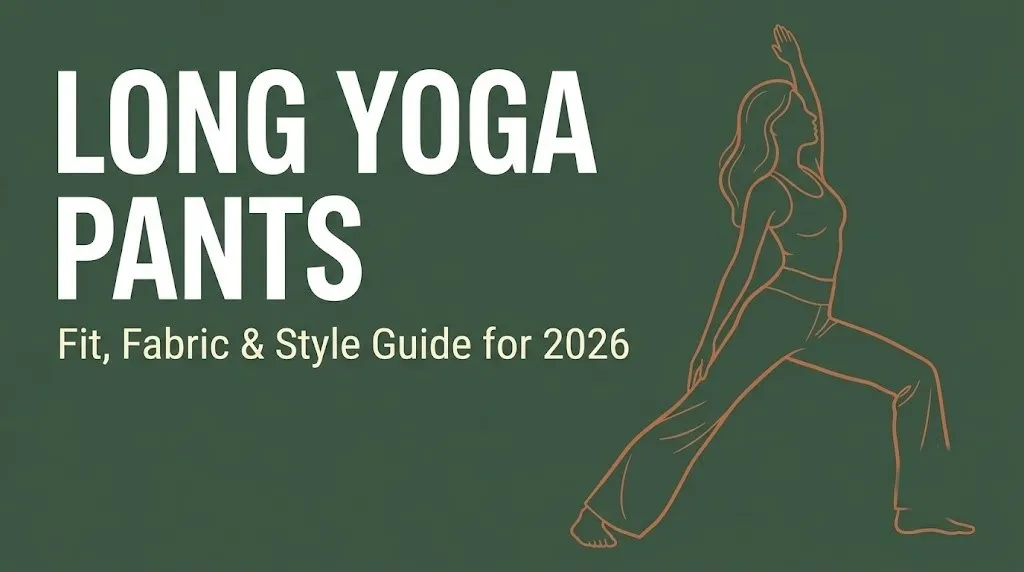
Long Yoga Pants: Fit, Fabric & Style Guide for 2026
Long yoga pants are yoga leggings or full-length yoga trousers with inseams of 32 inches or more, designed to fit women with longer legs without bunching, riding up, or restricting movement. For tall women who have been fighting standard 28-inch inseams for years, the difference is not a minor comfort upgrade; it changes how you move on the mat.
Fit matters more in yoga than in almost any other physical activity. Yoga requires deep hip flexion, spinal extension, balance, and inversion. Clothing that pulls, bunches, or slides mid-pose does not just feel annoying. It actively disrupts alignment cues and can shift weight distribution in standing poses. Yoga Alliance emphasizes that unrestricted range of motion is a foundational requirement for safe, effective practice.
This guide covers everything tall women need to know about long yoga pants in 2026: how to measure correctly, which inseam lengths work for which heights, which fabrics suit which yoga styles, and how fit connects to actual pose performance. Whether you practice Vinyasa, Yin, or hot yoga, there is a right pant for your practice.
What Are Long Yoga Pants and Who Needs Them
Long yoga pants are any yoga bottoms with an inseam of 32 inches or longer, built specifically to accommodate taller frames and longer legs without hemming or bunching.
Standard yoga pants sold in most retail stores are cut to a 28-inch inseam, which fits an average woman’s height of approximately 5’4″. For women between 5’8″ and 6’2″, that measurement leaves several inches of bare ankle exposed, or forces the fabric to bunch above the ankle rather than draping cleanly to the foot.
The issue is not purely cosmetic. Fabric bunching around the ankle creates a tactile distraction during balance poses like Vrksasana (Tree Pose). In poses that require attention to foot and ankle alignment, any surplus fabric around the lower leg competes with proprioceptive feedback.
Who genuinely benefits from long yoga pants:
- Women 5’8″ and taller who find standard inseams too short
- Practitioners with long legs relative to their torso, regardless of total height
- Anyone who prefers fabric to reach the ankle or mid-foot for aesthetic or warmth reasons
- Women practicing outdoor yoga or cooler environments where full leg coverage matters
- Practitioners whose short pants tend to slide up during floor poses and inversions
Modification note: Women who are tall but have a shorter torso with very long legs may need to size up in the waist or choose brands with separate tall sizing that accounts for both inseam and rise proportions.
Why Standard Yoga Pants Don’t Fit Tall Women
Standard yoga pants are cut to fit a statistical average, and that average excludes most women over 5’7″. The problem runs deeper than inseam length alone.
Rise is the measurement from the crotch seam to the waistband. Standard yoga pants have a rise calibrated for average-height proportions. On a taller woman, a standard rise often sits lower than intended, creating a gap between waistband and natural waist. That gap becomes a functional problem in forward folds, because the waistband rolls down as the torso hinges forward.
Crotch depth is a less-discussed but equally real issue. On tall frames, a shallow crotch seam creates restriction at the inner thigh during poses like Malasana (Garland Pose) or wide-legged forward folds. The seam pulls upward, which limits full hip flexion and can create an uncomfortable pinching sensation.
The three fit failures of standard yoga pants on tall women:
- Inseam too short: Fabric ends above the ankle. Bunching occurs or full-length coverage is lost.
- Rise too low: Waistband sits at or below the hip bone. Rolls down during forward folds and hip-dominant poses.
- Crotch depth too shallow: Restricts hip flexion. Creates discomfort in wide-stance and squat-based poses.
The combined effect is a pant that works fine standing still but fights the body through every demanding pose in the sequence. Brands with dedicated tall sizing address all three measurements simultaneously, not just the inseam.
How to Measure Inseam for Long Yoga Pants
Your inseam measurement is the distance from your crotch to the floor while barefoot, measured along the inside of your leg. This single number determines which long yoga pant length fits you correctly.
Measuring yourself accurately at home takes about two minutes.
To measure your inseam at home:
- Stand barefoot on a hard floor with feet hip-width apart.
- Place a book or ruler flush against your crotch, pressing gently upward to simulate seam placement.
- Measure from the top of the book straight down the inside of your leg to the floor.
- Record that number in inches. That is your inseam measurement.
- Compare it to the pant’s listed inseam, not just the labeled size.
- Choose a pant inseam 1 inch shorter than your measurement for ankle-length fit.
- Match your inseam exactly for full-length, floor-grazing coverage.
One practical note: inseam measurement varies by posture. If you have a tendency to stand with a slight anterior pelvic tilt, your functional inseam during yoga may run slightly shorter than your static standing measurement. Yoga teachers and fit specialists generally recommend choosing a pant that is 0.5 to 1 inch shorter than your bare-leg inseam for the most accurate active fit.
Modification note: If you cannot measure standing alone, sit at the edge of a chair and measure from the chair seat to the floor along the inner leg. That seated version slightly underestimates your standing inseam, so add 1 inch to the result.
Key Takeaway: Your inseam measurement matters more than your labeled pants size when buying long yoga pants. Measure your inseam barefoot and compare it directly to the pant’s listed inseam before purchasing.
Inseam Length Guide: 32, 34, and 36 Inch Options Compared
The three most common long inseam lengths in women’s yoga pants are 32 inches, 34 inches, and 36 inches. Each suits a different height range, and choosing incorrectly produces the same bunching and fit problems you were trying to escape.
A 32-inch inseam fits most women between 5’7″ and 5’9″ for an ankle-length finish. Women in this height range often find standard 28-inch inseams reach mid-calf, and 32-inch pants solve that problem cleanly.
A 34-inch inseam is the standard “tall” offering from most athletic brands. It fits women between 5’9″ and 5’11” for ankle-length coverage. Women at 5’10” who want fabric to reach the floor, not just the ankle, often prefer 34-inch over 32-inch options.
A 36-inch inseam is the “extra tall” category. Women 6’0″ and above typically need this length to achieve ankle coverage. At this inseam length, fabric options become more limited, and most dedicated tall athletic brands or specialty yoga retailers carry the widest selection.
Inseam guide by height:
| Height | Recommended Inseam | Expected Fit |
|---|---|---|
| 5’6″ to 5’8″ | 30 to 32 inches | Ankle-length |
| 5’8″ to 5’10” | 32 to 34 inches | Ankle to floor-length |
| 5’10” to 6’0″ | 34 to 36 inches | Ankle to floor-length |
| 6’0″ and above | 36 inches minimum | Ankle-length |
| Extra long legs relative to height | Size up one inseam | Check rise separately |
One important caveat: these ranges assume average proportions. Women with longer legs relative to their torso may need a longer inseam than the table suggests for their total height.
Best Fabric for Long Yoga Leggings by Practice Type
The fabric of your yoga leggings affects breathability, compression level, moisture management, grip, and how well the pants hold their shape over time. No single fabric is best for every yoga style.
Nylon-spandex blends (typically 80% nylon, 20% spandex) are the most popular high-performance choice. Nylon has a smooth, durable feel. It resists pilling better than polyester. It holds its shape through repeated washing and dynamic movement. The spandex content provides four-way stretch, which means the fabric moves with you in every direction without resistance.
Polyester-spandex blends are more affordable and dry faster than nylon. Polyester is slightly less smooth against the skin but offers excellent moisture-wicking performance. It also holds color better through repeated washing. For hot yoga styles like Bikram/26&2, where sweat volume is high, a polyester-spandex blend often outperforms nylon in terms of quick-dry speed.
Best fabric by yoga style:
| Yoga Style | Best Fabric | Why |
|---|---|---|
| Vinyasa (dynamic flow) | Nylon-spandex | Four-way stretch, shape retention under movement |
| Bikram/26&2 (hot yoga) | Polyester-spandex | Fast-drying, high breathability |
| Yin (long holds, floor-based) | Bamboo-spandex or modal blend | Soft against skin during still, passive poses |
| Restorative | Cotton-spandex or modal | Warmth, gentle compression, comfort |
| Hatha (moderate pace) | Nylon-spandex | Versatile, durable for varied movement |
| Outdoor yoga | Recycled nylon-spandex | Durability, UV protection options available |
Squat-proof performance is fabric-density dependent. A higher spandex percentage does not always mean squat-proof. Look for a tight knit structure and test with a squat in bright light before purchasing if this is a priority.
Key Takeaway: Nylon-spandex is the most versatile all-practice fabric for long yoga leggings, but polyester-spandex wins for hot yoga styles where rapid moisture management matters more than feel.
High Waist Long Yoga Pants: Do You Actually Need Them
High waist yoga pants sit at or above the natural waist, typically 3 to 4 inches above the hip bone, providing a wider waistband and more coverage across the lower abdomen than mid-rise options.
For tall women, high waist construction addresses a real problem. As explained in the fit section, standard rises tend to sit too low on tall frames. A high waist pant compensates by providing enough waistband height to actually reach the natural waist on a longer torso. The functional result is a waistband that stays put through forward folds, inversions, and seated poses.
The lumbar spine and core stabilizers benefit indirectly from a secure, non-rolling waistband. When the waistband does not require constant adjustment, the practitioner can maintain attention on breath and alignment rather than interrupting the practice to fix clothing. Yoga Alliance-trained teachers consistently note that clothing that requires adjustment mid-pose interferes with the focus and body-awareness that define good practice.
High waist vs. mid-rise yoga pants for tall women:
| Feature | High Waist | Mid-Rise |
|---|---|---|
| Waistband position | At or above natural waist | At or just above hips |
| Best for tall frames | Yes, especially long torso | Often sits too low |
| Forward fold stability | Stays up well | Prone to rolling down |
| Belly coverage | Full | Partial |
| Best practice types | All, especially inversions | Gentle yoga, Yin |
| Compression on abdomen | Moderate to firm | Light to moderate |
Modification note: Women who experience abdominal discomfort from firm waistband compression, including those with certain digestive conditions or recent abdominal surgery, should look for high waist pants with a softer, wider waistband rather than a narrow, firm elastic band. A fold-over waistband style offers high coverage with adjustable compression.
Wide Leg and Flare Yoga Pants for Tall Women
Wide leg and flare yoga pants offer a relaxed, non-fitted silhouette below the knee, which suits certain yoga styles and body types particularly well. On tall women, these silhouettes tend to land more proportionally than on shorter frames.
Wide leg yoga pants have a straight, broad leg from hip to ankle. They provide maximum room for hip-dominant poses like Malasana (Garland Pose) and seated hip openers without any compression at the thigh or calf. They work exceptionally well for Hatha and Yin sessions where movement is slower and static holds are long.
Flare yoga pants have a fitted thigh that widens below the knee, often finishing at or below the ankle. For tall women, this proportion tends to look intentional rather than overwhelming. The flare silhouette also helps with one specific practice challenge: the extra fabric at the ankle provides grip on hardwood floors or smooth mats during standing poses where the feet are wide-set.
When to choose wide leg or flare:
- Wide leg: Best for Hatha, Yin, Restorative, and meditation sessions where free hip movement matters most
- Flare: Best for moderate-pace practices and off-mat wear. Works well in Hatha and gentle Vinyasa.
- Fitted/compression: Best for dynamic Vinyasa, Ashtanga, and Bikram where fabric management during inversions and flows is the priority
For tall women, the most common wide leg and flare mistake is choosing a length that drags on the floor. At a 34-inch inseam or longer, wide leg pants often need to be worn slightly higher on the waist to clear the floor without bunching underfoot.
Key Takeaway: Wide leg and flare pants suit slow, floor-dominant yoga styles on tall frames, but fitted compression pants remain the more practical choice for dynamic flows and inversions where fabric management matters.
How Yoga Pant Fit Affects Alignment and Pose Performance
Clothing fit directly influences movement mechanics during yoga. This is the most overlooked dimension of the long yoga pants conversation, and it is the one most worth understanding before you buy anything.
Think of your hip flexors and hip joint like a hinge on a door. If the door frame is too narrow, the hinge cannot open fully. Yoga pants that are too tight in the hip or inner thigh create exactly that restriction. They limit the degree of hip flexion available in poses like Uttanasana (Standing Forward Fold) and Adho Mukha Svanasana (Downward-Facing Dog), not because your body cannot go deeper, but because the fabric stops it.
Research in the Physical Therapy Journal has examined how restrictive clothing affects joint range of motion during functional movement tasks. Findings suggest that non-elastic or low-stretch fabrics can reduce lower extremity range of motion by measurable degrees during deep hip flexion tasks. While yoga-specific studies on this question remain limited, the movement science principle is well-established: clothing that resists stretch reduces available range of motion.
How specific fit factors affect specific poses:
| Fit Factor | Pose Affected | How It Matters |
|---|---|---|
| Inseam too short | Standing poses, balances | Fabric pulls up mid-pose; tactile distraction |
| Waistband rolls down | All forward folds | Practitioner stops to adjust; alignment breaks |
| Crotch seam too shallow | Malasana, wide folds | Restricts hip flexion range |
| Thigh too tight | Virabhadrasana I (Warrior I) | Limits hip flexor extension |
| Ankle bunching | Vrksasana (Tree Pose) | Disrupts proprioceptive feedback at foot |
Correctly fitted long yoga pants with four-way stretch fabric remove clothing as a variable. The body can find its maximum available range in each pose without fighting the clothing. That is not a luxury; that is the minimum standard for practicing safely.
Long Yoga Pants for Vinyasa, Yin, and Hot Yoga Styles
Different yoga styles create different demands on your clothing. A pant that performs perfectly in a quiet Yin session may fail within ten minutes of a heated Vinyasa flow. Understanding what each style requires saves a lot of expensive trial and error.
Vinyasa yoga is a dynamic, breath-linked flow practice. Session intensity is moderate to high. Sweat is common. Poses transition quickly, which means fabric is under constant movement stress. You need four-way stretch, a secure waistband, moisture-wicking properties, and a gusseted crotch seam that allows full hip flexion without pulling. Fitted compression-style long yoga pants in a nylon-spandex blend are the most functional choice.
Yin yoga involves passive, long-held floor poses. Sessions are still and contemplative. Sweat is minimal. The priority is comfort during extended holds of 3 to 5 minutes per pose. A softer, less compressive fabric in a wider leg silhouette serves better here. Bamboo-blend or modal-blend long yoga pants provide warmth, softness, and enough stretch for wide hip openers without the snug fit of a compression legging.
Bikram/26&2 and hot yoga are practiced in rooms heated to approximately 105 degrees Fahrenheit with 40% humidity. This environment demands exceptional moisture management. Fabric that holds sweat against the skin becomes uncomfortable quickly and can reduce the tactile cues you rely on for balance and grounding. Lightweight polyester-spandex with a high air permeability rating performs best. Minimal coverage in the leg (though still full length for tall women) reduces thermal load.
Style-specific long yoga pant guide:
| Style | Fabric | Fit | Waistband | Inseam Priority |
|---|---|---|---|---|
| Vinyasa | Nylon-spandex | Fitted compression | High waist, wide band | Full length, secure |
| Yin | Bamboo or modal blend | Relaxed, wide leg | Soft, fold-over | Full length, soft hem |
| Bikram/Hot Yoga | Polyester-spandex | Fitted, lightweight | High waist, minimal bulk | Full length, quick-dry |
| Hatha | Nylon or polyester blend | Fitted to relaxed | High or mid-rise | Full length |
| Restorative | Cotton-spandex or modal | Relaxed | Soft, wide | Full length, warm |
Yoga Pants That Stay Up During Inversions and Standing Poses
A yoga pant that slides down during Adho Mukha Svanasana (Downward-Facing Dog) or rolls at the waist in Virabhadrasana I (Warrior I) is functionally unsuitable for active practice, regardless of how it looks standing still.
Waistband design is the primary factor in pant stability during poses. A wide, high-rise waistband with a reinforced inner grip strip holds the pant in place through forward folds and inversions better than any narrow elastic band. The wider the waistband, the more surface area contacts the body, and the less likely it is to roll or slip.
Fabric tension across the hip and seat also contributes. A pant that fits the hip and glute area with appropriate compression will not slip during movement. A pant that is too loose in the seat hangs and shifts as the body moves. Four-way stretch fabrics return to their original shape after each movement, which means the waistband springs back rather than staying stretched after a wide stance pose.
Features that keep long yoga pants in place:
- Wide waistband (3 to 4 inches or more): More contact area, less rolling tendency
- High waist construction: Sits above hip bone; stays in place through forward folds
- Inner grip strip or silicone band: Attaches waistband to skin for maximum hold
- Fitted hip and glute area: Prevents seat fabric from sliding during dynamic movement
- Four-way stretch fabric: Returns to shape after each pose; does not stretch out permanently
- Gusseted crotch: Prevents seam pulling during wide-leg and hip-flexion poses
Modification note: Women with narrower hip-to-waist ratios sometimes find that even high waist pants slip. A drawstring waistband option provides an extra level of security for practitioners whose body proportions cause standard elastic waistbands to slide.
Key Takeaway: Waistband width and construction matter more than any other single feature for keeping long yoga pants in place during active practice. A wide, high-rise waistband with a grip strip is the most reliable option.
Long Yoga Pants for Plus-Size Tall Women
Plus-size tall women face a fit challenge that is more specific than either “plus size” or “tall” alone. Standard plus-size yoga pants are cut for average heights. Standard tall yoga pants are cut for straight or athletic builds. The intersection of both needs is underserved by most mainstream athletic brands.
The most functional long yoga pants for plus-size tall women have three simultaneous adjustments compared to standard sizing: longer inseam (34 to 36 inches), wider seat and thigh, and a higher rise that accounts for a longer torso on a larger frame. When any one of those three is missing, fit breaks down in a different place.
Waistband width is especially relevant for plus-size tall practitioners. A narrow waistband on a larger frame creates a pressure point that can be uncomfortable during long holds and seated poses. A wide, smooth waistband with no internal seam distributes compression evenly across the abdomen, which is more comfortable during twists and forward folds.
What to look for specifically:
- Inseam of 34 to 36 inches in plus-size tall sizing (not just regular plus with a longer inseam)
- Wide, smooth waistband with even compression across the full abdominal width
- Gusseted crotch seam to allow full hip range in poses like Malasana (Garland Pose)
- Reinforced seat seam to prevent seam stress during seated and hip-dominant poses
- Four-way stretch nylon-spandex to accommodate varied body proportions without resistance
The American College of Sports Medicine notes that clothing that restricts movement or creates pressure points can discourage physical activity participation. Poorly fitting yoga pants are not a minor inconvenience for plus-size practitioners; they are a real barrier to consistent, safe practice.
Long Yoga Pants for Tall Women Over 50
Tall women over 50 have specific clothing needs shaped by changes in body composition, joint sensitivity, and temperature regulation. These are not the same needs as a 28-year-old tall athlete, and they should not be addressed by the same pant.
After 50, many women experience changes in waist-to-hip ratio, with fat redistribution toward the abdomen. This means a pant that fit well at 35 may now feel constrictive at the waist even at the same total weight. A wider, softer waistband with adjustable compression, such as a fold-over style, accommodates this change without sacrificing coverage.
Temperature regulation becomes more variable with age, particularly for women experiencing perimenopause or post-menopause. Hot flashes can make highly compressive, low-breathability fabrics deeply uncomfortable during practice. According to the National Center for Complementary and Integrative Health, yoga is one of the most studied complementary approaches for managing menopause symptoms, including hot flashes. A fabric that manages heat effectively can make the difference between a productive session and a miserable one.
Recommended features for tall women over 50:
- Soft, wide waistband: Fold-over or wide elastic; no narrow biting band
- Moisture-wicking, breathable fabric: Polyester-spandex or bamboo-spandex for temperature regulation
- Relaxed to moderate compression: Enough to feel supported, not enough to restrict breath or cause pressure
- Full-length inseam (32 to 36 inches): Provides warmth and coverage during gentler practice styles
- Flat or invisible seams: Reduces skin irritation during long holds and seated poses
Modification note: Women with varicose veins or lower limb circulation concerns should choose moderate compression rather than high-compression styles. If compression creates discomfort or visible skin marking, that is a sign the compression level is too high for your current needs.
Key Takeaway: Tall women over 50 benefit most from long yoga pants with breathable fabric, soft wide waistbands, and moderate compression, features that accommodate shifting body composition and temperature regulation needs.
How to Wash and Care for Long Yoga Leggings
Proper care extends the functional life of yoga leggings by a significant margin. Most long yoga pants fail early not from wear but from incorrect washing.
The most common mistake is washing yoga leggings in hot water. Heat breaks down elastane (spandex) fibers over time. Hot water accelerates fiber degradation, which leads to loss of stretch recovery, waistband roll, and fabric sagging. Wash yoga leggings in cold water, always.
The second most damaging practice is putting yoga leggings in the dryer. Dryer heat is more intense and more sustained than wash cycle heat. Even one or two high-heat dryer cycles can permanently damage the elastic recovery of spandex-blend fabrics. Air drying flat or hanging preserves the fabric’s stretch and shape substantially longer.
Yoga legging care guide:
| Step | Correct Practice | What to Avoid |
|---|---|---|
| Water temperature | Cold (below 30°C / 86°F) | Hot or warm water |
| Wash cycle | Gentle or delicate cycle | Heavy duty or high-agitation |
| Detergent | Mild, fragrance-free liquid | Fabric softener (degrades spandex) |
| Drying method | Air dry flat or hang | Machine dryer at any heat setting |
| Washing frequency | After every use | Leaving damp in bag post-practice |
| Storage | Folded flat or rolled | Hanging (stretches waistband over time) |
Fabric softener is specifically worth avoiding. It coats spandex fibers with a film that reduces their elasticity over time and also reduces the moisture-wicking performance of technical fabrics. After several softener washes, a high-performance nylon-spandex legging can feel heavy and non-responsive during practice.
Long Yoga Leggings vs Full-Length Yoga Pants: What’s the Difference
The terms “long yoga leggings” and “full-length yoga pants” are often used interchangeably, but they describe different garment constructions with different functional properties.
Long yoga leggings are form-fitting, compression-style garments that adhere closely to the leg from hip to ankle. They have no flare, no additional fabric volume, and minimal seam bulk. Leggings derive their support from fabric tension rather than garment structure. They are the most common choice for dynamic yoga styles because they move exactly with the body without shifting or catching.
Full-length yoga pants is a broader category. It includes leggings but also encompasses wide-leg yoga trousers, flare pants, and jogger-style yoga bottoms. These garments often have a more structured waistband, side seams, and in some cases pockets. They provide coverage and comfort similar to leggings but with different silhouettes and varying degrees of compression.
Leggings vs pants: quick comparison:
| Feature | Long Yoga Leggings | Full-Length Yoga Pants |
|---|---|---|
| Fit through leg | Compression, form-fitting | Varies: fitted to wide |
| Fabric volume | Minimal | Moderate to high |
| Best yoga styles | Vinyasa, Ashtanga, hot yoga | Hatha, Yin, Restorative, everyday |
| Movement freedom | High (fabric moves with body) | High (extra room reduces restriction) |
| Visibility of skin | Higher (form-fitting) | Lower (more coverage) |
| Pocket options | Rare | More common |
| Thermal warmth | Lower | Higher (more fabric) |
For tall women specifically, the distinction matters at the ankle. Full-length yoga pants in wider silhouettes often have wider hems that fall with more weight, meaning they are more likely to stay at ankle length rather than riding up during practice. Leggings can ride up if the fabric tension is not calibrated correctly for the body’s proportions.
How to Style Long Yoga Pants On and Off the Mat
Long yoga pants designed for tall women are proportioned correctly for real-world wear, not just studio use. Getting value from a quality pair means wearing them beyond your yoga session.
On the mat, the primary styling consideration is that the pant fits correctly before practice begins. A waistband that sits at the natural waist, a hem that reaches the ankle without bunching, and a fabric that does not require adjustment during the warm-up are all that you need. Top pairing on the mat is simple: a fitted tank or close-fitting top that will not fall forward during inversions.
Off the mat, long yoga pants in a solid dark color or textured knit pair cleanly with structured tops, oversized sweaters, and casual footwear. The proportional challenge for tall women with standard pants is eliminated when the inseam is correct. The leg line reads as intentional and clean when fabric ends at the ankle rather than floating mid-calf.
Styling long yoga pants by occasion:
| Setting | Pant Style | Pairing |
|---|---|---|
| Active yoga practice | Fitted compression legging, high waist | Fitted tank, sports bra |
| Studio to street | Wide leg or flare, neutral color | Structured cropped top, sneakers |
| Home practice | Relaxed wide leg, soft fabric | Loose tee, bare feet |
| Travel day | Fitted legging, mid-compression | Layered top, slip-on shoes |
| Outdoor practice | Fitted nylon-spandex | Moisture-wicking top, light layers |
One practical tip for tall women shopping for off-mat wear: a full 34-inch inseam in a wide leg or flare pant typically looks the most proportional when worn with a flat shoe or a low-profile sneaker. Heels push the hem into drag territory. Bare feet or flat shoes let the hem sit correctly at the ankle.
Key Takeaway: Long yoga pants with the correct inseam for your height work on and off the mat precisely because they are proportioned to your actual body, which makes casual styling as easy as active styling.
Frequently Asked Questions About Long Yoga Pants
What inseam length do I need for long yoga pants if I’m 5’10”?
At 5’10”, you typically need a 34-inch inseam for ankle-length coverage in long yoga pants.
If you have a longer leg relative to your torso, size up to 36 inches for full coverage without bunching.
Measure your own inseam barefoot before purchasing to confirm, since proportions vary even within the same total height.
What is the best fabric for long yoga leggings?
The best fabric for most yoga styles is a nylon-spandex blend, typically 80% nylon and 20% spandex.
Nylon resists pilling, holds its shape through repeated washing, and provides a smooth feel against the skin.
For hot yoga styles like Bikram/26&2, a polyester-spandex blend dries faster and manages high sweat volume more effectively.
Do high waist yoga pants stay up better during inversions?
Yes. High waist yoga pants with a wide, structured waistband stay in place substantially better during inversions and forward folds than mid-rise options.
The higher rise sits above the hip bone, where body circumference is typically consistent, rather than at the narrower hip level where pants are more prone to sliding.
An inner grip strip on the waistband provides an additional layer of security for practitioners who practice frequent inversions or transitions.
Can plus-size tall women find long yoga pants that actually fit?
Yes, but they need to look for brands offering plus-size tall sizing specifically, not just standard plus or standard tall sizing combined.
The correct fit requires three simultaneous adjustments: longer inseam, wider seat and thigh, and a higher rise for a longer torso.
Specialty athletic brands and dedicated tall sizing lines are the most reliable sources for this combination in 2026.
How do I measure my inseam for yoga pants at home?
Stand barefoot on a flat, hard floor with feet hip-width apart and press a book firmly against your crotch seam area.
Measure from the top of the book straight down the inner leg to the floor. That is your inseam length.
Choose a yoga pant inseam that is 0.5 to 1 inch shorter than your measured length for a clean ankle-length fit without drag.
Get the Fit Right First
Before you consider brand, color, or price, confirm your inseam measurement. That number is the foundation of every other long yoga pants decision. A 34-inch inseam in the wrong fabric for your yoga style still fails you on the mat, but the inseam is the entry point.
Once you know your inseam, match the fabric to your practice. Nylon-spandex for dynamic flows. Polyester-spandex for heat. Bamboo or modal for slow, quiet sessions. Get those two things right, and the rest is preference.
Your clothing should not compete with your practice. The right long yoga pants become invisible within the first five minutes of class. That is exactly what you are looking for.