Seal Pose Yoga: Benefits, Steps & Modifications 2026
Seal pose yoga is a passive prone backbend practiced almost exclusively in Yin yoga, designed to decompress and gently compress the lumbar spine while opening the entire front body over an extended hold. Unlike active backbends, Seal Pose asks you to let go rather than engage, making it one of the most accessible deep spinal stretches available to home practitioners.
The National Center for Complementary and Integrative Health (NCCIH) recognizes yoga as a well-supported practice for reducing chronic low back pain, with multiple clinical trials showing measurable improvement in pain and function. That science matters here, because Seal Pose sits at the center of that body of evidence.
This guide covers everything: what the pose is, how to do it safely, how long to hold it, who should modify or skip it, and how it fits into a Yin sequence. Whether you are brand new to yoga or refining an established practice, you will leave with a clear, practical plan.
Seal Pose Yoga: What It Is and Why It Matters
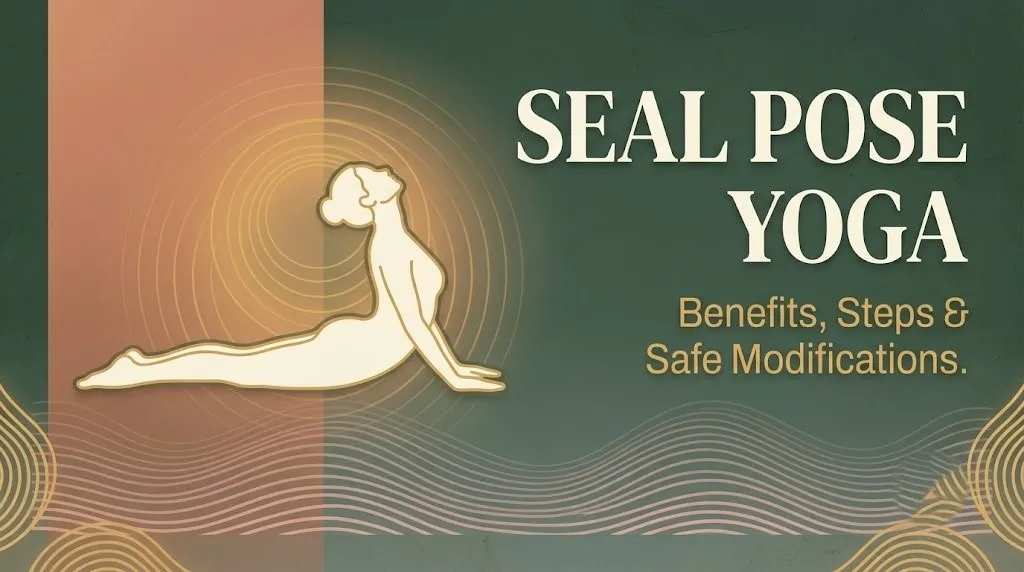
Seal pose yoga is a passive backbend practiced face-down, with the arms extended and the hands pressing into the floor to lift and arch the upper body while the lower body remains completely relaxed. The name comes from the pose’s resemblance to a resting seal, propped on its front fins with the spine curved.
It is primarily a Yin yoga pose, which means the goal is not muscular contraction but sustained, passive release of connective tissue, particularly the fascia surrounding the spine, hip flexors, and abdominal region. This distinguishes it from nearly every other backbend in mainstream yoga classes.
The pose targets the anterior body, meaning everything along the front: the abdomen, chest, hip flexors, and the anterior aspect of the lumbar spine. At the same time, it creates gentle compression along the posterior elements of the spinal column, which Yin yoga teachers describe as a targeted stimulus for the deeper tissues.
For home practitioners, Seal Pose is practical. You need no equipment beyond a mat. The setup takes seconds. The work happens during the hold, and that hold can be adjusted to suit any body and any experience level.
Pose Tip:
- Seal Pose is not about how high you can lift. Depth is individual.
- Ease into the arch slowly rather than pressing up all at once.
- Beginners can start with bent elbows at any angle that feels sustainable.
What Is Seal Pose in Yoga?
Seal Pose is a Yin yoga variation of a prone backbend where the hands are placed flat on the floor, arms are extended or partially extended, and the torso lifts into spinal extension without muscular gripping. There is no universally standardized Sanskrit name for this pose. It evolved within Yin yoga tradition, developed and popularized by teachers including Paul Grilley and Sarah Powers in the late 20th century, as a passive counterpart to the active Bhujangasana (Cobra Pose).
The key distinction is intent and muscular engagement. In Bhujangasana (Cobra Pose), you actively engage the back muscles to lift. In Seal Pose, you use your arms to support the upper body’s weight and allow the spine to hang passively between them. The back muscles should be as relaxed as possible.
This passive quality is the entire point. Connective tissue, specifically fascia, responds differently to passive long-duration stress than to active muscular effort. Yin yoga is built around this principle, applying gentle, sustained load to reach tissues that active yoga rarely touches.
| Feature | Seal Pose | Cobra Pose (Bhujangasana) |
|---|---|---|
| Yoga Style | Yin yoga | Hatha, Vinyasa, Ashtanga |
| Muscle engagement | Passive; arms support weight | Active; back muscles lift |
| Hold duration | 3 to 5 minutes | 5 to 30 seconds |
| Primary target | Fascia, connective tissue | Erector spinae, glutes |
| Arm position | Extended or nearly extended | Bent, close to sides |
| Intensity at spine | Deeper lumbar compression | Moderate lumbar extension |
Understanding this distinction helps you choose the right tool for the right goal, and prevents you from doing one pose while expecting the results of the other.
Seal Pose Yin Yoga: The Principles Behind the Practice
Seal Pose belongs to Yin yoga, a slow, floor-based practice where poses are held passively for 2 to 5 minutes with the intention of targeting deep connective tissues rather than muscles. This matters because the connective tissue system, including fascia, ligaments, and joint capsules, responds to sustained low-load stress over time, not to brief, high-intensity effort.
Yin yoga was shaped significantly by the work of Paul Grilley, who drew on both Traditional Chinese Medicine meridian theory and Western anatomy. In the Yin framework, Seal Pose stimulates the Kidney and Urinary Bladder meridians, which are said to run along the posterior spine and inner legs. Whether you follow meridian theory or prefer a purely anatomical lens, the physical effects of the hold are well-documented.
A study published in the International Journal of Yoga found that Yin yoga practices targeting the lumbar region produced measurable reductions in perceived lower back stiffness after a 6-week program. The mechanisms suggested included improved fascial hydration and reduced myofascial tension.
What makes Seal Pose distinctly Yin rather than Restorative is the intentional stress applied to the tissue. Restorative yoga eliminates stress entirely using props to fully support the body. Yin applies a gentle, calculated load. Seal Pose falls squarely in the Yin category because the spine is deliberately placed into extension without full support.
This distinction shapes how you should approach the pose: not with effort, but with patient tolerance of a sensation that is present but not painful.
Key Takeaway: Seal Pose is a Yin yoga backbend, not an active strength pose. Its value comes from passive, sustained hold time, not from how high you arch or how strong your back is.
Seal Pose Yoga Benefits
The primary benefits of seal pose yoga include spinal decompression, hip flexor lengthening, chest and abdominal opening, and a measurable reduction in perceived lower back stiffness. These outcomes are supported by research on Yin yoga and passive spinal extension practices.
The hip flexors, particularly the psoas muscle, are among the most chronically shortened muscles in people who sit for extended periods. Think of the psoas like a rubber band that has been held in a compressed position for eight hours straight. Seal Pose places it under sustained, gentle traction, encouraging a gradual release that brief stretches cannot replicate.
According to the NCCIH, yoga-based interventions for chronic lower back pain showed equivalent or superior outcomes to physical therapy in several randomized controlled trials. Seal Pose, as a Yin yoga spinal extension, fits within that evidence base.
Additional benefits, supported by yoga research and practitioner consensus, include:
- Chest and lung opening: The anterior chest expands as the thoracic spine extends, improving respiratory depth.
- Abdominal fascia release: The rectus abdominis and its surrounding fascia undergo passive lengthening during the hold.
- Nervous system regulation: Passive holds in Yin yoga are associated with parasympathetic activation, the “rest and digest” response.
- Spinal mobility over time: Regular practice maintains lumbar and thoracic range of motion, particularly relevant for adults over 50.
- Postural correction: Regular prone backbending can counteract the forward-rounded posture that develops from prolonged sitting.
Research in the Journal of Alternative and Complementary Medicine has found that consistent Yin yoga practice, practiced 3 or more times per week, produced improvements in spinal flexibility and self-reported well-being within 8 weeks.
Seal Pose Anatomy and Muscles
Seal Pose passively lengthens the anterior body while applying compressive stress to the posterior elements of the lumbar and thoracic spine. Understanding which structures are involved helps you practice more intelligently and recognize when something feels wrong.
The psoas muscle is the most consequential structure in this pose. It originates at the lumbar vertebrae, crosses the hip joint, and attaches to the inner femur. In Seal Pose, with the legs lying flat and the spine extended, the psoas undergoes meaningful passive lengthening. This is exactly what people who sit at desks for long hours need.
The erector spinae group runs along both sides of the spine. In Yin context, these muscles should remain as passive as possible. If you feel your back muscles gripping or contracting to hold you up, your arms are not bearing enough weight, or your depth is too deep for your current range of motion.
Key anatomical structures involved:
| Structure | Role in Seal Pose | Sensation You May Notice |
|---|---|---|
| Psoas muscle | Passively lengthened | Deep pulling in front of hip |
| Rectus abdominis | Passively lengthened | Mild stretch in abdomen |
| Erector spinae | Should remain relaxed | Warmth or dull pressure |
| Lumbar vertebrae | Gentle compression | Pressure or spaciousness |
| Thoracic spine | Extension and opening | Broadening in upper back |
| Shoulder girdle | Weight-bearing support | Possible arm fatigue |
| Intercostal muscles | Expansion with breath | Ribcage opening on inhale |
The sacroiliac joint also experiences movement during this pose, which is relevant for people with SI joint dysfunction. If you feel sharp, one-sided pain in the lower back near the pelvis, the pose is not appropriate without specific modification.
How to Do Seal Pose Yoga
To do seal pose yoga, lie face-down, place your hands flat on the floor wider than shoulder-width apart, and press up into spinal extension, letting the lower body relax completely. Here is the full step-by-step technique.
To practice Seal Pose:
- Begin lying flat on your stomach, legs extended behind you, hip-width apart or slightly wider. Let your toes point naturally outward.
- Place your hands flat on the mat, wider than shoulder-width, roughly at chest level. Spread your fingers.
- On an inhale, press gently through your palms and straighten your arms to lift your chest and abdomen off the mat. Move slowly.
- Let your lower body remain completely heavy. Hips stay on the floor. Legs are passive. No glute squeezing.
- Position your arms at whatever angle allows your back muscles to relax. This might be elbows bent at 45 degrees. It might be fully extended. There is no single correct arm position.
- Drop your head back gently if comfortable, or keep the gaze forward. Never crank the neck.
- Breathe slowly and naturally. With each exhale, allow the belly to soften further toward the floor.
- Hold for 3 to 5 minutes, or as modified below for beginners.
- To release, bend your elbows slowly and lower your chest to the mat. Rest for at least 30 seconds before moving.
Modification for beginners: Keep elbows bent and resting on the mat, forearms flat. This is closer to Salamba Bhujangasana (Sphinx Pose) and is the appropriate starting depth.
Modification for wrist sensitivity: Use fists instead of flat palms, or practice on fingertips to reduce wrist extension load.
Key Takeaway: The quality of Seal Pose depends on what you are NOT doing. Relaxing the legs, the glutes, and the back muscles matters as much as the position of your arms.
How Long to Hold Seal Pose
Most Yin yoga teachers recommend holding Seal Pose for 3 to 5 minutes, though beginners should start with 1 to 2 minutes and build gradually over several weeks of practice.
Hold duration is not arbitrary. Fascia, the connective tissue web that Yin yoga primarily targets, responds to sustained low-load stress over time. Research on connective tissue biomechanics, cited in the International Journal of Yoga, suggests that meaningful fascial change requires a minimum of 90 to 120 seconds of sustained passive load. Shorter holds may feel good, but they don’t reach the same depth of tissue.
That said, longer is not always better. If you feel any sharp, shooting, or nerve-like pain within the first 60 seconds, the pose is too deep or not appropriate for your body that day. A dull, achy, or “good hurt” sensation is typical. Pain that travels down the legs is not.
| Experience Level | Recommended Hold | Frequency |
|---|---|---|
| Beginner (0 to 3 months) | 60 to 90 seconds | 2 to 3 times per week |
| Intermediate (3 to 12 months) | 2 to 3 minutes | 3 to 4 times per week |
| Established Yin practitioner | 3 to 5 minutes | Daily or near-daily |
| Seniors or spinal condition | 60 seconds or less | With physical therapist guidance |
Always follow Seal Pose with a counter pose. Child’s Pose (Balasana) or a brief, neutral supine rest allows the spine to decompress before you change positions.
Seal Pose vs Sphinx Pose
Seal Pose and Sphinx Pose, known in Sanskrit as Salamba Bhujangasana, are both prone backbends, but they differ in arm position, spinal depth, and appropriate population. Sphinx Pose is the gentler, more accessible version. Seal Pose goes deeper into lumbar extension.
In Salamba Bhujangasana (Sphinx Pose), the forearms rest flat on the mat, elbows directly under the shoulders. This geometry limits how far the spine can extend. The lumbar curve is present but moderate. Most bodies, including those with mild lower back sensitivity, can practice Sphinx Pose comfortably.
In Seal Pose, the arms are extended further from the body. The torso lifts higher. The lumbar spine enters a deeper extension, and the compression on the posterior vertebral elements increases. This is not a problem for healthy spines, but it is a real consideration for people with specific conditions.
| Feature | Sphinx Pose (Salamba Bhujangasana) | Seal Pose |
|---|---|---|
| Arm position | Forearms flat, elbows under shoulders | Arms extended, hands on floor |
| Lumbar depth | Moderate extension | Deeper extension |
| Appropriate for beginners | Yes | With modification |
| Appropriate for back pain | Often yes, case by case | Consult spine specialist first |
| Appropriate for herniated disc | Sometimes yes | Generally no |
| Hold duration in Yin | 3 to 5 minutes | 3 to 5 minutes |
| Wrist load | Minimal | Moderate to significant |
The practical answer is this: if you are not yet comfortable in Sphinx Pose for 2 to 3 minutes, do not progress to Seal Pose. Let Sphinx be your version until your body tells you it wants more.
Seal Pose vs Cobra Pose Yoga
Seal Pose and Cobra Pose (Bhujangasana) look similar from across the room, but they are fundamentally different in muscular engagement, yoga style, purpose, and intended duration of hold. Confusing the two leads to practicing the wrong tool for the job.
Bhujangasana (Cobra Pose) is an active backbend. The back muscles, primarily the erector spinae, actively contract to lift the chest. In classical Hatha and Vinyasa yoga, Cobra is held for 5 to 30 seconds. It builds posterior spinal strength, opens the chest, and appears in sun salutation sequences worldwide.
Seal Pose, by contrast, is passive. The arms do the lifting. The back muscles rest. The hold lasts 3 to 5 minutes. You are not building strength in Seal Pose. You are releasing tension and stimulating connective tissue.
This means the two poses are not interchangeable. Cobra gives you strength and activation. Seal Pose gives you tissue release and decompression. A well-rounded practice may include both, but not as substitutes for each other.
The American College of Sports Medicine notes that flexibility work and strengthening work address different physical adaptations and should be planned as distinct components of an exercise program. That principle applies here directly.
| Feature | Cobra Pose (Bhujangasana) | Seal Pose |
|---|---|---|
| Yoga style | Hatha, Vinyasa, Ashtanga | Yin yoga |
| Muscular engagement | Active (erector spinae) | Passive (arms support) |
| Hold time | 5 to 30 seconds | 3 to 5 minutes |
| Primary benefit | Spinal strength, activation | Fascial release, decompression |
| Flow-friendly | Yes | No |
| Beginner entry | Yes, with modification | Start with Sphinx Pose |
Key Takeaway: Sphinx Pose is the gateway, Seal Pose is the destination, and Cobra Pose is a different road entirely. Knowing which one you’re practicing changes what you get from it.
Seal Pose Yoga for Beginners
Beginners can absolutely practice seal pose yoga, but the starting position for most new practitioners should be closer to Sphinx Pose than full Seal Pose, with hold times kept short and props used freely. There is no badge for going deeper faster.
The most common beginner mistake in Seal Pose is aiming for the full arm-extended position immediately. This pushes the lumbar spine into an extension it may not be ready for, particularly in people who have been sedentary, have anterior pelvic tilt, or carry significant tension in the hip flexors and abdomen.
Start here:
- Begin in Salamba Bhujangasana (Sphinx Pose), forearms flat, for 2 minutes.
- If that feels manageable, gradually walk your hands forward a few inches.
- Hold the new position for 60 to 90 seconds.
- Assess the sensation. Achy and spacious is fine. Sharp and pinching is not.
- Progress the hand position by small increments over multiple sessions, not within one practice.
Additional beginner-specific guidance:
- Do not hold the breath. Breathing fully is a beginner skill that takes practice.
- Let the belly drop. Beginners often brace the abdomen reflexively. Allow it to release.
- Keep legs hip-width apart and feet turned slightly outward. This naturally reduces lumbar compression.
- Rest between attempts. If you practice Seal Pose twice in one session, rest completely between holds.
Yoga Alliance recommends that beginners receive orientation from a trained yoga teacher before attempting extended Yin holds, particularly for spinal poses. In-person or live-streamed instruction provides real-time alignment feedback that video-based practice cannot replicate.
Seal Pose Yoga Modifications
Seal pose yoga can be modified for dozens of body types, physical conditions, and experience levels by adjusting arm position, leg position, surface support, and hold duration. There is no single correct version of this pose.
The following modifications address the most commonly needed adjustments:
- Wrist pain or carpal tunnel: Make fists instead of flat hands, or use yoga blocks under your palms to reduce wrist extension. You can also place fingertips on the floor to create a slight angle.
- Shoulder impingement: Narrow the hand position or bring elbows partially bent. Avoid any position that causes shoulder pinching.
- Lower back sensitivity (mild): Separate the feet wider, up to mat-width apart. This reduces the lumbar compression angle. Consider stopping at Sphinx Pose depth rather than extending to full Seal.
- Tight hip flexors: Place a folded yoga blanket under the hip bones. This slight elevation reduces the stretch on the hip flexors, making the pose more accessible and less intense.
- Pregnant practitioners (second and third trimester): Prone backbends are generally contraindicated. A supported side-lying chest opener or a modified seated back extension is a safer option. Consult your midwife or OB before continuing prone floor poses.
- Post-surgery recovery: Do not practice Seal Pose without explicit clearance from your surgeon or physical therapist. This applies to spinal surgeries, hip replacements, and abdominal procedures.
| Modification | Who It Helps | How to Apply |
|---|---|---|
| Fists instead of flat palms | Wrist pain, carpal tunnel | Make soft fists, press knuckles into mat |
| Bent elbows at 90 degrees | Shoulder issues, tight chest | Keep forearms at an angle, weight distributed |
| Feet wider than hip-width | Lower back sensitivity | Separate feet to mat width |
| Blanket under hips | Tight hip flexors | Fold blanket under hip bones |
| Shorter hold (60 seconds) | Beginners, seniors | Build to longer holds over weeks |
| Stop at Sphinx depth | Disc issues, stenosis | Forearms stay flat; do not extend arms |
Seal Pose Yoga Props
The most useful props for seal pose yoga are a yoga mat, a yoga blanket, yoga blocks, and a bolster, each serving a distinct purpose depending on your body and your goal in the pose. Props are not a sign of weakness. They are precision tools.
A folded yoga blanket placed under the hip bones is the single most underused prop in Seal Pose. It reduces the angle of lumbar compression, making the pose accessible for people who feel pinching in the lower back. It also adds comfort for practitioners with bony hip structures.
Yoga blocks serve two purposes here. Under the palms, they reduce wrist extension load. Under the forehead in Sphinx Pose transitions, they support the weight of the head without neck strain.
A bolster placed lengthwise under the torso converts the pose into something closer to Restorative yoga territory, where the spine is gently supported rather than loaded. This is appropriate for practitioners recovering from illness, practicing in an exhausted state, or needing a deeply nourishing rather than stimulating practice.
Props and their purposes at a glance:
- Yoga blanket: Placed under hips to reduce lumbar compression. Folded under shins for knee comfort.
- Yoga block: Under palms to reduce wrist load. Under forehead to support the head in Sphinx.
- Bolster: Under the torso for a supported, near-Restorative variation.
- Yoga mat: Non-negotiable. A grippy mat prevents hand sliding when arms are extended.
- Foam wedge: Under palms as an alternative to blocks for wrist issues. Provides a more gradual angle.
- Timer: Set a phone timer so you are not checking the clock during the hold. Distraction disrupts the parasympathetic state you are building.
Key Takeaway: A blanket under your hips and a timer set for 3 minutes transforms Seal Pose from something you endure into something that actually works. Use both.
Seal Pose Yoga for Seniors
Seal pose yoga can be an appropriate and beneficial practice for seniors, but it requires thoughtful modification based on spinal health history, bone density, and existing joint conditions. It is not off-limits for older adults. It requires honesty about where the body currently is.
The physiological changes that come with aging are directly relevant here. Lumbar disc dehydration reduces the spine’s ability to tolerate compression. Bone density changes mean that compressive forces need to be applied more conservatively. Shoulder and wrist joint changes may limit arm positions.
That said, the benefits of spinal extension work for seniors are well-supported. According to a study published in the Journal of Alternative and Complementary Medicine, older adults who practiced Yin-style yoga twice weekly showed improvements in spinal flexibility and reductions in self-reported pain after 8 weeks, with no adverse events when participants were appropriately screened and instructed.
For seniors, the recommended approach to Seal Pose:
- Start with Sphinx Pose only, forearms flat, hold for 60 to 90 seconds maximum.
- Avoid Seal Pose if you have been diagnosed with spinal stenosis, significant disc degeneration, osteoporosis of the spine, or are within 6 months of any spinal procedure.
- Use a blanket under the hips as a standard starting modification, not an optional one.
- Practice on a padded mat or add a second mat layer for additional cushioning on the hip bones and ribs.
- Older adults with conditions affecting the wrists, such as arthritis, should use fists or yoga blocks rather than flat-palm support.
Yoga teachers and physical therapists generally recommend that seniors begin Yin yoga with an instructor present, at least for the first 4 to 6 sessions, to establish safe alignment habits before independent home practice.
Seal Pose Yoga Lower Back
Seal pose yoga affects the lower back in two ways: it creates gentle compression on the posterior elements of the lumbar spine, and it passively lengthens the anterior structures, including the hip flexors and abdominal fascia, that are often the root cause of lower back tension. Understanding both effects helps you decide if the pose belongs in your practice.
The lower back is a common target of Seal Pose because the lumbar spine is the most mobile segment of the vertebral column. When we sit for long periods, the lumbar curve flattens, the hip flexors shorten, and the erector spinae develop chronic holding patterns. Seal Pose directly addresses all three by placing the lumbar spine into extension and the hip flexors into passive lengthening simultaneously.
The NCCIH has funded and reviewed multiple trials on yoga for low back pain. The evidence consistently shows that yoga-based interventions, when appropriately matched to the individual’s condition, reduce pain and functional limitation compared to no treatment. Passive backbending, specifically, is highlighted in several physical therapy protocols for disc-related back pain.
However, the lower back response to Seal Pose is not universal:
- Disc herniation: Spinal extension can worsen posterior herniations in some individuals. If extension-based movements typically increase your leg symptoms, avoid this pose and work with a spine specialist.
- Facet joint arthritis: Compression at the facet joints during extension may increase pain. In this case, Sphinx Pose with a blanket under the hips is safer.
- Mild, nonspecific lower back tension: This is the population that typically benefits most from Seal Pose. The passive hold releases the anterior structures and gives the posterior spine a gentle, rhythmic stimulus.
- Hyperlordosis: People with an already pronounced lumbar curve should approach Seal Pose cautiously and keep hand position closer to Sphinx Pose depth.
Seal Pose Yoga Contraindications
Seal pose yoga should be avoided or significantly modified in cases of lumbar disc herniation with radicular symptoms, spinal stenosis, osteoporosis affecting the spine, pregnancy beyond the first trimester, active abdominal conditions, and recent spinal surgery. This is not a pose to practice through pain.
The contraindications for Seal Pose are specific, not vague. Knowing which conditions apply helps practitioners make an informed decision rather than avoiding the pose entirely out of fear or practicing it recklessly.
Conditions that require avoidance or medical guidance before practice:
- Lumbar disc herniation with leg symptoms (radiculopathy): Spinal extension compresses the posterior disc and can worsen nerve impingement. Avoid without physical therapist clearance.
- Spinal stenosis: Narrowing of the spinal canal is aggravated by extension-based poses in most presentations. Stop if symptoms increase.
- Spondylolisthesis: Vertebral slippage is sensitive to extension stress. This pose may be contraindicated entirely, depending on grade.
- Osteoporosis of the spine (moderate to severe): Compressive forces, even passive ones, carry fracture risk. Medical clearance is necessary.
- Active sacroiliac joint inflammation: The SI joint moves during this pose. Acute SI joint dysfunction may be aggravated.
- Pregnancy (second and third trimester): Prone positioning compresses the vena cava and abdomen. Avoid all prone backbends.
- Wrist injuries (acute): Weight-bearing through extended wrists is contraindicated. Use fist position or practice Sphinx Pose instead.
- Abdominal hernia or recent abdominal surgery: Stretching the anterior abdominal wall is not appropriate during healing.
According to the Spine Journal, extension-based exercise programs require individual assessment because the same movement that relieves one type of back pain can worsen another. This is the clearest possible reason why “one size fits all” yoga advice is inadequate.
If any of the listed conditions apply to you, begin with Sphinx Pose at the shallowest depth, work with a qualified physical therapist familiar with yoga, and increase depth only under guidance.
Key Takeaway: The contraindication list for Seal Pose is specific, not a blanket warning. Most healthy adults can practice it. The exceptions are real exceptions, and they matter.
Frequently Asked Questions About Seal Pose Yoga
What is seal pose in yoga?
Seal pose is a passive prone backbend practiced in Yin yoga, where the arms support the lifted torso while the lower body remains relaxed on the floor.
It targets the anterior body, including the hip flexors, abdominal fascia, and the full length of the spine, through a sustained passive hold of 3 to 5 minutes.
Unlike active backbends, the back muscles are intentionally relaxed, making it a connective tissue stretch rather than a strength pose.
How long should you hold seal pose?
Most Yin yoga teachers recommend holding Seal Pose for 3 to 5 minutes for an established practitioner.
Beginners should start with 60 to 90 seconds and build hold time gradually over several weeks.
If any sharp, shooting, or radiating pain occurs within the first minute, release the pose immediately and reduce depth.
Is seal pose safe for people with lower back pain?
Seal Pose can be appropriate for some types of lower back pain, particularly nonspecific tension, but it is not appropriate for everyone.
People with lumbar disc herniation that causes leg symptoms, spinal stenosis, or spondylolisthesis should avoid Seal Pose without physical therapist guidance.
Starting with Sphinx Pose at a shallow depth and assessing the response is a safer first step than jumping directly into full Seal Pose.
What is the difference between seal pose and sphinx pose?
Sphinx Pose (Salamba Bhujangasana) uses forearms flat on the floor, creating a more moderate lumbar extension, while Seal Pose uses extended arms and produces a deeper spinal arch.
Sphinx Pose is the appropriate starting point for beginners and people with back sensitivity.
Seal Pose goes deeper into lumbar extension and requires a spine that is comfortable in Sphinx Pose first.
Can beginners do seal pose yoga?
Beginners can practice Seal Pose but should start at Sphinx Pose depth, with elbows bent and forearms on the floor, before progressing to the full extended-arm position.
Hold times should begin at 60 seconds and increase gradually, not within the first practice session.
Using a folded blanket under the hips and wide leg positioning makes the pose immediately more accessible for most beginners.
Building It Into Your Practice
Seal Pose is not a pose you drop into once and forget. Its benefits accumulate with consistency. Practice it 2 to 3 times per week, hold it for as long as feels productive, and follow it with a proper counter pose like Child’s Pose (Balasana) or a supine twist.
Start where you are, not where you think you should be. If Sphinx Pose is your current Seal Pose, that is the right choice for today. The spine responds to patient, regular practice over weeks, not dramatic deepening in a single session.
Three minutes of Seal Pose practiced consistently matters more than one perfect five-minute hold once a month.