Arizona Goat Yoga: What to Know Before You Go in 2026
Arizona goat yoga is a real, structured yoga class held outdoors on a farm, where small, friendly goats roam freely among practitioners during the session. It is one of the most beginner-friendly, low-pressure yoga experiences available in the Phoenix metro area, and it has been drawing new and curious practitioners since the format first gained national attention.
Research published in the journal Anthrozoös has found that brief, positive interaction with animals reduces perceived stress and measurably lowers cortisol levels. Paired with the documented stress-reduction effects of yoga documented by the National Center for Complementary and Integrative Health (NCCIH), the combination creates an experience with legitimate physiological backing, not just novelty.
This guide covers everything a first-timer needs: what actually happens during a class, where to find sessions across the Phoenix metro area, what the health benefits are, how to prepare, what to wear for Arizona’s outdoor conditions, and which experiences work best for groups, kids, and beginners.
Arizona Goat Yoga: What the Experience Actually Is
Arizona goat yoga is an outdoor yoga class, typically 45 to 60 minutes long, held on a working farm or open ranch property where Nigerian dwarf goats or pygmy goats move freely among students during the practice.
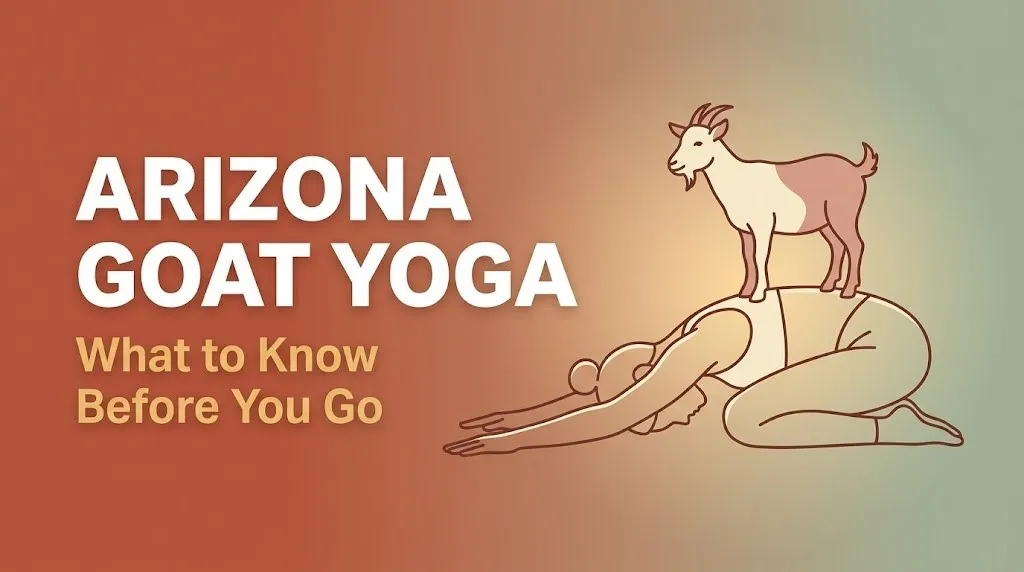
The yoga itself is typically taught in a Hatha or gentle Vinyasa format. The instructor leads a standard sequence of accessible poses. The goats are not trained to perform tricks. They simply wander, climb, nuzzle, and occasionally stand on a practitioner’s back during Balasana (Child’s Pose) or Adho Mukha Svanasana (Downward-Facing Dog).
That unpredictability is intentional. It loosens the self-seriousness that many beginners associate with yoga. The laughter that comes from a goat walking across your mat or nibbling your hair is a natural stress-release mechanism. Researchers at the University of California study laughter’s effect on the hypothalamic-pituitary-adrenal (HPA) axis, the system that regulates cortisol production, and have documented reductions in stress hormone output following genuine laughter episodes.
| Class Feature | Typical Details |
|---|---|
| Duration | 45 to 60 minutes |
| Class format | Hatha or gentle Vinyasa |
| Group size | 10 to 30 participants |
| Setting | Outdoor farm or ranch |
| Animal type | Nigerian dwarf or pygmy goats |
| Skill level required | None. Beginners welcome. |
What Is Goat Yoga: The Origin and Concept Explained
Goat yoga was first offered as a named practice by Lainey Morse at her farm in Oregon in 2016. The idea spread nationally within months after media coverage and social sharing brought the format to widespread attention.
The concept is straightforward. An established yoga teacher leads a class on an outdoor surface, usually grass or a flat outdoor area. Farm goats are let into the class area at the start of the session. What happens next is organic. Goats are curious, social animals. They investigate the practitioners, climb onto backs in lower positions, and respond to sounds and movement.
The yoga class itself follows the same structural logic as any beginner Hatha class. There is a warm-up, a sequence of standing and floor-based poses, and a closing relaxation in Savasana (Corpse Pose). The difference is that the environment is unpredictable, outdoor, sensory-rich, and inherently playful.
Goat yoga sits at the intersection of animal-assisted activity and structured physical exercise. It is not a clinical therapy format. It is a wellness-forward experience designed to make yoga accessible to people who would never walk into a traditional studio.
What to Know About the Format:
- No prior yoga experience is required at any session
- The goats are socialized and accustomed to human contact
- Sessions are held rain-permitting; Arizona providers often schedule early morning to avoid summer heat
- Most providers cap class size to keep the experience manageable for the animals and practitioners
Goat Yoga Arizona Locations: Where Classes Are Offered
Goat yoga in Arizona is offered primarily across the greater Phoenix metropolitan area, including the East Valley communities of Mesa, Chandler, Gilbert, and Queen Creek, and in North Scottsdale and the West Valley.
Several independent farms and event companies operate sessions throughout the year. Arizona’s climate creates an important timing factor: most quality providers schedule sessions in the early morning (typically 7:00 to 9:00 AM) between October and April to avoid extreme heat. Summer sessions are rare because outdoor yoga in 105-degree temperatures is not safe or comfortable for practitioners or animals.
When searching for an Arizona goat yoga location, check whether the provider is operating their own farm or renting an animal handler’s space. Farms that own and care for the animals year-round tend to offer better animal-welfare practices and more consistent animal socialization, which directly affects how relaxed and interactive the goats are during class.
Arizona Location Search Tips:
- Search by proximity to your zip code plus “goat yoga” for the most current active providers
- Prioritize providers who list the specific breed of goat (Nigerian dwarf and pygmy goats are the gentlest)
- Check whether sessions are held on a shaded property or exposed field, especially for warmer months
- Verify that the yoga instructor holds a current Yoga Alliance registration or equivalent certification
- Read recent reviews specifically for session timing, animal behavior, and class quality, not just overall star rating
Goat Yoga Scottsdale: What the North Valley Options Offer
Goat yoga in Scottsdale and the North Phoenix corridor tends to operate on private ranch land and boutique farm properties that align with the area’s wellness-focused culture. Several mobile goat yoga operators also bring their animals to private events and corporate campuses in North Scottsdale.
Scottsdale’s yoga community is well-established. Many goat yoga providers in this area source their instructors from studios already operating in the Old Town Scottsdale or North Scottsdale wellness districts, which means you are more likely to encounter a properly credentialed teacher rather than an untrained event host.
Sessions in this area often carry a slightly higher price point than East Valley providers, reflecting the higher operating costs of North Scottsdale venues. The trade-off is typically better event organization, smaller class sizes, and more curated experiences. Bachelorette parties and private wellness events are particularly common in this corridor.
Quick Summary for Scottsdale Seekers:
- Expect sessions priced between $25 and $50 per person for standard group classes
- Private event pricing is typically quoted by total group size, not per person
- Most Scottsdale-area providers offer weekend morning sessions between October and May
- Confirm the instructor’s credentials and the farm’s animal care practices before booking
Key Takeaway: Arizona goat yoga happens on real farms with real yoga instruction, and the Phoenix metro area offers options across Scottsdale, Phoenix, Mesa, and beyond, with the best sessions running in early morning from fall through spring.
Goat Yoga Phoenix: Finding Classes in the Core Metro Area
Goat yoga in Phoenix proper and the surrounding inner metro area is available through both permanent farm operations and mobile event providers who bring goats to parks, corporate campuses, and private properties.
Phoenix’s urban farm movement has grown steadily since 2020, and several of those operations have added goat yoga programming as a community engagement offering. Urban farm goat yoga classes tend to be more casual in format, with smaller herds and a community garden setting rather than a wide-open ranch environment.
For families and individuals looking for the most accessible option, Phoenix-area sessions are often easier to reach than farm properties in the outer East Valley or Queen Creek area. Transportation time matters in the Phoenix metro: a 40-minute drive to a goat yoga farm in an outlying area should be factored into your session planning.
The American College of Sports Medicine notes that outdoor physical activity delivers additional benefits compared to indoor exercise, including improved mood outcomes related to natural light exposure and reduced perceived exertion in natural settings. Outdoor yoga on a farm property offers those same benefits on top of the yoga and animal interaction effects.
Goat Yoga Mesa AZ: East Valley Sessions and Farm Access
Goat yoga near Mesa, Arizona operates across the broader East Valley corridor, which includes Gilbert, Chandler, Queen Creek, and San Tan Valley. This region has the highest concentration of hobby farms and goat-raising properties in the greater Phoenix area, making it the most active zone for farm-based goat yoga in Arizona.
Queen Creek and San Tan Valley, which sit at the southeastern edge of the metro area, are home to several working farms that offer goat yoga as part of agritourism programming. These locations often combine goat yoga with farm tours, animal feeding, and other outdoor experiences, making them a popular choice for families.
Mesa-based searchers should also check Gilbert and Chandler for providers, since these cities border Mesa and several farm yoga operators market to the entire East Valley region without distinguishing between city boundaries.
East Valley Goat Yoga Planning Notes:
- Sessions in Queen Creek and San Tan Valley require a 30 to 50 minute drive from central Mesa
- Many East Valley providers offer combined farm experience packages with goat yoga as the centerpiece
- Early spring (February through April) offers the best conditions: mild temperatures, green farm scenery
- Bring water for yourself; Arizona mornings warm up faster than expected even in cooler months
Key Takeaway: The East Valley, specifically Queen Creek, San Tan Valley, and Gilbert, has the greatest concentration of farm-based goat yoga operations in the Phoenix metro area, making it the best starting point for Mesa-area searchers.
Goat Yoga for Beginners: Is It the Right Starting Point?
Goat yoga is one of the best possible entry points into yoga for complete beginners because the playful environment removes the self-consciousness that stops many people from trying a traditional studio class.
In a standard Hatha or beginner yoga class, some practitioners feel anxious about doing poses incorrectly, not being flexible enough, or being the least experienced person in the room. Goat yoga dissolves that pressure immediately. When a goat decides to sit on someone’s back, every person in the class laughs. That collective ease changes the psychological experience of learning new physical movements.
From a physical standpoint, goat yoga classes are designed around accessible, foundational poses. Instructors typically include Tadasana (Mountain Pose), Marjaryasana-Bitilasana (Cat-Cow Pose), Virabhadrasana I (Warrior I), Balasana (Child’s Pose), and Adho Mukha Svanasana (Downward-Facing Dog). These poses are appropriate for most adults regardless of flexibility or prior experience.
Modification Notes for Beginners:
- Use a thicker yoga mat or double up mats for cushioning on outdoor surfaces
- Balasana (Child’s Pose) can be modified by placing a folded blanket behind the knees if knee flexion is limited
- Adho Mukha Svanasana (Downward-Facing Dog) can be practiced with bent knees for anyone with tight hamstrings
- If a goat approaches during a pose and causes balance concern, simply lower to the ground and reset
- Practitioners with wrist conditions should inform the instructor before class for seated or fist-grip modifications
What to Expect at Goat Yoga: A Session Walk-Through
A goat yoga session typically begins with check-in, mat placement, and a brief introduction from the instructor covering the format, the animals, and any session-specific guidelines. That orientation usually takes five to ten minutes.
The yoga class itself follows a standard beginner-friendly sequence. Most instructors open with seated breath awareness, move into a gentle warm-up on hands and knees, progress through standing poses, and return to the floor for closing stretches before Savasana (Corpse Pose). The goats are free to roam throughout.
Expect noise, laughter, and spontaneous interruptions. A goat may step onto your mat, chew your water bottle strap, or stand on your lower back during Balasana. The weight of a small Nigerian dwarf goat (typically 20 to 30 pounds) is not harmful on a healthy adult’s back in a supported floor position, but if any contact feels uncomfortable, the practitioner is always free to shift position or signal for the animal to be redirected.
What a Typical Session Includes:
- Check-in and mat setup (5 to 10 minutes)
- Instructor introduction and session guidelines (5 minutes)
- Seated breath awareness and warm-up (8 to 10 minutes)
- Standing pose sequence with goats roaming (20 to 25 minutes)
- Floor-based poses including Balasana and Setu Bandha Sarvangasana (Bridge Pose) (10 minutes)
- Savasana with goat interaction (5 to 10 minutes)
- Goat socializing and photo time after class (10 to 15 minutes)
Goat Yoga Benefits: What the Practice Does for Your Body and Mind
Goat yoga delivers measurable benefits through two overlapping mechanisms: the physical practice of yoga itself and the physiological response to positive human-animal interaction.
The NCCIH has documented that regular yoga practice is associated with reductions in perceived stress, improvements in mood, lower resting heart rate, and better sleep quality across multiple study populations. These benefits occur even in short, single-session exposures, particularly for people who are new to yoga and respond strongly to their first experience of intentional movement and breath.
On the animal interaction side, research published in Anthrozoös, the peer-reviewed journal of human-animal studies, has found that tactile contact with gentle animals, including petting and proximity, triggers measurable increases in oxytocin (a hormone associated with social bonding and calm) and corresponding decreases in cortisol. This response occurs within minutes of contact.
The combination of breath-regulated movement, outdoor natural environment, and animal-triggered oxytocin release creates a physiological state that is meaningfully different from either yoga alone or animal interaction alone.
Documented Benefits at a Glance:
- Reduced cortisol (stress hormone) through animal contact
- Increased oxytocin from tactile animal interaction
- Improved mood through outdoor physical exercise and sunlight exposure
- Reduced physical tension through yoga movement and stretching
- Social connection through group class environment
- Lower perceived exercise intensity due to playful distraction
Key Takeaway: Goat yoga is not just a novelty experience. The combination of outdoor yoga movement, breath awareness, and animal contact creates overlapping physiological stress-reduction effects that are supported by research in both yoga science and human-animal interaction studies.
Goat Yoga for Stress Relief and Anxiety: What the Research Shows
Goat yoga is particularly well-matched for people managing everyday stress, mild anxiety, or nervous system overactivation, because it targets the stress response through three simultaneous pathways.
First, yoga’s regulated breathwork activates the parasympathetic nervous system, shifting the body away from the sympathetic “fight or flight” state. The Journal of Alternative and Complementary Medicine has published multiple studies showing that slow, diaphragmatic breathing reduces heart rate and subjective anxiety ratings within a single session.
Second, animal contact independently reduces cortisol. A widely cited study from Washington State University found that just ten minutes of petting a cat or dog lowered cortisol levels in students measurably. While goats are not domestic pets, they are tactile, social animals, and the physiological response to gentle animal contact is consistent across species in the human-animal interaction literature.
Third, the laughter and social connection inherent in a group goat yoga class activates additional positive neurochemical pathways. Research from the Harvard T.H. Chan School of Public Health has linked social belonging and shared positive experiences to lower inflammatory markers and better mental health outcomes.
For people whose anxiety makes a traditional studio feel intimidating, goat yoga’s informal atmosphere reduces the social threat perception that keeps many beginners away from yoga entirely.
Safety Note: Individuals with severe animal allergies should check with the provider about the specific animals and outdoor setting before attending. Those with phobias related to animals should assess their comfort level honestly; the goats are friendly but they do make contact.
Goat Yoga Poses with Goats: What Actually Happens on the Mat
The poses practiced in a goat yoga class are the same foundational poses used in any beginner Hatha session. The difference is that a goat might be standing on your back while you hold them.
Balasana (Child’s Pose) is the most famous goat yoga moment. In this pose, the practitioner kneels and folds forward with arms extended or resting alongside the body. The flat back surface invites goats to climb on. A well-socialized Nigerian dwarf goat weighing 20 to 30 pounds on a healthy adult’s lower back during a supported floor pose is generally well-tolerated. Practitioners with acute lumbar disc issues or spinal osteoporosis should avoid this pose or practice a modified version with hips elevated on a block.
Adho Mukha Svanasana (Downward-Facing Dog) creates an inverted V shape with the body. Goats are attracted to the height of the hips in this position. Some will attempt to stand at the base of the pose. It is worth knowing your wrist tolerance before holding this position for an extended period with added movement from a curious animal nearby.
Common Goat Yoga Poses and What to Watch:
| Pose (Sanskrit) | Pose (English) | Goat Interaction Pattern | Modification Note |
|---|---|---|---|
| Balasana | Child’s Pose | Goats climb onto back | Elevate hips on a block if knee flexion is limited |
| Adho Mukha Svanasana | Downward-Facing Dog | Goats gather near hips | Bend knees if hamstrings are tight; avoid with wrist injury |
| Marjaryasana-Bitilasana | Cat-Cow Pose | Goats investigate nearby | Reduce spinal range of motion with disc conditions |
| Virabhadrasana I | Warrior I | Goats walk past or through legs | Use a shorter stance if hip flexors are tight |
| Savasana | Corpse Pose | Goats may step on or near the body | Bring a light cover if tactile contact feels uncomfortable |
What to Wear to Goat Yoga in Arizona
For goat yoga in Arizona, wear form-fitting, breathable athletic clothing in a color or pattern you do not mind getting dirty, because goat hooves carry farm debris and goat contact occasionally leaves marks on light-colored fabric.
The same fabric principles that apply to any outdoor yoga class apply here: moisture-wicking synthetic blends (nylon or polyester with spandex) handle sweat efficiently in Arizona’s morning warmth. High-waisted leggings stay in place when a goat steps onto your back. Avoid loose, flowing tops that can be investigated or chewed by curious animals.
Arizona’s outdoor mornings require layering consideration. Between October and March, early morning temperatures in the Phoenix area can sit between 45 and 65 degrees Fahrenheit at session start time, warming to 70 or above by class end. Start with a light long-sleeve base layer you can remove after the warm-up sequence.
What to Wear and Bring:
- High-rise fitted leggings (dark colors are practical for farm environments)
- Fitted tank top or moisture-wicking short-sleeve shirt
- A light zip-up or long-sleeve layer for the opening portion of class
- Closed-toe shoes or sandals for the walk from your car to the mat area
- Your own yoga mat with a mat strap or bag
- A water bottle with a secure cap (goats investigate open containers)
- Sunscreen applied before arrival (not during class)
- A hair tie if your hair is chin length or longer
Key Takeaway: Goat yoga classes use the same foundational poses as any beginner yoga session, and the main preparation difference is choosing dark, form-fitting clothing you can wash afterward and bringing a water bottle with a closed lid.
Goat Yoga for Kids in Arizona: Age Guidelines and Family Sessions
Goat yoga is genuinely suitable for children, and many Arizona providers specifically offer family-friendly sessions with age-appropriate sequencing. Kids typically respond to the animals with immediate delight, which makes it an effective first introduction to yoga movement for young people.
Most providers recommend a minimum age of five or six for structured goat yoga classes. Children under five may find the 45-minute format too long, and very young children may be startled by the unpredictable animal movement. Many providers offer shorter family sessions (30 to 40 minutes) designed specifically with younger participants in mind.
From a developmental standpoint, yoga movement for children supports proprioceptive development, which is the body’s sense of its own position in space. Research published in the International Journal of Yoga has found that regular yoga participation in school-age children is associated with improved attention regulation and reduced anxiety behaviors. Adding the animal interaction layer makes the experience feel like play rather than exercise.
Family Session Tips:
- Choose providers who specify child-friendly or family session formats
- Bring a small blanket for young children to sit on during longer pose holds
- Let children lead their own interaction with the goats rather than directing them
- Sunscreen and hats are essential for Arizona outdoor morning sessions with kids
- Sessions before 8:00 AM are ideal for family comfort in warmer months
Goat Yoga Bachelorette and Group Events in Arizona
Goat yoga has become one of the most requested activity formats for bachelorette parties, bridal showers, birthday celebrations, and women’s wellness retreats in Arizona. The format works because it requires no athletic skill, generates natural shared laughter, and produces great photos.
Most Arizona goat yoga providers offer private group bookings separate from their public session calendar. Private sessions typically accommodate groups of ten to forty people, include dedicated animal time before or after the yoga class, and can sometimes be combined with add-ons like mimosa service, farm tours, or catered picnic setups.
For bachelorette groups specifically, morning sessions work best because Arizona afternoons become too warm for outdoor yoga for most of the year. A 7:00 or 8:00 AM session followed by brunch is the most practical format for celebratory group bookings.
Group Event Planning Guide:
| Group Type | Ideal Session Format | Best Booking Timing |
|---|---|---|
| Bachelorette party | Private 60-minute session plus photo time | Book 4 to 8 weeks in advance |
| Birthday group | Semi-private or full buyout | Book 2 to 4 weeks in advance |
| Girls’ trip / wellness day | Public session or private session | Book 2 to 3 weeks in advance |
| Corporate wellness group | Private session at company venue or farm | Book 6 to 8 weeks in advance |
| Family reunion | Family-friendly format with shorter duration | Book 4 to 6 weeks in advance |
Goat Yoga vs Regular Yoga: How the Practices Actually Compare
Goat yoga and a standard yoga class share the same physical poses, the same breath-based structure, and the same foundational goals of stress reduction and body awareness. The differences lie in environment, pacing, and psychological context.
In a traditional Hatha or Vinyasa studio class, the environment is controlled and quiet. The instructor’s cues, your breath, and the internal experience of the pose are the entire focus. That level of internal attention is what deepens a regular practice over time. It builds body awareness, improves postural patterns, and develops breath capacity in ways that a distraction-rich environment cannot fully replicate.
Goat yoga trades that internal depth for external accessibility. The unpredictability and humor make it easier for beginners and people with yoga anxiety to get onto a mat for the first time. Think of it like learning to swim in a lake versus a lap pool. The lake is more fun and less intimidating. The lap pool builds better stroke mechanics. Both involve swimming.
| Feature | Goat Yoga | Traditional Yoga Class |
|---|---|---|
| Skill level needed | None | Beginner to advanced |
| Internal focus | Low to moderate | Moderate to high |
| Environment | Outdoor, unpredictable | Indoor, controlled |
| Beginner accessibility | Very high | Moderate |
| Depth of practice | Introductory | Introductory to advanced |
| Stress reduction | Yes (dual pathway) | Yes (single pathway) |
| Social experience | Group, playful | Group or individual |
How Much Does Goat Yoga Cost in Arizona
Goat yoga in Arizona typically costs between $20 and $55 per person for a standard group session. Private event pricing varies by group size and provider.
Public sessions in the East Valley farm corridor tend to sit at the lower end of that range ($20 to $35 per person). Scottsdale and North Phoenix providers generally charge $35 to $55 per person, reflecting higher venue operating costs. Private group bookings are typically priced per group rather than per person, with most providers quoting a flat rate for groups of ten to thirty participants.
Several providers offer multi-session packages or seasonal memberships at a reduced per-class rate. These are worth exploring if you plan to attend more than two or three sessions, as the savings are generally 20 to 30 percent per session compared to walk-in pricing.
Pricing Overview for 2026:
| Session Type | Typical Price Range | Notes |
|---|---|---|
| Public group class | $20 to $55 per person | Varies by location and provider |
| Private bachelorette or birthday | $300 to $800 flat rate | Based on group size, add-ons |
| Corporate or team event | $400 to $1,200 flat rate | Depends on group size, travel |
| Multi-session package | 20 to 30% savings vs single class | Where offered by provider |
| Family / kids session | $15 to $35 per person | Shorter format, lower price |
Key Takeaway: Goat yoga in Arizona is genuinely comparable to a standard yoga studio drop-in class in cost, making it an accessible option rather than a luxury splurge, especially for the East Valley farm-based providers.
Best Goat Yoga in Arizona: What Separates a Quality Session from a Poor One
The best goat yoga in Arizona comes from providers who combine a credentialed yoga instructor with well-socialized animals, an appropriate outdoor venue, and clear session management. Those three elements are what separate a genuinely good experience from a chaotic or disappointing one.
Yoga instruction quality is the element most often overlooked when booking. A properly credentialed instructor (registered with Yoga Alliance at the RYT-200 level or above) knows how to sequence poses safely, offer modifications for different bodies, and maintain class pacing even in an unpredictable outdoor environment. An untrained event host who happens to be surrounded by goats is not the same thing.
Animal welfare and socialization matter directly to your experience. Goats that are calm, accustomed to human contact, and handled ethically by farm staff will approach you gently and interact in the friendly way that makes goat yoga memorable. Overstimulated, poorly socialized, or recently weaned baby goats can be nippy or skittish, which changes the experience significantly.
What Makes a Quality Session:
- Yoga instructor holds current Yoga Alliance RYT-200 certification or equivalent
- Animals are specifically described as socialized and accustomed to class environments
- Session size is capped (20 to 30 participants maximum for an enjoyable experience)
- The venue provides shade, clean outdoor surface, and adequate space per mat
- The provider communicates clearly about weather contingency plans for Arizona heat
- Recent reviews specifically mention instructor quality, not only animal cuteness
Goat Yoga Team Building in Arizona: Corporate Wellness Applications
Goat yoga has become a requested format for corporate wellness programming in Arizona, particularly among companies looking for team-building activities that are accessible to all fitness levels and produce genuine connection rather than forced competition.
Unlike traditional team-building exercises, goat yoga creates shared vulnerability in a physical experience where everyone is equally new, equally amused, and equally likely to have a goat sit on their head. That shared experience is a social equalizer that crosses seniority levels and departmental divides in a way that few office activities can replicate.
The NCCIH has documented that workplace wellness programs incorporating mind-body practices are associated with reduced employee burnout scores and lower reported levels of occupational stress. Adding the animal interaction layer may amplify those outcomes based on the cortisol-reduction research associated with brief animal contact.
Most Arizona goat yoga providers with mobile capabilities can bring their animals to corporate campuses, hotel event spaces, or open outdoor venues. This removes the logistics barrier of getting an entire team to a farm location.
Corporate Session Considerations:
- Book a provider with liability insurance and animal-handling certifications
- Choose a morning time slot between 7:00 and 10:00 AM for year-round comfort
- A flat outdoor surface (grass, turf, or packed gravel) works best for mat placement
- Consider a private post-yoga goat interaction period as a dedicated networking space
- Request the instructor’s credentials and the provider’s animal care documentation before contracting
Frequently Asked Questions About Arizona Goat Yoga
What exactly happens at a goat yoga class in Arizona?
A goat yoga class in Arizona is a 45 to 60 minute outdoor yoga session where small farm goats roam freely among participants while a certified instructor leads beginner-friendly poses.
The goats are socialized and approach practitioners voluntarily, often climbing onto backs during floor poses like Balasana (Child’s Pose).
Most sessions end with ten to fifteen minutes of dedicated goat socializing and photos after the yoga class concludes.
Is goat yoga good for beginners with no yoga experience?
Yes, goat yoga is ideal for complete beginners because the playful atmosphere removes the self-consciousness that often keeps new practitioners out of traditional studio classes.
Instructors use foundational, accessible poses with modifications available for any fitness or flexibility level.
No prior yoga experience is required, and most providers specifically market their sessions to first-timers and casual participants.
What should I wear to goat yoga in Arizona?
Wear form-fitting, moisture-wicking athletic clothing in a dark color you do not mind getting dirty from farm contact.
High-rise leggings and a fitted tank top or short-sleeve shirt work best, paired with a light removable layer for Arizona’s cool early morning temperatures.
Bring a water bottle with a secure lid, your own yoga mat, and sunscreen applied before you arrive.
Are there goat yoga classes near Scottsdale or Phoenix?
Goat yoga sessions operate throughout the greater Phoenix metro area, including providers in North Scottsdale, the East Valley, and mobile operators who bring animals to urban venues.
The highest concentration of farm-based sessions is in the Queen Creek, San Tan Valley, and Gilbert area, which sits 30 to 50 minutes from central Phoenix.
Search for current providers by location and check that sessions are scheduled in early morning hours for comfort, especially outside of Arizona’s cooler winter months.
Is goat yoga actually good for you, or is it just for fun?
Goat yoga delivers measurable wellness benefits through overlapping mechanisms: yoga’s breath-regulated movement activates the parasympathetic nervous system, while animal contact measurably reduces cortisol and increases oxytocin.
Research published in Anthrozoös and supported by the NCCIH’s documentation of yoga’s stress-reduction effects confirms that both pathways work independently and simultaneously.
It is both genuinely fun and genuinely good for you, which is not a combination that comes along often in fitness programming.
Getting on the Mat with a Goat: Your Next Step
Goat yoga in Arizona is worth trying at least once, and for many beginners it becomes the experience that makes yoga feel approachable for the first time. The combination of fresh air, movement, and animal contact does something a studio class cannot replicate.
Book an early morning session between October and April for the most comfortable Arizona conditions. Bring your own mat, wear dark fitted clothing, apply sunscreen before you leave the house, and show up with no expectations beyond moving your body and laughing more than you planned to.
If you enjoy the experience, use it as a bridge to a regular Hatha or Vinyasa practice. The poses you learn in a goat yoga session are the same foundational shapes you will practice for years.