Home Yoga: How to Start and Stick With It in 2026
A home yoga practice is one of the most accessible and research-supported ways to improve flexibility, reduce stress, and build a sustainable movement habit without leaving your living room. You do not need a studio membership, expensive equipment, or years of experience to get real results on a mat at home.
According to the National Center for Complementary and Integrative Health (NCCIH), yoga is one of the most widely used complementary health approaches in the United States, with an estimated 21 million adults practicing regularly. The shift toward home-based practice has accelerated, and research consistently shows that frequency and consistency matter far more than class format or studio attendance.
This guide covers how to set up your space, choose the right yoga style, build beginner routines for morning and evening, adapt practice for specific needs like back pain or senior mobility, and maintain consistency long enough to actually feel the difference. Everything here is practical, specific, and grounded in what the research actually says.
What Is a Home Yoga Practice
A home yoga practice is any structured, self-directed yoga session completed in a private space without a live instructor physically present. It draws on the same foundational elements as a studio class: physical postures (asana), breathwork (pranayama), and a period of rest or integration at the end.
What distinguishes a home practice is the absence of real-time correction and the need for the practitioner to self-regulate pace, alignment, and duration. This is both the challenge and the freedom of practicing at home. You set the schedule, choose the style, and decide how long to hold each pose.
Home practice spans the full range of yoga traditions. A morning session of Hatha yoga with slow holds is structurally different from a Vinyasa yoga flow or a Yin yoga session focused on connective tissue release. Knowing which style you are practicing, and why, shapes every decision from how to warm up to how long to hold each shape.
According to Yoga Alliance, the largest yoga credentialing organization in the United States, home practice has become a primary format for the majority of active yoga practitioners, not a secondary supplement to studio attendance. That shift matters because it means more people need clear, honest guidance on how to practice effectively without a teacher in the room.
Home yoga is not inferior to studio yoga. It is different. And for many people, including those with tight schedules, limited budgets, or health conditions requiring a gentler pace, it is the better fit.
How to Start Yoga at Home
Starting yoga at home requires three decisions made in order: choose a style that matches your current physical capacity, gather the minimum equipment needed to practice safely, and commit to a specific time slot before doing anything else.
Most people skip the third step and then wonder why they never get on the mat. The research on habit formation is consistent: behavioral scientists at institutions including Harvard T.H. Chan School of Public Health have found that anchoring a new behavior to an existing routine (“habit stacking”) dramatically increases follow-through. Deciding to practice yoga after your morning coffee, before your evening shower, or right after your lunch break works because the habit cue already exists.
Steps to start your home yoga practice:
- Choose your starting style: Hatha yoga for slow, held poses; Vinyasa yoga for breath-linked movement; Yin yoga for long-held floor poses targeting connective tissue; Restorative yoga for supported, passive rest.
- Clear a space at least 6 feet long and 3 feet wide, enough for a yoga mat with arm extension room.
- Gather your minimum equipment: a non-slip yoga mat and two firm books or yoga blocks.
- Select a consistent time: morning, midday, or evening, and put it in your calendar like any other appointment.
- Start with 20 minutes per session, three times per week. Not five days. Not 60 minutes. Three sessions at 20 minutes builds the habit without overwhelming your schedule.
- Follow a written sequence or guided audio for the first four to six weeks before improvising.
Modification for complete beginners: If 20 minutes feels like too much in week one, start with 10 minutes. A short consistent practice always outperforms a long inconsistent one.
Home Yoga Setup and Space
A functional home yoga space requires a minimum floor area of 6 feet by 4 feet, good ventilation, and a surface that allows a non-slip yoga mat to lie flat without bunching. You do not need a dedicated yoga room. You need a cleared, consistent space.
The floor surface matters more than most beginners realize. Carpet creates instability in standing poses because the mat grips unevenly. Hardwood or tile floors are ideal. If carpet is your only option, use a thicker, heavier mat (at least 5mm) or place a rubber mat under your yoga mat for additional grip.
Lighting and temperature affect your practice more than you might expect. Natural light or warm-toned artificial light supports the parasympathetic nervous system response that makes yoga calming. Harsh overhead fluorescents do the opposite. For evening sessions, dimmer lighting signals to the nervous system that it is time to wind down. Aim for a room temperature between 68 and 72 degrees Fahrenheit for most practice styles; cooler for vigorous flows, warmer for restorative or Yin sessions.
Home yoga space checklist:
- Floor area: minimum 6 feet by 4 feet, ideally on hardwood or tile
- Mat: non-slip, at least 4mm thick (5 to 6mm for joint-sensitive practitioners)
- Lighting: warm-toned or natural; dimmable for evening sessions
- Temperature: 68 to 72 degrees for most styles
- Sound: minimize disruption; use a white noise machine or close the door
- Props within reach: blocks, blanket, and strap accessible without leaving the mat
- Phone: silenced and face-down, or in another room
Small space modification: In spaces under 6 feet long, chair-based yoga or a wall-supported practice works well. Many Iyengar yoga techniques use the wall as a primary prop, and the full range of upper and lower body work is accessible in a space no larger than a standard closet footprint.
Key Takeaway: You do not need a perfect space to start a home yoga practice. You need a cleared 6-by-4-foot area, a non-slip mat, and a consistent time slot. Everything else is optional until you know you will actually use it.
Home Yoga Props and Equipment
Home yoga props are not luxury items. They are the tools that allow you to practice with correct alignment, adequate support, and appropriate depth for your body’s current range of motion.
The minimum effective home yoga kit contains three items:
- A yoga mat: non-slip, 4 to 6mm thick, at least 68 inches long (72 inches for taller practitioners)
- Two yoga blocks: cork blocks are more stable than foam for standing poses; foam blocks are lighter and easier to reposition in floor work
- A yoga strap or long belt: used to bridge the distance between hands and feet in hamstring stretches and shoulder-opening poses
Beyond the minimum, the most useful additions are:
| Prop | Primary Use | Who Needs It Most |
|---|---|---|
| Yoga bolster | Restorative and Yin poses, chest support | People doing restorative yoga, those with back pain |
| Yoga blanket (firm) | Knee padding, head support, warmth in Savasana | Seniors, people with joint sensitivity |
| Yoga strap | Hamstring stretches, shoulder openers | Beginners, people with limited flexibility |
| Cork yoga blocks (x2) | Height support in standing and seated poses | All levels; particularly useful for tight hamstrings |
| Eye pillow | Blocking light in Savasana, oculocardiac pressure | Anyone using yoga for stress or sleep |
| Yoga wheel | Backbend support, thoracic spine mobilization | Intermediate practitioners adding backbend work |
No-equipment modification: A firm bed pillow substitutes for a bolster. Hardback books replace yoga blocks. A bathrobe belt or necktie replaces a strap. These substitutes are imperfect but functional for starting out. Invest in actual props once you know you’ll practice consistently.
According to the American College of Sports Medicine, using props to support correct alignment in yoga reduces the rate of yoga-related musculoskeletal strain, particularly in the lower back, knees, and wrists.
Best Yoga Style for Home Practice
The best yoga style for home practice is the one that matches your current physical capacity, your available session time, and the primary outcome you are looking for, whether that is stress relief, flexibility, strength, or recovery.
Different styles demand very different things from a home practitioner in terms of prior knowledge, space, and self-correction ability.
| Style | Pace | Session Length | Best For | Difficulty Without a Teacher |
|---|---|---|---|---|
| Hatha yoga | Slow | 30 to 60 min | Beginners, foundational alignment | Low: slow pace allows self-correction |
| Vinyasa yoga | Moderate to fast | 30 to 60 min | Fitness, strength, flow | Moderate: pace requires body awareness |
| Yin yoga | Very slow | 30 to 75 min | Flexibility, stress, sleep | Low: poses are passive and held long |
| Restorative yoga | Very slow | 30 to 60 min | Recovery, anxiety, chronic illness | Very low: fully supported positions |
| Ashtanga yoga | Fast, structured | 60 to 90 min | Experienced practitioners | High: fixed sequence requires prior learning |
| Kundalini yoga | Varies | 30 to 90 min | Breathwork, meditation focus | Moderate: specific kriyas require instruction |
For most beginners practicing at home, Hatha yoga is the recommended starting point. The slower pace allows time for self-correction. Poses are held long enough to feel alignment without rushing. The style’s emphasis on breath awareness builds the interoceptive habits that make every other yoga style safer over time.
Yin yoga is the second strongest recommendation for home practice, particularly for practitioners whose primary goals are stress reduction and flexibility. Long-held floor poses with minimal complexity make self-directed practice straightforward and low-risk.
Home Yoga Routine for Beginners
A beginner home yoga routine is a structured sequence of six to eight poses held for 5 to 8 breath cycles each, totaling 20 to 30 minutes, practiced at a pace that allows you to maintain breath awareness throughout every shape.
The sequencing logic matters. Moving from standing to kneeling to lying down mirrors the natural cooling of the nervous system and prevents the disorientation that comes from randomly moving between floor and standing work.
Beginner Home Yoga Routine (25 minutes):
- Tadasana (Mountain Pose), 1 minute: Stand with feet hip-width apart. Distribute weight evenly. Close your eyes and take five slow breaths. Notice where you are holding tension.
- Adho Mukha Svanasana (Downward-Facing Dog), 5 to 8 breaths: From hands and knees, tuck toes and lift hips. Press the floor away with your hands. Bend knees generously if hamstrings are tight.
- Uttanasana (Standing Forward Bend), 5 breaths: Walk feet forward from Downward Dog. Hang the torso heavy. Hold opposite elbows or place hands on blocks if the floor is far away.
- Setu Bandha Sarvangasana (Bridge Pose), 5 breaths: Lie on your back. Feet flat, hip-width apart. Press through the feet to lift the hips. Clasp hands beneath the back or rest arms flat.
- Supta Matsyendrasana (Supine Spinal Twist), 5 breaths each side: From lying on your back, draw one knee across the body. Extend the same-side arm wide. Look away from the bent knee. Switch sides.
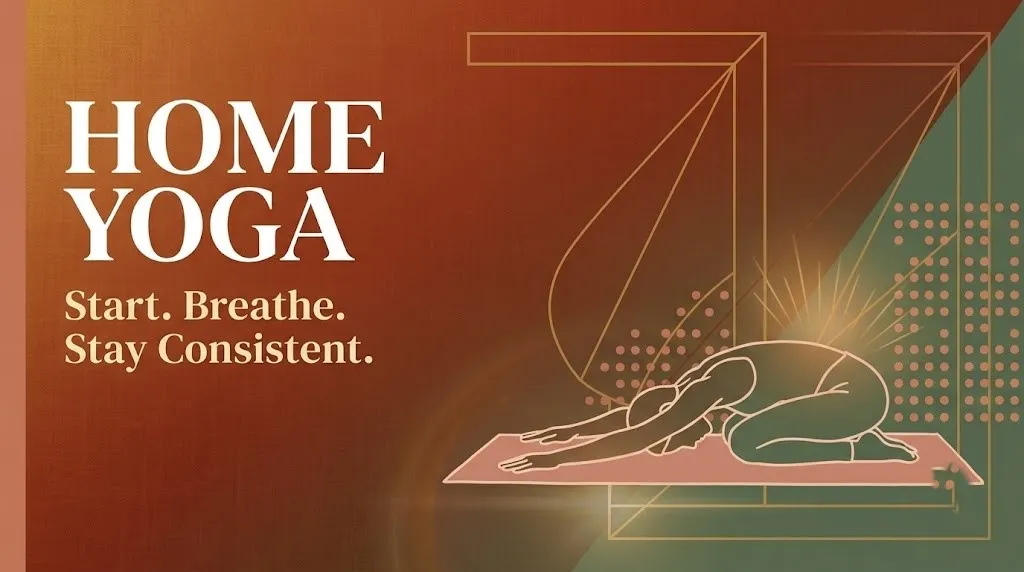
- Balasana (Child’s Pose), 1 to 2 minutes: Kneel and fold forward, arms extended or resting alongside the body. Breathe into the lower back.
- Savasana (Corpse Pose), 5 minutes: Lie flat. Let go of deliberate breath control. Rest completely.
Modification for wrist sensitivity: In Adho Mukha Svanasana (Downward-Facing Dog), place fists on the mat rather than flat palms to reduce wrist extension load. Alternatively, use yoga wedges under the heels of the hands.
Key Takeaway: A beginner home yoga routine does not need to be long to be effective. Six to eight poses, held with conscious breath, practiced three times per week, builds a stronger foundation than an occasional 60-minute session done inconsistently.
Morning Home Yoga Sequence
A morning home yoga sequence works best when it moves from gentle activation to moderate engagement, waking the body without shocking joints and muscles that have been still for six to eight hours overnight.
Think of your body in the morning like a cold engine. The oil needs a few minutes to circulate before you demand full performance. Morning stiffness is not a sign of poor fitness; it is a normal effect of overnight fluid redistribution in the joints and reduced muscle temperature. A proper warm-up changes everything about how morning practice feels.
Morning Home Yoga Sequence (30 minutes):
- Tadasana (Mountain Pose), 2 minutes: Slow breath awareness before any movement.
- Marjaryasana/Bitilasana (Cat/Cow Pose), 8 rounds: On hands and knees, alternate spinal flexion and extension with each breath. Warms the entire spine gently.
- Adho Mukha Svanasana (Downward-Facing Dog), 5 breaths: Pedal heels alternately to wake the calves and hamstrings.
- Anjaneyasana (Low Lunge), 5 breaths each side: Stretches the hip flexors, which shorten during sleep.
- Utkatasana (Chair Pose), 5 breaths: Builds lower body heat and wakes the quads and glutes.
- Parivrtta Utkatasana (Revolved Chair Pose), 3 breaths each side: Adds thoracic rotation to the morning sequence.
- Uttanasana (Standing Forward Bend), 5 breaths: Releases the posterior chain.
- Savasana (Corpse Pose), 3 minutes: Brief integration before the day begins.
According to a 2020 study published in the International Journal of Yoga, morning yoga practice was associated with lower perceived stress and improved mood scores throughout the subsequent day compared to no-practice control groups.
Modification for morning stiffness: In the first five minutes, keep all movements slow and exploratory. Do not push into any stretch before the body signals it is warm. Reduce Utkatasana (Chair Pose) depth to a comfortable range and increase it gradually across sessions.
Evening Home Yoga for Stress and Sleep
An evening home yoga session works by deliberately activating the parasympathetic nervous system, the rest-and-digest state, to lower cortisol, slow heart rate, and signal to the body that the day’s demands are over.
The sequencing principle for evening practice is the opposite of morning practice. Start from the floor. Stay low. Move slowly. Let the breath lead rather than the body chasing the shape.
Evening Home Yoga Sequence (30 minutes):
- Balasana (Child’s Pose), 3 minutes: Begin lying low. Breathe into the lower back.
- Supta Baddha Konasana (Reclining Bound Angle Pose), 4 minutes: Soles of feet together, knees falling open. Support each knee with a folded blanket.
- Supta Matsyendrasana (Supine Spinal Twist), 3 minutes each side: Release spinal rotation accumulated during the day.
- Viparita Karani (Legs-Up-the-Wall Pose), 8 minutes: Swing legs up the wall. Arms rest open. This is one of the most efficient nervous-system-calming poses in any yoga tradition.
- Savasana (Corpse Pose), 10 minutes: Complete rest with an eye pillow if available.
A 2019 study published in Complementary Therapies in Medicine found that slow yoga breathing practiced for 20 minutes before sleep improved both sleep onset time and subjective sleep quality in adults with mild insomnia.
Modification for people who cannot get to the floor: Replace Viparita Karani (Legs-Up-the-Wall Pose) with a reclined leg-on-chair version: lie on your back with both calves resting on a sturdy chair seat. This provides comparable venous return benefit with no floor-to-wall transition required.
Key Takeaway: Morning yoga wakes the body gently and reduces daily stress reactivity. Evening yoga actively lowers cortisol and prepares the nervous system for quality sleep. They serve different physiological purposes, and both are worth building into your weekly schedule.
Home Yoga Benefits for Body and Mind
Home yoga produces measurable physical and psychological benefits across multiple body systems, with the strongest research evidence supporting its effects on stress hormones, musculoskeletal flexibility, and sleep quality.
According to the NCCIH, clinical evidence supports yoga’s effectiveness for reducing low back pain, improving sleep quality, and decreasing stress and anxiety symptoms. These benefits are observed across multiple practice styles and are not contingent on attending a studio class.
Key research-supported benefits of a consistent home yoga practice include:
- Cortisol reduction: Multiple trials have found yoga practice associated with lower salivary cortisol levels, indicating reduced physiological stress response.
- Improved heart rate variability (HRV): Yoga’s slow breathing patterns consistently improve HRV, a key indicator of autonomic nervous system balance and stress resilience.
- Increased flexibility and joint range of motion: Research in the International Journal of Yoga reports measurable improvements in spinal mobility, hip range of motion, and hamstring length after 8 to 12 weeks of consistent practice.
- Reduced chronic pain perception: Yoga-based movement has been associated with reduced pain intensity ratings in adults with chronic low back pain, neck pain, and knee osteoarthritis.
- Improved sleep quality: Multiple trials report improvements in sleep onset time, duration, and quality in adults practicing yoga three or more times per week.
- Reduced anxiety and depressive symptoms: Meta-analyses in the Journal of Alternative and Complementary Medicine report yoga outperforming passive control conditions for anxiety and mood outcomes across diverse adult populations.
- Enhanced body awareness (proprioception and interoception): Regular yoga practice improves the ability to detect and interpret internal body signals, which supports injury prevention and emotional regulation.
Home Yoga for Back Pain and Flexibility
Home yoga is one of the most evidence-supported non-pharmacological approaches for managing chronic low back pain, with the caveat that pose selection and alignment matter significantly more in the presence of a spinal condition than in a general wellness context.
A 2017 clinical trial published in the Annals of Internal Medicine found that yoga was as effective as physical therapy for reducing chronic low back pain and improving function in adults who had lived with pain for at least three months. The yoga group maintained improvements at 52 weeks, suggesting durable effects from consistent practice.
For flexibility specifically, yoga produces gains through two mechanisms. Muscular stretching lengthens the muscle tissue itself over repeated exposures. Sustained holds of 2 to 5 minutes, as in Yin yoga, additionally target the fascial (connective tissue) layer that surrounds muscles and joints.
Home yoga poses for back pain and flexibility:
- Balasana (Child’s Pose): gently stretches the erector spinae and relieves lumbar compression
- Supta Matsyendrasana (Supine Spinal Twist): releases thoracic and lumbar rotation tension
- Setu Bandha Sarvangasana (Bridge Pose): strengthens the gluteus maximus and hamstrings, reducing anterior pelvic tilt that compresses the lumbar spine
- Viparita Karani (Legs-Up-the-Wall Pose): decompresses the lumbar spine passively
- Marjaryasana/Bitilasana (Cat/Cow Pose): mobilizes the entire spinal column through its full range of motion
Safety note for back pain: Anyone with a diagnosed disc herniation, spondylolisthesis, or spinal stenosis should discuss which specific poses and ranges of motion are appropriate with a physical therapist familiar with their imaging and symptoms before beginning a self-directed home practice.
Home Yoga for Seniors
Home yoga is particularly well-suited for older adults because it requires no gym membership, no commute, and can be fully adapted to a chair, a wall, or a mat with props, all within the safety and comfort of a familiar environment.
According to the American College of Sports Medicine, yoga-based programs for adults over 65 consistently improve balance, reduce fall risk, decrease perceived pain intensity, and support psychological wellbeing. These effects are observed even in participants who began practice with significant physical limitations.
The most common adaptation for senior home yoga is reducing or eliminating floor-to-standing transitions, which require adequate hip strength and balance that may not be present early in a practice. Chair yoga, which adapts the full range of standing and seated yoga poses for a sturdy chair, addresses this directly.
Senior home yoga sequence (chair-based, 20 minutes):
- Seated Tadasana (Mountain Pose), 2 minutes: Sit tall at the chair edge. Feel both feet flat on the floor. Take ten slow breaths.
- Seated cat/cow, 8 rounds: Hands on knees, alternate arching and rounding the spine with each breath.
- Seated forward fold, 5 breaths: Hinge forward from the hips, letting the arms hang. Keep the spine long.
- Seated twist, 5 breaths each side: Hand on opposite knee, rotate gently. Look over the back shoulder.
- **Seated *Virabhadrasana I* (Warrior I) variation**, 5 breaths each side: One foot forward, one back, arms raised if comfortable.
- **Seated *Savasana (Corpse Pose)* variation**, 5 minutes: Recline in the chair with eyes closed. Rest completely.
Safety note for seniors with osteoporosis: Deep forward folds and unsupported twists carry fracture risk when bone density is low. Seniors with diagnosed osteoporosis should practice only chair-based or wall-supported adaptations until a physical therapist has assessed appropriate range of motion for their specific bone density status.
Key Takeaway: Home yoga for seniors is not a watered-down version of the real thing. Chair yoga and wall-supported practice are legitimate, research-backed formats that produce real improvements in balance, flexibility, and pain management for older adults.
How Often to Do Yoga at Home
Practicing home yoga three times per week is the research-supported minimum for producing measurable improvements in flexibility, stress reduction, and pain management in adult beginners.
The evidence base for this recommendation comes from multiple trials. Most published yoga research uses three-sessions-per-week protocols as their study design, and this frequency consistently produces meaningful outcomes within eight to twelve weeks. Daily practice, while not harmful, is not necessary for beginners and can lead to overuse fatigue if the body is not given adequate recovery time between more vigorous sessions.
Session length also matters, but it is secondary to frequency. Research suggests that 20 to 30 minute sessions practiced consistently produce better outcomes than occasional 60-minute sessions done irregularly. The nervous system adapts to inputs it receives repeatedly, not inputs it receives intensely but rarely.
Home yoga frequency guide:
| Experience Level | Frequency | Session Length | Style Recommendation |
|---|---|---|---|
| Complete beginner | 3 times per week | 20 to 30 minutes | Hatha or Yin |
| 1 to 6 months experience | 3 to 4 times per week | 30 to 45 minutes | Hatha, Vinyasa, or Yin |
| 6 to 12 months experience | 4 to 5 times per week | 30 to 60 minutes | Mixed styles |
| Over 1 year experience | 5 to 6 times per week | 45 to 90 minutes | Practitioner preference |
| Seniors (all levels) | 3 to 4 times per week | 20 to 40 minutes | Chair yoga, Restorative, Yin |
One rest day per week is recommended even for experienced practitioners. This allows connective tissue to recover from sustained stretching loads and prevents the cumulative overuse patterns that cause most yoga-related injuries.
Home Yoga Breathing and Pranayama
Breathwork is not a supplement to home yoga practice. It is the mechanism through which most of yoga’s nervous system benefits are produced, and it can be practiced independently for five to ten minutes even on days when a full physical session is not possible.
Two pranayama techniques are most accessible and most supported by research for home practitioners: Ujjayi breath and Nadi Shodhana (Alternate Nostril Breathing).
Ujjayi breath involves a gentle constriction at the back of the throat during both the inhale and exhale, creating a soft oceanic sound. This auditory feedback anchors attention to the present moment and naturally slows breath rate to approximately five to six breaths per minute, the range associated with optimal parasympathetic activation.
To practice Ujjayi breath:
- Sit comfortably or lie in Savasana (Corpse Pose).
- Inhale through the nose for 4 counts.
- On the exhale, gently constrict the back of the throat. Mouth stays closed. Sound emerges from the throat, not the nose.
- Exhale for 5 to 6 counts.
- Continue for 5 to 10 minutes.
Nadi Shodhana (Alternate Nostril Breathing) alternates airflow between the left and right nostrils to balance the autonomic nervous system. A study published in the Journal of Alternative and Complementary Medicine found Nadi Shodhana associated with reduced anxiety and improved autonomic balance after four weeks of daily practice.
Modification for breathwork beginners: If any pranayama practice produces dizziness, tingling, or lightheadedness, return to natural breath immediately. Start with simple extended-exhale breathing: inhale for 4 counts, exhale for 6 counts, no other technique required.
Staying Consistent With Home Yoga
Consistency in home yoga practice is determined more by environmental design and identity than by motivation, and motivation is the variable most practitioners mistakenly rely on.
Behavioral science research consistently shows that motivation fluctuates daily and is not a reliable driver of behavior over time. What works instead is reducing friction (making the practice require less decision-making), increasing cues (keeping your mat visible and rolled out), and building a practice identity (“I am someone who moves every morning”) rather than relying on mood.
Practical strategies for home yoga consistency:
- Keep your mat rolled out permanently. A mat on the floor is a visual cue. A mat in a closet is an obstacle.
- Attach practice to an existing habit. Yoga after coffee, after waking, or before your evening shower uses an existing behavioral anchor.
- Start smaller than feels necessary. A 10-minute session you actually do beats a 45-minute session you repeatedly skip.
- Track completion, not quality. Mark each session on a calendar. The visual record of consistency is itself motivating.
- Plan for disruption. Decide in advance what a “minimum viable session” looks like on a difficult day: five minutes of breathing in Balasana (Child’s Pose) counts.
- Vary your practice intentionally. Rotating between morning flow, evening Yin, and breathwork-only sessions prevents monotony without requiring motivation to do something new.
According to behavioral research reviewed by the Harvard T.H. Chan School of Public Health, habits that are practiced at the same time of day and in the same location show significantly higher long-term adherence rates than habits practiced at variable times and locations.
Key Takeaway: Staying consistent with home yoga is an environmental and behavioral design challenge, not a willpower challenge. Roll your mat out and leave it there. That single action removes the biggest friction point between intention and practice.
Home Yoga Safety Tips
Home yoga is generally safe for most adults, but the absence of a teacher in the room means the practitioner carries full responsibility for recognizing their limits and responding to their body’s signals appropriately.
The most common home yoga injuries involve the lower back, knees, wrists, and shoulders, and they almost always result from one of three causes: pushing past a pain signal, skipping warm-up, or practicing advanced poses without the prerequisite strength and mobility.
Essential home yoga safety guidelines:
- Pain is a stop signal, not something to breathe through. Sharp, electric, or joint-located pain means come out of the pose immediately.
- Warm up before any deep stretch. Cold muscles and connective tissue resist stretching. Five minutes of gentle movement before holding any pose for longer than 30 seconds reduces strain risk.
- Learn foundational poses before advanced ones. Attempting inversions like Sirsasana (Headstand) or deep backbends without an established base of strength and alignment awareness is where most serious yoga injuries originate.
- Use props liberally. Props are not signs of weakness. They are alignment tools. A block under the hand in a standing twist prevents the lumbar spine from rotating past its safe range.
- Do not practice in socks. Grip is the difference between a stable pose and a fall. Practice barefoot on a non-slip mat.
- Stay hydrated. Particularly in vigorous Vinyasa yoga sessions, fluid loss through exertion is real. Drink water before and after practice.
- Know when to skip a session. Active illness, acute injury, or extreme fatigue are signals to rest, not push through. Restorative yoga or breathwork only are appropriate alternatives on these days.
For practitioners managing cardiovascular conditions, uncontrolled hypertension, or recent surgery, discussing which poses and styles are appropriate with their treating specialist before beginning a self-directed home practice ensures the practice supports rather than conflicts with their medical management.
Frequently Asked Questions About Home Yoga
Can I really learn yoga at home without a teacher?
Yes, most people can learn foundational yoga safely at home using written guides, audio cues, or video instruction for reference.
The key is starting with a beginner-appropriate style like Hatha yoga or Yin yoga, where poses are held slowly enough to self-correct, and avoiding advanced inversions or deep backbends until you have an established base of strength and body awareness.
A few in-person or live-streamed sessions with a qualified teacher during your first month helps establish correct alignment habits before you practice entirely on your own.
How long should a home yoga session be for beginners?
Beginners should start with 20 to 30 minute sessions, which is long enough to include a warm-up, a short sequence, and a final rest pose.
Research on habit formation consistently shows that shorter, more frequent sessions build adherence better than long, infrequent ones for people new to a practice.
Extend session length to 30 to 45 minutes only after you can complete 20-minute sessions consistently for at least four weeks.
What do I need to start yoga at home?
The minimum equipment for home yoga is a non-slip yoga mat and two firm books or yoga blocks.
A yoga strap or long belt is the next most useful addition, followed by a firm blanket for knee padding and warmth.
You do not need any equipment beyond a mat to start, but blocks and a strap make foundational poses more accessible and safer from day one.
How often should I do yoga at home to see results?
Three sessions per week is the research-supported minimum for producing measurable improvements in flexibility, stress, and pain management within eight to twelve weeks.
Daily practice is not necessary for beginners and can lead to fatigue if sessions are vigorous. Consistency over weeks and months matters far more than daily intensity.
Start at three times per week and increase frequency gradually as your body adapts and the practice becomes a reliable habit.
Is home yoga safe if I have back pain or a health condition?
Home yoga is safe for most people with back pain when practiced with appropriate pose selection, prop support, and a commitment to staying within a pain-free range of motion.
Specific conditions like disc herniation, spinal stenosis, or recent surgery require individualized guidance from a physical therapist who can assess which movements are appropriate before you begin a self-directed home practice.
For general chronic low back pain without a diagnosed structural cause, research supports yoga as an effective and low-risk management approach when practiced at a gentle, controlled pace.
Roll Out the Mat Today
The most important thing about starting a home yoga practice is not having the perfect mat, the ideal space, or the right style figured out in advance. It is doing something today, even if that something is five minutes of slow breathing in Balasana (Child’s Pose) on a folded blanket.
Start with the beginner routine in this guide. Use whatever props you have. Practice three times this week at the same time each day.
Four weeks from now, you’ll have a habit. Eight weeks from now, you’ll feel the difference.