Yoga Backpack 2026: Complete Guide to Mat-Carry Packs
A yoga backpack is a purpose-designed bag with a dedicated system for carrying a rolled yoga mat alongside your practice gear, and choosing the right one matters more than most practitioners realize because the wrong design either fails to fit your mat, loads your spine unevenly, or forces you to choose between your mat and everything else you need for the day. This guide gives you every specification and framework you need to buy the right one for your practice.
More people are commuting to yoga studios and traveling with their practice than at any point in the past decade, and poor bag design is a genuine musculoskeletal concern. According to the American College of Sports Medicine (ACSM), asymmetrically loaded bags carried over one shoulder contribute to compensatory muscle imbalances in the trapezius, rhomboids, and erector spinae over time. A properly fitted backpack distributes that same load bilaterally and reduces those cumulative effects.
This guide covers every yoga backpack design type, how mat holders actually work, how to match your mat size to the right bag, which features matter for commuters versus travelers versus hot yoga practitioners, what to pack by practice style, and when you do not need a dedicated yoga backpack at all.
Yoga Backpack: What It Is and Why It Matters
A yoga backpack is a backpack specifically engineered to carry a rolled yoga mat as part of its primary design, alongside compartments for the additional gear that yoga practice requires. The mat-carrying mechanism is the defining feature that separates a yoga backpack from a general-purpose backpack used by a yoga practitioner.
The practical problem a yoga backpack solves is real. A standard rolled yoga mat is 24 inches wide and 4 to 5 inches in diameter when rolled. It does not fit inside a standard backpack’s main compartment without taking up most of the usable space. Standard backpacks also lack the structural support to carry a mat externally without the mat shifting, falling, or creating an unbalanced load that stresses the back and shoulders.
Yoga backpacks address this through one of several mat-carrying attachment systems built into or onto the bag’s exterior. The mat-carrying solution determines the entire design of the bag and should be the first specification you evaluate before any other feature.
The market for yoga backpacks in 2026 ranges from basic mat-strap add-ons sewn onto standard bags (under $40) to fully integrated technical packs with purpose-built mat sleeves, waterproofing, laptop compartments, and ergonomic suspension systems (above $100). The price range reflects genuine design differences in functionality, durability, and how well the bag actually serves a yoga practitioner’s daily needs.
Key Reasons Practitioners Choose Yoga Backpacks:
- Hands-free mat carrying: Both hands remain free for phone, coffee, transit cards, and opening doors
- Bilateral load distribution: Weight distributed across both shoulders reduces compensatory muscle strain
- Studio-to-work or work-to-studio transitions: Single bag for the whole day reduces what gets forgotten
- Organized gear access: Dedicated compartments prevent searching through a jumbled bag mid-transition
- Mat security during transit: Straps or sleeves secure the mat during walking, cycling, and public transport
What Makes a Backpack a Yoga Backpack?
A backpack qualifies as a yoga backpack when it includes a structural mechanism designed specifically to carry a rolled yoga mat as a primary load-bearing feature of the bag’s design. The mat-carrying system is not an accessory. It is the defining engineering choice that everything else about the bag’s design flows from.
The difference between a yoga backpack and a regular backpack with a mat strapped to it using external bungee cords matters in practice. A bungee cord solution swings during movement, hits other people on public transit, and shifts the bag’s center of gravity unpredictably. A purpose-built yoga backpack either positions the mat along the bag’s back panel (keeping it close to the body and stable) or houses it in a dedicated external sleeve with compression straps that immobilize the mat during movement.
The secondary features that distinguish yoga backpacks from general bags are the compartment layout choices. A yoga backpack’s compartments are sized and positioned around the assumption that the practitioner is carrying a mat, blocks, a water bottle, a change of clothes, and potentially work or travel items. Standard backpacks optimize compartment space for a laptop, books, or general gear without any allowance for a 24-inch rolled mat.
What Counts as a True Yoga Backpack:
| Feature | True Yoga Backpack | General Backpack |
|---|---|---|
| Mat-carrying mechanism | Built-in: sleeve, integrated straps, or side pocket system | External bungee or lashing; no native system |
| Compartment layout | Designed around yoga gear dimensions | Designed for books, laptop, general items |
| Water bottle access | Side pocket for 32oz or larger bottle | Variable; often undersized |
| Wet-dry separation | Often present; separate compartment for damp gear | Rarely present |
| Back panel design | Often padded for mat proximity to the body | Standard padding only |
Backpack with Yoga Mat Holder: How the Designs Work
Backpacks with yoga mat holders use four distinct attachment design approaches, and each has specific advantages and limitations that determine whether it will work for your particular mat and carrying habits.
Side strap systems are the most common mat holder design. Two or three horizontal straps on one exterior side of the bag compress around the rolled mat. The mat stands vertically alongside the bag. This works reliably for standard-diameter mats (4mm to 6mm thickness rolled to approximately 4 to 4.5 inches diameter). For thick mats (8mm to 10mm, rolled to 5.5 to 6.5 inches diameter), standard side straps are often too short to close securely. Check the strap extension length before buying if you use a thick mat.
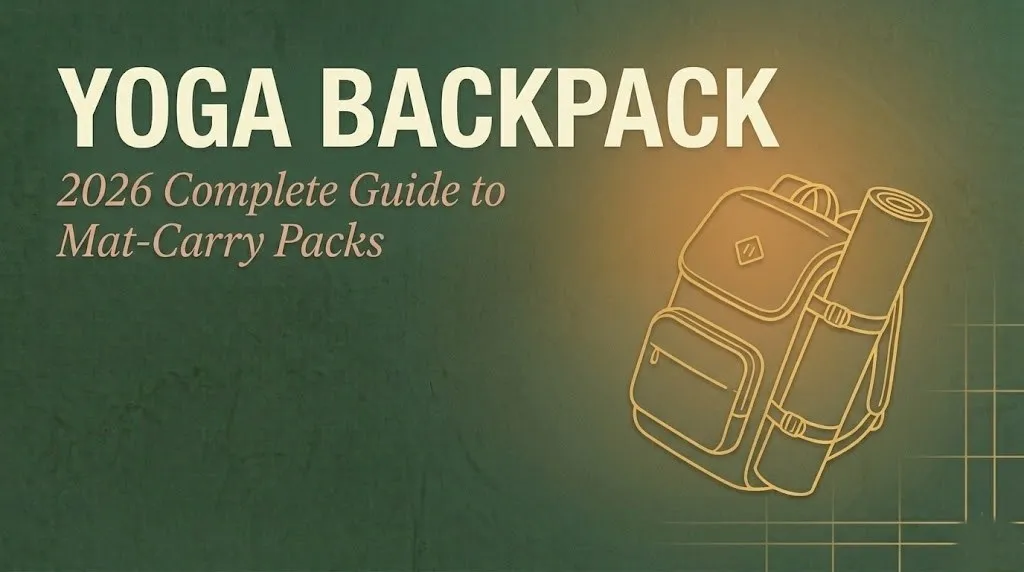
Top-loading integrated sleeves position the mat vertically inside a dedicated external pouch that runs along the back panel from top to bottom. This is the most secure and balanced design because the mat’s weight stays directly against the bag’s back panel, aligned with the body’s center of gravity. The limitation is that the sleeve must match your mat’s diameter. Most sleeves fit mats up to 5 inches in diameter; oversized mats may not fit.
Rolling compression strap systems use two horizontal strap pairs that compress the mat against the bag’s front or side panel. These are adjustable and work for a wider range of mat sizes. They are less secure during rapid movement but perform well for walking and transit.
Bottom-attached cradle systems hang the mat below the bag using a looped strap attached to the bag’s base. This is the least stable design and concentrates the mat’s weight below the bag’s center of gravity. It creates a pendulum effect during walking. Avoid this design for cycling commutes or any situation involving quick movement.
Mat Holder Design Comparison:
| Design Type | Mat Security | Mat Size Range | Best For | Limitation |
|---|---|---|---|---|
| Side strap system | Moderate | Standard diameter only | Casual use, short distances | Fails with thick mats |
| Integrated back sleeve | High | Sleeve-dependent | Commuters, cyclists | Fixed diameter; no thick mats |
| Rolling compression straps | Moderate to high | Wide range | Travel, varied mat types | Less secure at speed |
| Bottom cradle | Low | Variable | Walking short distances | Pendulum effect; poor for transit |
Key Takeaway: The mat holder design is the most important buying decision in a yoga backpack, and most buying regrets come from choosing a holder that does not fit the actual mat diameter. Measure your rolled mat before purchasing.
Yoga Bag Backpack vs Yoga Tote vs Yoga Duffle
The yoga backpack versus yoga tote versus yoga duffle question has a practical answer that depends on how you are getting to your practice, how much gear you carry, and whether you are managing other daily demands alongside your yoga sessions.
A yoga tote is the simplest option: a structured bag with an external side pocket or sleeve for the mat and a main compartment for gear. Totes work well for practitioners who walk short distances to a nearby studio and carry minimal gear. The single-shoulder carry creates asymmetric loading over time. For practice sessions two to three times per week with a short walking commute, this is a manageable trade-off. For daily commuters or anyone managing existing shoulder or back sensitivity, the asymmetric load is worth avoiding.
A yoga duffle provides maximum gear capacity and is the best choice for hot yoga and Bikram practitioners who carry a large mat towel, multiple water bottles, a change of clothes, and shoes. Duffles typically offer the most internal volume of any yoga bag format. The two-handle carry option allows symmetrical shoulder carrying, but most duffles also have a single long strap option that recreates the asymmetric loading problem of a tote.
A yoga backpack is the best choice for practitioners who commute more than a short walk, cycle to the studio, use public transit, or need their hands free during their commute. The bilateral shoulder loading distributes weight across both sides of the upper body and maintains a stable load position regardless of movement speed.
Yoga Bag Type Comparison:
| Bag Type | Best Commute | Gear Capacity | Load Distribution | Best Practice Style |
|---|---|---|---|---|
| Yoga tote | Walking, short distance | Moderate | Asymmetric (one shoulder) | Hatha, Yin, Restorative |
| Yoga duffle | Car, short walk | High | Variable; two handles best | Hot yoga, Bikram, Ashtanga |
| Yoga backpack | All commute types | Moderate to high | Bilateral (both shoulders) | Any style; all commute types |
| Yoga rucksack (structured) | Cycling, hiking, travel | High | Bilateral with hip belt | Outdoor yoga, travel, multi-day |
How to Choose the Right Yoga Backpack
Choosing the right yoga backpack requires answering four questions in order: What is my rolled mat’s diameter? How much gear do I carry? How do I get to the studio? And do I need the bag to serve a dual purpose (work bag, travel bag, gym bag)?
Your mat’s rolled diameter is the first and most constraining specification. Measure your mat before shopping: roll it normally and measure the diameter in inches. A standard 4mm mat rolls to approximately 4 inches in diameter. A 6mm mat rolls to approximately 4.5 inches. An 8mm thick mat rolls to approximately 5.5 to 6 inches. A 10mm mat rolls to approximately 6 to 7 inches. Side strap systems generally accommodate up to 5 inches. Integrated sleeves vary by product and must be verified against the manufacturer’s stated diameter capacity.
Your gear volume determines the backpack’s liter capacity. A practitioner carrying only a mat, one water bottle, and a change of clothes needs approximately 20 to 25 liters. A practitioner carrying a mat, blocks, a strap, a mat towel, work clothes, a laptop, lunch, and multiple water bottles needs 35 to 45 liters.
Yoga Backpack Selection Framework:
| Question | Your Answer | What It Determines |
|---|---|---|
| Rolled mat diameter | Measure before buying | Mat holder type and size |
| Gear volume | Count items you carry daily | Backpack liter capacity needed |
| Primary commute method | Walk, cycle, transit, car | Stability, security, and pack form factor |
| Dual purpose needed | Work, travel, gym | Compartment layout, laptop sleeve, carry-on compliance |
Yoga Backpack Size Guide: Matching Mat Size to Backpack
The most common yoga backpack buying mistake is purchasing a bag before checking whether it fits the specific yoga mat you own, and the consequences are a mat holder that either cannot close around the mat or leaves the mat so loose that it shifts dangerously during commuting.
Standard yoga mat dimensions are 68 inches long and 24 inches wide. When rolled to the standard diameter of approximately 4 to 4.5 inches, this fits the majority of yoga backpack mat holder systems on the market. If your mat falls within these dimensions and standard thickness (4mm to 6mm), almost any yoga backpack with side straps or an integrated sleeve will work.
Extra-long yoga mats (72 inches or 74 inches long) do not create a diameter problem but may create a height problem for bags with bottom-attached cradle systems or top-loading sleeves that are sized for 68-inch mats. The mat will protrude above or below the bag, which is usually tolerable but occasionally creates transit interference.
Wide yoga mats (26 inches or 27 inches wide) roll to a larger diameter than standard mats because the rolling circumference is proportionally larger. A 26-inch wide 4mm mat rolls to approximately 4.5 to 5 inches in diameter depending on the mat’s density. Check strap extension length for wide mat compatibility.
Mat Size to Backpack Compatibility Guide:
| Mat Spec | Rolled Diameter | Compatible Holder | Incompatible Holder |
|---|---|---|---|
| Standard (68″ x 24″, 4mm) | 4 inches | All standard systems | None |
| Standard (68″ x 24″, 6mm) | 4.5 inches | All standard systems | None |
| Thick (68″ x 24″, 8mm) | 5.5 inches | Extended compression straps only | Short side straps |
| Thick (68″ x 24″, 10mm) | 6 to 7 inches | Oversized compression straps only | Most standard systems |
| Wide (68″ x 26″, 4mm) | 4.5 to 5 inches | Most systems with strap extension | Fixed-length short straps |
| Extra-long (74″ x 24″, 4mm) | 4 inches | All standard systems | Bottom cradle (height issue) |
Key Takeaway: Measure your rolled mat’s diameter in inches before buying any yoga backpack. Most buying regrets come from discovering after purchase that the mat holder design cannot close around the actual mat.
Yoga Backpack for Commuters
A yoga backpack for commuters needs to solve a different set of problems than a bag designed purely for carrying gear to a studio. Commuter practitioners are using the bag for an entire workday, not just a 90-minute class round trip, which changes every relevant design specification.
The laptop compartment is the feature that most separates a commuter yoga backpack from a standard yoga gear bag. A padded sleeve large enough for a 13-inch or 15-inch laptop, positioned against the bag’s back panel for load stability, converts a yoga bag into a true workday companion. Without this compartment, commuters end up carrying two bags (one for work, one for yoga), which defeats the practical purpose of a yoga backpack entirely.
Load distribution becomes particularly important for commuters because the bag is being carried for longer periods and over greater distances than a simple studio trip bag. The American Physical Therapy Association (APTA) recommends that carried loads not exceed 10 to 15 percent of body weight for extended periods. A fully loaded commuter yoga backpack with a laptop, yoga gear, and daily essentials can easily reach 12 to 18 pounds. Padded shoulder straps, a sternum strap, and ideally a hip belt distribute this load more effectively across the body’s skeletal structure rather than concentrating it on the trapezius and rhomboids.
Commuter Yoga Backpack Must-Have Features:
- Padded laptop sleeve: 13-inch or 15-inch, positioned at back panel
- Water bottle pocket: Side access for a 32-ounce or larger bottle without removing the bag
- Quick-access top pocket: Phone, transit card, keys without opening main compartment
- Sternum strap: Keeps shoulder straps from sliding during cycling or rapid walking
- Mat holder with security: The mat must not shift during stair climbing or crowd navigation
- Professional appearance: Looks appropriate in a workplace setting; not overtly “athletic”
- Weight under empty: Lighter bags (under 2.5 pounds empty) add less to the total load
Yoga Backpack for Travel and as a Carry-On
A yoga backpack qualifies as a carry-on when its dimensions comply with the standard FAA and most airline carry-on size limits of 22 x 14 x 9 inches (approximately 40 liters maximum), and a well-designed travel yoga backpack achieves this while still providing effective mat carrying capability.
The challenge with travel yoga backpacks is that a rolled yoga mat attached externally often causes the total bag dimensions to exceed carry-on limits even when the bag body itself is compliant. Airlines measure carry-on dimensions including any external attachments. A yoga mat attached via side straps adds 4 to 5 inches to one dimension of the bag, which can push a compliant bag into non-compliant territory for overhead bin requirements.
The practical solution for travel practitioners is one of two options: use a yoga backpack with an integrated sleeve that positions the mat flush with the bag’s back panel without adding to the bag’s external dimensions, or pack a travel yoga mat (typically 1.5mm thick, rolls to under 3 inches in diameter) inside the main compartment of a standard carry-on backpack. Travel mats sacrifice some cushioning and grip but eliminate the mat-as-external-attachment problem entirely.
Travel Yoga Backpack Checklist:
- Carry-on compliance: Verify total dimensions including mat attachment against your specific airline’s limit
- TSA-friendly layout: Laptop sleeve accessible without full bag opening; toiletries in accessible pocket
- Dual-purpose packing: Yoga gear and travel clothes share the same space efficiently
- Mat solution: Integrated sleeve (preferred) or pack a travel mat inside the main compartment
- Water bottle access: Essential for long travel days; side pocket sized for at least 24 ounces
- Lockable zipper: Security for travel contexts; small padlock compatibility on main compartment zipper pulls
Yoga Backpack for Hot Yoga and Bikram Practice
A yoga backpack for hot yoga and Bikram practice needs to manage a substantially larger and wetter gear load than a bag designed for standard studio classes, because a 90-minute Bikram session at 105 degrees Fahrenheit produces sweat volumes that saturate clothing, mat towels, and any fabric they contact.
The gear requirements for a hot yoga class session are genuinely different from standard yoga. A Bikram or hot yoga practitioner typically carries a full-length mat towel (same dimensions as the mat, approximately 24 x 68 inches), a hand towel, 1.5 to 2 liters of water (often in a large insulated bottle), minimal moisture-wicking clothing that becomes saturated during class, and dry post-class clothes. This gear volume and the wet-gear management requirement shapes the entire backpack selection.
The wet-dry compartment is the single most important feature for hot yoga practitioners. This is a waterproof-lined interior section, typically positioned at the bottom of the bag, designed to contain damp or wet gear without soaking through to dry items. Post-class, the wet mat towel, damp clothing, and sweaty grip socks go into the wet compartment. Dry clothes, phone, and wallet remain protected in the main compartment.
Hot Yoga Backpack Specifications:
| Feature | Why It Matters | Minimum Specification |
|---|---|---|
| Wet-dry compartment | Contains post-class wet gear | Waterproof-lined, separate from main compartment |
| Total capacity | Hot yoga gear volume is higher | 30 liters minimum |
| Water bottle pocket | 1.5 to 2 liters of water needed | Side pocket for insulated bottle up to 40 oz |
| Ventilation | Damp bag left in car or locker creates odor | Mesh panel or ventilated back panel |
| Material | Post-class bag is heavy and damp | Water-resistant exterior at minimum |
| Mat holder | Full-size mat plus full-size towel | External holder for mat; towel fits inside |
Key Takeaway: Hot yoga and Bikram practitioners need a yoga backpack with a minimum 30-liter capacity, a dedicated wet-dry compartment, and a water bottle pocket sized for at least a 40-ounce insulated bottle. Standard yoga backpacks designed for 20-liter casual use will not serve this practice style.
Yoga Backpack for Yin and Restorative Yoga
A yoga backpack for Yin and Restorative yoga needs to accommodate a fundamentally different gear set than a hot yoga bag, because these practice styles require props that are bulky and awkward to carry but not particularly heavy.
Yin yoga and Restorative yoga rely on props to support long passive holds. A typical Restorative class may involve a yoga bolster (approximately 24 x 12 x 6 inches), two yoga blocks, two blankets, and a yoga strap, in addition to the mat itself. A bolster alone is too large to fit inside most yoga backpacks. The realistic solution for Yin and Restorative practitioners is a yoga backpack that handles the mat, blocks, and strap while the bolster and blankets are carried separately or left at the studio.
For practitioners who practice Yin at home or who own a studio where props are provided, the gear load returns to the standard mat-plus-daily-essentials profile. The backpack choice simplifies accordingly: a standard 20 to 25 liter yoga backpack with a reliable mat holder and adequate compartment organization handles this load without requiring oversized capacity.
Yin and Restorative Yoga Gear and Backpack Solutions:
| Prop | Dimensions | Backpack Solution |
|---|---|---|
| Yoga mat | 68 x 24 inches rolled | External mat holder |
| Yoga blocks (x2) | 9 x 6 x 4 inches each | Main compartment of 25-liter bag |
| Yoga strap | 6 to 8 feet, rolled | Interior pocket or clips to mat holder |
| Yoga bolster | 24 x 12 x 6 inches | Does not fit most backpacks; carry separately |
| Folded blanket | Variable | Top-load or front compartment if compact |
Modification for Yin Practitioners with Limited Mobility: If carrying a fully loaded yoga bag is difficult due to shoulder, back, or hip conditions, a wheeled yoga bag or a yoga backpack with a hip belt transfers significant load from the shoulders to the pelvis, reducing upper body strain considerably. This is particularly relevant for practitioners managing cervical disc conditions or rotator cuff issues.
Yoga Backpack Features That Actually Matter
The features that genuinely improve a yoga backpack’s daily usefulness are a shorter list than most marketing materials suggest. Many backpacks promote features that sound appealing but provide minimal practical value for yoga practitioners in real use conditions.
The features that demonstrably matter are: the mat holder design and mat compatibility range, padded and adjustable shoulder straps with a sternum strap, at least one dedicated water bottle side pocket sized for 32 ounces or larger, a main compartment large enough for a change of clothes plus personal items, and a durable exterior that handles repeated daily loading and unloading without hardware failure at zipper pulls or strap attachment points.
Features that are frequently marketed but rarely add meaningful practical value include: decorative external loops with no load-bearing function, color-matching accessories pouches that could be any zipper pouch, overly complex internal organization systems with dozens of small pockets that are too small to be useful but too numerous to leave empty, and reflective strips on bags that are otherwise so small or so dark that they provide no meaningful visibility improvement.
The Spine Journal has published findings on backpack design and musculoskeletal health, noting that padded shoulder straps, sternum straps, and hip belts reduce spinal compressive loading compared to single-strap bags or unpadded backpacks carrying equivalent loads. These features are ergonomically substantive. Most other yoga backpack marketing features are not.
Features Worth Paying For vs Features Worth Skipping:
| Feature | Worth Paying For | Why |
|---|---|---|
| Padded, adjustable shoulder straps | Yes | Reduces trapezius and rhomboid strain |
| Sternum strap | Yes | Prevents strap sliding; improves load stability |
| Wet-dry compartment | Yes (for hot yoga) | Genuinely protects dry gear |
| Mat holder with verified diameter | Yes | The core function of the bag |
| 32-ounce side water bottle pocket | Yes | Hydration access without removing bag |
| Laptop sleeve (commuters) | Yes | Converts bag to true daily use item |
| Decorative external loops | No | No functional load-bearing purpose |
| Branded accessory pouches | No | Generic zipper pouches are equivalent |
| Excessive internal pocket systems | No | Adds weight; rarely used in full |
Waterproof Yoga Backpack: When and Why It Matters
A waterproof yoga backpack matters most for cyclists, outdoor practitioners, and anyone commuting in frequently wet climates where the bag and its contents are regularly exposed to rain during transit.
The distinction between “water-resistant” and “waterproof” is worth understanding before paying a premium for either. Water-resistant fabrics (most commonly treated nylon or polyester with a DWR coating) repel light rain and brief exposure. They will fail in heavy sustained rain or submersion. Waterproof construction requires either a fully waterproof laminated fabric (like TPU-coated nylon) or a waterproof zipper system (or both) to provide genuine protection in heavy weather.
For most urban yoga practitioners who walk from a covered parking structure to a climate-controlled studio, water resistance is entirely sufficient and costs less than full waterproofing. For cyclists who commute 5 to 10 miles in variable weather, or for practitioners who practice outdoor beach or park yoga in coastal climates with regular rain, genuine waterproofing is worth the additional investment.
The mat itself adds a complicating factor. Most yoga mat materials (natural rubber, PVC, polyurethane) are not harmed by rain. A wet mat rolled back into a bag after outdoor practice is a hygiene and odor concern, but not a structural damage concern. The gear inside the bag (phone, laptop, clothing, blocks) is what actually needs protection from moisture.
Waterproofing Level Guide:
| Waterproofing Level | Construction | Adequate For | Not Adequate For |
|---|---|---|---|
| Water-resistant (DWR coating) | Treated fabric | Light rain, brief exposure | Heavy rain, cycling in downpour |
| Waterproof fabric (TPU or similar) | Laminated exterior | Heavy rain, extended exposure | Full submersion |
| Waterproof zipper plus fabric | Laminated + sealed zippers | Almost all weather conditions | Underwater; not needed for yoga |
| Water-resistant with wet-dry interior | Standard exterior + lined pocket | Mixed conditions; post-hot yoga | Sustained exterior rain exposure |
Key Takeaway: For most yoga commuters, water-resistant is sufficient. For cyclists and practitioners in wet climates, look specifically for TPU-laminated fabric and sealed or waterproof-rated zippers, not just a DWR coating that will degrade after 20 to 30 washes.
Eco-Friendly and Sustainable Yoga Backpacks
Eco-friendly yoga backpacks use materials and manufacturing processes that reduce environmental impact compared to standard petroleum-based synthetic fabrics, and the most common sustainable materials in this category have measurable environmental performance differences worth understanding before buying based on a “sustainable” label alone.
Recycled polyester (RPET) is the most widely used sustainable fabric in yoga backpacks and athletic gear generally. It is made from recycled plastic bottles and other post-consumer polyester. The Journal of Cleaner Production has documented that RPET production uses approximately 30 to 50 percent less energy than virgin polyester production and produces fewer greenhouse gas emissions per kilogram of fabric. RPET backpacks perform equivalently to standard polyester in durability, water resistance, and weight. They are the most accessible and affordable sustainable option in this category.
Organic cotton appears in some yoga bag designs, primarily in tote styles rather than technical backpacks. It requires no synthetic pesticides in cultivation, but organic cotton production uses more land and water per kilogram of fiber than polyester. Cotton yoga bags also absorb moisture rather than repelling it, making them less practical for daily commute use but appropriate for light casual studio bags in dry climates.
Natural rubber and cork appear as accent materials in some yoga backpack designs, primarily for grip panels, trim, or logo elements. These materials have low environmental impact relative to their synthetic equivalents and are biodegradable.
Sustainable Yoga Backpack Materials Guide:
| Material | Environmental Benefit | Performance | Best Use Context |
|---|---|---|---|
| RPET (recycled polyester) | Reduced energy vs virgin polyester | Equivalent to standard polyester | All-purpose yoga backpack |
| Organic cotton | No synthetic pesticides | Absorbs moisture; less durable than nylon | Light casual studio tote |
| Natural rubber accents | Biodegradable; renewable | Durable grip surface | Accent material on straps and bases |
| Cork accents | Renewable; biodegradable | Decorative and light grip | Accent only; not structural |
| Virgin polyester (standard) | None | High durability; water-resistant | Standard option; no sustainability claim |
Yoga Backpack for Seniors
A yoga backpack for seniors needs to address three specific physical considerations that are not relevant to most younger practitioners: total loaded weight, ease of access to contents, and ergonomic fit for bodies that may have reduced shoulder mobility, cervical disc sensitivity, or lumbar spine limitations.
Total loaded weight is the most practically important consideration. The American College of Sports Medicine recommends that backpack loads should not exceed 10 to 15 percent of body weight for extended carrying periods. For a 140-pound practitioner, that is a maximum of 14 to 21 pounds. A yoga backpack loaded with a mat, blocks, water, and personal items can approach this limit. Seniors who carry close to the weight limit should choose lightweight bag shells (under 2 pounds empty) and consider leaving blocks at the studio rather than carrying them.
Ease of access matters more for seniors because fumbling with complex zipper systems or reaching awkwardly for items in a bag with an uncomfortable carry position creates unnecessary physical strain. Top-loading bags with single main compartments and one or two accessible side pockets are generally simpler to use than bags with multiple zipped compartments on different panels. Magnetic closure pockets provide easier one-handed access than zipper pulls for practitioners with limited hand dexterity.
Senior-Specific Yoga Backpack Recommendations:
| Feature | Why It Matters for Seniors | What to Look For |
|---|---|---|
| Lightweight shell | Total load control | Under 2 pounds empty |
| Wide padded shoulder straps | Reduces trapezius and rotator cuff strain | At least 2-inch pad width |
| Hip belt or load lifters | Transfers load to pelvis from shoulders | Adjustable and removable preferred |
| Simple compartment layout | Reduces fumbling and awkward reaching | Top-load with 2 to 3 pockets maximum |
| Easy zipper pulls | Helpful with limited hand dexterity | Large pulls; D-ring or loop style |
| Mat holder without heavy compression | Avoids straining with stiff strap closures | Buckle release rather than slide-adjust |
Modification for Practitioners with Cervical Disc Conditions: Anyone managing cervical disc herniation or stenosis should prioritize a backpack with a hip belt that transfers at least 30 to 40 percent of the load to the pelvis. The Journal of Orthopaedic and Sports Physical Therapy notes that hip belt use during backpack carrying reduces cervical and thoracic spine compressive loading compared to shoulder-only carrying of equivalent loads.
What to Pack in a Yoga Backpack by Practice Style
What you pack in a yoga backpack should be determined by your practice style, class duration, and whether you are transitioning to or from work or another activity. The wrong packing approach either leaves you underprepared or causes you to carry unnecessary weight daily.
Vinyasa yoga practitioners need the lightest pack: mat, one water bottle (minimum 24 ounces), a small towel for sweat, change of clothes if commuting post-class, and personal essentials. A 20 to 25 liter backpack handles this comfortably.
Hot yoga and Bikram practitioners need the most gear: mat, full-length mat towel, hand towel, insulated water bottle (40 to 64 ounces), pre-class and post-class clothes, grip socks, and personal hygiene items for the post-class shower. A 30 to 40 liter bag with a wet-dry compartment is the appropriate size.
Yin and Restorative yoga practitioners who do not rely on studio props need additional bulk: two blocks, a strap, and sometimes a blanket, in addition to the mat. The volume of the blocks (approximately 9 x 6 x 4 inches each) means a 25 to 35 liter bag is the practical minimum.
Packing Guide by Yoga Style:
| Practice Style | Essential Items | Optional Items | Backpack Capacity |
|---|---|---|---|
| Vinyasa / Hatha | Mat, 24 oz water, small towel, personal items | Grip socks, snack | 20 to 25 liters |
| Hot yoga / Bikram | Mat, mat towel, 40 oz insulated water, 2 sets of clothes, hand towel | Electrolyte drink, hygiene kit | 30 to 40 liters |
| Yin / Restorative | Mat, 2 blocks, strap, 24 oz water, personal items | Blanket (usually left at studio) | 25 to 35 liters |
| Ashtanga | Mat, 24 oz water, hand towel, personal items | Grip socks, light snack | 20 to 25 liters |
| Commuter (any style) | All above plus laptop, work items, lunch | Extra shoes, umbrella | 30 to 40 liters |
| Travel yoga | Travel mat (inside bag), minimal gear | Resistance bands, yoga cards | 20 to 30 liters |
How to Carry a Yoga Mat Without a Yoga Backpack
Carrying a yoga mat without a yoga backpack is entirely practical and many experienced practitioners prefer minimal carrying systems over purpose-built bags, particularly for short walks to nearby studios.
The simplest option is a yoga mat carry strap: a single adjustable strap or a set of two straps with a handle that cinches around the rolled mat and allows it to be carried by hand or over one shoulder. These cost $5 to $20, weigh almost nothing, and work with any mat diameter. The trade-off is that you are carrying the mat in your hand or on one shoulder while everything else goes in a separate bag, which recreates the asymmetric loading problem that a backpack solves.
A yoga mat sling is a slightly more structured version of the strap system, using a shoulder strap that distributes the mat’s weight across the shoulder rather than concentrating it in one hand. These work well for single-purpose studio trips where the mat is the primary item being carried.
Many practitioners use a regular backpack with external lashing: a standard daypack or hiking pack with compression straps, lashing loops, or bungee cord attachments can secure a yoga mat to the exterior of the bag. The limitation is the mat’s security during rapid movement and the potentially awkward swinging if the mat is not secured close to the bag’s body.
DIY and Budget Mat Carrying Options:
| Method | Cost | Mat Security | Hands-Free | Load Distribution |
|---|---|---|---|---|
| Yoga mat strap (single) | $5 to $15 | Low to moderate | No | Single shoulder |
| Yoga mat sling | $15 to $30 | Moderate | Yes | Single shoulder |
| Regular pack with bungee | $0 (if pack owned) | Low | Yes | Both shoulders |
| Regular pack with compression straps | $0 (if pack owned) | Moderate | Yes | Both shoulders |
| Carrying in hand | $0 | High (you’re holding it) | No | One hand |
Frequently Asked Questions About Yoga Backpacks
What is the best yoga backpack for carrying a thick mat?
The best yoga backpack for a thick mat (8mm or 10mm) uses adjustable compression straps rather than fixed-length side straps, because thick mats roll to 5.5 to 7 inches in diameter and most standard side strap systems cannot close securely around that diameter.
Look specifically for bags that state the maximum mat diameter they accommodate in their product specifications, and measure your rolled mat before purchasing.
Rolling compression strap systems and oversized integrated sleeves are the two designs most reliably compatible with thick mats.
Can I use a regular backpack as a yoga backpack?
You can use a regular backpack for yoga if it has external compression straps or lashing loops that can secure a rolled mat to the outside of the bag.
Standard backpacks without these features will require an external bungee cord solution, which tends to swing during movement and creates instability during transit.
A purpose-built yoga backpack is the better investment for anyone commuting more than a short walk, cycling, or using public transit with a mat daily.
What size backpack do I need for yoga?
Most yoga practitioners need a 20 to 25 liter backpack for standard yoga gear: a mat, one water bottle, a change of clothes, and personal items.
Hot yoga and Bikram practitioners who carry a mat towel, large water bottle, and multiple sets of clothing need 30 to 40 liters of capacity.
Commuters who combine yoga gear with work items, a laptop, and lunch should look at 30 to 40 liter bags with a dedicated laptop sleeve.
Are yoga backpacks allowed as carry-on luggage?
Most yoga backpacks qualify as carry-on luggage when their dimensions comply with the standard limit of approximately 22 x 14 x 9 inches, but a yoga mat attached externally via side straps adds to the bag’s measured dimensions.
Airlines measure carry-on size including all external attachments, which means a bag that is dimension-compliant without the mat may exceed limits with the mat attached.
The safest travel solution is a yoga backpack with an integrated sleeve that keeps the mat flush with the bag body, or packing a thin travel mat inside the main compartment.
What should I pack in my yoga backpack?
For a standard Vinyasa or Hatha class, pack your mat, a 24-ounce water bottle, a small hand towel, and a change of clothes if going elsewhere after class.
Hot yoga practitioners should add a full-length mat towel, an insulated water bottle of at least 40 ounces, and an electrolyte supplement to replace sodium and potassium lost during an intense sweating session.
Yin and Restorative practitioners who do not rely on studio props should also pack two yoga blocks and a strap, which requires a 25 to 35 liter bag for comfortable packing.
Closing
The right yoga backpack is the one that fits your actual mat, carries what you actually need, and handles how you actually get to practice. That sounds simple, but most buying regrets in this category come from skipping one of those three checks.
Measure your rolled mat diameter today. Count the items you carry to a typical class. Then match those two numbers to a bag with the right holder design and liter capacity. Start there.
Once the logistics are solved, getting to your practice becomes easier. And showing up consistently is what the practice actually runs on.