Bliss Body Yoga: Guide to the Anandamaya Kosha 2026
Bliss body yoga refers to yoga practices specifically designed to access the Anandamaya Kosha, the innermost of the five layers of the self in classical yoga philosophy, understood as the seat of deep contentment, rest, and inner peace. This is not a trendy wellness concept. It is one of the oldest frameworks in Indian philosophy, described in the Taittiriya Upanishad over two thousand years ago.
The interest in this layer of practice is growing alongside research on deep meditative states. According to the National Center for Complementary and Integrative Health, practices that access deep rest states, including Yoga Nidra and extended meditation, show measurable effects on the autonomic nervous system, stress hormone levels, and subjective wellbeing that differ from ordinary relaxation.
This guide explains what the bliss body is, how it fits into the five-kosha framework, which poses, breathwork, and meditation techniques work with it most directly, and what the emerging science says about why these practices produce the effects they do. Whether you are brand new to yoga philosophy or a longtime practitioner, there is something here that will change how you think about your time on the mat.
Bliss Body Yoga: What It Is and Why It Matters
Bliss body yoga is a practice approach centered on the Anandamaya Kosha, the fifth and innermost layer of the self in yoga’s Pancha Kosha system, accessed through deep relaxation, meditation, Yoga Nidra, and pranayama rather than through physical postures alone.
The word “bliss” in this context is a translation of the Sanskrit “ananda.” It does not mean happiness in the ordinary sense. Ananda describes a state of being that is not dependent on external circumstances: a deep, stable, background contentment that is revealed when the noisier layers of mental activity and physical sensation are allowed to settle.
Think of it like this. When you stir a jar of muddy water, the particles stay suspended and the water looks opaque. Stop stirring, give it time, and the particles settle to the bottom. The water becomes clear. The bliss body is not something you add to your practice. It is what becomes visible when everything else settles enough to stop obscuring it.
This matters for yoga practice design. Practices that only work the physical layer (Annamaya Kosha) never reach the deeper sheaths. A genuinely complete practice addresses all five layers deliberately, moving from the physical body through the breath body, the mental body, and the wisdom body before arriving at the bliss body.
Key ways bliss body yoga differs from general yoga practice:
- Longer Savasana (Corpse Pose) is treated as the primary destination, not a postscript
- Pranayama and breathwork are used to transition between the physical and subtler layers
- Yoga Nidra replaces or supplements physical sequencing as a core practice tool
- Sessions end with extended stillness rather than movement
- Intention setting (sankalpa) is used to orient the practice toward inner awareness
What Is the Bliss Body in Yoga?
The bliss body in yoga is the Anandamaya Kosha, the fifth and deepest layer of the human self in the classical Pancha Kosha framework, associated with the state of deep dreamless sleep, profound meditation, and the experience of unconditional inner contentment.
“Anandamaya” translates as “made of bliss.” The suffix “maya” in Sanskrit means “consisting of” or “composed of,” and the full term describes a sheath or layer woven from the quality of ananda itself. In yogic understanding, this layer is not separate from the self but is the closest sheath to the unchanging awareness that underlies all experience.
The bliss body is the most paradoxical of the five layers. It is the most subtle and the most difficult to access consciously, yet it is also the most restorative. Deep dreamless sleep, certain meditative states, and moments of complete absorption in music, nature, or creative work are all understood in this framework as temporary contacts with the Anandamaya Kosha.
What distinguishes conscious yoga practice from ordinary sleep is the intention to remain aware while the body and mind enter this deep rest state. That is the specific skill that Yoga Nidra and deep meditation cultivate.
Bliss body states are not rare mystical experiences reserved for advanced practitioners. Research on deep rest and meditation states at institutions including Harvard T.H. Chan School of Public Health suggests that the brain states associated with deep relaxation and absorption show distinct neurological signatures, including reduced default mode network activity and increased gamma brainwave coherence, that are consistent with the qualities classical texts describe.
Anandamaya Kosha: Meaning and Definition
The Anandamaya Kosha is defined as the innermost of the five sheaths (koshas) in classical yoga philosophy, described in the Taittiriya Upanishad as the causal body that underlies and gives rise to all subtler and grosser layers of experience.
The Taittiriya Upanishad, one of the principal Upanishads of the Vedic tradition, describes the human person as consisting of five nested sheaths, each subtler and more interior than the last. The Anandamaya Kosha is the fifth and innermost. It is the causal body in the sense that it is the source from which the other layers arise and into which they dissolve during deep sleep and death.
In practical terms, this kosha is associated with the experience of joy that arises without an external cause. Unlike the happiness triggered by a pleasant event, ananda is described as self-arising and unconditional. Yoga practice does not create it. Practice removes what covers it.
The anatomical parallel in modern understanding is the state of deep parasympathetic nervous system dominance: the body at complete rest, the stress response fully disengaged, the mind no longer generating the traffic of ordinary thought. This is not the same as the Anandamaya Kosha in the philosophical sense, but it is the physiological state that correlates with it most closely in practice.
| Sanskrit Term | Translation | Layer Type | Accessed Through |
|---|---|---|---|
| Anandamaya Kosha | Bliss sheath | Causal body | Deep meditation, Yoga Nidra, deep sleep |
| Vijnanamaya Kosha | Wisdom sheath | Intellectual body | Contemplation, self-inquiry |
| Manomaya Kosha | Mental sheath | Mental-emotional body | Meditation, asana, ritual |
| Pranamaya Kosha | Energy sheath | Vital/breath body | Pranayama, asana |
| Annamaya Kosha | Physical sheath | Gross/food body | Asana, physical movement |
Key Takeaway: The bliss body is not a metaphor. It is the Anandamaya Kosha, a specific layer in a two-thousand-year-old map of human experience, and modern neuroscience is beginning to describe the brain states that correspond with it.
The Five Koshas in Yoga Philosophy
The five koshas are the five sheaths or layers of the human self described in the Taittiriya Upanishad: from the outermost physical body to the innermost bliss body, each layer more subtle than the last and each requiring different yoga practices to work with effectively.
Understanding the koshas changes how you approach a yoga session. Instead of asking “what poses should I do today,” you start asking “which layer of my experience needs attention right now.” That shift makes yoga a genuinely responsive practice rather than a fixed routine.
The five layers and their primary practices:
- Annamaya Kosha (food/physical body): The grossest layer. Includes all physical tissue, organs, and structure. Worked through asana (yoga postures), diet, physical movement, and bodywork.
- Pranamaya Kosha (energy/breath body): The layer of vital energy (prana) and breath. Worked through pranayama, breath-linked movement, and energy cultivation practices.
- Manomaya Kosha (mental body): The layer of ordinary mind, thought, emotion, and sensation processing. Worked through meditation, mantra, ritual, and mindful yoga practice.
- Vijnanamaya Kosha (wisdom/intellect body): The layer of discernment, higher intelligence, and intuition. Worked through self-inquiry, contemplation, philosophy study, and witnessing awareness practices.
- Anandamaya Kosha (bliss body): The innermost causal layer. Worked through deep meditation, Yoga Nidra, extended Savasana, and the deepest states of pranayama.
A complete yoga practice touches all five layers, not just the physical. Most modern yoga classes spend nearly all their time on the Annamaya and Pranamaya Koshas. Bliss body yoga extends the practice intentionally into the subtler layers.
Pancha Kosha System Explained
The Pancha Kosha system is a classical yogic framework that describes the human being as five nested energy sheaths, each enclosing the next, with the bliss body at the center as the innermost layer closest to pure awareness.
“Pancha” means five in Sanskrit. “Kosha” means sheath, cover, or layer. The word carries the implication of something that covers or conceals rather than something that is the self itself. The classical view is that pure awareness (Purusha or Atman) is not the same as any of the five sheaths but is the unchanging witness that animates all of them.
This framework is not purely philosophical. It is a practical diagnostic tool for a yoga teacher or practitioner. When a student arrives with physical tension, the work begins at the Annamaya Kosha. When the same student has addressed the physical layer but still feels chronically anxious, the work shifts to the Pranamaya and Manomaya layers. When the mental and energetic layers are steadier, the practice can reach toward the Vijnanamaya and, eventually, the Anandamaya Kosha.
The Pancha Kosha system is referenced extensively in modern yoga teacher training curricula through Yoga Alliance-registered programs, and it forms a foundational module in many 300-hour and 500-hour advanced teacher training courses.
| Kosha | Sanskrit | Element | Yoga Practice Layer |
|---|---|---|---|
| 1. Physical body | Annamaya | Earth, food | Asana, diet, physical healing |
| 2. Energy body | Pranamaya | Breath, prana | Pranayama, breathwork |
| 3. Mental body | Manomaya | Mind, emotion | Meditation, mantra, mindfulness |
| 4. Wisdom body | Vijnanamaya | Intellect, discernment | Self-inquiry, philosophy |
| 5. Bliss body | Anandamaya | Causal, being | Yoga Nidra, deep meditation |
How to Access the Bliss Body Through Yoga
You access the bliss body through yoga by systematically addressing each of the four outer koshas in sequence within a single practice session: physical movement to settle the body, breathwork to steady the energy, meditation to quiet the mind, and then extended stillness or Yoga Nidra to allow the awareness to rest in the deepest available layer.
The mistake most practitioners make is trying to jump directly to bliss. It does not work that way. The Anandamaya Kosha is not something you reach by effort. It is something you reveal by reducing the effort and interference of the outer layers.
A practical session structure for bliss body access:
- Begin with 15 to 20 minutes of gentle asana to address the Annamaya Kosha (physical body).
- Transition to 10 minutes of pranayama to steady the Pranamaya Kosha (energy body).
- Sit in 10 minutes of open meditation to settle the Manomaya Kosha (mental body).
- Rest in Yoga Nidra or extended Savasana for 20 to 30 minutes to allow the awareness to rest at the level of the Anandamaya Kosha.
The session arc moves from activity to progressively greater stillness. This mirrors what happens in the transition from waking to deep sleep, but with maintained awareness rather than unconscious dropping away.
Modification for time-limited practitioners: Even a 10-minute version of this arc works. Two minutes of gentle movement, three minutes of slow breath, two minutes of sitting quietly, and five minutes of Savasana activates the same sequence, even if the depth of access is shallower than a longer session.
Yoga Poses for Deep Inner Peace and the Bliss Body
The yoga poses most effective for bliss body access are fully supported, passive postures that remove muscular effort, encourage deep breath, and allow the nervous system to shift fully into parasympathetic dominance.
Active standing poses work the outer layers. Bliss body practice requires the opposite: postures where the body is completely held by props or the floor, so the mind has nothing to manage and the nervous system has nothing to respond to except the breath and the deepening stillness.
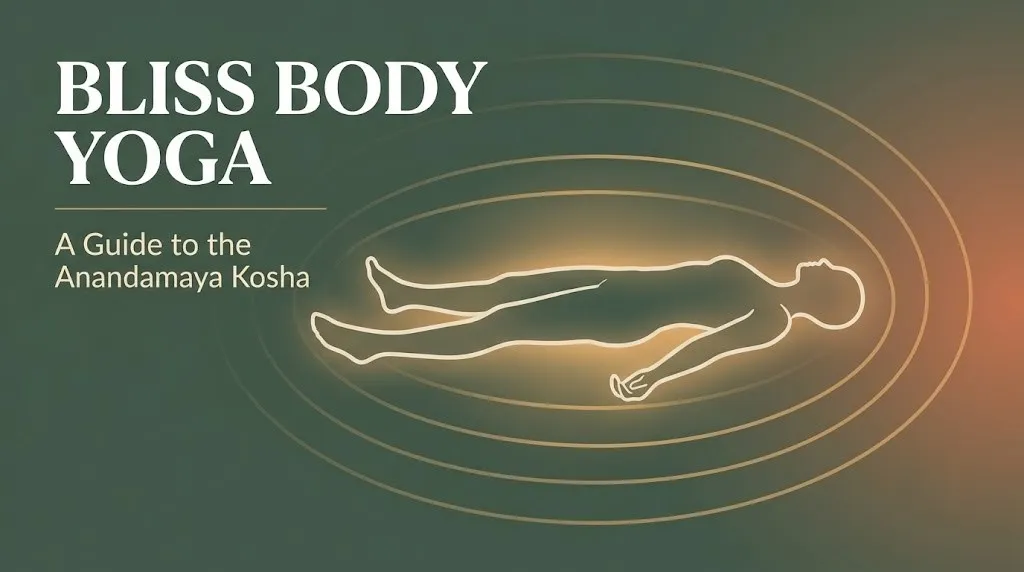
Core bliss body postures:
- Viparita Karani (Legs-Up-the-Wall Pose): Legs resting up the wall, body fully passive. Supports venous return from the lower limbs, reduces heart rate, and creates an immediate parasympathetic shift. Hold for 5 to 15 minutes.
- Supta Baddha Konasana (Reclined Bound Angle Pose): Soles of the feet together, knees falling outward, supported by blocks or blankets. Complete release of the hip adductors and hip flexors. Hold for 5 to 10 minutes with a bolster under the spine.
- Balasana (Child’s Pose): Forehead resting on the mat or a folded blanket. Gentle spinal flexion. Quiets the nervous system through the forward fold position and reduces sensory input. Hold for 3 to 5 minutes.
- Savasana (Corpse Pose): Full body horizontal rest. The body is completely passive. The breath settles naturally. This is the primary bliss body posture and should never be shortened to less than 7 to 10 minutes in a bliss body-oriented practice.
Modification for lower back sensitivity: In Savasana, place a rolled blanket under the knees to release lumbar spine tension. In Viparita Karani, sit a few inches away from the wall if full contact creates lower back compression.
Safety note: Viparita Karani should be avoided by anyone with unmanaged high blood pressure, glaucoma, or a detached retina.
Key Takeaway: Bliss body postures are the most passive poses in yoga, not the most demanding. The work is in the stillness, not the effort, and the props are what make that stillness available to a wide range of bodies.
Pranayama for the Anandamaya Kosha
The pranayama practices most effective for the Anandamaya Kosha are those that extend the exhale, slow the overall breath rate, and create a natural pause at the end of each exhale that allows the nervous system to drop into its deepest available rest state.
Pranayama (breath regulation) is the bridge between the physical and subtle layers of yoga practice. In the context of bliss body work, it functions specifically as the transition practice: after asana addresses the body and before meditation reaches the mind, pranayama steadies the Pranamaya Kosha so that deeper layers become accessible.
The most effective pranayama practices for bliss body access:
- Nadi Shodhana (Alternate Nostril Breathing): Balances the solar and lunar energy channels, quiets the mental body, and creates the even, steady breath quality that supports deeper meditative states. Practice for 10 to 15 rounds before sitting meditation or Yoga Nidra.
- Extended exhale breathing (2:1 ratio): Inhale for four counts, exhale for eight. The extended exhale activates the vagus nerve and increases parasympathetic tone. Practice for five to ten minutes as a transition into stillness.
- Bhramari pranayama (Humming Bee Breath): The vibration of the hum stimulates the vagus nerve and creates a rapid shift toward parasympathetic dominance. Particularly effective for practitioners who struggle to quiet an active mind.
Modification for beginners with pranayama: Start with simple natural breath observation before adding ratio counting. Noticing the breath without changing it is itself a valid pranamaya layer practice and a safer entry point than timed breath ratios for newer practitioners.
According to a study published in the International Journal of Yoga, regular pranayama practice produced measurable improvements in heart rate variability, respiratory rate, and self-reported anxiety scores over an eight-week intervention period.
Meditation for the Bliss Body
Meditation for the bliss body works by progressively withdrawing attention from sensory input and mental content until awareness rests in the background stillness that underlies all experience, which in yogic terms is described as the Anandamaya Kosha.
Most meditation practice addresses the Manomaya Kosha (the mental body) by training attention and reducing mental reactivity. Bliss body meditation goes one step further: it uses the steadiness developed through sustained practice to allow the awareness to sink beneath the mental layer into the subtler awareness of the Vijnanamaya and Anandamaya Koshas.
The classical technique associated with this depth of practice is dharana (concentrated attention) transitioning into dhyana (meditative absorption). In Patanjali’s Yoga Sutras, these are described as the sixth and seventh limbs of the eight-limbed path. Samadhi, the eighth limb, is understood as the full absorption associated with the bliss body state.
To practice meditation oriented toward the bliss body:
- Sit comfortably with the spine supported. Set a gentle timer for 20 to 30 minutes.
- Begin with five minutes of natural breath observation to settle the outer layers.
- Introduce a simple anchor: the sensation of breath at the nostrils, or the sound of silence in the room.
- When the mind wanders, return to the anchor without commentary or judgment.
- After fifteen minutes, release the anchor intentionally. Rest in open, objectless awareness.
- Allow whatever arises to arise without following it. Simply be present to the background of awareness itself.
- Close with a sankalpa (a brief, positive intention) before slowly returning to ordinary awareness.
Modification for beginning meditators: Start with five to ten minutes rather than twenty. A guided body scan recording can serve as a bridge between active thinking and meditative absorption for practitioners who find open silence too unfamiliar initially.
Yoga Nidra and the Bliss Body
Yoga Nidra is the single most direct yoga practice for accessing the Anandamaya Kosha because it is specifically designed to guide practitioners into the hypnagogic threshold state between waking and sleep, where the bliss body becomes consciously available.
“Yoga Nidra” translates as “yogic sleep.” It is a guided practice performed lying in Savasana, during which the teacher leads the practitioner through a systematic process: setting a sankalpa, rotating awareness through the body (rotation of consciousness), experiencing pairs of opposite sensations, and resting in awareness at progressively deeper levels. The goal is to remain consciously aware while the body and ordinary mind enter a sleep-equivalent rest state.
This threshold state (the hypnagogic state) corresponds neurologically with the transition from alpha brainwave activity (relaxed wakefulness) to theta brainwave activity (deep drowsiness and early sleep). The Anandamaya Kosha, in modern terms, corresponds most closely with the delta brainwave state of deep dreamless sleep, but practiced with maintained awareness.
Research published in the International Journal of Yoga found that Yoga Nidra practice reduced anxiety scores and improved sleep quality in participants over an eight-week period, with effects comparable to conventional relaxation training but sustained over a longer post-intervention period.
iRest (Integrative Restoration), a secular therapeutic adaptation of Yoga Nidra developed by clinical psychologist Richard Miller, has been studied specifically for PTSD, chronic pain, and anxiety in clinical populations, with peer-reviewed outcomes published in multiple complementary medicine journals.
Modification for beginners: Any practitioner of any experience level can practice Yoga Nidra lying down. It requires no physical flexibility, no strength, and no prior meditation experience. A guided audio recording is the most accessible entry point for complete beginners.
Key Takeaway: Yoga Nidra is not just relaxation. It is the most researched and direct technique for consciously accessing the bliss body layer, and it requires less physical prerequisite than almost any other yoga practice.
How to Practice Yoga Nidra Step by Step
A complete Yoga Nidra practice follows a structured sequence of seven stages, from body positioning and intention setting through sensory withdrawal, body scanning, and finally resting in open awareness at the threshold of the bliss body.
A full Yoga Nidra session takes 20 to 45 minutes. Shorter sessions of 10 to 15 minutes address the outer layers but may not reach the full depth of the Anandamaya Kosha for most practitioners. With regular practice, the depth of access increases and shorter sessions become more effective.
To practice Yoga Nidra:
- Set up your space. Lie in Savasana (Corpse Pose) on a firm, flat surface. Cover yourself with a blanket. Place an eye pillow over the eyes. Ensure the room is warm and quiet.
- Set your sankalpa. State a brief, positive intention silently three times: something true of your deepest self or a quality you are cultivating. Keep it present tense and positive.
- Rotation of consciousness. Mentally travel through the body part by part: right thumb, index finger, middle finger, ring finger, little finger, back of the hand, palm, wrist, forearm, elbow, upper arm, shoulder, armpit, right side of the chest… continuing systematically through every part of the body. Move at a steady pace without lingering.
- Breath awareness. Count breaths backward from 54 to 0. If the count is lost, return to 54 without frustration.
- Pairs of opposite sensations. Experience alternating sensations: heaviness then lightness, warmth then coolness, pleasure then discomfort. Move between them at the teacher’s direction.
- Visualization. Rapid images arise and dissolve. Simply observe without engagement: a red triangle, a blue ocean, a moonlit field.
- Rest in open awareness. Release all technique. Rest in the background of awareness itself. This is the bliss body contact point.
- Return. Gradually reintroduce sensory awareness. Repeat your sankalpa. Begin to move fingers and toes. Roll to one side. Return to sitting slowly.
Modification for people with PTSD or trauma history: Guided iRest Yoga Nidra protocols use choice-based language and allow practitioners to keep eyes open and remain seated rather than lying down. Working with a trained iRest or trauma-informed yoga teacher is strongly recommended for this population.
Yoga and the Nervous System: The Science Behind the Bliss Body
The science behind the bliss body experience is rooted in the measurable effects of yoga, pranayama, and Yoga Nidra on the autonomic nervous system, specifically the shift from sympathetic (stress response) dominance to parasympathetic (rest and repair) dominance.
When the parasympathetic nervous system is fully engaged, the body produces less cortisol, heart rate slows, breathing deepens, and GABA (gamma-aminobutyric acid, the brain’s primary calming neurotransmitter) increases. These are the physiological conditions under which the subtler layers of experience become accessible. You cannot access the bliss body in a state of sympathetic arousal. The system is simply too loud.
According to the National Center for Complementary and Integrative Health, yoga practices that incorporate breath regulation and deliberate relaxation show measurable increases in vagal tone and heart rate variability, two key indicators of healthy autonomic nervous system flexibility.
Research published in the Journal of Alternative and Complementary Medicine found that Yoga Nidra practice over eight weeks increased GABA levels in practitioners compared to a walking control group, a finding that helps explain the characteristic calm and sense of contentment that practitioners report after a Yoga Nidra session.
The default mode network (DMN), the brain network associated with self-referential thinking, rumination, and mind-wandering, shows measurably reduced activity during deep meditative states and Yoga Nidra. This reduction correlates with the subjective experience of bliss: when the mental chatter of the default mode network quiets, the background quality of awareness that was always present becomes perceptible.
Restorative Yoga for the Bliss Body
Restorative yoga is one of the most accessible entry points to bliss body practice because it uses props to fully support the body in passive postures held for extended periods, eliminating muscular effort and creating the physical conditions for deep nervous system rest.
Restorative yoga was systematized by B.K.S. Iyengar and later popularized by Judith Hanson Lasater, who developed specific protocols for using bolsters, blankets, blocks, and straps to hold the body in positions that are simultaneously supportive and gently opening. The absence of effort is the entire point.
In a Restorative yoga session, props function like a hands-on assistant: they hold the body so the practitioner can release the muscular guarding that normally supports every position. When the body stops guarding, the nervous system starts to genuinely rest. Over a ten-minute hold in Supta Baddha Konasana (Reclined Bound Angle Pose) supported by a bolster, blocks, and blankets, most practitioners experience a measurable shift in their mental state: thoughts slow, physical sensation recedes, and the quality of awareness changes.
Props for a restorative bliss body practice:
- Yoga bolster: Full-length body support in reclined poses. Placed under the spine, under the knees, or beneath the props.
- Yoga blankets: Temperature regulation and joint cushioning. Folded precisely to fill gaps between the body and the floor.
- Yoga blocks: Height adjustment for postures like Supta Baddha Konasana where the knees need support.
- Eye pillow: Light exclusion and mild pressure on the eyes activates the oculocardiac reflex, lowering heart rate measurably.
Research in Complementary Therapies in Medicine found that Restorative yoga interventions produced greater improvements in self-reported fatigue and stress levels than active yoga interventions in participants managing chronic stress, supporting its specific role in deeper rest states.
Signs That Your Bliss Body Is Active or Blocked
Signs that the Anandamaya Kosha is active include a spontaneous sense of contentment without external cause, reduced reactivity to stress, deep and restful sleep, and the experience during or after practice of a stillness that feels like “coming home.”
These signs are not mystical. They are recognizable to anyone who has had a genuinely restful night’s sleep, a meditation session where the thinking mind became quiet, or a moment of deep absorption in nature or music. Those experiences are ordinary contacts with the bliss body layer, even if they were not labeled as such.
Signs that the Anandamaya Kosha may be inaccessible or blocked in the classical sense include:
- Chronic inability to rest despite physical fatigue
- Sleep that feels unrefreshing even after adequate hours
- Persistent sense of disconnection or emptiness despite external wellbeing
- Difficulty staying present during meditation or Yoga Nidra
- The feeling that yoga practice is “doing something” to the body but nothing to the deeper self
These patterns do not indicate a damaged or diseased bliss body in a clinical sense. In the classical framework, they indicate that one or more of the outer koshas requires attention before the innermost layer becomes accessible.
The practical response is to work the layers in order: if the physical body is chronically tense, more asana and bodywork. If the energy body is dysregulated, more pranayama. If the mental body is overwhelmed, more meditation and less intensity in the asana practice.
A yoga teacher trained in the Pancha Kosha framework can help assess which layers need the most attention at a given time, making the practice genuinely individualized rather than one-size-fits-all.
Key Takeaway: You cannot force your way into the bliss body. But you can recognize which outer layer is blocking access and work there first. That recognition is itself a form of Vijnanamaya Kosha (wisdom body) practice.
Building a Weekly Yoga Practice to Reach the Bliss Body
A weekly yoga practice designed to reach the bliss body should include at least two sessions that work all five koshas in sequence, one dedicated Yoga Nidra session, and daily short pranayama practice as the connective tissue between sessions.
The framework below is not a rigid schedule. It is a template that can be adjusted based on your available time, physical condition, and current stress level. The most important principle is that each week contains at least one session that goes all the way to the Anandamaya Kosha through extended stillness.
Suggested weekly bliss body practice:
| Day | Practice | Duration | Kosha Focus |
|---|---|---|---|
| Monday | Gentle Hatha asana plus Nadi Shodhana | 40 minutes | Annamaya, Pranamaya |
| Tuesday | Nadi Shodhana plus open meditation | 20 minutes | Pranamaya, Manomaya |
| Wednesday | Full kosha sequence (asana, pranayama, meditation, Yoga Nidra) | 60 to 75 minutes | All five koshas |
| Thursday | Rest or restorative yoga only | 20 to 30 minutes | Annamaya, Anandamaya |
| Friday | Pranayama plus self-inquiry journaling | 25 minutes | Pranamaya, Vijnanamaya |
| Saturday | Full kosha sequence (shorter version) | 45 minutes | All five koshas |
| Sunday | Yoga Nidra only | 30 minutes | Anandamaya |
This schedule is realistic for most practitioners. The full 60 to 75 minute sessions appear twice per week. The lighter days maintain the practice thread without demanding full engagement when energy or time is limited.
Beginners should start with one full kosha sequence session per week and one Yoga Nidra session. Add sessions gradually over four to six weeks as the practice becomes familiar and the body adapts to the stillness demands.
Frequently Asked Questions About Bliss Body Yoga
What is the bliss body in yoga?
The bliss body in yoga is the Anandamaya Kosha, the fifth and innermost of the five koshas (sheaths) described in classical yoga philosophy.
It is associated with the state of deep dreamless sleep, profound meditation, and a background quality of contentment that is not dependent on external circumstances.
In practice, it is accessed through Yoga Nidra, deep meditation, extended Savasana, and pranayama rather than through active physical postures.
What is the Anandamaya Kosha and how do I access it?
The Anandamaya Kosha is the bliss sheath described in the Taittiriya Upanishad as the innermost causal body, the layer of pure restful awareness closest to the unchanging self.
You access it by systematically settling the outer four koshas in sequence: physical movement for the body, pranayama for the energy, meditation for the mind, and then extended stillness or Yoga Nidra to allow awareness to rest at the deepest available layer.
The key principle is that you cannot force access. You create the conditions by reducing interference from the outer layers.
Is Yoga Nidra the best way to reach the bliss body?
Yoga Nidra is the most direct and most accessible technique for reaching the Anandamaya Kosha because it is specifically designed to guide practitioners to the threshold state between waking and sleep where the bliss body becomes consciously available.
Other approaches, including deep meditation, extended Savasana, and Restorative yoga, also access this layer, but Yoga Nidra combines a systematic structure with guided awareness in a way that is effective for beginners and experienced practitioners alike.
Research published in the International Journal of Yoga supports its measurable effects on anxiety, sleep quality, and GABA levels, which are the physiological markers most associated with the bliss body state.
How long does it take to experience the bliss body through yoga?
Most practitioners report their first recognizable contact with the bliss body state within four to eight weeks of regular Yoga Nidra or deep meditation practice.
The timeline depends on how effectively the outer koshas are being addressed: practitioners who combine asana, pranayama, and meditation in each session tend to access deeper states more quickly than those who only practice one technique.
Brief contacts with the bliss body, moments of spontaneous contentment during or after practice, are common much earlier and often appear in the first few sessions even if they are not recognized as such at the time.
Can beginners work with the bliss body concept in yoga?
Yes, beginners can work with the bliss body through Yoga Nidra, Restorative yoga, and extended Savasana from their very first session, since none of these practices require physical flexibility, strength, or prior meditation experience.
Understanding the Pancha Kosha framework takes time to integrate fully, but the practices themselves are among the most accessible in all of yoga.
A beginner who lies in a supported Savasana for ten minutes after a gentle yoga practice is already working with the Anandamaya Kosha, even if they do not yet have words for the experience.
The Practice Is Already Here
The bliss body has not been waiting for you to achieve something. It has been here the whole time, beneath the noise. Your practice is simply learning to hear it.
Start this week with one 30-minute Yoga Nidra session. Lie down, cover yourself with a blanket, use an eye pillow if you have one, and follow a guided recording. That single session is a complete bliss body practice. You do not need anything else to begin.
When that feels natural, add one full kosha sequence session per week. Build the practice slowly. The depth comes with regularity, not intensity.