Yoga Space Williamsburg: Classes, Styles & 2026 Guide
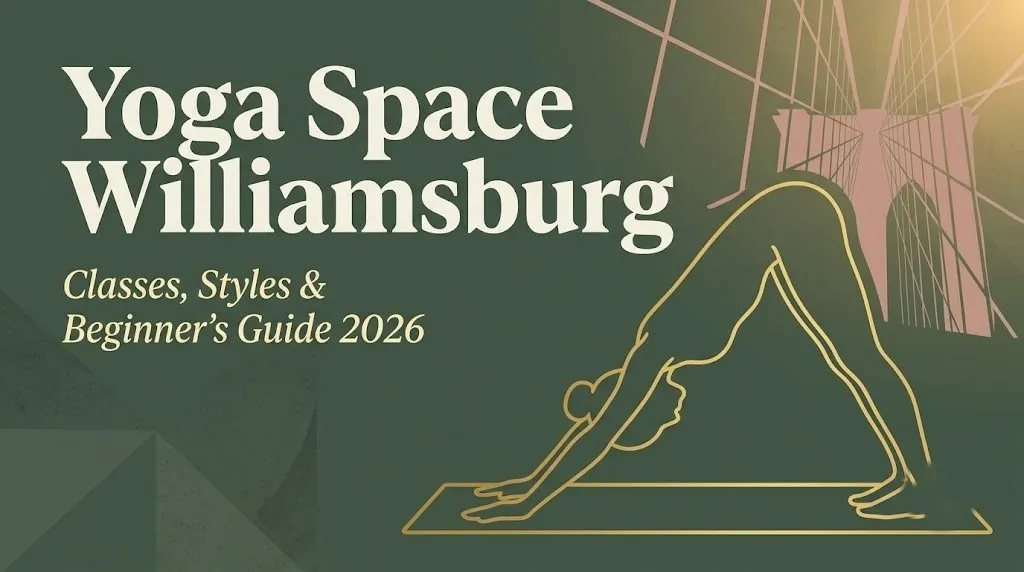
Yoga space Williamsburg refers to the community of yoga studios and practice environments in Williamsburg, Brooklyn, offering classes in multiple styles for every experience level from true beginners to long-term practitioners. If you want to know what’s available, what each class type demands from your body, and whether you’ll fit in, this guide answers all of it directly.
Brooklyn’s yoga community has grown steadily alongside national trends. The National Center for Complementary and Integrative Health reports that yoga participation among American adults has increased by more than 50 percent over the past decade, with urban neighborhoods like Williamsburg consistently among the highest-engagement areas for studio attendance.
This guide covers the yoga styles you’ll encounter in Williamsburg studios, what to realistically expect from your first class, beginner pose breakdowns with modifications, the research behind yoga’s physical and mental benefits, and how to build a sustainable practice that extends beyond any single studio visit.
Yoga Space Williamsburg
Yoga space Williamsburg describes the collection of yoga studios, community practice spaces, and independent teachers operating throughout the Williamsburg neighborhood of Brooklyn, New York, serving a population of urban professionals, artists, parents, seniors, and students at every level of yoga experience.
Williamsburg is a dense, walkable neighborhood with a high concentration of wellness-oriented businesses. Its yoga spaces range from boutique studios with heated rooms and curated soundscapes to community-based spaces offering sliding-scale pricing and open-level classes. The variety means that most people, regardless of budget or schedule, can find something that fits.
What distinguishes the best Williamsburg yoga spaces is not luxury of facilities but quality of instruction. Yoga Alliance requires a minimum 200-hour Registered Yoga Teacher (RYT-200) credential for studio-affiliated teachers, and the strongest Williamsburg studios set internal standards above that baseline. When choosing a space, a teacher’s training background matters more than the studio’s interior design.
Quick Summary:
- Williamsburg yoga spaces span boutique studios, community spaces, and independent teachers
- Class styles include Hatha, Vinyasa, Yin, Restorative, Iyengar, and Gentle formats
- Pricing ranges from sliding-scale community classes to premium boutique drop-in rates
- Yoga Alliance RYT-200 is the minimum instructor credential to look for
- Neighborhood proximity to the Williamsburg Bridge, L train, and G train makes most spaces accessible by transit
Yoga Classes in Williamsburg, Brooklyn
Yoga classes in Williamsburg, Brooklyn span a full range of styles, intensity levels, and scheduling formats, with most studios offering morning, midday, and evening options across seven days per week. Understanding how classes are organized helps you register for the right level rather than the most convenient time slot.
Most Williamsburg studios use a standard class level system: Level 1 for absolute beginners, Level 1-2 for those with a few classes of experience, Level 2 for intermediate students, and All Levels for mixed groups. Attending an All Levels class as a true beginner is generally manageable if the teacher cues modifications. Showing up to a Level 2 class in your first week typically produces frustration rather than progress.
Drop-in rates at Williamsburg yoga studios generally range from $20 to $35 per class. Monthly unlimited memberships run between $100 and $180 depending on studio size and programming depth. Many studios offer introductory packages for new students, typically one to two weeks of unlimited access at a reduced rate.
| Class Format | Duration | Best For | Typical Williamsburg Pricing |
|---|---|---|---|
| Beginner/Level 1 | 60 min | First-time students | Drop-in or intro package |
| All Levels Flow | 60-75 min | Students with 3+ classes | Drop-in or membership |
| Gentle Yoga | 60 min | Seniors, injury recovery | Drop-in or membership |
| Restorative | 75-90 min | Stress recovery, fatigue | Drop-in or membership |
| Deep Yin | 75 min | Connective tissue, tight hips | Drop-in or membership |
| Workshop | 90-120 min | Specific skill development | Workshop pricing |
| Community Class | 60 min | Budget-conscious students | Sliding scale or low fixed rate |
Williamsburg Yoga Studio Community and Philosophy
The best yoga spaces in Williamsburg operate with a community-first philosophy that prioritizes consistent, accessible instruction over performance or prestige. This matters for beginners who often feel intimidated walking into their first studio, and for experienced practitioners who want a space that evolves with them.
Williamsburg’s demographic mix, including young professionals, longtime Brooklyn residents, artists, and families, shapes how studios approach programming. The most attended spaces tend to offer something for each group: weekday morning flow classes for professionals, weekend gentle options for seniors and new movers, and evening workshops for people deepening their practice.
Research published in the Journal of Alternative and Complementary Medicine found that social support within a yoga group setting was independently associated with improved practice adherence and higher self-reported wellbeing compared to solo practice. A studio community provides accountability, encouragement, and the collective energy that makes showing up easier on the days motivation runs low.
What to look for in a Williamsburg yoga studio:
- Teacher credentials: Yoga Alliance RYT-200 minimum, RYT-500 preferred for specialized classes
- Class size: smaller classes allow for individual alignment cues from the teacher
- Props provided: studios should supply blocks, straps, and blankets at no extra charge
- Beginner visibility: at least one beginner-designated class on multiple days per week
- Clear level labeling: every class listing should name its intended student level
- Community policies: sliding-scale options, intro packages, or free trial classes signal accessibility values
Key Takeaway: Choosing a Williamsburg yoga studio based on teacher credentials and class level clarity produces better outcomes than choosing based on pricing, location, or aesthetics alone.
Yoga Styles Available in Williamsburg
Williamsburg yoga spaces offer at least six distinct yoga styles, each with different physical demands, pacing, and intended outcomes. Hatha, Vinyasa, Yin, Restorative, Iyengar, and Gentle yoga are not interchangeable names for the same practice.
The broadest distinction in any Williamsburg yoga studio schedule is between active styles and passive styles. Active styles like Vinyasa and Ashtanga raise the heart rate through breath-linked movement sequences. Passive styles like Yin and Restorative involve long stillness and target the connective tissue and nervous system rather than muscular strength and cardiovascular capacity.
Beginners are frequently mismatched with class styles because studio websites don’t always explain what “flow” or “power” actually involves. A student expecting a gentle stretch who finds themselves in a heated Vinyasa class is not a beginner failure. It’s an information gap that this section closes.
| Yoga Style | Pace | Physical Demand | Best For |
|---|---|---|---|
| Hatha | Slow to moderate | Low to moderate | Beginners, alignment learners |
| Vinyasa | Moderate to fast | Moderate to high | Active students, flow lovers |
| Yin | Very slow, long holds | Low physically, high mentally | Connective tissue, joint health |
| Restorative | Passive, prop-supported | Very low | Stress, illness, fatigue |
| Iyengar | Slow, precision-focused | Low to moderate | Injury rehab, alignment study |
| Gentle | Slow, fully accessible | Low | Seniors, people with chronic pain |
| Ashtanga | Fast, fixed sequence | High | Experienced, disciplined students |
Hatha Yoga vs. Vinyasa Yoga for Beginners
Hatha yoga is the foundational style that most other modern yoga forms derive from, characterized by individual poses held for several breaths each with attention to alignment and breath. Vinyasa yoga links poses together in flowing sequences synchronized breath-to-movement, producing a more dynamic, athletic experience with less time to understand any single shape.
For a beginner at a Williamsburg yoga space, Hatha offers something irreplaceable: time. When a teacher cues Tadasana (Mountain Pose) and holds it for five breaths, you actually have five breaths to feel your feet, adjust your posture, and connect breath to body. In a Vinyasa class, that same moment lasts one breath before the next transition arrives.
That said, Vinyasa is not closed to beginners. Students with baseline fitness, no significant joint concerns, and comfort with some initial confusion typically adapt within three to five classes. According to a study published in the International Journal of Yoga, Vinyasa practice over 12 weeks produced measurable improvements in upper body strength, flexibility, and self-reported energy in previously sedentary adults. The key is starting with a beginner-labeled Vinyasa class, not a general or mixed-level flow.
Pose Tip:
- In Hatha: hold each pose for 3 to 5 slow breath cycles before any transition
- In Vinyasa: one breath equals one movement; inhale to extend, exhale to fold or transition
- Beginners in any Vinyasa class can always take Balasana (Child’s Pose) between sequences as a rest without losing class continuity
Modification: If Vinyasa transitions feel too rapid, stay in the starting shape of each pose. Skip the transition movement and observe one full round before joining. No teacher at a competently run studio will object to this.
Yin Yoga vs. Restorative Yoga in Williamsburg
Yin yoga involves holding floor-based poses for two to five minutes to create sustained, gentle stress on the body’s connective tissues, specifically fascia, ligaments, and joint capsules, rather than targeting muscle strength. Restorative yoga uses bolsters, blankets, and blocks to fully support the body in passive positions, with zero muscular effort required, targeting the nervous system and the stress response.
Both styles are common in Williamsburg yoga spaces and both are frequently misunderstood. Yin yoga has a productive edge to it. There is a mild, dull stretch sensation that accumulates over the hold time. That sensation is the point. Restorative yoga, by contrast, should feel entirely comfortable. If you feel any stretch at all in a well-propped Restorative pose, the props need adjusting.
A review published in Complementary Therapies in Medicine found that passive yoga styles, including Restorative practice, were associated with measurable reductions in cortisol levels and improved sleep quality in adults with self-reported chronic stress. For the Williamsburg professional managing high-pressure work schedules, Restorative yoga is arguably the highest-return-per-hour investment in a weekly studio schedule.
| Feature | Yin Yoga | Restorative Yoga |
|---|---|---|
| Hold duration | 2-5 minutes per pose | 5-20 minutes per pose |
| Muscular effort | Minimal, some sensation | Zero |
| Props needed | 1-2 blocks, blanket | Bolster, multiple blankets, eye pillow |
| Primary target | Fascia, ligaments, joints | Nervous system, cortisol, stress |
| Sensation | Mild to moderate dull stretch | Complete comfort and stillness |
| Best for | Athletes, tight bodies, recovery | Burnout, chronic stress, insomnia |
Modification: In any Yin pose, if you feel sharp, shooting, or radiating sensation, come out immediately. The productive sensation is a dull, spreading “pull,” not a sharp or pinching feeling. This distinction is not subtle: sharp means back off, dull and achy means you’ve found the right depth.
Key Takeaway: Yin and Restorative yoga look almost identical from the outside but work completely differently. Yin targets connective tissue through productive stress. Restorative eliminates all stress and signals full recovery mode.
What to Expect at Your First Yoga Class
Your first yoga class at a Williamsburg yoga space will most likely begin with a brief breath-awareness exercise, move through a series of foundational standing and floor poses held for several breaths each, include a cool-down sequence, and close with Savasana (Corpse Pose), a final resting position held for five to ten minutes.
Arrive ten to fifteen minutes early. Use that time to introduce yourself to the teacher, mention any injuries or physical limitations, and collect your props from the studio’s prop wall. Arriving exactly at the start time as a first-time student leaves zero room to orient yourself.
Remove shoes before entering the studio. Most Williamsburg yoga spaces also request that students silence phones, avoid strong fragrances, and bring personal mat grip socks if practicing on a shared studio mat. Basic hygiene courtesies apply in any close-proximity shared space.
What to bring to your first Williamsburg yoga class:
- A yoga mat if you own one; studio loaner mats are usually available for a small fee or free
- Water bottle, filled before class to minimize mid-session disruption
- Comfortable, stretchy clothing that allows free hip and shoulder movement
- Socks you can remove easily at the studio entrance
- A small hand towel if you tend to run warm during movement
- Any health information the teacher might need: recent surgeries, chronic conditions, pregnancy status
Safety note for first-time students: The single most useful thing you can do before class starts is a 30-second conversation with the teacher about your body. Knowing about a student’s knee replacement, recent shoulder injury, or first-trimester pregnancy lets a teacher offer real-time modifications that protect you during the session.
Yoga Poses for Beginners
The most effective beginner yoga poses build body awareness, basic flexibility, breath connection, and foundational strength without requiring athletic conditioning or prior movement training. Tadasana (Mountain Pose), Balasana (Child’s Pose), Marjaryasana-Bitilasana (Cat-Cow Pose), Adho Mukha Svanasana (Downward-Facing Dog), and Setu Bandha Sarvangasana (Bridge Pose) appear in virtually every beginner class offered at Williamsburg yoga spaces.
None of these poses are universally accessible without some attention to form. Ease in yoga is always individual and body-dependent. A student with chronically tight hamstrings will find Adho Mukha Svanasana (Downward-Facing Dog) dramatically more challenging than someone with natural posterior chain flexibility, even when both are executing the fundamental alignment correctly.
To practice Marjaryasana-Bitilasana (Cat-Cow Pose):
- Begin on hands and knees, wrists stacked under shoulders, knees under hips.
- On an inhale, let the belly drop toward the mat, tail rises, chest lifts forward. This is Cow.
- On an exhale, press the hands into the mat and round the spine toward the ceiling. This is Cat.
- Keep the neck long and consistent with the rest of the spinal curve. Avoid cranking the head sharply up or down.
- Move for 10 slow breath cycles, letting the breath initiate each directional change rather than muscular effort.
- Return to neutral tabletop position and pause for two breaths before transitioning.
Muscles mobilized in Cat-Cow: erector spinae, multifidus, thoracic extensors, abdominals (engaged in Cat), and the sacroiliac joint and lumbar vertebrae (mobilized through both phases).
Modification: Students with wrist pain or carpal tunnel syndrome can perform Cat-Cow on fists rather than open palms, or substitute a seated version in a chair, rounding and extending the thoracic spine in rhythm with the breath.
Yoga Props for Beginners
Yoga props are precision tools that allow every body to access the correct alignment and intended sensation of a pose, regardless of current flexibility or strength. Props are not training wheels. They are instruments of accuracy.
A yoga block placed under the hand in a standing pose like Trikonasana (Extended Triangle Pose) doesn’t signal inability. It signals that the student’s hamstrings are at a particular length today, and the block closes the gap between the hand and the floor so the spine can remain long instead of rounded. The block-supported version is frequently the biomechanically superior version.
Yoga Alliance teaching standards require credentialed teachers to offer prop variations in beginner and general-level classes as a default offering, not as a concession to struggling students. If your teacher at a Williamsburg yoga space never mentions props, that is a teaching quality issue worth noting.
| Prop | Primary Use | Best For |
|---|---|---|
| Cork yoga block | Raise the floor, support the hand | Standing poses, seated forward folds |
| Foam yoga block | Lighter support, under head or hips | Restorative poses, seated meditation |
| Yoga strap | Extend reach for tight muscles | Forward folds, shoulder openers |
| Bolster | Full body passive support | Restorative poses, chest openers |
| Blanket | Cushion, height adjustment, warmth | Knee padding, Savasana warmth, hip lift |
| Wall | Balance support, alignment reference | Standing poses, inversions, hip work |
| Folding chair | Full seated support | Chair yoga, seniors, severe balance concerns |
Modification for beginners: Start every practice session with two blocks and one strap at minimum. Place them within arm’s reach before class begins. Reaching across the room mid-pose to get a block breaks concentration and sometimes alignment.
Key Takeaway: Using props in yoga class is the mark of a student who understands what the pose is trying to do. The block version and the strap version are often the more correct versions, not the compromise versions.
Yoga Modifications for Seniors and Limited Mobility
Yoga is one of the most fully modifiable movement practices available, and meaningful, beneficial participation is possible for people managing arthritis, osteoporosis, chronic joint pain, limited range of motion, balance concerns, and the full range of age-related physical changes. The key is matching the modification to the specific limitation rather than applying generic “easier” versions.
Chair yoga is the format most specifically designed for seniors and people with mobility limitations. Seated versions of standard standing poses preserve the muscular engagement, breath work, and alignment principles of the original pose without requiring floor-to-standing transitions or single-leg balance. Williamsburg yoga spaces that offer chair yoga classes typically run them in the morning or early afternoon on weekday schedules.
According to the National Center for Complementary and Integrative Health, yoga-based movement interventions for older adults have shown improvements in balance, gait speed, and self-reported quality of life across multiple randomized controlled trials. The most effective programs in those trials specifically used chair-supported and wall-supported modifications rather than standard studio-format instruction.
Modifications by specific condition:
- Knee osteoarthritis: avoid deep knee flexion; use folded blanket under knees in floor poses; use chair for all standing poses requiring bent-knee positions
- Osteoporosis: avoid extreme spinal flexion (deep forward folds); focus on Tadasana (Mountain Pose), gentle Setu Bandha Sarvangasana (Bridge Pose), and wall-supported standing poses
- Balance concerns: practice all standing poses with one hand on a wall or chair back; avoid unsupported single-leg balances until stability improves
- Shoulder impingement: skip Adho Mukha Svanasana (Downward-Facing Dog) until cleared; substitute Marjaryasana-Bitilasana (Cat-Cow Pose) for thoracic mobility
- High blood pressure: avoid strong inversions and breath retention techniques; focus on supine and seated poses with smooth diaphragmatic breathing throughout
Yoga for Back Pain and Tight Hips
Yoga is among the most extensively studied non-pharmacological approaches to chronic low back pain management, and the research base is consistently positive for regular, gentle practice over passive rest or avoidance of movement.
Tight hip flexors, particularly the psoas major and iliacus, directly influence lumbar spine positioning. When these muscles shorten from prolonged sitting, which is a daily reality for most Williamsburg desk workers, the lower back compensates by over-arching. That compensation compresses posterior lumbar structures and is a primary driver of chronic low-level back pain.
A 2017 study published in the Annals of Internal Medicine found yoga was as effective as physical therapy for reducing chronic low back pain over 12 weeks, with benefits maintained at 52 weeks post-intervention. This finding has been replicated in subsequent smaller trials and positions yoga as a clinically credible, not just anecdotally useful, back pain tool.
To practice Setu Bandha Sarvangasana (Bridge Pose) for back health:
- Lie on your back, knees bent, feet flat on the mat hip-distance apart.
- Arms rest at your sides, palms facing down.
- On an inhale, press feet firmly into the mat and lift hips toward the ceiling.
- Keep knees tracking directly over ankles, not splaying outward.
- Draw the lower belly gently inward without holding the breath.
- Hold for 5 slow breath cycles, then exhale and lower the spine one vertebra at a time back to the mat.
- Repeat 3 to 5 times with full controlled breath throughout.
Modification: Place a block under the sacrum (the flat triangular bone at the base of the spine) for a passive, supported Bridge Pose that opens the hip flexors without any muscular effort. This is a genuine Restorative pose in its own right.
Safety caution: Students with active disc herniation or diagnosed sacroiliac joint instability should get specific clearance from an orthopedic physical therapist before practicing full weight-bearing Bridge Pose.
Yoga Benefits Backed by Research
The documented physical and mental health benefits of regular yoga practice are substantial, reproducible, and supported by decades of indexed, peer-reviewed research. This section presents what named organizations and published studies have actually found, not general wellness claims.
A systematic review published in the Journal of Alternative and Complementary Medicine, covering 81 randomized controlled trials, found that yoga produced positive outcomes across flexibility, muscular endurance, balance, pain reduction, and self-reported quality of life in adult participants. These findings held across diverse age groups, fitness levels, and health conditions.
Mental health outcomes are equally well-documented. The Harvard T.H. Chan School of Public Health cites yoga as one of several mind-body practices with strong evidence for reducing self-reported anxiety and depression symptoms in non-clinical adult populations. Research published in Frontiers in Psychiatry suggests yoga practice may support BDNF (brain-derived neurotrophic factor) levels, a protein associated with neuroplasticity and mood regulation, though the mechanisms require further study.
Research-backed benefits of regular yoga practice:
- Chronic low back pain: reduced pain intensity and functional disability over 12 weeks (Annals of Internal Medicine, 2017)
- Flexibility: measurable increases in hamstring, thoracic, and hip external rotator range of motion after 10 to 12 weeks of twice-weekly practice
- Balance: improved Berg Balance Scale scores in adults over 60 after 8 to 12 weeks of yoga-based balance training (NCCIH)
- Blood pressure: modest but measurable reductions in resting systolic blood pressure in adults with mild hypertension
- Anxiety: reduced self-reported symptom scores in adults practicing 2 or more sessions per week (Journal of Alternative and Complementary Medicine)
- Sleep quality: improved sleep duration and onset time after 8 weeks of consistent evening yoga practice (Complementary Therapies in Medicine)
Key Takeaway: The research behind yoga’s benefits is not thin or unverified. Multiple large-scale reviews confirm measurable improvements in flexibility, back pain, balance, anxiety, and sleep quality across diverse adult populations.
Yoga for Stress and Anxiety Relief
Yoga relieves stress and anxiety by activating the parasympathetic nervous system, the biological counterpart to the “fight or flight” stress response. The three primary mechanisms are slow controlled breathing, deliberate physical attention to sensation in the body, and the intentional reduction of external stimulation during practice.
This is not vague wellness language. The physiological pathway is measurable. Yoga practice reduces circulating cortisol, the body’s primary stress hormone, and increases heart rate variability, a key marker of autonomic nervous system balance. A 2023 meta-analysis published in Frontiers in Psychiatry that examined 22 randomized controlled trials found yoga produced statistically meaningful cortisol reductions compared to inactive control groups in adults with chronic self-reported stress.
For Williamsburg practitioners managing urban workload, noise, commuting stress, and schedule density, the parasympathetic activation that happens in a 75-minute yoga class is not a luxury. It is a genuine physiological correction to a chronically overloaded sympathetic nervous system. Think of it as the nervous system equivalent of draining an overfull battery rather than leaving it plugged into a wall that keeps adding charge.
Yoga poses with the strongest evidence for stress and anxiety relief:
- Viparita Karani (Legs-Up-the-Wall Pose): promotes venous return and parasympathetic activation; hold 5 to 10 minutes
- Supta Baddha Konasana (Reclined Bound Angle Pose): opens chest and hips while fully prop-supported; hold 5 to 7 minutes with bolster under the spine
- Balasana (Child’s Pose): abdominal contact with thighs activates the vagal response; hold 3 to 5 minutes
- Savasana (Corpse Pose): minimum 10 minutes for measurable heart rate variability improvement
Modification for anxious students: If lying fully flat triggers anxiety, prop the upper back on a bolster at a 20 to 30-degree incline. The parasympathetic effect is maintained while reducing the physical vulnerability some anxious students feel in fully supine positions.
Yoga and Sleep Quality
Yoga improves sleep quality through a combination of cortisol reduction, parasympathetic activation, and the physical fatigue that naturally follows an hour of focused movement. The effect builds over weeks of consistent practice rather than appearing after a single session.
A study published in the Journal of Clinical Sleep Medicine found that participants who practiced yoga for 45 minutes per night, five nights per week, showed statistically meaningful improvements in sleep efficiency, total sleep time, and wake-after-sleep-onset time compared to a non-yoga control group, over a 12-week period.
Style timing matters enormously for sleep-specific outcomes. Fast-paced Vinyasa practiced within two hours of bedtime can delay sleep onset by raising core body temperature and sympathetic nervous system arousal. Evening Yin and Restorative yoga, by contrast, signal the body toward rest and consistently improve subjective sleep quality in the research literature.
Best yoga practices for sleep improvement:
- Practice in the evening, 1 to 2 hours before your target sleep time
- Choose Yin or Restorative styles for evening sessions, not Vinyasa or Ashtanga
- Include Viparita Karani (Legs-Up-the-Wall Pose) and Supta Baddha Konasana (Reclined Bound Angle Pose) in every evening routine
- End each session with a minimum 10-minute Savasana (Corpse Pose)
- Dim the practice space, use a blanket for warmth, and silence notifications before beginning
Quick Summary:
- Sleep benefits are documented after 8 or more weeks of consistent practice
- Evening Restorative or Yin yoga outperforms morning Vinyasa for insomnia management
- Avoid stimulating inversions close to bedtime; they raise alertness, not reduce it
Key Takeaway: For sleep improvement, style and timing matter as much as whether you practice at all. Evening Yin or Restorative yoga is the most evidence-supported choice for insomnia and poor sleep.
How Often Should Beginners Do Yoga
Most yoga teachers and physical therapists recommend beginners practice two to three times per week to see measurable improvements in flexibility, strength, and stress levels within the first six to eight weeks of consistent attendance. Daily practice is beneficial but not required.
The American College of Sports Medicine’s physical activity guidelines support movement frequency over volume. Three 50-minute yoga sessions per week outperform one 150-minute weekly session for neuromuscular adaptation, connective tissue hydration, and nervous system regulation. The body responds to how often it receives a stimulus, not just how long that stimulus lasts in any single event.
For the Williamsburg practitioner balancing work, commute, and social obligations, two anchor studio sessions per week combined with one shorter home practice is a realistic and effective pattern. That structure produces consistent results without requiring unrealistic schedule rearrangement.
| Goal | Recommended Frequency | Preferred Style | Timeline for Results |
|---|---|---|---|
| General wellbeing | 2-3 times/week | Hatha, Gentle Flow | 4-6 weeks |
| Flexibility | 3-4 times/week | Yin, Hatha | 6-10 weeks |
| Stress and anxiety | 3-4 times/week | Restorative, Yin, Gentle | 4-8 weeks |
| Back pain management | 3 times/week | Therapeutic Hatha, Iyengar | 8-12 weeks |
| Sleep improvement | 4-5 evenings/week | Restorative, Yin | 8-12 weeks |
| Balance and stability | 2-3 times/week | Hatha, Gentle | 6-8 weeks |
Safety note: Students over 55 or managing inflammatory joint conditions should include rest days between sessions. The connective tissue targeted in Yin yoga needs 36 to 48 hours of recovery time between intense holds. Starting with alternating days is the smart baseline.
Building a Yoga Practice at Home Alongside Studio Classes
A home yoga practice extends the benefits of studio attendance and fills the gaps between classes, but it requires a different approach than simply trying to recreate what you remember from class. At home, no teacher corrects your alignment, no class energy carries you through the difficult moments, and no structured sequence exists unless you build one yourself.
Start small and specific. A 20-minute home practice three times per week builds more durable habit than an ambitious 60-minute session you abandon after two weeks. Physical therapists consistently note that daily 15 to 20-minute movement routines produce stronger functional adaptation than occasional long sessions, because the nervous system responds to repetition frequency rather than single-session duration.
Your home setup requires minimal investment. A clear floor space of roughly 6 by 4 feet, a mat, two blocks, and one strap covers 95 percent of beginner and intermediate home practice needs.
A simple 20-minute home sequence to complement Williamsburg studio attendance:
- Marjaryasana-Bitilasana (Cat-Cow Pose): 10 slow breath cycles to warm the spine
- Adho Mukha Svanasana (Downward-Facing Dog): hold 5 breaths, pedal heels alternately to warm calves and hamstrings
- Anjaneyasana (Low Lunge): hold each side for 5 breaths, focusing on hip flexor lengthening
- Setu Bandha Sarvangasana (Bridge Pose): 5 controlled repetitions, 3 breaths at the lifted position each time
- Supta Matsyendrasana (Supine Spinal Twist): each side for 5 breaths
- Balasana (Child’s Pose): 10 breaths
- Savasana (Corpse Pose): minimum 5 minutes
Modification: If the floor is uncomfortable due to joint sensitivity, practice seated poses in a firm chair and substitute wall-supported standing poses for any floor-based sequence.
Frequently Asked Questions About Yoga Space Williamsburg
What is yoga space Williamsburg and what classes do they offer?
Yoga space Williamsburg refers to the community of yoga studios and practice spaces in Williamsburg, Brooklyn, offering classes in Hatha, Vinyasa, Yin, Restorative, and Gentle yoga formats for all experience levels.
Most spaces offer beginner-designated classes, all-levels flows, specialty workshops, and community classes with sliding-scale pricing.
Class durations typically run 60 to 90 minutes, with morning, midday, and evening scheduling across all seven days of the week.
What yoga style is best for beginners in Williamsburg Brooklyn?
Hatha yoga is the most consistently recommended starting point for beginners because its slower pace allows time to understand alignment, breath, and body awareness in each pose before moving to the next.
Most yoga teachers suggest attending at least three Hatha or beginner-labeled classes before trying faster formats like Vinyasa.
Chair yoga and Gentle yoga are equally strong entry points for students with limited mobility, balance concerns, or significant physical conditions.
How much do yoga classes cost in Williamsburg?
Drop-in yoga class rates in Williamsburg, Brooklyn generally range from $20 to $35 per session depending on studio size and format.
Monthly unlimited memberships typically run between $100 and $180, with introductory new-student packages available at most studios for reduced first-week rates.
Community classes and sliding-scale sessions at select spaces run significantly lower, often $5 to $15 per class, making regular attendance accessible across income levels.
What should I bring to my first yoga class in Brooklyn?
Bring a yoga mat, a filled water bottle, stretchy clothing that allows free hip and shoulder movement, and socks you can remove at the studio entrance.
Most Williamsburg studios provide props like blocks, straps, and blankets at no extra charge, so you don’t need to purchase equipment before your first class.
Arrive 10 to 15 minutes early, introduce yourself to the teacher, and share any physical limitations or injuries before the class begins.
Is yoga good for back pain and how often should I practice?
Yes, yoga is one of the most evidence-backed non-pharmacological approaches to chronic low back pain management. A 2017 study published in the Annals of Internal Medicine found yoga equally effective as physical therapy for back pain reduction over 12 weeks.
Most yoga teachers and physical therapists recommend three sessions per week for back pain management, specifically beginner or therapeutic Hatha formats.
Students with diagnosed disc conditions or sacroiliac instability should discuss yoga participation with the treating physical therapist before beginning a studio class program.
The most practical thing you can do right now is choose one class, pick one Williamsburg yoga space, and show up with your mat and a willingness to not know everything yet. Bring two blocks. Tell the teacher your name and any body concerns in thirty seconds before class starts.
Practice two to three times per week. Use props without apology. Let yourself be a beginner for longer than feels comfortable. The physical improvements, the calmer nervous system, the better sleep, all of it accumulates through consistent, patient repetition.