Wild Heart Yoga: Your Heart-Opening Practice for 2026
Wild heart yoga is a heart-centered practice that combines chest-opening poses, intentional breathwork, and mindful movement to release tension in the front body, improve posture, and support emotional steadiness. It is not a formally codified yoga style like Ashtanga or Iyengar yoga, but rather a philosophy and approach that draws from Vinyasa, Hatha, and Restorative yoga traditions.
The practice matters because most people spend large portions of their day with the chest collapsed forward. According to the National Center for Complementary and Integrative Health (NCCIH), yoga-based interventions that include spinal extension and breath awareness have shown measurable improvements in respiratory function, stress markers, and self-reported well-being across multiple controlled studies.
This guide covers what wild heart yoga is, the anatomy behind it, key poses and sequences, breathwork techniques, modifications for beginners and seniors, and how to build a consistent at-home practice. You’ll find the research, the practical instructions, and the safety guidance all in one place.
Wild Heart Yoga: What It Is and Why It Matters
Wild heart yoga is a heart-centered approach to practice that prioritizes chest opening, breath expansion, and emotional presence through physical movement. It draws from multiple yoga traditions rather than following a single fixed style.
The word “wild” in this context is intentional. It refers to a practice that is open, unguarded, and responsive to what the body and breath need in each session. Unlike a fixed sequence such as Ashtanga’s Primary Series, a wild heart yoga class or home practice adapts in structure while staying anchored to the core intention: opening the chest and breathing freely.
Most wild heart yoga sessions share a recognizable shape. They begin with grounding and breath awareness, build through increasingly active chest-opening and backbend poses, and close with restorative shapes and stillness. The arc mirrors how the body naturally warms up, works, and recovers.
Pose Tip:
- Wild heart yoga is not a certified style with a governing body. It is an approach and philosophy used by many independent teachers.
- The practice is particularly well-suited to people with rounded upper back posture or shallow breathing patterns.
- Any yoga style, including Yin, Hatha, or Vinyasa, can be taught through a wild heart framework.
What Is Wild Heart Yoga and Its Philosophy
The philosophy of wild heart yoga centers on the idea that physical openness in the chest mirrors and supports emotional openness in daily life. This is not merely poetic language. There is anatomical logic behind it.
The chest houses the lungs, the heart, and the majority of the thoracic cage. When the pectoralis major, pectoralis minor, and anterior deltoid muscles are chronically shortened from forward-flexed posture, the ribcage compresses. That compression reduces lung volume and creates a physical environment that many researchers associate with shallow breathing and elevated sympathetic nervous system tone.
Wild heart yoga addresses this directly. By lengthening the front body through supported and active backbends, the practice creates the physical conditions for deeper breathing and, by extension, greater parasympathetic nervous system activation. Think of the chest like a room with the curtains permanently half-drawn. Opening them doesn’t change the weather outside, but it changes how you experience being in the room.
The philosophical roots also include references to Anahata, the heart chakra in yogic tradition, which represents the meeting point between the physical and the emotional self. Whether or not you engage with that framework, the anatomical intention it points toward is consistent with what movement science supports.
| Philosophy Element | Anatomical Parallel | Practical Outcome |
|---|---|---|
| Open heart | Lengthened pectorals and anterior deltoids | Improved posture and shoulder mobility |
| Free breath | Expanded thoracic volume | Greater respiratory capacity |
| Emotional presence | Parasympathetic nervous system activation | Reduced stress response |
| Groundedness | Posterior chain engagement as counter-balance | Spinal stability during backbends |
Wild Heart Yoga Benefits for Body and Mind
Wild heart yoga offers specific, documented benefits across the musculoskeletal, respiratory, and psychological systems, not vague general wellness improvements.
On the physical side, regular chest-opening yoga practice lengthens the anterior shoulder and chest muscles that most people have chronically shortened. A study published in the International Journal of Yoga found that participants who practiced backbend-inclusive yoga sequences for eight weeks showed measurable improvements in thoracic spine mobility and self-reported postural comfort compared to a control group.
The respiratory benefits are equally concrete. Expanding the thoracic cage through poses like Matsyasana (Fish Pose) and Ustrasana (Camel Pose) increases the space available to the lungs with each breath cycle. Over time, practitioners typically report easier, fuller breathing without conscious effort.
Key benefits include:
- Postural improvement: Lengthening of the pectoralis minor and anterior deltoid reduces forward head posture and rounded shoulders
- Reduced upper back tension: The rhomboids and mid-trapezius release chronic holding patterns built up from desk work or screen time
- Greater lung capacity: Chest expansion during backbends encourages fuller diaphragmatic breathing
- Mood support: The Journal of Alternative and Complementary Medicine has published multiple reviews associating backbend yoga with improved self-reported mood and reduced depressive symptoms
- Nervous system regulation: Breathwork integrated into the practice activates the vagus nerve and supports parasympathetic recovery
- Improved shoulder mobility: Consistent anterior chest lengthening restores range of motion in the glenohumeral joint over weeks of practice
Key Takeaway: Wild heart yoga is a philosophy-driven, chest-opening practice with genuine anatomical and research-backed benefits for posture, breathing, stress, and mood, and it draws from multiple established yoga styles rather than being one fixed system.
Wild Heart Yoga Poses and Chest Openers
The core poses of wild heart yoga are all chest openers and backbends, selected for their ability to lengthen the anterior body and strengthen the posterior chain simultaneously.
The five most central poses in this practice are:
- Bhujangasana (Cobra Pose): a prone backbend that targets the thoracic spine and rhomboids while lengthening the pectorals
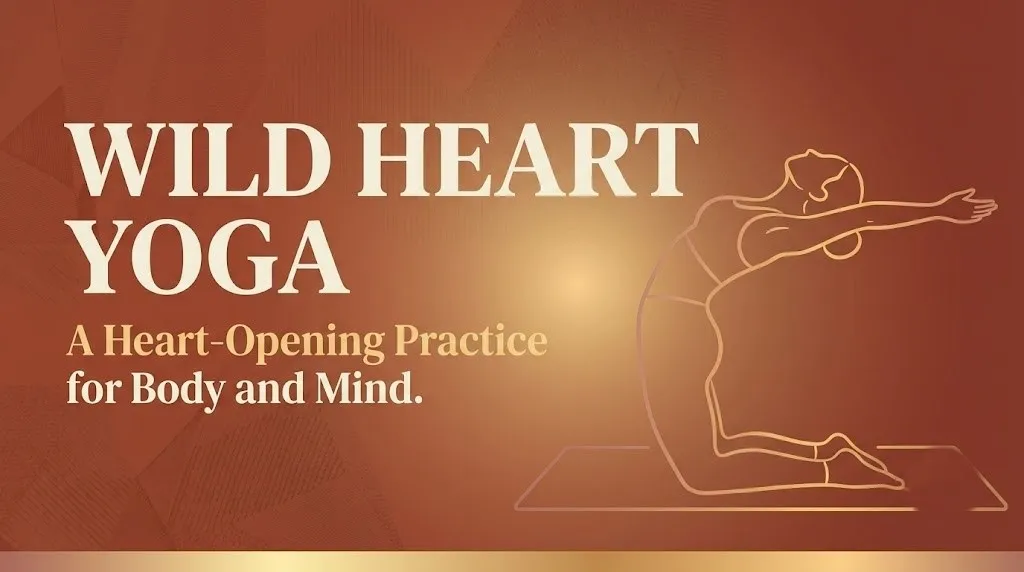
- Ustrasana (Camel Pose): a kneeling backbend that provides a deep hip flexor and chest stretch
- Matsyasana (Fish Pose): a supine chest opener that expands the intercostals and anterior neck
- Setu Bandha Sarvangasana (Bridge Pose): a semi-inversion that strengthens the posterior chain while opening the anterior hip and chest
- Anahatasana (Extended Puppy Pose): a gentle prone chest opener appropriate for all levels, including beginners and seniors
Each of these poses works the same anatomical intention from a different angle and body position. Practicing them in sequence allows the chest, shoulders, and thoracic spine to open progressively rather than being asked to move immediately into a deep range.
| Pose | Sanskrit Name | Body Position | Intensity Level |
|---|---|---|---|
| Cobra Pose | Bhujangasana | Prone | Beginner to intermediate |
| Camel Pose | Ustrasana | Kneeling | Intermediate |
| Fish Pose | Matsyasana | Supine | Beginner to intermediate |
| Bridge Pose | Setu Bandha Sarvangasana | Supine | Beginner to intermediate |
| Extended Puppy Pose | Anahatasana | Prone with hips elevated | Beginner |
Modification for beginners: In Cobra Pose, keep the elbows bent and the hands under the shoulders without fully pressing up. This “baby cobra” variation removes the demand on the lower back and wrists while still opening the chest.
Wild Heart Yoga Anatomy and Muscles Worked
Understanding the anatomy of wild heart yoga tells you exactly why the practice feels the way it does and helps you identify the difference between productive sensation and potential strain.
The primary muscles lengthened in wild heart yoga are the pectoralis major, pectoralis minor, anterior deltoid, and intercostals. These are the muscles that shorten when the chest collapses forward. When they are chronically short, they pull the shoulder blades apart and the head forward, creating the rounded-upper-back pattern that affects a large proportion of adults who work at desks or use handheld devices for extended periods.
The muscles strengthened in wild heart yoga are primarily the rhomboids, mid and lower trapezius, erector spinae, gluteus maximus, and posterior deltoid. These are the muscles that draw the shoulder blades together and support spinal extension. Think of the front and back of the chest like two sides of a drawbridge. Wild heart yoga lowers the front side while raising the back side simultaneously, restoring the balance between anterior and posterior tension.
The vagus nerve, which runs through the thoracic cavity and communicates between the gut, heart, and brain, is also indirectly influenced by chest expansion and slow breathwork. Research reviewed by Harvard T.H. Chan School of Public Health associates increased vagal tone with better stress regulation and improved heart rate variability, both of which yoga practitioners often report after consistent practice.
| Muscle Group | Role in Wild Heart Yoga | Effect of Practice |
|---|---|---|
| Pectoralis major and minor | Lengthened through chest openers | Reduced forward rounding |
| Anterior deltoid | Stretched in backbends | Improved shoulder mobility |
| Rhomboids | Strengthened as counter-muscles | Scapular retraction and stability |
| Erector spinae | Activated in spinal extension | Upright postural support |
| Intercostals | Expanded through chest-opening | Greater breathing capacity |
| Gluteus maximus | Engaged in prone and kneeling backbends | Lumbar protection and hip extension |
Wild Heart Yoga Breathwork and Pranayama
Breathwork is not a supplementary element of wild heart yoga. It is structural. The breath determines whether a chest-opening pose stretches the intended tissues or creates compression instead.
The primary breath technique used is Ujjayi pranayama, a slow, nasal breath with a soft constriction at the back of the throat that creates a gentle audible sound. This breath pattern builds mild intra-abdominal pressure, which supports spinal stability during backbends. It also slows the breath rate, which research in Complementary Therapies in Medicine has associated with decreased cortisol levels and improved parasympathetic tone during yoga practice.
A secondary technique used in wild heart yoga is Nadi Shodhana, or alternate nostril breathing. This practice is typically used at the opening or closing of a session to settle the nervous system before entering physically demanding chest openers or to transition smoothly into meditation or Savasana after the active portion of the practice.
To practice Ujjayi breath for wild heart yoga:
- Sit or lie comfortably with the spine long and the chest slightly lifted
- Inhale slowly through both nostrils for a count of 4
- Constrict the back of the throat slightly, as if fogging a mirror with your mouth closed
- Exhale slowly through both nostrils for a count of 6, maintaining the throat constriction
- Allow the belly to soften on inhale and gently draw in on exhale
- Practice for 5 to 10 cycles before beginning any chest-opening movement
Modification: Practitioners with asthma or breath-related conditions should use natural breath rather than Ujjayi during active poses, reserving pranayama techniques for seated or supine positions where breathing can be fully monitored.
Key Takeaway: In wild heart yoga, the breath is not background noise. Using Ujjayi pranayama during chest-opening poses actively supports spinal stability and helps the nervous system shift toward a calmer, more receptive state.
Wild Heart Yoga Sequence for a Complete Practice
A complete wild heart yoga sequence moves through four phases: grounding, warming, peak chest opening, and restoration. Each phase serves a specific physiological purpose.
To practice a complete wild heart yoga session (approximately 45 minutes):
Phase 1: Grounding (5 to 8 minutes)
- Begin in Balasana (Child’s Pose) for 10 breaths. Set an intention. Let the chest soften toward the floor.
- Move through Marjaryasana-Bitilasana (Cat-Cow Pose) for 8 cycles, synchronizing each movement with the breath.
Phase 2: Warming (10 to 12 minutes)
- Rise to Adho Mukha Svanasana (Downward-Facing Dog) for 5 breaths.
- Transition through a low lunge, Anjaneyasana, for 5 breaths per side to open the hip flexors.
- Come to prone and practice Bhujangasana (Cobra Pose), baby cobra variation, for 3 breaths, three rounds.
Phase 3: Peak Chest Opening (15 to 20 minutes)
- Practice Anahatasana (Extended Puppy Pose) for 8 to 10 breaths, pressing the chest toward the floor.
- Come to kneeling for Ustrasana (Camel Pose), holding for 5 breaths, using blocks at the sacrum if needed.
- Move to supine for Matsyasana (Fish Pose), holding for 8 breaths.
- Follow with Setu Bandha Sarvangasana (Bridge Pose) for 5 breaths, three rounds.
Phase 4: Restoration (8 to 10 minutes)
- Rest in Supta Baddha Konasana (Reclined Bound Angle Pose) for 10 breaths to allow passive chest opening.
- Close in Savasana (Corpse Pose) for at least 5 minutes.
Modification: Seniors or practitioners with limited floor mobility can practice the warming and peak phases using a chair for Camel and a bolster under the chest for Fish Pose.
Wild Heart Yoga for Beginners
Wild heart yoga is genuinely accessible to beginners, provided they start with foundational chest-opener shapes rather than jumping directly into deep backbends. The most common beginner mistake is attempting Camel Pose before the thoracic spine and hip flexors have been prepared.
The best entry point is Anahatasana (Extended Puppy Pose). This pose asks you to keep the hips stacked over the knees while melting the chest toward the floor, arms extended. It creates a gentle but effective thoracic and shoulder opener with minimal joint load and no wrist weight-bearing demand. Most beginners can feel it working within their first attempt.
From there, Bhujangasana (Cobra Pose) in its baby cobra form (elbows bent, hands under the shoulders, belly on the floor) builds spinal extension experience without the full demand on the lumbar spine or wrists. These two poses together form a practical beginner foundation for the full practice.
According to a review published in Complementary Therapies in Medicine, beginners who progressed through foundational poses before attempting deeper backbends reported fewer acute musculoskeletal complaints than those who were introduced to advanced shapes too early. The review specifically recommended a gradual increase in spinal extension load over a minimum of four weeks.
Beginner-specific guidance:
- Hold chest-opening poses for 3 to 5 breaths initially, extending to 8 to 10 as the body adapts
- Always follow a deep chest opener with a neutral spine position, such as Balasana (Child’s Pose), before moving on
- If any pose causes sharp pain in the lower back or neck, return to neutral immediately and reduce the range of motion in the next attempt
Wild Heart Yoga Props and Modifications
Props are not training wheels in wild heart yoga. They are tools that make the correct anatomical shape possible for your current body, which is exactly what good yoga teaching looks like.
The most useful props for this practice are a yoga block, a bolster, a yoga strap, and a wall. Each serves a specific purpose in helping the chest open without the lower back or neck compensating.
| Prop | Use in Wild Heart Yoga | Who It Helps |
|---|---|---|
| Yoga block (under the sacrum) | Supports passive hip elevation in Bridge or Fish Pose | Practitioners with hamstring or lower back tightness |
| Bolster (under the thoracic spine) | Creates supported spinal extension in restorative Fish Pose | Beginners, seniors, people with rounded upper backs |
| Yoga block (at the hands in Camel) | Raises the “floor” so hands reach without collapsing the lumbar | Practitioners with limited hip flexor or shoulder mobility |
| Wall (for supported backbend) | Allows a standing chest opener with lumbar support | Seniors, people with knee discomfort on the floor |
| Strap (looped around upper arms) | Prevents the elbows from flaring wide in Camel or Cobra | Practitioners with narrow shoulders or rotator cuff sensitivity |
| Folded blanket (under the knees) | Cushions the knee joints in kneeling backbends | Practitioners with knee discomfort |
The bolster-supported Fish Pose deserves special attention for practitioners new to chest opening. Place the bolster lengthwise along the spine, resting the full back body on it with the head supported. This is a completely passive shape that allows the anterior chest to open without any muscular effort. It is the single most accessible chest opener in the entire practice and works for virtually every body.
Key Takeaway: Props in wild heart yoga are not optional extras. Using a bolster under the thoracic spine or blocks at the hands in Camel Pose allows the correct anatomical shape to happen safely, which is more valuable than struggling through an unsupported version.
Wild Heart Yoga for Stress and Anxiety
Wild heart yoga has a specific and credible mechanism for reducing stress and anxiety, not just a general claim that yoga is relaxing.
The mechanism centers on the vagus nerve and the parasympathetic nervous system. Slow, extended exhale breathing, which is built into every wild heart yoga session through Ujjayi pranayama, increases vagal tone. Higher vagal tone is associated with better stress regulation, lower resting heart rate, and reduced reactivity to perceived threats. The Journal of Alternative and Complementary Medicine has published multiple reviews noting that yoga breathing practices produce consistent reductions in self-reported anxiety scores across diverse adult populations.
Chest-opening poses add another layer. When the chest is chronically compressed, the breathing pattern tends to be shallow and primarily clavicular, which keeps the body in a mild state of sympathetic arousal. Opening the thoracic cage and practicing full diaphragmatic breathing signals the nervous system that conditions are safe, which facilitates a genuine downshift in stress physiology.
For practitioners managing anxiety specifically:
- Favor the restorative and passive chest openers, such as bolster-supported Fish Pose and Extended Puppy Pose, over active backbends in acute stress states
- Extend the exhale to be at least two counts longer than the inhale during all breathing practices in the session
- Close every session with at least 5 minutes of Savasana (Corpse Pose) to allow the nervous system to integrate the shift before returning to activity
- Avoid heated or fast-paced Vinyasa formats when anxiety is high. A slower Hatha or Restorative version of wild heart yoga is more appropriate in those moments.
Wild Heart Yoga for Posture Improvement
Wild heart yoga is one of the most anatomy-appropriate practices available for correcting the forward-rounded posture pattern that affects the majority of adults who work seated or use screens for extended periods.
The postural pattern most relevant here is thoracic kyphosis, an exaggerated outward curve of the upper spine that positions the head forward of the shoulders and collapses the sternum downward. This pattern shortens the pectoralis minor, weakens the rhomboids and lower trapezius, and compresses the intervertebral discs in the mid-back. Wild heart yoga addresses all three of those components simultaneously.
A study published in the International Journal of Yoga found that an eight-week yoga program including backbends and chest openers produced measurable reductions in thoracic kyphosis angle and improved shoulder retraction strength in office workers compared to a non-yoga control group. The researchers attributed the changes to both the lengthening of anterior chest tissues and the strengthening of posterior chain muscles through sustained spinal extension.
For posture-specific practice:
- Prioritize Bhujangasana (Cobra Pose) and Anahatasana (Extended Puppy Pose) as daily maintenance poses, even on days when a full session is not possible
- Hold posture-corrective poses for 5 to 8 breaths rather than 3, allowing the anterior chest fascia to respond to sustained length
- Combine the yoga practice with awareness of screen height and seated posture during the workday for compounding effect
- Practice 3 to 4 times per week for at least six weeks before expecting measurable postural change. Connective tissue adaptation takes time.
Wild Heart Yoga Safety and Contraindications
Wild heart yoga is safe for most people when practiced with appropriate preparation and modifications, but specific conditions require careful consideration before attempting any backbend or chest-opening sequence.
The primary risk areas in this practice are the lumbar spine, the cervical spine (neck), and the knees in kneeling backbend poses. Most injury in chest-opening yoga comes not from the poses themselves but from attempting too deep a range too quickly, or from allowing the lumbar spine to bear the full load of the backbend instead of distributing it through the thoracic spine.
Absolute contraindications (skip the active backbends entirely and use passive restorative shapes only):
- Recent spinal surgery: Any spinal extension pose requires full clearance from the surgical team, not a general medical green light.
- Acute herniated lumbar disc: Extension-based poses may aggravate posterior disc presentations depending on the specific location and direction of the herniation. A physical therapist familiar with the specific diagnosis should advise on which shapes are appropriate.
- Severe cervical stenosis: Neck extension in poses like Fish Pose or deep Camel can compress already narrowed cervical spaces.
- Acute shoulder injury including rotator cuff tear: Weight-bearing and traction forces through the shoulder joint during backbends can worsen active tears.
Proceed with modification:
- Mild lower back tightness: Use baby cobra rather than full Cobra, and support Bridge Pose with a block under the sacrum
- Knee discomfort: Fold a blanket under the knees in Camel Pose and avoid kneeling shapes entirely if acute knee pain is present
- Neck sensitivity: In Fish Pose, keep a folded blanket under the head to prevent full cervical extension
Key Takeaway: Most people can practice wild heart yoga safely, but the lumbar spine and neck need specific attention in every backbend. The modification is almost always to reduce the range of motion rather than skip the pose entirely.
Wild Heart Yoga for Seniors
Older adults can access the full benefits of wild heart yoga through targeted adaptations that reduce joint load, slow the pace, and prioritize supported over unsupported shapes. Age is not a barrier. Inadequate preparation is.
The most appropriate format for seniors is a Hatha or Restorative version of wild heart yoga rather than a flowing Vinyasa sequence. Slower transitions give the joints time to warm up and allow for balance adjustments without the time pressure of a continuous flow. According to research reviewed by the NCCIH, adapted yoga programs for adults over 60 show consistent improvements in spinal flexibility, balance, and self-reported quality of life, with a particularly strong evidence base for gentle and restorative formats.
Chair-adapted wild heart yoga options for seniors:
- Seated chest opener: Sit in a sturdy chair, clasp the hands behind the back, and gently draw the shoulder blades together while lifting the sternum. Hold for 5 breaths.
- Chair-supported Camel: Stand behind a chair and hold the back with both hands. Step the hips forward while arching the thoracic spine gently back, creating a supported backbend with the chair providing stability.
- Supported Fish with bolster: Lie on a bolster placed lengthwise along the spine with the head fully supported. This is a completely passive chest opener with zero joint load and is suitable for virtually all seniors regardless of mobility level.
- Wall chest opener: Stand facing away from a wall, place both palms flat on the wall at shoulder height, and walk the feet forward until the chest stretches open. Hold for 8 breaths per side.
Seniors with osteoporosis should avoid any pose that flexes the spine forward against resistance and should check with a physical therapist or bone health specialist before practicing any spinal extension sequence.
Wild Heart Yoga vs. Vinyasa and Hatha Yoga
Wild heart yoga is not a standalone yoga style. It is better understood as a thematic approach or teaching philosophy that can be applied within multiple formal styles.
Vinyasa yoga is a style defined by the continuous linking of movement and breath, where each pose flows into the next on an inhale or exhale. A wild heart yoga Vinyasa class would select chest-opening poses and backbend transitions as the thematic spine of the sequence, building heat while keeping the heart-opening intention central.
Hatha yoga is a slower, more pose-by-pose format where each asana is entered, held, and released before the next begins. A wild heart Hatha class gives practitioners more time in each chest opener and tends to include longer breath holds and more deliberate alignment cues. For beginners and seniors, the Hatha format is generally more appropriate for chest-opening work because it removes the time pressure of continuous flow.
| Feature | Wild Heart Vinyasa | Wild Heart Hatha | Wild Heart Restorative |
|---|---|---|---|
| Pace | Fast to moderate | Slow to moderate | Very slow or static |
| Pose hold time | 1 to 3 breaths per pose | 5 to 10 breaths per pose | 3 to 10 minutes per pose |
| Physical intensity | Moderate to high | Low to moderate | Very low |
| Best for | Intermediate practitioners | Beginners and all levels | Seniors, high stress, injury recovery |
| Breathwork style | Ujjayi throughout | Ujjayi with more attention to each breath | Slow natural or Nadi Shodhana |
Choosing between these formats depends on your current fitness level, any existing injuries, and what you most need from the practice on a given day.
Wild Heart Yoga Anahata Chakra Connection
The Anahata chakra is the fourth energy center in the classical yogic chakra system, located at the level of the heart in the center of the chest. In Sanskrit, Anahata means “unstruck” or “unhurt,” referring to a state of openness that exists beneath accumulated emotional protection.
Whether you approach the chakra system as a spiritual framework, a symbolic map, or simply a useful teaching language, the anatomical location of Anahata maps directly onto the target area of wild heart yoga practice. The chest, the sternum, the ribcage, the lungs, and the thoracic spine are all within the Anahata region. Working this area physically creates conditions that many practitioners describe in terms the chakra system was designed to articulate: openness, ease, greater access to feeling.
From a purely physiological standpoint, the Anahata connection also points to the cardiovascular and respiratory systems, both of which respond to chest-opening yoga and breathwork. The American College of Sports Medicine notes that regular yoga practice, particularly breath-focused and postural work, is associated with modest but measurable improvements in resting heart rate and blood pressure in previously sedentary adults.
You do not need to adopt any particular spiritual framework to benefit from wild heart yoga. The anatomical benefits are independent of the interpretive layer. But the chakra language can be a useful internal cue. When a teacher asks you to “breathe into the heart,” they are asking you to expand the ribcage laterally and anteriorly with each inhale, which is precisely what opens the chest and stretches the intercostals.
Key Takeaway: The Anahata chakra framework in wild heart yoga is not separate from the anatomy. It points directly at the chest, lungs, and thoracic spine, the same structures that the physical practice is designed to open and strengthen.
Wild Heart Yoga At-Home Practice Tips
Building a consistent wild heart yoga practice at home requires less equipment than most people assume and more structure than most people apply.
The single most important element of a sustainable home practice is a fixed time and a dedicated space. Research on habit formation, including work reviewed by Harvard T.H. Chan School of Public Health, consistently shows that environmental cues, a specific time of day, a cleared floor area, a rolled-out mat, are stronger predictors of consistency than motivation alone. Motivation fluctuates. A cleared space at 7 a.m. does not.
For equipment, a yoga mat is the only non-negotiable item. A bolster, two blocks, and a strap significantly expand what you can do safely, particularly for chest openers and senior modifications, but they are not required to start. A tightly rolled firm blanket substitutes for a bolster in most wild heart yoga shapes.
Practical at-home tips:
- Start with 20 minutes, not 60. A 20-minute wild heart practice done consistently three times per week builds more adaptation than a 60-minute practice done once.
- Warm up before going deep. Begin every home session with at least 5 minutes of Cat-Cow and Child’s Pose before any chest opener deeper than Cobra.
- Use a timer for hold durations. Guessing how long you’ve held a pose leads to shorter holds than intended. Set a 30-second timer for beginner holds and a 60-second timer as you progress.
- Close every session with Savasana. This is not optional. The nervous system integration that happens in Savasana (Corpse Pose) is where much of the stress-reduction benefit is consolidated.
- Practice at the same time daily if possible. Morning sessions activate the body. Evening sessions decompress it. Choose based on your primary goal.
- Record your practice once a week with your phone. Watching a brief video of yourself in Cobra or Extended Puppy Pose gives you alignment feedback that no amount of internal sensing can replicate.
Frequently Asked Questions About Wild Heart Yoga
What is wild heart yoga?
Wild heart yoga is a heart-centered yoga approach that combines chest-opening poses, intentional breathwork, and mindful movement to open the anterior body, improve posture, and support nervous system regulation.
It is not a formally licensed yoga style but rather a teaching philosophy applied within Vinyasa, Hatha, or Restorative yoga formats.
The practice focuses on the muscles, joints, and breath patterns associated with the chest, thoracic spine, and shoulder girdle.
What poses are included in a wild heart yoga practice?
The core poses in wild heart yoga are Bhujangasana (Cobra Pose), Ustrasana (Camel Pose), Matsyasana (Fish Pose), Setu Bandha Sarvangasana (Bridge Pose), and Anahatasana (Extended Puppy Pose).
These poses are selected because they lengthen the front body and strengthen the posterior chain from different angles and body positions.
A complete session typically sequences them from gentler to deeper and closes with restorative shapes to allow integration.
Is wild heart yoga good for anxiety and stress?
Yes, wild heart yoga is particularly well-suited for anxiety and stress because it combines slow breathwork with chest-opening movement, both of which activate the parasympathetic nervous system.
The Journal of Alternative and Complementary Medicine has published multiple reviews associating breath-focused yoga with measurable reductions in anxiety scores across diverse adult populations.
For acute stress states, prioritize passive chest openers like bolster-supported Fish Pose and extend the exhale longer than the inhale throughout the session.
Can beginners do wild heart yoga?
Beginners can absolutely practice wild heart yoga, provided they start with foundational poses like baby Cobra and Extended Puppy Pose rather than deep backbends like Camel.
The key is progressing gradually, allowing the thoracic spine, hip flexors, and shoulders to adapt over several weeks before attempting more demanding shapes.
A review in Complementary Therapies in Medicine found that gradual sequencing significantly reduces acute musculoskeletal complaints in new yoga practitioners.
How often should you practice wild heart yoga to see results?
Yoga teachers and physical therapists generally recommend practicing chest-opening yoga three to four times per week for at least six weeks to observe measurable postural and mobility improvements.
The NCCIH notes that yoga’s benefits for flexibility and stress markers are dose-dependent, meaning consistency matters more than session length.
Even a 20-minute practice three times per week will produce more adaptation than a single long session once weekly.
Start with Extended Puppy Pose and a bolster-supported Fish Pose today. Those two shapes alone will tell you where your chest and thoracic spine are holding tension and give you a clear sense of what the full practice can open up over time.
Practice three times this week. Keep each session at 20 to 30 minutes and follow every chest opener with Child’s Pose. Build the sequence gradually from there.
You don’t need a perfect setup or a full hour. You need a mat, a consistent time, and a genuine willingness to let the chest open. That’s where this practice begins.