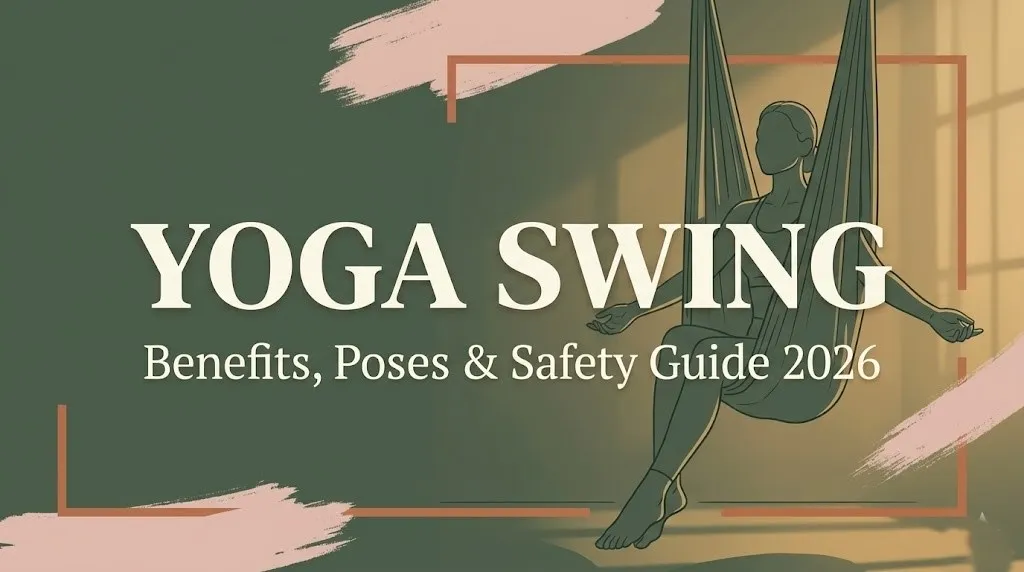
Yoga Swing Guide 2026: Benefits, Poses & Safety Tips
A yoga swing is a suspended fabric or rope apparatus that supports your body during yoga poses, inversions, and stretches. It makes poses accessible that are difficult or impossible on the floor alone, and it creates a unique form of spinal traction that gravity-based practice cannot replicate.
Interest in home aerial yoga tools has risen steadily since 2020. According to the National Center for Complementary and Integrative Health (NCCIH), yoga participation among American adults continues to grow, with home practice driving much of that expansion. A swing fits that shift: it requires one anchor point, minimal floor space, and no studio membership.
This guide covers every angle of yoga swing practice. You will learn what types exist, how to pick and set one up, which poses to start with, what the research says about benefits, and who should approach this practice with caution or skip certain moves entirely.
What Is a Yoga Swing?
A yoga swing is a hanging support system, made from strong fabric, nylon webbing, or rope, that allows practitioners to perform yoga poses while fully or partially suspended off the ground.
Unlike a standard yoga mat, a swing introduces a third dimension to practice: height. Your body can hang, lean, rotate, or invert in ways that floor-based poses do not permit. The swing supports your hips, lower back, shoulders, or feet depending on the pose, allowing muscles to release rather than contract to hold you up.
The category includes several distinct tools. Some swings are single-point hammocks. Others are multi-handle rope systems. Still others resemble gymnastic trapezes with rigid bars. They share a core function: using suspension to assist or deepen movement.
Yoga swings are used across yoga styles including Hatha, Iyengar (known for its prop-heavy approach), and Restorative practice. Aerial yoga studios have also popularized them as a group class format worldwide.
Key features of a yoga swing include:
- A load-bearing anchor point (ceiling, beam, or doorframe)
- Adjustable height using daisy chains or carabiners
- One or more fabric or rope sections for different body positions
- A weight capacity typically between 300 and 600 pounds depending on brand and hardware
What Makes a Hanging Yoga Swing Different From a Standard Hammock?
A hanging yoga swing is purpose-built for movement, weight distribution across multiple body segments, and repeated directional loading, which distinguishes it from a standard hammock built for passive rest.
A camping hammock is designed to hold a resting body in one curved position. A hanging yoga swing is designed to shift load as you transition between poses. The fabric is often narrower, stiffer, and arranged with multiple handle points so you can grip it, lean into it, or wrap it around specific body parts.
The hardware matters too. Yoga swing mounting systems use carabiners rated for dynamic load, meaning they are tested for the sudden force shifts that happen when you swing or drop into an inversion. Camping hammock hardware is tested for static load only.
A study published in the Journal of Alternative and Complementary Medicine examining suspension-based exercise systems noted that grip positioning and fabric width both affect how force is distributed across the spine and shoulders during hanging movements. This is why yoga-specific suspension tools are worth choosing over improvised alternatives.
Pose Tip:
- Use a hanging yoga swing rated for at least 300 lbs of dynamic load, not static load alone
- Narrow fabric (6 to 12 inches wide) suits hip cradles and single-limb support
- Wider hammock fabric (36+ inches) suits full-body supported inversions
What Is a Yoga Rope Swing and How Does It Work?
A yoga rope swing is a multi-handle suspension system made of nylon or cotton ropes with separate grip points, foot loops, and sometimes a central support bar, all hanging from a single ceiling anchor.
Think of it like a vertical gym with soft components. Each rope or handle lets you position a different part of your body at a different height. You can hold the handles above your head while your feet rest in loops below. Or you can sit in a central cradle while gripping the side ropes for stability.
The rope design comes closest to the traditional Iyengar rope wall, a fixed rope system used in Iyengar studios to assist alignment in standing and inverted poses. The suspended version brings that concept into home practice.
Rope swings typically have a lower weight capacity than solid hammock-style swings because the load distributes across multiple attachment points. Most quality rope swings are rated for 200 to 400 pounds. Check the rating on both the ropes and the ceiling hardware separately.
| Feature | Yoga Rope Swing | Hammock-Style Swing | Trapeze Bar Swing |
|---|---|---|---|
| Build material | Nylon or cotton rope | Parachute silk or nylon webbing | Fabric + rigid bar |
| Handle points | 4 to 8 separate loops | 1 to 2 main fabric sections | 2 handles + bar |
| Best for | Multi-position stretching | Full-body inversions | Core and hang work |
| Beginner-friendly | Moderate | High | Lower |
| Typical weight limit | 200 to 400 lbs | 300 to 600 lbs | 300 to 500 lbs |
Key Takeaway: Yoga swings are not a single product. Knowing whether you want a rope swing, hammock swing, or trapeze helps you choose the right tool before you spend a dollar or drill a single hole.
Best Yoga Swings: What to Look For in 2026
The best yoga swings in 2026 share three non-negotiable qualities: verified weight capacity, hardware tested for dynamic loading, and fabric that does not compress or pinch under body weight.
Beyond those basics, the right swing depends on your goals. Someone wanting passive spinal decompression needs different fabric width and handle positioning than someone training toward aerial yoga inversions.
Weight capacity is the most commonly misread spec. Manufacturers often list “static load capacity,” which measures how much weight a motionless hanging object can hold. The relevant figure is “dynamic load capacity,” which accounts for the sudden force your body generates when you swing or drop. For most adults, a dynamic rating of at least 300 pounds provides a meaningful safety margin.
Fabric quality separates budget swings from reliable ones. Parachute-grade nylon and high-tenacity polyester both work well. Avoid swings where the fabric frays or stiffens in the first month of use. The stitching at attachment points is where most swings fail: look for bar-tacking or box stitching at every load-bearing seam.
When comparing yoga swings, prioritize:
- Dynamic load rating (not just static): minimum 300 lbs
- Carabiner quality: steel, not aluminum, for ceiling mounts
- Fabric width options: narrow handles plus a wider central section covers more pose types
- Adjustable daisy chains for height customization
- A starter guide or pose card from the manufacturer
What Comes in an Aerial Yoga Swing Set?
An aerial yoga swing set is a complete package that includes the suspension hardware, the swing itself, and often basic rigging instructions, giving you everything needed to set up and begin practicing at home.
A quality aerial yoga swing set typically includes:
- One central hammock or rope system
- Two steel carabiners (load-rated)
- Two daisy chains or extension straps for height adjustment
- One or two ceiling mount hooks with hardware for joist installation
- A carry bag
- A basic instruction booklet or QR code to instructional videos
Some sets also include wrist guards, foam grip covers for the handles, or a doorframe bar adapter for renters who cannot drill into their ceiling.
The ceiling mount hardware is the most important component in the set. A swing only performs safely when the anchor point is rated correctly. According to guidelines from the American College of Sports Medicine, overhead suspension equipment used for exercise should be anchored to structural members, specifically ceiling joists or beams rated for at least twice the dynamic load of the intended user.
Sets priced under $40 frequently omit hardware quality specifications or use aluminum carabiners, which can fatigue under repeated loading. A set in the $60 to $120 range from an established aerial equipment brand will include properly rated hardware.
Pose Tip:
- Never anchor to drywall alone: always locate a ceiling joist or beam
- Test your mount by hanging your body weight statically before attempting any swinging motion
- If you rent your home, a freestanding aerial yoga frame is a safer alternative to ceiling mounting
Yoga Trapeze vs Yoga Swing: Which One Do You Actually Need?
A yoga trapeze is a specific type of yoga swing that includes a rigid horizontal bar at the bottom with two fabric handles extending from it, while a yoga swing is a broader term that includes hammock-style, rope-style, and fabric-sling systems without a bar.
The distinction matters for what you can do with each. A yoga trapeze, popularized by the YogaBody brand and used widely in circus arts training, allows you to hang from the bar using your knees, hips, or hands. The rigid bar creates consistent grip and allows movements that flowing fabric cannot support.
A fabric yoga swing, by contrast, lets you wrap, cradle, and coil the material around different body parts. You can create a hip swing for traction, a shoulder cradle for backbend support, or a full-body hammock for inverted rest. The flexibility is higher but the grip precision is lower.
| Feature | Yoga Trapeze | Fabric Yoga Swing |
|---|---|---|
| Rigid bar component | Yes | No |
| Wrap-around poses | Limited | Full range |
| Knee hang possible | Yes | Sometimes |
| Best use case | Strength and aerial training | Flexibility and decompression |
| Learning curve | Steeper | More gradual |
| Better for beginners | No | Yes |
| Better for seniors | Not typically | Yes (with modification) |
For most home practitioners, especially beginners and those focused on spinal health or flexibility, a fabric yoga swing is the more practical starting point. The trapeze suits people with some aerial or gymnastics background who want to develop grip and core strength alongside flexibility work.
How to Set Up a Yoga Swing at Home
Setting up a yoga swing at home requires identifying a structurally sound anchor point, installing load-rated hardware, and adjusting the swing height before you place any body weight on it.
To set up your yoga swing safely:
- Locate a ceiling joist using a stud finder. Joists run parallel, typically 16 inches apart. Mark the center.
- Choose your mounting hardware. A steel eye bolt (3/8-inch diameter minimum) with a lag thread suits most residential joists.
- Pre-drill a pilot hole slightly narrower than the bolt’s threads to prevent joist splitting.
- Thread the eye bolt until at least 2.5 inches of the bolt shaft is embedded in the joist.
- Attach your carabiner through the eye bolt and test by hanging your full weight statically for 60 seconds before adding movement.
- Connect your daisy chain through the carabiner and attach the swing’s main loop.
- Set the height so the lowest point of the swing sits at hip height when you stand beneath it. This is your starting reference point.
- Do a seated test first. Sit in the central fabric section and let it bear your full weight before attempting any inversion or movement.
If your ceiling height is below 9 feet, some full overhead inversions will be restricted. A ceiling height of 9 to 10 feet is ideal for most adults up to 6 feet tall.
For renters or those with unsuitable ceilings, a freestanding aerial yoga frame eliminates the installation question entirely. These frames stand 8 to 10 feet tall and are rated for the same dynamic loads as ceiling-mounted systems.
Key Takeaway: A yoga swing is only as safe as its anchor. The time you spend confirming your mounting point is secure pays for itself the first time you fully invert.
How to Use a Yoga Swing: First Steps for New Practitioners
Using a yoga swing for the first time means building trust with the equipment before you attempt anything that takes your feet off the ground.
Most new practitioners overestimate how quickly they should progress to full inversions. Your first session should stay grounded: use the swing as a prop while keeping at least one foot on the floor. This lets your nervous system register the sensation of the fabric supporting your weight without triggering the fear response that comes with being fully suspended.
A simple first session sequence:
- Stand inside the swing loop. Let the fabric rest against your lower back. Lean back slightly and feel the support.
- Seated hip swing. Sit in the central section with feet on the floor. Rock gently side to side.
- Supported forward fold (Uttanasana variation). Loop the fabric around your hips at hip height. Hinge forward, letting the swing support your pelvis. Hold 5 breaths.
- Half inversion. Lower the swing to mid-thigh height. Lean back with the swing at your hips and let your upper body hang down, head below hips. Keep feet on the floor. Hold 3 to 5 breaths.
- Seated spinal twist. Sit in the swing. Reach one arm across your body and gently rotate. Hold 3 breaths each side.
According to yoga teachers and physical therapists who specialize in suspension-based movement, the most common beginner mistake is rushing to full inversion before establishing comfort with partial weight bearing. Give yourself three to five sessions before any full overhead hang.
Yoga Swing Poses for Beginners and Beyond
Yoga swing poses range from supported standing stretches that keep both feet grounded to full aerial inversions that require grip strength, core control, and spatial confidence.
The following poses are organized by difficulty and use common yoga terminology. Sanskrit names are given where the swing version derives from a classical pose.
Beginner Yoga Swing Poses:
- Supported Uttanasana (Standing Forward Fold): Swing at hip height supports the pelvis. Hinge forward. Hamstrings and spinal erectors release passively. Hold 5 to 8 breaths.
- Supported Viparita Karani (Legs Up) variation: Lie under the swing. Rest legs in the fabric. Knees can be bent. Lower back releases against the floor.
- Swing-Assisted Anjaneyasana (Low Lunge): Place the back foot in a lower handle loop. Front foot on the floor. This deepens hip flexor stretch while the swing stabilizes balance.
Intermediate Poses:
- Full Back Bend (supported Chakrasana variation): Swing at hip height. Let your back drape over the fabric into a supported backbend. Arms hang toward the floor.
- Hip Flexor Hang: Stand with the swing at hip height. Lean back and let your hips tilt forward, creating traction through the lumbar spine and a deep hip flexor stretch.
Advanced Poses (with prior experience only):
- Assisted Sirsasana (Headstand): The swing supports the hips during the inversion. Requires experienced guidance and a spotter for first attempts.
- Full inversion hang: Hips in the swing at shoulder height. Hands down or extended overhead. Full spinal decompression position.
Modification: For any pose where feet leave the floor, always have a spotter present for your first three attempts.
Yoga Swing Benefits: What the Research Actually Says
Yoga swing benefits include spinal decompression, improved flexibility, enhanced proprioception, and reduced perceived back pain, though most research to date focuses on aerial yoga broadly rather than swing-specific practice.
A 2017 study published in the Journal of Alternative and Complementary Medicine examined aerial yoga’s effects on cardiovascular markers and flexibility. Participants practicing aerial yoga three times per week for six weeks showed measurable improvements in flexibility and reductions in fear of movement, a psychological marker tied to chronic pain avoidance behavior.
The NCCIH notes that yoga broadly, including suspension-based forms, may support pain management, stress reduction, and balance improvement, with the strongest evidence existing for lower back pain and anxiety.
Documented or research-supported yoga swing benefits:
- Spinal traction: Partial and full inversion creates axial unloading of the intervertebral discs
- Flexibility gains: Gravity-assisted stretching allows deeper passive range of motion than floor-based stretching alone
- Core activation: Stabilizing the body against a moving suspension point recruits deep core stabilizers including the transverse abdominis
- Balance and proprioception: The unstable suspension surface demands constant neuromuscular adjustment
- Stress reduction: Inversions and supported poses activate the parasympathetic nervous system, which governs the rest-and-digest response
- Increased body awareness: Working in three dimensions forces greater attention to breath and position
Research is still emerging. Most yoga swing-specific studies are small or use yoga aerial formats with hammocks rather than individual swing tools. The general yoga research base is stronger, and yoga swing practice shares most of its mechanics with aerial yoga, which has more documented study.
Key Takeaway: The research on aerial yoga is promising but still growing. The benefits that are best supported are flexibility gains and pain reduction, not the dramatic spinal claims you will sometimes see on product pages.
Yoga Swing and Spinal Decompression: What Is Really Happening?
Yoga swing spinal decompression refers to the reduction in compressive load on the intervertebral discs that occurs when the spine is suspended or partially unloaded from the vertical forces of gravity.
Throughout a typical day, gravity compresses your spine from head downward. By the end of a waking day, the average adult loses 1 to 2 centimeters of disc height from this compression, a well-documented phenomenon in spinal biomechanics research published in the Spine Journal. When you invert or suspend your body in a yoga swing, that compressive load reverses or reduces, allowing disc tissue to rehydrate and the space between vertebrae to briefly expand.
This is different from clinical inversion therapy, which uses inversion tables at full 60-to-90-degree inversion angles. A yoga swing typically creates partial inversions at 30 to 60 degrees, which produces gentler traction with less cardiovascular effect.
The spinal erectors, the long muscles running either side of your spine, also release tension when suspended. They are constantly working to hold you upright. Suspension removes that demand temporarily.
Important: Spinal decompression in a swing is not a treatment for herniated discs, spondylolisthesis, or spinal stenosis. Anyone with a diagnosed spinal condition should work with their treating physical therapist or spine specialist before using a yoga swing for traction. A brief conversation with a physical therapist familiar with traction therapy can clarify whether inversion at any degree is appropriate for your specific diagnosis.
Using a Yoga Swing for Flexibility: Does It Actually Work?
A yoga swing can meaningfully improve flexibility by using gravity to assist passive stretches at ranges of motion that are difficult to achieve through muscular effort alone.
Standard floor-based stretching requires your muscles to hold you in a position while simultaneously being asked to lengthen. A yoga swing removes that paradox for many poses. When your hips are supported in the swing, your hamstrings and hip flexors can release without your lower back muscles needing to stabilize the pose. The result is often a deeper, longer hold with less muscular tension interfering.
A study in the International Journal of Yoga examining passive versus active stretching methods found that gravity-assisted passive stretching consistently produced greater immediate gains in range of motion compared to active stretching. Yoga swings operate on this same principle.
Consistency matters more than intensity. Yoga teachers and physical therapists generally recommend three sessions per week, with holds of 30 to 90 seconds per position, as the minimum threshold for measurable flexibility improvement over six to eight weeks.
Flexibility-focused yoga swing poses and their primary stretch targets:
| Pose | Primary Stretch | Hold Time |
|---|---|---|
| Supported Forward Fold | Hamstrings, spinal erectors | 5 to 8 breaths |
| Hip Flexor Hang | Iliopsoas, rectus femoris | 4 to 6 breaths |
| Supported Backbend | Thoracic spine, chest, hip flexors | 3 to 5 breaths |
| Wide-Leg Hang | Inner thigh adductors, hamstrings | 5 to 8 breaths |
| Shoulder Cradle Hang | Anterior deltoid, pectorals | 3 to 4 breaths |
Modification: Those with hamstring injuries should reduce the depth of forward folds and avoid full hip flexion. Keep a slight bend in both knees in all hanging forward fold variations until the area has fully healed.
Yoga Swing for Back Pain: What to Know Before You Invert
A yoga swing can support back pain management for some individuals by unloading the lumbar spine and stretching tight supporting musculature, but the appropriateness depends entirely on the type and origin of the pain.
Not all back pain benefits from inversion or traction. Muscle tension and postural fatigue often respond well. Acute disc herniation, spinal instability, or conditions involving nerve compression can worsen with inversion if not approached carefully.
The NCCIH and multiple peer-reviewed yoga research reviews note that yoga-based movement, including supported inversions, may reduce chronic lower back pain when practiced consistently and within pain-free ranges. The key phrase is “pain-free range.” A yoga swing should never be used to push through back pain.
Conditions that may benefit from gentle yoga swing use (with medical guidance):
- Postural lower back tension
- Mild lumbar compression from prolonged sitting
- Tight hip flexors contributing to anterior pelvic tilt
Conditions where a yoga swing should not be used without specific clearance:
- Herniated or bulging lumbar disc (especially with radiculopathy)
- Spinal stenosis
- Spondylolisthesis (any grade)
- Osteoporosis (risk of vertebral fracture under traction)
- Recent back surgery
If you are managing a diagnosed spinal condition, speak with the physical therapist or spine specialist currently treating you before adding any inversion to your practice. They can advise on whether axial unloading is appropriate and at what angle.
Modification: Start with the swing at hip height and practice the supported forward fold only, with both feet on the floor. This creates mild lumbar traction without full suspension. Hold for 3 to 5 breaths and assess how your back responds before progressing.
Key Takeaway: For back pain, less is more with a yoga swing. A few minutes of supported, partial-inversion stretching three times a week is more beneficial than aggressive daily inversion if your back is actively irritated.
Yoga Swing for Beginners: How to Start Safely
A yoga swing for beginners is most effective when the first priority is comfort and trust with the equipment, not pose variety or inversion depth.
Many beginners approach a yoga swing with either overconfidence or significant anxiety about being off the ground. Both extremes lead to poor form. The overconfident beginner rushes to full inversion before their body knows how to stabilize. The anxious beginner grips the swing so tightly that the muscular tension they are trying to release stays locked in.
The solution is a structured progression over four to six weeks.
A beginner yoga swing progression:
Week 1 to 2:
- Seated swinging with feet on floor
- Supported forward fold with hips in swing, feet grounded
- Swing-assisted low lunge (Anjaneyasana)
Week 3 to 4:
- Half inversion: hips in swing, upper body hanging, feet on floor
- Supported backbend with swing at mid-back height
- Standing balance poses with one hand on swing for support
Week 5 to 6:
- First full inversion with a spotter: hips fully in swing, feet clear of floor
- Seated spinal twist in swing
- Guided entry into one or two full aerial poses
According to yoga teachers and aerial arts instructors who work with beginners, the minimum recommended session length for beginners is 20 minutes, two to three times per week. Less frequent practice makes each session feel like starting over rather than building on the last.
Modification: Those with wrist or shoulder injuries should avoid any pose where the hands grip the swing above shoulder height. Use the hip cradle position instead, which keeps the upper body passive and the load on the pelvis and lower body.
Yoga Swing for Seniors: Adapting the Practice for Older Bodies
A yoga swing for seniors offers real value: it provides support during poses that would otherwise require significant balance, flexibility, or floor mobility, which can make yoga more accessible as the body ages.
For many older adults, getting down to and up from the floor is a barrier to yoga practice. A swing at hip or mid-thigh height creates a supported standing or semi-seated practice environment. The fabric can function as a grab bar during balance poses, a support during stretches, and a gentle traction tool for the spine.
A study published in Complementary Therapies in Medicine examining yoga for adults over 60 found that supported and chair-based yoga formats produced comparable flexibility and balance benefits to mat-based yoga, with significantly lower rates of reported discomfort or fear of falling.
Specific adaptations for seniors using a yoga swing:
- Set swing height at hip height for all initial poses: this avoids any full lift-off from the floor
- Use the swing fabric as a standing balance aid during Vrksasana (Tree Pose) or Virabhadrasana III (Warrior III)
- Gentle seated spinal decompression: sit in the swing with feet on the floor and let the hips hang slightly below the swing’s lowest point
- Avoid full inversions unless the practitioner has prior aerial yoga experience and has consulted with their doctor about blood pressure and eye pressure responses to inversion
Grip strength declines with age. Seniors should use the widest fabric section available for any hanging position and avoid poses that require sustained gripping of narrow rope handles.
Modification: For practitioners managing osteoporosis, avoid any spinal flexion pose in the swing and skip all inversion work entirely. Gentle standing poses with the swing as a support prop provide benefit without fracture risk.
Is a Yoga Swing Safe?
A yoga swing is safe for most healthy adults when the equipment is properly installed, the weight capacity is observed, and poses are learned progressively with attention to form.
The risk level rises significantly when any of these three conditions are missing. Poorly installed ceiling hardware is the leading cause of yoga swing injuries. Overloading the swing’s weight capacity is the second. Attempting advanced inversions without foundational practice experience is the third.
According to the American College of Sports Medicine, any suspension-based exercise modality carries inherent risk related to equipment failure and user error. The ACSM’s general guidance for overhead suspension exercise emphasizes verified anchor strength, progressive skill development, and always having a spotter present for new inversions.
Contraindications: who should avoid a yoga swing or specific poses:
- Glaucoma or elevated intraocular pressure: Inversions increase blood pressure in the head and eyes
- Uncontrolled hypertension: Inversions elevate cardiovascular load
- Vertigo or inner ear disorders: Inverted positions and swinging motion can trigger episodes
- Pregnancy (second and third trimester): Inversions are not appropriate; gentle supported poses only, with medical guidance
- Active disc herniation with nerve involvement: Traction may worsen symptoms
- Recent surgery (any abdominal, spinal, or shoulder procedure): Wait for full medical clearance
- Carpal tunnel or wrist injury: Avoid any grip-heavy hanging poses
Safe practice principles:
- Always test the anchor before first use
- Never practice alone during your first month of inversion work
- Stop immediately if you experience dizziness, pressure in the eyes, or pain in the neck or shoulders
- Progress poses over weeks, not days
Key Takeaway: A yoga swing is safe for most people, but safe setup and honest self-assessment about your starting fitness and health status matter more than which swing you buy.
Frequently Asked Questions About Yoga Swings
How much weight can a yoga swing hold?
Most quality yoga swings have a dynamic load rating of 300 to 600 pounds, but the ceiling mount hardware determines the real limit.
Always match your ceiling hardware rating to or above the swing’s maximum rating.
Check both figures before buying, and verify your ceiling joist can support the intended load.
Can you use a yoga swing without a ceiling mount?
Yes, using a freestanding aerial frame designed for yoga swings eliminates the need for ceiling drilling entirely.
These frames stand 8 to 10 feet tall, have a crossbar for the suspension point, and are rated for the same dynamic loads as ceiling systems.
They are a practical solution for renters, anyone with low ceilings, or practitioners who want to move the swing between rooms.
How long should you stay in a yoga swing inversion?
Most yoga teachers and physical therapists recommend beginners stay in any inversion for no more than 1 to 3 minutes at a time in a single session.
The total inversion time per session should generally stay under 10 minutes for those new to the practice.
Listen to your body: dizziness, pressure behind the eyes, or neck discomfort are clear signals to exit the inversion immediately.
Is a yoga swing good for beginners with no aerial experience?
A yoga swing is accessible to beginners, but requires a structured progression that keeps feet on or near the ground for the first several sessions.
Starting with the swing as a ground-based prop, rather than a suspension device, builds familiarity before full weight-bearing begins.
Beginners with no prior aerial, gymnastics, or inversion experience benefit from at least one in-person session with a trained aerial yoga teacher before practicing alone at home.
Can a yoga swing help with herniated disc pain?
A yoga swing may provide temporary relief for some types of lower back tension, but it is not a treatment for herniated discs.
Inversion can actually worsen symptoms for some herniated disc conditions, particularly when nerve compression is involved.
Anyone with a herniated disc diagnosis should get specific clearance from the physical therapist or spine specialist managing their care before attempting any inversion in a yoga swing.
Starting Your Yoga Swing Practice
Start with one pose. Not ten. Not a full sequence. Pick the supported forward fold, loop the swing around your hips, hinge forward, and hold it for five breaths. Feel what happens to your lower back when gravity is doing the work instead of you.
That single experience tells you more about a yoga swing than any product description can. From there, you build: one session at a time, one pose at a time, one degree of inversion at a time.
Set your swing up safely, respect the progression, and treat your first month as an orientation rather than a training block. The practice rewards patience more than most.