Free Chair Yoga for Seniors: Best Poses and Plans 2026
Free chair yoga for seniors is one of the most accessible and evidence-supported ways for older adults to build strength, improve flexibility, and reduce pain without leaving home. You do not need a mat, a gym membership, or any prior yoga experience to start.
The stakes here are real. The Centers for Disease Control and Prevention reports that falls are the leading cause of injury-related death among adults over 65, and balance training through practices like chair yoga directly addresses the muscle control and proprioception gaps that make falls more likely. That is not a small thing.
This guide covers what chair yoga actually is, which poses work best for seniors, how it affects weight and joint health, what a 28-day plan looks like, and how to find genuinely good free resources in 2026. You’ll also find breathing techniques, app guidance, and detailed modifications for common conditions including arthritis, osteoporosis, and limited range of motion.
Free Chair Yoga for Seniors
Free chair yoga for seniors refers to seated or chair-supported yoga classes, videos, apps, and downloadable guides available at no cost to older adults who want to practice safely at home or in community settings.
The word “free” matters more in this context than in most fitness categories. Many seniors are on fixed incomes. Travel to a studio may not be possible. In 2026, the landscape of free chair yoga has grown considerably, with high-quality options available through public libraries, YouTube channels run by certified yoga teachers, community center websites, and senior center apps. The quality varies widely, and knowing what to look for is more than half the challenge.
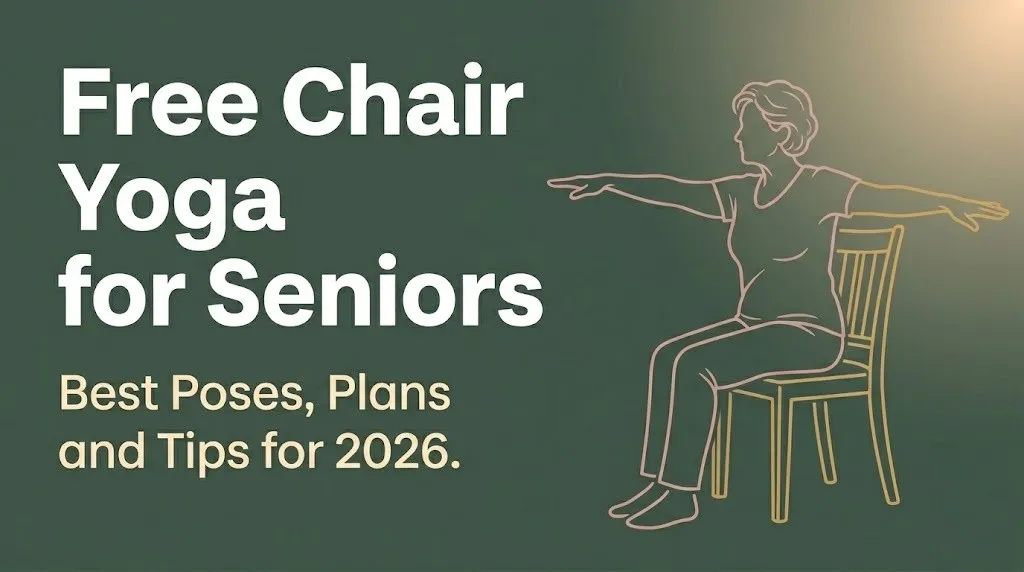
A session of free chair yoga can range from 10 minutes of gentle seated stretches to a full 45-minute guided class. What makes chair yoga distinct from general stretching is the intentional breath-movement coordination, the progressive pose sequencing, and the structural attention to alignment even while seated.
What good free chair yoga includes:
- Instruction by a yoga teacher with a Registered Yoga Teacher (RYT) credential or equivalent
- Cues for breath coordination with every movement
- Verbal or written modifications for common conditions
- Appropriate pacing for older adults, not a general beginner pace recycled for seniors
- A seated-first approach, not just poses adapted poorly from standing sequences
What Is Chair Yoga for Seniors?
Chair yoga is a modified form of yoga practiced while seated in a standard chair or using a chair as a balance support for standing poses.
It originated from the broader tradition of adaptive yoga, developed to make yoga accessible to people who cannot easily get up from or down to the floor. The chair becomes a prop, much like a yoga block or wall, offering stability so the practitioner can focus on movement quality and breath rather than the fear of falling or losing balance.
Chair yoga for seniors most commonly draws from Hatha yoga traditions. Hatha focuses on held poses and breath awareness rather than flowing movement sequences. This makes it particularly well-suited to older bodies that benefit from steady, controlled movement rather than rapid transitions.
The seated position does not diminish the practice. Research published in the International Journal of Yoga has demonstrated measurable improvements in flexibility, strength, and psychological well-being from chair-based yoga programs. The chair changes the entry point, not the outcome.
| Feature | Traditional Floor Yoga | Chair Yoga |
|---|---|---|
| Floor contact required | Yes | No |
| Balance demands | High (unsupported) | Low to moderate |
| Joint loading | Varies; can be high | Controlled and low |
| Entry point for beginners | Moderate difficulty | Low difficulty |
| Effectiveness for seniors | High if mobility allows | High across mobility levels |
People with balance disorders, recent hip or knee surgery, severe arthritis, or fear of floor-based movement are often ideal candidates. Chair yoga is not a lesser version of yoga. It is yoga adapted intelligently for a specific body and situation.
Chair Yoga Benefits for Seniors
Chair yoga offers seniors documented benefits across physical strength, joint mobility, mental health, and fall prevention, all without requiring the floor.
The National Center for Complementary and Integrative Health (NCCIH) identifies yoga as a practice with credible evidence supporting its benefits for musculoskeletal pain, stress, and anxiety management in older adults. For seniors specifically, the benefits are particularly relevant.
Physical benefits include:
- Improved range of motion in hips, shoulders, and spine
- Increased muscle activation in the core, legs, and upper body
- Reduced stiffness from prolonged sitting or inactivity
- Better circulation, particularly in the lower limbs
- Improved posture from spinal extension and shoulder opening work
Mental and neurological benefits include:
- Reduced cortisol levels from breath-focused practice
- Improved sleep quality, documented in studies on yoga and aging
- Reduced symptoms of depression and anxiety in older adult populations
- Enhanced body awareness and proprioception, which directly reduces fall risk
A study published in the Journal of Alternative and Complementary Medicine found that older adults who participated in chair yoga twice weekly for eight weeks reported significant reductions in pain, fear of falling, and self-reported disability. Participants also showed measurable improvements in gait speed and balance.
The breath component alone has measurable value. Diaphragmatic breathing, practiced in virtually every chair yoga session, activates the parasympathetic nervous system. This reduces resting heart rate and blood pressure over time, which is meaningful for a population where cardiovascular risk is a primary health concern.
Best Chair Yoga for Seniors: What to Look For
The best chair yoga for seniors combines qualified instruction, appropriate pacing, clear verbal cues, and genuine modifications, not just slow versions of poses designed for a younger body.
Not all free chair yoga is equal. A 22-year-old fitness influencer calling their video “senior yoga” is not the same as a certified yoga therapist or a teacher with specific training in adaptive or senior populations. Knowing the difference protects your body.
Look for these markers of quality:
- Teacher credentials: RYT-200 or RYT-500 from Yoga Alliance, or a Certified Yoga Therapist (C-IAYT) designation
- Explicit mention of contraindications within the class or guide
- Pace that allows you to breathe comfortably through every move
- Instructions that address chair selection, foot placement, and arm support
- Modifications offered within each pose, not just a single version presented as universal
| Quality Marker | Good Program | Poor Program |
|---|---|---|
| Instructor credential | Named, verifiable | Anonymous or unlisted |
| Pace for seniors | Slow with breath cues | Standard beginner pace |
| Modifications offered | Per pose, per condition | Generic or absent |
| Chair guidance | Specific (chair height, stability) | None |
| Contraindications | Named in session | Not mentioned |
Community centers, hospitals with integrative medicine programs, and public libraries often host higher-quality free chair yoga than random YouTube searches produce. The YMCA and local senior centers frequently partner with credentialed instructors for exactly this programming.
Key Takeaway: Free chair yoga for seniors works best when the instruction is qualified, the pace is genuinely senior-appropriate, and modifications are built into every pose, not added as an afterthought.
Chair Yoga Poses for Seniors
The most effective chair yoga poses for seniors target the hips, spine, shoulders, and legs because these are the areas most affected by age-related stiffness, reduced mobility, and muscle loss.
Below are six core poses used in virtually every quality senior chair yoga program. Each includes alignment cues and a modification.
Pose 1: Seated Tadasana (Mountain Pose)
A foundational pose that establishes upright spinal alignment and activates core stabilizers.
To practice seated Tadasana:
- Sit with feet flat on the floor, hip-width apart.
- Press both sitting bones evenly into the seat.
- Lengthen the spine upward without arching the lower back.
- Draw the shoulders back and down, away from the ears.
- Rest hands on thighs, palms down. Hold for 5 breath cycles.
Modification: If you cannot sit without back support, place a folded blanket behind the lumbar spine for gentle support.
Pose 2: Seated Marjaryasana-Bitilasana (Cat-Cow)
This spinal mobilization pose targets the thoracic and lumbar spine and is particularly useful for seniors with morning stiffness.
To practice seated Cat-Cow:
- Place hands on knees, feet flat on the floor.
- Inhale, arch the back gently, lift the chest, look slightly upward. This is Cow.
- Exhale, round the spine, draw the navel in, drop the chin toward the chest. This is Cat.
- Move slowly, one breath per direction.
- Repeat 5 to 8 cycles.
Modification: Reduce the range of motion if you feel pinching in the spine. Small movements are equally effective.
Pose 3: Ardha Matsyendrasana (Seated Spinal Twist)
Targets the obliques, thoracic spine, and rhomboids. Supports digestion and spinal mobility.
To practice the Seated Spinal Twist:
- Sit upright, feet flat on the floor.
- Inhale to lengthen the spine.
- Exhale and rotate the torso gently to the right. Place the left hand on the outer right knee.
- Look over the right shoulder if comfortable.
- Hold for 3 to 5 breaths. Return to center. Repeat left.
Safety caution: Do not force the twist. People with spinal stenosis or a history of vertebral fractures should limit rotation to a gentle range or skip this pose entirely.
Pose 4: Chair-Supported Vrksasana (Tree Pose)
Builds single-leg stability and hip abductor strength.
To practice Chair Tree Pose:
- Sit sideways on the chair, holding the back for support.
- Stand on both feet, then shift weight to the right foot.
- Place the left foot on the inner right calf, not the knee.
- Stand tall, pressing the standing foot into the floor.
- Hold 5 breaths. Switch sides.
Pose Tip:
- Never place the raised foot directly against the knee joint
- Keep a light grip on the chair back for safety
- If balance feels unsteady, keep both feet on the floor and focus on the spinal alignment instead
Chair Yoga for Weight Loss
Chair yoga supports weight loss in seniors primarily through improved metabolic function, muscle activation, and stress hormone reduction rather than caloric burn alone.
This is where the honest conversation matters. Seated yoga does not burn as many calories per minute as brisk walking or swimming. A 30-minute chair yoga session burns roughly 70 to 100 calories depending on body weight and session intensity, according to general metabolic equivalency research. That is not nothing, but it is not the primary weight loss mechanism.
What chair yoga does that matters more for senior weight management:
- Activates underused muscle groups, including the core, hip stabilizers, and shoulder girdle, which increases baseline metabolic rate
- Reduces cortisol, a stress hormone directly linked to abdominal fat accumulation in older adults
- Improves insulin sensitivity when practiced consistently, which affects how the body processes glucose
- Makes regular movement feel manageable and sustainable, which is the real weight-loss factor
A study published in the Journal of Aging and Physical Activity found that older adults who engaged in regular low-intensity movement, including yoga-based activity, showed meaningful improvements in body composition over 12 weeks when combined with mindful eating patterns.
Chair yoga alone will not produce rapid weight loss. Paired with modest dietary awareness and daily light activity, it becomes part of a realistic, sustainable approach that fits a senior’s body and life.
Key Takeaway: Chair yoga supports senior weight management through cortisol reduction, muscle reactivation, and metabolic improvement rather than caloric output alone. Consistency matters far more than intensity.
Chair Yoga for Balance and Flexibility
Chair yoga improves balance and flexibility in seniors by progressively challenging proprioception and increasing the functional range of motion in key joints.
Balance is not just a muscular issue. It is neurological. Your body’s balance system relies on input from the vestibular system, the visual system, and proprioceptive receptors in the muscles and joints. As people age, proprioceptive sensitivity decreases, which is why a healthy 70-year-old may feel steady on two feet but unsteady on uneven ground.
Chair yoga addresses this directly. Poses like chair-supported Vrksasana (Tree Pose) and standing exercises done while holding a chair create controlled proprioceptive challenges. These challenge the balance system in a safe environment and gradually rebuild the neural pathways responsible for postural control.
According to the American College of Sports Medicine, balance training should be performed two to three times per week for older adults to produce measurable improvements in fall risk reduction. Chair yoga, practiced three times weekly, fits this recommendation.
Flexibility gains in chair yoga come from consistent, held stretches in poses that target the hip flexors, hamstrings, thoracic spine, and shoulder girdle. Think of chronically shortened hip flexors after years of sitting as a shortened bungee cord. Consistent seated forward bends and hip-opening poses gradually lengthen those tissues over weeks of practice.
| Joint Area | Target Poses | Flexibility Benefit |
|---|---|---|
| Hip flexors | Seated forward fold | Reduces lower back pull |
| Thoracic spine | Seated Cat-Cow | Improves posture |
| Hamstrings | Seated leg extension | Reduces knee and hip pain |
| Shoulders | Seated arm circles | Improves overhead reach |
| Ankles | Ankle circles | Reduces fall risk |
Chair Yoga for Arthritis and Joint Pain
Chair yoga reduces arthritis-related joint pain and stiffness by promoting synovial fluid circulation, reducing inflammation through breath work, and building the muscle support around affected joints.
Arthritis is the most common reason seniors seek out chair yoga specifically. The low-impact nature of the practice makes it suitable when weight-bearing exercise is painful or contraindicated. The Arthritis Foundation recommends range-of-motion exercises as a core component of arthritis management, and chair yoga delivers exactly this.
Synovial fluid, the joint’s natural lubricant, circulates more effectively with gentle movement. Joints that remain still for long periods become more stiff and painful. Chair yoga’s slow, repetitive movements essentially pump that fluid back into action.
Effective poses for arthritis include:
- Seated finger interlacing and wrist circles for hand and wrist arthritis
- Seated Cat-Cow (Marjaryasana-Bitilasana) for spinal arthritis
- Knee lifts and ankle circles for hip and knee osteoarthritis
- Gentle seated shoulder rolls for shoulder and neck arthritis
Safety note for arthritis: Practice during your body’s best time of day. Many people with arthritis find mid-morning, after morning stiffness has eased, works best. Avoid practicing during a flare when joints are acutely swollen or hot. If a pose creates a sharp pain response (not gentle discomfort, but sharp or stabbing), stop and consult with a physiotherapist before continuing.
A review published in Complementary Therapies in Medicine found that yoga-based interventions reduced pain scores in adults with osteoarthritis by an average of 30 to 40 percent over 8 to 12 week programs.
Chair Yoga for Back Pain
Chair yoga reduces back pain in seniors by lengthening the erector spinae muscles, decompressing lumbar discs through gentle spinal extension, and activating the deep core stabilizers that support spinal alignment.
Back pain affects an estimated 80 percent of adults at some point, and the rate is higher in older populations due to disc degeneration, reduced core strength, and postural collapse from prolonged sitting. Chair yoga addresses several of these causes simultaneously.
Seated spinal extension, as practiced in the Cow portion of Cat-Cow, gently creates space between lumbar vertebrae. Spinal twists mobilize the thoracic vertebrae and release the paraspinal muscles that often become locked in protective guarding patterns around pain sites.
Poses most useful for senior back pain:
- Seated Tadasana (Mountain Pose): Restores lumbar curve and engages spinal stabilizers
- Marjaryasana-Bitilasana (Cat-Cow): Mobilizes the entire spine with breath
- Ardha Matsyendrasana (Seated Spinal Twist): Releases tension in the paraspinal muscles
- Seated side bend: Lengthens the lateral trunk muscles (quadratus lumborum) that often pull the pelvis out of alignment
Important safety note: Chair yoga is generally appropriate for non-specific back pain and mild to moderate disc-related discomfort. Seniors with spinal stenosis, active nerve compression, recent spinal surgery, or diagnosed vertebral fractures should get clearance from their physician or physical therapist before beginning any spinal movement practice.
According to the NCCIH, yoga has demonstrated effectiveness for chronic low back pain and is among the few non-pharmacological interventions with consistent evidence across multiple clinical trials.
Key Takeaway: Chair yoga targets back pain through multiple mechanisms simultaneously, including spinal mobility, muscle lengthening, and core activation, which is why it outperforms isolated stretching for many older adults.
Chair Yoga for Seniors Over 70
Chair yoga is particularly well-suited to adults over 70 because it meets the most common physical realities of this age group: reduced bone density, slower recovery from exertion, decreased joint cartilage, and a genuine fall risk that makes floor work genuinely dangerous.
Adults over 70 often have more than one health condition that affects movement. This is called multimorbidity, and it is the norm, not the exception, in this population. Chair yoga’s adaptability makes it one of the few exercise forms that can accommodate a senior with high blood pressure, osteoporosis, and knee replacement history in the same session, with appropriate modifications for each.
Specific considerations for adults over 70:
- Bone density: Avoid deep forward flexion at the lumbar spine if osteoporosis is present, as spinal flexion loading can increase fracture risk
- Blood pressure: Move slowly between positions; rapid standing or sitting can cause orthostatic hypotension (dizziness from position change)
- Grip strength: Chairs with armrests or a sturdy back are preferable to chairs without support
- Heat tolerance: Avoid practicing in warm rooms; older adults regulate body temperature less efficiently
- Recovery time: Sessions of 20 to 30 minutes are often more sustainable than 60-minute classes for this age group
| Age Group | Recommended Session Length | Intensity Level | Rest Between Poses |
|---|---|---|---|
| 60 to 69 | 30 to 45 minutes | Low to moderate | 15 to 30 seconds |
| 70 to 79 | 20 to 35 minutes | Low | 20 to 45 seconds |
| 80 and over | 15 to 25 minutes | Very low | 30 to 60 seconds |
The goal shifts as age increases. For adults over 70, the primary goals are maintaining what mobility exists, reducing pain, and preserving independent function, not performance or progression.
How to Start Chair Yoga at Home
Starting chair yoga at home requires only a sturdy chair, enough floor space to extend both arms fully, and a reliable free resource to follow.
The chair is the most important variable. Use a chair without wheels. The seat should be at a height where your feet rest flat on the floor and your knees form roughly a 90-degree angle. Armrests are optional but helpful. A folding metal or solid wood dining chair works well.
What you need:
- One standard chair with a stable base (no wheels, no rocking)
- Optional: a folded blanket for seat cushioning or lumbar support
- Optional: a yoga strap or belt for poses involving arm or leg extension
- Optional: a yoga block placed under the feet if the chair is too tall
- Comfortable, non-restrictive clothing
- Bare feet or non-slip socks
Set up your space near a wall for additional support if needed. Keep the area around the chair clear on all sides. You should be able to extend both arms and one leg without touching anything.
Plan for sessions of 20 to 30 minutes to start. Three sessions per week is enough to produce measurable benefit. Daily practice is safe and often preferred by seniors who find that the breathing and stretching help manage morning stiffness or evening restlessness.
Before your first session: If you have had a cardiac event in the last 6 months, a recent fracture, or an acute joint flare, confirm with your cardiologist, orthopedist, or physiotherapist that seated yoga is appropriate for your current condition.
Chair Yoga Breathing Exercises for Seniors
Breathing exercises in chair yoga activate the parasympathetic nervous system, reduce blood pressure, and directly improve oxygen efficiency in older adults whose breathing capacity often declines with age.
Most seniors breathe shallowly, using only the upper third of the lungs. Diaphragmatic breathing, the foundation of pranayama, retrains the body to use the full lung capacity by engaging the diaphragm and expanding the lower ribcage. This has measurable effects on blood oxygen levels, heart rate variability, and perceived stress.
Three core breathing exercises for senior chair yoga:
1. Diaphragmatic Breathing (Belly Breathing)
Sit upright in the chair. Place one hand on the belly, one on the chest. Inhale through the nose, allow the belly to rise first, then the chest. Exhale slowly through the nose or mouth. Repeat 8 to 10 cycles. This is the base technique for all chair yoga sessions.
2. Sama Vritti (Equal Breathing)
Inhale for a count of 4. Exhale for a count of 4. Keep the count equal. This regulates the nervous system and is particularly useful for seniors with anxiety or sleep difficulty.
3. Nadi Shodhana (Alternate Nostril Breathing)
Close the right nostril with the right thumb. Inhale through the left nostril. Close the left nostril with the ring finger, release the thumb, exhale through the right. Inhale right, close right, exhale left. This is one cycle. Practice 5 to 10 cycles.
Safety note: Seniors with severe COPD or a history of pulmonary hypertension should begin with simple diaphragmatic breathing only, and extend to other techniques gradually as breath tolerance improves.
According to a study in the International Journal of Yoga, regular pranayama practice in older adults produced measurable improvements in lung function, perceived stress, and sleep quality after 8 weeks of twice-weekly practice.
Key Takeaway: Breathing exercises are not warm-up filler in chair yoga. They are a central mechanism through which the practice produces real physiological change, especially for seniors managing cardiovascular or stress-related conditions.
28 Day Chair Yoga for Seniors
A structured 28-day chair yoga program works by building progressive difficulty across four weekly phases, starting with breath and spinal awareness in week one and adding balance, strength, and longer holds by week four.
Structure is what separates a 28-day program from a collection of random videos. The progression matters. Jumping to balance work before establishing core awareness is like building a second floor with no first floor. A well-designed four-week plan follows this logic:
| Week | Focus | Session Length | Frequency |
|---|---|---|---|
| Week 1 | Breath, posture, spinal mobility | 15 to 20 minutes | 3 to 4 days |
| Week 2 | Hip and shoulder mobility, gentle core | 20 to 25 minutes | 4 days |
| Week 3 | Balance work, full-body sequences | 25 to 30 minutes | 4 to 5 days |
| Week 4 | Strength integration, longer holds | 30 minutes | 5 days |
Each week builds on the previous one. By week four, most seniors find they are holding poses longer, breathing more comfortably through sequences, and feeling more stable in daily movement.
A 28-day program also works because of habit formation. Research in behavioral psychology consistently shows that it takes approximately three to four weeks of repeated behavior to establish a new routine. By completing a 28-day chair yoga program, seniors are not just getting fitter; they are building a movement habit that can extend far beyond the four weeks.
For free 28-day programs, public libraries increasingly offer access to yoga platform subscriptions at no cost. Senior centers often run four-week cohort-based programs online or in person. YouTube channels run by certified yoga therapists occasionally post full 28-day playlists with daily sequenced videos.
The most realistic use of a 28-day plan: treat it as a flexible four-week exploration, not a rigid pass-fail challenge. Missed a day? Continue from where you left off. The program serves you, not the reverse.
Best Free Chair Yoga App for Seniors
The best free chair yoga apps for seniors in 2026 offer seated-specific sequences, voice-guided instruction, adjustable session lengths, and clear credentials for the instructors leading the sessions.
App quality varies enormously. Many general yoga apps have a “seniors” or “beginner” filter that routes users to standard beginner content with no genuine chair-specific adaptation. True chair yoga apps design their content specifically for seated practice.
What to evaluate in a free chair yoga app:
- Chair-specific content: Not just adapted floor poses, but sequences built for the chair from the start
- Voice guidance: Full verbal cueing so users do not need to watch a screen while practicing
- Instructor credentials: Verifiable RYT or C-IAYT designation listed within the app
- Session length variety: Options from 10 to 40 minutes to match energy and schedule
- Offline access: The ability to download sessions for use without internet
| App Feature | Priority for Seniors | Why It Matters |
|---|---|---|
| Chair-specific sequences | Very high | Generic seated poses are not equivalent |
| Voice-guided cues | High | Allows eyes-up practice without screen watching |
| Adjustable pace | High | Senior-appropriate speed, not general beginner |
| Free tier depth | High | Meaningful free content, not just a 7-day trial |
| Accessibility settings | Moderate | Font size, audio volume, contrast options |
Many of the most reliable free chair yoga options in 2026 are not apps at all. YouTube channels from certified yoga therapists, hospital integrative medicine programs, and senior-focused nonprofits often provide higher quality free content than app store offerings, with the added benefit of no subscription required and no personal data collection.
A useful test: watch the first two minutes of any free class. If the instructor has not mentioned the chair setup, foot placement, or a contraindication by the two-minute mark, the session is likely not designed specifically for seniors.
Chair Yoga Modifications for Limited Mobility
Chair yoga modifications for limited mobility allow people with restricted range of motion, joint replacements, balance disorders, or post-surgical limitations to participate safely and effectively.
Modification is not about making yoga easier. It is about making yoga appropriate. The same pose can produce the same physiological benefit through a smaller range of motion when the alignment and breath engagement are correct.
Core modification principles:
- Range of motion: Always work to the edge of comfortable movement, not the edge of pain. If a pose creates a sharp or burning sensation, reduce the range immediately.
- Chair contact: More chair contact equals more safety. Using armrests, placing a hand on the seat edge, or keeping both feet flat on the floor are all legitimate choices.
- Props: A folded blanket under the sitting bones elevates the pelvis slightly, which reduces strain on the hip flexors and makes spinal lengthening easier for people with tight hips or knee replacements.
- Hold duration: Shorter holds (2 to 3 breaths instead of 5 to 8) are appropriate for people managing fatigue, chronic pain, or very early-stage recovery.
Modifications by common condition:
| Condition | Key Modification | Poses to Approach Carefully |
|---|---|---|
| Knee replacement | Keep knees at or above hip level | Avoid deep knee flexion beyond 90 degrees |
| Hip replacement | Avoid hip adduction past midline | Seated forward folds with legs together |
| Osteoporosis | Avoid spinal flexion loading | Cat pose; forward folds from the hip not spine |
| Vertigo/dizziness | Avoid head-down positions | Forward folds; neck rotations |
| COPD | Keep breath natural; no breath retention | Pranayama with retention components |
| Severe arthritis flare | Rest; resume after the flare subsides | All poses during acute flare |
People who have had a hip replacement within the past year should confirm the specific movement restrictions given by their surgeon before beginning any yoga practice. These restrictions vary by surgical approach (anterior vs. posterior) and individual healing.
According to the American College of Sports Medicine, adapted exercise programs for older adults with functional limitations produce comparable quality-of-life improvements to standard exercise programs when modifications are appropriately applied.
Frequently Asked Questions About Chair Yoga for Seniors
Is free chair yoga for seniors actually effective for improving health?
Yes, free chair yoga for seniors produces real, measurable health improvements when practiced consistently.
A study published in the Journal of Alternative and Complementary Medicine found that twice-weekly chair yoga reduced pain, improved gait speed, and reduced fear of falling in older adults over an eight-week period.
The word “free” affects the cost, not the effectiveness; quality of instruction matters more than whether you paid for it.
How many days a week should seniors do chair yoga?
Most yoga teachers and physical therapists recommend two to four days per week for older adults beginning a chair yoga practice.
The American College of Sports Medicine supports balance and flexibility training two to three times weekly for seniors to produce measurable improvements in fall risk and functional mobility.
Daily practice is safe for most seniors if sessions are short (15 to 20 minutes) and the body is not reporting pain or excessive fatigue.
Can chair yoga help seniors lose weight?
Chair yoga supports weight management rather than producing rapid weight loss by improving metabolism, reducing stress hormones, and reactivating underused muscle groups.
Research from the Journal of Aging and Physical Activity indicates that consistent low-intensity movement improves body composition in older adults, particularly when paired with mindful eating.
Expecting chair yoga alone to produce significant weight loss is unrealistic; expecting it to be part of a sustainable, whole-body approach is completely reasonable.
What do I need to start chair yoga at home?
You need one sturdy, armless or lightly armed chair with a stable base, comfortable clothing, and a flat floor surface with space to extend both arms to the sides.
Optional but helpful props include a folded blanket for seat cushioning, a yoga strap for extended reach, and a yoga block under the feet if the chair is too tall.
No mat, no special equipment, and no prior yoga experience are required.
Is chair yoga safe for seniors with osteoporosis or arthritis?
Chair yoga is generally safe and beneficial for seniors with osteoporosis and arthritis when specific modifications are applied.
People with osteoporosis should avoid loading the spine in flexion (deep forward folds with a rounded back) and should focus on spinal extension, hip opening, and balance work instead.
Seniors with arthritis should practice during their best mobility window of the day, avoid poses that create sharp joint pain, and rest during acute flares; a physiotherapist or certified yoga therapist familiar with these conditions can help design an appropriate session.
Closing
Starting is the only complicated part. Pick one pose from this guide, preferably seated Tadasana or the seated Cat-Cow sequence, sit in your most stable chair, and try five breath cycles today. That is a complete session for day one.
Three sessions a week, 20 minutes each, is enough to change how your joints feel, how your back holds up, and how confident you feel on your feet. Free chair yoga for seniors exists in abundance in 2026. The quality is there if you know what to look for.
Come back to this guide when you are ready to add more poses, try the 28-day structure, or explore breathing techniques. The chair is your starting point. Where you go from there is entirely up to you.