Focus Barre and Yoga: Your Full 2026 Practice Guide
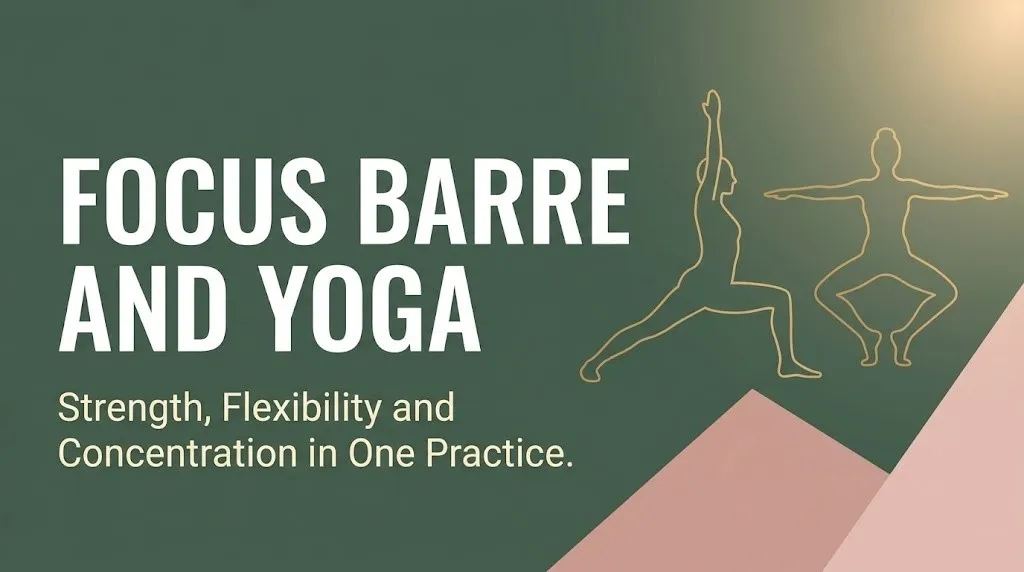
Focus barre and yoga is a hybrid practice that blends the small isometric movements of barre fitness with the breath awareness, alignment principles, and mindfulness of yoga. Together, they create a workout that builds precise muscular strength, improves flexibility, and trains your ability to concentrate under physical effort.
This combination is worth paying attention to. The American Council on Exercise notes that isometric training, the contraction style at the heart of barre work, builds muscular endurance and joint stability in ways that dynamic movement alone does not match. Pair that with yoga’s documented effects on cortisol reduction and nervous system regulation, and you have a practice that covers both physical and mental conditioning in a single session.
This guide covers everything you need to know about barre yoga as a combined practice. You’ll find a clear explanation of what it is, how it differs from traditional yoga, which muscles it targets, how to build a home routine, and how to adapt it for your specific needs, whether you’re brand new, managing a lower back issue, or practicing well into your senior years.
Focus Barre and Yoga: What This Practice Actually Is
Focus barre and yoga is a structured fitness and mindfulness practice that combines barre technique’s precision and isometric loading with yoga’s philosophy of breath, body awareness, and intentional movement. It is not simply “yoga near a ballet barre.” It is a genuinely distinct practice with its own movement logic.
Barre fitness originated from the Lotte Berk Method, developed in London in the 1950s. Lotte Berk combined her ballet training with rehabilitative exercises she learned during her own recovery from a back injury. Yoga’s influence entered the barre world gradually as instructors recognized how breath cueing and alignment language from yoga improved both safety and results.
The “focus” element in this practice refers to two things simultaneously. First, it describes the mental concentration required to feel small muscular contractions while maintaining postural control. Second, it names a core principle borrowed directly from yoga: directing your attention intentionally to the present movement rather than letting the mind wander during physical effort.
What makes this combination effective is the physiological contrast between the two movement styles:
- Barre technique: Short-range, high-repetition isometric and isotonic contractions that fatigue slow-twitch muscle fibers
- Yoga postures: Longer holds with breath coordination that lengthen the same muscles barre contracts, restoring range of motion
- Combined effect: Strength gains without the shortening of muscle fibers that resistance training can produce over time
Modification for beginners: Start with the yoga-based sections first. Build body awareness and breath coordination before adding barre pulsing movements.
What Is Barre Yoga? A Clear Definition
Barre yoga is a hybrid fitness practice that uses a ballet barre, a chair back, or a wall for balance support while incorporating yoga postures, yoga breathing, and yoga alignment principles alongside barre-style isometric exercises. The goal is a practice that develops both muscular precision and physical flexibility within the same session.
In a standard barre yoga session, you might hold Utkatasana (Chair Pose) for 30 seconds, then pulse your hips a quarter-inch up and down in that range for 20 repetitions, then immediately transition to Adho Mukha Svanasana (Downward-Facing Dog) to lengthen the muscles just worked. That sequence: contract, pulse, lengthen, is the structural signature of barre yoga.
The practice draws from multiple yoga styles. The alignment language comes from Iyengar yoga. The breath coordination comes from Hatha yoga. The flowing transitions between barre and yoga postures sometimes mirror Vinyasa yoga principles. Understanding these distinctions matters because it explains why barre yoga feels different from a general fitness class.
Pose Tip:
- In all barre yoga poses, the breath should always lead the movement
- Never hold your breath during a barre pulse or isometric hold
- If you cannot maintain smooth breathing, reduce the range of movement until you can
Modification for people new to yoga vocabulary: Focus on three breath cues first: inhale through the nose, exhale through the nose, and make the exhale slightly longer than the inhale. Add alignment cues gradually over your first three to four sessions.
Barre Yoga vs Yoga: Key Differences Explained
Barre yoga and traditional yoga differ primarily in their approach to muscular effort, pacing, and the role of the barre as a physical prop. Traditional yoga builds strength through bodyweight holds and transitions. Barre yoga adds external support and small-range isometric contractions that target specific muscle groups more directly.
The most important practical difference is the role of fatigue. In Hatha yoga or Vinyasa yoga, the goal is controlled effort with breath, not muscular failure. Barre yoga intentionally works muscles to fatigue within specific holds, then uses yoga-based stretches to recover. This is a fundamentally different physiological pattern.
| Feature | Traditional Yoga | Barre Yoga |
|---|---|---|
| Primary contraction type | Isometric holds, slow transitions | Isometric holds plus small-range pulsing |
| Breath approach | Central to all movement | Central but adapted for fatigue states |
| Props used | Blocks, straps, bolsters, wall | Barre or chair, plus yoga props |
| Muscular goal | Endurance and flexibility | Endurance, precision strength, and flexibility |
| Flexibility work | Integrated throughout | Specifically positioned after strength sections |
| Mental focus approach | Breath and drishti (gaze) | Breath plus proprioceptive body feedback |
| Pace | Slower holds in Hatha; flowing in Vinyasa | Alternating between pulse sequences and longer holds |
Traditional yoga is not better than barre yoga, or vice versa. They address different physiological needs. Someone whose primary goal is deep flexibility and nervous system recovery may prefer traditional yoga. Someone who also wants targeted lower body strength and core precision may find barre yoga more complete.
Modification note: If you have a strong yoga practice but no barre experience, begin with barre yoga at 50% of your usual range of motion. Barre pulsing at full range before the muscles are adapted to that contraction pattern can cause next-day soreness that is higher than expected.
Key Takeaway: Barre yoga is a distinct hybrid practice that combines yoga’s breath and alignment principles with barre’s isometric precision work. Understanding what makes it different from each parent practice helps you use it more effectively.
Barre Yoga Benefits for Body and Mind
Barre yoga delivers benefits across three systems simultaneously: muscular strength and endurance, flexibility and joint mobility, and nervous system regulation. No single traditional fitness modality addresses all three in the same session.
According to research published in the International Journal of Yoga, mind-body practices that combine breath awareness with physical movement produce greater reductions in cortisol and self-reported stress than exercise alone. Barre yoga’s integration of yoga breathing into physically demanding barre sequences places it squarely in this category.
The physical benefits documented across barre research and yoga research independently, and logically applicable to their combination, include:
- Improved postural alignment: Barre training emphasizes neutral spinal position, which carries over into daily posture
- Increased muscular endurance: High-repetition isometric holds build slow-twitch fiber capacity in the glutes, quadriceps, and core
- Greater flexibility: Yoga-based stretches placed after barre sequences capitalize on the warmth and blood flow the barre work creates
- Enhanced balance and proprioception: Standing balance poses combined with barre support build ankle and hip stability simultaneously
- Reduced perceived stress: Breath-led movement consistently activates the parasympathetic nervous system
The mental focus benefit deserves specific mention. Barre yoga requires you to feel a contraction that is often less than a quarter-inch in range. This demands a quality of internal attention that most people find they can transfer to other areas of focus after consistent practice.
Modification for beginners: Work at half the repetition count of any barre sequence for the first two to three weeks. Your nervous system needs time to learn the contraction patterns before your muscles can work at full capacity safely.
Barre Yoga for Core Strength
Barre yoga builds core strength by targeting the deep stabilizing muscles of the abdomen and spine, particularly the transverse abdominis and the multifidus, through sustained isometric engagement during every standing and floor-based sequence. This is different from surface-level core work like crunches.
Think of the transverse abdominis like a corset that wraps around your entire midsection. Barre yoga teaches you to engage it gently and consistently throughout the entire class, which means your core is working for 45 to 60 minutes rather than for the 30 seconds of a traditional ab set.
A 2019 study published in the Journal of Strength and Conditioning Research found that isometric core exercises produced significant improvements in lumbar stability when performed three times per week for eight weeks. The contraction style in barre yoga aligns directly with this training pattern.
To practice the foundational barre yoga core engagement cue:
- Stand in Tadasana (Mountain Pose) with feet hip-width apart
- Inhale fully through your nose
- On the exhale, draw your lower belly gently inward and upward, as if your navel were rising toward your lower ribcage
- Hold that engagement at about 30% effort, not a full brace, as you breathe normally
- Practice maintaining this engagement for 5 full breath cycles
- Release and repeat three times before beginning any barre sequence
This cue becomes the foundation for every subsequent pose in barre yoga. Without it, the pulsing movements in barre sequences load the lumbar spine rather than the abdominal stabilizers.
Modification for people with diastasis recti: Avoid any cue that draws the belly hard inward. Instead, use a gentle lateral rib expansion breath, where the ribs widen on the inhale and gently recoil on the exhale. A pelvic floor physical therapist can provide specific guidance for your situation.
Barre Yoga for Flexibility
Barre yoga improves flexibility more efficiently than static stretching alone because it uses a contract-relax principle. You contract a muscle through a barre sequence, then immediately lengthen it through a yoga posture. The preceding contraction triggers the muscle’s relaxation response, allowing a deeper and more lasting stretch.
This mechanism is related to a neuromuscular process called proprioceptive neuromuscular facilitation, or PNF. PNF stretching, where you contract a muscle before stretching it, is consistently rated by sports physiotherapists as one of the most effective methods for improving range of motion. Barre yoga applies this principle structurally across an entire class.
The Journal of Alternative and Complementary Medicine has published research showing that yoga-based stretching, when combined with breath coordination, produces greater flexibility improvements than static stretching at the same duration. Adding barre pre-fatigue amplifies this effect by further activating the muscle before the stretch.
Key flexibility targets in barre yoga:
- Hamstrings: Targeted through standing barre exercises followed by Uttanasana (Standing Forward Fold)
- Hip flexors (iliopsoas): Targeted through plié sequences followed by low-lunge yoga holds
- Hip rotators (piriformis, external rotators): Targeted through barre attitude holds followed by Supta Kapotasana (Reclined Pigeon Pose)
- Thoracic spine: Targeted through barre back extension work followed by Setu Bandha Sarvangasana (Bridge Pose)
- Adductors (inner thighs): Targeted through barre wide-stance pliés followed by Baddha Konasana (Bound Angle Pose)
Modification for very tight hamstrings: In all forward-folding yoga stretches after barre work, maintain a generous bend in the knees. Keep the spine long rather than forcing a straight-leg position.
Key Takeaway: Barre yoga’s contract-then-stretch structure uses neuromuscular science to produce flexibility gains faster than static stretching alone. The sequence matters: barre first, yoga stretch immediately after.
Barre Yoga Poses for Beginners
Barre yoga poses for beginners are those with the lowest barrier to entry in terms of balance, strength, and flexibility, while still representing both the barre and yoga elements of the practice. Three poses form the clearest starting point: Utkatasana (Chair Pose), Vrksasana (Tree Pose), and Setu Bandha Sarvangasana (Bridge Pose).
Each of these poses has a direct barre analog and a yoga version. Learning both versions of each pose helps you understand the full practice from the beginning.
| Pose (Sanskrit and English) | Barre Version | Yoga Version | Primary Target |
|---|---|---|---|
| Utkatasana (Chair Pose) | Plie hold with small pulses | Static hold for 5 breath cycles | Quadriceps, glutes, core |
| Vrksasana (Tree Pose) | Barre balance hold, releve option | Standing balance with breath focus | Hip stabilizers, ankle strength |
| Setu Bandha Sarvangasana (Bridge) | Hip lift with small pulses | Full hold with breath coordination | Glutes, hamstrings, spinal extensors |
To practice Utkatasana (Chair Pose) as a beginner barre yoga sequence:
- Stand facing a barre or chair back, hands lightly resting on it
- Place feet hip-width apart, toes pointed slightly outward
- Inhale and lengthen through your spine
- Exhale and bend your knees to a 45-degree angle, no deeper to start
- Draw your lower belly gently inward
- Hold for 3 breath cycles, then pulse a half-inch up and down for 10 repetitions
- Inhale to rise fully and release
Safety caution: Never let your knees travel past your toes in this position. If they do, widen your stance or reduce your depth.
Modification for knee sensitivity: Reduce the bend to 20 to 30 degrees only. Use the barre or chair for as much support as needed. Depth is irrelevant until your quadriceps are strong enough to control the movement without joint stress.
Barre Yoga Routine for Home Practice
A barre yoga routine for home practice needs four things: a stable support structure at approximately hip height, a yoga mat, enough floor space to extend both arms sideways, and a clear sequence that alternates barre and yoga sections. You do not need a studio or expensive equipment to build an effective home practice.
A kitchen counter, the back of a sturdy dining chair, or a wall-mounted bar all work as barre substitutes at home. The surface should be stable enough to bear your weight during balance work but should not be gripped tightly. Your hands rest on the barre lightly. The barre gives you a reference point for balance, not a crutch for it.
A 35-minute beginner barre yoga home routine:
- Warm-up (5 minutes): Marjaryasana-Bitilasana (Cat-Cow) for 8 cycles; Balasana (Child’s Pose) for 10 breaths; Tadasana (Mountain Pose) for 5 breaths with core engagement cue
- Barre standing section (10 minutes): Plie holds and pulses at support (2 sets of 20 pulses); Releve holds for balance (3 holds of 10 seconds each side); Barre arabesque lifts (10 each side)
- Yoga integration (8 minutes): Virabhadrasana II (Warrior II) for 5 breaths each side; Uttanasana (Standing Forward Fold) for 8 breaths; Adho Mukha Svanasana (Downward-Facing Dog) for 5 breaths
- Floor barre section (7 minutes): Bridge pulses (20 repetitions, 2 sets); Side-lying leg lifts (15 each side)
- Yoga cool-down (5 minutes): Supta Matsyendrasana (Supine Spinal Twist) for 8 breaths each side; Savasana (Corpse Pose) for 3 minutes
Modification for very small spaces: Skip the arabesque section and replace it with standing hip abductor lifts holding the chair. These require less space and work the same muscle group.
Focus Yoga: Building Mental Concentration Through Practice
Focus yoga refers to the intentional use of yoga’s attention-training tools, including drishti (focused gaze), breath anchoring, and proprioceptive awareness, to build mental concentration as a primary goal of practice, not just a side effect. In barre yoga, this focus element is what separates practitioners who get consistent results from those who simply go through the motions.
The neuroscience behind this is worth understanding. According to research from the National Center for Complementary and Integrative Health, regular mind-body practice strengthens the prefrontal cortex’s capacity for sustained attention. This is the same region involved in impulse control, working memory, and planning. Yoga’s focus training has measurable effects on brain structure with consistent practice over months.
In practical terms, focus yoga means three things during a barre yoga session:
- Drishti (fixed gaze): Choose one unmoving point at eye level during balance poses. This is not optional. Your visual system is your primary balance reference. A wandering gaze destabilizes every balance pose you attempt.
- Breath anchoring: Return your attention to the breath at every transition. When the barre pulse sequence ends and the yoga stretch begins, your breath is the signal to shift your nervous system from effort to recovery.
- Proprioceptive check-in: Every 5 to 10 minutes, pause for one breath and scan your body from feet to head. Notice where you are gripping unnecessarily and release it.
Modification for people with high mental restlessness: Start focus practice with just the drishti tool. Choose your gaze point before each pose and hold it for the full duration. Add breath anchoring in week two. Add the proprioceptive scan in week three. Layer tools progressively rather than trying all three at once.
Key Takeaway: The focus element in barre yoga is not decorative. Drishti, breath anchoring, and proprioceptive awareness are specific tools that produce measurable changes in concentration and balance with regular practice.
Barre Yoga for Seniors
Barre yoga is particularly well-suited for seniors because it provides a stable support structure during balance training, uses low-impact movement patterns that protect the joints, and builds the specific muscle groups most associated with fall prevention. The chair or barre support removes the anxiety of balance work without removing its training benefits.
According to research published in Complementary Therapies in Medicine, adults over 65 who participated in twice-weekly yoga and balance-focused movement programs showed measurable improvements in gait stability, balance confidence, and lower-limb strength after 8 weeks. Barre yoga addresses all three of these outcomes directly.
The senior-appropriate barre yoga approach differs from a general class in three ways: reduced depth of all knee bends, longer rest periods between barre sequences, and more time spent in supported yoga postures rather than flowing transitions.
Safe and effective barre yoga modifications for seniors:
- All plie and squat movements: Keep knee bend to 20 to 30 degrees maximum; use the barre or chair for full support
- Balance poses (Vrksasana, Tree Pose): Always practice with a wall or chair within reach; foot placed at inner calf only, never at or above the knee
- Bridge Pose: Support the sacrum with a folded blanket if lifting causes lumbar discomfort
- Floor transitions: Use a chair to get down to and up from the floor safely; never drop to the floor from standing
- Pulse sequences: Reduce repetitions to 8 to 10 from the standard 20; rest between sets for 2 full breath cycles
Safety caution: Seniors with osteoporosis should avoid deep spinal flexion. Replace all forward-folding poses with supported seated or standing variations that keep the spine in a neutral or slightly extended position. This guidance applies specifically because forward flexion under load can increase vertebral fracture risk in osteoporotic spines.
Barre Yoga for Lower Back Pain and Posture
Barre yoga addresses lower back pain through two complementary mechanisms: it strengthens the posterior chain muscles, particularly the glutes and hamstrings, that support the lumbar spine from behind, and it improves hip mobility, which reduces compensatory strain on the lower back from restricted hip movement.
Poor posture is often the structural precursor to lower back pain. When the thoracic spine rounds forward and the hip flexors shorten from prolonged sitting, the lumbar spine compensates by increasing its natural curve. Over time, this hyperextension pattern creates chronic muscular tension and joint loading at the L4 and L5 vertebrae.
The American Council on Exercise notes that exercises targeting glute and hip stability, both central to barre yoga, are among the most effective interventions for reducing chronic lower back discomfort in otherwise healthy adults.
Barre yoga poses most effective for lower back support:
- Setu Bandha Sarvangasana (Bridge Pose): Activates the glutes and hamstrings directly; reduces anterior pelvic tilt over time
- Marjaryasana-Bitilasana (Cat-Cow): Mobilizes the lumbar spine through flexion and extension; reduces morning stiffness
- Barre plie with neutral spine: Teaches the pelvis to remain neutral during leg movement, a skill that transfers to daily lifting mechanics
- Supta Matsyendrasana (Supine Spinal Twist): Releases thoracic rotation restriction that contributes to lumbar compensation patterns
Safety caution: Anyone with a diagnosed disc herniation, spinal stenosis, or active sciatica should work with a physical therapist to determine which specific barre yoga movements are appropriate before beginning a group or home practice.
Modification for lower back sensitivity: Perform all standing barre sequences with the back in contact with a wall. This provides proprioceptive feedback about lumbar position and prevents the tendency to hyperextend during leg lifts.
Key Takeaway: Barre yoga’s glute and posterior chain work is one of the most targeted approaches to reducing chronic lower back strain. Strengthening the muscles that support the lumbar spine from behind changes how that spine loads during daily movement.
Barre Yoga Modifications and Props
Barre yoga modifications and props make the practice accessible regardless of current fitness level, flexibility, joint health, or body size. Props in barre yoga are not remedial tools. They are precision instruments that improve the quality of every movement they support.
The prop needs in barre yoga overlap significantly with traditional yoga, with one addition: the barre itself or its home equivalent.
| Prop | Primary Purpose | Home Alternative |
|---|---|---|
| Ballet barre or portable barre | Balance support during standing sequences | Sturdy chair back, kitchen counter, wall |
| Yoga blocks (pair) | Floor elevation for limited range of motion | Thick books, stacked folded towels |
| Yoga strap | Extended reach for tight shoulders or hamstrings | Bathrobe belt, resistance band |
| Yoga bolster | Support in restorative yoga postures | Rolled blankets, firm pillow |
| Folded blanket | Knee and hip cushioning on the floor | Folded bath towel |
| Resistance band | Added challenge in floor barre sequences | Can be skipped initially |
The two most valuable props for a beginner starting at home are a sturdy chair and a pair of yoga blocks. The chair handles everything the barre does in standing sequences. The blocks handle forward fold accessibility and seated pose elevation.
For seniors, a non-rolling, four-legged chair is the single most important prop in the entire practice. It provides balance support, a surface for seated sequences, and a safe mechanism for transitioning to and from the floor.
Modification for people with wrist sensitivity: In any floor-based barre yoga sequence that involves bearing weight on the hands, replace palm-down positions with fist-supported positions or forearm-supported positions. This reduces wrist extension load considerably.
Barre Yoga Muscles Worked
Barre yoga works muscles across the entire body, but its most distinctive contribution is the targeted fatigue it produces in the quadriceps, glutes, hip adductors, hip abductors, and core stabilizers through sustained low-range contractions that most standard workouts bypass entirely.
Think of the quadriceps in a standard gym squat like a car engine at full throttle. The quadriceps in a barre yoga plie at 45 degrees with small pulses is like a car engine idling at precise, controlled rpm for three minutes. Both work the engine. The second approach builds a very specific kind of endurance and neuromuscular control.
The primary muscle groups engaged across a full barre yoga session:
- Quadriceps: Sustained loading through plié holds, pulsing sequences, and Utkatasana (Chair Pose)
- Glutes (maximus and medius): Loaded through bridge work, arabesque lifts, and side-lying leg sequences
- Hip adductors (inner thighs): Engaged in wide-stance plié variations and Baddha Konasana (Bound Angle Pose)
- Hip abductors (outer hips): Targeted in side-lying barre sequences and Vrksasana (Tree Pose)
- Transverse abdominis and core stabilizers: Engaged throughout every standing and floor sequence with proper cueing
- Hamstrings: Loaded in arabesque and barre kick-back movements, then lengthened in forward fold yoga postures
- Shoulder girdle stabilizers (serratus anterior, lower trapezius): Engaged during barre arm sequences and yoga postures requiring shoulder stability
Modification for people with knee replacement or knee injury: Skip plié pulsing below 20 degrees of knee flexion. Focus on glute and hip abductor work in the side-lying sequences instead, which place minimal stress on the knee joint.
Barre Yoga Breathing Techniques
Breathing in barre yoga serves two distinct functions that do not exist in isolation in most other fitness practices: it regulates effort intensity during demanding barre sequences, and it triggers the recovery response between barre and yoga sections. Learning to use breath for both purposes is what gives barre yoga its particular quality of calm-within-effort.
The primary breath used in the yoga sections of barre yoga is Ujjayi pranayama (Victorious Breath). This involves a gentle constriction at the back of the throat that creates a soft audible sound on both the inhale and exhale. It slows the breath rate, creates internal heat, and provides a consistent auditory anchor for your attention.
During barre pulse sequences, practitioners often find that Ujjayi breath is difficult to sustain at full effort. In these moments, use a simple rhythmic breath instead: exhale on the effort (the pulse or lift), inhale on the recovery (the lowering or pause). This breath pattern coordinates the core stabilizers with the movement, reducing lumbar strain.
To practice Ujjayi pranayama before a barre yoga session:
- Sit in Sukhasana (Easy Seated Pose) or stand in Tadasana (Mountain Pose)
- Inhale through your nose for 4 counts
- At the top of the inhale, gently narrow the back of your throat as if beginning to fog a mirror
- Exhale through your nose with that same gentle constriction for 5 to 6 counts
- The exhale should be audible but soft, like a very gentle ocean wave
- Practice 8 cycles before beginning your barre yoga session
According to the National Center for Complementary and Integrative Health, slow nasal breathing activates the parasympathetic nervous system more effectively than mouth breathing during physical exercise. Maintaining nasal breathing throughout a barre yoga session directly supports the stress-reduction benefits of the practice.
Modification for beginners who find Ujjayi breath uncomfortable: Use a simple “in through the nose, out through the nose” pattern without the throat constriction. Add the constriction element after three to four sessions when the movement patterns feel more automatic.
Key Takeaway: Breath in barre yoga is doing two jobs at once: managing effort during barre sequences and triggering recovery between them. Learning to use it deliberately makes every section of the practice more effective.
How Often Should You Do Barre Yoga?
Most yoga teachers and fitness professionals recommend practicing barre yoga three to four times per week for beginners seeking noticeable physical results, with at least one rest day between sessions to allow muscular recovery from the isometric work.
This frequency recommendation is rooted in how slow-twitch muscle fibers, the primary target of barre training, adapt. They recover faster than fast-twitch fibers and can be trained more frequently. However, the small stabilizing muscles of the hip and knee that barre yoga targets are also easily over-trained if rest is skipped.
| Experience Level | Recommended Frequency | Session Length | Rest Between Sessions |
|---|---|---|---|
| Complete beginner | 2 times per week | 20 to 30 minutes | At least 2 days |
| Beginner with some fitness base | 3 times per week | 30 to 45 minutes | 1 day minimum |
| Intermediate | 4 times per week | 45 to 60 minutes | Alternate days |
| Advanced | 5 times per week | 60 minutes | 1 full rest day per week |
The single most consistent finding in barre research and yoga research alike is that regularity over months matters more than intensity per session. Practicing twice a week every week for three months produces more durable results than five sessions a week for two weeks followed by a break.
A practical starting point: commit to two sessions per week for the first month. Track how your body responds. If soreness resolves within 24 to 36 hours and you feel recovered before each session, add a third session in month two.
Modification for those returning from injury: Begin with one session per week and monitor joint response for 48 hours after each session. Only increase frequency when the previous session produces no unusual soreness or swelling at the affected joint.
Frequently Asked Questions About Focus Barre and Yoga
What is the difference between barre and barre yoga?
Standard barre fitness focuses purely on isometric and small-range strengthening movements at a ballet barre, with no yoga integration.
Barre yoga adds yoga postures, yoga breathing techniques like Ujjayi pranayama, yoga alignment principles, and mindfulness elements to create a practice that also develops flexibility and nervous system regulation.
The key structural difference is that barre yoga includes deliberate yoga-based stretching sequences placed strategically after barre strengthening sections.
Is barre yoga good for beginners with no dance background?
Yes, barre yoga is accessible to beginners with no dance background because it replaces ballet terminology with yoga alignment language and uses a support structure for all balance work.
You do not need flexibility, dance experience, or any specific fitness level to begin, though starting with shorter sessions at reduced range of motion reduces the risk of next-day muscle soreness.
Most beginners find the yoga-based sections more familiar than the barre sections initially, and the two elements complement each other well during the learning curve.
How many times a week should I do barre yoga to see results?
Most barre yoga practitioners and fitness professionals recommend starting with two sessions per week for the first month, then progressing to three sessions per week in months two and three.
Research on isometric training frequency suggests that three sessions per week produces measurable strength and endurance improvements within six to eight weeks for most adults.
Consistency over months is more important than session frequency in the short term.
Can barre yoga help with lower back pain?
Barre yoga can support lower back pain reduction by strengthening the glutes and hamstrings that stabilize the lumbar spine, and by improving hip mobility that reduces compensatory lumbar strain.
The American Council on Exercise identifies glute and hip stability training as one of the most effective approaches for chronic low back discomfort in otherwise healthy adults.
Anyone with a diagnosed spinal condition such as disc herniation or stenosis should get specific guidance from a physical therapist before beginning barre yoga, as certain movements require modification.
What do I need to start barre yoga at home?
To start barre yoga at home, you need a yoga mat, a sturdy chair with a non-rolling base or a kitchen counter at approximately hip height, and enough floor space to extend both arms sideways.
Two yoga blocks are the most useful optional addition for beginners, as they make forward fold positions accessible before flexibility develops.
A portable ballet barre is a worthwhile investment if you practice regularly, but it is not necessary for a functional beginner home practice.
Start with two sessions this week. Pick the beginner sequence in the home practice section and run through it at half intensity. Notice where your body finds the barre pulses easy and where the yoga stretches feel tight. That information tells you exactly where to focus your first month of practice.
Add one element at a time: first the movement, then the breath cue, then the focus tool. Barre yoga rewards patience with precision.
The practice is not about how deep your plie is or how long you can hold a balance pose. It’s about showing up consistently and bringing your full attention with you each time.