Greenhouse Yoga Guide: Nature Practice and Classes 2026
Greenhouse yoga is a style of yoga practiced in plant-filled, naturally lit, warm environments, blending the physical discipline of yoga with the documented psychological benefits of nature immersion. It is one of the fastest-growing practice formats in the wellness community, particularly in regions like Great Barrington, Massachusetts, where nature and mindful movement culture are deeply intertwined.
The research behind this combination is worth your attention. A study published in the Journal of Environmental Psychology found that even brief exposure to natural settings reduces cortisol levels and self-reported stress more effectively than equivalent time spent in built environments. When that natural setting becomes your yoga space, the practice gains a measurable physiological advantage before you even step on the mat.
This guide covers what greenhouse yoga actually is, how it works physically and mentally, what the Berkshires yoga scene looks like in 2026, which poses and sequences work best in warm nature-immersive environments, and how to practice safely whether you are a complete beginner or a long-term practitioner managing a health condition.
What Is Greenhouse Yoga?
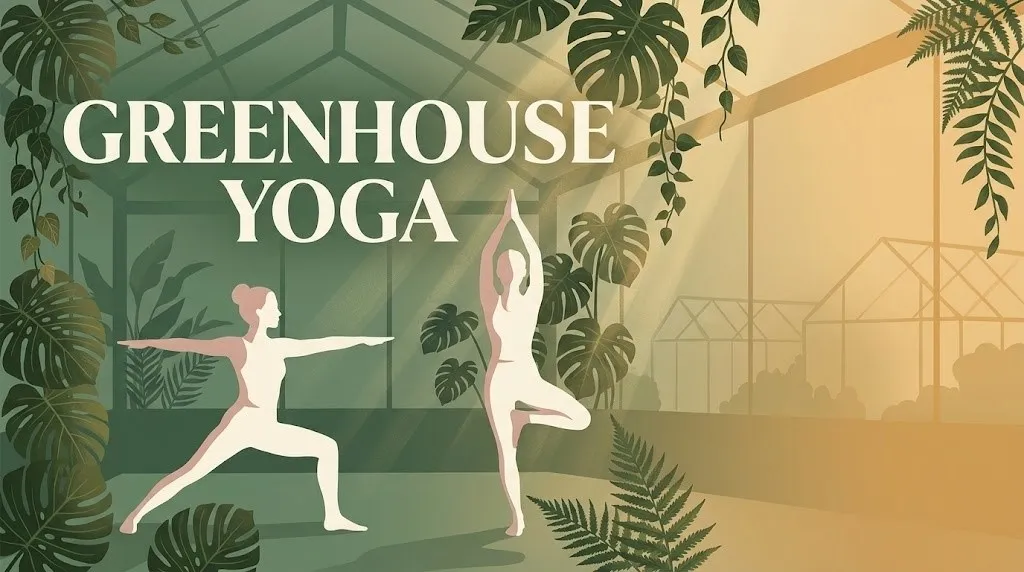
Greenhouse yoga is yoga practiced inside a glass-enclosed, plant-rich space where natural warmth, humidity, and living greenery create an immersive sensory environment distinct from a conventional yoga studio. The setting is the defining feature, not a separate style.
The practice itself may be Hatha yoga, Vinyasa yoga, Restorative yoga, or Yin yoga, depending on the studio’s programming. What makes it “greenhouse yoga” is the environment: glass walls or ceiling panels that admit natural light, plants at various heights surrounding the practice space, and ambient warmth that typically ranges between 72 and 80 degrees Fahrenheit, generated passively by solar heat rather than mechanical systems.
This is not the same as hot yoga or Bikram/26&2 yoga, which uses an artificially heated room at 105 degrees Fahrenheit. Greenhouse yoga temperatures are moderate, and humidity levels reflect the natural transpiration of surrounding plants rather than a humidification system.
The sensory effect is meaningful. Natural light shifts throughout the session as clouds pass. The sound of leaves, the scent of soil, and the visual presence of green living things create a practice environment that activates different neural pathways than a mirrored, climate-controlled studio.
Pose Tip:
- In a greenhouse environment, your mat grip may change as humidity increases. Natural rubber mats perform best.
- Avoid placing your mat directly under overhanging plants where dripping water could affect footing.
- Arrive five minutes early to let your body acclimatize to the warmth before beginning active poses.
Greenhouse Yoga Studio: What to Expect Inside
A greenhouse yoga studio is a dedicated practice space built within or designed to resemble a botanical greenhouse, with structural emphasis on natural light, plant life, and passive climate management. Walking in feels meaningfully different from walking into a standard studio.
Structurally, most greenhouse yoga studios feature glass or polycarbonate panel walls and ceilings, exposed wooden or steel framing, and a mix of tropical and temperate plants arranged around the perimeter and overhead. Floors are typically hardwood, polished concrete, or cork, chosen for warmth underfoot and environmental resonance.
Temperature and humidity are the two environmental factors that most directly affect your practice. Expect a room that feels warm without being oppressive, somewhere between a mild spring day and a heated room in winter. Humidity from plant transpiration keeps the air moist, which many practitioners find easier on the respiratory system than dry conditioned air.
Class sizes in greenhouse yoga studios tend to be smaller than in conventional studios. The intimate spatial layout typically accommodates between eight and sixteen students, which supports more individualized instruction.
| Feature | Greenhouse Yoga Studio | Conventional Yoga Studio |
|---|---|---|
| Light source | Primarily natural sunlight | Artificial, often fluorescent or LED |
| Temperature | 72 to 80°F, passively managed | 68 to 72°F, climate-controlled |
| Humidity | Moderate, from plant transpiration | Low to moderate, mechanically controlled |
| Ambiance | Botanical, sensory-rich | Neutral, often minimalist |
| Class size | Typically 8 to 16 students | Typically 15 to 40 students |
| Floor surfaces | Wood, cork, or polished concrete | Hardwood or rubberized flooring |
Yoga Great Barrington: The Local Scene Explained
Yoga great barrington refers to the well-established, community-driven yoga culture in Great Barrington, Massachusetts, a small Berkshire County town with a concentration of wellness practitioners, studios, and nature-centered programs that is unusually large for a town of its size.
Great Barrington has roughly 7,000 residents, but its yoga and wellness infrastructure resembles that of a much larger urban center. The town sits in the southern Berkshires, surrounded by forested hills, rivers, and the kind of natural setting that makes nature-immersive yoga practices like greenhouse yoga a natural fit for the community.
Studios in Great Barrington generally offer a range of styles: Hatha yoga, Vinyasa yoga, Restorative yoga, and increasingly Yin yoga and Kundalini yoga. The community skews toward experienced practitioners and wellness-oriented visitors rather than casual gym-goers, which tends to mean classes are more carefully sequenced and teachers tend to have deeper training backgrounds.
For visitors planning to practice yoga in Great Barrington during 2026:
- Most studios welcome drop-in students, but booking ahead is strongly recommended for weekend sessions during peak Berkshire tourism season, typically late spring through fall foliage season.
- Smaller class sizes mean teachers will notice you. Tell them your experience level before class begins.
- Great Barrington studios typically offer new-student introductory rates, usually covering your first one to three sessions at a reduced price.
- The town’s farmers’ markets, local food culture, and walking trails make it practical to build a full wellness day around a morning yoga class.
Key Takeaway: Greenhouse yoga is defined by its environment, not its poses. A warm, plant-filled, naturally lit space changes how your body responds to practice before you take a single breath.
Yoga in the Berkshires: Why This Region Matters
Yoga in the Berkshires has developed into one of New England’s most distinctive wellness ecosystems, shaped by the region’s long history of arts, contemplative practice, and deep connection to the natural landscape. The Berkshires attract practitioners who want more than a fitness class.
The region includes Great Barrington, Lenox, Stockbridge, and Pittsfield, each with its own yoga and wellness offerings. The cultural density of this area, Tanglewood, the Norman Rockwell Museum, Kripalu Center for Yoga and Health in Stockbridge, and numerous retreat centers, has created an environment where serious yoga instruction is genuinely accessible.
Kripalu Center for Yoga and Health, located approximately 12 miles from Great Barrington in Stockbridge, is one of the largest yoga retreat centers in North America. Its presence has shaped the teaching standards and community expectations across the entire Berkshire yoga scene. Many local teachers have trained or taught at Kripalu, which elevates the baseline quality of instruction throughout the region.
For practitioners visiting the Berkshires specifically for yoga in 2026:
- The shoulder seasons (May through June and September through October) offer cooler temperatures ideal for outdoor or greenhouse-format practice without summer tourist crowds.
- Retreat programs in the Berkshires frequently combine yoga with hiking, forest bathing (shinrin-yoku), meditation, and nutrition programs.
- The driving distances between Great Barrington, Lenox, and Stockbridge are short, typically under 20 minutes, making it practical to explore multiple studios or retreat offerings in one visit.
Greenhouse Yoga Benefits for Body and Mind
Greenhouse yoga delivers the standard physical benefits of yoga practice alongside specific advantages created by the warm, plant-rich environment that a conventional studio cannot replicate. The combination is genuinely different from indoor practice.
Physical benefits associated with practicing yoga in warm, moderately humid conditions include:
- Increased muscle pliability: Warmth softens connective tissue slightly, which supports deeper range of motion in poses like Adho Mukha Svanasana (Downward-Facing Dog) and hip openers without the injury risk of aggressive stretching.
- Improved circulation: Moderate warmth promotes vasodilation, increasing blood flow to working muscles and accelerating recovery between poses.
- Enhanced breath awareness: Higher humidity makes nasal breathing more comfortable than in dry environments, supporting pranayama practice more naturally.
- Stress hormone reduction: According to the Journal of Environmental Psychology, exposure to living plant environments during physical activity measurably reduces cortisol compared to equivalent exercise in non-plant settings.
- Improved balance: Natural light variation and the visual complexity of a plant-filled space engage proprioceptive systems differently than a mirrored studio wall, which may improve body awareness in standing balance poses.
- Respiratory ease: Plants release oxygen and filter airborne particles. Research in Frontiers in Psychology indicates that indoor environments with substantial plant coverage improve air quality measures relevant to respiratory comfort.
The cumulative physical benefit is a practice environment where your muscles, nervous system, and respiratory system are all supported simultaneously by the space itself.
Greenhouse Yoga Mental Health Benefits
The mental health benefits of greenhouse yoga come from two converging sources: the well-documented effects of yoga on the nervous system and the specific psychological benefits of nature immersion during physical practice.
According to the National Center for Complementary and Integrative Health (NCCIH), yoga practice has demonstrated consistent evidence for reducing anxiety, depressive symptoms, and perceived stress across multiple clinical populations. These effects are primarily mediated through activation of the parasympathetic nervous system, reduction of cortisol, and improvements in body awareness and self-regulation.
Nature immersion adds a distinct layer. Research published in Frontiers in Psychology found that spending time in environments with living plants activates the brain’s attention restoration systems, reducing mental fatigue and improving mood more effectively than equivalent time in non-natural settings. In a greenhouse yoga context, this happens passively throughout the session.
Think of it this way: a conventional studio asks your mind to quiet itself by effort. A greenhouse yoga environment creates conditions where quiet arrives more naturally, because the visual and sensory richness of living plants draws attention outward and away from rumination.
For practitioners managing anxiety, this environmental advantage can make the initial settling-into-practice phase shorter and less effortful. The parasympathetic shift that yoga teachers work to create through breathwork begins arriving the moment you walk into a plant-filled, naturally lit space.
Frontiers in Psychology research also documents that nature-immersive environments reduce physiological markers of stress including heart rate and skin conductance, effects that compound with yoga’s own regulatory mechanisms.
What Does the Research Say About Yoga and Nature?
The research on yoga and nature as combined wellness practices draws from two growing bodies of evidence: clinical yoga research and environmental psychology. Together, they make a coherent case for the greenhouse yoga model.
On the yoga side, a study published in the International Journal of Yoga found that eight weeks of consistent yoga practice produced measurable reductions in perceived stress, anxiety scores, and inflammatory markers compared to a control group. These effects were present across age groups and experience levels.
On the nature side, the concept of shinrin-yoku (forest bathing), developed in Japan in the 1980s and now extensively studied, documents that even 20 minutes of exposure to natural plant environments reduces cortisol, lowers heart rate, and improves self-reported mood. A 2019 review in Frontiers in Psychology synthesizing 64 studies confirmed these effects across diverse populations.
| Research Area | Key Source | Primary Finding |
|---|---|---|
| Yoga and stress reduction | International Journal of Yoga | Reduced perceived stress and anxiety after 8 weeks |
| Nature immersion and cortisol | Journal of Environmental Psychology | Lower cortisol in natural vs. built environments |
| Plant environments and mood | Frontiers in Psychology | Improved mood and reduced mental fatigue |
| Yoga and inflammatory markers | International Journal of Yoga | Reduced inflammation markers over 8 weeks |
| Nature and heart rate | Frontiers in Psychology (2019 review) | Lower heart rate during nature exposure in 64 studies |
The greenhouse yoga model places practitioners at the intersection of both research streams simultaneously. That is not a marketing claim. It is the logical implication of combining two independently validated wellness mechanisms.
Key Takeaway: Greenhouse yoga works on two levels at once: yoga quiets the nervous system from the inside out, while the plant-rich natural environment does the same from the outside in. The two mechanisms reinforce each other.
Greenhouse Yoga Schedule and Classes: How to Get Started
A well-structured greenhouse yoga schedule typically runs sessions across the full week with variety in style and intensity, serving beginners, experienced practitioners, and everyone in between within the same weekly calendar.
Most greenhouse yoga studios in Great Barrington and the broader Berkshires region offer a mix of:
- Morning sessions (7:00 to 9:00 AM): Energizing Hatha or Vinyasa flows that take advantage of early natural light filling the greenhouse space.
- Midday sessions (12:00 to 1:00 PM): Shorter, often 45-minute practices focused on breathwork, gentle movement, or seated sequences.
- Evening sessions (5:30 to 7:00 PM): Restorative yoga, Yin yoga, or candlelit Hatha sessions where the fading natural light creates a naturally quieting atmosphere for nervous system wind-down.
- Weekend workshops (Saturday or Sunday mornings): Extended 90-minute to 2-hour sessions covering themed sequences, seasonal practices, or specific skill-building topics.
For first-time students, the practical steps are:
- Contact the studio or check their posted schedule for a class labeled “beginner,” “all levels,” or “intro to yoga.”
- Book your spot in advance, especially for weekend sessions.
- Arrive ten minutes early to complete any new-student paperwork and speak with the teacher.
- Tell the teacher your experience level and any physical considerations before class begins.
- Bring a water bottle. Even moderate greenhouse warmth increases fluid loss during active practice.
Greenhouse Yoga for Beginners: What You Need to Know
Greenhouse yoga is genuinely accessible to beginners, provided the class is labeled all-levels or beginner and the student arrives prepared for the environmental conditions. The warm, plant-filled setting can actually make first-time practice easier, as the warmth supports muscle relaxation and reduces the stiffness that often makes beginners feel discouraged.
What a beginner should know before attending their first greenhouse yoga class:
- Wear breathable, moisture-wicking clothing. The ambient warmth of a greenhouse space will make you perspire more than in a cooler studio, even during a gentle Hatha class. Avoid heavy cotton.
- Hydrate before and after. Drink approximately 16 ounces of water in the hour before class. Do not drink large amounts during the session, but small sips are appropriate.
- Eat lightly. Practicing on a full stomach in a warm environment is uncomfortable. A light snack two hours before class is appropriate. Avoid a full meal within three hours of practice.
- Props are always available. In a quality greenhouse yoga studio, blocks, straps, and blankets are provided. Use them without hesitation. They are standard equipment, not training wheels.
- Rest in Balasana (Child’s Pose) whenever needed. This is always an acceptable option in any class, at any moment. No explanation is required.
Beginners with no prior yoga experience should prioritize Hatha yoga sessions for their first four to six weeks. The slower pace and detailed alignment instruction build a physical foundation that makes every subsequent class more effective.
Greenhouse Yoga Sequence and Poses
A greenhouse yoga sequence is built around poses that respond well to moderate warmth and natural light, where slightly increased muscle pliability supports safe exploration of range of motion without overreach. The following sequence works for all levels.
To practice a foundational greenhouse yoga sequence:
- Begin in Sukhasana (Easy Seated Pose) on your mat. Close your eyes. Take ten slow natural breaths. Let the warmth and ambient plant scent register.
- Shift to hands and knees. Practice Marjaryasana-Bitilasana (Cat-Cow Pose) for eight slow breath cycles, synchronizing the spinal flexion and extension with the inhale and exhale.
- Press back into Adho Mukha Svanasana (Downward-Facing Dog). Hold for five breaths. Keep a micro-bend in the knees if hamstrings are tight.
- Step to the front of your mat. Rise to Tadasana (Mountain Pose). Stand tall. Take three grounding breaths.
- Shift weight to the right foot. Slowly move into Vrikshasana (Tree Pose). Place the left foot above or below the right knee, never on it. Hold for five breaths. Repeat on the left side.
- Step into Virabhadrasana II (Warrior II) on the right side. Front knee tracks over the second toe. Arms extend wide. Hold five breaths. Switch sides.
- Come to the floor. Place feet flat, knees bent. Practice Setu Bandha Sarvangasana (Bridge Pose). Press through the feet to lift the hips. Hold five breaths. Lower with control.
- Hug knees to chest. Breathe. Slowly extend into Savasana (Corpse Pose). Rest for five to ten minutes.
Modification for all poses: If the warmth causes lightheadedness at any point, lower immediately to the floor and rest in Balasana (Child’s Pose) until it passes. This is a normal response to warmth adjustment and resolves quickly with rest.
Key Takeaway: A greenhouse yoga sequence uses the warmth to your advantage in every pose, but resting on the floor the moment you feel dizzy is not optional. Heat adjustment is real, and the mat is always the safest place to be.
Yoga Breathing in Nature: Pranayama for Greenhouse Practice
Breathing in a greenhouse yoga environment has a genuine physiological advantage: the air quality is measurably better than in a sealed, climate-controlled studio, and the higher humidity makes nasal breathing more comfortable and sustainable throughout practice.
Pranayama (yogic breath control) is the formal name for breathing practices in yoga. Three techniques are particularly well suited to greenhouse and nature-immersive settings:
Dirga Pranayama (Three-Part Breath):
This technique fills the lungs in three sequential stages: the lower belly first, then the mid-chest, then the upper chest. It is the ideal opening breath for a greenhouse yoga session because it slows the respiratory rate immediately and activates the parasympathetic nervous system before any physical movement begins.
To practice Dirga Pranayama:
- Sit in Sukhasana (Easy Seated Pose) or lie in Savasana (Corpse Pose).
- Inhale slowly into the lower belly first. Feel it expand.
- Continue the inhale into the mid-chest. Feel the ribcage widen.
- Complete the inhale into the upper chest and collarbones.
- Exhale in reverse: upper chest releases, mid-chest drops, belly draws in gently.
- Practice for five to ten complete cycles before beginning movement.
Ujjayi Pranayama (Victorious Breath):
Produced by slight throat constriction during nasal breathing, this technique is used throughout Hatha and Vinyasa practice. In a plant-rich space, the gentle sound of Ujjayi breath mixing with ambient natural sounds creates an experience of focused calm that is genuinely distinct from studio practice.
Modification: Anyone with a respiratory condition, significant nasal blockage, or recent sinus surgery should return to natural nasal breathing rather than forcing either technique.
Yoga in Heated Spaces vs. Hot Yoga: What Is the Difference?
Greenhouse yoga and hot yoga (specifically Bikram/26&2 yoga) both involve practicing in warm spaces, but the similarities end there. Confusing them is one of the most common misconceptions for people new to greenhouse practice.
| Factor | Greenhouse Yoga | Hot Yoga (Bikram/26&2) |
|---|---|---|
| Temperature | 72 to 80°F (passively generated) | 105°F (mechanically controlled) |
| Humidity | Moderate, from plant transpiration | 40% relative humidity, mechanically set |
| Heat source | Solar gain and plant environment | Industrial heating system |
| Sequence | Variable (Hatha, Vinyasa, Restorative, Yin) | Fixed 26-pose sequence, always the same |
| Sensory environment | Living plants, natural light, ambient sound | Mirrors, artificial light, carpeted floors |
| Cardiovascular demand | Low to moderate | High; elevated heart rate is standard |
| Risk level for beginners | Low to moderate | Moderate to high; heat acclimation required |
| Risk level for seniors | Low to moderate with modifications | Higher; cardiovascular load requires medical clearance |
The American College of Sports Medicine advises that exercising in environments above 90°F substantially increases cardiovascular load and thermoregulatory demand, particularly in adults over 50 and people with cardiovascular conditions. Greenhouse yoga temperatures do not reach that threshold under normal conditions.
If you have been advised to avoid vigorous heat-based exercise for a cardiovascular, blood pressure, or thermoregulation-related reason, greenhouse yoga at passive warmth levels is generally appropriate, but confirm with the physician managing your condition before your first session.
Greenhouse Yoga Modifications for Every Body
Modifications in greenhouse yoga account for two variables simultaneously: the individual’s physical capacity and the environmental warmth that affects how poses feel and how the body responds. Both matter.
Core modifications for common greenhouse yoga poses:
| Pose | Standard Version | Modification | Who It Serves |
|---|---|---|---|
| Adho Mukha Svanasana (Downward Dog) | Straight legs, heels toward floor | Knees bent, focus on spinal length | Tight hamstrings; wrist sensitivity |
| Vrikshasana (Tree Pose) | Foot at inner thigh | Foot at ankle, toes touching floor | Balance challenges; ankle instability |
| Virabhadrasana II (Warrior II) | Full depth lunge | Shorter stance, hands on hips | Knee sensitivity; hip tightness |
| Setu Bandha Sarvangasana (Bridge Pose) | Full hip lift | Block under sacrum (Restorative version) | Lower back sensitivity; fatigue |
| Tadasana (Mountain Pose) | Both feet together | Feet hip-width apart | Balance concerns; dizziness prevention in warmth |
In warm environments specifically, these additional modifications apply:
- If you feel overheated during any pose, lower to the floor immediately. Rest in Balasana (Child’s Pose) with forehead on the mat.
- Standing poses should always be accessible from a seated position if warmth causes dizziness. Every standing sequence can be practiced seated on a block or folded blanket.
- Props are especially important in greenhouse settings because sweat reduces grip. A non-slip mat, a microfiber towel, and foam blocks (which resist moisture better than cork in humid conditions) are the three most useful items.
Greenhouse Yoga for Seniors and Health Conditions
Greenhouse yoga is well suited to older adults and people managing common health conditions when the environmental warmth is moderate and the teacher provides appropriate instruction. The key variables to assess are temperature, cardiovascular load, and the physical demands of the specific class style.
According to the National Center for Complementary and Integrative Health (NCCIH), yoga practice in older adults is associated with improvements in balance, flexibility, gait speed, and self-reported quality of life. Community-based yoga settings with consistent instruction, like greenhouse studios with smaller class sizes, support these benefits more reliably than large anonymous group classes.
Condition-specific guidance for greenhouse yoga:
- Osteoporosis: Standing weight-bearing poses like Tadasana (Mountain Pose) and Vrikshasana (Tree Pose) are generally appropriate and bone-supportive. Avoid unsupported forward folds, deep twists, and full inversions. The warmth of a greenhouse setting is beneficial for bone-adjacent joint comfort.
- Arthritis: Moderate warmth reduces joint stiffness, making greenhouse yoga particularly comfortable for people with osteoarthritis of the hips, knees, or spine. Avoid holding poses past the point of joint discomfort. Gentle Hatha yoga sessions are the most appropriate starting point.
- Hypertension (high blood pressure): The passive warmth of greenhouse yoga is within acceptable ranges for most people with managed hypertension. Avoid inversions and breath-holding. People whose blood pressure is currently uncontrolled should get clearance from the physician managing their care before beginning any warm-environment practice.
- Anxiety and depression: The combined environmental (plant-immersive) and yogic (parasympathetic) effects of greenhouse yoga make it one of the most supportive practice formats available for people managing anxiety. Restorative greenhouse yoga sessions are the gentlest entry point.
- Chronic lower back pain: Setu Bandha Sarvangasana (Bridge Pose) in its restorative block-supported variation and gentle supine sequences are well tolerated. Avoid deep forward folds or poses that provoke lumbar pain regardless of the environmental warmth.
Seniors attending greenhouse yoga for the first time should arrive early, speak with the teacher about any joint replacements, cardiovascular history, or balance concerns, and choose seats or mat placement near the door or a wall for easy exit if needed.
Key Takeaway: Greenhouse yoga’s moderate warmth is genuinely beneficial for seniors and people with arthritis or anxiety, but anyone with uncontrolled hypertension or recent surgery needs individualized clearance before practicing in any warm environment.
Frequently Asked Questions About Greenhouse Yoga
What is greenhouse yoga and how is it different from regular yoga?
Greenhouse yoga is yoga practiced in a plant-filled, glass-enclosed space where natural warmth, humidity, and living greenery create an immersive environment distinct from a conventional studio.
The poses and styles practiced are the same as in any yoga class, including Hatha, Vinyasa, or Restorative yoga. The environment is what changes the experience.
Research from the Journal of Environmental Psychology shows that the presence of living plants during physical activity measurably reduces cortisol compared to non-plant settings.
Is greenhouse yoga the same as hot yoga?
Greenhouse yoga and hot yoga are not the same practice.
Hot yoga (Bikram/26&2) heats the room mechanically to 105°F with 40% humidity and follows a fixed 26-pose sequence. Greenhouse yoga uses passive warmth between 72 and 80°F generated by natural solar gain and plant transpiration.
The cardiovascular demand, temperature, and sensory environment are all substantially different.
What should I bring to a greenhouse yoga class?
Bring a non-slip yoga mat, a small microfiber towel, and a water bottle with at least 16 ounces of water.
Wear breathable, moisture-wicking clothing since greenhouse warmth will increase perspiration even during gentle sessions.
Props including blocks, straps, and blankets are typically provided by the studio, but confirm with your specific studio before your first visit.
Is greenhouse yoga safe for beginners and older adults?
Greenhouse yoga at moderate warmth levels (72 to 80°F) is safe for most beginners and older adults when classes are appropriately labeled all-levels or gentle.
Older adults with cardiovascular conditions, joint replacements, or balance concerns should tell the teacher before class so appropriate modifications can be offered.
Anyone with uncontrolled blood pressure or a recent serious injury should get clearance from the physician managing their condition before attending.
What yoga styles are most common at greenhouse yoga studios in Great Barrington?
Hatha yoga and Restorative yoga are the most commonly offered styles at greenhouse yoga studios in the Great Barrington and broader Berkshires area.
Vinyasa yoga and Yin yoga appear regularly on most studio schedules, with occasional Kundalini yoga workshops.
The regional yoga culture in the Berkshires tends toward thoughtful, alignment-focused instruction rather than high-intensity fitness-oriented classes.
Your Practice Starts With the First Breath Inside That Space
Find one greenhouse yoga class this week, whether in Great Barrington, online, or at a local studio that uses natural light and plants in its space. Arrive early. Speak to the teacher. Put your mat near the plants.
Try the foundational sequence in this guide before your first attended session. Run through it at home with a block under your hand in Adho Mukha Svanasana (Downward-Facing Dog) if your hamstrings are tight, and use the Dirga Pranayama opening breath to settle in.
The warmth, the green, and the breath will do the rest.