Complete Release Yoga Guide: Best Poses and Sequences 2026
Release yoga is a slow, intentional practice that uses sustained holds, deliberate breath, and gentle gravity to dissolve chronic muscle tension from the inside out. Whether you’re a beginner, a senior, or someone managing chronic stress, this guide gives you everything you need to start practicing today.
Research from the National Center for Complementary and Integrative Health confirms that slow, mind-body practices like yoga reduce markers of physiological stress, including elevated cortisol and heightened sympathetic nervous system activation. That’s not vague wellness talk. That’s measurable change in how your body responds to tension.
Here you’ll find clear definitions, the science behind why sustained holds work, a full beginner sequence with timing and breath cues, pose breakdowns for hips, back, and shoulders, and safety guidance for people with specific conditions or limited mobility.
What Is Release Yoga?
Release yoga is a practice that uses slow, passive, long-duration poses to let the body soften and discharge accumulated physical and mental tension. Unlike dynamic or strength-based yoga styles, release yoga asks you to stop working and simply let gravity and breath do the work for you.
The word “release” in this context refers to both physical and neurological letting go. Muscles that have been held in chronic contraction, think the neck after hours at a screen, need a specific kind of invitation to relax. Quick stretches don’t always reach that layer. Sustained holds with breath awareness get closer.
Release yoga is not a single trademarked style. It’s a category of practice, sometimes taught within Yin yoga, sometimes within Restorative yoga, and sometimes as a standalone therapeutic sequence. A teacher might call a class “release yoga” to indicate its purpose: tension relief, parasympathetic activation, and recovery.
What distinguishes it practically:
- Poses are held for 1 to 5 minutes, sometimes longer
- The body is largely passive, not actively engaging muscles to hold the shape
- Props (bolsters, blocks, blankets, straps) are used to fully support the body
- Breath awareness is central to every pose, not optional
- The pace is significantly slower than Hatha, Vinyasa, or Ashtanga classes
This practice suits desk workers, athletes in recovery, people managing anxiety, and anyone who moves through life in a state of low-grade physical bracing.
Release Yoga Benefits: What Your Body Actually Gains
Release yoga benefits the body and mind through several overlapping mechanisms, including reduced muscle tension, improved joint mobility, lower stress hormone levels, and better sleep quality.
A study published in the Journal of Alternative and Complementary Medicine found that regular slow yoga practice was associated with statistically lower cortisol levels compared to sedentary control groups. That matters because cortisol, the body’s primary stress hormone, contributes to muscle tension, poor sleep, and immune suppression when chronically elevated.
Here are the core documented benefits:
- Reduced chronic muscle tension in the neck, shoulders, hips, and lower back
- Improved range of motion in major joints, particularly hips, thoracic spine, and hamstrings
- Lower perceived stress and anxiety through parasympathetic nervous system activation
- Better sleep onset and quality, particularly when practiced in the evening
- Reduced inflammation markers, based on findings cited by the Harvard T.H. Chan School of Public Health in relation to mind-body practices
- Improved body awareness, which helps people recognize and interrupt tension patterns before they become pain
- Emotional processing support, especially in trauma-informed release yoga settings
Release yoga won’t build strength the way Ashtanga or active Hatha classes do. Its purpose is recovery, restoration, and nervous system regulation. When used alongside more active practices, it creates a more balanced weekly movement diet.
Pose Tip:
- The benefit comes from sustained ease, not pushing further into a stretch
- You should feel a dull, spreading sensation, not a sharp or burning one
- If a pose increases pain rather than easing it, come out and modify
Release Yoga vs. Yin Yoga and Restorative Yoga: What’s the Difference?
Release yoga, Yin yoga, and Restorative yoga are related but distinct approaches to slow, passive practice. Understanding the differences helps you choose the right practice for your needs on any given day.
Yin yoga specifically targets the connective tissues (fascia, ligaments, joint capsules) rather than just muscles. Poses in Yin yoga are held for 3 to 5 minutes or longer, with a deliberate mild discomfort that signals the deeper tissues are being accessed. Yin yoga is rooted in Traditional Chinese Medicine concepts of meridians and qi, though its physical effects on fascia are increasingly supported by Western research.
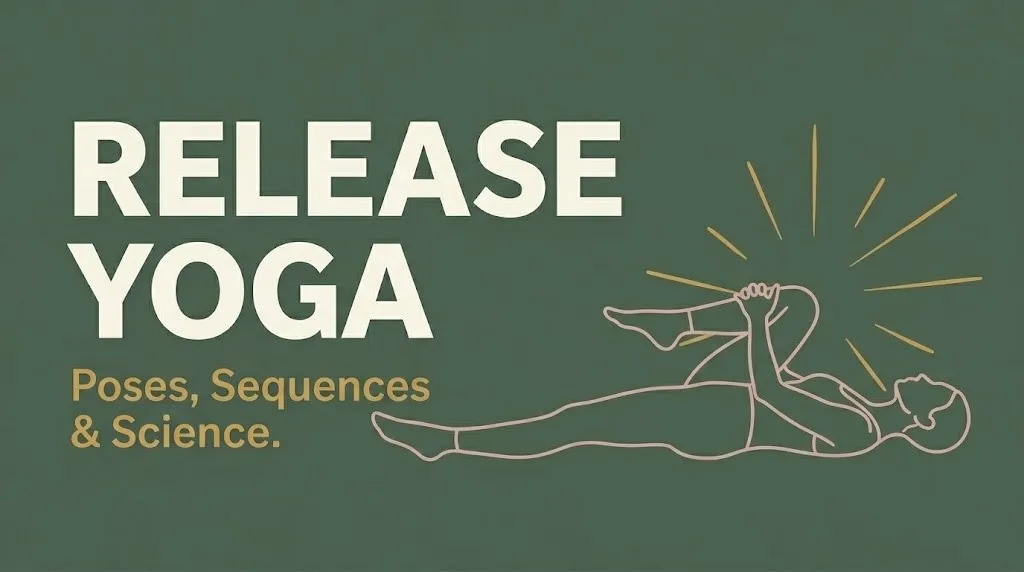
Restorative yoga uses extensive propping to place the body in positions of total support. The goal is complete muscular surrender, and the parasympathetic response is the primary target. Hold times range from 5 to 20 minutes per pose. There is no sensation goal in Restorative yoga. If you feel anything, you may need more props.
Release yoga as a term is broader. It can blend elements of both Yin and Restorative approaches. A release yoga class might hold poses for 1 to 3 minutes, use moderate propping, and focus specifically on the body areas where tension is most socially common: hips, shoulders, neck, and lower back.
| Practice | Hold Duration | Target Tissue | Sensation Goal | Props Used |
|---|---|---|---|---|
| Release Yoga | 1 to 3 min | Muscle and fascia | Mild to moderate | Moderate |
| Yin Yoga | 3 to 5+ min | Fascia and joints | Moderate, intentional | Minimal to moderate |
| Restorative Yoga | 5 to 20 min | Nervous system | None, full surrender | Extensive |
If you’re new to slow practice, release yoga is often the most accessible starting point. It’s less intense than Yin and more structured than pure Restorative.
Release Yoga Poses for Beginners
The best release yoga poses for beginners are those that require no prior flexibility and can be fully supported with simple props. Start with poses that target the areas most people hold tension first: hips, lower back, and shoulders.
Here are six beginner-appropriate release poses:
- Balasana (Child’s Pose): Kneels and folds forward, releasing the lumbar spine and hip flexors. Place a blanket between thighs and calves if your hips don’t reach your heels.
- Supta Baddha Konasana (Reclined Bound Angle Pose): Lying on the back with the soles of the feet together, knees falling wide. Place blocks or rolled blankets under each knee for support.
- Viparita Karani (Legs Up the Wall Pose): Legs rest vertically against a wall. Releases the lumbar spine, hamstrings, and lower leg circulation.
- Supta Kapotasana (Reclined Pigeon Pose): Lying on the back with one ankle crossed over the opposite thigh, gently drawing the legs toward the chest. Safer than the floor version for beginners and tight hips.
- Paschimottanasana (Seated Forward Fold): Seated on the floor, folding forward over straight legs. Use a strap around the feet or sit on a folded blanket to reduce lumbar rounding.
- Uttanasana (Standing Forward Fold): Standing fold with knees gently bent. Hands can rest on blocks or thighs. Decompresses the lumbar spine passively.
Pose Tip:
- Never force a fold. Bend knees generously before worrying about straight legs
- Sit on a folded blanket in any seated pose to reduce tailbone pressure
- Seniors and those with knee concerns should prioritize Supta Kapotasana over floor-based pigeon variations
Key Takeaway: Release yoga is a slow, passive practice that anyone can begin today with just a blanket and floor space, and it works differently from regular stretching by engaging the nervous system, not just the muscles.
Release Yoga Sequence for Full-Body Tension Relief
A complete release yoga sequence moves through the major tension zones: hips and lower back first, then shoulders and thoracic spine, finishing with nervous system calming poses. This order works with the body’s natural release progression.
Suggested Full-Body Release Sequence (40 to 50 minutes total):
- Balasana (Child’s Pose): Hold 2 to 3 minutes. Knees wide, arms extended or alongside body. Breathe into the lower back.
- Supta Kapotasana (Reclined Pigeon Pose), right side: Hold 2 minutes. Flex the top foot. Keep the lower back on the floor.
- Supta Kapotasana (Reclined Pigeon Pose), left side: Hold 2 minutes. Switch legs.
- Supta Baddha Konasana (Reclined Bound Angle Pose): Hold 3 to 4 minutes. Bolster or blocks under both knees. Arms wide to sides.
- Paschimottanasana (Seated Forward Fold): Hold 2 minutes. Strap around feet if needed. Round gently, no forcing.
- Seated spinal twist, right side (Ardha Matsyendrasana, Half Lord of the Fishes Pose): Hold 90 seconds. Breathe into the ribcage on the inhale, deepen the twist slightly on the exhale.
- Ardha Matsyendrasana (Half Lord of the Fishes Pose), left side: Hold 90 seconds.
- Supported Matsyasana (Supported Fish Pose): Bolster under the thoracic spine, arms wide. Hold 3 to 4 minutes. Opens the chest and front shoulders.
- Viparita Karani (Legs Up the Wall Pose): Hold 5 minutes. Optional: cover the eyes with a folded cloth.
- Savasana (Corpse Pose): Hold 5 minutes minimum. Blanket over body. Complete stillness.
Modification: Shorten holds to 60 to 90 seconds if you’re new. Skip the seated twist if you have disc herniation and substitute a gentle supine knee-to-chest pose (Apanasana) instead.
How Long Should You Hold Release Yoga Poses?
Most release yoga holds range from 1 to 5 minutes, depending on your experience level, the targeted tissue, and your comfort in the pose. Shorter holds are appropriate for beginners; longer holds (3 to 5 minutes) are better suited for experienced practitioners and deeper tissue work.
The reason duration matters is biomechanical. Muscles need approximately 60 to 90 seconds of sustained, gentle load before they begin to neurologically “signal” a reduction in protective tension. This is related to a mechanism called autogenic inhibition, where the Golgi tendon organs (tension-sensing receptors in the muscle-tendon junction) signal the nervous system to reduce contraction.
Fascia, the connective tissue surrounding muscles and joints, responds to even longer holds. Physical therapists and Yin yoga teachers generally note that 3 to 5 minutes is the threshold where fascial tissue begins to remodel in response to sustained gentle load. This is not the same as aggressive stretching. The load must be moderate and consistent.
| Experience Level | Recommended Hold | Focus |
|---|---|---|
| Beginner | 60 to 90 seconds | Muscle relaxation, breath awareness |
| Intermediate | 2 to 3 minutes | Muscle and fascial release |
| Advanced / Yin practitioner | 3 to 5+ minutes | Deep fascial and joint tissue |
| Seniors / Sensitive conditions | 45 to 90 seconds | Comfort, safe range |
If a hold feels sharp or intensifies significantly past the first 30 seconds, that is a signal to modify or come out. A gradual, spreading sensation that slowly eases is the target feeling.
Release Yoga Breathing Techniques That Deepen the Release
Breath is not optional in release yoga. The specific way you breathe during a sustained hold directly influences how much tension your nervous system allows the body to release.
The most effective breathing pattern for release yoga is diaphragmatic breathing, sometimes called belly breathing. The belly expands on the inhale, not the chest. The exhale is slow, controlled, and slightly longer than the inhale. This activates the vagus nerve and signals the parasympathetic nervous system to downregulate arousal.
A commonly taught technique in release yoga is a 4:6 breath ratio: inhale for a count of 4, exhale for a count of 6. Research published in Frontiers in Human Neuroscience has documented that extended exhalation patterns increase parasympathetic tone measurably within just a few minutes.
Ujjayi pranayama (ocean breath) is also appropriate for release yoga. It involves a gentle constriction at the back of the throat during breathing, creating a soft audible sound. Ujjayi adds a slight warmth to the breath and helps maintain internal focus during long holds.
To practice diaphragmatic release breathing:
- Settle into your chosen pose and allow your body weight to rest fully.
- Place one hand on the belly, one on the chest.
- Inhale slowly through the nose for a count of 4. The belly should rise; the chest stays relatively still.
- Exhale slowly through the nose for a count of 6. Let the belly fall fully.
- Repeat for the duration of the hold, ideally 5 to 10 breath cycles minimum.
Modification: If nasal breathing is difficult due to congestion or anxiety, use a gentle open-mouth exhale with a soft “haaa” sound. This still activates the vagus nerve and is appropriate for all levels.
Key Takeaway: The breath is the mechanism, not a background detail. A 4:6 inhale-to-exhale ratio during holds measurably shifts your nervous system toward calm and is the single most effective tool in your release yoga practice.
How Release Yoga Helps With Stress and Anxiety
Release yoga reduces stress and anxiety by physically interrupting the body’s fight-or-flight activation patterns and replacing them with postures and breath patterns that signal safety to the nervous system.
Anxiety has a physical component that is easy to overlook. When the body is chronically stressed, the muscles of the shoulders, jaw, hip flexors, and diaphragm often tighten reflexively. Think of your hip flexors like a compressed spring that has been loaded all day under desk-work and worry. Release yoga poses that target these specific areas begin to physically undo that compression.
According to the National Center for Complementary and Integrative Health (NCCIH), yoga practices that emphasize slow movement, breath awareness, and relaxation have shown positive effects on self-reported anxiety levels, sleep quality, and mood in multiple clinical trials. The NCCIH identifies yoga as a complementary approach that can be used alongside standard care for anxiety disorders, not as a replacement.
The emotional dimension matters too. Slow, body-aware practice can bring up feelings that have been physically stored as tension. This is not a medical claim. Many yoga teachers and somatic therapists observe this pattern consistently. If emotions arise during long holds, treating them as part of the release rather than something to suppress tends to produce more lasting results.
People with generalized anxiety disorder or PTSD who want to use release yoga should know that certain poses, particularly those that feel vulnerable or constrictive, may feel activating rather than calming. A trauma-informed yoga teacher can help identify modifications that maintain the felt sense of safety throughout the practice.
How Release Yoga Affects Your Nervous System
Release yoga works on the nervous system by activating the parasympathetic nervous system, the branch responsible for rest, digestion, and recovery, and downregulating the sympathetic nervous system, which governs the stress response.
The two branches of the autonomic nervous system are always in a dynamic balance. Most adults in high-demand environments spend extended time with the sympathetic system dominant. Muscle tension, shallow breathing, poor digestion, and disrupted sleep are common results. Release yoga uses posture and breath to shift that balance.
The vagus nerve is the primary pathway through which this shift happens. It runs from the brainstem through the chest and into the abdomen, and it governs parasympathetic responses. Slow exhalation, gentle inversion (as in Viparita Karani), and abdominal breathing all stimulate the vagus nerve directly.
A 2022 review published in Complementary Therapies in Medicine found that yoga practices involving sustained poses and controlled breathing produced measurable increases in heart rate variability (HRV), a marker of parasympathetic tone and resilience. Higher HRV is associated with better stress regulation and recovery capacity.
This is why release yoga often produces a feeling of physical heaviness, warmth, or involuntary twitching in muscles during or after a session. Those sensations are neurological, signs that protective muscle tension is being discharged through the nervous system.
Pose Tip:
- The “melting” feeling in a long hold is a positive neurological sign, not weakness
- If you feel suddenly emotional, cold, or spacey, you may be moving through a stress response quickly; slow your breath and shorten the hold if needed
- End every session with at least 5 minutes of Savasana (Corpse Pose) to allow the nervous system to integrate
Key Takeaway: Release yoga shifts your body out of chronic sympathetic overdrive and into the rest-and-recover state through vagus nerve stimulation, and that shift is measurable in your heart rate variability within a single session.
Fascia Release Yoga: Why Connective Tissue Matters
Fascia release yoga targets the dense, three-dimensional network of connective tissue that wraps every muscle, bone, nerve, and organ in the body. When fascia becomes restricted, it limits range of motion and contributes to chronic pain even when muscles themselves are not injured.
Fascia responds differently from muscle. It is largely avascular (meaning it has limited blood supply), which is why it responds slowly to treatment and requires long-duration, low-load input rather than brief, forceful stretching. Think of fascia like a thick cotton sweater. If you pull it hard for one second, nothing changes. If you gently hold a stretch for several minutes, the fibers begin to reorganize.
Research published in the Journal of Bodywork and Movement Therapies has documented that sustained, low-load stretching (the type used in Yin yoga and release yoga) produces measurable changes in fascial tissue organization over time. These changes correlate with improved mobility and reduced local discomfort.
The areas most commonly affected by fascial restriction:
- Thoracolumbar fascia (lower back and sacral region, often tight in people with sedentary lifestyles or chronic back pain)
- Iliotibial band and lateral hip fascia (particularly in runners and cyclists)
- Plantar fascia (bottom of the foot, often connected to restricted calf and hamstring lines)
- Anterior chest and shoulder fascia (compressed by prolonged desk posture)
Poses that address fascial release include long-held Supta Kapotasana (Reclined Pigeon Pose) for lateral hip fascia, supported Matsyasana (Supported Fish Pose) for chest fascia, and Balasana (Child’s Pose) for thoracolumbar fascia.
Modification: If you experience sharp or burning sensations rather than a dull spreading stretch, the load is too intense for your current fascial sensitivity. Reduce the depth of the pose and increase the prop support instead.
Release Yoga for Tight Hips
Release yoga for tight hips focuses on the hip flexors, external rotators, and the deep muscles of the hip joint, particularly the iliopsoas and piriformis, which accumulate tension from prolonged sitting and stress.
The hip joint is where the body stores a significant amount of unconscious bracing. Prolonged sitting shortens the iliopsoas. Stress activates the piriformis. Poor posture loads the sacroiliac joint unevenly. Release yoga addresses all three through different hip-targeted poses.
The most effective release yoga poses for tight hips:
- Supta Kapotasana (Reclined Pigeon Pose): Targets the piriformis and deep external rotators. Lie on the back, cross one ankle over the opposite thigh, flex the top foot, and draw the legs gently toward the chest. Hold 2 to 3 minutes per side.
- Supta Baddha Konasana (Reclined Bound Angle Pose): Soles of the feet together, knees falling wide. Targets the inner thighs (adductors) and hip flexors passively. Hold 3 to 4 minutes.
- Ananda Balasana (Happy Baby Pose): On the back, knees toward armpits, hands gripping the outer feet. Rocks the pelvis and releases the sacroiliac joint. Hold 90 seconds to 2 minutes.
- Low Lunge variation (Anjaneyasana): One knee on the floor, front foot forward. Targets the iliopsoas of the back leg. Use blocks under the hands. Hold 90 seconds per side.
According to the American College of Sports Medicine, flexibility improvements in the hip joint require sustained stretching performed at least three times per week to produce lasting range-of-motion changes.
Modification: If getting down to the floor is uncomfortable, all hip release poses above have chair or wall alternatives. Seated figure-four (ankle over knee in a chair) mimics Supta Kapotasana effectively and safely.
Release Yoga for Back Pain
Release yoga for back pain uses passive, supported poses that decompress the lumbar spine, reduce muscle guarding, and restore natural spinal curves without loading the vertebral discs or aggravating inflamed structures.
Back pain is one of the most common reasons people search for release yoga. Research from the Spine Journal and multiple NIH-funded studies has established that yoga-based interventions reduce chronic low back pain symptoms in a clinically meaningful way, particularly for non-specific lower back pain.
The key distinction for back pain is between muscle-related and disc-related pain. Muscle tension and spasm respond well to gentle, supported release yoga. Active disc herniation with nerve compression is more complex. People with known disc herniation should work with a physical therapist or yoga teacher trained in therapeutic yoga before attempting poses that involve forward flexion or deep hip work.
The safest back-relief poses in a release yoga context:
- Balasana (Child’s Pose): Gently flexes and decompresses the lumbar spine. Wide-knee variation reduces compression on the lower back.
- Supta Padangusthasana (Reclined Hand to Big Toe Pose): Lying on the back, one leg extended upward with a strap around the heel. Releases the hamstrings without loading the lumbar spine.
- Apanasana (Knees to Chest Pose): Both knees drawn to the chest. Gently mobilizes the sacrolumbar junction and releases erector spinae tension.
- Viparita Karani (Legs Up the Wall Pose): Completely passive. Decompresses the lumbar spine by removing axial load entirely.
Pose Tip:
- Avoid deep forward folds if you have a current disc flare. Use Viparita Karani instead
- Place a folded blanket under the lumbar spine in Savasana if the floor feels hard on your lower back
- If back pain is new, sudden, or accompanied by leg numbness, get a medical evaluation before beginning a release yoga practice
Key Takeaway: Release yoga for back pain works best for muscle-tension and stress-related low back discomfort, and the safest approach is passive decompression (Viparita Karani, Apanasana) rather than aggressive forward folding.
Release Yoga for Seniors
Release yoga for seniors focuses on maintaining joint mobility, reducing the risk of falls through improved body awareness, and managing the chronic muscle stiffness that often accompanies aging. Seniors benefit significantly from slow, supported practice.
Age-related changes in connective tissue, joint fluid production, and muscle fiber composition mean that the body takes longer to respond to stretching and needs more support to do so safely. The answer isn’t less yoga. It’s smarter yoga.
The American College of Sports Medicine recommends that adults over 65 engage in flexibility exercises at least two days per week to maintain functional range of motion and reduce musculoskeletal injury risk. Release yoga fits this guideline directly.
Chair-adapted release yoga is particularly well-suited for seniors with:
- Limited floor mobility or difficulty getting down and up
- Osteoporosis or osteopenia (certain poses require modification to avoid vertebral compression risk)
- Hip or knee replacements (range-of-motion restrictions apply; always follow surgical team guidelines)
- Balance concerns
| Pose | Senior Modification | Why It Helps |
|---|---|---|
| Supta Kapotasana | Seated figure-four in a chair | Same hip release, no floor required |
| Balasana | Seated forward fold in a chair | Spinal decompression without kneeling |
| Viparita Karani | Legs elevated on a bolster on the floor | Safer access than full wall version |
| Paschimottanasana | Seated with strap around feet | Hamstring release without lumbar strain |
Hold times for seniors are best kept between 45 and 90 seconds initially. Longer holds can be introduced gradually as the practice becomes familiar and comfortable.
Modification note: Seniors with osteoporosis should avoid deep spinal flexion poses like Paschimottanasana. A gentle seated cat-cow (spinal undulation) is a safer alternative for lumbar mobility.
Release Yoga Props and Modifications
Release yoga props are not optional extras for “inflexible people.” They are the tools that make the practice work for every body. Using props correctly is what creates the supported, passive conditions that allow genuine release to happen.
Without adequate support, the body can’t fully let go. A muscle that’s working hard to hold a pose is not releasing. A bolster under the knees in Supta Baddha Konasana (Reclined Bound Angle Pose) removes that work completely and allows the inner thighs to soften over minutes rather than seconds.
Core release yoga props and their uses:
| Prop | Primary Uses | Budget Alternative |
|---|---|---|
| Yoga bolster | Under knees, under thoracic spine, between thighs | Rolled blanket or pillow |
| Yoga blocks (2) | Under hands in forward folds, under hips | Thick hardcover books |
| Yoga blanket | Under head, knees, or tailbone; as warmth layer | Regular folded blanket |
| Yoga strap | Around feet in forward folds, around thighs | Belt or necktie |
| Wall | Support for Viparita Karani, standing poses | Any stable wall surface |
For home practice, start with one bolster (or a firm pillow), two blocks, and one strap. These three items cover the majority of release yoga needs.
Modification for very tight or deconditioned bodies: In any supine pose where the feet, knees, or hips don’t reach their “ideal” position, always bring the ground to you with a prop rather than forcing the body toward the ground. This is the core principle of smart prop use.
Release Yoga Contraindications and Safety Guidelines
Release yoga is gentle by design, but certain health conditions, injuries, and life stages require specific modifications or mean that particular poses should be avoided entirely.
General safety applies to every yoga practice: if a sensation is sharp, electric, burning, or rapidly intensifying, stop the pose immediately. A dull, spreading, gradually easing sensation is a release. Pain is a warning signal.
Contraindications and safety considerations by condition:
- Active disc herniation with radiculopathy (nerve compression): Avoid deep forward folds and any pose that reproduces radiating leg pain. Passive decompression poses (Viparita Karani, Apanasana) may still be appropriate with a physical therapist’s clearance.
- Osteoporosis (moderate to severe): Avoid spinal flexion poses such as Paschimottanasana and Balasana in their deep forms. Gentle supine poses with no spinal loading are safer.
- Glaucoma or unmanaged high blood pressure: Avoid Viparita Karani (Legs Up the Wall Pose) and any prolonged inversion, as these may increase intraocular or intracranial pressure.
- Late-stage pregnancy (third trimester): Avoid supine poses that place body weight on the vena cava. Side-lying modifications and supported seated poses are appropriate alternatives.
- Acute joint inflammation (arthritis flare, acute bursitis): Do not stretch inflamed joints. Rest the area and return to practice when inflammation has subsided.
- Recent surgery: Follow your surgical team’s return-to-activity guidelines specifically. Release yoga is frequently appropriate in recovery, but timing and pose selection require professional guidance.
According to the National Center for Complementary and Integrative Health, yoga is considered safe for most healthy adults when practiced with appropriate instruction. Adverse events are uncommon and typically related to pre-existing conditions, forceful practice, or inadequate instruction.
Pose Tip:
- Never use pain-masking medication before a release yoga session, as it removes the feedback your body needs to stay safe
- Beginners and people with health conditions benefit most from at least one session with a qualified yoga teacher before practicing independently at home
- “Gentle” does not mean “without risk.” Every pose should be adapted to your body’s current state, not a theoretical ideal
Key Takeaway: Props are not a crutch. They’re the mechanism that makes release yoga actually work, and no release session is complete without a bolster, a blanket, or at least a folded mat placed where your body needs support.
Frequently Asked Questions About Release Yoga
What is release yoga and how is it different from regular yoga?
Release yoga is a slow, passive practice focused specifically on dissolving chronic muscle and fascial tension through long-duration holds and breath-led nervous system regulation.
Unlike active yoga styles like Vinyasa or Ashtanga, release yoga asks the body to stop engaging muscles and instead surrender to gravity, breath, and time.
The emphasis is on recovery and neurological downregulation rather than strength, balance, or aerobic challenge.
How often should I do release yoga to feel results?
Most yoga teachers and physical therapists recommend practicing release yoga two to three times per week to see consistent improvements in flexibility, tension, and stress response.
Daily short sessions of 15 to 20 minutes can be equally effective, especially if your tension is stress-related rather than purely structural.
Results in perceived stress reduction can be felt after a single well-executed session, while structural flexibility changes generally take four to eight weeks of consistent practice.
Can release yoga help with chronic back pain?
Release yoga can reduce chronic low back pain symptoms when the pain is related to muscle tension, poor posture, or stress-driven guarding.
NIH-funded research has found yoga-based interventions to be as effective as physical therapy for non-specific chronic low back pain in multiple comparative trials.
People with disc herniation, spinal stenosis, or nerve compression should get clearance from a spine specialist or physical therapist before beginning, since certain poses may need to be avoided or significantly modified.
Is release yoga good for anxiety and sleep?
Yes. Release yoga is one of the most consistently supported yoga styles for reducing anxiety symptoms and improving sleep quality.
The National Center for Complementary and Integrative Health identifies slow yoga practices with breath awareness as evidence-supported complementary approaches for anxiety and sleep disturbance.
Practicing a short release yoga sequence (20 to 30 minutes) within two hours of bedtime, particularly poses like Viparita Karani and Supta Baddha Konasana, appears to support faster sleep onset and deeper rest.
What props do I need to start release yoga at home?
You can start release yoga with nothing but a mat and a folded blanket, though three props cover almost all beginner needs.
A yoga bolster (or firm pillow), two yoga blocks (or thick books), and a yoga strap (or belt) allow you to fully support your body in every foundational release pose.
A wall is also your most underrated free prop. Viparita Karani (Legs Up the Wall Pose) is one of the most effective release yoga poses you can do, and it costs nothing.
Start with one pose today. Viparita Karani (Legs Up the Wall Pose) takes less than a minute to set up and delivers measurable nervous system benefits within a single five-minute hold. That’s a reasonable place to begin.
Build from there. Add Supta Kapotasana (Reclined Pigeon Pose) for the hips and Balasana (Child’s Pose) for the lower back. Three poses, practiced three times a week, is enough to feel a real difference within a month.
Trust the slowness. Release yoga works precisely because it doesn’t rush.