Easy BFF 2 Person Yoga: Best Poses for Friends in 2026
The best easy BFF 2 person yoga poses are seated back-to-back stretches, partner forward folds, and mirrored standing balance poses that require no prior yoga experience and minimal equipment. Two people, two mats or one shared space, and a willingness to communicate openly is genuinely all you need.
Partner yoga is more than a fun activity. According to the National Center for Complementary and Integrative Health (NCCIH), yoga practice reduces self-reported stress and anxiety across a broad range of adult populations, and research published in Frontiers in Psychology documents that cooperative physical activity with a trusted person amplifies mood benefits beyond what solo exercise produces.
This guide covers exactly what to do, step by step. You will get precise instructions for beginner seated and standing poses, safety and communication guidelines, how to adapt for different body types and ages, and how to structure a complete partner yoga session from warm-up to cool-down.
What Are Easy BFF 2 Person Yoga Poses?
Easy BFF 2 person yoga poses are accessible, cooperative yoga positions practiced by two people simultaneously, using each other’s body weight, resistance, or proximity to deepen a stretch or find balance.
The term “partner yoga” covers everything from simple seated stretches done side by side to complex weight-sharing balances. Easy versions sit firmly at the beginner end: no one is being lifted, no advanced flexibility is required, and the poses work because two people can create gentle, controlled resistance that neither person could achieve alone.
Think of the simplest version as two friends sitting back to back on a mat, spines touching, breathing together. That shared contact creates a feedback loop. Each person feels the other’s breath, which naturally slows and synchronizes breathing rates. This is not just pleasant; it activates the parasympathetic nervous system in a way that solo practice often takes longer to achieve.
| Pose Category | Difficulty | What Makes It Work | Equipment |
|---|---|---|---|
| Seated back-to-back | Beginner | Spinal support, shared breath | Mat or floor |
| Seated forward fold assist | Beginner | Gentle hamstring stretch with partner resistance | Mat |
| Standing mirror poses | Beginner | Bilateral symmetry builds balance | Open floor space |
| Partner Tree Pose | Beginner to moderate | Side-by-side balance support | Open floor space |
| Seated twist with partner | Beginner | Rotational assist deepens thoracic rotation | Mat |
| Double Downward Dog | Moderate | Upper body strength, inverted hip stretch | Two mats |
Easy BFF partner poses do not require matching flexibility levels, identical heights, or any prior yoga experience. They require communication, patience, and the ability to laugh when something does not work on the first try.
How to Start Partner Yoga With No Experience
Starting partner yoga with no experience means following three principles before attempting any pose: establish clear verbal communication, start with zero weight sharing, and warm up your own body individually before connecting with your partner.
These three steps separate a safe, enjoyable first session from one that ends with someone pulling a hamstring or feeling pressured beyond their range. Partner yoga amplifies individual yoga practice. If you start without a warm body and without a shared language for “stop” or “ease off,” you remove the two safeguards that make the practice sustainable.
Before your first session, agree on these communication basics:
- A “check-in” word: A simple word like “good,” “more,” or “hold” tells your partner exactly what you need without stopping the pose.
- A “stop” signal: This can be verbal (“stop” or “ease off”) or physical (two taps on your partner’s arm). Both partners agree on this before starting.
- No silent suffering: The most common partner yoga injury happens when one person does not want to complain and allows a stretch to go too far. Make “this is my limit” part of your vocabulary before you begin.
Modification note: For anyone with anxiety about physical contact or boundary-setting, starting with poses that involve only back-to-back contact rather than face-to-face or hand-held poses reduces the initial discomfort. Back-to-back work maintains personal space while still delivering all the breathing synchronization and spinal support benefits.
Seated Back-to-Back Partner Yoga Poses for Beginners
Seated back-to-back partner poses are the most accessible starting point for any 2 person yoga session, requiring only a flat surface, clear communication, and the ability to sit upright.
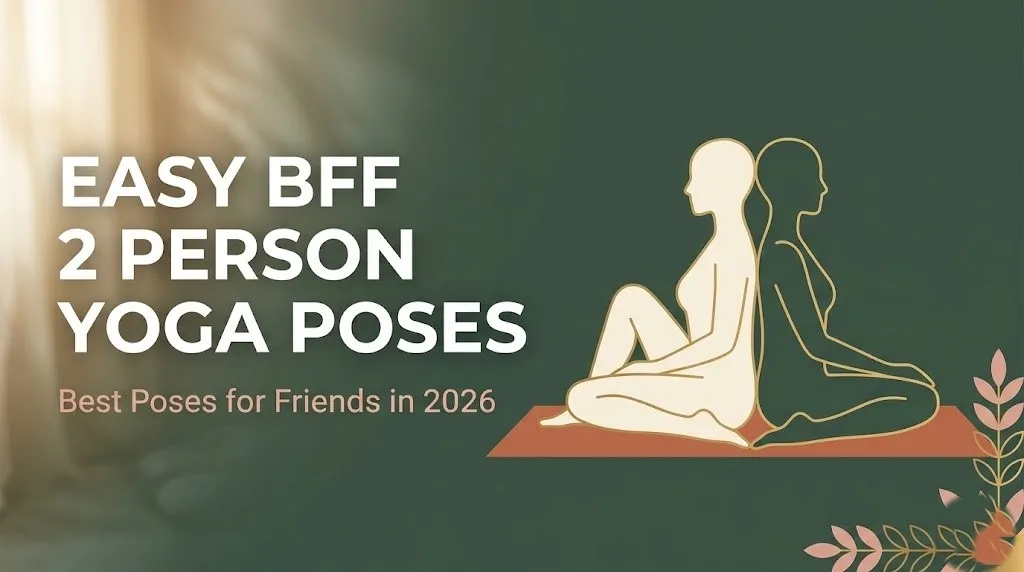
The back-to-back position in Dandasana (Staff Pose) is the foundational starting point. Both partners sit with legs extended forward, spines pressing gently against each other from the sacrum to the mid-back. This contact does two things simultaneously: it provides proprioceptive feedback that helps each person feel their spinal alignment, and it creates a shared base of support that allows both people to sit taller than they typically do alone.
From back-to-back Dandasana (Staff Pose), two beginner variations build naturally:
Back-to-Back Seated Breathing:
- Both partners sit in Dandasana (Staff Pose) with spines touching
- Place hands on your own knees or thighs
- Both partners inhale together, expanding the ribcage; feel the partner’s back expand against yours
- Both partners exhale together, softening the ribcage; feel the shared release
- Continue for 5 to 10 breath cycles, matching the pace of the slower breather
Back-to-Back Seated Twist:
- From back-to-back Dandasana (Staff Pose), both partners inhale to lengthen the spine
- Both partners exhale and twist in opposite directions: Partner A twists right, Partner B twists left
- Each partner places one hand on their own knee and one hand on the partner’s knee for gentle leverage
- Hold for 3 to 5 breaths, then unwind and twist to the opposite side
- Return to center and take 2 neutral breaths before repeating
Modification note: Anyone with tight hamstrings will round the lumbar spine in Staff Pose, which reduces the effectiveness of the back-to-back support. Place a folded blanket under both sitting bones to tilt the pelvis forward and restore lumbar curve before adding the partner contact.
Key Takeaway: The safest and most effective way to start any 2 person yoga session is seated back-to-back in Staff Pose, using shared breath as the first cooperative movement before attempting any stretch or balance.
Partner Seated Forward Fold: The Best Beginner Stretch for Two
The partner-assisted Paschimottanasana (Seated Forward Fold) is the single most effective beginner partner pose for opening the hamstrings, lumbar spine, and posterior chain because one partner’s gentle assist creates a stretch depth that neither person achieves alone with the same level of safety.
This pose works on the principle of proprioceptive neuromuscular facilitation, a technique documented in physical therapy research, where a gentle external assist applied to a relaxed muscle achieves greater lengthening than the practitioner can create through effort alone. Your partner’s hands on your upper back or shoulders signal the nervous system that the stretch is supported and safe, which allows the hamstrings to release more fully.
To practice partner-assisted Paschimottanasana (Seated Forward Fold):
- Both partners sit facing each other with legs extended straight and feet pressing together at the soles
- Partner A sits upright in Dandasana (Staff Pose). Partner B does the same.
- Both partners hold each other’s wrists or forearms with a firm but relaxed grip
- Partner A inhales to lengthen the spine. Partner B keeps their spine neutral.
- Partner A exhales and folds forward from the hips, not the waist, while Partner B gently leans back, providing counter-traction
- Partner A holds the fold for 3 to 5 breaths, communicating any discomfort immediately
- On an inhale, Partner A uses core strength to return upright
- Switch roles and repeat
Safety note: The assisting partner must increase traction gradually. A sudden pull is how hamstrings get strained. The rule is: increase resistance only after your partner signals “more” or “good,” never proactively.
Modification note: Partners with significantly different leg lengths can bend both knees slightly to keep foot-to-foot contact. This does not reduce the hamstring benefit.
Standing Partner Yoga Poses for Beginners
Standing partner yoga poses for beginners include mirrored Virabhadrasana II (Warrior II), hand-to-hand forward folds, and side-by-side balance work that develops proprioception and builds the trust needed for more advanced partner work later.
Standing poses introduce a different challenge than floor work: both partners are weight-bearing on their own feet, which means balance, not strength or flexibility, becomes the primary skill being developed. This makes standing partner yoga accessible to most people while building the coordination that makes later poses feel more natural.
Mirrored Virabhadrasana II (Warrior II) for two:
- Both partners stand facing each other, approximately 3 to 4 feet apart
- Both partners step the right foot back simultaneously, creating a wide stance
- Both partners bend the front (left) knee to approximately 90 degrees, checking that the knee tracks over the second toe
- Both partners extend arms wide: the front arm reaches toward each other; back arms extend away from each other
- Gaze forward over the front hand. Hold for 4 to 6 breaths.
- Both partners straighten the front leg on an inhale and step feet together before switching sides
The mirroring element serves a real function beyond aesthetics. Watching your partner’s alignment gives you an external reference for your own. Seeing that your partner’s front knee is collapsing in or their back foot is not grounded correctly is often easier to notice than feeling it in your own body.
Modification note: Partners with knee pain should keep the front knee bent to only 45 degrees rather than the full 90 degrees. This reduces the quadriceps load on the joint while maintaining the hip-opening and balance benefits of the pose.
Double Tree Pose: A Fun Balance Challenge for Two Friends
Double Vrksasana (Double Tree Pose) is a side-by-side partner balance where both people stand in Tree Pose simultaneously, pressing their inner arms or palms together to create a shared point of balance that is more stable than solo Tree Pose for most beginners.
The physics of this pose work like two adjacent structures leaning gently into each other. Neither person is fully bearing the other’s weight. Instead, the shared lateral contact point at the shoulder or hand creates a proprioceptive cue that the nervous system uses to fine-tune balance faster than solo standing on one leg allows.
To practice Double Vrksasana (Double Tree Pose):
- Both partners stand side by side, inner shoulders touching or close
- The inside foot (the foot closest to each other) stays grounded
- Both partners lift the outside foot and place it against the inner calf or inner thigh of the standing leg. Do not press the foot against the inner knee joint.
- Both partners press their inner palms or upper arms together lightly for shared stability
- Both partners raise the outer arm overhead or press outer palms together above the heads for the full expression
- Hold for 4 to 6 breaths, then lower the raised foot and switch sides
The gluteus medius, tibialis anterior, and deep core stabilizers are all working during this pose. These are the same muscles that prevent ankle rolling and maintain lateral spinal stability in daily movement.
Modification note: Anyone with significant balance difficulties or vestibular issues can practice this pose with the raised foot on the floor in a wide stance rather than lifted, while still maintaining the shared arm contact. This provides the proprioceptive and social benefits without the single-leg balance demand.
Key Takeaway: Standing partner poses like mirrored Warrior II and Double Tree Pose develop individual balance and proprioception faster than solo practice because your partner’s body gives you a real-time visual and tactile alignment reference you cannot get from a mirror alone.
Partner Yoga Poses for Different Heights and Body Types
Partner yoga poses work best when both people understand that physical differences between partners require specific adjustments, and that no single pose configuration fits every pair of bodies equally.
The most common mismatch in beginner partner yoga is height difference. When two people of notably different heights sit back to back in Dandasana (Staff Pose), the taller partner’s mid-back meets the shorter partner’s upper back or shoulder blades. This asymmetric contact reduces the spinal support benefit for both people. A simple fix: the shorter partner sits on a folded blanket to raise their spine height, which brings contact points into better alignment.
Forward fold partnerships with different hamstring flexibility levels also require adjustment. When one partner folds much further than the other in a seated fold with feet touching, the flexible partner tends to pull the less flexible one past their safe range. The fix is having the less flexible partner bend their knees slightly, reducing hamstring tension and keeping both people in control of their own depth.
Adjustment guide for common physical differences:
| Difference | Problem It Creates | Practical Fix |
|---|---|---|
| Height difference (seated) | Uneven spinal contact points | Raise shorter partner with a folded blanket |
| Flexibility difference (forward fold) | Less flexible partner gets pulled | Less flexible partner bends knees |
| Strength difference (counterbalance) | Stronger partner pulls weaker one off-balance | Both partners start with bent elbows and shorter lever |
| Weight difference (counterbalance) | Heavier partner tilts the pair | Heavier partner sits closer to the midline |
| Arm length difference (hand-hold) | Grip strain or shoulder tension | Use a yoga strap held between partners instead |
A yoga strap held between partners rather than a direct hand grip is one of the most underused adjustments in beginner partner yoga. It allows each partner to hold the strap at the point that works for their arm length, removing the shoulder tension that direct grips create when arm lengths differ.
How to Communicate and Stay Safe in Partner Yoga
Safe partner yoga requires a clear, pre-agreed communication system, a shared commitment to gradual progression, and the understanding that partner poses are never about pushing someone else past their stated limit.
The most common partner yoga injuries are hamstring strains from over-assisted forward folds, lower back strains from asymmetric counterbalance pulling, and wrist discomfort from sustained gripping. All three are preventable with the same root practice: moving slowly, checking in verbally, and increasing intensity only at the receiver’s invitation.
The three-level check-in system used by experienced partner yoga teachers:
- Level 1 (hold): “Hold here” means the current position is at the edge of comfortable. No more pressure or traction. Breathe and wait.
- Level 2 (more): “A little more” means the person is ready to go slightly deeper. The assisting partner increases pressure by five to ten percent at most.
- Level 3 (ease off): “Ease off” or two physical taps means the assisting partner immediately reduces pressure. No delay. No questions first.
Yoga Alliance teacher training programs that include partner yoga consistently emphasize that the receiving partner is always in control of the pose depth. The assisting partner’s role is to follow, not to lead.
Safety cautions specific to beginner partner yoga:
- Never apply sudden force: All assist pressure should increase gradually and release gradually
- Avoid assisting near the lumbar spine directly: Pressure on the lumbar vertebrae is not the same as pressure on the upper back. Keep assists above the sacrum or on the shoulders.
- Skip hand-to-hand counterbalance if either partner has wrist issues: Use a strap or forearm-to-forearm grip instead
Partner Yoga Warm-Up: How to Prepare Your Body Together
A partner yoga warm-up is a 5 to 8 minute individual movement sequence done in the same space at the same time, followed by one to two minutes of back-to-back breathing before moving into shared poses.
Warming up in partner yoga serves a dual purpose. Individually, it increases tissue temperature, improves joint lubrication through synovial fluid circulation, and prepares the specific muscles that partner poses demand most: the hamstrings, hip flexors, thoracic spine rotators, and shoulder girdle. Together, the shared breathing before the first pose builds the communication and attunement that makes the rest of the session safer and more effective.
5-minute partner yoga warm-up sequence:
- Individual Cat-Cow: Both partners begin on hands and knees. Perform 8 rounds of Marjaryasana-Bitilasana (Cat-Cow Pose), inhaling to arch the spine, exhaling to round it. This warms the spinal segments that all seated partner twists and forward folds will use.
- Individual Child’s Pose: From hands and knees, both partners press back into Balasana (Child’s Pose) for 5 breaths. This opens the hips and lower back before seated work begins.
- Individual Seated Neck Rolls: Both partners sit in Sukhasana (Easy Pose). Slowly drop the right ear toward the right shoulder and circle the head gently. 4 to 5 slow circles per side. This releases trapezius and levator scapulae tension before back-to-back contact.
- Shared back-to-back breathing: Both partners sit back-to-back in Dandasana (Staff Pose) and synchronize 5 breath cycles before the first partner pose begins.
Modification note: Anyone with wrist pain should perform Cat-Cow on their fists rather than their open palms to reduce wrist extension. Seniors or those with knee pain can perform the warm-up seated in a chair.
Key Takeaway: Warm up your own body first, then warm up together with shared breathing before touching. This two-phase approach reduces injury risk and makes the first shared pose feel immediately more connected and controlled.
Easy Partner Yoga Floor Poses and Cool-Down Stretches
Partner yoga floor poses and cool-down stretches are the closing segment of any 2 person session, designed to bring the nervous system into parasympathetic dominance and release the muscles most actively used during the main practice.
The cool-down serves the same physiological purpose it does in any physical practice: allowing heart rate to normalize, muscles to release accumulated tension, and the mind to transition from active movement focus to rest. In partner yoga, the cool-down has an additional social dimension. Ending a session with a shared reclined pose or synchronized breathing completes the relational circuit that the practice opened.
Partner cool-down sequence (10 to 12 minutes):
- Upavistha Konasana (Wide-Angle Seated Forward Fold) back-to-back: Both partners sit back to back with legs wide. Each partner gently folds forward over their own legs. The partner’s back provides a gentle reminder to keep the spine long. Hold for 5 to 8 breaths.
- Partner-assisted Baddha Konasana (Bound Angle Pose): Both partners sit in Bound Angle Pose (soles of feet together, knees falling wide). Partner A sits behind Partner B and places their hands gently on Partner B’s knees, applying no pressure unless invited. Hold for 5 breaths per partner.
- Side-by-side Savasana (Corpse Pose): Both partners lie on their backs, arms at their sides, palms up. If comfortable, the backs of the hands or little fingers touch lightly. Rest for 3 to 5 minutes in complete stillness.
Modification note: In partner-assisted Baddha Konasana (Bound Angle Pose), the assisting partner should ask before placing hands anywhere near the knees. For anyone with hip labral issues, groin injuries, or hip replacements, the assisting hands should stay on the outer thighs, not the knees.
Benefits of Doing Yoga With a Friend: What Research Says
Practicing yoga with a friend produces distinct physical and psychological benefits that go beyond what either solo yoga or social interaction alone delivers, because cooperative movement activates both the body’s flexibility and strength systems and the brain’s social bonding circuitry simultaneously.
The physical benefits of partner yoga mirror those of solo yoga, including improved flexibility, spinal mobility, and balance, but with one documented advantage: partner-assisted stretches consistently produce greater range of motion gains than self-directed stretches for the hamstrings, hip flexors, and thoracic rotators. This is consistent with research on contract-relax stretching techniques published in the Journal of Bodywork and Movement Therapies, which found that externally assisted stretching produces greater flexibility improvements than self-stretching over equivalent time periods.
The psychological benefits are where shared yoga most clearly outperforms solo practice. Research published in Frontiers in Psychology documents that cooperative physical tasks with a trusted partner increase oxytocin release, reduce cortisol levels, and produce greater post-activity wellbeing scores than the same tasks performed alone. Synchronized movement specifically, where two people move in matched patterns, amplifies this effect.
Documented benefits of practicing yoga with a friend:
- Greater hamstring and hip flexibility gains through partner-assisted stretching versus solo stretching
- Reduced cortisol levels during and after cooperative physical activity with a trusted person
- Increased oxytocin release from synchronized movement and positive physical contact
- Higher motivation to practice regularly when accountability and social enjoyment are combined
- Faster improvement in balance when a partner provides real-time visual and tactile feedback
- Reduced anxiety about yoga when a non-judgmental, trusted companion is present in the practice
BFF Partner Yoga Poses for Kids and Teens
Partner yoga for kids and teens uses the same foundational poses as adult beginner practice, but with a playful, game-based framing that keeps younger practitioners engaged and removes the seriousness that makes traditional yoga feel boring to this age group.
The key difference in teaching partner yoga to kids and teens is that the communication framework matters even more, not less, than it does for adults. Children and teens are still developing their understanding of physical boundaries and consent in shared movement. A well-facilitated kids’ partner yoga session explicitly teaches that each person controls their own body and that “stop” is always respected immediately.
Age-appropriate partner yoga for kids and teens:
| Age Group | Best Poses | Why They Work | Safety Note |
|---|---|---|---|
| Ages 6 to 10 | Back-to-back breathing, mirrored Mountain Pose (Tadasana), seated twist | Simple, no weight-sharing, immediately successful | Always include “stop” signal before starting |
| Ages 10 to 14 | Partner Tree Pose, mirrored Warrior II, seated forward fold | Builds coordination and body awareness | No direct assisting; side-by-side only |
| Ages 14 to 18 | Full beginner partner sequence, partner forward fold assist | Teens can manage verbal communication protocols | Full communication framework required |
The mirrored Tadasana (Mountain Pose) is the simplest possible starting point for two kids: both stand facing each other, matching each other’s foot width, arm position, and breath timing exactly. No physical contact required, no flexibility needed, and the mirroring game aspect keeps younger children engaged.
Modification note: Kids and teens should always practice on a non-slip mat surface. Floor-level poses for younger children should use mats with adequate cushioning under the knees.
Key Takeaway: The research case for partner yoga is clear: cooperative movement with a trusted person increases flexibility gains, reduces stress hormones, and raises post-practice wellbeing scores beyond what solo yoga delivers. The social layer is not a bonus; it is part of what makes the practice work.
Partner Yoga for Seniors: Accessible 2 Person Poses
Partner yoga for seniors uses seated, supported, or standing-near-a-wall variations of core partner poses, making the practice accessible for older adults managing limited mobility, balance concerns, or joint sensitivity.
The American College of Sports Medicine recommends that adults over 65 practice flexibility and balance training at least two days per week. Partner yoga addresses both simultaneously in a format that is inherently social and lower-pressure than solo class participation. The presence of a trusted companion also reduces the fear of falling that inhibits many seniors from engaging in balance work at all.
Accessible senior partner yoga poses:
- Chair-based back-to-back breathing: Both partners sit in sturdy chairs positioned back to back. The chair provides full spinal support, and the shared breathing practice delivers the nervous system benefits without any floor work.
- Standing hand-hold forward fold: Both partners stand facing each other, holding hands. Each person folds slowly at the hips while the other leans back gently as counterbalance. This creates a supported hamstring stretch without requiring floor-level flexibility.
- Seated side-by-side neck and shoulder release: Both partners sit in chairs side by side. Partner A places a hand gently on Partner B’s opposite shoulder while Partner B drops their ear toward the shoulder on the open side. This assists a trapezius and levator scapulae stretch without any spinal loading.
- Partner-assisted seated Cat-Cow: Both partners sit in chairs. Partner A places their hands on Partner B’s upper back and shoulder blades. As Partner B inhales to arch (Cow), Partner A’s hands provide gentle feedback on thoracic extension. Switch roles after 4 rounds.
Modification note: Seniors with osteoporosis should avoid all forward folds that involve deep spinal flexion, even partner-assisted versions. The standing hand-hold version should be performed with only a very gentle forward lean, keeping the spine long rather than rounded.
How to Build a Full Partner Yoga Session at Home
A complete at-home partner yoga session for two beginners runs 35 to 45 minutes and follows a clear structure: individual warm-up, shared breathing, beginner seated poses, standing poses, floor cool-down, and shared Savasana.
Building a session at home is straightforward when the structure is clear. The temptation for first-timers is to jump straight to the most interesting-looking poses. Skipping the warm-up removes the tissue preparation that makes partner assists safe, and skipping the communication setup removes the shared language that makes them enjoyable.
Complete beginner partner yoga session at home:
| Phase | Duration | What to Do |
|---|---|---|
| Individual warm-up | 5 minutes | Cat-Cow, Child’s Pose, neck rolls (each person independently) |
| Shared breathing | 2 minutes | Back-to-back Dandasana, 5 to 10 synchronized breath cycles |
| Seated partner poses | 10 minutes | Back-to-back twist, partner forward fold, Bound Angle assist |
| Standing partner poses | 10 minutes | Mirrored Warrior II, Double Tree Pose, standing forward fold hold |
| Floor cool-down | 8 minutes | Wide-Angle Seated Forward Fold back-to-back, partner Bound Angle |
| Shared Savasana | 5 minutes | Side-by-side Corpse Pose with optional light hand contact |
What you need at home:
- Two yoga mats or two folded blankets on a non-slip floor
- One yoga strap (can substitute a belt or scarf for hand-hold distance adjustments)
- Two folded blankets (for sitting bone support and knee padding)
- Optional: two yoga blocks for the forward fold sequence
Modification note: If one partner has significantly less floor mobility than the other, adapt by keeping the less mobile partner in a chair for seated phases and joining them in chair-based versions of each pose. This keeps both people practicing the same session rather than one person watching.
Frequently Asked Questions About Easy BFF 2 Person Yoga Poses
What are the easiest 2 person yoga poses for complete beginners?
The easiest 2 person yoga poses for complete beginners are seated back-to-back breathing in Dandasana (Staff Pose), a partner-assisted Paschimottanasana (Seated Forward Fold), and mirrored Virabhadrasana II (Warrior II).
These three poses require no flexibility, no prior yoga experience, and no weight-sharing, which makes them genuinely accessible from the first attempt.
Start with back-to-back breathing for two minutes before attempting any stretch or balance pose, because the shared breath builds the attunement that makes everything else feel more natural.
Do you need yoga experience to do partner yoga with a friend?
No yoga experience is needed for easy beginner partner yoga poses.
The poses in this guide are designed for people who have never practiced yoga, and the instructions provide enough alignment guidance to practice safely without a teacher present.
The one non-negotiable is setting up a verbal communication system before you start, which replaces the teacher’s guidance in an at-home setting.
What do you need for 2 person yoga at home?
Two yoga mats or folded blankets on a non-slip floor, one yoga strap or substitute for hand-hold adjustments, and two folded blankets for sitting support are everything you need.
You do not need specialized partner yoga equipment, matching flexibility levels, or any prior yoga experience.
A yoga strap is the single most useful addition for beginner partner yoga because it solves the arm-length difference problem that makes hand-to-hand grips uncomfortable for many pairs.
Is partner yoga safe if my friend and I have different flexibility levels?
Yes, partner yoga is safe for friends with different flexibility levels when both people follow a graduated communication system and the less flexible partner sets the pace.
The modifications in this guide specifically address flexibility differences, including bending knees in forward folds and using a strap for hand-hold distance.
The rule is that the less flexible or less comfortable partner always determines how far a shared pose goes. The more flexible partner adapts to their partner’s range, not the other way around.
How long should we hold poses in partner yoga?
Most beginner partner yoga poses are held for 3 to 5 breath cycles, which is roughly 20 to 40 seconds at a comfortable breathing pace.
Longer holds of 1 to 2 minutes are appropriate for passive cool-down stretches like partner-assisted Baddha Konasana (Bound Angle Pose) and side-by-side Savasana (Corpse Pose).
Start with shorter holds in your first session, because partner-assisted stretches often feel more intense than solo poses and the body needs time to adapt to the shared resistance.
Grab a Friend and Start With Back-to-Back Breathing
You do not need a plan for all fifteen poses today. Start with one: back-to-back Dandasana (Staff Pose) and five synchronized breaths. That is your entire first partner yoga session if you want it to be.
From there, add the partner forward fold next time. Add Double Tree Pose the session after. Let the sequence build naturally as your comfort and communication get sharper.
Three short sessions per week, even twenty minutes each, will create a noticeable improvement in both your flexibility and your connection with your practice partner within a month.