What Is Slow Flow Yoga? Benefits, Poses & Sequences 2026
Slow flow yoga is a breath-led style of yoga that moves through poses at a deliberate, unhurried pace, holding each position long enough to build both awareness and strength. It sits between the dynamic speed of Vinyasa and the extended stillness of Yin, making it one of the most accessible and therapeutically useful styles available.
More people are choosing slower practices, and the research supports the instinct. According to the National Center for Complementary and Integrative Health (NCCIH), yoga practices that emphasize breath synchronization and mindful movement show measurable benefit for stress reduction, musculoskeletal health, and sleep quality in adults across multiple age groups.
This article covers what slow flow yoga actually is, how it compares to other popular styles, what the science says about its benefits, and how to build a complete practice at home. Whether you are brand new to yoga or transitioning from a faster class, this guide gives you the full picture.
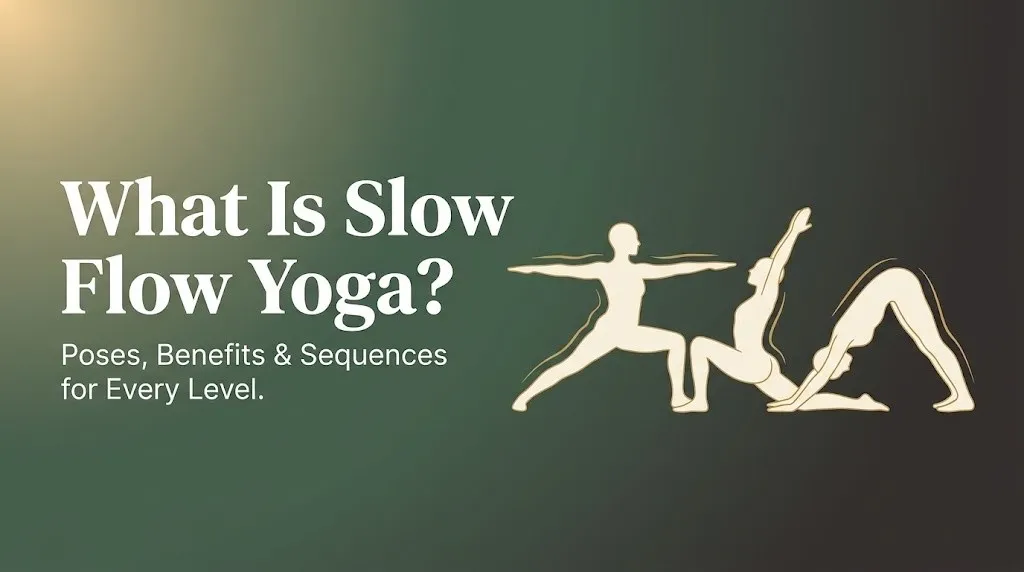
What Is Slow Flow Yoga?
Slow flow yoga is a yoga style that links movement to breath at a gentle, controlled pace, typically holding each pose for 3 to 8 breath cycles rather than moving pose-to-pose on a single breath.
The term “slow flow” is not a formally codified style the way Ashtanga or Iyengar yoga are. It is a pacing descriptor applied to breath-led sequences, usually drawn from the Vinyasa tradition, where transitions are slowed down and holds are lengthened. Think of it as Vinyasa with the dial turned down: the same breath-movement connection, but with enough space between each transition to actually feel what the body is doing.
That space matters more than most people expect. When you hold a pose for five full breaths instead of one, your nervous system has time to register the position, your muscles have time to respond and stabilize, and your proprioceptive system (your body’s internal GPS) gets a more complete signal about where you are in space.
Classes typically run 45 to 75 minutes and build from warm-up through standing poses, balancing shapes, hip openers, and a closing floor sequence. The mood is calm and deliberate, never rushed.
Key characteristics of slow flow yoga:
- Hold duration of 3 to 8 breaths per pose, sometimes longer
- Continuous breath-movement linkage throughout the entire class
- Smooth, unhurried transitions between poses
- Emphasis on alignment awareness within each shape
- Suitable for beginners through intermediate practitioners
- Accessible with props including blocks, straps, and bolsters
Slow Flow Yoga vs. Vinyasa Yoga: Key Differences
Slow flow yoga and Vinyasa yoga share the same DNA: both link breath to movement in a continuous sequence. The difference lies entirely in pacing, hold duration, and the physiological response each creates.
In a standard Vinyasa class, poses change on a single breath. One inhale, one exhale, next pose. The result is a cardiovascular workout with a meditative undercurrent, often fast enough that beginners spend more time catching up than feeling the pose.
Slow flow extends each hold to 3 to 8 breaths, sometimes more. That shift in timing changes the entire experience. Your muscles have time to engage properly. Your breath has space to regulate. Your nervous system begins to shift toward a parasympathetic state, the rest-and-digest mode, rather than staying in the alert, active sympathetic state that fast movement sustains.
| Feature | Slow Flow Yoga | Vinyasa Yoga |
|---|---|---|
| Pose hold duration | 3 to 8 breaths | 1 to 2 breaths |
| Pace | Deliberate and unhurried | Dynamic and continuous |
| Cardiovascular intensity | Low to moderate | Moderate to high |
| Best for | Beginners, stress relief, injury recovery | Intermediate practitioners, fitness focus |
| Nervous system effect | Parasympathetic activation | Sympathetic engagement |
| Breath focus | Central and prominent | Present but secondary to flow |
| Heat generated | Mild to moderate | Moderate to high |
Neither style is superior. They serve different purposes. Many experienced practitioners use slow flow on recovery days and Vinyasa on days when they want more physical challenge.
Slow Flow Yoga vs. Yin Yoga: Not the Same Practice
Slow flow yoga and Yin yoga are frequently confused, but they are genuinely distinct practices with different goals, mechanics, and target tissues.
Slow flow is an active practice. Your muscles are engaged throughout. You are working within your range of motion, not beyond it. Slow flow poses are held for seconds to a minute or so, and the sequence keeps the body warm and moving.
Yin yoga, by contrast, is a passive practice. Poses are held for 3 to 7 minutes, often with complete muscular relaxation. The target is connective tissue: fascia, ligaments, and joint capsules rather than muscles. Gravity does the work. Props support the body fully. The experience is closer to deep meditation than to movement.
A simple way to understand the distinction: in slow flow, you are the active participant shaping the pose. In Yin, you surrender the pose and let time and gravity do the shaping.
| Feature | Slow Flow Yoga | Yin Yoga |
|---|---|---|
| Muscle engagement | Active throughout | Passive, muscles relaxed |
| Hold duration | 3 to 8 breaths (30 to 60 seconds) | 3 to 7 minutes per pose |
| Target tissue | Muscles, cardiovascular system | Fascia, ligaments, joint capsules |
| Temperature | Mild warmth builds | Cool, static |
| Props | Optional | Usually essential |
| Suitable for | Beginners to intermediate | All levels, especially stressed or stiff |
| Yoga style lineage | Vinyasa tradition | Taoist yoga tradition |
Some studios combine them into a “Slow Flow and Yin” class, moving through an active slow flow sequence in the first half and transitioning to Yin holds in the second half. This structure covers both muscles and connective tissue in one session.
Key Takeaway: Slow flow sits between Vinyasa and Yin in terms of pace and intensity. It is active and breath-led, but not cardiovascular. If you want movement without urgency, slow flow is the style to choose.
Slow Flow Yoga Benefits Backed by Research
Slow flow yoga builds flexibility, core stability, and balance while simultaneously training the nervous system to recover from stress more efficiently.
According to the NCCIH, yoga practices that combine breathwork with mindful movement show documented benefits for musculoskeletal health, anxiety reduction, sleep improvement, and pain management in adults. Slow flow yoga, with its extended holds and breath emphasis, is particularly well-positioned to deliver these outcomes.
A review published in the Journal of Alternative and Complementary Medicine found that slower, breath-synchronized yoga practices produced greater reductions in cortisol (the body’s primary stress hormone) compared to faster movement-based exercise sessions of equal duration. The mechanism is the breath: slow, extended exhalation activates the vagus nerve and shifts the nervous system toward parasympathetic dominance.
Documented benefits of a regular slow flow yoga practice:
- Improved flexibility: Extended holds allow the musculotendinous unit time to adapt and lengthen
- Core strength: Active stabilization in every pose trains deep core muscles including the transverse abdominis
- Balance and proprioception: Slower movement gives the vestibular and proprioceptive systems more data to process
- Stress hormone reduction: Breath-paced movement is associated with lower cortisol levels after practice
- Sleep quality improvement: Research in Complementary Therapies in Medicine links regular yoga practice to better sleep onset and duration
- Blood pressure regulation: Studies indicate yoga practices emphasizing breath control show measurable reductions in resting blood pressure
- Joint mobility: Active ranges of motion practiced slowly improve joint health without inflammatory load
The American College of Sports Medicine includes yoga as an approved form of flexibility and balance training in its general physical activity guidelines for adults.
Slow Flow Yoga for Stress and Anxiety
Slow flow yoga reduces stress and anxiety by activating the parasympathetic nervous system through sustained breath-movement coordination.
When you move through poses slowly while breathing in a controlled rhythm, you are directly communicating safety to your nervous system. The extended exhale, which slow flow naturally encourages, stimulates the vagus nerve. That nerve is the primary highway of the parasympathetic system. Stimulate it, and the body starts to shift out of a stress state.
This is not a metaphor. A 2021 study published in Frontiers in Human Neuroscience found that slow, rhythmic breathing patterns of 5 to 6 breaths per minute (close to the pace naturally reached in slow flow yoga) produced measurable reductions in heart rate variability markers associated with stress and anxiety.
For people dealing with generalized anxiety, slow flow offers something fast-paced exercise cannot: a practice where you learn to stay calm while your body is in motion. That skill transfers directly to daily life.
People managing clinically diagnosed anxiety disorders should work with both a mental health professional and an experienced yoga teacher when establishing a slow flow practice. The practice supports, but does not replace, professional mental health care.
Slow flow is especially useful for:
- People coming off high-stress periods who find stillness uncomfortable
- Those who feel too activated for seated meditation but want the benefits of breath regulation
- Individuals transitioning out of fast-paced Vinyasa who notice elevated cortisol or burnout
Slow Flow Yoga Breathing Technique
The primary breathing technique in slow flow yoga is ujjayi pranayama (also called ocean breath or victorious breath), a slightly constricted nasal breath that creates an audible sound in the back of the throat.
To practice ujjayi breath:
- Sit or stand comfortably with your spine tall.
- Inhale through your nose for 4 to 5 counts, feeling the ribcage expand in all directions.
- As you exhale, lightly constrict the muscles at the back of your throat, as if you are trying to fog a mirror but with your mouth closed. This creates a soft ocean-wave sound.
- Exhale fully for 5 to 6 counts, slightly longer than the inhale.
- Keep the face and jaw completely relaxed throughout.
- Continue this breath pattern as you move through poses, using the inhale to set up expansive movements and the exhale to deepen into folds or twists.
The longer exhale is not an accident. Exhaling longer than you inhale is a direct signal to the vagus nerve that you are safe. The body responds by downregulating stress hormones.
In slow flow, the breath sets the pace. You do not rush to match a teacher’s count. You move when your breath is ready. That distinction separates slow flow from every other yoga style that uses ujjayi breath.
Modification for beginners: If ujjayi breath feels forced or creates tension, simply breathe in and out through the nose without the throat constriction. The nasal breath alone is therapeutic. Build the ujjayi quality gradually over your first four to six weeks of practice.
Slow Flow Yoga Poses: The Core Building Blocks
Slow flow yoga sequences draw from a consistent group of foundational poses that appear across virtually every class at every level.
These poses are chosen for their versatility. Each one can be made accessible for a beginner with a block or simplified alignment, and each can be deepened for an experienced practitioner through longer holds, narrower base, or added balance challenge.
Core slow flow yoga poses:
| Pose (English) | Sanskrit Name | Primary Focus |
|---|---|---|
| Mountain Pose | Tadasana | Grounding, alignment awareness, breath baseline |
| Cat-Cow | Marjaryasana-Bitilasana | Spinal warm-up, breath-movement coordination |
| Downward Facing Dog | Adho Mukha Svanasana | Full-body stretch, posterior chain lengthening |
| Warrior I | Virabhadrasana I | Hip flexor stretch, standing strength, focus |
| Warrior II | Virabhadrasana II | Hip opening, leg strength, endurance |
| Low Lunge | Anjaneyasana | Hip flexor and quad stretch, balance |
| Triangle Pose | Trikonasana | Lateral stretch, hamstring lengthening, stability |
| Bridge Pose | Setu Bandha Sarvangasana | Posterior chain, glute and spinal strength |
| Child’s Pose | Balasana | Rest, spinal decompression, breath reset |
| Corpse Pose | Savasana | Integration, nervous system downregulation |
Modification note: For any standing pose, a student with limited balance can work near a wall, using fingertips for support without relying on the wall for full body weight. For floor poses, a folded blanket under the hips or knees reduces joint load significantly.
Key Takeaway: The foundational poses of slow flow are the same ones found in many other yoga styles. What makes slow flow distinct is how long you stay in them and how intentionally you breathe while you do.
Slow Flow Yoga Sequence for Beginners
A beginner slow flow yoga sequence builds from the ground up, starting with breath awareness and spinal mobility before asking the body to hold more demanding shapes.
This sequence is designed for someone new to yoga or returning after a long break. Hold each pose for 4 to 5 full breaths unless noted otherwise.
Beginner slow flow yoga sequence:
- Arrive in Savasana (Corpse Pose) on your back. Spend 10 full breaths simply noticing your natural breath before doing anything.
- Move to Marjaryasana-Bitilasana (Cat-Cow Pose) on hands and knees. Flow through 6 full cycles, inhaling into Cow and exhaling into Cat.
- Press back to Balasana (Child’s Pose) with arms extended. Hold for 5 breaths. Feel the lower back release.
- Come to Tadasana (Mountain Pose) at the top of your mat. Stand with feet hip-width apart, arms at sides, eyes soft. Hold for 5 breaths, noticing how you stand.
- Fold into Uttanasana (Standing Forward Fold), bending the knees generously if the hamstrings are tight. Hold for 5 breaths.
- Step the right foot back to Anjaneyasana (Low Lunge). Back knee down. Hold for 5 breaths per side.
- Return to Adho Mukha Svanasana (Downward Facing Dog). Press into all four fingers, heels reaching toward the floor. Hold for 5 breaths.
- Come to the floor for Setu Bandha Sarvangasana (Bridge Pose). Feet flat, knees over heels, hips lifted. Hold for 5 breaths.
- Release to the floor and take Savasana (Corpse Pose) for 3 to 5 minutes to close.
Modification: Beginners with tight hamstrings should keep a generous bend in the knees for all forward folds. Blocks under the hands in Downward Dog reduce wrist extension and make the pose more accessible immediately.
Slow Flow Yoga at Home: How to Set Up and Practice
Slow flow yoga at home is one of the most effective ways to build a consistent practice because the pace is forgiving, the equipment needs are minimal, and the sequences adapt to any room size.
The minimum setup you need is a yoga mat, enough floor space to extend your arms and legs in all directions, and a quiet 30 to 45 minutes. That is genuinely it.
Props upgrade the experience but are not required to start. A single yoga block transforms dozens of poses from strained to spacious. A yoga strap makes hamstring stretches accessible for tight bodies. A folded blanket under the knees or hips eliminates joint discomfort on hard floors.
Setting up for home slow flow practice:
- Choose a consistent time of day. Morning practice builds energy; evening practice supports sleep.
- Start with 20 to 30 minutes rather than trying to match a 60-minute studio class immediately.
- Use a timer for hold durations rather than counting breaths while also thinking about alignment.
- Play soft, non-lyrical background music if silence feels uncomfortable. The music should not set a pace.
- Keep a notebook nearby. After class, write one sentence about how the practice felt. Over weeks, patterns emerge.
The Yoga Alliance notes that home practice is one of the strongest predictors of long-term yoga commitment, even more than studio attendance alone. The accessibility of slow flow makes it particularly well-suited to home settings.
Modification for small spaces: All standing poses can be practiced facing a wall. All floor sequences fit in a space the size of a yoga mat. Slow flow requires no jumping, no large lateral movement, and no special footwear.
Key Takeaway: You do not need a studio, a subscription, or an hour of free time to start slow flow yoga at home. A mat, a block, and 25 minutes three times a week is enough to build a real practice.
Slow Flow Yoga Sequence: A Full 30-Minute Practice
A well-structured 30-minute slow flow yoga sequence moves through five distinct phases: arrival and breath, spinal warm-up, standing sequence, floor sequence, and rest.
Hold each pose for 5 full ujjayi breaths unless otherwise noted. Move between poses on the breath, not on a clock.
Full 30-minute slow flow sequence:
Phase 1: Arrival (3 minutes)
- Savasana (Corpse Pose) on the back. Eyes closed. 10 breaths of natural breathing.
- Draw knees to chest. Rock gently side to side for 5 breaths.
Phase 2: Spinal Warm-Up (5 minutes)
- Marjaryasana-Bitilasana (Cat-Cow) on hands and knees, 8 breath cycles.
- Adho Mukha Svanasana (Downward Facing Dog), 5 breaths, pedaling heels.
- Balasana (Child’s Pose), 5 breaths.
Phase 3: Standing Sequence (12 minutes)
- Tadasana (Mountain Pose), 5 breaths.
- Uttanasana (Standing Forward Fold), 5 breaths.
- Virabhadrasana I (Warrior I), right side, 5 breaths.
- Virabhadrasana II (Warrior II), right side, 5 breaths.
- Trikonasana (Triangle Pose), right side, 5 breaths.
- Return to Adho Mukha Svanasana, 3 breaths, then repeat steps 8 to 10 on the left side.
Phase 4: Floor Sequence (7 minutes)
- Anjaneyasana (Low Lunge), right side, 5 breaths.
- Setu Bandha Sarvangasana (Bridge Pose), 5 breaths, lower slowly.
- Supine twist on both sides, 5 breaths each.
Phase 5: Rest (3 minutes)
- Savasana (Corpse Pose), 3 full minutes minimum. Do not rush this phase.
Modification: Anyone with knee sensitivity should place a folded blanket under the back knee in Low Lunge and add a block under each hand in Warrior poses to reduce reach and keep the torso upright.
Slow Flow Yoga for Seniors: Safe and Effective Adaptations
Slow flow yoga is particularly well-suited for older adults because its unhurried pace, emphasis on breath, and adaptability with props address the specific physical and neurological needs that come with aging.
Balance, bone density, joint mobility, and proprioception all change with age. According to the NCCIH, yoga practice in older adults is associated with reduced fall risk, improved balance and functional mobility, and better self-reported quality of life. The slow, controlled nature of slow flow makes it safer than faster yoga styles for this population.
The most important adaptations for seniors involve reducing the balance demand and protecting sensitive joints:
- Chair-supported Warrior poses: Place a chair to the side of the mat. Rest fingertips on the chair back during Virabhadrasana I and II to reduce balance demand while still getting the hip and leg strengthening benefit.
- Seated Cat-Cow: Practice Marjaryasana-Bitilasana sitting in a chair, hands on knees. The spinal mobility benefit is nearly identical. The floor-kneeling load on knees and wrists is eliminated.
- Wall-supported Downward Dog: Place hands on the wall at hip height rather than on the floor. This version builds shoulder and back strength without requiring full weight-bearing through the wrists and arms.
- Shorter holds: Begin with 3 breaths per pose rather than 5 to 8. Build hold tolerance gradually over 4 to 6 weeks.
Seniors with osteoporosis should avoid poses that require deep spinal flexion under load. A yoga teacher with senior yoga or therapeutic yoga training can adapt the sequence accordingly.
Slow Flow Yoga for Back Pain: What Works and What to Avoid
Slow flow yoga can support recovery from certain types of back pain, but selecting the right poses and understanding which phases to modify is essential.
For general lower back tension caused by prolonged sitting, postural imbalance, or mild muscle fatigue, the spinal mobility work in slow flow (especially Marjaryasana-Bitilasana and gentle forward folds) provides the rhythmic movement that reduces stiffness and improves circulation to spinal structures.
The Spine Journal has published research indicating that low-impact movement practices, including yoga, outperform bed rest for most types of non-specific lower back pain in adults. Slow flow yoga’s combination of core engagement, spinal mobility, and breath regulation addresses several contributing factors simultaneously.
Poses that generally support back pain recovery:
- Marjaryasana-Bitilasana (Cat-Cow): Rhythmic spinal mobilization without load
- Setu Bandha Sarvangasana (Bridge Pose): Posterior chain strengthening, lumbar support
- Balasana (Child’s Pose): Passive spinal decompression and breath reset
- Supine twists: Gentle rotation that releases paraspinal muscle tension
Poses to approach carefully or modify with back pain:
- Uttanasana (Standing Forward Fold): Keep a significant bend in the knees; avoid reaching aggressively for the floor
- Virabhadrasana I (Warrior I): Shorten the stance if it creates lumbar compression
- Adho Mukha Svanasana (Downward Facing Dog): Bend the knees generously if hamstring tightness tilts the pelvis and rounds the lumbar spine
Anyone with a diagnosed disc herniation, spondylolisthesis, or spinal stenosis should work with a physical therapist to identify which poses are appropriate before beginning a home slow flow practice.
Key Takeaway: Slow flow yoga is one of the best movement options for mild to moderate back pain because it combines spinal mobility, core strength, and breath in a low-load environment. The key is choosing the right poses for your specific condition.
Slow Flow Yoga Modifications and Props
Props in slow flow yoga are not accommodations for weakness. They are tools that bring the pose to you, rather than forcing your body into a shape it is not yet ready for.
The most used props in slow flow yoga and their specific functions:
| Prop | Common Uses | Who Benefits Most |
|---|---|---|
| Yoga block (two recommended) | Under hands in forward folds and standing poses; under hips in seated poses | Beginners, people with tight hamstrings, wrist sensitivity |
| Yoga strap | Extends reach in seated forward folds; loops around foot in reclined leg stretches | People with limited flexibility, tight hamstrings or shoulders |
| Yoga bolster | Under knees in Savasana; under torso in supported backbends; under hips in seated poses | Seniors, people with back pain, prenatal practitioners |
| Folded blanket | Under knees in kneeling poses; under hips for seated poses; as a neck support in Savasana | Knee sensitivity, hip tightness, all levels |
| Wall | Fingertip support in balance poses; modified Downward Dog; standing backbend support | Beginners, seniors, anyone rebuilding balance |
The most common modification error in slow flow is not using props. Straining to reach a pose with poor alignment teaches the body compensations, not strength. A block under the hand in Trikonasana (Triangle Pose) allows the spine to stay long and the rotation to happen correctly, which is the entire point of the pose.
Modification for prenatal practitioners: After the first trimester, many standard supine poses and deep twists require adjustment. A prenatal yoga teacher can provide trimester-specific modifications. Props including bolsters and blocks become essential for safe positioning as pregnancy progresses.
Slow Flow Yoga for Flexibility and Strength
Slow flow yoga builds both flexibility and functional strength simultaneously, a combination that few single-modality exercises achieve.
Flexibility gains in yoga come from two sources: the relaxation of the nervous system’s protective reflex (which limits range of motion in unfamiliar positions) and genuine lengthening of the musculotendinous unit over time. Slow flow addresses both. The extended hold gives the nervous system time to register that the position is safe. The controlled breath prevents the stress response from triggering protective muscle guarding.
Strength gains come from isometric and eccentric muscle contractions maintained throughout each hold. In Virabhadrasana II (Warrior II), for example, the thigh of the front leg is working in an isometric contraction for the entire hold. The longer the hold, the more endurance and strength that muscle builds. Researchers at the American College of Sports Medicine note that sustained isometric contractions of 30 to 60 seconds produce measurable improvements in muscle endurance and joint stability.
Poses particularly effective for building strength in slow flow:
- Virabhadrasana I and II (Warrior I and II): Quadriceps, glutes, hip stabilizers
- Adho Mukha Svanasana (Downward Facing Dog): Shoulder stabilizers, posterior chain
- Setu Bandha Sarvangasana (Bridge Pose): Glutes, hamstrings, erector spinae
- Trikonasana (Triangle Pose): Core obliques, hip abductors, thoracic rotators
Note on intensity: Slow flow is not a high-caloric expenditure activity. It will not replace cardiovascular exercise for those needing heart-rate-based fitness work. What it does replace effectively is static stretching and isolated strength training, by combining both in every pose.
Slow Flow Yoga Class: What to Expect as a New Student
Walking into a slow flow yoga class for the first time, you can expect a warm, unhurried environment where breath is audible, transitions are gradual, and teachers typically offer modifications without prompting.
Classes usually open with 2 to 5 minutes of seated or lying breath awareness, establishing the ujjayi breath before any physical movement begins. From there, expect a spinal warm-up (usually Cat-Cow or gentle seated twists), a standing sequence, and a floor sequence closing with Savasana (Corpse Pose).
What to bring to your first slow flow class:
- A yoga mat (studios usually loan them, but your own is more hygienic)
- Comfortable, non-restrictive clothing that allows full range of movement
- Two yoga blocks and a strap if you own them (studios provide these)
- Water, though you will not need it as urgently as in a heated class
- An open willingness to stay in poses longer than feels immediately comfortable
What not to expect: slow flow is not a nap. Your muscles will work. Your legs may shake in Warrior poses. You may feel more challenged than you anticipated, especially in the first two to three weeks as your body adapts to sustained holds.
Most slow flow classes are explicitly labeled as beginner-friendly or all-levels. If you are uncertain about a specific class, ask the studio or teacher directly whether the class accommodates first-timers. A well-run slow flow class will always have the teacher offering prop suggestions and verbal modifications for anyone who needs them.
Key Takeaway: A slow flow yoga class is not passive. It works your body in ways that feel manageable in the moment and accumulate into real physical change over consistent weeks of practice.
Slow Flow Yoga Sequence for Morning Practice
A morning slow flow yoga sequence gently reverses the effects of sleep: it re-lubricates stiff joints, activates the core and posterior chain, and transitions the nervous system from the low-activity state of rest toward alert, functional readiness.
The goal of a morning sequence is not to immediately max out range of motion. Cold muscles and connective tissue need time and warmth before deep stretching is appropriate. Morning slow flow begins gently and builds gradually over 20 to 30 minutes.
Morning slow flow yoga sequence (hold each pose for 4 to 5 breaths):
- Begin lying on your back. Draw both knees to your chest. 5 slow breaths.
- Marjaryasana-Bitilasana (Cat-Cow) on hands and knees, 6 full cycles.
- Adho Mukha Svanasana (Downward Facing Dog), bending knees generously. 5 breaths.
- Tadasana (Mountain Pose) at the top of your mat. Feel your feet on the floor. 5 breaths.
- Uttanasana (Standing Forward Fold), knees generously bent. 5 breaths. Let gravity do the work.
- Virabhadrasana I (Warrior I), right side. 5 breaths. Left side. 5 breaths.
- Virabhadrasana II (Warrior II), right side. 5 breaths. Left side. 5 breaths.
- Anjaneyasana (Low Lunge), right side. 5 breaths. Left side. 5 breaths.
- Return to the floor for Setu Bandha Sarvangasana (Bridge Pose). 5 breaths, lower slowly.
- Supine twist on both sides. 5 breaths each side.
- Savasana (Corpse Pose) for 2 to 3 minutes before rising.
Modification for stiff mornings: In the first 5 to 10 minutes, keep every hold to 2 to 3 breaths only. Let the body warm up before asking it to hold longer shapes. Deep hip and hamstring stretches work best after the first 10 minutes of movement.
Frequently Asked Questions About Slow Flow Yoga
What is slow flow yoga good for?
Slow flow yoga is good for building flexibility, core strength, balance, and stress resilience through controlled, breath-led movement.
It is particularly effective for people managing lower back tension, anxiety, poor sleep, and limited joint mobility.
Research cited by the NCCIH supports yoga practices like slow flow for musculoskeletal health, stress reduction, and improved functional movement in adults.
Is slow flow yoga good for beginners?
Slow flow yoga is one of the best yoga styles for beginners because the extended holds give new practitioners time to understand each pose before moving on.
The unhurried pace reduces the risk of injury from rushing into unfamiliar positions, and props are easily integrated to make every pose accessible.
Most slow flow classes are explicitly labeled all-levels, and teachers routinely offer modifications for those with limited experience or mobility.
How is slow flow yoga different from yin yoga?
Slow flow yoga is an active practice where muscles engage throughout, while Yin yoga is a passive practice where muscles fully relax during holds of 3 to 7 minutes.
Slow flow targets muscles and cardiovascular function; Yin targets connective tissue including fascia and ligaments.
Both are beneficial, but they serve fundamentally different purposes and create different physiological responses.
How long should I hold poses in slow flow yoga?
In slow flow yoga, most poses are held for 3 to 8 full breath cycles, which translates to roughly 20 to 60 seconds depending on your breath rate.
Beginners can start at 3 breaths per pose and gradually extend to 5 to 8 breaths as strength and breath control improve.
Unlike Yin yoga, slow flow holds are measured in breaths rather than minutes, keeping the practice dynamic and movement-oriented.
Can slow flow yoga help with back pain?
Slow flow yoga can help with general lower back tension and mild back discomfort by combining spinal mobility, core strengthening, and breath regulation in a low-load setting.
Research published in the Spine Journal supports low-impact movement practices including yoga over rest for most types of non-specific lower back pain.
People with diagnosed conditions including disc herniation or spinal stenosis should work with a physical therapist to identify which poses are appropriate before starting a home practice.
Start Where You Are, Not Where You Think You Should Be
Slow flow yoga meets you exactly where you are on any given day. You do not need a particular level of fitness, flexibility, or prior experience to begin. You need a mat, a few feet of space, and enough curiosity to stay in a pose for five full breaths.
Start with the beginner sequence in this guide three times this week. Keep a block nearby. Let the breath lead every transition. Notice what changes after seven days.
The practice builds quietly. That is the entire point.