Peoples Yoga Guide: Everything Beginners Need in 2026
Peoples yoga is a community-centered approach to yoga that prioritizes accessibility, affordability, and inclusion over performance or prestige. It is not a single branded style. It is a philosophy: yoga belongs to everyone, regardless of age, body size, income level, or prior experience.
According to the National Center for Complementary and Integrative Health, more than 21 million adults in the United States practice yoga, yet many people still feel excluded by studio costs, intimidating aesthetics, and fitness culture gatekeeping. The peoples yoga movement directly addresses this gap.
This guide covers what peoples yoga actually means, the core poses and sequences, breathing practices, modifications for seniors and people with pain, the props worth owning, and how to structure a sustainable home practice. Everything here is grounded in research, written for real bodies, and designed to get you practicing today.
Peoples Yoga
Peoples yoga refers to the broader cultural and community movement that brings yoga practice to people who have historically been priced out or made to feel unwelcome in conventional studio settings. It centers affordability, physical diversity, and non-competitive practice as core values.
The term has been used by community studios, donation-based programs, park yoga collectives, and online platforms since the early 2000s. What unites these efforts is a shared belief: yoga should not require expensive gear, a specific body type, or membership at a $200-per-month studio.
This does not mean peoples yoga is a distinct yoga “style” with its own codified poses or sequences. Think of it more like a delivery system. You can practice Hatha yoga, Restorative yoga, or Vinyasa yoga within a peoples yoga framework. The style is secondary to the principle of open access.
Key values common across peoples yoga movements include:
- Sliding-scale or donation-based class pricing
- Multi-level classes where all practitioners share the same space
- Explicit welcoming of all body sizes, ages, and ability levels
- De-emphasis on advanced poses or competitive progression
- Community building as part of the practice itself
Understanding this context matters before you start. It shapes how you approach your own practice: with curiosity and self-compassion, not performance anxiety.
What Is Peoples Yoga
Peoples yoga is yoga practice made genuinely accessible, in terms of cost, instruction quality, and physical inclusivity, rather than yoga that is simply marketed as beginner-friendly. The distinction is important and often missed.
Many “beginner” yoga classes still move too fast, assume too much flexibility, or involve instructors who do not demonstrate modifications. Peoples yoga, as a philosophy, demands that every class or practice format actually meets the practitioner where they are, not where the instructor assumes they should be.
Historically, yoga in its classical Indian context was not practiced in mirrored studios by athletes in branded activewear. Hatha yoga, the foundational physical branch of yoga practice, developed as a systematic approach to preparing the body for meditation and sustained seated practice. The community dimension was built in from the start, through the guru-student relationship and shared ashram life.
The modern peoples yoga movement reclaims that community spirit. It rejects the idea that yoga is a luxury product. Instead, it positions consistent, accessible practice as a genuine health tool available to anyone willing to show up.
What peoples yoga is NOT:
- A specific branded yoga style with defined poses or sequences
- Automatically “easy” yoga (accessible does not mean unchallenging)
- Limited to studio settings (home practice is fully valid)
- A replacement for medical care when managing serious health conditions
Peoples Yoga Philosophy
The peoples yoga philosophy rests on three principles: access, community, and non-judgment. These are not marketing slogans. They are structural commitments that shape how classes are taught and how home practice is approached.
Access means removing financial, physical, and cultural barriers. Many peoples yoga programs use a sliding-scale model where practitioners pay what they can genuinely afford. Some operate entirely on donations. Others partner with community centers, libraries, and parks to offer free public classes.
Community means recognizing that practicing alongside others, even virtually, creates accountability and belonging. Research published in the Journal of Alternative and Complementary Medicine has found that group yoga participation is associated with greater consistency and reported well-being compared to solo practice alone, suggesting the social element is not incidental but genuinely supportive of outcomes.
Non-judgment is perhaps the most practiced but least understood principle. In practical terms, it means instructors do not single out bodies, correct postures in ways that cause embarrassment, or advance the class faster than the least experienced practitioner can safely follow.
For your home practice, this philosophy translates directly:
- Do not compare today’s practice to yesterday’s
- Use props without apology. They are tools, not crutches
- Skip poses that cause pain, rather than pushing through to prove something
- Define progress as consistency and body awareness, not deeper flexibility
Key Takeaway: Peoples yoga is not a yoga style. It is a commitment to making practice genuinely accessible, affordable, and non-judgmental, and those principles apply equally to your home practice as to any studio.
Community Yoga Practice
Community yoga practice is any yoga format where the social and collective dimension is intentional and central to the experience. This includes in-person studio classes, outdoor group sessions, online live classes with real-time interaction, and even accountability partnerships between home practitioners.
The health implications of this community structure go beyond motivation. According to a study published in Complementary Therapies in Medicine, group-based mind-body practices showed measurable reductions in perceived stress and improved self-reported social connectedness compared to solo practice. The mechanism appears to involve synchronized breathing and movement creating a mild neurological co-regulation effect, though research in this specific area is still developing.
For people who practice at home, community yoga is still accessible. Options include:
- Joining online live classes with real-time instruction
- Participating in practice challenges through social platforms
- Following community yoga YouTube channels or apps with comment communities
- Starting or joining a neighborhood walking or park yoga group
The practical reality: Most home practitioners drift away from their practice not because they lack information, but because they lack accountability. Building even a minimal community structure around your practice, one friend who checks in, one weekly live class, significantly improves long-term consistency.
| Community Format | Cost Range | Accountability Level | Best For |
|---|---|---|---|
| In-person studio class | $10 to $30 per class | High | Social learners |
| Donation-based community class | $0 to $15 | Medium-High | Budget-conscious practitioners |
| Online live class | $5 to $20 per session | Medium | Home practitioners wanting instruction |
| App-based practice | $10 to $30 per month | Low-Medium | Self-directed learners |
| Outdoor/park yoga | Free to low cost | Medium | Beginners wanting low-pressure entry |
Accessible Yoga for Beginners
Accessible yoga for beginners means instruction and practice formats that meet practitioners at their actual starting point, not an idealized beginner body. It accounts for stiffness, chronic pain, limited range of motion, low confidence, and unfamiliarity with yoga terminology.
The most common mistake beginners make is choosing classes or videos that are labeled “beginner” but still assume baseline flexibility, core strength, or body awareness that takes months to develop. If you feel lost in the first five minutes of a beginner class, the class is not accessible. That is a content problem, not a you problem.
What genuinely accessible yoga for beginners includes:
- Pose names given in both Sanskrit and English on first mention
- Verbal and demonstrated modifications for every pose
- Explicit breath cues, not just movement cues
- Permission to rest in Balasana (Child’s Pose) at any time
- Class pacing that allows time to set up and understand each shape before moving on
The American College of Sports Medicine notes that flexibility, balance, and functional strength respond positively to consistent yoga practice in beginners, typically showing measurable improvement within 8 to 12 weeks of two to three sessions per week.
If you are starting from zero, the most important thing is not the style you choose but the consistency you build. Three 20-minute sessions per week outperforms one 90-minute class per week for building foundational body awareness and neuromuscular coordination.
Best Yoga Poses for Beginners
The best yoga poses for beginners are those that build foundational strength, flexibility, and body awareness without requiring advanced joint mobility or prior athletic conditioning. Seven poses form the backbone of most accessible beginners’ practices.
Each pose below is listed with its Sanskrit name, primary muscles engaged, and a modification option.
| Pose (Sanskrit + English) | Primary Muscles | Beginner Modification |
|---|---|---|
| Tadasana (Mountain Pose) | Quadriceps, core, postural muscles | Stand with feet hip-width apart if balance is challenging |
| Balasana (Child’s Pose) | Erector spinae, hip extensors | Place a folded blanket between thighs and calves for knee relief |
| Adho Mukha Svanasana (Downward-Facing Dog) | Hamstrings, calves, shoulders, core | Bend knees generously; heels do not need to touch the floor |
| Virabhadrasana I (Warrior I) | Hip flexors, quadriceps, glutes | Shorten stance length for stability |
| Setu Bandha Sarvangasana (Bridge Pose) | Glutes, hamstrings, spinal extensors | Place a block under the sacrum for a supported version |
| Supta Kapotasana (Reclined Pigeon) | Hip external rotators, piriformis, IT band | Keep the foot flexed to protect the knee joint |
| Savasana (Corpse Pose) | Full nervous system, diaphragm | Place a bolster under the knees if the lower back is sensitive |
People with wrist pain or carpal tunnel syndrome should avoid weight-bearing on flat palms. Instead, practice Adho Mukha Svanasana on fists or forearms to reduce wrist extension load.
Pose Tip:
- In Tadasana, imagine a string gently pulling the crown of your head toward the ceiling
- In Balasana, let gravity do the work. You should not feel strain
- If a pose causes sharp joint pain, exit immediately and choose its modification
Beginner Yoga Sequence at Home
A beginner yoga sequence at home is a structured series of poses performed in an intentional order that safely warms the body, builds toward peak effort, and then allows full recovery. Randomizing poses without structure often leads to stiffness or mild injury.
Here is a complete, research-informed beginner sequence. Hold each pose for 3 to 5 breath cycles unless otherwise noted. One breath cycle equals one inhale plus one exhale.
To practice this beginner home sequence:
- Tadasana (Mountain Pose): Stand tall for 5 breaths. Feel your feet fully on the floor. This establishes body awareness before movement begins.
- Cat-Cow (Marjaryasana-Bitilasana): On hands and knees, alternate spinal flexion and extension for 8 slow breath cycles. This warms the spine.
- Adho Mukha Svanasana (Downward-Facing Dog): Hold for 5 breaths. Bend the knees freely. Pedal the heels alternately to release the calves.
- Virabhadrasana I (Warrior I): Step the right foot forward. Hold 5 breaths each side. This builds hip flexor length and leg strength simultaneously.
- Balasana (Child’s Pose): Rest here for 8 to 10 breaths. Allow the spine to decompress.
- Setu Bandha Sarvangasana (Bridge Pose): Lie on your back, feet flat. Press into the feet and lift the hips. Hold 5 breaths. Repeat twice.
- Supta Kapotasana (Reclined Pigeon): Lie on your back and cross one ankle over the opposite thigh. Hold 8 breaths per side. This targets the hip external rotators.
- Savasana (Corpse Pose): Rest completely for 3 to 5 minutes. Do not skip this. The rest phase consolidates the physical work.
This sequence takes approximately 25 to 35 minutes. It is appropriate for most beginners without injuries. Anyone recovering from hip replacement, knee surgery, or acute spinal injury should work with a qualified yoga teacher or physical therapist before attempting unsupported home practice.
Key Takeaway: A structured home sequence matters more than a perfect one. Eight poses practiced consistently three times per week will produce more progress than a complex routine practiced irregularly.
Yoga Breathing Techniques for Beginners
Yoga breathing for beginners begins with diaphragmatic breathing, which is the foundation of all yoga breathwork and the single most accessible pranayama technique for people new to practice. Without breath awareness, yoga becomes stretching. With it, it becomes a regulated, nervous-system-level practice.
Diaphragmatic breathing means breathing so that the belly expands on the inhale and gently falls on the exhale. Most adults default to shallow chest breathing, especially under stress. Retraining this pattern is one of yoga’s most evidence-backed contributions to health.
The three breathing techniques most relevant to peoples yoga beginners are:
- Diaphragmatic breathing: Belly rises on inhale, falls on exhale. Start here. Practice lying down with one hand on the chest and one on the belly. The belly hand moves; the chest hand stays relatively still.
- Ujjayi breath: A soft constriction at the back of the throat creates a gentle ocean-wave sound on both inhale and exhale. This technique is used during active yoga sequences to anchor focus and regulate pace. Think of it like breathing through a slightly fogged-up mirror.
- 4-7-8 breathing: Inhale for 4 counts, hold for 7, exhale for 8. This pattern activates the parasympathetic nervous system and is supported by research from the International Journal of Yoga as an effective tool for reducing acute anxiety.
People with high blood pressure should practice breath retention patterns, including the 4-7-8 hold phase, only under the guidance of a qualified yoga teacher or after clearance from their cardiologist, as breath holds can temporarily elevate blood pressure.
Yoga for Stress and Anxiety
Yoga is one of the most researched non-pharmacological tools for managing stress and anxiety, with consistent findings across multiple study types and populations. The mechanism is not vague “relaxation.” It involves specific, measurable changes in the nervous system, hormone levels, and brain activity.
According to the National Center for Complementary and Integrative Health, yoga practice is associated with reduced cortisol levels, the body’s primary stress hormone. Several studies have found significant reductions in self-reported anxiety in practitioners who complete 8 to 12 weeks of regular yoga practice.
A 2022 analysis published in the International Journal of Yoga found that Hatha yoga, practiced twice weekly for 10 weeks, reduced generalized anxiety scores by an average of 31% in adult participants with no prior yoga experience. The researchers noted that breath regulation was the most predictive component of anxiety reduction, ahead of physical pose practice.
For a peoples yoga approach to stress, prioritize these practices:
- Begin every session with 5 minutes of diaphragmatic breathing before moving
- Include Savasana (Corpse Pose) at the end of every practice without exception
- Choose Restorative yoga or Yin yoga on high-stress days rather than skipping practice entirely
- Practice consistently at the same time each day to build a nervous system habit, not just a fitness habit
Pose Tip:
- Balasana (Child’s Pose) activates the body’s rest-and-digest response when combined with slow exhales
- Savasana is not optional. It is where the nervous system integrates the session’s work
- If anxiety makes lying still uncomfortable, try Viparita Karani (Legs Up the Wall) as a gentler alternative
Yoga for Seniors at Home
Yoga for seniors at home is one of the most evidence-backed applications of peoples yoga principles, with research consistently showing benefits for balance, joint mobility, fall prevention, and psychological well-being in adults over 60. The key is selecting poses and sequences designed for the specific physical realities of aging.
After age 60, the major physical considerations in yoga practice include reduced spinal disc hydration, decreased hip and shoulder range of motion, reduced proprioception (the body’s internal awareness of joint position), and slower neuromuscular response time. None of these make yoga unsafe. They make thoughtful modification essential.
The NCCIH notes that yoga practice in older adults has been associated with improvements in balance, gait speed, and quality of life in multiple controlled studies. Balance improvements are particularly relevant given that falls are a leading cause of injury in adults over 65 in the United States.
Safe yoga for seniors at home prioritizes:
- Standing poses practiced near a wall or chair for balance support
- Seated and supine poses that eliminate standing balance risk when needed
- Shorter hold times (3 to 5 breaths rather than 5 to 10) to account for joint stiffness
- Warm-up sequences of at least 5 minutes before any standing or weight-bearing work
- Tadasana (Mountain Pose) practiced near a wall rather than in open space until balance confidence builds
Seniors with osteoporosis should avoid deep spinal flexion poses including Balasana (Child’s Pose) and Paschimottanasana (Seated Forward Fold) without specific guidance, as compressive spinal loading in osteoporotic bone carries fracture risk. A physical therapist or certified yoga therapist familiar with osteoporosis can adapt the practice safely.
Key Takeaway: Yoga for seniors works best when balance support tools like walls and chairs are used without apology, and when the practice is built around consistency over intensity.
Chair Yoga Modifications
Chair yoga modifications allow practitioners who cannot safely lower to or rise from the floor to access most of the physical and breathing benefits of yoga practice using a standard folding chair as their primary prop. This is not a compromise version of yoga. It is a fully valid and research-supported practice format.
According to a study published in the Journal of Alternative and Complementary Medicine, chair-based yoga for older adults with osteoarthritis showed measurable improvements in pain scores, mobility, and self-reported quality of life compared to a control group. Chair yoga is also widely used in rehabilitation settings and for people managing multiple sclerosis, Parkinson’s disease, and post-surgical recovery.
Key chair yoga modifications for common poses:
| Standing Pose | Chair Yoga Equivalent | Primary Benefit |
|---|---|---|
| Tadasana (Mountain Pose) | Seated tall in chair, feet flat | Postural alignment and body awareness |
| Virabhadrasana I (Warrior I) | Seated twist with one arm reaching forward | Hip flexor stretch, spinal rotation |
| Adho Mukha Svanasana (Down Dog) | Hands on chair seat, hinge at hips | Hamstring and shoulder stretch |
| Setu Bandha Sarvangasana (Bridge Pose) | Seated pelvic tilts, glute squeezes | Glute activation, lower back mobility |
| Balasana (Child’s Pose) | Seated fold, chest resting on thighs | Spinal decompression, rest |
To practice chair yoga safely, use a chair without wheels on a non-slip floor surface. Place a non-slip mat under the chair legs if needed. The chair should allow both feet to rest flat on the floor.
Yoga Props for Home Practice
Yoga props for home practice are tools that make poses accessible to your body as it actually is today, not as it might be after six months of consistent practice. They are used by beginners and experienced practitioners alike, and in styles like Iyengar yoga, props are considered an integral part of the practice, not training wheels.
The four most useful props for a peoples yoga home practice are:
- Yoga blocks (2): Bring the floor closer to your hands in standing folds. Support the sacrum in Bridge Pose. Use under the sit bones in seated poses to reduce hamstring strain.
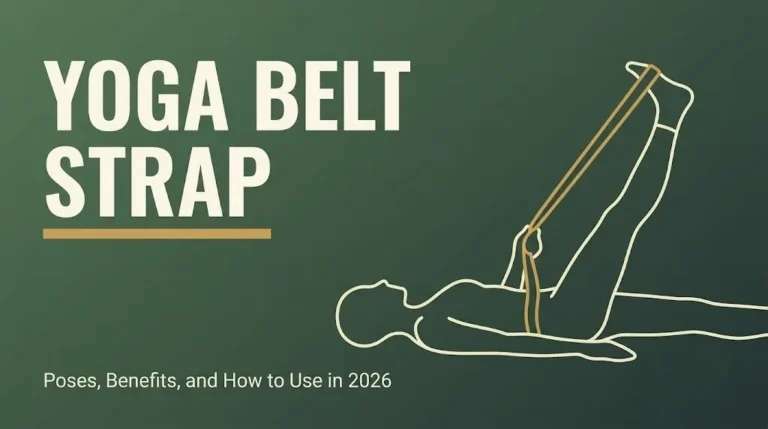
- Yoga strap: Extends your reach in poses where tight hamstrings or shoulders prevent safe alignment. Loop it around the foot in Supta Padangusthasana (Reclined Hand-to-Big-Toe Pose) to prevent knee hyperextension.
- Yoga bolster or firm pillow: Supports the spine in Savasana, elevates the hips in seated poses, and makes Restorative yoga poses deeply effective. A rolled-up firm blanket works as a substitute.
- Non-slip mat: The single most essential item. A 4mm to 6mm thickness mat provides adequate cushioning for floor work without reducing stability in standing poses.
Budget reality: You do not need all four to start. A non-slip mat and two blocks cover 90% of beginner pose modifications. A strap adds value once you begin working on hamstring-intensive poses like seated forward folds.
Props do not need to be branded yoga equipment. Firm bed pillows, leather belts, and thick hardback books work as substitutes while you decide whether to invest in dedicated equipment.
Yoga for Back Pain Beginners
Yoga for back pain beginners is one of the most searched and most mishandled applications of yoga instruction online. The evidence is strong. The execution in popular content is often unsafe. Done correctly, yoga can meaningfully reduce chronic lower back pain. Done incorrectly, it can aggravate it.
The American College of Sports Medicine supports yoga as a complementary approach to chronic low back pain management, noting that core strengthening, spinal mobility, and postural awareness are all addressed within a well-structured yoga practice. A 2017 study published in the Annals of Internal Medicine found that yoga practice was as effective as physical therapy for reducing chronic low back pain in adults.
For beginners managing back pain, these poses are generally considered safe and beneficial when practiced with correct alignment:
- Setu Bandha Sarvangasana (Bridge Pose): Strengthens the glutes and hamstrings, which reduces load on the lumbar spine
- Marjaryasana-Bitilasana (Cat-Cow): Restores gentle spinal mobility without compression
- Supta Kapotasana (Reclined Pigeon): Releases piriformis and hip external rotator tightness, which frequently contributes to sciatic pain patterns
- Balasana (Child’s Pose): Gently decompresses the lumbar spine in extension-biased back pain
Poses beginners with back pain should approach with caution or skip entirely:
- Deep forward folds with straight knees (high hamstring tension can pull on the lumbar attachments)
- Paschimottanasana (Seated Forward Fold) without a strap and bent knees
- Any backbend deeper than a gentle Bhujangasana (Cobra Pose) until lumbar stability improves
Anyone managing acute herniated disc, spinal stenosis, or spondylolisthesis should work with both a physical therapist and a certified yoga therapist before beginning unsupported home practice.
Key Takeaway: For back pain, yoga works best as a consistent, gentle practice built around core stability and hip mobility, not flexibility achievement or advanced poses.
How Often Should Beginners Do Yoga
Beginners should practice yoga two to three times per week to build foundational strength, flexibility, and body awareness without accumulating excessive soreness or fatigue. This frequency is consistently recommended by yoga teachers and supported by exercise science research on neuromuscular adaptation in novice movers.
The American College of Sports Medicine recommends that flexibility training, which includes yoga, be performed at least two to three days per week for measurable improvement. Their guidelines note that daily practice is safe and beneficial for most adults, provided intensity is varied and adequate recovery is built in.
A practical weekly structure for beginners:
| Day | Practice Type | Duration |
|---|---|---|
| Monday | Active sequence (beginner poses) | 25 to 35 minutes |
| Tuesday | Rest or gentle walk | N/A |
| Wednesday | Breathing practice and seated poses | 15 to 20 minutes |
| Thursday | Rest | N/A |
| Friday | Active sequence (repeat Monday’s) | 25 to 35 minutes |
| Saturday | Restorative yoga or Yin | 20 to 30 minutes |
| Sunday | Rest | N/A |
The most common beginner mistake is practicing five to seven days per week in the first two weeks, becoming sore or burned out, and stopping entirely by week three. Sustainable practice matters far more than ambitious practice.
Daily yoga is appropriate for experienced practitioners and for gentle practices like breathing work and Restorative yoga. Beginners should treat rest days as part of the practice, not gaps in it. Neuromuscular adaptation, the process by which your body learns new movement patterns, largely occurs during rest, not during the session itself.
Frequently Asked Questions About Peoples Yoga
What exactly is peoples yoga and how is it different from regular yoga?
Peoples yoga is yoga practice centered on accessibility, affordability, and community inclusion rather than performance, profit, or physical idealism.
It is not a specific yoga style. It is a philosophy applied to any style, from Hatha to Restorative to Vinyasa, that prioritizes meeting practitioners where they actually are.
Regular commercial yoga classes may technically offer beginner options but often still assume baseline fitness, financial access, or cultural familiarity that peoples yoga deliberately removes.
Can I do peoples yoga at home without any equipment?
Yes. A peoples yoga home practice requires no equipment to begin. A non-slip surface, whether a yoga mat or a carpet, is the only essential.
Props like blocks and straps improve accessibility and safety, but they are not required for your first weeks of practice.
As your practice deepens, two yoga blocks and a strap are the most cost-effective investments you can make for safe alignment.
How long should a beginner yoga session last?
Most yoga teachers and exercise physiologists recommend beginner sessions of 20 to 35 minutes, three times per week.
Shorter sessions practiced consistently outperform longer sessions practiced sporadically, particularly in the first three months of practice.
As body awareness and endurance develop, sessions can extend to 45 to 60 minutes naturally, without forcing the timeline.
Is peoples yoga safe for people with chronic pain or injuries?
Yoga can be safe and beneficial for many people managing chronic pain, but the specific poses and modifications matter enormously.
People with diagnosed conditions including herniated discs, osteoporosis, or joint replacements should work with a certified yoga therapist or physical therapist to identify safe poses before beginning unsupported home practice.
The peoples yoga philosophy supports this: access means access to appropriately adapted practice, not a one-size instruction set applied without adjustment.
What yoga style is best for absolute beginners?
Hatha yoga is widely considered the most appropriate starting point for absolute beginners because of its slower pace, longer hold times, and instructional focus on individual pose alignment.
Restorative yoga is an equally valid entry point for people dealing with fatigue, chronic pain, high stress, or physical deconditioning.
Vinyasa yoga, which links poses to breath in flowing sequences, is better suited after foundational pose familiarity has been established, typically after 4 to 8 weeks of Hatha or Restorative practice.
Peoples yoga starts with one decision: that yoga belongs to you, as your body is right now. You do not need a flexible spine, a new mat, or a studio membership to begin.
Start this week with the eight-pose sequence in this guide. Practice it three times. Notice how your body feels on the third session compared to the first. That shift, subtle and real, is where practice lives.
Come back to this guide when you are ready to add breathing techniques, explore chair modifications, or work toward a consistent weekly structure. The practice will meet you wherever you begin.