Chair Yoga Exercises: Poses, Safety & Sequences 2026
Chair yoga exercises are structured yoga poses and breathwork practices performed while seated in a chair, making yoga fully accessible to people who cannot comfortably get up and down from the floor. This guide gives you everything you need to build a safe, effective practice starting today, whether you are 65 or 35, a first-timer or someone returning to movement after an injury.
The stakes for getting this right are real. According to the Centers for Disease Control and Prevention, falls are the leading cause of injury-related death among adults over 65, and one in four older adults falls each year. Research published in the Journal of Alternative and Complementary Medicine has found that chair-based yoga programs improve balance, gait speed, and lower body strength in older adults within eight weeks of regular practice.
You’ll find 16 detailed sections here covering every part of the body, a complete 20-minute sequence, specific guidance for back pain, arthritis, and balance, and breath instruction that most chair yoga guides skip entirely. Start at the beginning or jump to what your body needs most.
What Are Chair Yoga Exercises?
Chair yoga exercises are yoga poses, breath practices, and movement sequences adapted so they can be performed while seated in or supported by a stable chair. The chair replaces the floor as the base of the practice, removing the need for kneeling, lying down, or weight-bearing through the wrists.
These exercises draw primarily from Hatha yoga tradition, which emphasizes alignment, breath coordination, and held poses over flowing sequences. The chair does not make the practice lesser. It changes the mechanical demands while preserving the core principles: breath awareness, spinal alignment, and body-mind connection.
What separates chair yoga from plain seated stretching is breath integration. Every pose in authentic chair yoga practice is coordinated with a specific breath pattern. Inhaling into a spinal extension, exhaling into a forward fold. This coordination activates the parasympathetic nervous system, which reduces cortisol output and lowers physical tension in ways that stretching alone does not replicate.
The NCCIH notes that yoga’s combination of physical posture, breath regulation, and mental attention appears to engage multiple health pathways simultaneously, which explains why its benefits extend beyond simple flexibility improvements.
What chair yoga exercises address:
- Spinal mobility in all directions: flexion, extension, rotation, lateral bending
- Upper body strength and shoulder range of motion
- Lower body strength, hip flexibility, and knee stability
- Core stabilization and postural alignment
- Breath capacity and nervous system regulation
- Balance and proprioception, even in a seated position
Seated Yoga for Seniors: Why the Chair Changes Everything
Seated yoga for seniors works because it removes the primary access barrier to yoga practice: getting onto and up from the floor. For adults managing arthritis, osteoporosis, balance limitations, or post-surgical recovery, floor transitions carry genuine injury risk. The chair eliminates that risk without eliminating the practice.
Think of the chair as a standing block and a floor mat combined. It gives the pelvis a stable platform from which every spinal and limb movement can be initiated safely. This means seniors who could never safely practice traditional floor yoga can access the same spinal rotations, hip openers, and breath-based relaxation responses.
The physiological case for seated yoga in seniors is specific. According to research published in the International Journal of Yoga, older adults who practiced chair-based yoga twice weekly for eight weeks showed measurable improvements in lower body strength, functional mobility, and self-reported pain levels compared to a control group. Lower body strength and functional mobility are the two physical factors most directly linked to independent daily living in older adults.
Why seated yoga works for seniors:
- No floor transitions needed, reducing fall and injury risk
- Chair provides proprioceptive grounding, helping balance regulation
- Reduced joint compression compared to standing or floor poses
- Easily modified for wheelchair users or those with significant mobility limitations
- Consistent practice is more sustainable when it does not require full-body floor work
Modification: Seniors with significant spinal instability or recent vertebral fractures should work with a certified yoga therapist, rather than a general class instructor, to identify which poses are appropriate for their specific condition.
Chair Yoga Poses for Seniors: The Foundation Moves
The five foundational chair yoga poses for seniors cover the primary movement directions of the spine and build the body awareness needed for more complex sequences. Mastering these five before adding others produces better long-term results than jumping into a full pose library.
Each of these five creates a specific physiological response. They are sequenced here in an order that builds from stillness into increasing movement demand.
The five foundational chair yoga poses for seniors:
| Pose (Sanskrit and English) | Primary Action | Primary Muscles | Hold Time |
|---|---|---|---|
| Tadasana in chair (Seated Mountain Pose) | Spinal alignment and grounding | Erector spinae, core stabilizers | 5 to 8 breaths |
| Marjaryasana-Bitilasana (Seated Cat-Cow) | Spinal flexion and extension | Erector spinae, multifidus | 6 to 8 rounds |
| Ardha Matsyendrasana (Seated Spinal Twist) | Thoracic rotation | Obliques, rhomboids, piriformis | 3 to 5 breaths each side |
| Seated lateral bend | Lateral spinal flexion | Quadratus lumborum, obliques | 3 breaths each side |
| Uttanasana in chair (Seated Forward Fold) | Spinal flexion, hamstring lengthening | Hamstrings, erector spinae | 5 breaths |
Modification: For seniors with osteoporosis, avoid deep spinal flexion under load. In Seated Forward Fold, keep the spine lengthened rather than rounded. Hinge forward from the hips with a flat back, and stop at the point where the spine would begin to curve.
Key Takeaway: Chair yoga exercises differ from seated stretching because every movement is coordinated with breath, which activates the parasympathetic nervous system and multiplies the physical benefit.
Chair Yoga Exercises for Beginners: How to Start Safely
Chair yoga exercises for beginners should begin with posture awareness and breath before any movement. Getting this sequence right in the first two weeks builds the foundation for every pose that follows.
Most beginners make the same mistake: they skip setup and jump straight to poses. Without a stable seated base, every pose is built on an unstable foundation. The seated base is two sit bones evenly grounded on the front third of the chair seat, feet hip-width apart and flat on the floor, spine tall.
If your feet do not reach the floor comfortably, place a folded yoga blanket or a firm block under both feet. This single adjustment changes the quality of your entire practice. Dangling feet shift the pelvis into a posterior tilt, which rounds the lumbar spine and reduces the mechanical benefit of every pose above it.
Beginner setup checklist before every session:
- Chair is armless, four-legged, and placed on a non-slip surface
- Sit at the front third of the seat, not fully back
- Both feet flat on the floor or on a prop
- Spine tall: sit bones rooted, top of head reaching up
- Shoulders relaxed away from the ears
- Take 5 full breath cycles in this position before any movement begins
Modification: Complete beginners with no yoga background should practice only the setup position and the Seated Mountain Pose for the first two sessions. Getting comfortable in stillness and breath awareness first produces better body awareness for all poses that follow.
Chair Yoga Warm-Up Exercises: Always Start Here
Chair yoga warm-up exercises prepare the joints, increase circulation to the muscles, and signal the nervous system to shift from a stress-dominant state toward a more receptive one. Skipping the warm-up is the most common beginner error.
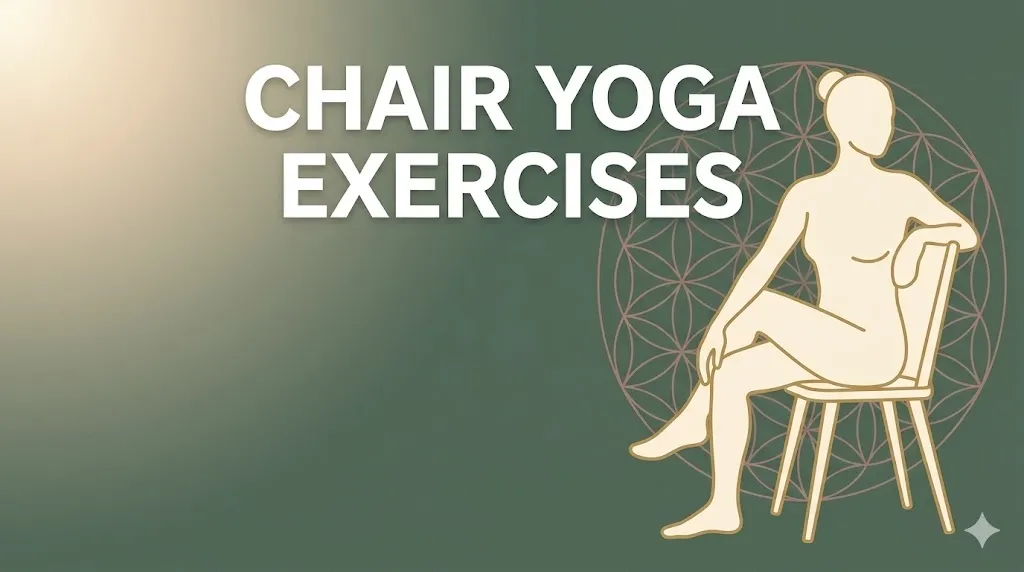
A warm-up does not need to be long. Five to seven minutes of targeted movement through the neck, shoulders, wrists, spine, and hips is sufficient. The goal is not to stretch. The goal is to increase synovial fluid circulation in the joints and gently mobilize tissue before it is asked to bear load or hold extended positions.
To practice a complete chair yoga warm-up:
- Neck rolls: Sit tall. Drop the right ear toward the right shoulder. Slowly roll the chin down toward the chest. Roll to the left ear toward the left shoulder. Repeat 3 times in each direction. Do not roll the head backward.
- Shoulder circles: Both arms at sides. Circle both shoulders forward 5 times, then backward 5 times. Move slowly and breathe.
- Wrist and finger warm-up: Extend both arms forward. Circle both wrists in both directions, 5 times each. Open and close the fists slowly, 5 times.
- Seated Cat-Cow (Marjaryasana-Bitilasana): Hands on knees. Inhale: arch the low back, lift the chest (Cow). Exhale: round the spine, tuck the chin (Cat). 6 to 8 slow rounds.
- Seated hip circles: Hands on thighs. Circle the entire pelvis clockwise 4 times, then counterclockwise 4 times. This mobilizes the sacroiliac joint and warms the hip flexors.
- Ankle pumps and circles: Feet flat on the floor. Alternately lift and lower each heel 8 times. Then circle each ankle 4 times in each direction.
Pose Tip:
- Keep the neck warm-up gentle and within a pain-free range at all times.
- For anyone with cervical spine stenosis or recent neck injury, skip the neck rolls and substitute gentle forward chin tucks instead.
- Move at a pace that allows full breath coordination with every movement.
Chair Yoga Upper Body Exercises: Shoulders, Neck, and Arms
Chair yoga upper body exercises target the shoulder girdle, cervical spine, thoracic spine, and arms, which are the regions most affected by prolonged sitting, screen use, and age-related postural changes.
The most common postural pattern in adults who sit for extended periods is a forward head position, rounded shoulders, and a collapsed thoracic spine. Think of the upper back like a bow that has been strung too tightly on one side. The front of the chest shortens. The back of the shoulders and upper back lengthen and weaken. Chair yoga upper body exercises address both sides of this imbalance.
To practice Garudasana arms (Eagle Arms):
- Sit tall in Tadasana position.
- Extend both arms forward at shoulder height.
- Cross the right arm under the left at the elbows.
- Bend both elbows and try to bring the backs of the hands together, or wrap the palms if range allows.
- Lift the elbows slightly. Feel the stretch across the upper back and rhomboids.
- Hold for 4 breaths. Inhale to lengthen the spine. Exhale to settle into the stretch.
- Release and repeat with left arm under right.
To practice Gomukhasana arms (Cow Face Arms):
- Sit tall. Reach the right arm up overhead, then bend the elbow, dropping the right hand toward the center of the upper back.
- Reach the left arm down and behind, bending the elbow and reaching the left hand up the back toward the right hand.
- If the hands do not meet, hold a yoga strap between them.
- Hold for 4 breaths. Switch sides.
Modification: If significant rotator cuff limitation is present, practice Eagle Arms only and skip Cow Face Arms until shoulder range improves. Never force the arms into position.
Key Takeaway: Upper body chair yoga exercises reverse the forward-rounded posture pattern caused by prolonged sitting, targeting the rhomboids, posterior deltoids, and thoracic extensors that tend to lengthen and weaken over time.
Chair Yoga Lower Body Exercises: Hips, Legs, and Feet
Chair yoga lower body exercises address the hip flexors, quadriceps, hamstrings, gluteus medius, and the muscles of the lower leg and feet. These are the muscle groups most shortened or weakened by long periods of seated inactivity.
Hip flexors are particularly important in this context. After hours of seated position, the iliopsoas muscle group remains in a shortened state. When a person then stands and walks, shortened hip flexors alter gait mechanics, increase anterior pelvic tilt, and contribute to lower back strain. Chair yoga lower body work directly counteracts this pattern.
To practice a seated hip flexor stretch:
- Sit at the front edge of the chair.
- Slide the right foot back so the right leg extends behind the chair, right toes on the floor.
- Keep the left foot flat on the floor, left knee at 90 degrees.
- Sit tall and gently shift the pelvis forward to feel a stretch in the front of the right hip.
- Hold for 5 breaths. Keep the spine lengthened throughout.
- Return the right foot forward and repeat on the left side.
To practice Virabhadrasana I in chair (Warrior I variation):
- Sit sideways on the chair, right hip at the seat edge.
- Extend the left leg back, left toes on the floor.
- Press the left heel toward the floor. Bend the right knee to 90 degrees.
- Raise both arms overhead, palms facing each other.
- Hold for 3 to 4 breaths. Repeat on the other side.
Modification: For practitioners with knee osteoarthritis, keep the front knee directly above the ankle and avoid bending beyond 90 degrees. Reduce the range of the hip flexor stretch if pain occurs at the front of the hip.
Chair Yoga Core Exercises: Stabilizing the Center
Chair yoga core exercises target the transverse abdominis, obliques, erector spinae, and multifidus, which are the deep stabilizing muscles that support spinal integrity during every other pose.
Core strength in yoga does not mean doing crunches or sit-ups. It means developing the deep muscular support that holds the spine in optimal alignment during movement. A strong yoga core is an internal corset, not a six-pack. The goal is stability and endurance in the deep layers, not surface-level muscle bulk.
To practice seated abdominal engagement (core foundation):
- Sit tall in Tadasana position.
- Place both hands on the lower abdomen.
- Inhale to expand the belly outward.
- Exhale slowly and draw the navel gently in and up toward the spine.
- Hold this engagement for 5 to 8 seconds. Breathe normally.
- Release and repeat 6 to 8 times.
To practice seated oblique twist for core strength:
- Sit tall. Hands behind the head, elbows wide.
- Inhale to lengthen the spine.
- Exhale and rotate the right elbow toward the left knee. Keep both sit bones grounded.
- Inhale back to center.
- Exhale and rotate left elbow toward right knee.
- Complete 6 to 10 repetitions each side.
Pose Tip:
- Never hold the breath during core work. Continuous breathing is part of the exercise.
- For people with diastasis recti, avoid twisting core exercises. Focus only on the basic abdominal engagement breath exercise above.
- Keep the chin neutral during oblique twists. Do not pull the head forward with the hands.
Key Takeaway: Chair yoga core work builds the deep spinal stabilizers, not the surface abs, and that internal strength is what protects the lower back during every other exercise in the sequence.
Chair Yoga Breathing Exercises: The Missing Piece
Chair yoga breathing exercises, formally called pranayama, are the element that separates authentic chair yoga from simple seated stretching. Breath regulation directly influences heart rate, cortisol levels, and nervous system state.
The Yoga Alliance defines pranayama as conscious breath regulation used to influence physiological and psychological states. Three pranayama techniques are particularly well-suited to chair yoga practice for seniors and beginners: Ujjayi breath, Dirga Pranayama (three-part breath), and Nadi Shodhana (alternate nostril breathing).
To practice Dirga Pranayama (three-part breath):
- Sit tall. Place one hand on the lower belly and one on the chest.
- Inhale slowly into the lower belly first, expanding it forward.
- Continue inhaling into the middle ribs, expanding sideways.
- Continue inhaling into the upper chest, just below the collarbones.
- Exhale in reverse: chest, ribs, belly.
- Complete 5 to 8 full breath cycles.
To practice Nadi Shodhana (alternate nostril breathing):
- Sit tall. Bring the right hand to the face.
- Close the right nostril with the right thumb. Inhale slowly through the left nostril for 4 counts.
- Close both nostrils briefly. Hold for 1 to 2 counts.
- Open the right nostril. Exhale for 4 counts through the right.
- Inhale through the right for 4 counts.
- Close both. Open the left. Exhale through the left.
- This completes one full cycle. Repeat 4 to 6 cycles.
According to the Journal of Alternative and Complementary Medicine, alternate nostril breathing practices produce measurable reductions in resting heart rate and blood pressure in adults who practice regularly. These effects are relevant for seniors managing cardiovascular risk factors.
Modification: People with significant nasal congestion or a deviated septum can practice the breath patterns without the nostril alternation, simply breathing in and out through the nose with the same count pattern.
Chair Yoga Routine for Seniors: Building a Weekly Practice
A sustainable chair yoga routine for seniors is built on frequency over duration. Three sessions per week of 20 to 30 minutes each produces more consistent results than one long weekly session. This is consistent with what the American College of Sports Medicine recommends for flexibility and balance training in older adults.
The biggest barrier to consistency in seniors is not ability. It is scheduling and habit anchoring. Attaching chair yoga sessions to an existing daily activity, such as morning coffee, an afternoon television program, or a post-lunch rest period, significantly increases the likelihood of consistency. The practice becomes the interruption, not the event.
A weekly structure that works for most beginners:
| Day | Session Length | Focus |
|---|---|---|
| Monday | 20 minutes | Warm-up, upper body, breathing |
| Wednesday | 25 minutes | Warm-up, lower body, core |
| Friday | 25 minutes | Full sequence (all body regions) |
| Saturday or Sunday | 15 minutes | Breath practice and seated relaxation only |
| Tuesday and Thursday | Rest or gentle walking | Active recovery |
Progress the session length by 5 minutes per week once the current duration feels fully comfortable. Do not increase intensity and duration simultaneously. Choose one variable at a time.
Modification: For seniors with fatigue-related conditions, including those managing multiple sclerosis or post-COVID fatigue, shorter sessions of 10 to 15 minutes practiced daily may be more appropriate than longer sessions three times per week. Consistency of shorter sessions outperforms occasional longer ones in fatigue management contexts.
Chair Yoga Workout for Seniors: Making It Count
A chair yoga workout for seniors becomes genuinely effective when it is structured to include cardiovascular stimulation, muscular engagement, and nervous system regulation within a single session. This is more than a gentle stretch.
Chair yoga raises the heart rate moderately when poses are held for appropriate durations and breath is maintained throughout. A 2019 review in Complementary Therapies in Medicine found that yoga-based exercise programs produced improvements in cardiovascular fitness markers, including resting heart rate and blood pressure, in older adults over 12 weeks of regular practice.
To increase the workout intensity of chair yoga without adding joint stress:
- Extend hold times for seated strength poses from 3 breaths to 8 to 10 breaths
- Add upper body movement to lower body poses, such as reaching the arms overhead in the seated hip flexor stretch
- Reduce rest time between poses without rushing the movements themselves
- Incorporate more repetition-based movements, like seated marching or seated leg lifts, between static held poses
What a structured chair yoga workout targets:
- Cardiovascular: elevated heart rate through extended holds and sequences
- Muscular endurance: sustained engagement of postural muscles
- Flexibility: held stretches at appropriate durations
- Balance: single-leg or weight-shifting poses performed with chair support
- Neurological: breath coordination and proprioceptive feedback
Modification: Seniors with hypertension or cardiovascular conditions should maintain steady, controlled breathing throughout the entire session. Breath-holding during exertion increases blood pressure temporarily. If breathlessness or dizziness occurs, return to Seated Mountain Pose and resume normal breathing before continuing.
Key Takeaway: A chair yoga workout for seniors is a genuine cardiovascular and muscular training session when structured correctly, not just a stretching break. Extend hold times and sequence poses without excessive rest to build real fitness.
Chair Yoga for Back Pain: What Works and What Doesn’t
Chair yoga for back pain is most effective when the specific type of back pain is understood before choosing poses. Lumbar muscle tension, disc-related pain, sacroiliac joint dysfunction, and spinal stenosis each respond differently to yoga-based interventions.
For lumbar muscle tension, which is the most common type of back discomfort in adults who sit for long periods, gentle spinal mobility in all directions is typically helpful. Seated Cat-Cow mobilizes the full spinal column and reduces the stiffness that accumulates from static seated postures. The erector spinae and multifidus muscles, which are the primary spinal stabilizers, respond well to the rhythmic flexion and extension of this movement.
For disc-related issues, including herniated or bulging discs, forward folds that involve lumbar rounding increase intradiscal pressure and can worsen symptoms. The safe modification is a hip-hinge forward fold: keep the spine in a neutral or slightly extended position and hinge from the hip joints rather than rounding through the waist.
What helps vs. what to approach carefully:
| Movement Type | Helpful for Muscle Tension | Caution with Disc Issues |
|---|---|---|
| Seated Cat-Cow | Yes | Limit lumbar flexion range |
| Seated Spinal Twist | Yes | Reduce rotation range |
| Hip-hinge forward fold | Yes | Yes (safer than lumbar rounding) |
| Lateral bend | Yes | Yes (keep range moderate) |
| Deep lumbar forward fold | Yes for muscle tension | Avoid with disc issues |
Anyone managing ongoing back pain that has been investigated by a spine specialist or physical therapist will have condition-specific guidance that should take priority over any general article recommendations.
Chair Yoga for Balance: Reducing Fall Risk
Chair yoga improves balance by training proprioception, which is the body’s internal sense of its own position in space. Most balance-training programs focus on strength or reaction time. Chair yoga adds a third element: the mindful attention to body position and weight distribution that makes balance a conscious, trainable skill.
The CDC reports that one in four adults over 65 falls each year, and many falls occur during ordinary activities like standing from a chair, walking on uneven surfaces, or reaching overhead. Chair yoga directly trains the movement patterns and body awareness involved in all three scenarios.
To practice seated weight shifting for balance training:
- Sit at the front edge of the chair in Tadasana position.
- Slowly shift your weight toward the right sit bone. Feel the left side lighten.
- Return to center. Shift to the left sit bone.
- Repeat 6 times each direction. Move slowly and with full breath awareness.
- Progress to lifting one foot slightly off the floor during the weight shift.
To practice Vrksasana in chair (Seated Tree Pose):
- Sit tall. Place the right foot flat on the floor.
- Lift the left foot and rest it on the right ankle, shin, or inner thigh (not the knee joint).
- Bring hands to heart center or extend arms overhead.
- Hold for 5 breaths. Focus the gaze on one still point in front of you.
- Repeat on the other side.
Modification: Practitioners with significant balance impairment can keep both feet on the floor during the weight-shifting exercise and skip the foot lift. The proprioceptive benefit of mindful weight shifting is present even without the foot leaving the floor.
Chair Yoga for Arthritis: Moving Without Aggravating
Chair yoga for arthritis works by increasing synovial fluid circulation in the affected joints, maintaining range of motion, and reducing the inflammatory response through the nervous system regulation that consistent breath-coordinated movement produces.
The guiding principle for chair yoga with arthritis is simple: move to the edge of comfort, but not into pain. Pain is a signal that the joint is being loaded beyond its current tolerance. Mild stiffness that loosens with movement is different from sharp, joint-specific pain during a pose. Practitioners must learn to distinguish the two.
According to a study published in the Journal of Alternative and Complementary Medicine, adults with knee osteoarthritis who practiced yoga twice weekly for eight weeks reported meaningful reductions in pain scores and improved physical function compared to a control group. The chair modifications used in that study kept participants weight-bearing through the chair rather than through the knees.
Best chair yoga exercises for arthritis by joint:
- Hands and fingers: slow fist opening and closing, wrist circles, finger interlacing stretches
- Shoulders: Eagle Arms (Garudasana), shoulder circles, gentle chest opening with hands clasped behind the back
- Hips: seated hip circles, gentle Seated Spinal Twist, seated figure-four stretch (placing one ankle on the opposite knee)
- Knees: seated leg extensions with a gentle flexion-extension rhythm, not forceful straightening
- Lower back: Seated Cat-Cow, lateral bends, gentle rotations in a pain-free range
Modification: During any acute arthritis flare involving heat, swelling, and joint tenderness, reduce all movement to breath practice only. Passive breath exercises maintain the nervous system regulation benefits of yoga without adding joint stress during a flare.
Key Takeaway: Chair yoga for arthritis is effective because it moves joints through their available range with breath coordination, maintaining function and reducing stiffness without compressing or loading the joint in ways that aggravate inflammation.
Chair Yoga for Flexibility: Realistic Expectations
Chair yoga builds flexibility by applying consistent, breath-coordinated lengthening stress to muscles and connective tissue over time. The timeline for measurable change depends on the tissue type being stretched, the age of the practitioner, and the consistency of practice.
Muscular tightness responds faster than structural tissue changes. Research suggests that consistent stretching held for 30 to 60 seconds, practiced three to five days per week, produces noticeable increases in active range of motion within four to six weeks. The hip flexors and thoracic erector spinae are among the first areas to show change in consistent chair yoga practitioners who spend long hours seated.
For adults over 60, the connective tissue surrounding joints, including the joint capsule and ligaments, responds more slowly to flexibility training than muscle tissue does. This is not a reason to stop. It is a reason to hold poses longer, use props to support extended holds, and measure progress in terms of functional improvement, such as easier overhead reach or more comfortable spinal rotation, rather than comparing range of motion to a younger standard.
Expected flexibility improvements by practice frequency:
| Practice Frequency | Expected Timeline | Where Change Appears First |
|---|---|---|
| Daily (20 min) | 3 to 4 weeks | Hip flexors, thoracic spine |
| 3x per week (25 min) | 4 to 6 weeks | Hamstrings, shoulder girdle |
| 2x per week (30 min) | 6 to 8 weeks | Lumbar rotation, hip external rotation |
| 1x per week | Maintenance only | Minimal new gains |
Modification: Practitioners with hypermobility conditions, including Ehlers-Danlos syndrome, should focus on building strength at the end range of motion rather than increasing flexibility. Overstretching hypermobile joints without corresponding strength work increases joint instability and injury risk.
Chair Yoga Sequence for Seniors: A 20-Minute Full Practice
This complete chair yoga sequence for seniors incorporates all major movement directions, breath coordination, and a balanced progression from warm-up through cool-down. It is designed for independent home practice.
Full 20-minute chair yoga sequence:
Minutes 1 to 3: Breath awareness and grounding.
- Sit at the front third of the chair in Tadasana (Seated Mountain Pose).
- Close the eyes or soften the gaze.
- Take 5 Dirga Pranayama (three-part breath) cycles.
- Observe where the body holds tension. Do not try to change it yet.
Minutes 3 to 7: Warm-up.
- Neck rolls: 3 slow half-circles each direction.
- Shoulder circles: 5 forward, 5 backward.
- Marjaryasana-Bitilasana (Seated Cat-Cow): 6 to 8 rounds coordinated with breath.
- Seated hip circles: 4 clockwise, 4 counterclockwise.
- Ankle circles and heel lifts: 8 repetitions each.
Minutes 7 to 14: Main pose sequence.
- Garudasana arms (Eagle Arms): 4 breaths each side.
- Seated lateral bend: 3 breaths each side.
- Ardha Matsyendrasana (Seated Spinal Twist): 4 breaths each side.
- Seated hip flexor stretch: 5 breaths each side.
- Vrksasana in chair (Seated Tree Pose): 5 breaths each side.
- Seated core engagement breath: 6 rounds.
- Uttanasana in chair (Seated Forward Fold, hip-hinge variation): 5 breaths.
Minutes 14 to 18: Cool-down.
- Gentle Seated Spinal Twist, reduced range: 3 breaths each side.
- Seated chest opener: interlace hands behind the back, open the chest, hold 5 breaths.
- Nadi Shodhana (Alternate Nostril Breathing): 4 to 6 full cycles.
Minutes 18 to 20: Closing stillness.
- Return to Tadasana (Seated Mountain Pose). Eyes closed.
- Take 5 natural breath cycles without controlling the breath.
- Open the eyes. Sit quietly for 30 seconds before rising.
Modification: For a 10-minute version, keep steps 1 to 4, steps 7 and 8, steps 11 to 13, and steps 19 to 22. Even the shortened sequence delivers full breath, spinal mobility, and nervous system regulation when practiced consistently.
Frequently Asked Questions About Chair Yoga Exercises
What are the best chair yoga exercises for seniors?
The best chair yoga exercises for seniors are Seated Mountain Pose, Seated Cat-Cow, Seated Spinal Twist, seated hip flexor stretches, and alternate nostril breathing.
These five cover all primary spinal directions, address the hip flexors shortened by sitting, and integrate breath regulation in a way that generates the full physiological benefit of yoga practice.
Start with these five, practice them three times per week, and build from there once they feel comfortable and controlled.
How long should a chair yoga session be for beginners?
Beginners should start with sessions of 15 to 20 minutes, three times per week.
This duration is sufficient to complete a warm-up, four to six poses, and a breath-based cool-down without overtaxing the body or creating the fatigue that discourages consistency.
Most yoga teachers and physical therapists recommend increasing session length by five minutes per week as tolerance and familiarity improve.
Can chair yoga help with arthritis pain?
Yes, research supports chair yoga as a tool for managing arthritis-related pain and stiffness.
A study published in the Journal of Alternative and Complementary Medicine found that older adults with knee osteoarthritis who practiced yoga twice weekly for eight weeks reported meaningful reductions in pain scores and improved physical function.
The key is moving within a pain-free range and focusing on breath coordination, which reduces the inflammatory stress response over time.
How often should seniors do chair yoga exercises?
Most yoga teachers and physical therapists generally recommend seniors practice chair yoga three to four times per week for 20 to 30 minutes per session.
The American College of Sports Medicine recommends this frequency for flexibility and balance training in older adults.
Daily shorter sessions of 10 to 15 minutes can produce equivalent results for seniors managing fatigue or chronic conditions.
Is chair yoga as effective as regular yoga?
Chair yoga produces comparable benefits to floor-based yoga for the populations it is designed for, including seniors, people with limited mobility, and those managing chronic pain.
Research published in the International Journal of Yoga found that chair-adapted yoga programs improved balance, strength, and functional mobility in older adults within eight weeks, outcomes consistent with floor-based yoga studies in similar populations.
The method of delivery differs, but the mechanisms, breath coordination, mindful movement, and held poses, are the same.
Start with Seated Mountain Pose today. Sit at the front edge of a stable, armless chair, plant both feet flat on the floor, lengthen the spine, and take five slow, deliberate breaths. That is a complete chair yoga exercise. Everything else builds from it.
Practice three times this week, even if each session is only 15 minutes. Use the warm-up sequence before every session, without exception. Add one new pose per week once the current ones feel controlled and comfortable.
The chair is not a limitation. It is the beginning.