Chair Yoga Classes Near Me: Complete 2026 Guide
Finding chair yoga classes near me is easier than it was five years ago, and the options now range from hospital wellness centers to community recreation programs to live-streamed sessions you can join from your living room. This guide tells you exactly how to locate a class, what to expect when you get there, and whether chair yoga is actually worth your time.
The research backing chair yoga has grown considerably. According to the National Center for Complementary and Integrative Health (NCCIH), yoga practiced with props and modifications can safely support adults managing chronic pain, reduced mobility, and age-related balance changes. That is not a small claim for a practice that requires nothing more than a sturdy chair.
You will find everything here: the science, the specific poses, how to adapt them for arthritis or back pain, what instructor credentials actually mean, and how often to practice for results that hold.
Chair Yoga Classes Near Me: What You Are Actually Looking For
When someone searches for chair yoga classes near me, they are usually looking for one of three things: a local in-person group class, an online live session they can join from home, or a hybrid option that lets them do both.
The good news is that all three exist in 2026 and are more accessible than ever. Community centers, senior centers, hospital wellness programs, YMCA locations, and dedicated yoga studios all commonly offer chair yoga. Many have added hybrid formats since 2020, meaning you can attend virtually even if a physical location is nearby.
The key is knowing which setting fits your body and your schedule. A hospital-based wellness program may have more medically informed instructors. A community center class may be more social and lower cost. A private yoga studio may offer smaller class sizes and more individualized attention.
| Setting Type | Typical Cost | Class Size | Instructor Background |
|---|---|---|---|
| Hospital wellness center | $10 to $25 per class | Small, 5 to 12 people | Often RYT-500 or yoga therapist |
| Community/senior center | Free to $10 | Medium, 10 to 20 people | Varies; ask for credentials |
| YMCA or rec center | Membership-based | Medium to large | Certified fitness or yoga instructor |
| Private yoga studio | $15 to $35 per class | Small, 4 to 10 people | Usually RYT-200 minimum |
| Online live-stream | $5 to $20 per session | Varies widely | Verify independently |
Call ahead and ask one direct question: “Does the instructor have a specific chair yoga or adaptive yoga certification?” The answer tells you a great deal about the program’s quality.
What Is Chair Yoga
Chair yoga is a modified style of yoga practiced while seated in a chair or while standing and using a chair for support. It draws primarily from Hatha yoga traditions, adapting classical poses so that practitioners who cannot safely get to and from the floor can still access the benefits of the practice.
Think of a standard yoga class where poses like Trikonasana (Triangle Pose) or Vrikshasana (Tree Pose) are done standing on a mat. In a chair yoga format, those same movements are adapted: the seated version of Triangle works the same lateral spinal muscles and hip flexors, just from a supported position. The chair is a prop, not a limitation.
Chair yoga is distinct from Restorative yoga, which is entirely floor-based and passive. It is also different from Yin yoga, which targets deep connective tissue through long passive holds. Chair yoga is active, breath-connected movement. Most poses are held for 3 to 5 breath cycles and involve both flexibility and gentle strengthening.
It is also worth distinguishing chair yoga from chair aerobics or seated exercise classes. Chair yoga specifically incorporates pranayama (breath control techniques), mindful awareness, and yoga pose mechanics. The breath-movement connection is what separates it from generic seated exercise.
How to Find Chair Yoga Classes in My Area
Locating chair yoga classes in my area takes less than 10 minutes if you know where to search. The most reliable starting points are local senior centers, hospital wellness departments, and community recreation programs.
Start with your city or county parks and recreation website. Most publish seasonal schedules of fitness and wellness classes. Search specifically for “adaptive yoga,” “gentle yoga,” or “chair yoga” in their class listings. These programs are often heavily subsidized, meaning costs are very low.
Call your nearest hospital’s wellness or integrative medicine department. Many hospital systems in 2026 run community-facing chair yoga programs, sometimes at no charge for patients managing specific conditions. Ask whether their instructors hold an International Association of Yoga Therapists (IAYT) credential, which is the gold standard for medically informed yoga instruction.
Online platforms including Zoom-based yoga communities, YouTube channels from credentialed teachers, and subscription apps have expanded access significantly. If nothing local meets your needs, a live-streamed class from a verified 200-hour or 500-hour registered yoga teacher is a legitimate option.
Ways to find chair yoga classes near you:
- City and county parks and recreation websites
- Local senior center program listings
- Hospital integrative medicine or wellness department
- YMCA or Jewish Community Center class schedules
- Yoga studio websites filtered by “gentle” or “adaptive”
- Community bulletin boards at libraries and pharmacies
- Yoga Alliance’s online teacher search (filter by location and specialty)
Key Takeaway: The best place to start your search for chair yoga classes is your local senior center or hospital wellness program. They typically have the most qualified instructors for health-condition-specific needs, and costs are often low or subsidized.
Chair Yoga in Burbank and Southern California: What’s Available
Yoga in Burbank and the broader Los Angeles area benefits from one of the densest concentrations of certified yoga teachers in the country. Finding chair yoga specifically in Burbank means looking at several reliable community anchors.
The Burbank Senior Center, operated by the City of Burbank, historically offers fitness and movement programming for adults 50 and older. Gentle and seated yoga formats cycle through their schedules seasonally. Call the center directly to confirm current chair yoga offerings, as programming changes each quarter.
The Verdugo Hills area, which borders Burbank, also has several community centers and medical facilities with wellness programming. Yoga studios in the Burbank-Toluca Lake corridor increasingly list “gentle yoga” or “chair yoga” as dedicated class types rather than just a modification within a regular class.
Throughout the San Fernando Valley and greater Los Angeles region, adaptive yoga programs have expanded through partnerships with medical systems like Kaiser Permanente and Cedars-Sinai, which have integrated yoga therapy into their outpatient wellness offerings.
What to search when looking for yoga in Burbank:
- “Burbank Parks Recreation fitness schedule 2026”
- “Burbank Senior Center class schedule”
- “Gentle yoga Burbank studio”
- “Adaptive yoga Los Angeles”
- “Chair yoga San Fernando Valley”
Always confirm class format before attending. “Gentle yoga” does not always mean chair-based. Ask specifically whether the class uses chairs throughout or only as an occasional prop.
Chair Yoga for Seniors: Why It Works and What the Research Says
Chair yoga for seniors is one of the best-studied applications of yoga in older adult populations. The evidence is specific and worth knowing before you commit to a class.
A study published in the International Journal of Yoga found that a 12-week chair yoga program significantly improved physical function, fatigue levels, and overall quality of life in older adults with osteoarthritis. Participants practiced twice per week. The improvements were measurable not just in self-reported experience but in standardized physical performance tests.
Harvard Health Publishing has noted that balance and fall prevention represent two of the most clinically important benefits of yoga for older adults. Falls are the leading cause of injury-related death among adults over 65 in the United States, according to the Centers for Disease Control and Prevention. Practices that build proprioception (the body’s sense of its own position in space) and lower body stability directly address this risk.
Chair yoga is also appropriate for seniors managing osteoporosis. Weight-bearing poses done standing while holding the chair build bone-stress response in the lower body. Seated poses build spinal extensor strength without requiring the spinal flexion that can be risky in confirmed osteoporosis cases. A yoga teacher or yoga therapist with senior-specific training will know which poses to modify or avoid for this population.
Chair yoga benefits specific to older adults:
- Improved range of motion in the hips, shoulders, and spine
- Reduced fear of falling through balance training
- Better proprioceptive awareness
- Reduced muscle tension contributing to chronic joint pain
- Lower reported fatigue in people with inflammatory conditions
- Social engagement in group class settings, which research associates with reduced depression risk
Chair Yoga Benefits Backed by Science
Chair yoga benefits extend well beyond flexibility. The physiological effects touch multiple body systems in ways that matter for long-term health.
According to the NCCIH, yoga practices that combine breath awareness with gentle movement show measurable effects on cortisol levels, the body’s primary stress hormone. Lower cortisol is associated with reduced systemic inflammation, which connects yoga practice to benefits for conditions including cardiovascular health, blood pressure regulation, and immune function.
Complementary Therapies in Medicine published research showing that regular gentle yoga, including chair-based formats, reduced self-reported pain scores in adults with chronic musculoskeletal conditions. The mechanism is partly biomechanical (improved joint mobility and muscle length) and partly neurological (the parasympathetic nervous system response activated by slow, deliberate breathing).
The mental health effects are also documented. The Journal of Alternative and Complementary Medicine has published multiple studies linking yoga practice to reduced symptoms of anxiety and depression. For older adults who may face social isolation, the group class format adds a layer of benefit that purely physical exercise does not replicate.
| Benefit Category | Mechanism | Supported By |
|---|---|---|
| Reduced stress and anxiety | Parasympathetic activation via breath | NCCIH, JACM |
| Improved joint mobility | Synovial fluid circulation, connective tissue lengthening | International Journal of Yoga |
| Better balance | Proprioceptive training, lower body strengthening | Harvard Health Publishing |
| Reduced chronic pain | Nervous system regulation, muscle tension release | Complementary Therapies in Medicine |
| Improved mood and social connection | Group engagement plus breath-mediated nervous system shifts | NCCIH |
Is Chair Yoga Effective, or Is It Just Gentle Stretching
Chair yoga is effective as a structured practice, but only when it is done with genuine yoga mechanics. Random seated stretching is not the same thing.
The difference lies in three elements: breath integration, sequential movement, and intentional alignment. When a seated forward fold is done with an Ujjayi breath (a specific diaphragmatic breathing technique with a slight constriction at the back of the throat), it engages the vagus nerve more directly than the same movement done while watching television. That vagus nerve activation is part of what drives the measurable stress-reduction and pain-modulation effects.
A 2022 review published in the International Journal of Yoga analyzed chair yoga programs across multiple studies and found consistent improvements in flexibility, balance, and psychological well-being in adults over 60. The programs that showed the strongest results shared two features: they included breath guidance throughout the session, and they ran for at least 8 weeks with at least two sessions per week.
That is important context. One class per month is not a yoga practice. It is a sampling. The benefits documented in research require consistency. Think of it like physical therapy: the exercises are simple, but skipping weeks means starting over.
Chair yoga is also effective as a gateway practice. Many people who begin with chair yoga because of pain or limited mobility eventually progress to mat-based classes. The foundational alignment principles are identical. What changes is the support structure, not the yoga itself.
Key Takeaway: Chair yoga is most effective when it includes real breath guidance and runs for at least 8 weeks at two sessions per week. A single class per month will not produce the balance, flexibility, or stress-reduction benefits documented in research.
Chair Yoga Poses: The Core Movements in Every Class
Most chair yoga classes draw from the same foundational pose library. Knowing these before your first class removes the intimidation factor completely.
To practice Seated Cat-Cow (Marjaryasana-Bitilasana in a chair):
- Sit at the front edge of the chair. Place both feet flat on the floor, hip-width apart.
- Place both hands on your thighs, just above the knees.
- Inhale: gently arch your lower back, lift your chest, and roll your shoulders back and down. This is the Cow position.
- Exhale: round your spine gently, draw your navel toward your spine, and let your head release forward slightly. This is the Cat position.
- Repeat 5 to 8 cycles, moving with your breath.
- Return to a neutral spine to finish.
Modification: If you have a disc herniation in the lumbar spine, skip the rounding phase. Perform only the gentle arch on the inhale and return to neutral on the exhale.
To practice Chair-Assisted Vrikshasana (Tree Pose):
- Stand behind the chair with both hands resting lightly on the backrest.
- Shift your weight onto your left foot. Root through all four corners of the foot.
- Lift your right foot and place it either against your left ankle, shin, or inner thigh. Never against the knee joint itself.
- Hold for 3 to 5 breaths. Keep your gaze soft and fixed on a point at eye level.
- Lower the foot and repeat on the other side.
Safety note: Use the chair for balance assistance only, not to hold your full body weight. The goal is to develop balance, not to redistribute it entirely to the chair.
Core poses found in most chair yoga classes:
- Sukhasana (Easy Seated Pose): Foundational posture, spinal alignment, breath awareness
- Seated Marjaryasana-Bitilasana (Cat-Cow): Spinal mobility, breath coordination
- Seated Garudasana arms (Eagle Arms): Shoulder and upper back opening, posterior deltoid and rhomboid engagement
- Chair-Assisted Vrikshasana (Tree Pose): Balance, hip external rotation, focus
- Seated Uttanasana (Forward Fold): Hamstring and lower back lengthening
- Seated spinal twist: Thoracic rotation, spinal mobility
Chair Yoga for Arthritis: What Actually Helps
Chair yoga for arthritis works best when it targets the specific joints affected and respects the difference between discomfort from movement and pain from inflammation.
The American College of Sports Medicine recommends that adults with arthritis engage in low-impact flexibility and strengthening activities most days of the week. Chair yoga fits both categories. The gentle range-of-motion movements that characterize seated yoga directly address the stiffness that accumulates when arthritic joints are kept still for extended periods.
For osteoarthritis, which is the most common form and involves cartilage wear in weight-bearing joints, chair yoga offers relief by improving circulation to the joint, reducing the muscle tension that increases compressive load, and maintaining the range of motion that helps slow functional decline.
For rheumatoid arthritis, the calculus is slightly different. On high-inflammation days, when joints are hot, swollen, and acutely tender, movement should be minimal. Chair yoga on low-inflammation days supports joint health without the impact or load that worsens symptoms. Anyone managing rheumatoid arthritis should discuss activity timing with their rheumatologist, integrated into an overall care plan.
Pose Tip for Arthritis Practitioners:
- Avoid gripping props tightly if hand joints are involved. Use open-palm contact on the chair instead.
- Skip any pose that produces sharp joint pain. Mild discomfort from moving a stiff joint is different from joint pain.
- Warm up for at least 5 minutes before attempting any pose that asks for significant range of motion.
Chair Yoga for Back Pain: What to Expect and What to Avoid
Chair yoga for back pain addresses one of the most common reasons people seek out gentle movement practices. Back pain affects roughly 80% of adults at some point, according to data cited by the National Institutes of Health.
The seated format removes the need to get down to and up from the floor, which is a real barrier for people with acute lumbar pain. Most chair yoga poses work the erector spinae, multifidus, and transverse abdominis muscles, which are the deep stabilizing muscles of the spine. Building strength and coordination in those muscles is one of the primary mechanisms by which yoga reduces recurring back pain.
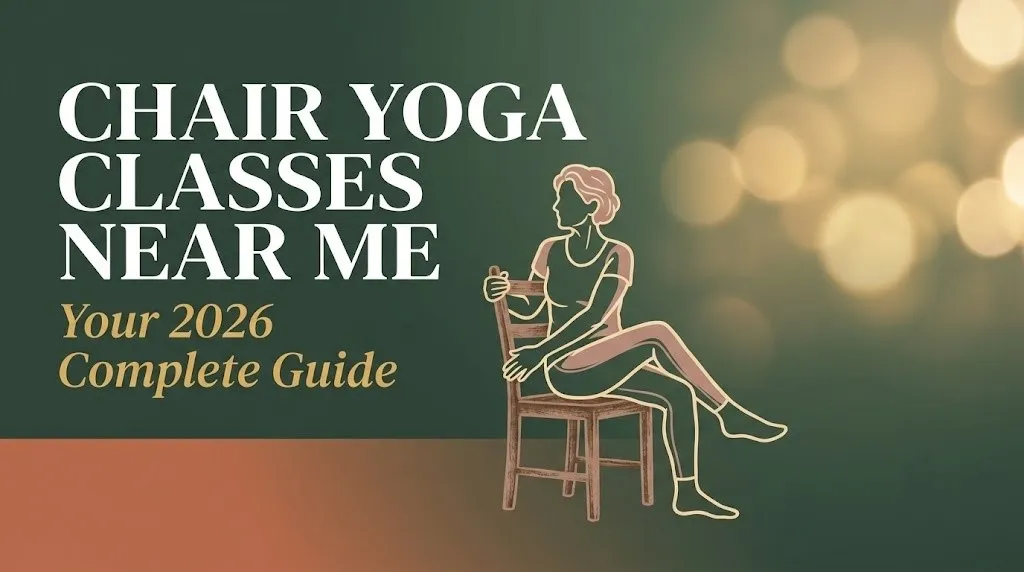
What typically helps with back pain in chair yoga:
- Gentle seated spinal twists (improve thoracic mobility, reduce lumbar load)
- Seated Marjaryasana-Bitilasana (Cat-Cow) (mobilizes the lumbar and thoracic vertebrae)
- Seated hip flexor work (tight iliopsoas contributes directly to lumbar compression)
- Diaphragmatic breathing (reduces the muscular bracing pattern that often accompanies chronic pain)
What to avoid if you have back pain:
- Deep forward folds with a rounded spine if you have disc herniation
- Seated twists that go beyond a comfortable range if you have sacroiliac joint instability
- Any pose that produces radiating pain down the leg, which warrants medical evaluation before continuing
A yoga teacher with back pain experience will cue the difference between the productive discomfort of a stiff spine being moved and the warning signal pain of a nerve being compressed. These are very different sensations, and a qualified instructor knows how to help students recognize the distinction.
Key Takeaway: Chair yoga for back pain works best when it targets the deep spinal stabilizers through breath-connected movement. Avoid deep spinal flexion if disc herniation is part of your history, and treat any radiating leg pain as a reason to see a clinician before continuing.
Chair Yoga for Balance: The Poses That Build Stability
Chair yoga for balance addresses one of the most clinically meaningful areas where yoga can help older adults. Balance is not a static skill. It is an active, trainable capacity.
Proprioception is the body’s internal GPS system: the network of sensory receptors in muscles, tendons, and joints that tell the brain where the body is in space. As people age, proprioceptive sensitivity naturally declines. This is a primary contributor to fall risk. Chair yoga trains proprioception directly through standing balance poses done near the chair’s support.
According to research published in the Journal of Alternative and Complementary Medicine, a regular yoga practice of at least 60 minutes per week improved static and dynamic balance measures in adults over 60. The improvement was attributed to the combination of single-leg standing poses, focused gaze (called drishti in yoga practice), and the neuromuscular coordination required to hold poses without gripping external supports.
Chair-assisted balance poses to build stability:
- Chair-Assisted Vrikshasana (Tree Pose): Single-leg stance, hip external rotation, ankle stabilizer activation
- Standing hip hinge at the chair: Trains posterior chain strength and proprioception in the hip and knee
- Heel-to-toe rocking: Activates the tibialis anterior and soleus to improve ankle mobility and balance response
- Weight shifting side to side: Trains the gluteus medius, which is the primary lateral hip stabilizer and a key muscle in fall prevention
Modification: If standing near the chair feels unstable, practice all balance poses initially while seated. Lift one foot slightly off the floor and hold for 5 breaths. This activates the same hip stabilizers with zero fall risk.
Seated Yoga for Beginners: How to Start With Zero Experience
Seated yoga for beginners is genuinely one of the most accessible entry points into a yoga practice that exists. You do not need flexibility. You do not need experience. You do not need special clothes.
What helps most at the beginning is understanding three things: how to sit correctly, how to breathe deliberately, and how to know the difference between productive sensation and pain.
Correct sitting alignment for yoga begins with sitting bones (the ischial tuberosities). Perch at the front edge of the chair rather than sinking into the back of the seat. Feel both sitting bones in equal contact with the chair. Lengthen your spine upward. This position alone, held with awareness, is a yoga pose.
Deliberate breathing means breathing on purpose rather than breathing on autopilot. In a beginner chair yoga class, this typically means inhaling for a count of 4 and exhaling for a count of 6. The longer exhale activates the parasympathetic nervous system, which is the part of the nervous system responsible for rest, digestion, and recovery. This is not metaphor. It is measurable physiology.
What to expect in your first seated yoga class:
- A 5 to 10 minute seated breathing and centering exercise
- Gentle spinal movements coordinated with breath
- Hip, shoulder, and neck mobility sequences
- One or two standing or balance poses using the chair
- A 5 to 10 minute closing relaxation, often done seated with eyes closed
You will not sweat heavily. You will not be asked to do anything that requires getting on the floor. You may feel mild muscle fatigue in your core and hips after class. That is normal and indicates the poses are working.
Chair Yoga Modifications: Adapting Poses for Your Body
Chair yoga modifications are built into the practice from the start. Unlike a general yoga class where modifications feel like accommodations, in chair yoga they are the baseline structure.
Every pose in chair yoga already represents a modified version of a traditional pose. The question becomes how to adapt further for specific bodies and conditions.
| Original Chair Yoga Pose | Modification for Limited Range of Motion | Modification for Acute Pain or Flare |
|---|---|---|
| Seated forward fold | Keep a gentle bend in the knees; fold only halfway | Skip. Rest in neutral spine with breath awareness |
| Seated spinal twist | Reduce rotation to 30%; use arm on thigh for support | Skip. Do gentle shoulder rolls instead |
| Eagle Arms (Garudasana arms) | Cross arms at shoulder height and hug yourself | Use open-palm chest hug only |
| Chair-Assisted Tree Pose | Keep toes of raised foot on the floor, heel against ankle | Do seated single-leg lift instead |
| Seated Cat-Cow | Reduce range to a very small movement | Seated arch only (Cow), skip the Cat phase |
Props that help in chair yoga:
- Yoga blocks: Placed under the feet if legs don’t reach the floor comfortably
- Folded blanket: Placed under the sitting bones to tilt the pelvis forward and ease lower back strain
- Yoga strap: Used to extend reach in forward folds or shoulder stretches
- Wall: Used instead of a chair for certain standing balance poses
Safety note: Never force a modification that still causes joint pain. The goal is sensation without sharp pain. If a modified version of any pose still hurts, skip that pose entirely and tell your instructor after class.
Key Takeaway: Every body modifies differently. The right modification is the one that lets you feel the intended area of the pose without producing pain. If the modified version still hurts, skip it and tell your teacher.
Chair Yoga at Home: Building a Practice Without a Studio
Chair yoga at home is a completely valid and effective way to practice, provided you have two things: a structurally sound chair and guidance from a qualified teacher, even if that guidance comes through a video or app.
The chair matters more than most people realize. Use a sturdy, non-swiveling chair with a flat seat. Avoid armchairs, recliners, and chairs with wheels. The chair should not slide on the floor surface; place it on a non-slip mat if needed. The seat height should allow your feet to rest flat on the floor with knees at approximately 90 degrees.
A reliable home practice routine for beginners:
- 5 minutes of seated breathing: inhale for 4 counts, exhale for 6 counts
- 5 minutes of seated Marjaryasana-Bitilasana (Cat-Cow) with breath
- 3 minutes of gentle neck and shoulder rolls
- Seated Garudasana arms (Eagle Arms): 5 breaths per side
- Seated spinal twist: 5 breaths per side
- Chair-Assisted Vrikshasana (Tree Pose): 5 breaths per side
- Seated forward fold with hands on thighs: 5 breaths
- 5 minutes of seated relaxation with eyes closed, natural breath
This sequence takes approximately 30 minutes. Practiced three times per week, it covers the minimum frequency supported by the research on yoga’s balance and mobility benefits.
For accountability and safety, especially for older adults new to yoga, supplementing home practice with at least one in-person or live-streamed class per week is worth the investment. A real teacher can see alignment errors that a mirror cannot catch and that pre-recorded video cannot correct in real time.
Chair Yoga Teacher Credentials: What to Look For Before You Enroll
Chair yoga teacher credentials are an area where the industry has significant variation in quality, and knowing the difference protects you.
The baseline credential for any yoga teacher is a 200-hour RYT (Registered Yoga Teacher) certificate recognized by Yoga Alliance. This indicates the teacher completed a foundational teacher training program. However, a 200-hour RYT is a general credential. It does not guarantee specific training in chair yoga, adaptive yoga, or working with older adults or health conditions.
Look for additional training markers:
- 500-hour RYT (Registered Yoga Teacher, advanced level): Indicates more in-depth training, though not necessarily specialized.
- C-IAYT (Certified Yoga Therapist through the International Association of Yoga Therapists): The gold standard for medically informed yoga instruction. C-IAYT teachers complete a minimum of 800 hours of training and clinical practice. This credential is particularly relevant for health condition-specific classes.
- Yoga Alliance Continuing Education certificates in adaptive yoga, senior yoga, or chair yoga from recognized training programs.
- Physical therapy or occupational therapy background combined with yoga training: This combination is especially valuable for chair yoga in clinical or rehabilitation settings.
Questions to ask before enrolling in a chair yoga class:
- What is your yoga certification level and with which organization?
- Do you have specific training in chair yoga, adaptive yoga, or senior yoga?
- How many years have you been teaching chair yoga specifically?
- Is this class appropriate for someone managing [your specific condition]?
A qualified teacher will answer these questions without hesitation. Evasive answers are a clear signal to look elsewhere.
How Often Should Seniors Do Chair Yoga for Real Results
Seniors should practice chair yoga at least two to three times per week to see measurable improvements in flexibility, balance, and pain management within 8 to 12 weeks.
This frequency recommendation is grounded in the research. The International Journal of Yoga study on older adults with osteoarthritis found that twice-weekly practice over 12 weeks produced the most consistently documented improvements in physical function. Practicing once per week showed slower progress, though still positive trends.
The American College of Sports Medicine recommends that older adults engage in flexibility and balance training on at least 2 to 3 days per week. Chair yoga, when conducted by a qualified instructor, satisfies both categories simultaneously.
What matters as much as frequency is session length. A 20-minute home practice three times per week produces better outcomes than a single 60-minute class attended sporadically. Consistency builds the neuromuscular patterns that improve balance and the tissue adaptations that improve flexibility.
Progression timeline for seniors practicing chair yoga:
| Timeframe | What Typically Changes |
|---|---|
| Weeks 1 to 2 | Improved body awareness; better sense of breathing mechanics |
| Weeks 3 to 4 | Noticeable reduction in morning stiffness; easier seated posture |
| Weeks 5 to 8 | Measurable improvement in single-leg balance and hip mobility |
| Weeks 9 to 12 | Reduced reported pain scores; improved functional reach and strength |
| Beyond 12 weeks | Ongoing maintenance and gradual progression to more complex poses |
Starting slowly and building gradually protects joints and prevents the overuse injuries that happen when enthusiasm outpaces physical readiness. Three 30-minute sessions per week is a sustainable, research-supported starting point. Progress from there as comfort and confidence grow.
Key Takeaway: Two to three sessions per week is the minimum frequency for chair yoga to produce the balance, mobility, and pain-reduction benefits documented in research. Consistency over time matters far more than session length.
Frequently Asked Questions About Chair Yoga Classes Near Me
What should I look for in a chair yoga class near me?
Look for a class taught by a Yoga Alliance RYT-200 certified teacher at minimum, ideally with specific adaptive or senior yoga training.
Prioritize classes held in small group settings where the teacher can observe and cue your individual alignment.
Hospital wellness programs, senior centers, and specialized yoga studios typically offer the most qualified chair yoga instruction.
Is chair yoga good for people with arthritis?
Yes. Chair yoga is one of the most appropriate forms of exercise for people with arthritis, particularly osteoarthritis affecting the hips, knees, and spine.
According to research published in the International Journal of Yoga, structured chair yoga programs improved function and reduced pain in older adults with osteoarthritis over 12 weeks.
On high-inflammation days with rheumatoid arthritis, skip vigorous movement and focus on breath-centered seated rest instead.
Can chair yoga help with back pain?
Chair yoga can help reduce chronic low back pain by strengthening the deep spinal stabilizing muscles, including the multifidus and transverse abdominis, through breath-connected seated movement.
Research cited by the NCCIH supports yoga as a low-risk intervention for chronic low back pain when properly modified.
If you have a diagnosed disc herniation or sciatica, work with a teacher who has specific back pain training and avoid deep spinal flexion poses.
How often should seniors do chair yoga?
Two to three times per week is the research-supported minimum for measurable improvements in balance, flexibility, and pain management.
Sessions can range from 20 to 60 minutes depending on your energy and schedule, with consistency mattering more than session length.
Adding a short 10-minute home breathing and movement routine on off days accelerates progress significantly.
What do I need to bring to my first chair yoga class?
Wear comfortable, non-restrictive clothing that allows you to move your hips and shoulders freely.
Bring a water bottle and, optionally, a small folded blanket to place under your sitting bones if seated posture is uncomfortable.
Most chair yoga classes provide all props including chairs, blocks, and straps; call ahead to confirm what is supplied.
Start Where You Are
The best chair yoga class is the one you actually show up to. You do not need to be flexible, experienced, or pain-free to begin. The practice was specifically designed to meet bodies where they are.
Start with two sessions per week, either in person at a local senior center or hospital wellness program, or through a live-streamed class with a verified instructor. Try the seated Cat-Cow and Eagle Arms sequences at home in the days between classes.
Give it 8 weeks before you evaluate results. The research supports that timeline, and so does every chair yoga teacher worth their certification.