Best Yoga Block Substitute Options for Home Practice 2026
The best yoga block substitutes are items you already own: hardcover books, firm folded blankets, a sturdy wooden box, or a foam roller. Any of these can stand in for a yoga block when used at the correct height and with attention to stability.
Props matter more than most beginners realize. The National Center for Complementary and Integrative Health identifies yoga as one of the most widely practiced complementary health approaches in the United States, and research consistently shows that proper prop support reduces injury risk while improving alignment quality. A missing block should not stop your practice.
This guide covers exactly which household items work, which poses they work best for, how to set them up correctly, and when a substitute is not stable enough to be safe. You will also find guidance specific to beginners, seniors, and people managing pain or limited mobility.
Yoga Block Substitute: What You Need to Know First
A yoga block substitute is any stable, firm, appropriately sized household object that can replicate the height and support a standard yoga block provides during a pose. The key word is stable. Not soft, not flexible, not wobbly.
Standard yoga blocks measure 9 x 6 x 4 inches and can be used at three heights: flat at 4 inches, medium at 6 inches, and tall at 9 inches. Different poses require different heights. A substitute that only offers one height is not inherently a problem, as long as that height matches what the pose actually needs.
The function of a block varies by context. Sometimes it brings the floor closer to your hand. Sometimes it supports body weight under the hips or sacrum. Sometimes it props the spine into a gentle backbend. The right substitute depends entirely on which of those functions you need it to serve.
What makes this topic worth getting right is that a bad substitute can do more harm than no substitute at all. A pillow that compresses fully under your hip in Setu Bandha Sarvangasana (Bridge Pose) offers no real support. A stack of books with slippery covers can slide out from under a weight-bearing hand in Trikonasana (Triangle Pose) mid-pose. Getting the substitute right requires understanding the function first.
Quick Summary:
- Standard block size: 9 x 6 x 4 inches
- Three usable heights: 4 inches (flat), 6 inches (medium), 9 inches (tall)
- Key qualities of any safe substitute: firm, stable, non-slip surface, consistent height under pressure
- Primary block functions: height support, balance aid, body weight support, spinal prop
What Does a Yoga Block Actually Do?
A yoga block brings the ground closer to the practitioner, which allows the body to maintain correct alignment without forcing range of motion the body does not yet have. That is its entire function, stated plainly.
Think of it this way. When you reach your hand toward the floor in Trikonasana (Triangle Pose), your hamstring and hip flexibility determines how close your hand gets. If your hand cannot reach the floor without rounding the spine or collapsing the chest, the pose mechanics break down. A block at the right height corrects that. It meets your hand where it is, so your spine stays long and your hip stays open.
The second function is support under body weight. In Setu Bandha Sarvangasana (Bridge Pose), placing a block under the sacrum creates a supported version that allows the hip flexors and lumbar spine to decompress passively. This is Restorative yoga territory, and it requires a substitute that will not compress, shift, or tilt under sustained pressure.
The third function is proprioceptive feedback. Squeezing a block between the thighs in Utkatasana (Chair Pose) activates the adductor muscles and helps the knee track correctly over the second toe. A household substitute can replicate this too, but it needs the right firmness and dimensions to work.
According to Yoga Alliance, proper prop use is a foundational element of accessible yoga instruction and is specifically included in teacher training curriculum standards. Props are not training wheels. They are precision tools used by practitioners at every level.
Yoga Block Height Levels Explained
The three height positions of a standard yoga block correspond to three distinct levels of support, and choosing the right height for a substitute is more important than the specific object you choose. Getting height wrong can compromise alignment or overload a joint.
Flat (4 inches): Used when you are close to reaching the floor but need a small boost. Common in poses like Paschimottanasana (Seated Forward Fold), where the block sits under the hands, or in seated meditation to lift the hips above knee level.
Medium (6 inches): The most commonly used height. This is the default position for many standing poses, including Trikonasana (Triangle Pose) and Ardha Chandrasana (Half Moon Pose), where the hand needs moderate elevation from the floor.
Tall (9 inches): Used when flexibility is most limited or when maximum height is needed. Common for practitioners with very tight hamstrings or those using a block under the hips for seated poses to achieve a neutral pelvic position.
| Block Height | Inches | Common Poses | Best Household Substitute |
|---|---|---|---|
| Flat position | 4 inches | Seated poses, meditation lift, forward fold hand support | 2 to 3 stacked hardcover books, firm folded blanket |
| Medium position | 6 inches | Trikonasana, Ardha Chandrasana, supported backbend | 4 to 5 stacked books, small wooden box |
| Tall position | 9 inches | Very tight hamstrings, seated hip lift, Restorative support | Large book stack, sturdy crate, firm bolster substitute |
Modification note: If your substitute only reaches one height and you need more, add a folded blanket on top to fine-tune the elevation. Remove it if the combined surface becomes unstable.
Key Takeaway: A yoga block substitute works best when you match its height to the function the block serves in that specific pose. Getting the height right matters more than the specific item you choose.
Best Household Items to Use as a Yoga Block Substitute
The best household yoga block substitutes are hardcover books, firm folded blankets, a sturdy wooden box, a foam roller, a telephone directory, a water bottle, and a tightly rolled bath towel. Each works for specific poses and height requirements.
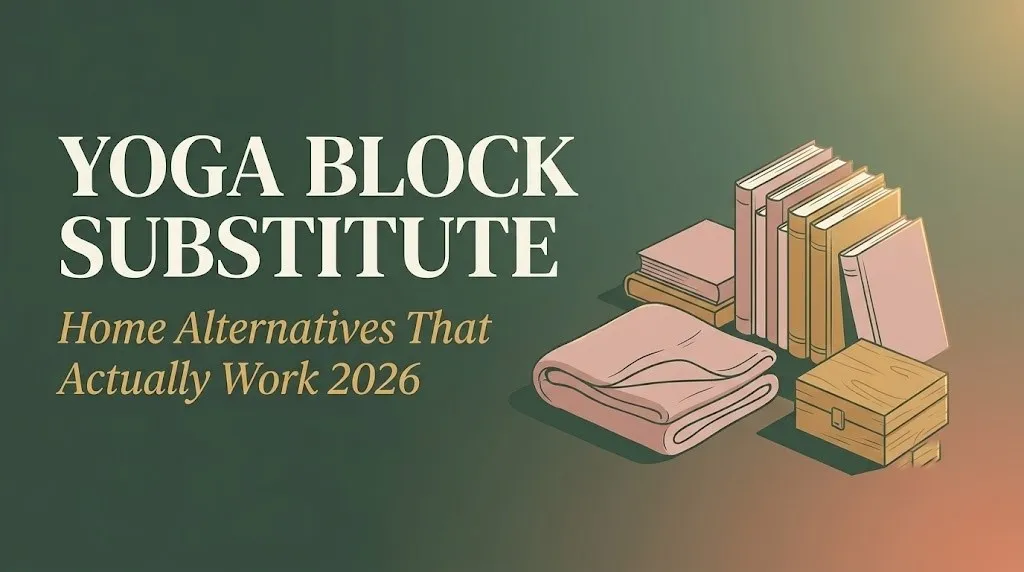
The common thread among all effective substitutes is firmness. The item must not compress significantly under body weight. It must hold a consistent height. And its surface must be stable enough that it will not slide across a yoga mat or hardwood floor mid-practice.
Here is a practical comparison of the most commonly available options:
| Substitute Item | Height Approximate | Weight Bearing | Best Use | Avoid For |
|---|---|---|---|---|
| Stacked hardcover books (2 to 4) | 4 to 9 inches (adjustable) | Moderate, with rubber band or tape to bind | Standing poses, hand support | Sacrum support in Bridge (can tilt) |
| Firm folded blanket | 3 to 6 inches | Low to moderate | Seated hip lift, gentle prop | Any weight-bearing standing pose |
| Wooden box or crate | 6 to 12 inches | High if solid wood | All block functions | Boxes with gaps or weak joins |
| Foam roller | 5 to 6 inches diameter | Moderate for hands | Forward fold hand support | Sacrum support (will roll) |
| Tightly rolled bath towel | 4 to 6 inches | Low | Cushioning, gentle lift only | Weight-bearing standing poses |
| Full water bottle (large) | 10 to 11 inches | Moderate if capped tightly | Tall-height hand support | Unstable floors, slippery surfaces |
| Telephone directory or large catalog | 3 to 5 inches | Moderate | Flat or low height support | Poses with sideways force |
Safety note: Always test any substitute by pressing your full hand or both hands onto it before committing body weight in a pose. If it slides, compresses, or wobbles, it is not safe for that application.
Books as a Yoga Block Substitute
Hardcover books are the most practical and widely available yoga block substitute, and when stacked and secured correctly, they function reliably for most hand-support applications in standing and seated poses.
The key word is hardcover. Paperbacks compress and splay under pressure. A stack of paperbacks will shift unpredictably under a weight-bearing hand. You want thick hardcover books, the kind you find on a coffee table or in a reference collection, stacked with the spines aligned.
Two to three books at flat or medium height work well for hand support in Trikonasana (Triangle Pose) and Uttanasana (Standing Forward Fold). Four to five books approach the tall height and can work for practitioners with limited hamstring flexibility who need maximum elevation from the floor.
To improve stability, wrap a rubber band or a piece of athletic tape around the stack before using it. This prevents individual books from sliding apart under lateral or angled pressure. Place the stack on your yoga mat rather than bare floor for additional grip.
Pose Tip:
- Stack books with spines aligned and all covers facing the same direction.
- Wrap the stack with a rubber band or tape to prevent splaying.
- Test with full hand pressure before entering the pose.
- Do not use a book stack to support body weight under the sacrum or hips in Bridge Pose. A tilted stack under the sacrum creates uneven spinal pressure.
- For Adho Mukha Svanasana (Downward-Facing Dog), placing books under the hands raises the wrist angle, which reduces wrist extension and may help those with wrist sensitivity.
Pillows and Blankets as Yoga Block Alternatives
Pillows and blankets can work as yoga block alternatives, but only in specific applications where firm height is not required. They are best suited for cushioning, gentle elevation, and Restorative yoga support rather than weight-bearing substitution.
A standard sleeping pillow is too soft for any hand-support function. Under body weight, it compresses almost completely. However, a firm bed pillow, particularly a memory foam pillow or a buckwheat pillow, holds its shape better under moderate pressure and can substitute a block under the hips for seated poses.
Folded blankets offer adjustable height. Two or three firm blankets folded into precise thirds and stacked create a relatively stable surface that works well for hip elevation in seated positions. This is how blankets are used in Iyengar yoga as standard props for practitioners who cannot yet achieve a neutral pelvic tilt in cross-legged seated poses.
The key distinction: blankets and pillows work best in static, gentle poses where the body is not applying lateral or twisting force on the prop. They are not appropriate for balance-intensive standing poses.
According to physical therapists who specialize in yoga-based rehabilitation, soft props under the hips in seated positions can meaningfully reduce strain on the sacroiliac joint and lumbar spine for people with lower back sensitivity. The height adjustment allows the pelvis to tilt forward slightly, reducing compression at the posterior lumbar discs.
Modification for limited mobility: A firm bed pillow under each knee in Supta Baddha Konasana (Reclined Bound Angle Pose) removes the hip abductor strain that often makes this pose inaccessible to beginners and older practitioners.
Key Takeaway: Books work best for hand support in standing poses; blankets and firm pillows work best for gentle hip and seated elevation. Never use soft pillows where firm, non-compressing support is needed.
How to Use a Yoga Block Substitute for Standing Poses
In standing poses, a yoga block substitute must be stable enough to bear partial upper-body weight while tolerating the lateral and rotational forces that occur when the body is in a side-oriented position. This is where substitute selection becomes most specific.
Trikonasana (Triangle Pose) is the standing pose most commonly associated with block use. The block goes under the lower hand, at a height that allows the spine to lengthen and the chest to rotate open. A substitute at medium height (around 6 inches) works for most practitioners.
To use a book stack or wooden box in Trikonasana:
- Place the substitute on your mat, directly below where your lower hand will land.
- Stand in a wide-legged stance with your front foot pointing forward and your back foot at roughly 90 degrees.
- Extend your arms wide at shoulder height, then hinge laterally over your front leg.
- Lower your hand onto the substitute at whatever height allows your spine to stay long.
- Press your lower hand firmly into the substitute and rotate your chest open toward the ceiling.
- Hold for 5 breath cycles, then press through your feet to rise back to standing.
- Release the substitute and repeat on the other side.
In Ardha Chandrasana (Half Moon Pose), the substitute goes under the front hand for balance support. This is a higher-demand application. The substitute must be on a non-slip surface, and the object itself must have a non-slip bottom. A wood block on hardwood is inherently risky. Place it on your yoga mat.
Modification for beginners: Practice standing balance poses near a wall first. Touch the wall with your top hand rather than using a block at all. This removes the balance demand and lets you focus on the hip and spine mechanics.
Yoga Block Substitute for Seated and Floor Poses
For seated and floor poses, a yoga block substitute primarily serves two functions: elevating the hips above knee level to achieve a neutral pelvic tilt, and supporting the hands or forearms during forward folds.
Hip elevation in seated poses is one of the most underappreciated uses of a block. When the hips are level with or below the knees in a cross-legged position, the pelvis tilts posteriorly. This rounds the lower back and places compression on the lumbar discs. Sitting on a folded blanket, a firm pillow, or a stacked book set brings the hips higher and allows the pelvis to tilt slightly forward. The spine straightens naturally as a result.
Think of it like sitting on a sloped stadium seat versus a flat bleacher. The slope gives your hips permission to tip forward. That small mechanical shift removes the effort of fighting against your own anatomy.
For Paschimottanasana (Seated Forward Fold), placing a substitute under the hands rather than reaching toward the feet allows the hamstrings to lengthen gradually without forcing the spine to round. This is especially relevant for practitioners with very tight posterior chain muscles.
For practitioners with tight hamstrings: Sit on a folded blanket and place a second substitute in front of you. Fold forward until your hands land on the second substitute. This creates a two-prop setup that supports both the pelvis and the forward fold simultaneously.
Pose Tip:
- Hips should be at or above knee height in all seated cross-legged poses.
- Test hip height: if your knees are higher than your hip bones, add more height under the hips.
- In Balasana (Child’s Pose), a folded blanket between the thighs and calves reduces compression at the knee joint for practitioners with limited knee flexion.
Yoga Block Substitute for Restorative Yoga
Restorative yoga poses rely on firm, sustained prop support that allows the body to fully release without any muscular effort. This is where the quality of your substitute matters most, because the body rests on it for 10 to 20 minutes at a time.
A substitute for Restorative yoga must meet a higher bar than one used for a single breath cycle in a standing pose. It must hold consistent height under sustained body weight. It must not shift, tilt, or compress over time. And it must be wide enough to support the body part resting on it evenly.
For Supta Baddha Konasana (Reclined Bound Angle Pose), the standard Restorative setup uses a bolster under the spine and blocks under the outer knees. A firm pillow or tightly rolled blanket substitutes the bolster reasonably well. Folded blankets stacked under each outer knee substitute the lateral blocks.
For a Restorative supported backbend, a rolled blanket placed horizontally across the mat under the mid-thoracic spine creates gentle spinal extension. This is one of the best Restorative poses to attempt without actual blocks, because the roll provides a curved surface that a block cannot.
According to research published in the Journal of Alternative and Complementary Medicine, Restorative yoga practices are associated with measurable reductions in perceived stress and self-reported anxiety in adult populations. The quality of prop support directly affects how completely the body can relax into the pose. A substitute that creates discomfort or instability will prevent the nervous system response that makes Restorative yoga effective.
Safety note: Never place a substitute under the cervical spine (neck) in any Restorative pose without confirming it is at the correct, gentle height. The neck is the most vulnerable area for overstretching in supported positions.
Key Takeaway: Restorative yoga places the highest demands on any block substitute because the body rests on it for extended periods. Only use firm, non-compressing, stable items for Restorative support.
DIY Yoga Block: Can You Make Your Own?
A DIY yoga block is a block constructed at home from foam, wood, or other materials cut to standard block dimensions of 9 x 6 x 4 inches. It is a legitimate option that performs better than most loose household substitutes.
The most practical DIY approach uses high-density foam. Hardware stores and craft suppliers sell foam in various densities. For a yoga block, you need foam rated at 2 to 4 pounds per cubic foot in density. Softer foam compresses under weight and is not appropriate. A foam piece cut to 9 x 6 x 4 inches from a high-density block costs a fraction of a commercial yoga block and performs comparably for most applications.
A second DIY approach uses wood. A solid piece of untreated pine or poplar cut to block dimensions is extremely durable and handles full body weight without any compression. The downside is weight (wood blocks are heavier than foam) and surface hardness (a wood substitute is less comfortable under sensitive joints). Wrapping it in grip tape or a thin layer of rubber improves surface traction.
What does not work as a DIY block: PVC pipe (unstable), stacked cardboard boxes (compress under weight), air-filled items (shift under lateral pressure), and anything with hollow construction that might collapse.
According to Yoga Alliance, foam and cork are the two most commonly recommended commercial block materials. Foam offers cushioning and light weight. Cork offers natural grip, firmness, and moisture resistance. A homemade high-density foam block approximates a commercial foam block more closely than any other DIY approach.
Modification note: If you cut foam at home, use a serrated blade for a cleaner edge and sand any rough spots that might snag a mat surface.
When a Yoga Block Substitute Is Not Safe Enough
A yoga block substitute is not safe when it cannot hold a consistent height under pressure, when its surface slides against the floor or mat, or when it will tilt or collapse under the directional force a specific pose applies. Recognizing these failure points before you enter a pose is what keeps you safe.
The highest-risk scenario is a substitute that fails during a balance-dependent standing pose. In Ardha Chandrasana (Half Moon Pose), the body is balanced on one leg with the other extended parallel to the floor and one hand pressing into the block. A substitute that shifts under this position can cause the practitioner to fall, potentially loading the wrist, shoulder, or hip at an unexpected angle.
The second high-risk scenario is a soft substitute under the sacrum in Supported Bridge Pose. The sacrum is the triangular bone at the base of the spine. It sits under the full weight of the lower torso in this position. A pillow or folded towel that compresses unevenly under this weight can cause the sacrum to tilt to one side, creating asymmetrical lumbar compression. This is not theoretical. Physical therapists frequently see this pattern in practitioners who improvised Restorative props incorrectly.
A substitute is not safe enough when:
- It shifts more than one inch under firm hand pressure before you enter the pose.
- Its surface is smooth and your mat or floor is smooth (creating a double-slip surface).
- It compresses by more than 25 percent of its height under your body weight.
- It has rounded edges that prevent stable stacking.
- It cannot bear your full body weight without structural deformation.
If you are uncertain, the safer choice is to skip the prop rather than use an inadequate substitute. Many poses can be modified without any prop at all.
Yoga Block Substitute for Seniors and Limited Mobility
For seniors and practitioners with limited mobility, a yoga block substitute must prioritize stability and predictability above all else. Falls during yoga are rare but most likely to occur during transitions to and from poses where props are involved.
The American College of Sports Medicine recommends that balance training for older adults include stable, non-slip surfaces and support structures that eliminate fall risk. This applies directly to prop use. A substitute that a younger practitioner could manage safely may not meet the stability threshold appropriate for a senior practitioner.
For seniors, the most reliable substitutes are a firm chair seat (used as an elevated block surface for hand placement in standing poses), a wooden step stool with rubber feet, or a stack of books secured with a rubber band and placed on a yoga mat. Each of these options provides predictable, non-compressing support.
Chair yoga modifications are the safest adaptation for seniors who practice at home without equipment. The chair itself functions as the primary prop, replacing blocks entirely for most standing and balance poses.
| Senior-Safe Substitute | Best Application | Risk Level |
|---|---|---|
| Firm chair seat | Standing pose hand support | Low |
| Rubber-footed step stool | Medium height hand support | Low to moderate |
| Secured book stack on mat | Standing or seated hand support | Moderate (test first) |
| Firm folded blanket (3 layers) | Hip elevation in seated poses | Low |
| Firm bed pillow (memory foam) | Knee support in Reclined Bound Angle | Low |
Safety note for seniors: Avoid foam rollers as a block substitute. They are inherently unstable as a hand-support surface due to their cylindrical shape. In any balance-dependent pose, an unstable prop is more dangerous than no prop.
Key Takeaway: Seniors and practitioners with limited mobility should choose substitutes based on stability first. A chair seat or a secured book stack on a mat beats a creative but unstable substitute every time.
Yoga Block Substitute for Beginners
Beginners are the practitioners who most often need a yoga block substitute and are also the least likely to know how to set one up correctly. That is a combination worth addressing directly.
The most common beginner scenario: you are following an online yoga class, the teacher says “grab your block,” and you do not own one. The instinct is to skip the prop entirely and try the pose without it. That often results in a rounded spine, strained hamstrings, or a collapse through the hip that the instructor’s alignment cues cannot correct from a screen.
A better approach is to pause the video, build a substitute, and then continue. Two thick hardcover books bound with a rubber band will get most beginners through the majority of block applications in a beginner class. Keep them within reach before you start.
A basic beginner substitute setup to have ready:
- Two to three thick hardcover books, rubber-banded together (covers medium height)
- One firm folded blanket for seated hip support
- A wall (available to every practitioner, requires no preparation)
The wall is the most underused block substitute available to beginners. In Trikonasana (Triangle Pose), pressing your back against a wall removes the balance demand and lets you focus entirely on the hip and spinal mechanics. No prop needed at all.
For Uttanasana (Standing Forward Fold), bending the knees generously reduces the demand on the hamstrings and may allow the hands to reach the floor without any block. Yoga teachers and physical therapists generally recommend a slightly bent-knee forward fold for beginners over a straight-leg version that requires a prop to reach safely.
The most important beginner rule with any substitute: test it before you trust it. Press both hands into it firmly. If it moves, replace it with something more stable.
Do You Actually Need a Real Yoga Block?
You do not need a real yoga block to begin or maintain a yoga practice, but at some point, a good-quality block will serve your practice better than any household substitute. The question is when that point arrives.
For the first four to six weeks of practice, household substitutes are genuinely adequate for most beginners. You are learning poses, building body awareness, and establishing a routine. The specific quality of your props matters less in this phase than your consistency.
After that initial period, if you are practicing three or more times per week, the limitations of household substitutes become apparent. A book stack requires rebuilding before every session. A folded blanket shifts unpredictably. The time spent preparing and troubleshooting improvised props adds friction to your practice.
A standard foam yoga block costs between $8 and $15 for a single block and less in multipacks. Cork blocks run between $15 and $30 per block. At that price point, the practical argument for continuing with substitutes indefinitely is weak. The props pay for themselves in convenience within a month.
What a real block offers that substitutes cannot fully replicate:
- Consistent, predictable height at all three positions
- Non-slip surface on all six sides
- Structural integrity under full body weight at any angle
- Lightweight and easy to position quickly mid-practice
That said: if cost is a barrier, a well-constructed DIY foam block or a secured book stack handles most block functions adequately. Do not let the absence of equipment stop you from practicing. The substitute is not the point. The practice is.
Yoga Block Substitute vs Buying Real Blocks
Choosing between a yoga block substitute and purchasing real blocks depends on three factors: how often you practice, what types of poses you most commonly work with, and your budget. Neither option is universally correct.
A yoga block substitute is the right choice when you are brand new to yoga and want to test whether a regular practice suits you before investing in equipment. It is also the right choice when you are traveling, when you need a prop immediately and shipping takes days, or when budget is genuinely limited.
A real yoga block becomes the clearly better option when you practice four or more times per week, when you practice Iyengar or Restorative yoga where prop precision directly affects therapeutic outcomes, or when you have a specific physical condition where improper prop height could create strain. Practitioners managing back pain, sacroiliac joint issues, or wrist injuries benefit most from the predictable, consistent support that commercial blocks provide.
| Factor | Block Substitute | Real Yoga Block |
|---|---|---|
| Upfront cost | $0 (household items) | $8 to $30 per block |
| Setup time per session | 2 to 5 minutes | Under 30 seconds |
| Stability | Variable, depends on item | Consistent |
| Height accuracy | Approximate | Precise (three positions) |
| Best for | Beginners, occasional practice | Regular or therapeutic practice |
| Durability | Limited (books wear, blankets shift) | Years of daily use |
| Portability | Difficult | Easy |
The most honest assessment: start with what you have, practice consistently, and invest in real blocks when you find yourself practicing regularly. The decision makes itself at that point.
Frequently Asked Questions About Yoga Block Substitutes
What can I use instead of a yoga block at home?
The best items to use instead of a yoga block at home are stacked hardcover books, a firm folded blanket, a wooden box or step stool, or a large foam roller placed flat.
Each substitute works best for specific applications: books for hand support in standing poses, blankets for seated hip elevation, wooden boxes for stable medium-height support.
Test any substitute by pressing your full hand weight onto it before entering a pose to confirm it does not slide, compress, or tilt.
Can I use books as a yoga block substitute?
Yes, stacked hardcover books make one of the most reliable yoga block substitutes for hand-support applications in standing and seated poses.
Use two to four thick hardcovers stacked with aligned spines and secured with a rubber band, and place the stack on your yoga mat for added grip.
Do not use books to support body weight under the sacrum or hips in Bridge Pose, as uneven stacking can cause the substitute to tilt under sustained pressure.
Is a pillow a good substitute for a yoga block?
A standard sleeping pillow is not a good yoga block substitute for most applications because it compresses too much under body weight to provide reliable height or support.
A firm memory foam or buckwheat pillow works better and can substitute a block for gentle hip elevation in seated poses or knee support in Restorative poses.
For any pose requiring firm, stable hand support or balance assistance, a book stack or wooden surface is safer than a pillow.
How do I know if my yoga block substitute is safe to use?
A yoga block substitute is safe if it does not shift more than one inch under full hand pressure, does not compress by more than 25 percent of its height under body weight, and has a non-slip surface.
Place the substitute on your yoga mat and press both hands into it firmly before entering any pose. If it moves, tilts, or collapses, choose a different item.
For balance-intensive standing poses, the safety bar is higher. Only use substitutes you have tested and confirmed are fully stable on your specific floor surface.
Do I actually need to buy real yoga blocks eventually?
You do not need real yoga blocks to start practicing yoga, and household substitutes are adequate for most beginner applications for the first four to six weeks.
Once you are practicing three or more times per week, the convenience and precision of a real foam or cork block typically outweigh the cost, which starts at around $8 to $15 for a basic foam block.
Practitioners using yoga therapeutically for back pain, sacroiliac issues, or post-rehabilitation recovery benefit most from the consistent height and structural stability that commercial blocks reliably provide.
Start With What You Have. Practice Anyway.
Pick two thick hardcover books from your shelf right now. Stack them, wrap a rubber band around them, and place them on your yoga mat. That is your block for tonight’s practice. It is enough to get started.
As your practice becomes a consistent habit, real blocks will start to make sense. The friction of setting up substitutes before every session fades once you have proper props within reach. But the practice comes first. The equipment follows.
Do not wait for the perfect setup to begin. Show up on the mat, work with what you have, and make the adjustments that serve your body today.