B Yoga Mat Reviews 2026: Best Model for Your Practice
The B Yoga mat is a premium natural rubber mat designed for practitioners who have outgrown basic foam and want consistent grip, serious durability, and materials they can feel good about. Choosing the right model from B Yoga’s lineup makes a real difference in how your practice feels day to day.
Mat quality has a direct impact on practice safety. A study published in the Journal of Bodywork and Movement Therapies found that surface instability and inadequate grip during weight-bearing yoga poses increases compensatory muscle activation, particularly in the wrists and ankles, raising the risk of joint strain over time. Your mat is not just a surface; it is a functional piece of practice equipment.
This guide covers every B Yoga mat model in detail, breaks down the materials and what they mean for your practice, compares B Yoga directly against Manduka PRO and Liforme, addresses joint protection and thickness guidance, and explains exactly how to care for your mat to maximize its lifespan.
B Yoga Mat: What It Is and Why Practitioners Choose It
The B Yoga mat is a line of premium yoga mats built on a natural rubber base with a polyurethane (PU) top layer, designed to offer moisture-activated grip, consistent cushioning, and eco-conscious construction. B Yoga was founded in Canada and has developed a loyal following among Vinyasa, Ashtanga, and hot yoga practitioners specifically because the grip improves as you sweat, rather than deteriorating.
Most budget yoga mats use PVC (polyvinyl chloride) foam, which offers predictable grip when dry but becomes slippery with moisture and degrades relatively quickly under daily use. B Yoga’s rubber-plus-PU construction addresses both issues. The PU surface absorbs surface moisture and maintains traction, while the natural rubber base provides resilience and dimensional stability.
Practitioners choose B Yoga mats for several specific reasons:
- Moisture-activated grip: The PU top layer grips better when hands and feet are warm and slightly damp, making it well-suited to heated and dynamic practices
- Environmental standards: B Yoga mats are made without toxic glues, PVC, or phthalates, and carry certifications aligned with responsible manufacturing
- Durability relative to price: The mats are built to last several years under regular use, which practitioners report makes the upfront cost justifiable over time
- Tactile feedback: The slightly textured PU surface provides proprioceptive information about foot placement, which matters for balance poses like Vrksasana (Tree Pose) and Virabhadrasana III (Warrior III)
Latex note: Natural rubber contains latex. Practitioners with a confirmed latex allergy should avoid natural rubber yoga mats entirely and choose a TPE or PVC alternative instead.
B Yoga Mat Models Compared: B MAT, B MAT Strong, and B MAT Traveller
B Yoga produces three primary mat models, each designed for different practice intensities, portability needs, and body types. Understanding the differences prevents an expensive mismatch.
The B MAT (sometimes called B MAT Everyday) is the standard entry model in the B Yoga lineup. It measures 4mm thick, making it a moderate-cushion option suited to practitioners who prioritize ground connection over joint padding. It strikes a balance between portability and performance for regular studio or home use.
The B MAT Strong is the highest-performance option in the range. It measures 6mm thick and uses the same PU-over-rubber construction as the standard B MAT but with added base density for more cushioning. The Strong is the most popular choice among practitioners with regular heated or flow-based practices who also want a degree of joint support.
The B MAT Traveller is the ultra-portable option at 2mm thick. It folds rather than rolls, fits into a suitcase without adding bulk, and is built for practitioners who travel frequently and need a reliable grip surface wherever they land. The minimal thickness means it is not suitable as a primary mat for practitioners with knee or wrist sensitivity.
| Model | Thickness | Weight | Best For | Not Ideal For |
|---|---|---|---|---|
| B MAT (Everyday) | 4mm | Approx. 2.2 kg | Regular studio practice, mixed styles | Practitioners needing significant joint padding |
| B MAT Strong | 6mm | Approx. 2.9 kg | Hot yoga, Vinyasa, joint support needs | Travel or commuting to studio |
| B MAT Traveller | 2mm | Approx. 0.9 kg | Travel, supplemental mat, light practice | Primary mat for joint-sensitive practitioners |
All three models share the same PU-over-natural-rubber construction and are available in the same standard dimensions. The choice between them depends almost entirely on how much cushioning your practice and body require.
Key Takeaway: If you’re buying your first B Yoga mat and practice more than twice a week, the B MAT Strong at 6mm is the most versatile starting point for most body types and practice styles.
What Is a B Yoga Mat Made Of: Materials and Construction Explained
A B Yoga mat is constructed from two bonded layers: a natural rubber base and a polyurethane (PU) top layer, and that combination is what separates it from most of the yoga mat market.
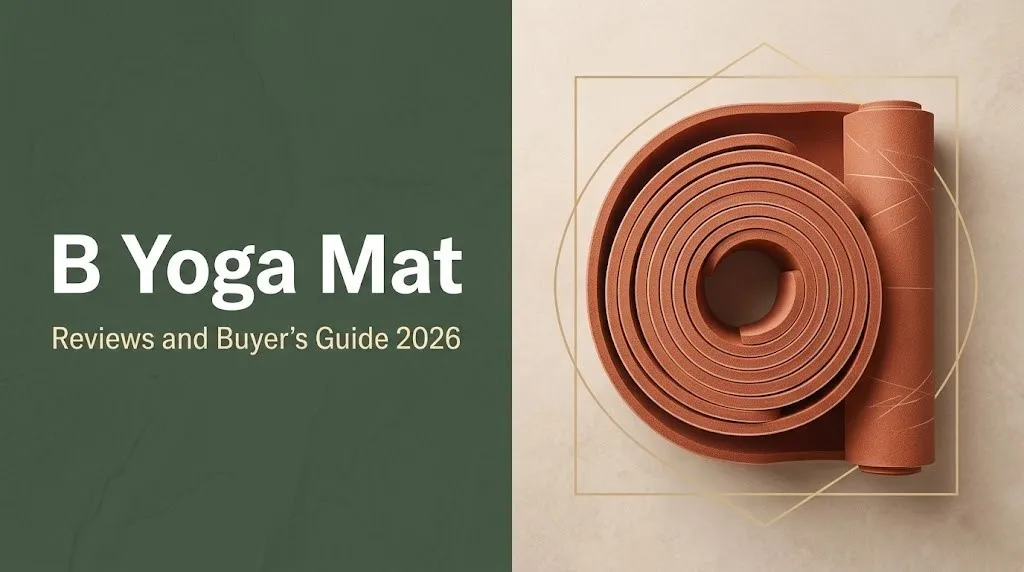
Natural rubber comes from the Hevea brasiliensis tree. It is a non-cellular, open-cell material with high elasticity and strong dimensional memory, meaning it returns to its original shape after compression rather than permanently deforming the way closed-cell PVC foam does over time. Natural rubber also has superior grip against studio floors because its texture creates more surface contact than smooth PVC.
The polyurethane top layer is what you feel under your hands and feet. PU is a semi-porous material that absorbs surface moisture rather than letting it sit on top of the mat. This is why B Yoga’s grip feels better mid-practice than at the start of a session. Think of it like a road tire’s tread pattern: the more contact points engaged, the more traction generated. The PU surface creates micro-contact with the skin that improves as warmth and light moisture build.
Key material properties of B Yoga mats:
- Free of PVC, toxic dyes, and phthalates: PVC mats off-gas chemicals during use and are not biodegradable. B Yoga’s rubber-PU construction avoids these concerns.
- Latex-containing: Natural rubber contains latex proteins. This is worth noting for anyone who has experienced latex sensitivity in other contexts.
- Not fully biodegradable: PU is a synthetic polymer. While the natural rubber base is more environmentally benign than PVC, the full mat is not compostable or biodegradable at end of life.
- No off-gassing odor concern with PU top: The initial natural rubber smell some practitioners notice comes from the base layer, not chemicals. It dissipates with airing out, typically within one to two weeks.
Comparison note: TPE mats (thermoplastic elastomer) are the most eco-friendly option in terms of end-of-life recyclability but generally offer less grip than PU-rubber constructions in heated or sweaty conditions.
B Yoga Mat Grip: How It Performs Across Different Practice Styles
The B Yoga mat grip is moisture-activated, meaning it performs best when your hands and feet are warm and slightly damp, and it outperforms most competitors specifically in heated or dynamic practice conditions.
On a completely dry mat at the start of a room-temperature class, the B Yoga mat’s grip is solid but not exceptional. Many practitioners report that the first few minutes of a dry Hatha session feel slightly less grippy than expected. This is the PU surface behaving exactly as designed: it’s waiting for the thermal and moisture conditions that activate its full grip coefficient.
Once warmth and perspiration build, the performance noticeably changes. In Adho Mukha Svanasana (Downward-Facing Dog) and Chaturanga Dandasana (Four-Limbed Staff Pose), the hands and feet grip decisively without slipping during transitions. This is the core reason hot yoga and Vinyasa practitioners consistently choose B Yoga mats over dry-grip alternatives.
| Practice Condition | B Yoga Grip Performance | Notes |
|---|---|---|
| Dry hands, room temperature | Good | Slightly better after brief warm-up |
| Warm hands, light perspiration | Excellent | PU surface activates strongly |
| Heavy sweat, hot yoga conditions | Excellent | Top performer in this condition |
| Cold room, minimal movement | Moderate | Less ideal for Yin or Restorative |
| Wet from cleaning, not dried | Poor | Always dry completely before use |
For Yin and Restorative practitioners: These slower formats involve longer holds on the floor with minimal sweat generation. The B Yoga mat is not the optimal choice for a Yin-only practice, where a slightly cushioned TPE or foam mat with consistent passive grip serves better. However, if you practice both dynamic and slow formats, the B Yoga mat handles both reasonably well.
B Yoga Mat Thickness Guide: Which Depth Suits Your Practice
Yoga mat thickness directly affects joint cushioning, ground connection, and balance stability, and the right choice depends on your practice style, injury history, and personal sensitivity in weight-bearing joints.
The general principle is this: thinner mats offer more ground connection and proprioceptive feedback, which benefits balance-intensive practices. Thicker mats offer more joint cushioning, which benefits practitioners with knee, wrist, or hip sensitivity. Think of it like the difference between running shoes and hiking boots: each is built for a different surface demand.
At 2mm (B MAT Traveller): Almost no cushioning. Maximum ground connection. Suitable for travel or as a secondary mat placed over a studio mat for hygiene purposes.
At 4mm (B MAT): The standard range for most yoga styles. Sufficient for practitioners without significant joint sensitivity. Good for Vinyasa, Hatha, and moderate Ashtanga practice.
At 6mm (B MAT Strong): The most joint-protective option in the B Yoga range. Appropriate for practitioners with knee meniscus sensitivity, wrist discomfort in weight-bearing poses, hip joint concerns, or anyone over 60 whose bone density has changed.
| Thickness | Ground Feel | Joint Cushion | Best Practice Style |
|---|---|---|---|
| 2mm (Traveller) | Maximum connection | Minimal | Travel, light practice |
| 4mm (B MAT) | Moderate connection | Moderate | Hatha, Vinyasa, mixed |
| 6mm (B MAT Strong) | Slightly reduced | Good | Hot yoga, joint concerns, seniors |
Modification note: If you use a 4mm mat and find your knees uncomfortable in Balasana (Child’s Pose) or lunges, fold a yoga blanket under the knees rather than immediately purchasing a thicker mat. This allows you to target cushioning exactly where you need it without sacrificing ground connection for the rest of your practice.
Key Takeaway: Thickness is not about preference, it’s about what your specific joints need. Start by identifying your most sensitive contact point (usually knees or wrists) and choose thickness to protect that structure first.
B Yoga Mat for Hot Yoga: Does It Handle Sweat and Heat
The B Yoga mat is one of the better-performing mats for hot yoga specifically because its PU top layer is designed to grip under the exact conditions hot yoga creates: elevated heat, full-body perspiration, and sustained dynamic movement.
In Bikram yoga (the structured 26 and 2 sequence practiced at 105°F with 40% humidity) and hot Vinyasa classes, mat grip failure is the most common and frustrating equipment problem. PVC foam mats become dangerously slippery when wet. Towel-covered mats shift and bunch during pose transitions. The B Yoga mat’s bonded PU surface eliminates both problems because the moisture is absorbed rather than pooling on top.
According to yoga teachers and studio operators who manage heated rooms, the B Yoga mat is frequently recommended to students who have had grip failure with PVC mats during heated classes. The B MAT Strong at 6mm is the specific model most often cited for hot yoga, as the additional cushioning also helps with the fatigue that accumulates during a 90-minute heated sequence.
For hot yoga use, follow these care practices:
- Wipe the mat with a damp cloth after every hot yoga session, not just when it looks dirty
- Allow the mat to air-dry flat, not rolled up, to prevent moisture trapping between layers
- Do not use a yoga towel on top of a B Yoga mat in heated classes. The PU surface performs better with direct skin contact.
- Avoid leaving the mat in a hot car. Sustained extreme heat can degrade the adhesive bond between the PU layer and the rubber base over time.
Who should be cautious: Practitioners managing cardiovascular conditions should discuss heated practice safety with their treating physician, as the thermal load in rooms above 95°F places measurable additional strain on heart rate regulation.
B Yoga Mat for Vinyasa and Flow-Based Practices
For Vinyasa yoga, the B Yoga mat performs strongly because Vinyasa’s continuous breath-linked movement generates the warmth and light perspiration that activates the PU grip layer within the first five to eight minutes of class.
Vinyasa practice involves repeated transitions through Adho Mukha Svanasana (Downward-Facing Dog), Chaturanga Dandasana (Four-Limbed Staff Pose), and Urdhva Mukha Svanasana (Upward-Facing Dog), sequences that demand consistent wrist and foot traction through dozens of repetitions per class. Grip inconsistency in these transitions doesn’t just feel uncomfortable; it creates compensatory patterns in the shoulders and wrists that yoga teachers and physical therapists associate with overuse strain.
The B MAT at 4mm is the more popular choice for Vinyasa among practitioners who value ground connection for balance poses. The B MAT Strong at 6mm suits Vinyasa practitioners who also manage wrist sensitivity or who practice on hard concrete studio floors where base cushioning matters more.
Practice-specific tips for Vinyasa on a B Yoga mat:
- Allow the mat 3 to 5 minutes of warm-up before expecting peak grip performance
- In early flow transitions, spread fingers wide and press through the full palm, not just the heel of the hand, to maximize contact surface
- The mat’s traction in Virabhadrasana I (Warrior I) and Virabhadrasana II (Warrior II) is particularly reliable, with the back foot gripping firmly through stance width changes
Modification note: Practitioners new to Vinyasa who are still building wrist strength can place yoga blocks under the hands in Downward-Facing Dog to reduce wrist extension angle, regardless of mat type. This reduces the compressive load through the carpal bones until wrist flexor and extensor strength develops.
B Yoga Mat for Beginners: What to Know Before You Buy
The B Yoga mat is a good investment for beginners who plan to practice consistently, but it requires a brief adjustment period and a clear-eyed look at the price point before committing.
Most beginners start yoga with a $20 to $40 PVC mat because the entry cost feels safer before they know if they’ll stick with the practice. That’s reasonable. But if you’ve practiced for two or three months and know yoga is part of your regular routine, buying a B Yoga mat early saves money over replacing low-quality mats annually.
The B MAT at 4mm is the recommended starting model for most beginners. It offers enough cushioning for foundational poses, reliable grip once the practice warms up, and a weight that’s manageable for carrying to and from a studio.
What beginners should know before buying:
- The mat has a break-in period of two to four weeks. During this time, the PU surface performs best if you practice barefoot and avoid using harsh cleaners that strip the surface.
- The initial rubber smell is normal. Air the mat outdoors or in a well-ventilated room for 48 to 72 hours before the first use. The smell fades completely within two weeks of regular use.
- You don’t need a yoga towel. Unlike many mats that require a microfiber towel for sweat management, the B Yoga mat’s PU surface handles light to moderate perspiration on its own.
- Pair the mat with two yoga blocks. Blocks are the single most important prop for beginners. They bring the floor closer in standing forward folds and support alignment in poses like Trikonasana (Triangle Pose) before hamstring flexibility develops.
Budget note: If the B MAT price feels out of reach right now, that is a completely valid concern. Start with a mid-range TPE mat, practice consistently for six months, and then invest in a B Yoga mat when you know exactly what your practice demands.
Key Takeaway: The B Yoga mat’s moisture-activated grip means it genuinely gets better as your practice warms up, which is the opposite of how most budget mats behave and exactly what practitioners with dynamic or heated practices need.
B Yoga Mat for Joint Protection: Knees, Wrists, and Hips
Mat thickness and surface hardness have a direct effect on joint comfort during yoga, and the B Yoga mat’s natural rubber base provides meaningfully better joint protection than PVC foam mats of equivalent thickness.
The Arthritis Foundation notes that cushioning and surface stability are both relevant factors in reducing joint stress during low-impact exercise. A mat that compresses unevenly or bottoms out under pressure creates micro-instabilities in the knee, wrist, and hip joints that accumulate over hundreds of sessions.
Natural rubber has better compression-recovery properties than PVC foam. When you kneel in Balasana (Child’s Pose) or press through the hands in Adho Mukha Svanasana (Downward-Facing Dog), the rubber base compresses under the load and then fully rebounds. PVC foam, especially on older or cheaper mats, develops permanent compression spots over time, creating uneven surfaces that alter joint alignment subtly but meaningfully.
Joint-specific guidance for B Yoga mat selection:
| Joint Concern | Recommended B Yoga Model | Additional Support |
|---|---|---|
| Knee pain or meniscus sensitivity | B MAT Strong (6mm) | Fold a blanket under the knee in lunges |
| Wrist discomfort in weight-bearing | B MAT Strong (6mm) | Use yoga blocks under hands |
| Hip sensitivity in floor poses | B MAT Strong (6mm) | Add a folded blanket under the sitting bones |
| General joint awareness, no specific pain | B MAT (4mm) | Blocks as needed for individual poses |
| Travel with joint concerns | B MAT Traveller plus a blanket | Use the blanket as supplemental padding |
Safety note for practitioners with osteoporosis: The National Center for Complementary and Integrative Health notes that yoga is generally considered safe and beneficial for bone health when practiced with appropriate modifications. For this population, a 6mm mat reduces the impact of any unexpected balance loss during standing poses. Always inform your yoga teacher of a diagnosis so they can cue floor transitions safely.
B Yoga Mat Size Guide: Length, Width, and Weight Considerations
Standard B Yoga mats measure 183cm long and 61cm wide (approximately 72 inches by 24 inches), which is the industry-standard dimension for yoga mats. This length accommodates practitioners up to approximately 5’10” (178cm) comfortably in Savasana (Corpse Pose) with full arm extension.
Practitioners taller than 5’10” will likely find the standard length limiting, particularly in reclined poses and in inversions like Viparita Karani (Legs-Up-the-Wall Pose) where the full spine needs to rest on the mat. B Yoga does not currently offer an extended-length model as a standard product, which is one of the brand’s notable gaps relative to Manduka, which offers a 85-inch PRO model for taller practitioners.
The width at 61cm is adequate for most body types in foundational poses. Wider practitioners may find that hip-width stances in Utkatasana (Chair Pose) or Prasarita Padottanasana (Wide-Legged Standing Forward Fold) push the feet toward the mat edges. A wider mat (typically 76cm) would serve this situation better.
Mat weight considerations:
- B MAT (4mm): approximately 2.2 kg. Manageable for most adults carrying to a studio.
- B MAT Strong (6mm): approximately 2.9 kg. Heavier; more comfortable with a quality mat bag that distributes the weight across the shoulder.
- B MAT Traveller (2mm): approximately 0.9 kg. Folds flat and fits in a backpack or carry-on.
Tip for taller practitioners: Until B Yoga releases an extended mat, a standard B Yoga mat combined with a folded blanket at the head end in Savasana achieves the same effect as an extended mat for resting positions.
B Yoga Mat vs. Manduka PRO: Honest Comparison
The B Yoga mat and the Manduka PRO are the two most frequently compared premium yoga mats, and they serve different practice priorities despite sitting at similar price points.
The Manduka PRO is a closed-cell PVC mat at 6mm thick with a dry-grip textured surface. It is extraordinarily durable, comes with a lifetime guarantee, and performs exceptionally in room-temperature classes where sweat is minimal. Its surface grip is consistent from the first use without any break-in period. The Manduka PRO is also significantly heavier than the B MAT Strong, typically coming in around 3.2 kg compared to the B MAT Strong’s 2.9 kg.
The primary functional difference: the Manduka PRO grips best when dry. The B Yoga mat grips best when warm and slightly moist. This single distinction should drive the decision for most practitioners.
| Feature | B Yoga B MAT Strong | Manduka PRO |
|---|---|---|
| Thickness | 6mm | 6mm |
| Weight | Approx. 2.9 kg | Approx. 3.2 kg |
| Material | Natural rubber + PU top | Closed-cell PVC |
| Grip Type | Moisture-activated | Dry-grip |
| Best Practice Condition | Hot yoga, Vinyasa | Room-temp Hatha, Iyengar |
| Break-in Period | 2 to 4 weeks | None |
| Latex Content | Yes | No |
| Price Range (2026) | $$$ | $$$ |
| Eco Profile | Better (no PVC) | PVC base, recyclable program |
Bottom line: If your practice is primarily heated or flow-based, the B Yoga mat wins on grip performance. If your practice is primarily room-temperature and structured, or if you have a latex allergy, the Manduka PRO is the better fit.
Key Takeaway: The comparison between B Yoga and Manduka comes down to one question: does your practice generate sweat? If yes, choose B Yoga. If your practice stays cool and dry, the Manduka PRO’s consistent dry grip is the more reliable choice.
B Yoga Mat vs. Liforme: Grip, Markings, and Eco Credentials
The Liforme yoga mat is B Yoga’s closest competitor in the premium natural rubber category, and the comparison is more nuanced than the B Yoga vs. Manduka matchup because both mats use similar material construction.
Liforme uses a natural rubber base with a PU top layer, the same fundamental construction as B Yoga. The grip performance of both mats in heated conditions is comparable, with slight practitioner preference differences that appear to come down to surface texture rather than measurable grip coefficient differences. Where they differ meaningfully is in three areas: alignment markings, dimensions, and sustainability positioning.
Liforme is well-known for its AlignForMe system: laser-etched alignment guides on the mat surface that mark center lines, foot placement zones, and hand position guides. These markings are genuinely useful for beginners learning spatial awareness in Virabhadrasana I (Warrior I) and Trikonasana (Triangle Pose), and for practitioners refining symmetry in one-sided poses.
| Feature | B Yoga B MAT Strong | Liforme Original |
|---|---|---|
| Base Material | Natural rubber | Natural rubber |
| Top Layer | PU | PU |
| Alignment Markings | None | Full AlignForMe system |
| Thickness | 6mm | 4.2mm |
| Dimensions | 183 x 61cm | 185 x 68cm |
| Width Advantage | Standard | Wider (68cm) |
| Eco Certifications | Clean materials, no PVC | Oeko-Tex, FSC rubber |
| Best For | Hot yoga, Vinyasa | Beginners, alignment-focused practice |
Liforme’s wider mat (68cm vs. 61cm) is a genuine advantage for broader-shouldered practitioners or anyone who finds standard-width mats feel constraining in wide-stance poses.
Honest assessment: For alignment learning, Liforme’s markings are worth the consideration. For pure performance in extreme sweat conditions, the B MAT Strong edges slightly ahead in user-reported traction consistency. Neither mat is objectively better; the choice depends on whether you value alignment guides or maximized grip.
Is the B Yoga Mat Worth the Price in 2026
The B Yoga mat is worth the price in 2026 for practitioners who practice three or more times per week in heated or dynamic classes, because the grip performance, durability, and material quality justify the premium over three or more years of use.
The cost-per-use calculation is straightforward. A B MAT Strong priced in the $130 to $160 USD range in 2026, used in three classes per week, equals approximately 156 sessions per year. Over three years of typical lifespan, that’s around 468 sessions, bringing the cost per session below $0.35. A $35 PVC mat replaced annually runs the same calculation but degrades in grip and cushioning within six to twelve months of regular use.
Where the B Yoga mat is not worth the price:
- Practitioners who practice once a week or less (the durability advantage doesn’t compound quickly enough)
- Beginners who haven’t yet established a consistent practice (start with a mid-range mat first)
- Practitioners whose primary format is Yin or Restorative yoga (these formats don’t generate the sweat that activates B Yoga’s core grip advantage)
- Anyone with a confirmed latex allergy (natural rubber is not a safe choice)
Where the B Yoga mat absolutely delivers on its price:
- Daily or near-daily Vinyasa practitioners
- Hot yoga regulars who have burned through cheaper mats from grip failure
- Practitioners with wrist or knee sensitivity who benefit from natural rubber’s cushioning resilience
- Environmentally conscious buyers who want to avoid PVC
According to yoga teachers and equipment reviewers across multiple platforms, B Yoga consistently ranks among the top three premium mats for heated and flow-based practice. That consensus across independent voices carries weight.
How to Clean and Care for Your B Yoga Mat
Clean your B Yoga mat after every practice session using a diluted gentle cleanser, because the PU surface absorbs sweat and oils during class and those residues degrade the PU layer over time if left to accumulate.
The cleaning method is simple but specific:
- Mix one part white vinegar and three parts water in a spray bottle, or use a commercially made yoga mat cleaner free of alcohol and harsh detergents
- Lightly spray the entire PU surface; do not saturate it
- Wipe with a soft, lint-free cloth using long strokes from top to bottom
- Flip the mat and briefly wipe the rubber underside as well
- Hang or lay the mat flat in a well-ventilated space to air-dry completely before rolling
- Never place a B Yoga mat in a washing machine or dryer; both damage the rubber-PU bond irreparably
- Store rolled loosely, not tightly coiled, in a cool, dry location away from direct sunlight
What to avoid when cleaning a B Yoga mat:
- Alcohol-based sprays strip the PU surface coating and reduce grip over time
- Dish soap or harsh surfactants leave a residue that makes the PU surface slippery
- Hot water can weaken the adhesive between the PU layer and the rubber base
- Essential oils used in diffusers or sprays leave an oily film that defeats moisture-activated grip
For the natural rubber underside: Occasional wiping with a damp cloth is sufficient. The rubber base does not need the same frequency of cleaning as the PU top because it doesn’t contact skin directly.
How Long Does a B Yoga Mat Last: Durability and Lifespan
A B Yoga mat lasts three to five years under regular practice conditions, which means two to five sessions per week, when cleaned and stored correctly. Heavy daily use in hot yoga conditions may shorten this to two to three years before grip performance noticeably declines.
The most common end-of-life indicators for a B Yoga mat are visible peeling or bubbling of the PU top layer, loss of grip despite cleaning, thinning at high-contact zones like the hand and foot placement areas, and rubber degradation on the underside. None of these typically appear before the two-year mark with proper care.
Factors that extend B Yoga mat lifespan:
- Consistent post-practice cleaning that removes sweat residue before it degrades the PU
- Flat or loose-roll storage away from UV light
- Avoiding hot car storage, which accelerates adhesive breakdown between layers
- Keeping the mat surface free of shoes, outdoor use, or abrasive surfaces
Factors that shorten B Yoga mat lifespan:
- Alcohol-based cleaning products used repeatedly
- Machine washing or any heat-drying method
- Rolling tightly and storing compressed, which stresses the rubber-PU bond
- Using the mat on rough concrete or abrasive tile without a mat bag for transport protection
Comparative durability note: The Manduka PRO comes with a lifetime guarantee against manufacturing defects. B Yoga does not offer a lifetime guarantee, but the brand’s warranty covers manufacturing defects, not wear-related degradation. For practitioners who want the security of a lifetime guarantee, this is a genuine point of differentiation. For practitioners who prefer natural rubber materials over PVC regardless, B Yoga’s lifespan under proper care is sufficient.
Key Takeaway: Three to five years of reliable performance from a well-cared-for B Yoga mat is a realistic expectation, and the cost per session over that period is lower than any annual budget mat replacement cycle.
Frequently Asked Questions About B Yoga Mats
What is the difference between the B MAT and the B MAT Strong?
The B MAT is 4mm thick and the B MAT Strong is 6mm thick, with the Strong offering additional joint cushioning alongside the same PU-over-natural-rubber construction.
Both mats share identical grip performance, material composition, and dimensions; the only meaningful difference is cushioning depth.
Choose the B MAT Strong if you have knee, wrist, or hip sensitivity, practice on hard floors, or want more padding during extended floor-based sequences.
Is a B Yoga mat good for hot yoga and sweaty practices?
Yes, the B Yoga mat is one of the strongest performers in hot yoga conditions because its PU top layer activates grip as moisture builds.
Unlike PVC mats that become slippery when wet, the B Yoga mat’s PU surface absorbs surface moisture and increases traction during the practice rather than losing it.
The B MAT Strong at 6mm is the most recommended model for hot yoga specifically, because the additional cushioning supports sustained practice in heated rooms.
How thick should a yoga mat be for bad knees?
Yoga teachers and physical therapists generally recommend a mat of at least 6mm for practitioners with knee pain, meniscus sensitivity, or post-surgical knee conditions.
The 6mm depth provides meaningful cushioning in kneeling poses like Balasana (Child’s Pose) and low lunge transitions without creating so much instability that balance poses are compromised.
For additional protection in specific poses, fold a yoga blanket and place it under the knee regardless of mat thickness.
How do you clean a B Yoga mat without damaging it?
Clean a B Yoga mat with a diluted vinegar-water solution or an alcohol-free yoga mat spray, applied lightly and wiped with a soft cloth.
Never use alcohol-based cleaners, dish soap, or machine washing; all three damage the PU surface or the rubber-PU bond.
After wiping, air-dry the mat flat or hung over a rack in a ventilated space before rolling or storing.
How does the B Yoga mat compare to the Manduka PRO?
The B Yoga mat outperforms the Manduka PRO in heated and sweaty conditions because its PU surface grips better with moisture, while the Manduka PRO grips best when completely dry.
The Manduka PRO is made from closed-cell PVC and carries a lifetime guarantee; the B Yoga mat uses natural rubber and PU, making it a better eco-aligned choice but without the same warranty.
If your practice is hot yoga or frequent Vinyasa, the B Yoga mat is the better functional match. For structured room-temperature practice or if you have a latex allergy, the Manduka PRO is more appropriate.
Your Mat Is Your Foundation: Make It Count
The right B Yoga mat for your practice exists in a very specific intersection of thickness, grip type, and practice style. You now have the information to identify that intersection clearly rather than guessing.
If you practice dynamic or heated yoga more than twice a week, start with the B MAT Strong. If you travel frequently and need a mat that fits your carry-on, add the B MAT Traveller as a secondary option. Clean it after every session, let it air-dry flat, and keep it away from harsh chemicals.
Three to five years from now, you’ll still be practicing on a mat that performs the way it did on day one. That’s the actual value of buying well.