Half Moon Yoga: Complete Ardha Chandrasana Guide 2026
Half moon yoga, known in Sanskrit as Ardha Chandrasana (Half Moon Pose), is a standing balance posture that trains lateral hip strength, single-leg stability, and full-body coordination in one integrated shape. It is one of the most anatomically specific poses in yoga practice, targeting muscles that most people rarely train directly.
Balance-based yoga postures like this one are backed by real research. According to the National Center for Complementary and Integrative Health (NCCIH), yoga practices that include standing balance poses are associated with measurable improvements in proprioception, postural control, and fall prevention in adults across age groups. For older adults especially, this evidence is both relevant and actionable.
This guide covers the pose’s origins, anatomy, step-by-step instructions, modifications for beginners and seniors, block use, the revolved variation, safety considerations for people with back and hip issues, and a complete warm-up sequence. Whether you’ve never stood on one leg in yoga or you’re working to find your steadiest version of this pose, what follows is the most thorough practical resource available for 2026.
Half Moon Yoga: What It Is and Why It Matters
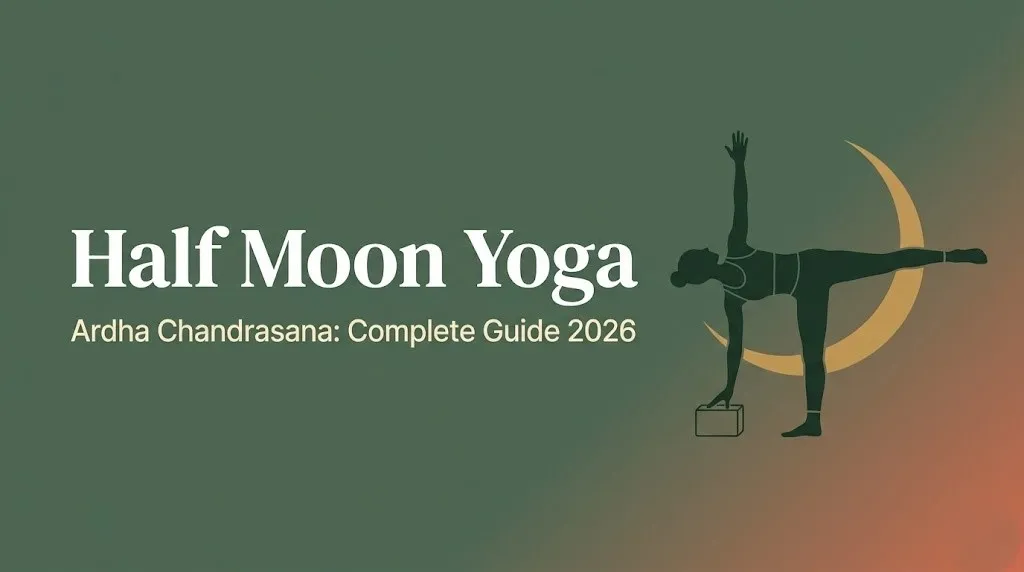
Half moon yoga refers to Ardha Chandrasana, a standing balance posture where the body forms a lateral arc, one leg extended parallel to the floor while the torso opens sideways toward the sky.
The shape of the body in this pose resembles the arc of a crescent or half moon, which explains both the Sanskrit and English names. The standing leg carries all the body’s weight. The lifted leg extends straight back or slightly higher. Both arms reach in opposite directions: one toward the floor (or a block), one toward the ceiling.
What makes this pose distinct from other standing balances is its lateral orientation. Most yoga balance poses, like Vrksasana (Tree Pose) or Natarajasana (Dancer Pose), are forward-facing. Half Moon opens the entire body sideways, recruiting the lateral hip stabilizers in a way that very few yoga postures do.
This lateral demand is also what makes the pose genuinely functional. Think of it like training the outside of a wheel rather than just the axle. Your hip abductors are responsible for every sideways movement you make in daily life, from stepping off a curb to catching your balance on an uneven surface. Half Moon trains them directly.
| Feature | Half Moon Pose | Tree Pose | Warrior III |
|---|---|---|---|
| Body orientation | Lateral, sideways open | Upright, forward-facing | Forward diagonal |
| Primary hip action | Abduction (lifted leg) | External rotation (bent leg) | Extension (lifted leg) |
| Balance challenge | High: lateral center of gravity shift | Moderate | High: forward lean |
| Muscles primarily targeted | Gluteus medius, IT band | Hip external rotators | Gluteus maximus, hamstrings |
Ardha Chandrasana: Meaning and Origins
“Ardha” means half, “chandra” means moon, and “asana” means posture in Sanskrit, making Ardha Chandrasana literally the “half moon posture.”
The moon holds deep symbolic meaning in yoga philosophy. In Hatha yoga texts, the moon is associated with cooling, receptive energy and the left channel of the body (called Ida Nadi in yogic anatomy). The half moon specifically represents a transitional, dynamic state: neither full nor absent, always in motion between one form and another.
In classical Hatha yoga, the pose appears in the Gheranda Samhita, one of the three foundational Hatha yoga texts, though its modern form owes much to the Iyengar yoga tradition. B.K.S. Iyengar’s precise, alignment-based teaching system is largely responsible for the detailed technical instruction that now accompanies this pose in most yoga lineages.
There is also a distinct posture called Half Moon in the Bikram/26&2 yoga sequence. That version is significantly different from Ardha Chandrasana. In Bikram practice, Half Moon (also called Ardha Chandrasana with Pada Hastasana) is a standing lateral side bend performed with feet together, arms reaching overhead, hinging the torso sideways. It is the second posture in the 26&2 sequence and has a different muscle focus than the classical Ardha Chandrasana described throughout this article.
| Version | Yoga Style | Shape Description | Primary Target |
|---|---|---|---|
| Ardha Chandrasana | Hatha, Vinyasa, Iyengar | One-legged balance, body opens sideways | Lateral hip stabilizers, balance |
| Bikram Half Moon | Bikram/26&2 | Two-footed lateral bend, arms overhead | Lateral spine, obliques |
Half Moon Pose Muscles Worked
Half Moon Pose primarily works the gluteus medius and tensor fasciae latae of the standing leg, the adductor complex of the lifted leg, and the obliques and transverse abdominis for rotational stability.
On the standing leg side, the gluteus medius is the star of the show. This muscle runs along the outer hip and is responsible for holding the pelvis level when you stand on one foot. When the gluteus medius is weak, the opposite hip drops, a compensation pattern physical therapists call a Trendelenburg gait. Half Moon trains this muscle directly and specifically.
The tensor fasciae latae (TFL) assists in hip abduction and stabilizes the outer knee through the iliotibial band. Runners and cyclists with IT band tightness often have an underactive TFL on one side. Practicing Half Moon regularly can help restore lateral hip activation patterns, though anyone with active IT band syndrome should approach the pose with care and a physical therapist’s input.
The lifted leg’s adductor complex (inner thigh muscles including the adductor longus, brevis, and magnus) works eccentrically to maintain the leg’s horizontal position against gravity. Many practitioners overlook this effort, letting the lifted leg slowly drift toward the floor. Keeping it actively lifted requires sustained adductor and gluteus maximus engagement.
| Muscle Group | Location | Role in Half Moon Pose |
|---|---|---|
| Gluteus medius | Outer hip, standing leg | Stabilizes pelvis on single leg |
| Tensor fasciae latae | Outer hip/thigh, standing leg | Hip abduction, IT band tension |
| Adductor complex | Inner thigh, lifted leg | Keeps lifted leg horizontal |
| Gluteus maximus | Buttock, lifted leg | Drives hip extension |
| Obliques | Side waist | Rotational and lateral stability |
| Transverse abdominis | Deep core | Spinal protection and balance |
| Quadriceps | Front thigh, standing leg | Knee extension and stabilization |
Key Takeaway: Half Moon Pose is one of the only yoga postures that directly trains the gluteus medius, making it especially valuable for runners, people with knee tracking issues, and anyone whose hips drop when walking on uneven ground.
Half Moon Pose Yoga Benefits
The benefits of half moon pose yoga include lateral hip strengthening, single-leg balance development, spinal lateral extension, improved proprioception, and therapeutic value for people with hip weakness or knee instability.
On the strength side, the gluteus medius activation in this pose is genuinely hard to replicate. Most strength training exercises like squats and lunges train the gluteus maximus primarily. The gluteus medius is only fully recruited in abduction-based movements. The American College of Sports Medicine notes that hip abductor weakness is a contributing factor in patellofemoral pain syndrome (runner’s knee), IT band syndrome, and hip drop during running gait. Half Moon directly addresses this deficit.
The balance component provides neurological training as well. Standing on one leg while maintaining a horizontal lifted leg and an open lateral torso requires constant micro-adjustments from the ankle, knee, and hip. A study published in the Journal of Alternative and Complementary Medicine found that yoga-based balance training, practiced three or more times per week, produced measurable improvements in balance test scores among adults aged 50 and older after 12 weeks.
Spinal lateral extension is another underappreciated benefit. Most yoga backbends and forward folds work in the sagittal plane (front to back). Half Moon extends the spine laterally, opening the intercostal muscles between the ribs and creating space along the side body that few other poses address.
Key benefits of half moon pose include:
- Strengthens the gluteus medius and lateral hip stabilizers
- Develops single-leg proprioception and balance
- Stretches the inner thigh (adductors) of the lifted leg
- Opens the thoracic spine in lateral extension
- Strengthens the ankle and foot of the standing leg
- Builds oblique and deep core endurance
Half Moon Pose Yoga for Balance and Hip Stability
Half Moon Pose is one of yoga’s most effective postures for training the hip abductors and proprioceptive balance system simultaneously, making it particularly valuable for fall prevention and lateral stability.
Proprioception is the body’s ability to sense its position in space without looking. It is processed through receptors in the muscles, joints, and connective tissues, and it degrades naturally with age. The NCCIH has documented that single-leg balance training, as practiced in yoga poses like Half Moon, improves proprioceptive sensitivity in older adults and reduces fall incidence when practiced consistently.
Half Moon’s specific value for hip stability goes beyond just balance. The lateral loading of the standing hip in this pose places the gluteus medius under sustained isometric demand. Physical therapists use single-leg lateral-loaded exercises specifically to rehabilitate hip abductor weakness after knee surgery, hip replacement, and following lower body injuries. Half Moon Pose mimics this therapeutic loading pattern within a yoga framework.
The ankle also plays a critical role here that most practitioners ignore. Think of the standing ankle like the base of a tall antenna: every millimeter of wobble at the base magnifies up through the whole structure. Training ankle stability through repeated Half Moon practice improves balance at every joint above it.
Pose Tip:
- Press all four corners of the standing foot evenly into the mat
- Micro-bend the standing knee rather than locking it straight
- Fix your gaze (drishti) on one unmoving point at eye level or slightly above
- Beginners: keep the gaze at the floor initially before working up to forward or overhead
How to Do Half Moon Pose Step by Step
To practice Ardha Chandrasana (Half Moon Pose), begin in a wide-legged stance, bring the front hand to a block, then shift weight onto the front leg and lift the back leg to hip height while rotating the torso open.
Read through all steps before attempting. A yoga block under the lower hand is strongly recommended for beginners and is standard practice in Iyengar yoga for this pose at all levels.
To practice half moon pose yoga:
- Start in Utthita Trikonasana (Extended Triangle Pose) on your right side. Right foot forward, left foot back at roughly 45 to 60 degrees, torso long and open.
- Place a yoga block about 12 inches ahead of your right foot, to the right side.
- Bend your right knee slightly. Place your right hand (or fingertips) on the block.
- Shift your weight entirely onto your right foot. Begin to lift your left leg off the floor.
- Straighten the right leg, engaging the quadriceps without locking the knee completely.
- Lift the left leg to hip height, extending it straight back. Keep the left foot flexed, toes pointing toward the left wall.
- Stack the hips: rotate the left hip upward so both hip points face the left wall, not the floor.
- Extend the left arm toward the ceiling. Reach through the fingertips actively.
- Set your gaze (drishti): forward, toward the floor, or upward toward your top hand. Choose based on your balance comfort.
- Breathe steadily. Hold for 3 to 5 breath cycles (20 to 40 seconds).
- To release: lower the left leg slowly on an exhale. Return to Triangle. Repeat on the left side.
Modification for beginners: Keep the gaze toward the floor and the top hand on the hip rather than reaching skyward. This lowers the balance challenge while maintaining the hip and leg mechanics.
Half Moon Pose Alignment Cues and Common Mistakes
The most common mistake in half moon pose is allowing the standing hip to sag outward, which collapses the gluteus medius engagement and turns the pose into a passive hang rather than an active balance.
When the standing hip sags, the pelvis tilts sideways and the entire structure loses integrity. Cue yourself to press the standing hip firmly inward, as if someone is pushing gently on the outer hip. This activates the gluteus medius and creates the stable, lifted line the pose requires.
The second frequent error is rotating the torso toward the floor instead of opening it toward the side wall. Both hip points should stack vertically, one above the other. When the top hip rolls forward and the chest faces down, you lose the lateral opening that makes the pose valuable and place extra rotational strain on the lumbar spine.
The third mistake is using the bottom hand as a weight-bearing support rather than a light balance guide. The hand or fingertips on the block should bear only a small fraction of your weight. Most of the work belongs in the standing leg. If you’re heavily pressing down through the bottom hand, the standing leg is not working hard enough.
| Common Mistake | What It Causes | The Correction |
|---|---|---|
| Standing hip sags outward | Collapses glute medius, passive pose | Press hip inward, engage outer hip actively |
| Chest faces floor | Loses lateral opening, strains lumbar | Stack hips, rotate chest toward side wall |
| Bottom hand bears too much weight | Standing leg disengaged | Light fingertip touch, work the standing leg |
| Lifted leg drops below hip | Adductors disengaged | Keep leg at hip height, flex the foot |
| Gaze drops to floor at every attempt | Disrupts vestibular balance | Choose one gaze point and hold it |
Key Takeaway: If your bottom hand is working hard and your standing leg is passive, you’ve shifted the pose from balance training to arm support. Lift through the standing hip and let the hand barely graze the block.
Half Moon Pose for Beginners
Beginners should practice half moon yoga with a block under the lower hand and near a wall for back-leg support, which removes the balance barrier and allows focus on the hip alignment mechanics.
The single biggest obstacle for beginners in Half Moon is the balance demand arriving before the hip strength or body awareness is developed. Using a block and a wall solves both problems at once. Place the block one height level lower than what feels natural. Work up over time. There is no benefit in using a block at the wrong height; it just creates more compensations.
Wall-supported Half Moon is a genuinely different learning experience than the free-standing version. Stand with your back a few inches from the wall. As you lift the back leg, press the lifted foot lightly against the wall. This frees your attention from the balance challenge and directs it entirely to the hip rotation and torso opening.
According to Yoga Alliance, foundational yoga teacher training at the 200-hour level specifically teaches teachers to use props and wall support as primary instructional tools rather than as accommodations. This is worth knowing because a block in Half Moon is not a beginner shortcut. It is the standard setup in the Iyengar yoga tradition at every level of practice.
Beginner modifications for half moon pose:
- Use a yoga block under the lower hand at the tallest height first, lower as flexibility improves
- Practice near a wall with the lifted foot touching the wall lightly for balance security
- Keep the top arm on the hip rather than reaching skyward until balance stabilizes
- Shorten the hold to 3 breath cycles and build duration over weeks
- Keep the gaze toward the floor until standing balance feels steady
Half Moon Pose with Block
Using a yoga block in half moon pose is not just for beginners. It is a standard prop in Iyengar yoga practice that allows the spine to lengthen fully and the hips to stack correctly, regardless of experience level.
When the block is too low or absent, the lower hand must reach further toward the floor, which causes the torso to collapse forward and the shoulder to round. The spine shortens. The hip rotation reverses. The whole alignment deteriorates in one chain reaction. A block at the right height prevents all of that from happening.
The correct block height varies by individual. Taller practitioners with longer torsos may need the block at medium height. People with shorter torsos or greater hamstring flexibility may be comfortable at the lowest height. The test is simple: with the block in place, the spine should feel long, the shoulder directly over the wrist, and the hip able to rotate upward without strain.
B.K.S. Iyengar, whose alignment-based teaching system standardized the use of props in yoga, placed the block under the lower hand as a teaching tool that improves the pose, not a crutch that reduces it. This distinction matters for how practitioners mentally approach prop use.
| Block Height | Who It Suits | What It Changes |
|---|---|---|
| Tall (highest setting) | Beginners, tight hamstrings, first-time attempt | Maximum support, easiest spine length |
| Medium | Intermediate practitioners, moderate flexibility | Good balance of support and challenge |
| Low (lowest setting) | Advanced practitioners, high flexibility | Minimal support, closest to floor variation |
| No block, floor | Very advanced, exceptional flexibility | Full range, highest balance demand |
Half Moon Pose Variations and Revolved Half Moon
The two primary variations of half moon pose are the standard Ardha Chandrasana and the Parivrtta Ardha Chandrasana (Revolved Half Moon), which adds a full spinal rotation that dramatically increases the difficulty and the anatomical demands.
Standard Ardha Chandrasana, as described throughout this article, opens the torso sideways and stacks the hips. The revolved version, Parivrtta Ardha Chandrasana, does the opposite. The torso rotates toward the floor, the lower hand (or a block) is placed on the outside of the standing foot, and the upper arm reaches skyward in a twisted position.
Revolved Half Moon requires significantly more hip flexor and hamstring flexibility, spinal rotational mobility, and balance control than the standard version. Physical therapists and experienced yoga teachers generally recommend establishing at least three months of steady standard Half Moon practice before attempting the revolved variation.
A third variation is Sugarcane Pose (sometimes called Candy Cane Pose or Ardha Chandra Chapasana), where in standard Half Moon, the top hand reaches back to grip the lifted foot, creating a backbend similar to Dancer Pose while still balancing on one leg. This is an advanced variation requiring both balance mastery and significant quadriceps flexibility.
| Variation | Sanskrit Name | Level | Key Addition |
|---|---|---|---|
| Standard Half Moon | Ardha Chandrasana | Intermediate | Lateral body opening |
| Revolved Half Moon | Parivrtta Ardha Chandrasana | Advanced | Full spinal rotation |
| Sugarcane / Candy Cane | Ardha Chandra Chapasana | Advanced | Back leg gripped, backbend added |
| Wall-supported | (No separate Sanskrit name) | Beginner | Wall contact for lifted foot |
Key Takeaway: Revolved Half Moon is not just a harder version of the same pose. It is a different movement pattern with different muscle demands and should only be introduced after the standard version is steady and accessible.
Half Moon Pose for Seniors
Half Moon pose for seniors is best practiced near a wall with a block, focusing on the hip stabilizer engagement and gentle lateral opening rather than height of the lifted leg or depth of the rotation.
The balance training benefit of this pose is especially relevant for older adults. The NCCIH has published data showing that yoga-based balance practice reduces fall risk in adults over 65 when practiced at least twice weekly. Half Moon, even in its most supported version, delivers the gluteus medius training and proprioceptive challenge that underlies this benefit.
Seniors with osteoporosis should approach the lateral spinal extension in this pose carefully. Compression fractures of the thoracic vertebrae are a risk in aggressive lateral bending for people with low bone density. A shallow lateral opening, keeping the torso more upright, is the appropriate modification. A spine-specialized physical therapist or a yoga teacher with senior or therapeutic training should supervise the first several attempts.
For seniors with a history of hip replacement or knee replacement, the key is ensuring that the standing leg’s joint does not bear excessive rotational stress. The standing knee should track directly over the second toe. A micro-bend prevents hyperextension at the knee joint, which is particularly important for people with joint replacements.
Pose Tip for Seniors:
- Lift the back leg only a few inches off the floor initially
- Keep the torso more upright rather than fully lateral
- Use a chair back instead of a block for greater stability
- Skip the overhead arm reach until balance on one leg feels completely stable
- Practice barefoot on a non-slip surface for better foot proprioception
Half Moon Pose for Low Back Pain and Hip Issues
Half Moon pose can support low back health by strengthening the lateral hip stabilizers that control pelvic alignment, but it requires careful modification for anyone with active lumbar disc issues or sacroiliac joint dysfunction.
The connection between hip abductor weakness and low back pain is well-documented. When the gluteus medius is weak, the pelvis shifts and tilts with every step, creating asymmetrical loading on the lumbar spine and sacroiliac joints over time. Strengthening this muscle through Half Moon practice addresses one of the more common root causes of chronic low back discomfort, rather than just managing symptoms.
For people with current low back pain, the key modification is keeping the torso more upright rather than fully extending into lateral opening. The full lateral position can compress the lumbar vertebrae on the lower side. A softer version, where the torso is roughly 45 degrees rather than fully parallel to the floor, provides the hip strength benefit without the compressive loading.
People with sacroiliac joint instability should approach single-leg balance poses with caution. The asymmetrical loading of SI joint conditions means that some configurations of this pose may increase instability rather than reduce it. Working with a pelvic floor physical therapist alongside a yoga teacher who understands SI joint mechanics is the most appropriate approach here.
A study published in Complementary Therapies in Medicine found that yoga programs specifically designed for chronic low back pain, including hip-strengthening postures, reduced pain intensity scores and improved functional movement over an 8-week period. Hip-focused standing poses were identified as a key component of effective programs.
Half Moon Pose Contraindications and Who Should Avoid It
Half moon pose is contraindicated for people with acute low back injuries, severe sacroiliac joint dysfunction, active ankle sprains, and those experiencing vertigo or significant vestibular disorders.
This is a pose where “modify it for everyone” is genuinely unhelpful advice. Some people need to skip it entirely, at least temporarily, and that information serves them better than a generic caution.
Avoid or skip half moon pose if you have:
- Acute lumbar disc herniation or prolapse: The combination of single-leg loading and lateral spinal extension can increase compressive force on the posterior disc.
- Active sacroiliac joint dysfunction: Asymmetrical single-leg loading can aggravate SI joint irritation, particularly on the standing leg side.
- Recent ankle sprain or ligament instability: The entire load of the body falls on one ankle. An unstable ankle joint is a fall risk.
- Uncontrolled high blood pressure: Extended single-leg balance poses with overhead arm reach can temporarily raise arterial pressure.
- Active vertigo or vestibular disorders: The lateral body position and fixed gaze requirements can worsen vestibular symptoms.
- Third-trimester pregnancy: Balance is significantly altered and the lateral compression of the abdominal area is inappropriate without guidance from a prenatal-specialized yoga teacher.
- Severe hip bursitis on the standing leg side: The abductor demand on the standing hip can aggravate bursal inflammation.
Anyone with these conditions who wants to practice should work directly with a qualified yoga therapist and, where appropriate, a physical therapist who understands the mechanical demands of this posture.
Half Moon Pose Preparatory Poses
Effective preparation for half moon pose targets the lateral hip stabilizers, hamstrings, ankle stability, and single-leg balance in progression, building each component before the full pose combines them.
Half Moon demands that your gluteus medius is warm and engaged, your hamstrings are open enough to allow hip extension, and your standing ankle can bear your full weight with stability. Arriving at the pose cold, without this preparation, is when most falls and compensations happen.
Preparatory poses in recommended practice order:
- Utthita Trikonasana (Extended Triangle Pose): Direct preparation. The same leg and hip action, with the back foot on the floor for stability. Hold 5 breaths per side.
- Virabhadrasana II (Warrior II): Warms the hip abductors and builds lateral hip endurance. Hold 5 breaths per side.
- Vrksasana (Tree Pose): Trains single-leg balance and mental focus before adding lateral complexity.
- Anjaneyasana (Low Lunge): Opens the hip flexors, which must lengthen to allow the back leg to extend in Half Moon.
- Prasarita Padottanasana (Wide-Legged Forward Fold): Warms the inner thighs and hamstrings. Both muscle groups support the lifted leg’s position.
- Setu Bandha Sarvangasana (Bridge Pose): Strengthens the gluteus maximus and medius in a safe supine position.
| Preparatory Pose | Sanskrit Name | Primary Preparation |
|---|---|---|
| Extended Triangle | Utthita Trikonasana | Direct hip and leg preparation |
| Warrior II | Virabhadrasana II | Hip abductor endurance |
| Tree Pose | Vrksasana | Single-leg balance training |
| Low Lunge | Anjaneyasana | Hip flexor opening |
| Wide-Legged Forward Fold | Prasarita Padottanasana | Inner thigh and hamstring warm-up |
| Bridge Pose | Setu Bandha | Glute strength in safe position |
Half Moon Pose Yoga Sequence
A complete half moon pose yoga sequence includes a 15-minute lateral hip warm-up, the peak pose itself, and a 15-minute cool-down that releases the adductors, IT band, and lumbar spine.
The sequence below is built for intermediate practitioners. Beginners should substitute Tree Pose for Half Moon as the peak posture until single-leg balance is stable. All hold times assume steady Ujjayi breathing.
Warm-Up (15 minutes):
- Balasana (Child’s Pose): 2 minutes. Ground the nervous system.
- Marjaryasana-Bitilasana (Cat-Cow): 10 rounds. Warm the spine.
- Adho Mukha Svanasana (Downward Dog): 5 breaths. Hamstrings and lateral hips.
- Anjaneyasana (Low Lunge): 5 breaths per side. Hip flexors.
- Virabhadrasana II (Warrior II): 5 breaths per side. Hip abductor endurance.
- Utthita Trikonasana (Extended Triangle): 5 breaths per side. Direct preparation.
- Vrksasana (Tree Pose): 5 to 8 breaths per side. Balance preparation.
Peak Pose (10 minutes):
- Ardha Chandrasana (Half Moon Pose): 5 breath hold, 3 rounds per side. Rest in Mountain Pose between rounds.
Cool-Down (15 minutes):
- Baddha Konasana (Bound Angle Pose): 2 minutes. Inner thigh and adductor release.
- Supta Kapotasana (Supine Pigeon): 2 minutes per side. Deep lateral hip release.
- Supta Padangusthasana (Reclined Hand-to-Big-Toe Pose, lateral variation): 2 minutes per side. IT band and outer hip.
- Setu Bandha Sarvangasana (Bridge Pose): 5 breaths. Spinal reset.
- Savasana (Corpse Pose): 5 minutes minimum.
According to Complementary Therapies in Medicine, yoga sequences that include adequate warm-up and cool-down phases are associated with lower injury rates and greater reported benefit compared to isolated pose practice without preparation.
Key Takeaway: Practicing Triangle Pose immediately before Half Moon is not just a warm-up choice. It is the most direct preparation available, using the same leg and hip mechanics with both feet on the floor before lifting one.
Frequently Asked Questions About Half Moon Yoga
How do beginners do half moon pose in yoga?
Beginners should practice half moon yoga with a block under the lower hand at its tallest height and near a wall for back-leg support.
Place the lifted foot lightly against the wall, keep the top arm on the hip rather than reaching skyward, and hold for 3 breath cycles.
Build duration and remove the wall gradually over several weeks as balance and hip strength develop.
What muscles does half moon pose work?
Half moon pose primarily works the gluteus medius and tensor fasciae latae of the standing leg, which stabilize the pelvis in single-leg balance.
The lifted leg’s adductor complex engages to keep the leg horizontal, and the obliques and transverse abdominis maintain lateral stability throughout the torso.
The standing leg’s quadriceps and ankle stabilizers also work continuously to keep the base of the pose steady.
Is half moon pose good for your back?
Half moon pose can support back health by strengthening the lateral hip stabilizers that control pelvic alignment and reduce asymmetrical lumbar loading.
For people with active disc herniation, sacroiliac joint instability, or acute low back injury, the pose should be modified significantly or avoided until those conditions are assessed by a physical therapist.
A shallow version with the torso more upright, rather than fully lateral, provides the hip strength benefit with less spinal compression.
How long should you hold half moon pose?
Most yoga teachers recommend holding half moon pose for 3 to 5 breath cycles, roughly 20 to 40 seconds, for intermediate practitioners.
Beginners should start with 3 breaths and build gradually over weeks as balance and muscular endurance improve.
In restorative or wall-supported versions, holds of up to 2 minutes can develop deeper lateral hip awareness without the balance demand.
What is the difference between half moon pose and revolved half moon pose?
Standard half moon pose (Ardha Chandrasana) opens the torso sideways toward the ceiling, with both hips stacking vertically.
Revolved half moon (Parivrtta Ardha Chandrasana) rotates the torso toward the floor, with the lower hand placed outside the standing foot and the spine in a deep twist.
The revolved version is significantly more demanding in terms of spinal rotation, hamstring flexibility, and balance, and should only be attempted after the standard version is fully stable.
Closing
Half Moon Pose rewards patience more than flexibility. You do not need exceptional hamstring length or an impressive lifted leg height to get real benefit from this posture. You need gluteus medius activation, a steady standing foot, and the willingness to use a block without apology.
Start with the preparatory sequence three times this week. Practice Extended Triangle on both sides first. Then bring the block in and try Half Moon with one hand at the wall. Hold it for three breaths per side, focus on keeping the top hip rotating upward, and let that be enough.
Mastered carefully over months, this pose will change how your hips function in everything you do off the mat.
***
META BLOCK
Meta Title: Half Moon Yoga: Complete Ardha Chandrasana Guide 2026
Meta Title Chars: 55/59
Meta Desc: Master half moon yoga with step-by-step alignment cues, muscles worked, beginner modifications, block use, and expert safety tips for 2026 practice.
Meta Desc Chars: 152/159
Focus Keywords: half moon yoga, ardha chandrasana, half moon pose, half moon pose for beginners, half moon pose benefits
Slug: /half-moon-yoga/