Ekam Yoga: Complete Guide to Practice and Benefits 2026
Ekam yoga is a practice rooted in the Sanskrit principle of “one,” bringing breath, movement, and focused attention into a unified experience on the mat. Understanding what it is and how to practice it gives beginners a clear conceptual framework that many other yoga introductions simply skip.
The interest in structured, philosophy-grounded yoga has grown steadily. According to the National Center for Complementary and Integrative Health (NCCIH), more than 21 million Americans practice yoga, and a growing number cite a desire for practices that combine physical movement with clear mental frameworks, not just exercise.
This guide covers what “ekam” actually means in Sanskrit, how the principle shapes physical practice, which poses and sequences express it best, and how to build a home practice around it. You’ll also find modifications for beginners and seniors, breathing techniques, safety notes, and what the research says about yoga’s effects on the body and mind.
What Is Ekam Yoga
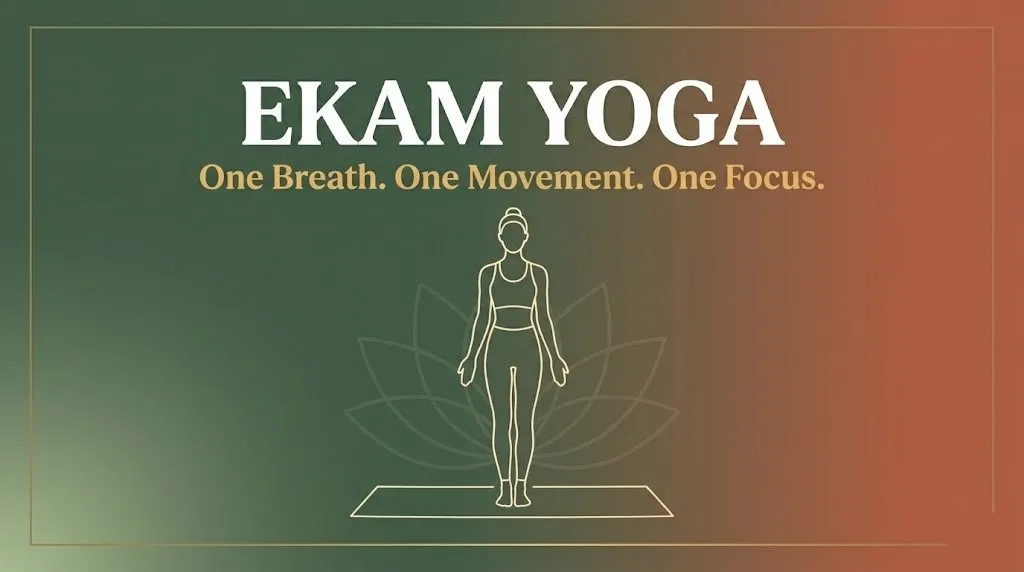
Ekam yoga is a yoga practice philosophy and teaching approach that centers on the Sanskrit concept of “one,” integrating breath, movement, gaze, and mental focus into a single, unified act of attention. It is less a distinct yoga style and more a guiding principle that can be applied across Hatha, Ashtanga, and Vinyasa-based practices.
The name is sometimes used by specific schools and teacher training programs, but its core meaning predates any branded usage. At its simplest, practicing ekam yoga means treating each pose as a moment of complete unification: one breath, one movement, one point of attention, all happening at the same time.
This is different from how many people approach yoga class. Most beginners move first, breathe second, and pay attention to where they are going third. The ekam approach asks you to do all three simultaneously, from the very first movement.
Key qualities that define an ekam yoga approach:
- Breath and movement begin at exactly the same moment, not breath first or movement first
- Each transition between poses is given the same focused attention as the pose itself
- A single point of gaze (drishti) is maintained throughout each shape
- The mind is treated as part of the physical practice, not separate from it
- Stillness between poses is considered as important as the poses themselves
What Does Ekam Mean in Sanskrit and Yoga Philosophy
Ekam is a Sanskrit word meaning “one” or “the singular,” and in yoga philosophy it refers to the undivided state of awareness that practitioners work toward through consistent practice. The word appears in foundational texts of Indian philosophy, including the Rig Veda, where it describes the primordial unity underlying all existence.
In practical yoga terms, ekam functions as both a count and a concept. In the Ashtanga yoga system, “ekam” is the first count called in Surya Namaskar A (Sun Salutation A). The teacher calls “ekam, inhale” and the student raises their arms overhead into Urdhva Hastasana (Upward Salute). This isn’t arbitrary numbering. It’s a signal that the sequence is a unified whole, not a series of disconnected shapes.
Think of it like this. Most people experience a yoga class the way they experience a traffic jam: a sequence of stops and starts, each one separate and mildly frustrating. Ekam asks you to experience practice the way a river moves: continuous, directed, and always flowing toward the same place.
In the Yoga Sutras of Patanjali, the concept of ekagrata (one-pointedness of mind) directly parallels the ekam principle. Patanjali describes the ability to sustain single-pointed awareness as a key marker of a maturing practice. The ekam principle makes this abstract philosophical goal into something you can practice on a mat, breath by breath.
The word “ekam” is pronounced “ay-kum.” The “a” is short, the stress falls on the first syllable, and the “m” carries a slight nasal resonance.
Ekam Yoga vs Other Yoga Styles: How It Compares
Ekam yoga, as a principle-centered approach, differs from named yoga styles in that it functions as an organizing philosophy rather than a fixed sequence or branded method. It can be applied within multiple styles, but it shares the closest structural relationship with Ashtanga yoga.
In Ashtanga yoga, ekam is the literal first spoken count of the primary series. The entire Ashtanga system is built on the integration of breath, movement, gaze, and energy locks (bandhas), which is exactly what the ekam principle describes. This makes Ashtanga the most direct stylistic expression of ekam yoga as a practice.
Hatha yoga shares the philosophical foundation but moves at a slower pace, making it more accessible for beginners who need time to integrate the breath-movement link before speeding up. Vinyasa yoga applies the ekam concept in flowing sequences but varies more widely in structure and can lose the philosophical rigor in faster-paced classes.
| Yoga Style | Relation to Ekam Principle | Pace | Best For |
|---|---|---|---|
| Ashtanga | Direct, structured, ekam is first count | Moderate to vigorous | Consistent practitioners |
| Hatha | Philosophical alignment, slower execution | Slow to moderate | Beginners and all levels |
| Vinyasa | Applied in flow, less explicit | Moderate to fast | Fitness-focused practitioners |
| Iyengar | Precise alignment, minimal breath counting | Slow and precise | Injury rehab, detail-oriented |
| Restorative | Unity of stillness and breath, no movement sequence | Very slow | Stress recovery, nervous system |
| Kundalini | Breath and energy focus, different framework | Variable | Energy and consciousness focus |
Safety note: Ashtanga yoga is not recommended as a first yoga experience for people with wrist, shoulder, or lower back injuries. The Hatha-based expression of ekam principles is a safer starting point for those managing active conditions.
The Core Principles of Ekam Yoga Practice
The core principles of ekam yoga practice are breath synchronization, unified attention, continuous presence, and the integration of stillness and movement as equally weighted parts of practice. These four principles work together and cannot be practiced in isolation.
Breath synchronization means movement and breath begin simultaneously. No pose starts before the inhale or exhale does. This sounds simple but requires consistent attention, especially in transitions. Most beginners hold their breath during challenging moments. Ekam practice treats a held breath as a signal that the body has exceeded its current capacity in that shape.
Unified attention refers to the simultaneous focus on three internal anchors: the breath, the physical sensation of the pose, and the drishti (gaze point). Maintaining all three at once trains the nervous system to remain calm under mild physical effort. Over time, this transfers to the ability to stay focused under stress outside of practice.
Continuous presence means each moment of practice receives the same quality of attention: the beginning of the session, the middle, and the transition into the final rest pose. There is no “throwaway” movement.
Core principles at a glance:
- Breath synchronization: inhale and movement begin at the same instant
- Unified attention: breath, sensation, and gaze held simultaneously
- Continuous presence: every movement, including transitions, receives full focus
- Equanimity in stillness: rest poses are practiced with the same attentiveness as active poses
- Non-forcing: poses are explored at the edge of current capacity, not pushed past it
Key Takeaway: Ekam yoga is a philosophy of unified attention applied to physical practice. Understanding the Sanskrit root and core principles before stepping on the mat gives every subsequent session a clearer purpose.
How to Practice Ekam Yoga at Home
Practicing ekam yoga at home means setting up a space and a time structure that supports unified attention, because distractions directly undermine the core principle of the practice. Preparation is not optional; it’s part of the practice itself.
Choose a consistent spot with at least 6 feet of clear floor space. Leave your mat rolled out and visible. Keep two blocks and a strap nearby. These aren’t luxuries for beginners; they are precision tools that allow you to access the correct shape of a pose without forcing. A forced shape breaks breath synchronization immediately.
Before starting, sit quietly for two to three minutes. This is not wasted time. According to the Harvard T.H. Chan School of Public Health, brief pre-practice mindfulness preparation increases the quality of attention sustained during subsequent movement, which is the specific skill ekam practice develops.
Set a time boundary before you begin. A 25-minute home session practiced with unified attention is more effective than 60 minutes of distracted movement. Use a soft timer so you don’t check the clock.
Steps to set up your ekam home practice:
- Choose your consistent space and roll the mat out permanently if possible.
- Store blocks, a strap, and a blanket within arm’s reach of the mat.
- Sit in Sukhasana (Easy Seated Pose) for 2 to 3 minutes before moving.
- Set a timer for your session length: 20 to 30 minutes for beginners.
- Choose one sequence and practice it fully rather than selecting poses at random.
- End every session with at least 3 minutes in Savasana (Corpse Pose).
Modification: If sitting on the floor for the opening centering is uncomfortable, sit in a firm chair with feet flat on the floor and spine away from the chair back.
Ekam Yoga Sequence Step by Step for Beginners
A beginner ekam yoga sequence uses a modified Surya Namaskar (Sun Salutation) structure as its foundation, because the Sun Salutation was built specifically to express the breath-movement unity that ekam describes. Each count in the traditional Ashtanga calling corresponds to one breath and one movement.
This sequence is slower than a traditional Ashtanga Sun Salutation. Each pose is held for a full 5-breath count before moving. This gives beginners time to find the breath-movement connection before increasing pace.
To practice the beginner ekam sequence:
- Stand in Tadasana (Mountain Pose) with feet hip-distance apart. Take 5 full breaths. Feel all four corners of each foot pressing evenly into the mat.
- Inhale and sweep both arms overhead into Urdhva Hastasana (Upward Salute). This is ekam: one breath, one movement, beginning together.
- Exhale and hinge forward into Uttanasana (Standing Forward Fold). Bend knees generously. Place hands on blocks if the floor is out of reach.
- Inhale, lengthen the spine into a half-lift. Fingertips on blocks or shins. Gaze toward the floor, not forward.
- Exhale, step or walk both feet back to a high plank position. Pause. Breathe here for 3 counts.
- Lower slowly to the floor. Beginners: lower knees first, then hips and chest. Hold Bhujangasana (Cobra Pose) for 3 breaths, keeping elbows slightly bent.
- Exhale and press back into Adho Mukha Svanasana (Downward Facing Dog). Hold for 5 breaths.
- Walk feet toward hands. Inhale to half-lift. Exhale back to Uttanasana.
- Inhale, sweep arms wide and up to Urdhva Hastasana. Pause at the top.
- Exhale, bring hands to heart center in Anjali Mudra (Prayer Position). Return to Tadasana. Rest here for 5 full breaths before the next round.
Modification: Replace Adho Mukha Svanasana with a tabletop position if shoulder or wrist discomfort prevents a full inversion. The breath-movement link is what matters most, not the specific shape.
Ekam Yoga Breathing Techniques and Pranayama
The primary breathing technique in ekam yoga practice is Ujjayi pranayama (Ocean Breath), a nasal breath with a slight constriction at the back of the throat that creates an audible, wave-like sound. This breath is not a warm-up technique or a calming exercise added before practice. In ekam yoga, it is the practice. It runs continuously from the first movement to the last.
Ujjayi breath serves two functions simultaneously. First, it slows and regulates the breath automatically because the throat constriction creates mild resistance on the inhale and exhale. Second, the sound of the breath becomes an auditory anchor for attention, the ekam practice equivalent of a concentration object. When you can hear your own breath, you are present.
A 2021 study published in the International Journal of Yoga found that Ujjayi breathing practice significantly reduced heart rate and perceived exertion during moderate-intensity yoga sessions, compared to unregulated nasal breathing. This supports its use as both a performance and a calming tool within the ekam framework.
To practice Ujjayi breath before your session:
- Sit comfortably in Sukhasana (Easy Seated Pose).
- Breathe in through the nose. On the exhale, fog a mirror with your mouth open. Notice the “hhh” sound at the throat.
- Close the mouth. Repeat that same throat sensation on the exhale through the nose.
- Once the exhale feels natural, apply the same constriction to the inhale.
- Aim for a 4-count inhale and a 4-count exhale, equal length. Extend to 5 counts as it feels natural.
- Continue for 8 to 10 breath cycles before beginning movement.
Modification: If Ujjayi breath feels forced or causes dizziness, return to natural nasal breathing. The breath should feel slightly engaged, not strained. Lightheadedness is a signal to ease the constriction, not increase it.
Key Takeaway: The Ujjayi breath is the thread that holds the ekam sequence together. If you can maintain it from the first pose to the last, you are practicing ekam yoga correctly, regardless of how the shapes look.
Ekam Yoga Benefits for the Body
Ekam yoga builds functional strength, spinal mobility, and connective tissue health simultaneously, because its sequences require the body to move through full ranges of motion while maintaining active muscular engagement and steady breath. This combination is more demanding than it looks.
The primary physical benefits come from three consistent patterns within ekam-based sequences. First, the repeated spinal flexion and extension in sequences like Bitilasana Marjaryasana (Cat-Cow) and the transition between Bhujangasana (Cobra Pose) and Adho Mukha Svanasana (Downward Facing Dog) maintains thoracic and lumbar spine mobility. This is the movement most desk-based adults lose first.
Second, the weight-bearing elements of ekam sequences, specifically the plank and Downward Dog positions, build shoulder girdle stability through the serratus anterior, deltoids, and rotator cuff muscles. These are the same muscles that protect the shoulder joint from injury in everyday lifting and reaching.
Third, the breath synchronization requirement trains the diaphragm as an active muscle. Most adults breathe shallowly into the upper chest. Ujjayi breath used consistently throughout practice retrains the diaphragm to engage fully, which improves breathing efficiency over weeks, not just during practice.
Physical benefits of a consistent ekam yoga practice:
- Spinal mobility through repeated full-range flexion and extension patterns
- Shoulder stability from consistent weight-bearing in plank and Downward Dog positions
- Hip flexor lengthening through lunge-based and forward fold transitions
- Core stabilizer engagement from breath-linked movement throughout every session
- Improved respiratory efficiency through consistent Ujjayi breath training
- Hamstring and gastrocnemius lengthening from forward fold positions
Safety note: Anyone with active lumbar disc herniation should avoid deep forward folds and full Chaturanga lowering. A physical therapist familiar with spinal conditions can guide appropriate modifications before starting a sequence-based practice.
Ekam Yoga and Mental Health: What Research Says
Yoga practices that integrate breath regulation, focused attention, and physical movement show consistent effects on anxiety, stress markers, and mood, according to multiple peer-reviewed studies. The ekam approach, which specifically trains all three simultaneously, aligns with the mechanisms researchers identify as most effective.
The National Center for Complementary and Integrative Health (NCCIH) notes that yoga’s mental health benefits are among its best-supported outcomes, with the strongest evidence for generalized anxiety reduction, perceived stress management, and improved sleep quality.
The key mechanism connecting ekam practice to mental health is vagal tone. The vagus nerve runs from the brainstem through the heart and abdomen and directly governs the parasympathetic nervous system. Slow, rhythmic breathing patterns like Ujjayi pranayama measurably increase vagal tone, which is associated with greater emotional regulation and reduced stress reactivity.
A 2022 study in Complementary Therapies in Medicine found that 8-week yoga programs combining breath awareness with movement produced greater reductions in anxiety scores than either breath practice or movement practiced separately. The integrated approach at the heart of ekam yoga was specifically identified as a key variable.
Research findings relevant to ekam-style practice:
- Integrated breath-movement yoga reduced self-reported anxiety in 87% of participants in a 2022 Complementary Therapies in Medicine study
- Consistent yoga practice of 20 minutes or more three times weekly reduced cortisol markers in multiple controlled trials cited by the NCCIH
- One-pointed focus training (as in dharana and drishti practice) showed improvement in sustained attention measures in studies from the International Journal of Yoga
Ekam Yoga for Stress and Anxiety Relief
Ekam yoga reduces stress and anxiety by training the nervous system to sustain a calm, focused state during mild physical effort, a skill that transfers directly to high-stress situations outside of practice. The mechanism is repeated parasympathetic activation through controlled breath combined with moving attention.
Think of the stress response like a smoke alarm wired too sensitively. Every minor event triggers a full alarm. The consistent breath-and-attention practice in ekam yoga works like recalibrating that alarm so it fires appropriately, not constantly.
For acute stress relief, three ekam yoga poses are particularly effective when held with Ujjayi breath:
Balasana (Child’s Pose) places the body in a protective shape that narrows sensory input and physically signals safety to the nervous system. Hold for 5 to 10 breaths with arms extended forward and forehead resting on the mat or a block.
Viparita Karani (Legs Up the Wall) creates a gentle inversion that shifts blood flow and directly calms the heart rate through baroreceptor stimulation. Hold for 3 to 10 minutes.
Uttanasana (Standing Forward Fold) with bent knees and a soft neck creates spinal traction and reduces the physical tension pattern associated with the stress response, specifically trapezius and cervical spine tightness.
| Pose | Hold Time | Primary Stress Effect | Modification |
|---|---|---|---|
| Balasana (Child’s Pose) | 5 to 10 breaths | Narrows sensory field, signals safety | Blanket between thighs and calves |
| Viparita Karani (Legs Up the Wall) | 3 to 10 minutes | Lowers heart rate via baroreceptors | Bent knees if hamstrings are tight |
| Uttanasana (Standing Forward Fold) | 1 to 3 minutes | Releases cervical and trapezius tension | Hands on blocks, knees generously bent |
Safety note: Avoid Viparita Karani if you have glaucoma or a diagnosed cervical spine condition. Your ophthalmologist or spinal specialist can clarify appropriate inversion pressure for your situation.
Ekam Yoga for Seniors and People with Limited Mobility
Ekam yoga principles apply fully to chair-based and wall-supported practice, making the approach accessible for seniors, people recovering from surgery, or anyone managing reduced lower body mobility. The core principle of breath-movement unity does not require floor work.
According to a 2019 study in the Journal of Alternative and Complementary Medicine, chair yoga programs that emphasized breath awareness alongside movement produced greater improvements in balance, pain levels, and emotional wellbeing than movement-only programs in older adult participants. This directly supports the ekam principle: the breath component is not decorative.
For seniors, the ekam approach is valuable precisely because it slows the practice down to match the breath. Rushing through poses to keep up with a faster class is one of the most common causes of injury in older adult yoga practitioners. An ekam-based practice gives the body permission to move at the rhythm it can sustain.
Starter ekam yoga poses for seniors using a chair:
- Seated Tadasana (Mountain Pose): Sit tall at the chair’s edge. Feet flat. Feel the sit bones evenly weighted. Take 5 Ujjayi breaths. This is ekam: full attention in a simple shape.
- **Seated *Bitilasana Marjaryasana (Cat-Cow)*: Hands on knees. Inhale, arch the spine and lift the chest. Exhale, round the spine and drop the chin. 8 to 10 rounds.
- **Seated *Uttanasana* (Forward Fold)**: Hinge at the hips and lower chest toward thighs. Arms can hang or rest on shins. Hold 5 breaths.
- **Seated *Trikonasana* (Triangle Pose) adapted**: Reach one arm to the side and down toward the foot while the other arm reaches upward. Maintain the gaze at the upper hand (drishti).
Safety note: Use a chair with a non-slip rubber base. Chairs with wheels or light plastic feet are not appropriate for weight-bearing yoga positions.
Key Takeaway: The ekam principle scales to any body and any mobility level. Breath synchronization and one-pointed focus work as well seated in a chair as they do in a full standing sequence.
Ekam Yoga Modifications and Props for Beginners
Yoga props in an ekam practice are not substitutes for correct form. They are the tools that make correct form possible. Without them, beginners often sacrifice breath synchronization to reach a shape, which is the opposite of what ekam practice requires.
The two most important props for beginning ekam yoga are yoga blocks and a yoga strap. Blocks bring the floor closer in standing forward folds and supported balancing poses, allowing the spine to remain long rather than rounded. A strap extends reach in seated forward folds and shoulder stretches, so the breath can stay full and unrestricted.
The American College of Sports Medicine notes that using appropriate support tools during movement practice reduces compensatory movement patterns and allows the body to access the intended muscular engagement. In ekam terms: props keep the breath-movement link intact.
| Prop | Use in Ekam Practice | Budget Substitute |
|---|---|---|
| Yoga Block (2 recommended) | Supports hands in forward folds; elevates hips in seated poses | Firm hardcover books, stacked |
| Yoga Strap | Extends reach in hamstring stretches and shoulder work | Bathrobe belt or necktie |
| Yoga Blanket | Cushions knees in kneeling poses; supports in Restorative shapes | Folded firm bath towel |
| Yoga Bolster | Full support in Restorative holds | Two stacked firm couch cushions |
| Yoga Mat (non-slip) | Defines practice space; prevents slipping in standing poses | Firm non-slip surface only |
Modification for wrist sensitivity: In any weight-bearing position such as plank or Downward Dog, shift to fists or use a wedge under the palms to reduce wrist extension angle. This protects the carpal tunnel and allows the session to continue without pain.
Ekam Yoga and One-Pointed Focus (Dharana) Explained
Dharana, the sixth of Patanjali’s eight limbs of yoga, means one-pointed concentration or the sustained focusing of attention on a single object. Ekam yoga treats dharana not as a separate meditation practice but as the continuous thread running through every physical movement, breath, and transition.
In practical terms, dharana in ekam practice means choosing one anchor per pose and holding it. The most common anchor is the drishti (gaze point). Each pose has a specific traditional drishti: the tip of the nose in forward folds, the navel in certain seated poses, the extended hand in triangle shapes. Maintaining the drishti is not a cosmetic detail. It stabilizes the vestibular system, reduces balance-related muscular work, and keeps the attention from fragmenting.
Think of dharana like tuning a radio to a single clear station. When attention scatters between your to-do list, the sound outside, and whether you look right doing the pose, you’re getting static. The drishti is how you tune in.
Practical ways to build dharana into your ekam practice:
- Choose one drishti point per pose and commit to it for the full hold duration
- When the mind wanders, use the sound of Ujjayi breath as a return anchor
- Practice Trataka (Steady Gaze Meditation) for 2 to 3 minutes before your physical session: fix your gaze on a candle flame or a fixed point on the wall without blinking longer than comfortable
- In seated meditation after practice, use the sensation of breath at the nostrils as the single concentration object
Safety note: Trataka is not recommended for people with photosensitivity, certain eye conditions, or migraines triggered by visual focus tasks. A qualified yoga teacher or eye care provider can suggest an appropriate focus anchor.
Ekam Yoga Teacher Training: What to Expect
Ekam yoga teacher training programs vary in structure depending on the school, but the most credible programs share a common curriculum framework: Sanskrit philosophy, anatomy and movement mechanics, sequencing principles, pranayama instruction, and supervised teaching hours. Programs aligned with Yoga Alliance standards require a minimum of 200 hours for a foundational certification.
The ekam principle, specifically the integration of breath, movement, gaze, and attention, is taught both as theory and as a lived practice in quality training programs. Students practice the same sequences repeatedly until the breath-movement link becomes automatic before they learn to teach it.
What to look for in an ekam yoga teacher training program:
- Yoga Alliance registration or equivalent national certification body recognition
- A named lead trainer with verifiable teaching credentials and documented study lineage
- Anatomy content taught by a qualified movement specialist, not only a yoga teacher
- Supervised teaching practicums with recorded feedback
- Sanskrit instruction that goes beyond vocabulary and addresses application to practice
- Clear policy on trauma-aware and inclusive language in teaching
| Training Feature | Minimum Standard | Better Standard |
|---|---|---|
| Total Hours | 200 hours (Yoga Alliance) | 300 to 500 hours |
| Anatomy Instruction | Basic muscular review | Taught by movement specialist |
| Sanskrit Coverage | Terminology only | Applied to sequence calling |
| Teaching Practicum | 5 to 10 hours supervised | 20 or more hours with video review |
| Philosophy Depth | Eight limbs overview | Yoga Sutras with ekam application |
Note on costs: Teacher training tuition varies widely. In-person residential programs in 2026 range from $2,500 to $5,000 or more. Online programs range from $500 to $2,500. Verify Yoga Alliance registration independently before enrolling.
Ekam Yoga Safety and Contraindications
Ekam yoga is generally safe for healthy adults of all fitness levels when practiced at an appropriate pace and with adequate props. The risks increase when the breath-movement link is abandoned in favor of forcing a shape, which is the primary cause of yoga-related injuries.
The most common yoga injuries reported in peer-reviewed literature include lumbar spine strain, hamstring tears at the proximal attachment, rotator cuff irritation from Chaturanga performed with poor form, and wrist impingement from weight-bearing positions. All of these are most likely to occur when practitioners push past their current capacity without the breath as a guide. In ekam yoga, the breath loss is the warning signal.
A 2016 study published in Orthopaedic Journal of Sports Medicine found that yoga-related injuries were most commonly associated with overstretching, inadequate warm-up, and improper pose execution rather than the practice itself. The ekam principle of never moving past the breath’s capacity directly addresses all three causes.
Conditions requiring modification or medical clearance before practice:
- Active lumbar disc herniation or sciatica: avoid deep forward folds and Chaturanga; use a modified sequence with a physical therapist’s guidance
- Rotator cuff tear: avoid all weight-bearing in plank and Downward Dog; replace with standing sequences
- Glaucoma or retinal detachment: avoid inversions including Downward Dog; a qualified ophthalmologist can clarify safe positions
- Pregnancy (second trimester and beyond): modify supine poses and twists; work with a certified prenatal yoga teacher
- Recent abdominal surgery: avoid core compression poses; your surgeon can specify when movement practice is safe to resume
- Uncontrolled high blood pressure: skip all inversions; seated and standing sequences are appropriate with breath awareness
Safety note: The breath is the best safety guide in ekam yoga. If you cannot maintain steady Ujjayi breath in a shape, the shape is too advanced for today. Scale back. The practice will still be complete.
Key Takeaway: Safety in ekam yoga comes directly from its core principle: if you cannot breathe steadily in a pose, you have gone too far. The breath is your built-in safety system, not a secondary concern.
Frequently Asked Questions About Ekam Yoga
What does ekam mean in yoga?
Ekam is a Sanskrit word meaning “one” and in yoga it refers to the unified state of breath, movement, and attention practiced simultaneously.
In the Ashtanga yoga system, ekam is the first count called in Sun Salutation sequences, signaling that the practice begins as a single unified act.
The concept connects to dharana (one-pointed concentration), the sixth of Patanjali’s eight limbs of yoga.
Is ekam yoga good for complete beginners?
Yes, ekam yoga is suitable for complete beginners when practiced at a slow pace with props and a modified sequence like the one in this guide.
The core skill, synchronizing breath with movement, is accessible to anyone regardless of flexibility or fitness level.
Beginners should start with a 20 to 25 minute session, use two blocks and a strap, and prioritize the breath link over achieving the full pose shape.
How is ekam yoga different from Ashtanga yoga?
Ekam is a Sanskrit counting term and philosophical principle used within Ashtanga yoga, rather than a separate or competing style.
Ashtanga yoga is the structured practice system; ekam describes the foundational principle of unified breath-movement-attention that runs through it.
You can apply the ekam principle in Hatha or Vinyasa contexts without following the full Ashtanga series.
How often should I practice ekam yoga to see results?
Yoga teachers and movement researchers generally recommend 3 to 4 sessions per week for beginners to build the breath-movement synchronization that ekam practice requires.
The American College of Sports Medicine recommends at least 2 to 3 days of flexibility and mind-body practice per week as part of a balanced fitness plan.
Consistent shorter sessions of 20 to 25 minutes practiced 4 times weekly tend to build the ekam focus skill faster than sporadic longer sessions.
What props do I need to start ekam yoga at home?
Two yoga blocks and one yoga strap are the minimum props needed to begin a home ekam yoga practice safely and effectively.
Blocks allow you to maintain a long spine in forward folds, which keeps the breath full and the ekam link intact.
A non-slip yoga mat defines your practice space and prevents slipping in standing poses; firm hardcover books and a bathrobe belt work as budget substitutes for blocks and a strap.
Take the First Step on Your Ekam Mat Today
The most practical thing you can do right now is roll out a mat, sit quietly for two minutes, and take 10 Ujjayi breaths. That’s it. That is already ekam practice. Everything else builds from that single point of unified attention.
Start with the beginner sequence in this guide three times this week. Keep it at 25 minutes. Use blocks in every forward fold. Let the breath lead the movement, not follow it.
The principle is simple. The practice takes time to trust. Keep coming back to the breath.