Yin Yang Yoga: Benefits, Poses and Practice Guide
Yin yang yoga is a balanced practice that pairs the long, passive holds of Yin yoga with the active, strength-building movement of Yang yoga in a single session. The result is a practice that addresses both the body’s deep connective tissue and its muscular system within one class or home routine.
Most yoga styles work in only one direction: either active and warming, or passive and cooling. Research published in the International Journal of Yoga has consistently shown that combining flexibility training with active strength work produces better overall functional range of motion than either approach alone.
This guide covers the philosophy behind the practice, the specific science of why it works, a complete sequence with alignment cues, and guidance for beginners, seniors, and people managing specific physical concerns like back pain or hypermobility.
What Is Yin Yang Yoga
Yin yang yoga is a yoga practice that combines two contrasting approaches: the slow, floor-based, long-hold poses of Yin yoga with the dynamic, muscle-engaging, breath-linked movement of Yang yoga, typically practiced together in one session.
The “yin” half involves poses held for 2 to 5 minutes in stillness, targeting the connective tissue layer beneath the muscles: fascia, ligaments, and joint capsules. The “yang” half involves active sequences like Sun Salutations, standing poses, and flows where the muscles are engaged and warmed.
A typical class runs 60 to 90 minutes, with the format varying by teacher. Some begin with the Yang section to warm the body before transitioning to Yin holds. Others begin with Yin, using the stillness to arrive before building heat. Both approaches are valid.
The term “yin yang” comes from Taoist philosophy, where yin and yang represent complementary forces: receptive and active, cooling and warming, passive and dynamic. Applied to yoga, the concept maps naturally onto two distinct physiological systems: connective tissue loading (yin) and muscular loading (yang).
Key distinguishing features of yin yang yoga:
- Yin component: Floor-based, gravity-assisted poses held 2 to 5 minutes; muscles relaxed
- Yang component: Active standing and flowing sequences; muscles engaged
- Temperature: Session builds from cool to warm or warm to cool depending on format
- Mental quality: Alternates between meditative stillness and focused physical effort
- Suitable for: All levels, with appropriate modifications
Yin Yang Yoga Philosophy
Yin yang yoga philosophy draws from Taoist thought and Traditional Chinese Medicine (TCM), treating the body as a system of complementary forces that require balance rather than constant activation in one direction.
In Taoist philosophy, yin and yang are not opposites in conflict. They are interdependent. Night gives meaning to day. Rest gives meaning to effort. Without periods of genuine receptivity, the body’s active systems become depleted. This is the philosophical argument for building both into a single practice.
Traditional Chinese Medicine teaches that the body contains meridian pathways through which life energy (called qi or chi) flows. Yin yoga’s long holds are thought to stimulate these meridian lines, particularly those running through the hips, inner thighs, and spine. The Yang component then moves qi through the body actively. While meridian theory remains outside the framework of Western physiological science, its mapping onto the body’s fascial lines has attracted interest from researchers studying fascia since the early 2000s.
The Western scientific parallel is useful here. Think of yin and yang in the body like your nervous system’s two modes: the parasympathetic (rest and digest) and the sympathetic (active and responsive). A body locked in sympathetic dominance from constant high-intensity training benefits from parasympathetic activation. Yin holds are one of the most effective ways to trigger that shift.
Paul Grilley, widely credited with developing Yin yoga as a Western practice in the 1980s, drew explicitly on both Taoist principles and Western anatomy. His foundational insight was that yoga needed to address the relatively inelastic tissues of the body (fascia, ligaments, joint capsules) separately from the muscles that most Yang practices target.
Yin Yang Yoga vs Yin Yoga
Yin yang yoga differs from pure Yin yoga in that it includes an active Yang component, making it a complete full-body practice rather than an exclusively passive, meditative one.
Pure Yin yoga consists entirely of floor-based, long-hold poses targeting connective tissue. A 60-minute Yin class involves perhaps 6 to 8 poses, each held for 3 to 5 minutes, with no active muscular engagement sequences between them. It is meditative, cooling, and demands a high tolerance for physical and mental stillness.
Yin yang yoga retains the Yin component but adds the Yang element, making it more accessible to practitioners who find a full class of passive holding difficult or who want a practice that addresses muscular strength and endurance alongside connective tissue work.
| Feature | Yin Yoga | Yin Yang Yoga |
|---|---|---|
| Pose hold duration | 3 to 5 minutes per pose | 2 to 3 min (yin) plus active flows (yang) |
| Muscle engagement | Muscles deliberately relaxed | Both relaxed (yin) and active (yang) |
| Temperature | Consistently cool | Progresses from cool to warm or reverse |
| Cardio element | None | Moderate in Yang sequences |
| Best for | Deep flexibility, stress relief | Balanced full-body practice |
| Meditative quality | High throughout | High in Yin section; focused in Yang |
| Session pace | Slow and still | Varied: slow then active or active then slow |
Practitioners who are hypermobile or who manage joint instability conditions should be aware that pure Yin yoga requires careful monitoring of loading intensity. Yin yang yoga’s active component actually provides beneficial muscular stability around those same joints, making it a potentially more appropriate choice for hypermobile practitioners than pure Yin practice.
Yin Yang Yoga vs Vinyasa Yoga
Yin yang yoga differs from Vinyasa yoga in that it deliberately includes sustained passive holds targeting connective tissue, while Vinyasa is entirely active, movement-based, and does not address fascia and ligament loading in any systematic way.
Vinyasa yoga links breath to movement in continuous flowing sequences. The emphasis is on muscular engagement, cardiovascular activation, and dynamic transitions. Poses are held for 1 to 5 breaths, never the sustained stillness of a Yin hold. The connective tissue layer is warmed and stretched incidentally but never loaded directly.
Yin yang yoga’s Yang component resembles a moderate Vinyasa flow. The critical difference is what comes before or after: the Yin section, which targets the tissues that Vinyasa leaves largely unaddressed.
| Feature | Yin Yang Yoga | Vinyasa Yoga |
|---|---|---|
| Connective tissue loading | Deliberate (Yin section) | Incidental only |
| Hold duration | 2 to 5 min (Yin) plus active flows | 1 to 5 breaths per pose |
| Cardiovascular intensity | Low to moderate | Moderate to high |
| Caloric expenditure | Lower than Vinyasa | Higher than Yin Yang |
| Flexibility focus | Joint capsules and fascia | Primarily muscular |
| Mental demand | Stillness plus focus | Continuous attention to transitions |
| Recovery suitability | Excellent | Depends on intensity level |
For practitioners who train hard in Vinyasa, weightlifting, or other high-output activities, adding one or two weekly yin yang yoga sessions addresses the connective tissue system that intense training consistently loads but rarely allows to recover. The American College of Sports Medicine recommends incorporating flexibility and mobility training alongside strength and endurance work for comprehensive musculoskeletal health.
Key Takeaway: Yin yang yoga is distinct from both pure Yin yoga and Vinyasa: it targets connective tissue and muscles within one session, making it the most complete single-practice option for practitioners who want both depth and activity.
Yin Yang Yoga Benefits
Yin yang yoga offers a broader range of physical and psychological benefits than either Yin or Yang practice alone, because it addresses the muscular, connective tissue, nervous system, and mental attention simultaneously.
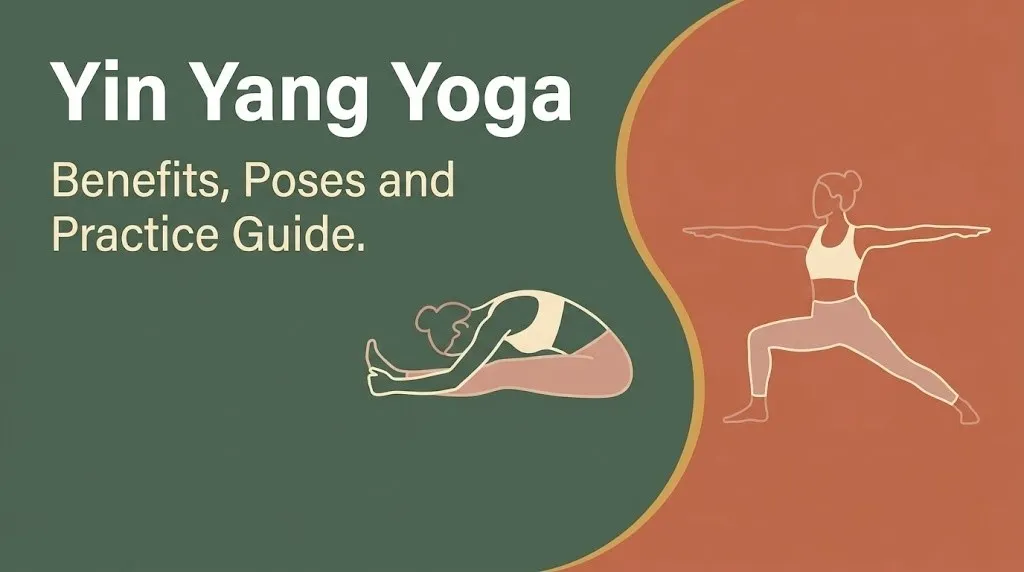
The benefits divide cleanly into what each component contributes:
Yin component benefits:
- Increased range of motion in the hips, spine, and shoulders through sustained connective tissue loading
- Reduced cortisol and stress hormone levels through parasympathetic nervous system activation
- Improved joint lubrication through compression and release of synovial fluid
- Enhanced body awareness and proprioception through extended stillness
Yang component benefits:
- Improved muscular strength and endurance
- Cardiovascular activation and improved circulation
- Heat generation that prepares muscles for safe deeper stretching
- Balance and coordination through standing and transitional poses
According to the National Center for Complementary and Integrative Health (NCCIH), regular yoga practice is associated with reduced anxiety, improved sleep quality, and decreased markers of systemic inflammation. These findings apply to yoga broadly, and the combined Yin-Yang format appears particularly suited to delivering stress-reduction benefits because the Yin section directly activates parasympathetic tone.
A 2019 review published in Complementary Therapies in Medicine found that yoga practices incorporating both passive flexibility work and active movement produced greater improvements in reported quality of life and physical function than single-modality yoga formats. Yin yang yoga’s combined structure aligns directly with those findings.
Yin Yang Yoga and Fascia
Yin yang yoga targets fascia, the web of connective tissue that surrounds every muscle, bone, joint, and organ in the body, through the sustained passive loading of the Yin component, which is the only type of mechanical stress that effectively stimulates fascial remodeling.
Fascia is not just inert packaging. It is a dynamic tissue containing mechanoreceptors (sensory nerve endings that respond to pressure and stretch), fibroblasts (cells that produce collagen and elastin), and its own fluid matrix. When fascia is loaded slowly and held for extended periods, fibroblasts respond by remodeling the collagen structure, gradually increasing the tissue’s length and pliability.
Muscular stretching, the kind done in Vinyasa or Hatha for one to five breaths, does not reach this layer effectively. The tissue response requires time. Research published in the Journal of Bodywork and Movement Therapies has shown that sustained tensile loading of 2 minutes or more is required before fascial tissue begins to demonstrate measurable viscoelastic change.
Think of fascia like cold taffy. A quick pull snaps it. Slow, sustained warmth and gentle traction allows it to lengthen without damage. This is exactly the mechanical argument for Yin yoga’s long holds.
The Yang component of yin yang yoga then acts on this primed tissue. Active muscular contraction after sustained fascial loading helps stabilize the newly achieved range of motion and prevents the passive hypermobility that can develop if Yin practice is done without corresponding strengthening work.
Quick Summary:
- Fascia requires 2 to 5 minutes of sustained loading to respond
- Yang strengthening stabilizes the range gained in Yin
- The combined approach addresses tissue health more completely than either alone
Yin Yang Yoga for Flexibility
Yin yang yoga improves flexibility more effectively than most active-only practices because the Yin component directly loads the connective tissues that limit range of motion: the joint capsules, ligaments, and fascial sheaths that surround every joint in the body.
The majority of movement restriction people experience is not primarily muscular. After childhood, the most common tissue limiting range of motion in the hips, hamstrings, and shoulders is the joint capsule and surrounding fascia. Muscular yoga styles stretch the muscles well, but they cannot adequately load capsular tissue.
Yin yoga’s hold duration of 2 to 5 minutes applies what biomechanists call “creep” loading to these tissues. Over time, consistent creep loading leads to gradual tissue lengthening and improved joint range of motion that persists beyond the session itself.
Research in the International Journal of Yoga has shown that long-hold passive stretching practices produced greater hip range of motion improvements at 8 weeks compared to dynamic stretching alone.
Progress in flexibility with yin yang yoga follows a predictable pattern. In weeks 1 to 2, you may notice reduced sensation during holds as the nervous system habituates to the stretch signal. In weeks 3 to 6, measurable range of motion improvements become apparent. By 8 to 12 weeks of consistent practice (three or more sessions per week), most practitioners notice changes in postures they previously found inaccessible.
Modification for hypermobile practitioners: If you can easily fold into most Yin poses, do not push to your maximum range. Stop well short of your end range and allow the hold to work at 70% of your comfortable maximum. Going to full passive end range without muscular support risks ligament overstretching in hypermobile joints.
Key Takeaway: Yin yang yoga builds flexibility by targeting the joint capsules and fascia that most yoga styles miss, and the science shows this requires holds of 2 minutes or more to produce meaningful tissue change.
Yin Yang Yoga for Stress
Yin yang yoga reduces stress by activating the parasympathetic nervous system during the Yin component and then re-engaging alert but calm focus during the Yang component, creating a neurological reset that most single-format practices cannot replicate.
The Yin section is particularly effective for stress reduction because long stillness holds trigger the vagal nerve’s calming response. The vagal nerve is the primary channel of the parasympathetic system, and sustained stillness combined with deep, slow breathing is one of the most consistent ways to activate it.
According to research reviewed by Harvard T.H. Chan School of Public Health, yoga practices that emphasize breath regulation and extended holds are associated with measurable reductions in cortisol, the body’s primary stress hormone, as well as improvements in heart rate variability, a marker of autonomic nervous system resilience.
The Yang component then brings the nervous system back to a functional, grounded level of arousal without returning to high-stress sympathetic dominance. This oscillation between parasympathetic and balanced arousal during a single practice trains the nervous system to shift between states more fluidly. Over time, practitioners often report feeling less reactive to daily stressors outside of yoga class.
For practitioners dealing with anxiety disorders or chronic stress, yoga teachers and mental health professionals generally recommend beginning with short Yin holds (1 to 2 minutes) rather than full 5-minute holds, as sustained stillness can initially amplify rather than reduce anxiety for some individuals. Gradual progression over four to six weeks allows the nervous system to adapt.
Pairing the Yin section with Ujjayi pranayama (Victorious Breath, a slight constriction of the back of the throat that creates an audible breath sound) deepens the parasympathetic response and gives the mind a steady auditory anchor during long holds.
Yin Yang Yoga for Back Pain
Yin yang yoga can reduce chronic lower back pain by releasing the fascial and connective tissue restrictions in the hips, hamstrings, and thoracolumbar fascia that are among the most common contributors to lumbar tension and pain.
Lower back pain is frequently not a problem originating in the back itself. Restricted hip flexors (the iliopsoas muscle group) pull the lumbar spine into anterior tilt. Tight hamstrings increase posterior pelvic tilt and lumbar strain. Stiff thoracolumbar fascia limits spinal rotation and contributes to the chronic “locked up” feeling many people experience.
Yin poses targeting the hips and hip flexors directly address these contributing tissues. A 2020 study in Complementary Therapies in Medicine found that yoga practices incorporating passive hip opening and spinal release exercises significantly reduced chronic low back pain intensity scores over 8 weeks compared to a control group.
Poses most relevant for back pain in yin yang yoga:
- Anjaneyasana (Low Lunge) held passively for 2 to 3 minutes per side: targets the iliopsoas
- Supta Baddha Konasana (Reclined Bound Angle Pose): releases the inner hip and groin
- Balasana (Child’s Pose): decompresses the lumbar spine with gravity assistance
- Paschimottanasana (Seated Forward Fold) held with soft knees: loads the thoracolumbar fascia
Safety note: People with lumbar disc herniations or diagnosed spinal stenosis should work with a yoga teacher experienced in back conditions before practicing Yin forward folds, as sustained spinal flexion under compression can exacerbate certain disc-related conditions. The Yang component’s Setu Bandha Sarvangasana (Bridge Pose) and gentle backbends are generally safe and can strengthen the posterior chain to support the lumbar spine.
Yin Yang Yoga Poses
Yin yang yoga uses two distinct categories of poses: floor-based, gravity-assisted Yin poses held in muscular stillness, and active Yang poses that engage the muscles dynamically through movement or sustained muscular contraction.
The Yin poses work most effectively on the hips, inner thighs, spine, and shoulders, the areas with the densest fascial and connective tissue networks. The Yang poses build strength and stability through the legs, core, and upper body.
Core Yin poses used in yin yang yoga:
| Yin Pose | Sanskrit Name | Primary Target | Typical Hold |
|---|---|---|---|
| Child’s Pose | Balasana | Lumbar spine, hips | 3 to 5 minutes |
| Low Lunge (Yin) | Anjaneyasana | Hip flexors, iliopsoas | 2 to 4 minutes per side |
| Reclined Bound Angle | Supta Baddha Konasana | Hip adductors, groin | 3 to 5 minutes |
| Seated Forward Fold | Paschimottanasana | Hamstrings, thoracolumbar fascia | 3 to 5 minutes |
| Sleeping Swan | Eka Pada Rajakapotasana (modified) | Piriformis, outer hip | 3 to 5 minutes per side |
Core Yang poses used in yin yang yoga:
| Yang Pose | Sanskrit Name | Primary Target | Hold/Duration |
|---|---|---|---|
| Downward-Facing Dog | Adho Mukha Svanasana | Hamstrings, shoulders | 5 breaths |
| Warrior I | Virabhadrasana I | Quads, hip flexors, core | 5 to 8 breaths |
| Warrior II | Virabhadrasana II | Lateral hip, adductors | 5 to 8 breaths |
| Bridge Pose | Setu Bandha Sarvangasana | Glutes, hamstrings, spine extensors | 5 to 8 breaths |
| Cobra Pose | Bhujangasana | Erector spinae, chest, abdominals | 5 breaths |
Key Takeaway: Yin poses and Yang poses target completely different tissue types and require different muscular qualities: Yin demands relaxation, Yang demands engagement, and the contrast between them is what makes the combined practice work.
Yin Yang Yoga Sequence
A complete yin yang yoga sequence alternates between an active Yang warm-up, Yin floor-based holds, and a Yang active middle section before closing with final Yin poses and Savasana, covering both tissue systems in a single 60 to 75 minute practice.
Here is a complete beginner-friendly yin yang yoga sequence for home practice:
Yang Opening (10 to 12 minutes):
- Begin in Balasana (Child’s Pose) for 5 slow breaths to arrive and orient.
- Move to Adho Mukha Svanasana (Downward-Facing Dog). Hold for 5 breaths, pedaling the heels alternately.
- Flow through 3 rounds of Surya Namaskar A (Sun Salutation A) at a moderate pace.
- Step to the top of the mat. Stand in Tadasana (Mountain Pose) for 3 full breaths.
Yang Standing Section (12 to 15 minutes):
- Enter Virabhadrasana I (Warrior I) on the right side. Hold for 6 breaths. Switch sides.
- Move to Virabhadrasana II (Warrior II) on the right side. Hold for 6 breaths. Switch sides.
- Lower to the mat for Setu Bandha Sarvangasana (Bridge Pose). Hold for 6 breaths. Release and repeat once.
- Come to hands and knees. Take one round of Bhujangasana (Cobra Pose) for 5 breaths.
Yin Floor Section (30 to 35 minutes):
- Lower to your back. Come into Supta Baddha Konasana (Reclined Bound Angle Pose). Place a block or bolster under each outer thigh. Hold for 4 minutes.
- Roll to one side. Enter Anjaneyasana (Low Lunge) on the right side passively, with a blanket under the back knee. Hold for 3 minutes. Switch sides.
- Come to seated. Enter Paschimottanasana (Seated Forward Fold) with a slight bend in the knees. Let the spine round naturally. Hold for 4 minutes.
- Return to your back. Draw the right knee across the body into a supine spinal twist. Hold for 2 to 3 minutes per side.
Closing:
- Rest in Savasana (Corpse Pose) for 5 to 8 minutes. Allow the body to integrate.
Modification for home beginners: Use a folded blanket under the hips in Supta Baddha Konasana if the inner thighs are very tight. In the forward fold, use a strap around the feet or simply rest the hands on the shins. Never force any Yin pose. Mild sensation is the target, not sharp stretch.
How Long to Hold Yin Yang Yoga Poses
Yin poses in yin yang yoga are held for 2 to 5 minutes per pose, while Yang poses are held for 1 to 8 breaths, with beginners starting at the shorter end of both ranges and progressing gradually over 4 to 8 weeks.
The hold-time difference between Yin and Yang is not arbitrary. It reflects the different mechanical response times of the tissues being targeted.
Muscles respond to stretch within seconds. Their stretch reflex activates, and most of the resistance to a stretch in an active muscle can be felt within the first 30 to 60 seconds. This is why Yang poses work effectively at 5 to 8 breath holds.
Connective tissue, specifically fascia and joint capsules, does not respond on this timeline. These tissues are viscoelastic, meaning they resist deformation initially and yield gradually under sustained loading. Research in the Journal of Bodywork and Movement Therapies has established that meaningful fascial lengthening requires a minimum of 90 to 120 seconds of sustained loading, with optimal effects observed between 3 and 5 minutes.
| Pose Type | Target Tissue | Minimum Hold | Optimal Hold | Beginner Starting Point |
|---|---|---|---|---|
| Yang standing pose | Muscles, balance | 3 breaths | 5 to 8 breaths | 3 to 5 breaths |
| Yang flow (Sun Salutation) | Cardiovascular, muscles | 1 breath per position | Full round | Slow pace |
| Yin floor pose | Fascia, joint capsules | 90 seconds | 3 to 5 minutes | 2 minutes |
| Final Savasana | Full body integration | 5 minutes | 8 to 10 minutes | 5 minutes |
Beginners who find 3-minute Yin holds uncomfortable should start at 90 seconds and add 30 seconds per session over 4 weeks. The discomfort in a Yin hold should feel like a steady, dull sensation of stretch or pressure, never sharp, shooting, or joint-specific pain. Sharp pain means the pose needs to be released or modified immediately.
Yin Yang Yoga for Beginners
Yin yang yoga is well-suited to beginners because the Yin component requires no prior flexibility or strength, the Yang component can be kept at a basic level, and the combined format gives new practitioners more variety than a pure Yin class while being less physically demanding than a full Vinyasa class.
New practitioners often worry they are not flexible enough for yoga. Yin yang yoga directly addresses this concern. The Yin section is designed for people who are stiff. You are supposed to feel the stretch. The tissues doing the work are supposed to resist. Lack of flexibility is not a barrier; it is the point.
The Yang section for beginners should stay simple. Three rounds of Surya Namaskar A (Sun Salutation A) is sufficient to generate appropriate warmth. One set each of Warrior I and Warrior II covers the standing section adequately. Beginners do not need a complex sequence.
Practical beginner setup:
- Mat: Any non-slip yoga mat works. No special mat required.
- Props: Two yoga blocks, one bolster or firm pillow, and one blanket cover 90% of common beginner modifications.
- Schedule: Start with two sessions per week of 45 to 60 minutes each. Three sessions weekly after the first month.
- Clothing: Wear comfortable, loose or stretchy clothing. You will be on the floor for extended periods, so avoid anything that restricts the hips.
According to Yoga Alliance, the world’s largest yoga credentialing organization, new practitioners benefit most from starting with shorter hold times and simpler sequences before attempting longer holds or more complex transitions. This is particularly relevant for yin yang yoga, where the Yin component’s long holds can feel mentally challenging before the nervous system adapts.
Modification for beginners in the Yang section: If Downward-Facing Dog is uncomfortable in the wrists, use fists instead of flat palms, or lower to the forearms for Dolphin Pose, which provides a similar shoulder and hamstring stretch without wrist loading.
Yin Yang Yoga for Seniors
Yin yang yoga is one of the most appropriate yoga formats for seniors because the Yin component’s floor-based poses require no balance or muscular force, while the Yang component can be easily adapted with chair support, reduced hold times, and gentler transitions.
As the body ages, connective tissue becomes progressively less hydrated and less elastic. This is not a disease process; it is normal biology. However, it does mean that the fascial loading of Yin yoga becomes increasingly relevant with age. Regular sustained stretching of connective tissue helps maintain joint range of motion in ways that brief, active stretching cannot.
The Yang component matters equally for seniors. Loss of quadriceps, glute, and posterior chain strength is a primary contributor to fall risk in older adults. The standing poses and active sequences in the Yang portion of a yin yang yoga practice directly address these muscle groups.
Adaptations for senior practitioners:
- Chair support for Yang standing poses: Practice Warrior I and Warrior II with one hand on the back of a stable chair for balance support.
- Reduce Yin hold times: Begin at 90 seconds to 2 minutes rather than 3 to 5 minutes. Bone density changes mean extended passive loading at end range is not appropriate for everyone.
- Bolster support in all Yin poses: Use a bolster under the hips in Supta Baddha Konasana, under the torso in Balasana, and under the knees in supine poses.
- Skip poses that require getting up from the floor quickly: Design the sequence to minimize rapid position changes that could compromise balance.
Caution for seniors with osteoporosis: Deep passive forward folds that involve sustained spinal rounding under load (like Paschimottanasana held for several minutes) are generally not recommended for those with vertebral fragility. A yoga teacher with specific training in osteoporosis should guide pose selection, and the attending physician familiar with the individual’s bone density measurements can clarify safe loading parameters.
Yin Yang Yoga Contraindications and Modifications
Yin yang yoga has specific contraindications and modification requirements depending on a practitioner’s existing conditions, with hypermobility, acute joint injuries, recent surgery, and advanced osteoporosis each requiring particular adjustments to avoid harm.
Hypermobility: Hypermobile practitioners should limit Yin holds to no more than 2 minutes and should stop well before their natural end range. The goal is mild sensation, not end-range loading. The Yang component is particularly beneficial for hypermobile practitioners because muscular strengthening around unstable joints is exactly what they need.
Acute injuries: Any acute soft tissue injury (sprain, strain, tear) is a contraindication for direct loading of the affected area. If you have a fresh hamstring strain, seated forward folds targeting the hamstrings should be skipped entirely until the tissue has healed. Modified sequences avoiding the injured area are appropriate.
Post-surgical conditions: Anyone within 6 to 12 weeks of joint surgery (hip, knee, or shoulder replacement; spinal surgery) should not practice yin yang yoga without clearance from their surgeon and guidance from a yoga teacher with post-surgical experience.
| Condition | Yin Modification | Yang Modification |
|---|---|---|
| Hypermobility | Shorter holds, 50% to 70% of range | Prioritize strength; add Yang sessions |
| Osteoporosis | Avoid deep spinal rounding; use props | Keep standing poses; use chair support |
| Acute injury | Avoid direct loading of injury site | Work around injury, not through it |
| Sciatica | Avoid hip external rotation if aggravating | Gentle core work; avoid deep lunges |
| Wrist pain | No modification needed (Yin is floor-based) | Use fists or forearm positions |
| Knee pain | Pad knees in all kneeling poses | Reduce depth in lunges; use chair |
| Pregnancy | Avoid supine poses after first trimester | Consult midwife or OB before practice |
Modification for practitioners with sciatica: The Sleeping Swan pose (a deep hip opener) can compress the sciatic nerve in some body types. If you feel shooting pain down the leg during any Yin hip pose, release immediately and substitute Supta Kapotasana (Supine Pigeon, where you lie on your back and cross one ankle over the opposite thigh) instead. This position provides a similar hip opening effect with less direct nerve compression.
Key Takeaway: Yin yang yoga is safe and appropriate for most bodies with correct modifications, but hypermobility, osteoporosis, and acute injuries each require specific adjustments that protect the joints being targeted.
Frequently Asked Questions About Yin Yang Yoga
What is the difference between Yin yoga and Yin Yang yoga?
Yin yoga is an exclusively passive practice of long-held floor poses targeting connective tissue, with no active muscular sequences.
Yin yang yoga includes both the passive Yin component and an active Yang component such as standing poses, Sun Salutations, or flowing sequences, making it a more complete full-body practice.
Yin yoga is better for deep meditative stillness; yin yang yoga is better for practitioners who want both flexibility work and physical activity in one session.
How long should you hold poses in Yin Yang yoga?
Yin poses in yin yang yoga are held for 2 to 5 minutes to allow sufficient time for connective tissue and fascial loading.
Yang poses are held for 3 to 8 breath cycles, roughly 15 to 45 seconds, which is long enough to engage the muscles without crossing into sustained connective tissue loading.
Beginners should start at the shorter end of both ranges and build hold times gradually over 4 to 6 weeks.
Is Yin Yang yoga good for beginners?
Yes, yin yang yoga is a suitable practice for most beginners because the Yin component requires no prior flexibility or strength, only willingness to sit with sensation.
The Yang component can be kept simple with basic Sun Salutations and standing poses, adjustable to any fitness level.
Using props like blocks and bolsters and starting with 90-second Yin holds makes the practice accessible from the very first session.
Can Yin Yang yoga help with back pain?
Research suggests that yoga practices combining passive hip opening with gentle spinal movement can reduce chronic lower back pain, and yin yang yoga’s structure is well-suited to this goal.
The Yin component addresses the tight hip flexors, hamstrings, and thoracolumbar fascia that frequently contribute to lumbar tension.
People with disc herniations or spinal stenosis should work with a yoga teacher familiar with spinal conditions before beginning any deep passive forward fold practice.
How often should you practice Yin Yang yoga?
Most yoga teachers and physical therapists recommend practicing yin yang yoga 2 to 3 times per week for consistent connective tissue and flexibility benefits.
Daily practice is possible but requires varying the intensity: alternate full sequences with shorter 30-minute Yin-focused sessions to avoid over-stressing the same tissue areas repeatedly.
Connective tissue adapts more slowly than muscle, so consistency over 8 to 12 weeks is more important than frequency in any single week.
Building Your Practice from Here
The most practical starting point is a simple one. This week, practice the sequence in this guide once. Do not worry about perfect hold times or perfect alignment. Get a feel for the contrast between the active Yang section and the stillness of the Yin floor holds. Notice how different your body feels after 4 minutes in a Yin pose compared to 5 breaths in Warrior I.
Then add a second session in the following week. Two consistent sessions per week for eight weeks will produce measurable changes in your hip range of motion, your stress response, and your relationship to physical stillness.
The practice works. Give it enough time to show you.