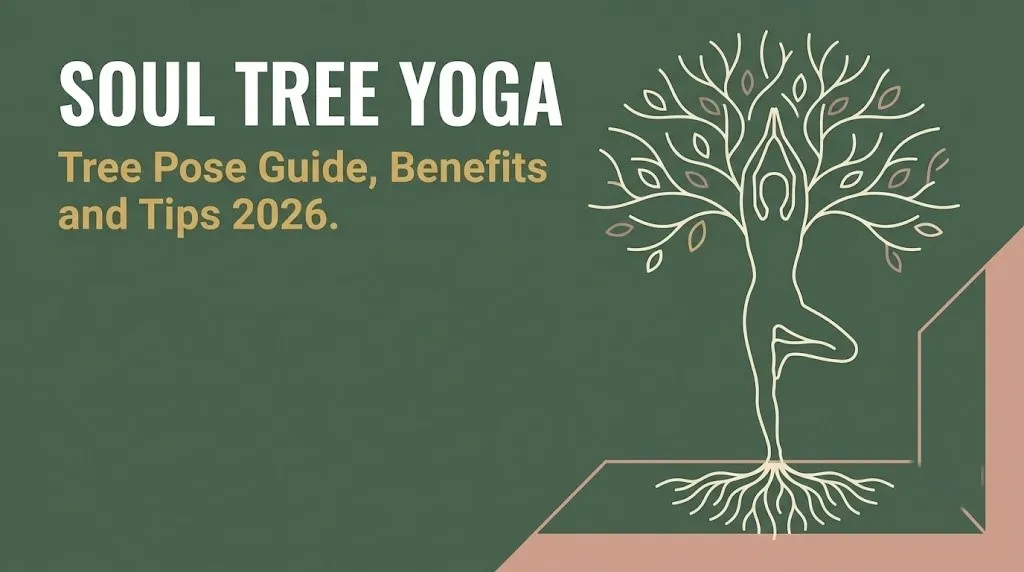
Soul Tree Yoga: Tree Pose Guide and Benefits 2026
Soul tree yoga describes a grounded, community-centered approach to practice built around the qualities of a tree: deep roots, steady presence, and upward reach. At its physical core is Vrksasana (Tree Pose), one of yoga’s most recognized standing balance poses and one of its most instructive.
Balance training matters far beyond the yoga mat. The American College of Sports Medicine identifies single-leg balance exercises as a key component of fall-prevention programs, particularly for adults over 60. Tree Pose trains exactly the muscle systems and neural pathways that make upright stability possible in everyday life.
This guide covers the complete picture: the mechanics of Tree Pose, the science behind why it works, how to adapt it for any body, the grounding poses that support it, and what it means to build a rooted, connected yoga practice in the soul tree tradition.
What Is Soul Tree Yoga?
Soul tree yoga is an approach to practice that emphasizes groundedness, inner steadiness, and community connection as the foundations of a sustainable yoga life.
The name draws on the metaphor of a tree: rooted deeply into the earth, flexible enough to move with the wind, reaching toward light without losing contact with what holds it. This philosophy shows up practically in class design choices: slower entry into poses, longer holds, attention to breath as an anchor, and a genuine investment in the people practicing together.
Studios that identify with this approach, including community practices in areas like Lafayette, Colorado, tend to prioritize accessibility and individual adaptation over performance. The practice is not about achieving advanced poses. It is about building something lasting.
Quick Summary:
- Soul tree yoga centers on groundedness, stability, and community
- It draws on the tree metaphor: roots down, grow up
- Vrksasana (Tree Pose) is the physical centerpiece of this practice philosophy
- The approach suits beginners, seniors, people in recovery, and anyone building a long-term relationship with yoga
- Classes in this tradition typically prioritize breath awareness and body attunement over sequencing complexity
The soul tree approach is a values framework as much as a teaching style. You can bring it to any yoga class or home practice.
What Is Tree Pose in Yoga (Vrksasana)?
Vrksasana (Tree Pose) is a standing single-leg balance pose in which one foot grounds into the earth while the other foot rests on the inner leg, arms reach overhead or meet at the heart.
The Sanskrit name breaks down as: “vrksa” meaning tree, and “asana” meaning pose or seat. It is one of the oldest and most universally recognized yoga poses, appearing in all major yoga styles from Hatha to Vinyasa to Iyengar.
Physically, the pose requires the standing leg to carry the full body’s weight while maintaining precise alignment through the ankle, knee, and hip. The raised leg adds a rotational element at the hip joint that challenges the inner thigh adductors and hip external rotators simultaneously. The arms reaching overhead add an additional challenge to shoulder stability and thoracic extension.
| Feature | Description |
|---|---|
| Sanskrit Name | Vrksasana |
| English Name | Tree Pose |
| Pose Type | Standing balance |
| Primary Standing Leg Challenge | Ankle stability, hip stability, quad endurance |
| Primary Raised Leg Challenge | Hip external rotation, inner thigh adduction |
| Arm Options | Hands at heart, arms overhead, arms out wide |
| Experience Level | Beginner to intermediate |
Tree Pose is categorized as a beginner pose in terms of sequencing position, though it challenges aspects of neuromuscular control that intermediate and advanced practitioners continue to refine throughout their practice.
How to Do Tree Pose Step by Step
Tree Pose is entered from Tadasana (Mountain Pose), standing at the top of the mat with weight evenly distributed through both feet.
To practice Vrksasana (Tree Pose):
- Begin in Tadasana (Mountain Pose). Stand with feet hip-width apart, arms at sides. Feel all four corners of each foot pressing into the mat.
- Shift your weight gently into your right foot. Distribute weight evenly across the heel and the ball of the foot.
- Lift your left foot off the mat. Bend the left knee and externally rotate the left hip.
- Place the left foot on the inner right leg: either above the knee on the inner thigh, or below the knee on the inner calf. Never place the foot directly on the knee joint.
- Press the left foot and right inner leg firmly against each other. This mutual pressure improves stability for both legs.
- Find your drishti: a fixed gaze point at eye level or slightly above. Soft focus, not a stare.
- On an inhale, bring hands to heart center (Anjali Mudra) or extend arms overhead, palms facing each other.
- Hold for 3 to 6 breath cycles. Keep the standing knee soft, not locked.
- On an exhale, lower the foot and return to Tadasana. Pause, then repeat on the left side.
Modification for beginners: Keep the toes of the raised foot on the floor as a kickstand. The heel rests against the inner ankle of the standing foot. This reduces balance demand while teaching the hip and arm positioning.
Key Takeaway: In Tree Pose, the foot goes either above or below the knee, never on it. That one rule prevents lateral knee stress and makes the pose both safer and more stable.
Tree Pose Alignment Cues: The Full-Body Breakdown
Good Tree Pose alignment means the body is stacked vertically over the standing foot, with no lateral lean in the torso or hip.
Starting from the ground, the standing foot spreads wide. All four corners, the base of the big toe, the base of the little toe, the inner heel, and the outer heel, press evenly. The standing knee stays soft, meaning it does not hyperextend backward. The quadriceps engage to support the joint without locking it.
The pelvis stays level. One of the most common errors is allowing the hip of the raised leg to drop or jut to the side. The gluteus medius of the standing leg works actively to keep the pelvis horizontal. Think of balancing a tray of water on your hip bones: it should stay level.
The torso stacks directly over the standing foot. No leaning, no compensating sideways. The core, specifically the transverse abdominis and obliques, works to maintain this central stack. The crown of the head reaches upward, lengthening the spine.
| Body Segment | Correct Alignment | Common Error |
|---|---|---|
| Standing foot | Four corners grounded, spread wide | Weight rolling to outer or inner edge |
| Standing knee | Soft, tracking over second toe | Hyperextended backward, or collapsing in |
| Pelvis | Level, both hip points equal height | Raised-leg hip dropping or jutting sideways |
| Torso | Stacked over standing foot | Leaning away from raised leg |
| Gaze (drishti) | Fixed soft focus, eye level or above | Looking down at the floor |
| Arms | Heart center or overhead | Shrugging shoulders, locking elbows |
Pose Tip:
- Engage your standing gluteus medius to keep hips level
- Press raised foot and standing leg into each other for mutual stability
- Beginners can keep fingertips on a wall for balance support
Tree Pose Muscles Worked
Vrksasana (Tree Pose) trains a specific set of muscles that are underworked in most daily movement patterns.
The standing leg does the most work. The gluteus medius on the outer standing hip is the primary stabilizer for keeping the pelvis level. The tibialis anterior and peroneal muscles along the lower leg and outer ankle control minute balance adjustments constantly throughout the hold. The quadriceps hold the knee in its soft, controlled extension.
The raised leg contributes active work too. The hip adductors (inner thigh muscles) press the raised foot into the standing leg. The hip external rotators, including the piriformis and deep rotator muscles, hold the external rotation of the raised hip.
The core is working throughout. The transverse abdominis resists the pull of gravity trying to tip the torso sideways. The erector spinae maintains spinal length.
Key muscles engaged in Tree Pose:
- Gluteus medius (standing leg outer hip): primary balance stabilizer
- Tibialis anterior and peroneals (standing lower leg): micro-balance adjusters
- Quadriceps (standing leg front thigh): knee control
- Hip adductors (raised leg inner thigh): pressing foot into standing leg
- Hip external rotators (raised leg deep hip): maintaining the turned-out position
- Transverse abdominis (deep core): resisting lateral tipping
- Deltoids and trapezius (if arms overhead): shoulder stability
Tree Pose Benefits
Tree Pose improves single-leg balance, strengthens the hip stabilizers, and trains the neuromuscular pathways responsible for upright stability in daily life.
The National Center for Complementary and Integrative Health (NCCIH) identifies yoga including balance-focused standing poses as having evidence-based benefits for balance improvement and functional mobility, particularly in older adults. Tree Pose is one of the most commonly used poses in yoga-based balance intervention studies.
The proprioceptive training is one of the pose’s most underappreciated benefits. Proprioception refers to the body’s ability to sense its own position in space. Single-leg standing places unusually high demands on the ankle proprioceptors and the neural pathways connecting them to the cerebellum, which coordinates balance. Regular practice genuinely improves these neural pathways over time.
Key benefits of consistent Tree Pose practice:
- Improved single-leg balance: measurable improvement in stabilometry (balance testing) with regular practice
- Hip stabilizer strengthening: particularly the gluteus medius, which is chronically weak in many adults
- Ankle stability: proprioceptor training reduces ankle roll risk in daily activities
- Postural awareness: the demand to stand tall without compensating builds habitual postural improvement
- Focus and concentration: the gaze-hold (drishti) trains attentional control alongside physical balance
- Lateral hip flexibility: the external rotation of the raised leg gradually improves hip mobility over time
Key Takeaway: Tree Pose is not just about balancing. It trains the proprioceptors, hip stabilizers, and neural pathways that protect you from falls and improve posture in everything you do off the mat.
Yoga for Balance and Stability: The Science
Yoga improves balance and stability by training the neuromuscular systems that govern upright posture, rather than just the individual muscles involved.
Balance is a whole-system skill. The vestibular system in the inner ear, the proprioceptors in the joints and muscles, and the visual system all send constant signals to the cerebellum. The cerebellum integrates these signals and sends corrective motor commands back to the muscles. This feedback loop operates faster than conscious thought.
A 2019 study published in the International Journal of Yoga found that an eight-week yoga program improved single-leg balance scores and reduced postural sway in both younger and older adult participants. The improvements were attributed to both the neuromuscular training from standing poses and the attentional training from breath and gaze focus.
Think of the balance system like a three-legged stool: the visual, vestibular, and proprioceptive inputs each support the whole. When one weakens with age or disuse, the others must compensate. Yoga, and Tree Pose in particular, trains all three simultaneously.
According to the American College of Sports Medicine, balance training should be performed at least 2 to 3 times per week to produce measurable improvements in postural stability. Yoga standing poses, practiced consistently at that frequency, meet this threshold effectively.
Modification note: Practitioners with vestibular disorders or chronic dizziness should practice Tree Pose near a wall and keep the gaze low and fixed rather than allowing it to move.
Tree Pose for Beginners
Tree Pose for beginners starts with reducing the balance demand and building the foundational muscle control before advancing to the full expression.
The most effective beginner modification is the toe-touch variation: the toes of the raised foot remain on the floor, and only the heel lifts to rest against the inner ankle of the standing foot. This creates a tripod of support (two points on the standing foot, one toe on the floor) while teaching the correct hip rotation, arm position, and torso alignment.
Beginners commonly make two errors. First, they look down at the floor, which disrupts the visual component of the balance system. Second, they tense the entire body in an effort to stay still. Tension actually makes balance harder by reducing the ankle’s ability to make the micro-adjustments that stability requires.
Practical beginner guidance for Tree Pose:
- Use a wall: stand beside it and rest one fingertip on the surface
- Use a chair: hold the chair back lightly with one hand
- Start with the foot at the ankle rather than the thigh
- Hold for just 3 breaths initially. Build duration gradually over weeks.
- Practice on a non-slip mat surface for maximum foot grounding
The standing surface matters. A carpeted floor reduces tactile feedback to the foot’s proprioceptors, making balance harder than on a firm, non-slip surface.
Tree Pose Modifications
Tree Pose modifications allow the same balance-training benefits to be accessed by people with limited hip flexibility, balance concerns, or lower body injuries.
The most widely used modification is foot-at-calf position: the raised foot rests on the inner calf of the standing leg rather than on the inner thigh. This position is biomechanically stable, requires less hip external rotation flexibility, and still provides meaningful balance and hip stabilizer training.
For people with very limited hip mobility, foot-at-ankle keeps the toes on the floor and only raises the heel. The hip rotation is minimal, making it accessible to nearly everyone.
| Modification | Foot Position | Best For | Balance Demand |
|---|---|---|---|
| Kickstand / toe-touch | Toes on floor, heel at ankle | True beginners, severe balance issues | Very low |
| Foot at inner calf | Below knee, inner calf | Beginners with some balance experience | Low to moderate |
| Foot at inner thigh | Above knee, inner thigh | Intermediate practitioners | Moderate to high |
| Arms at heart center | Hands together at chest | Shoulder issues, balance instability | Lower than overhead arms |
| Arms overhead | Palms facing, arms framing ears | Full expression, stable balance | Highest |
| Wall support | Fingertip touch on wall | Any level with balance concerns | Adjustable |
| Chair support | Hand on chair back | Seniors, balance disorders, rehabilitation | Very low |
The wall and chair modifications do not reduce the pose’s benefits. They simply shift the balance demand to a manageable level while the neuromuscular systems develop.
Key Takeaway: There is no version of Tree Pose that is “too easy.” The kickstand modification with a wall trains the same hip stabilizers and proprioceptors as the full expression, just with a safer starting point.
Tree Pose Variations: From Beginner to Advanced
Tree Pose variations extend the balance challenge progressively as the foundational skills develop.
Beyond the foot-position variations covered in modifications, several arm and gaze variations add meaningful challenge. Closing the eyes is one of the most demanding variations available. Without the visual system’s input, the vestibular and proprioceptive systems must do all the balance work alone. This is not a beginner option. It requires a stable full Tree Pose first.
A more accessible advancement is moving the arms: reaching them wide like branches, shifting slowly from heart center to overhead on an inhale, and back on an exhale. This dynamic arm movement introduces mild instability that strengthens the hip stabilizers further.
Advanced variations related to Tree Pose:
- Closed-eye Tree: removes visual balance input; very challenging
- Tree on a folded mat edge: slightly unstable surface increases proprioceptive demand
- Revolved Tree: gentle torso rotation with foot at calf position
- Tree into Warrior III (Virabhadrasana III): dynamic transition between poses, advanced
- Eagle Pose (Garudasana): related single-leg balance with different hip mechanics
- Dancer Pose (Natarajasana): advanced balance and backbend combination
Each variation requires the foundational alignment of the basic pose to be stable before progression. If Tree Pose wobbles frequently, adding closed eyes or dynamic transitions will reinforce the instability rather than resolve it.
Tree Pose for Seniors
Tree Pose is one of the most recommended yoga poses for older adults because of its direct effect on fall-prevention skills and hip stabilizer strength.
A study published in the Journal of Aging and Physical Activity found that yoga-based balance training, including single-leg standing poses, reduced fall rates and improved balance confidence scores in community-dwelling older adults over a 12-week period. Tree Pose was among the poses most consistently used in these protocols.
For seniors, the chair-assisted variation is the most practical starting point. Standing beside a sturdy chair, holding the chair back lightly with one hand, allows the full hip rotation and torso alignment work of Tree Pose while eliminating the fall risk. Many seniors who begin with the chair variation progress to the wall, then to freestanding, over several weeks.
Specific adaptations for seniors in Tree Pose:
- Use a sturdy chair with both hands initially; progress to one fingertip contact
- Keep the raised foot at ankle or calf level, never at the thigh initially
- Practice for 2 to 3 minutes per side total, broken into shorter holds with rest
- Wear yoga-grip socks or practice barefoot on a non-slip mat
- Practice near a clear wall for emergency stabilization
- Avoid deep hip external rotation if hip replacement surgery has occurred; check post-surgical guidelines with the orthopedic team
Fall risk is a real and measurable concern. Any senior practicing Tree Pose should have a clear, unobstructed practice space free of furniture, rugs, or objects that could interfere with a recovery step.
Tree Pose Contraindications
Tree Pose is not appropriate for everyone in its standard form, and certain conditions require specific modifications or avoidance.
Knee injuries are the most important contraindication. The lateral stress of placing the foot on or near the knee can aggravate ligament injuries, meniscus issues, or post-surgical tissue. The foot-at-ankle variation, which bypasses the knee entirely, is generally safe for most knee conditions, but anyone in active knee rehabilitation should consult their physical therapist before adding single-leg standing.
Recent hip replacement surgery requires careful guidance. Deep external rotation of the hip, which Tree Pose demands in the raised leg, may be contraindicated depending on surgical approach and timeline. Protocols vary significantly between surgical procedures and surgeons.
Conditions and situations requiring modification or avoidance:
- Active knee ligament injury or surgery: use foot-at-ankle only; skip if any lateral knee pain occurs
- Hip replacement (posterior approach): deep hip external rotation may be contraindicated; follow surgeon’s guidelines
- Severe ankle instability or sprains: use wall or chair support; avoid freestanding
- Acute balance disorders or vertigo: practice only with chair or wall; avoid closed-eye variations entirely
- Peripheral neuropathy in the standing foot: reduced proprioceptive feedback increases fall risk; use chair support always
- Uncontrolled high blood pressure: arms-overhead variation may elevate blood pressure; keep arms at heart center
These are not reasons to avoid yoga entirely. They are reasons to choose the right variation and set up the right support structure.
Key Takeaway: The foot-at-ankle variation with chair or wall support makes Tree Pose accessible to nearly everyone, including seniors, people with knee history, and those with balance disorders.
Grounding Yoga Poses to Practice Alongside Tree Pose
Grounding yoga poses are standing and floor-based poses that build the physical stability and body awareness that Tree Pose requires.
The concept of grounding in yoga refers to the quality of pressing actively into the earth rather than floating above it. Poses that build this quality strengthen the foot muscles, ankle stabilizers, and hip roots that Tree Pose draws on. Practicing them before Tree Pose improves the quality of the balance significantly.
Tadasana (Mountain Pose) is the foundation. Standing in Tadasana with deliberate attention to foot grounding, knee softness, and core engagement for 2 to 3 minutes trains every element Tree Pose needs, without the balance challenge.
Virabhadrasana II (Warrior II) builds the gluteus medius strength that keeps the pelvis level in Tree Pose. Utkatasana (Chair Pose) develops quad endurance in the standing leg. Malasana (Garland Pose / Deep Squat) improves ankle flexibility and hip external rotation range of motion.
Grounding poses to pair with Tree Pose:
- Tadasana (Mountain Pose): standing attentiveness and root-down practice
- Virabhadrasana II (Warrior II): gluteus medius and hip stabilizer strengthening
- Utkatasana (Chair Pose): quad and ankle endurance building
- Malasana (Garland Pose / Squat): hip external rotation and ankle flexibility
- Balasana (Child’s Pose): grounding rest and nervous system settling between balance attempts
Rooted Yoga Practice and Community
A rooted yoga practice means one built on consistent habits, genuine self-knowledge, and connection with a community of practitioners rather than performance or comparison.
The “soul tree” concept in yoga philosophy is partly about this: the idea that a tree does not compete with other trees. It grows in its own direction, at its own pace, from its own rootedness in the soil. That is the model for sustainable yoga practice.
Research supports the community component. A study published in Complementary Therapies in Medicine found that group yoga practitioners reported higher practice consistency and greater satisfaction with their practice than solo practitioners, even when the yoga content was identical. The presence of others, the shared breath, the teacher’s voice, and the collective stillness of Savasana all contribute to an experience that home practice alone does not fully replicate.
Building a rooted practice involves:
- Choosing a style and community that feel genuinely welcoming, not aspirationally intimidating
- Returning to the same teacher or class format consistently enough to build trust
- Allowing the practice to look different on different days without viewing that as failure
- Bringing the quality of attention you practice in Tree Pose (steady gaze, steady breath, steady core) into the rest of your week
No single pose captures this philosophy better than Vrksasana: rooted, reaching, and still.
Yoga in Lafayette, CO and Local Yoga Culture
Lafayette, Colorado has a distinctive local yoga culture shaped by its community identity as a walkable, wellness-oriented Front Range city.
Situated between Boulder and Denver, Lafayette draws practitioners who want the depth and quality of Boulder’s well-known yoga scene in a more neighborhood-scale setting. Studios serving this community tend to emphasize accessibility, authenticity, and a non-performative approach to practice. That is the soil in which a “soul tree” approach grows naturally.
The Front Range climate also shapes practice choices. Altitude (Lafayette sits at approximately 5,200 feet above sea level) affects breath during yoga practice in ways practitioners from lower elevations notice immediately. Ujjayi breath (victorious breath), the slow throat-constricted breathing technique used in many yoga styles, becomes especially valuable at altitude because it encourages fuller use of lung capacity and more deliberate breath management.
Practical altitude considerations for yoga in Lafayette and similar Front Range communities:
- Hydrate well before and after practice; altitude increases respiratory water loss
- Expect breathwork to feel more demanding initially if you are new to the area
- Pranayama (breath practice) is particularly useful for adapting to altitude demands
- Give yourself two to three weeks of acclimatization before pushing intensity
Local yoga culture at this altitude tends to favor slower, more breath-conscious styles: Hatha, Yin, and Restorative yoga are popular. These styles complement the body’s need for deliberate breath management and recovery at elevation.
How Long to Hold Tree Pose?
The recommended hold time for Tree Pose depends on your experience level and your specific training goal.
For beginners, 3 to 5 breath cycles per side (approximately 15 to 30 seconds) is a practical starting point. This duration allows the balance systems to engage without creating the compensatory muscle tension that comes from gripping and holding too long.
Intermediate and advanced practitioners typically hold for 5 to 10 breath cycles (30 to 60 seconds) per side. Research on balance training suggests that holds of 20 to 30 seconds are sufficient to activate the proprioceptive training effect when repeated consistently across a weekly practice.
For balance rehabilitation in seniors or people recovering from injury, shorter holds repeated more frequently are more effective than single long holds. Three to five holds of 10 to 15 seconds per side, with brief rest between each, typically produces better balance improvements than one sustained 60-second hold.
| Experience Level | Hold Duration | Frequency Per Session | Goal |
|---|---|---|---|
| True beginner | 3 to 5 breaths (15 to 25 seconds) | 2 to 3 holds per side | Learning the position |
| Beginner building | 5 to 8 breaths (25 to 45 seconds) | 2 holds per side | Building proprioceptor training |
| Intermediate | 8 to 10 breaths (45 to 60 seconds) | 1 to 2 holds per side | Strength and focus building |
| Senior/rehabilitation | 10 to 15 seconds, repeated | 3 to 5 holds per side | Balance confidence building |
| Advanced | 60+ seconds, with variations | 1 hold per side | Meditation, advanced stability |
Yoga teachers and physical therapists generally recommend practicing Tree Pose at least 3 days per week to produce measurable balance improvements over a 6 to 8 week period.
Frequently Asked Questions About Soul Tree Yoga
What is soul tree yoga and what makes it different?
Soul tree yoga is a philosophy and practice approach built around groundedness, inner stability, and community connection, using the tree as a metaphor for sustainable practice.
It emphasizes roots (consistent habits, body awareness) as the foundation for growth, rather than advanced poses or performance.
Physically, it centers on grounding poses like Vrksasana (Tree Pose) and slow, breath-conscious movement styles.
How do I stop wobbling in tree pose?
Wobbling in Tree Pose typically comes from a fixed gaze that lacks focus, a locked standing knee, or tension through the foot and ankle.
Soften the standing knee slightly, spread all four corners of the foot wide, and find a soft but steady gaze point at eye level.
Pressing the raised foot firmly into the standing leg also creates mutual stability that reduces wobble significantly.
Where should I put my foot in tree pose?
Place your foot either above the knee on the inner thigh, or below the knee on the inner calf.
Never place the foot directly on the knee joint, as this creates lateral stress on a joint not designed for lateral loading.
The foot-at-inner-ankle variation, with toes still touching the floor, is the safest starting position for beginners.
Is tree pose safe for seniors with balance problems?
Yes, with the right support. Vrksasana (Tree Pose) performed with a chair or wall for hand support is appropriate for most seniors.
The Journal of Aging and Physical Activity found that yoga-based balance training including single-leg poses reduced fall risk in older adults over 12 weeks.
Always practice near a clear, unobstructed space, and use the chair modification until freestanding feels consistently stable.
How long should I hold tree pose to improve my balance?
Holding Vrksasana (Tree Pose) for 20 to 30 seconds per side, repeated consistently at least 3 days per week, is sufficient to produce measurable balance improvements.
Research on proprioceptive training suggests frequency matters more than single-session hold duration.
Three shorter holds per side with brief rest between them often builds balance faster than one long unsupported hold.
Root down before you reach up. That is the core instruction of Tree Pose and the core principle of a soul tree approach to practice.
Start this week with three sessions of Tree Pose using whatever support you need: wall, chair, or just the foot-at-ankle kickstand. Hold each side for five breaths. Do that three times per week for six weeks.
The wobble will reduce. The hip stabilizers will strengthen. The steadiness you build on one leg will carry into everything else you do on the mat, and off it.