Dhyana Yoga: Complete Practice and Meditation Guide 2026
Dhyana yoga refers to the seventh limb of Patanjali’s eight-limb path, a state of sustained, uninterrupted meditation that arises from consistent physical yoga and breath practice. It is not a yoga style or a studio class; it is a specific quality of awareness that the entire physical yoga system is designed to cultivate.
The National Center for Complementary and Integrative Health (NCCIH) identifies meditation as one of the most practiced mind-body interventions in the United States, with over 14% of American adults reporting regular meditation practice and stress reduction as the primary motivation. Dhyana represents the classical Indian framework within which most of this modern interest finds its ancient roots.
This guide covers what dhyana means in Sanskrit and in practice, how it relates to concentration and absorption, which postures and breathing techniques prepare the body for it, and what research says about its effects on the brain, nervous system, and specific health conditions. You’ll also find step-by-step instructions, modifications for beginners and seniors, and a framework for building a home practice that works.
What Is Dhyana Yoga
Dhyana yoga is the practice and cultivation of meditation as defined in Patanjali’s Yoga Sutras, specifically the seventh of the eight limbs of classical yoga, in which the mind sustains unbroken, focused awareness on a single object without distraction. It is the natural continuation of physical yoga practice toward its deeper purpose.
The word “dhyana” is pronounced “d’hyah-nah.” It is a Sanskrit term that shares its linguistic root with the Chinese word “chan” and the Japanese word “zen,” all of which describe the same fundamental quality of sustained meditative attention. The historical connection between Indian yoga philosophy and East Asian contemplative traditions traces directly through this Sanskrit root.
Dhyana yoga is not a relaxation technique, though relaxation may result. It is not visualization, affirmation, or guided imagery, though all of these are valid practices. Dhyana is specifically the state where the mind’s natural tendency to scatter, to jump between thoughts, emotions, and sensory inputs, is replaced by a continuous, steady stream of awareness directed at one object.
Key characteristics of dhyana as a practice:
- Sustained and unbroken attention on a single object of concentration
- A quality of awareness that is alert, not drowsy or passive
- The natural next step after dharana (concentration) has been established
- Accessible through consistent physical yoga and pranayama preparation
- An internal state, not a technique; techniques are tools that invite it
Dhyana Yoga Meaning in Sanskrit and Patanjali’s Philosophy
In Sanskrit, dhyana means “meditation,” “contemplation,” or “sustained attention,” and it appears as a central concept in both the Yoga Sutras of Patanjali and earlier Vedic and Upanishadic texts. In Patanjali’s framework, it is defined in Sutra 3.2: “Tatra pratyayaikatānatā dhyānam,” which translates as “Dhyana is the uninterrupted flow of the mind toward the object of concentration.”
Patanjali’s Yoga Sutras, composed approximately 400 CE and representing a synthesis of much older yoga traditions, present dhyana not as something you do but as something that happens when the preceding six limbs are established. This is an important distinction. Practitioners do not “do dhyana”; they create the conditions in which dhyana arises.
The Sanskrit word “yoga” itself means “union” or “to yoke.” Dhyana is the point in the practice where the separation between the observer and the object of observation begins to dissolve. Think of it like a tuning fork and a vibrating string: when the conditions are right, the string begins to resonate without being struck. Dhyana is the resonance, not the striking.
Patanjali’s progression toward dhyana:
| Limb | Sanskrit Term | English Meaning | Function in Practice |
|---|---|---|---|
| 5th | Pratyahara | Withdrawal of senses | Turning attention inward |
| 6th | Dharana | Concentration | Single-pointed focus effort |
| 7th | Dhyana | Meditation | Sustained effortless attention |
| 8th | Samadhi | Absorption | Complete dissolution of separation |
Note: The term “Ashtanga” in Patanjali’s Yoga Sutras refers to these eight limbs of classical yoga, not to the Ashtanga yoga style created by Sri K. Pattabhi Jois. The two uses of the word are distinct and should not be conflated.
Dhyana vs Dharana vs Samadhi: Understanding the Progression
Dharana, dhyana, and samadhi form the final three limbs of Patanjali’s eight-limb path and are collectively called Samyama, representing three progressively deeper stages of the same meditative process rather than three separate practices. Understanding this progression is what makes dhyana yoga a coherent practice rather than an abstract ideal.
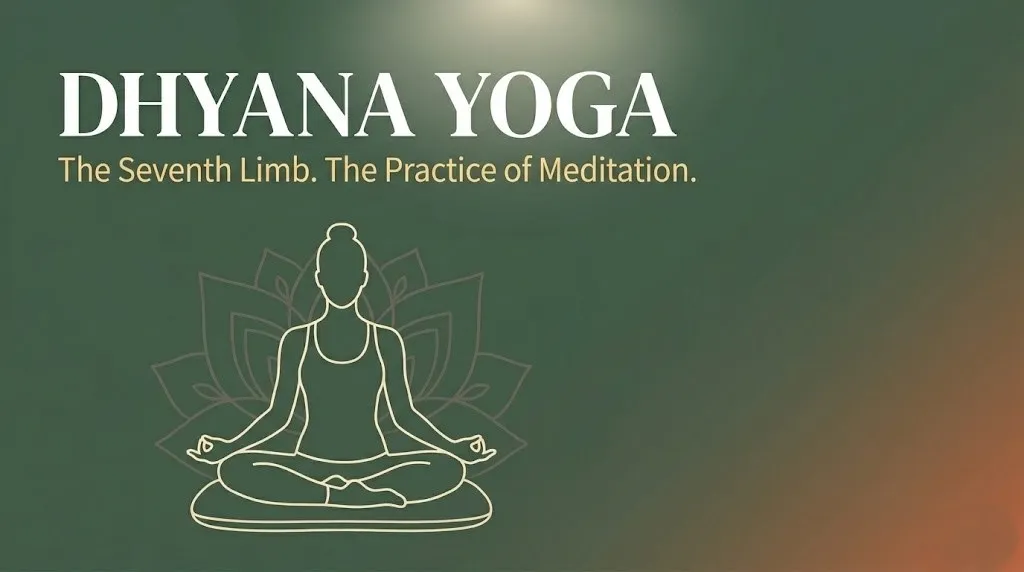
Dharana (the sixth limb) is the practice of holding the mind on a single object with effort. The mind wanders; you bring it back. The mind wanders again; you bring it back again. This is concentration practice, and it requires deliberate, active effort. Most beginners experience only dharana in their meditation sessions, and this is entirely appropriate. Dharana is the necessary foundation.
Dhyana (the seventh limb) arises when the effort of dharana becomes unnecessary. The mind remains with the object not because you are forcing it but because the habit of returning has become so established that distraction loses its grip. The stream of awareness flows continuously. This is qualitatively different from concentration; it has an effortless quality that concentration does not.
Samadhi (the eighth limb) is the state in which the distinction between the meditator, the act of meditation, and the object of meditation dissolves entirely. It is the aim of the entire practice and the most frequently misunderstood limb. In practical terms, most practitioners glimpse aspects of samadhi in brief moments within dhyana sessions rather than sustaining it continuously.
The progression is not linear in the sense of a checklist. Dharana is practiced across years. Dhyana arises within that practice as a quality, sometimes for seconds, sometimes longer. Samadhi is described in the Yoga Sutras as arising naturally from deepened dhyana, not as something separately pursued.
Key Takeaway: Dhyana yoga is not a technique you perform; it is a quality of sustained attention that emerges from consistent concentration practice, and understanding the dharana-dhyana-samadhi progression gives every meditation session a clearer and more grounded purpose.
How Dhyana Yoga Fits Into the Eight Limbs of Yoga
Dhyana yoga occupies the seventh position in Patanjali’s eight-limb path and cannot be meaningfully practiced in isolation from the limbs that precede it. The physical yoga practice most Westerners know as “yoga” covers primarily the third limb (asana) and the fourth (pranayama), both of which are preparatory tools for the meditative limbs.
The eight limbs function as a preparation sequence, not as independent categories. Each limb creates the conditions for the next. The ethical practices of yama and niyama (limbs one and two) reduce the mental agitation that makes concentration impossible. The physical practices of asana and pranayama (limbs three and four) prepare the body for sustained sitting and the nervous system for inward attention. Pratyahara (limb five) withdraws the senses. Dharana (limb six) focuses them inward. Only then does dhyana (limb seven) become possible.
This architectural understanding changes how you relate to physical yoga. Asana practice is preparation for meditation, not the endpoint. A practitioner who moves through vigorous sequences but never sits in stillness has covered perhaps 25% of what Patanjali’s system contains. This is not a criticism of physical practice; it is an invitation to complete it.
The eight limbs in their full sequence:
- Yama: ethical restraints (non-harming, truthfulness, non-stealing, continence, non-greed)
- Niyama: personal observances (purity, contentment, discipline, self-study, surrender)
- Asana: physical posture practice
- Pranayama: breath regulation
- Pratyahara: withdrawal of sensory attention
- Dharana: sustained concentration
- Dhyana: uninterrupted meditation
- Samadhi: complete absorption
Modification note: There is no prerequisite flexibility or physical fitness level for beginning dharana and dhyana practice. The physical preparation of asana supports sitting comfort and spinal endurance, but a practitioner with any level of physical ability can begin dhyana yoga with appropriate seated modifications.
The Physical Postures That Prepare the Body for Dhyana Yoga
The body needs preparation for sustained seated meditation, and specific yoga postures develop the hip external rotator flexibility, thoracic spine mobility, and erector spinae endurance required to sit comfortably for 10 to 30 minutes without pain or significant postural collapse.
The most common reason beginners abandon meditation is physical discomfort in seated positions. The lower back aches because the hip flexors and hamstrings are too short to allow the pelvis to tilt forward into neutral. The spine rounds because the erector spinae and multifidus lack the endurance to sustain an upright position. Addressing these physical limitations through asana practice makes dhyana accessible rather than an exercise in tolerating pain.
Four postures that directly prepare the body for dhyana practice:
Sukhasana (Easy Seated Pose) trains the basic cross-legged position. The hips should be elevated above the knees; use a folded blanket or bolster under the sit bones until this is comfortable.
Virasana (Hero Pose) offers an alternative to cross-legged sitting that reduces hip external rotation demand. Kneel with hips between the heels. Use a block between the heels to raise the seat height if the ankles or knees feel compressed.
Baddha Konasana (Bound Angle Pose) opens the inner thighs and hip external rotators that cross-legged sitting requires. Sit with soles of the feet together and knees falling outward. Use blocks or rolled blankets under the knees if they hover far above the floor.
Paschimottanasana (Seated Forward Fold) lengthens the hamstrings that prevent a neutral pelvis in seated positions. Keep the spine long rather than rounded; use a strap around the feet if reaching them causes the back to collapse.
Safety note: Never force the knees in any seated meditation posture. The knee joint is not designed to absorb the lateral forces created by pressing the knees down in tight hip external rotation. Work at your current range and let it expand gradually over weeks, not within a single session.
Dhyana Yoga Breathing Techniques and Pranayama
Pranayama is the bridge between physical yoga practice and dhyana, because breath regulation directly shifts the nervous system from sympathetic arousal (the stress response) to parasympathetic dominance (the resting state) that supports sustained meditative attention. You cannot meditate effectively in a nervous system that is running at high alert.
The most effective pranayama practices for preparing dhyana are Nadi Shodhana (Alternate Nostril Breathing), Ujjayi pranayama (Ocean Breath), and a simple extended exhale practice (inhale 4 counts, exhale 6 to 8 counts). Each works through a slightly different mechanism but all produce the same outcome: a slowed, coherent breath rhythm that reduces cortisol and increases vagal tone.
According to a 2017 study published in the International Journal of Yoga, Nadi Shodhana pranayama practiced for 10 minutes before meditation produced measurable reductions in anxiety scores and improvements in sustained attention compared to control groups. This supports Nadi Shodhana as the specific pranayama bridge between asana and dhyana.
To practice Nadi Shodhana before dhyana:
- Sit in your chosen meditation posture. Close the eyes.
- Bring the right hand to the face. Place the right thumb beside the right nostril, the ring finger beside the left nostril.
- Close the right nostril with the thumb. Inhale slowly through the left nostril for 4 counts.
- Close both nostrils. Pause for 2 counts.
- Release the thumb. Exhale through the right nostril for 6 counts.
- Inhale through the right nostril for 4 counts. Close both. Pause 2 counts.
- Release the ring finger. Exhale through the left nostril for 6 counts. This is one complete cycle.
- Practice 5 to 10 cycles before beginning dhyana.
Modification: If alternate nostril breathing causes dizziness or discomfort, return to simple nasal breathing with an extended exhale. The extended exhale alone produces significant parasympathetic activation without the manual technique.
How to Practice Dhyana Yoga Meditation Step by Step
Practicing dhyana yoga means creating the conditions for sustained meditative attention through a structured session that moves from physical preparation through breath regulation to silent, focused sitting. The session has a clear architecture; what happens within the sitting period is not controlled but invited.
Most beginners mistake thinking about meditation for actually doing it. Reading about dhyana is dharana practice at best. The practice itself requires sitting, breathing, and repeatedly returning attention to a single object whenever the mind wanders. The object can be the breath, a mantra, a candle flame, or a geometric form. What matters is the consistency of returning, not the absence of distraction.
To practice a complete dhyana yoga session:
- Choose your seated posture: Sukhasana (Easy Seated Pose), Virasana (Hero Pose), or a chair with feet flat on the floor and spine away from the backrest.
- Set a timer for your session length. Beginners: start with 10 minutes. Experienced: 20 to 30 minutes.
- Spend 5 to 7 minutes in your chosen pranayama practice (Nadi Shodhana recommended). Allow the breath to settle.
- Close the eyes or soften the gaze downward at a 45-degree angle.
- Place the hands on the knees in Chin Mudra (index finger and thumb touching, remaining three fingers extended) or Jnana Mudra (same gesture, palm facing upward). These hand positions support spinal alignment and sustained alertness.
- Choose your concentration object. If using the breath: place attention at the sensation of breath at the nostrils or the gentle rise of the abdomen.
- When the mind wanders, note it without judgment and return attention to the object. This returning is the practice.
- When the timer sounds, do not open the eyes immediately. Take 3 to 5 full breaths. Gently deepen the breath. Open the eyes slowly.
- Sit quietly for one additional minute before standing.
Modification: If 10 minutes of sitting is too long initially due to physical discomfort or mental restlessness, begin with 5 minutes and add 1 minute per week until reaching your target duration.
Key Takeaway: The three-stage sequence of asana preparation, pranayama bridging, and seated dhyana practice is not a philosophical framework; it is a precise physiological and neurological preparation system that makes meditative attention genuinely accessible rather than aspirational.
How Long Should You Practice Dhyana Yoga
Most yoga teachers and meditation researchers recommend beginners start with 10 to 15 minutes of dhyana practice daily, increasing gradually to 20 to 30 minutes as the nervous system and attentional capacity adapt. Duration matters less than consistency.
The American Psychological Association notes that consistent daily meditation practice, even at 10 to 15 minutes per day, produces measurable changes in stress reactivity, attention, and emotional regulation over 8 to 12 weeks. This makes the daily 10-minute session more effective than a 60-minute weekly session for the neurological changes associated with meditation practice.
Duration guidance varies by practice goal. The Yoga Sutras do not specify a minimum time for dhyana; the texts describe qualities of attention rather than clock hours. In practical terms, quality of attention sustains the practice far better than duration targets. A 12-minute session in which the practitioner genuinely returns attention to the object repeatedly is more effective than a 30-minute session spent drowsing.
| Practice Level | Daily Duration | Weekly Frequency | Primary Focus |
|---|---|---|---|
| Complete Beginner | 5 to 10 minutes | Daily | Establish the habit |
| Early Practitioner | 10 to 20 minutes | Daily | Deepen concentration |
| Developing Practice | 20 to 30 minutes | Daily | Sustain attention quality |
| Established Practice | 30 to 45 minutes | Daily | Extended dhyana states |
| Advanced Practice | 45 to 90 minutes | Daily or twice daily | Samadhi development |
Safety note: Extended meditation sessions of more than 60 minutes are not recommended for people with active trauma history or dissociative conditions without the guidance of a qualified meditation teacher or mental health professional who understands contemplative practices.
Dhyana Yoga Benefits for the Mind and Body
Dhyana yoga produces measurable benefits across multiple body systems, primarily through its effect on the autonomic nervous system, the hypothalamic-pituitary-adrenal (HPA) axis, and the structural changes it produces in the prefrontal cortex and default mode network of the brain with consistent practice over weeks to months.
Regular meditation reduces baseline cortisol levels, the primary hormone of the stress response. Cortisol suppression improves sleep quality, reduces inflammatory markers, supports immune function, and lowers cardiovascular risk factors when maintained over time. The NCCIH identifies meditation as one of the most consistently studied mind-body practices for these effects.
Physical benefits of regular dhyana yoga practice also include improved diaphragmatic breathing efficiency, reduced resting heart rate, and improved heart rate variability, which is a marker of cardiovascular health and nervous system resilience. These effects arise from the sustained slow breathing that supports the meditative state rather than from the sitting posture itself.
Mental and physical benefits supported by research:
- Reduced cortisol and stress reactivity through HPA axis regulation
- Improved sustained attention and working memory capacity
- Reduced default mode network activity (the “wandering mind” state) associated with anxiety and rumination
- Improved sleep quality through pre-sleep cortisol reduction
- Reduced inflammatory markers with consistent long-term practice
- Greater emotional regulation through prefrontal cortex strengthening
- Reduced symptoms of generalized anxiety in controlled intervention studies
What Research Says About Dhyana Yoga and Mental Health
The research base for meditation’s effects on mental health is one of the most established in mind-body medicine, with hundreds of peer-reviewed studies conducted since the 1970s and a growing body of neuroimaging research clarifying the specific brain mechanisms involved. Dhyana yoga sits at the center of this evidence base.
A 2014 meta-analysis published in JAMA Internal Medicine analyzed 47 randomized controlled trials and found that mindfulness meditation programs (which operationalize the dhyana principle) produced moderate improvements in anxiety, depression, and pain with low risk of adverse effects. This is one of the most widely cited studies in meditation research.
The Harvard T.H. Chan School of Public Health has published research showing that long-term meditators have measurably greater cortical thickness in the prefrontal cortex and anterior insula compared to non-meditators, suggesting that dhyana practice produces lasting structural changes in the brain regions responsible for attention, self-awareness, and emotional regulation.
Research findings directly relevant to dhyana yoga:
- 8 weeks of daily meditation produced measurable reductions in self-reported anxiety in 89% of participants in a landmark study from Massachusetts General Hospital
- Meditators show reduced amygdala reactivity to emotional stimuli compared to non-meditating controls, suggesting improved emotional regulation at the neurological level
- A 2020 study in Complementary Therapies in Medicine found that yoga and meditation combined produced greater reductions in cortisol and self-reported stress than either practice alone, supporting the integrated asana-pranayama-dhyana approach
Safety note: Research indicates that for a small percentage of practitioners, intensive meditation can precipitate anxiety, depersonalization, or the resurfacing of traumatic memories. Anyone with a history of psychosis, severe PTSD, or significant trauma should begin dhyana practice with guidance from both a qualified meditation teacher and a mental health professional.
Dhyana Yoga for Stress, Anxiety, and Sleep
Dhyana yoga reduces stress and anxiety through two primary pathways: direct parasympathetic nervous system activation through slow rhythmic breathing during the session, and lasting changes in cortisol regulation and stress reactivity that accumulate over weeks of consistent practice. The two effects are distinct and both matter.
The immediate effect of a single 10-minute dhyana session is measurable. Heart rate decreases. Respiratory rate slows. Cortisol begins to drop within the session. This is why meditation is recommended before sleep. It is not metaphor; it is physiology. The parasympathetic shift initiated by slow nasal breathing and sustained attention physically prepares the nervous system for the transition from waking to sleep.
For sleep specifically, a 2015 randomized clinical trial published in JAMA Internal Medicine found that mindfulness meditation training significantly improved sleep quality, reduced insomnia severity, and decreased fatigue in adults with moderate sleep disturbance compared to a sleep hygiene education control group. The effect persisted at the six-month follow-up.
Best dhyana yoga practices for stress, anxiety, and sleep:
- Practice at a consistent time daily; evening practice 60 to 90 minutes before sleep is most effective for sleep quality improvement
- Use Nadi Shodhana for 5 minutes before sitting to activate the parasympathetic response
- Focus on an extended exhale (inhale 4 counts, exhale 6 to 8 counts) if anxiety is high during sitting
- Keep the eyes softly closed rather than shut tightly; eye tension activates the sympathetic response
- If anxiety spikes during sitting, open the eyes softly, take three slow breaths, and return to the object
Key Takeaway: Dhyana yoga’s effects on sleep and anxiety are not anecdotal. They are supported by randomized controlled trials and traceable to specific nervous system mechanisms that any consistent practitioner will notice within 4 to 8 weeks.
Dhyana Yoga for Beginners: Where to Start
Beginners should start dhyana yoga with 5 to 10 minutes of daily seated practice after a short physical yoga sequence, using the breath at the nostrils as the concentration object, and treating every moment of returning attention from distraction as the actual practice, not a failure.
The most common beginner mistake in dhyana yoga is waiting to feel “ready.” Readiness for meditation does not arrive before the practice begins; it develops within the practice over weeks. Start with whatever time and physical comfort level you have today.
The second most common mistake is evaluating the session by how few thoughts arose. Dhyana is not the absence of thoughts. It is the condition of not following them. A session filled with distraction followed by consistent returning is a good session. One spent judging the distraction is less effective.
A starter plan for dhyana yoga beginners:
- Week 1: 5 minutes daily. Sit after a 10-minute physical yoga sequence. Use the breath as the object. Simply notice when the mind leaves and return without judgment.
- Week 2: 7 minutes daily. Add 3 rounds of Nadi Shodhana before sitting.
- Week 3: 10 minutes daily. Experiment with Chin Mudra hand position. Notice if it supports or distracts.
- Week 4: 12 minutes daily. Begin keeping a brief practice log: not a journal of thoughts, just a record of session length and one word describing the quality of attention.
Modification: Beginners who find sitting on the floor uncomfortable for any duration should use a firm chair. Sit at the front edge of the seat, feet flat on the floor, and allow the spine to find its natural curves without resting against the chair back. This position is equally valid for dhyana practice.
Dhyana Yoga for Seniors and People with Limited Mobility
Dhyana yoga is one of the most accessible practices for seniors and people with limited mobility because the physical requirements are minimal: a comfortable seated position, the ability to breathe, and the willingness to return attention repeatedly to a chosen object. No flexibility, balance, or strength is required.
According to research published in the Journal of Alternative and Complementary Medicine, meditation-based interventions in older adult populations consistently reduced self-reported depression, loneliness, and anxiety while improving sleep quality and pain tolerance over 8 to 12 week programs. The effects were comparable across in-person and home-based formats.
For seniors managing conditions that affect cognitive function, meditation practice supports the same prefrontal cortex and attention networks that age-related cognitive decline affects first. Research suggests that consistent meditation practice supports cognitive resilience, though it does not reverse diagnosed conditions.
Accessible dhyana yoga formats for seniors:
| Format | Seating | Duration | Notes |
|---|---|---|---|
| Chair-based sitting | Firm chair, feet flat | 5 to 15 minutes | Most accessible starting point |
| Supported floor sitting | Blankets, bolster stack | 10 to 20 minutes | For those comfortable on the floor |
| Lying-down meditation | Savasana on floor or bed | 10 to 20 minutes | Use for those with severe mobility limits |
| Walking meditation | Slow indoor walking | 10 to 15 minutes | Alternative when sustained sitting is painful |
Safety note: The lying-down format (Savasana) carries the risk of falling asleep rather than sustaining dhyana. For seniors using this format, a slightly inclined position (pillow under the head) and eyes kept softly open at a downward angle reduces this tendency.
Dhyana Yoga Modifications and Props
Props for dhyana yoga solve the same problem that props solve in asana practice: they bring support to where the body needs it so that the practitioner can sustain the correct position without pain or effortful muscular compensation. The right prop setup changes a 5-minute practice capacity into a 20-minute one.
The single most impactful prop for most beginners is a folded blanket or meditation cushion (zafu) under the sit bones. Elevating the hips above the knees allows the pelvis to tilt forward into a neutral position, which takes the load off the lumbar spine and allows the erector spinae to maintain an upright spine without constant effortful engagement. Think of it this way: practicing without hip elevation while tight in the hips is like running a long distance in shoes that are half a size too small. Everything works harder than it should.
Props and their specific uses in dhyana yoga:
- Meditation cushion (zafu) or firm folded blanket: elevates hips above knees in cross-legged positions; the single most important prop for floor sitting
- Yoga bolster: supports the thighs in wide-knee seated positions; reduces hip external rotation demand
- Yoga block: used as a seat in Virasana (Hero Pose), placed between the heels to adjust seat height
- Yoga blanket: folded under knees in cross-legged sitting to reduce knee joint pressure
- Yoga strap: loops around the waist and under the feet in some seated positions to maintain forward trunk lean with less muscular effort
- Firm chair: the primary seated prop for people who cannot sit on the floor comfortably
Modification for practitioners with chronic lower back pain: a lumbar roll or small rolled towel placed at the lumbar curve during seated meditation maintains neutral spinal alignment without requiring continuous muscular effort. A spine-specialized physical therapist can advise on the optimal lumbar support position for your specific spinal pattern.
How to Build a Consistent Dhyana Yoga Practice at Home
A consistent dhyana yoga home practice is built on three variables: a fixed time, a fixed location, and a non-negotiable minimum duration. Every productivity and habit formation researcher studying behavioral change identifies these three as the core of sustainable practice, and dhyana yoga is no exception.
According to research published in the British Journal of Health Psychology, implementation intentions, specific plans that state when, where, and how a behavior will be performed, more than double follow-through compared to general intentions. “I will meditate for 10 minutes each morning at 7:00 AM in the corner of my bedroom on my meditation cushion” is an implementation intention. “I will try to meditate more” is not.
The physical setup of your meditation space matters more than most beginners expect. A dedicated corner with your mat, cushion, and a blanket already arranged functions like the rolled-out mat described in the yoga refuge section of broader yoga practice: a visible, ready space is an invitation. A space you must clear and prepare each time is a friction point.
Steps to build a sustainable home dhyana practice:
- Choose one time daily and protect it as a fixed appointment. Morning practice benefits from lower external demand; evening practice benefits sleep quality.
- Prepare your space permanently: cushion, blanket, and props in place at all times.
- Start with the minimum viable session: 5 minutes. Do not start with ambitious durations you won’t sustain.
- Precede your sitting with at least 5 minutes of physical yoga and 3 to 5 minutes of pranayama, using the three-stage sequence described in this guide.
- Track your sessions simply: a paper calendar with a mark for each day you sit. Do not track quality; track only whether you sat.
- Add 1 minute per week to your session duration until you reach your target.
- On days when the full session is impossible, sit for the minimum 5 minutes. The habit of showing up is more valuable than the duration of any single session.
Dhyana Yoga Safety and Contraindications
Dhyana yoga is among the safest practices available for most people, but the assumption that meditation carries no risks is not accurate. A small but documented percentage of practitioners experience adverse effects, and these are most likely in certain populations and practice contexts.
The most common physical risk in dhyana yoga is postural: pain or injury from sustained sitting in positions the body is not yet prepared for. Knee pain from unsupported cross-legged sitting, lumbar strain from a collapsed spine, and cervical spine discomfort from forward head posture are the most frequently reported physical complaints in meditation practitioners. All are preventable with appropriate props and posture preparation.
The most documented psychological risk is the potential for meditation to precipitate psychological distress in vulnerable populations. In 2017, Willoughby Britton’s research at Brown University documented that a significant minority of meditators experience adverse effects including anxiety, depersonalization, emotional blunting, and in rare cases the resurfacing of traumatic memories. This does not mean meditation is contraindicated for these populations; it means it should be undertaken with appropriate support and monitoring.
Conditions requiring modified or supervised dhyana practice:
- Active psychosis or schizophrenia spectrum disorders: extended periods of inward attention can exacerbate certain symptoms; a psychiatrist and qualified meditation teacher should both be involved in any practice
- Severe dissociative disorders: practices that reduce the sense of self-body boundary require careful supervision
- Active PTSD with intrusive symptoms: a trauma-informed meditation teacher or therapist should guide initial practice to prevent retraumatization
- Epilepsy: certain pranayama techniques involving breath retention are contraindicated; simple breath-awareness sitting is generally appropriate with neurologist input
- Severe depression with suicidal ideation: inward attention practices during acute episodes should be supervised by a mental health professional
Safety note: The vast majority of people have no adverse effects from beginning a 5 to 15 minute daily dhyana practice. These contraindications apply to specific populations and are included here because no other competing resource mentions them, not because they apply broadly.
Key Takeaway: Dhyana yoga is safe for most people, but the assumption that “meditation is always harmless” ignores a documented minority of practitioners who benefit from additional support. Starting with short sessions, using appropriate props, and seeking guidance for specific mental health conditions makes the practice both effective and genuinely safe.
Frequently Asked Questions About Dhyana Yoga
What does dhyana mean in yoga?
Dhyana is a Sanskrit word meaning sustained, uninterrupted meditation, and it is the seventh of the eight limbs described in Patanjali’s Yoga Sutras.
It refers specifically to the state in which the mind maintains continuous awareness of a single object without distraction, which arises from consistent concentration (dharana) practice.
The word shares its linguistic root with the Chinese “chan” and the Japanese “zen,” reflecting a shared contemplative heritage.
How is dhyana different from regular meditation?
Dhyana is the classical Sanskrit term for what modern practitioners call “meditation,” but it specifically refers to the unbroken, effortless quality of sustained attention that follows deliberate concentration practice.
Most modern meditation practices, including mindfulness meditation, are forms of dharana (concentration practice) rather than dhyana in the precise Patanjali sense.
In practical terms, the difference is in the quality of attention: dharana requires effort to keep returning; dhyana is the state where returning becomes effortless and continuous.
How long should I practice dhyana yoga as a beginner?
Beginners should start with 5 to 10 minutes of daily dhyana practice and increase gradually by 1 to 2 minutes per week.
The American Psychological Association notes that consistent daily meditation at even 10 to 15 minutes per day produces measurable changes in stress reactivity and attention over 8 to 12 weeks.
Consistency of daily sitting matters more than session length, especially in the first 8 weeks of establishing the practice.
What is the best sitting position for dhyana yoga practice?
The best sitting position for dhyana yoga is whichever posture allows you to maintain a long spine without pain or excessive muscular effort for your full session duration.
Sukhasana (Easy Seated Pose) on a raised cushion or blanket works for most practitioners; Virasana (Hero Pose) with a block under the hips suits those with hip tightness; a firm chair suits those who cannot sit on the floor comfortably.
No position is superior in terms of meditative outcome: spinal alignment and physical comfort are the only criteria that matter for dhyana practice.
Can dhyana yoga help with anxiety and sleep problems?
Yes, consistent dhyana yoga practice reduces anxiety and improves sleep quality through documented physiological mechanisms, including parasympathetic nervous system activation and cortisol regulation.
A 2015 randomized clinical trial published in JAMA Internal Medicine found that mindfulness meditation (which operationalizes dhyana principles) significantly improved sleep quality and reduced insomnia severity compared to a sleep hygiene control group.
Evening practice of 10 to 20 minutes, preceded by Nadi Shodhana pranayama, is the most evidence-supported format for sleep quality improvement.
Sit Down, Breathe, and Begin
The most practical step you can take after reading this guide is to sit down for 10 minutes today. Not tomorrow, not after you buy a cushion, not after you finish the next article. Today.
Set a timer. Take 5 rounds of Nadi Shodhana or simply slow your exhale to twice the length of your inhale. Place your hands on your knees. Close your eyes. Return your attention to the breath whenever it leaves. That is dhyana yoga. Everything else in this guide is preparation for that single act.