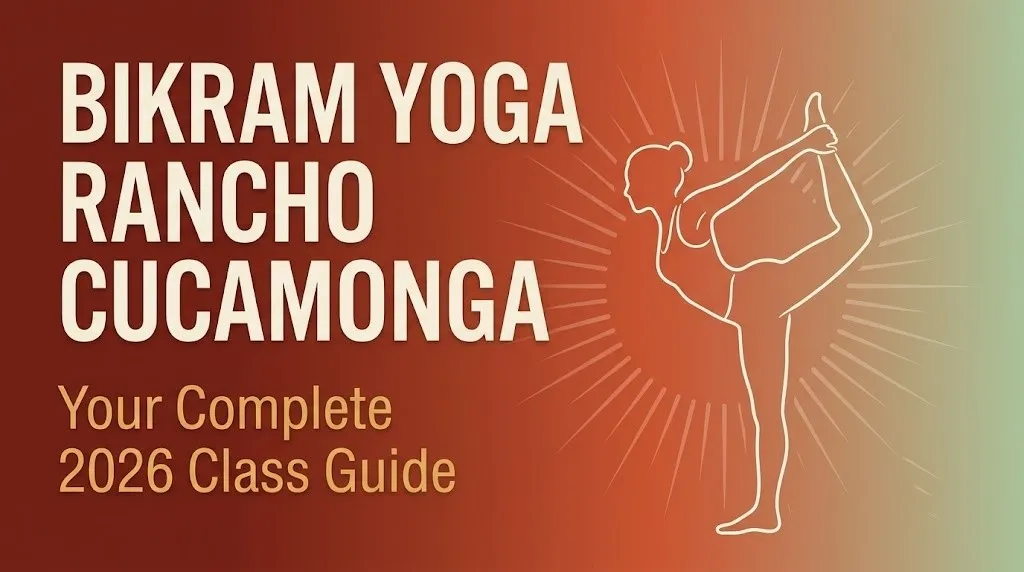
Bikram Yoga Rancho Cucamonga: Your 2026 Class Guide
Bikram yoga in Rancho Cucamonga draws students from across the Inland Empire who want a structured, heat-based practice with real physical results. If you are considering your first 26&2 class or switching from general hot yoga, this guide tells you exactly what to expect, what the research supports, and how to stay safe in one of Southern California’s hottest regions.
The practice has earned a serious following for good reason. According to the National Center for Complementary and Integrative Health, regular yoga participation has been associated with measurable improvements in flexibility, stress reduction, and blood pressure management across multiple studies. Bikram yoga, with its fixed sequence and demanding thermal environment, amplifies several of these effects.
This article covers the full 26-pose sequence, how Bikram differs from general hot yoga, what the science says about benefits and risks, how to prepare and pack for your first class, and specific guidance for beginners and seniors. You will also find honest safety notes tailored to the Inland Empire climate.
Bikram Yoga Rancho Cucamonga: What the Local Practice Looks Like
Bikram yoga in Rancho Cucamonga refers to the traditional 26-posture and 2-pranayama sequence practiced in a studio heated to 105 degrees Fahrenheit with 40 percent humidity, offered at studios serving the Inland Empire community in San Bernardino County. The Rancho Cucamonga area has maintained a steady hot yoga and Bikram yoga community for well over a decade.
What makes practicing here specific is the Southern California climate context. Rancho Cucamonga sits in the eastern Inland Empire, where summer temperatures regularly exceed 95°F outdoors. Students arriving for a class in July may have already spent 20 minutes in a hot car or walking from a sun-baked parking lot. That pre-class heat exposure matters and should factor into your hydration strategy.
Studios in the area generally fall into one of two formats: those offering strict Bikram 26&2 classes with the fixed sequence every time, and those offering heated yoga classes that are Bikram-inspired but allow sequence variation. Confirming which format you are booking before you arrive is the most practical first step.
| Studio Format | Temperature | Class Length | Sequence |
|---|---|---|---|
| Authentic Bikram 26&2 | 105°F, 40% humidity | 90 minutes | Fixed, never varies |
| Bikram-inspired hot yoga | 95 to 100°F | 60 to 75 minutes | Modified, teacher-led |
| Infrared heated yoga | 90 to 98°F | 60 minutes | Variable, often Hatha-based |
Call ahead and ask specifically: “Is this a traditional 26&2 Bikram sequence?” The answer tells you everything about what you are walking into.
What Is Bikram Yoga
Bikram yoga is a fixed sequence of 26 yoga postures and 2 pranayama breathing exercises, always practiced in a room heated to exactly 105 degrees Fahrenheit with 40 percent relative humidity, designed by Bikram Choudhury in the 1970s. Every authentic Bikram class follows this exact sequence in the same order, regardless of the instructor or studio.
The fixed-sequence format is both a feature and a challenge. Knowing exactly what is coming next allows students to track their own progress from class to class. A pose that felt impossible in week one becomes a measurable benchmark by week eight.
The 90-minute structure is non-negotiable in authentic classes. The standing series runs approximately 45 minutes, followed by a brief Savasana (Corpse Pose), then the floor series for the remaining 45 minutes. The class closes with Kapalbhati pranayama, a rhythmic exhale-driven breathing technique.
Bikram yoga is formally categorized as a Hatha yoga style. It uses static holds rather than flowing movement, which distinguishes it sharply from Vinyasa yoga and Ashtanga yoga. Each posture is held for a specific count, with dialogue-based instruction that follows a scripted format regardless of which teacher is leading the class.
Pose Tip:
- The scripted dialogue in Bikram class is intentional. Follow verbal cues rather than looking around.
- You will practice each pose twice, with a short rest between repetitions.
- Beginners should focus on correct starting position before attempting full expression of any pose.
Bikram Yoga vs Hot Yoga
Bikram yoga is a specific, fixed 26&2 sequence practiced at 105°F, while hot yoga is a broader term for any yoga class taught in a heated room, regardless of sequence, temperature, or style. These two things are frequently confused, and the distinction matters practically.
Hot yoga studios in Rancho Cucamonga may offer classes at 90 to 100°F with sequences that change every session, taught by teachers who design their own flow. A Bikram class has no such variation. The teacher follows a script. The room is always 105°F. The sequence never changes.
Think of it this way: Bikram yoga is to hot yoga what a specific brand of sparkling water is to the general category of carbonated beverages. All Bikram is hot yoga. Almost no hot yoga is Bikram.
| Feature | Bikram Yoga (26&2) | General Hot Yoga |
|---|---|---|
| Room temperature | 105°F, 40% humidity | 90 to 100°F, variable humidity |
| Sequence | Fixed, always the same 26 poses | Variable by teacher and style |
| Class length | 90 minutes | 45 to 75 minutes |
| Instructor style | Scripted dialogue | Personal instruction style |
| Yoga category | Hatha | Hatha, Vinyasa, Yin, or blended |
| Pose count | 26 postures plus 2 pranayama | Varies by class |
For a first-timer in Rancho Cucamonga: if you want predictability and a measurable benchmark, the 26&2 format offers that. If you prefer variety and shorter classes, a general hot yoga format may suit you better for the first few weeks.
Key Takeaway: Bikram yoga and hot yoga are not the same thing. Bikram is always 105°F, always 90 minutes, always the same 26 poses. Know which one you are booking before you walk through the studio door.
Bikram Yoga 26 Poses Explained
The Bikram yoga sequence consists of 26 postures and 2 pranayama exercises practiced in a specific order, beginning with standing poses and ending with floor poses, designed to work every major muscle group, joint, and body system in a single session. Each posture is practiced twice with a brief rest between sets.
The standing series includes:
- Pranayama (Standing Deep Breathing): Opens the lungs and raises core temperature.
- Ardha Chandrasana (Half Moon Pose) with Pada Hastasana (Hands to Feet Pose): Lateral flexion of the spine, hamstring engagement.
- Utkatasana (Chair Pose): Quadriceps, gluteus maximus, ankle and knee stability.
- Garudasana (Eagle Pose): Hip adductors, shoulder girdle, balance, and proprioception.
- Dandayamana-Janushirasana (Standing Head-to-Knee Pose): Hamstrings, core, hip flexors, standing-leg quadriceps.
- Dandayamana-Dhanurasana (Standing Bow Pose): Hip flexors, thoracic extensors, shoulder mobility, balance.
- Tuladandasana (Balancing Stick Pose): Full-body balance, cardiovascular demand, hamstrings.
- Dandayamana-Bibhaktapada-Paschimotthanasana (Standing Separate Leg Stretching): Hamstrings, inner thighs, spinal traction.
- Trikonasana (Triangle Pose): Hip abductors, obliques, thoracic rotation.
- Dandayamana-Bibhaktapada-Janushirasana (Standing Separate Leg Head-to-Knee Pose): Hamstrings, spinal flexion.
- Tadasana (Tree Pose) and Padangustasana (Toe Stand Pose): Balance, ankle stability, hip external rotation.
The floor series includes Savasana (Corpse Pose) as repeated rest, followed by Pavanamuktasana (Wind-Removing Pose), Sit-up, Bhujangasana (Cobra Pose), Salabhasana (Locust Pose), Poorna Salabhasana (Full Locust Pose), Dhanurasana (Bow Pose), Supta Vajrasana (Fixed Firm Pose), Ardha Kurmasana (Half Tortoise Pose), Ustrasana (Camel Pose), Sasangasana (Rabbit Pose), Janushirasana with Paschimotthanasana (Head-to-Knee Pose with Stretching Pose), Ardha Matsyendrasana (Spine Twisting Pose), and Kapalbhati (Blowing in Firm Pose).
Modification: For any standing balance pose, keep the foot of the lifted leg on the standing ankle or calf rather than attempting full expression. Progress over multiple sessions.
Bikram Yoga Breathing Exercises
The two pranayama practices in the Bikram sequence are Standing Deep Breathing (called Pranayama in the 26&2 script) and Kapalbhati (known in the Bikram context as Blowing in Firm Pose), which open and close the 90-minute class respectively. These are not optional warm-up activities. They are integral to the physiological sequence.
Standing Deep Breathing is practiced standing in Tadasana (Mountain Pose) with fingers interlaced beneath the chin, elbows together. The inhale expands the elbows wide and the head tilts back. The exhale closes the elbows and drops the chin toward the chest. Each breath cycle is slow, controlled, and counted.
To practice Standing Deep Breathing as it appears in the Bikram sequence:
- Stand in Tadasana (Mountain Pose), feet together, spine tall.
- Interlace all ten fingers beneath the chin, elbows touching in front.
- Inhale slowly through the nose for a count of 6 seconds, opening the elbows wide and extending the head back gently.
- Hold the inhale for 2 seconds at the top, elbows at maximum width.
- Exhale slowly through the mouth for a count of 6 seconds, closing the elbows together and dropping the chin to the chest.
- Complete 10 repetitions.
Kapalbhati at the end of class uses short, sharp exhales through the rounded mouth with passive inhales. It is practiced seated in Vajrasana (Fixed Firm Pose) and serves to clear residual CO2 and stimulate alertness after the demanding floor series.
Modification: People with uncontrolled hypertension should avoid breath retention at the top of Standing Deep Breathing and breathe at a natural pace instead.
Bikram Yoga Benefits
Bikram yoga offers documented benefits including improved cardiovascular endurance, increased flexibility, better blood sugar regulation, reduced stress hormone levels, and measurable gains in lower body strength. These outcomes are supported by peer-reviewed research, not just practitioner anecdote.
A study published in the Journal of Strength and Conditioning Research found that 8 weeks of Bikram yoga practice produced statistically meaningful improvements in lower body strength, cardiovascular fitness, and deadlift performance in previously sedentary adults. The combination of heat stress and static holds produced aerobic conditioning effects comparable to moderate-intensity gym training.
Research published in the Journal of Alternative and Complementary Medicine found that regular hot yoga practice, including Bikram-format classes, was associated with improved insulin sensitivity in adults with elevated fasting blood glucose levels. The mechanism appears to involve both the physical work of the postures and the metabolic effects of heat exposure.
Key documented benefits of consistent Bikram yoga practice include:
- Cardiovascular conditioning: Heat raises heart rate during each session, producing aerobic training adaptations over time.
- Flexibility improvements: Consistent practice increases range of motion in the hips, spine, and shoulders through repeated static stretching under heat.
- Strength development: Standing poses like Utkatasana (Chair Pose) and Garudasana (Eagle Pose) produce meaningful lower body muscular demand.
- Stress reduction: Post-session cortisol decreases have been measured in multiple yoga studies.
- Blood sugar management: Improved insulin sensitivity is one of the more surprising and well-supported findings in the Bikram-specific research.
Results are not guaranteed and depend on consistency, effort, and individual health status. Research generally points to 3 to 4 sessions per week over at least 8 weeks for measurable outcomes.
Key Takeaway: The research on Bikram yoga benefits is more specific and more credible than most competitor pages acknowledge. Flexibility, cardiovascular fitness, and blood sugar regulation are the three best-supported outcomes.
Bikram Yoga and Flexibility
Bikram yoga improves flexibility primarily through repeated static stretching of the hamstrings, hip flexors, thoracic spine, and shoulder girdle in a room heated to 105°F, where elevated tissue temperature increases muscle extensibility beyond what room-temperature practice produces. The heat is not incidental. It is doing real physiological work.
Think of cold muscles the way you would think of cold taffy: stiff, resistant, prone to tearing under sudden force. Warm muscles, like taffy left in a warm hand, become more pliable, more willing to lengthen. The 105°F environment in a Bikram class does this systematically before you even begin moving.
The American College of Sports Medicine notes that passive stretching in elevated temperature conditions produces greater acute gains in range of motion compared to room-temperature stretching, but also cautions that the reduced sensation of resistance in warm tissue can lead practitioners to exceed safe ranges. This is particularly relevant in poses like Dandayamana-Janushirasana (Standing Head-to-Knee Pose), where the hamstring stretch feels far more comfortable at 105°F than it would at 70°F.
Flexibility gains from Bikram practice are real but gradual. Most students notice measurable changes in hip mobility and spinal extension within 6 to 10 weeks of consistent practice.
Modification: If you cannot touch your forehead to your knee in Dandayamana-Janushirasana (Standing Head-to-Knee Pose), hold the ankle or shin with both hands and focus on keeping the spine long. Forcing the full expression before the hamstrings are ready is the single most common source of strain in beginners.
Bikram Yoga for Weight Loss
Bikram yoga can support weight management as part of a consistent practice by increasing caloric expenditure per session, improving insulin sensitivity, and reducing stress-related eating patterns through cortisol regulation. It is not a standalone fat-loss tool, but the evidence for its contribution is more solid than many people expect.
Research conducted at the Colorado State University Human Performance Laboratory measured caloric expenditure during authentic Bikram yoga sessions. Male participants burned an average of 460 calories per 90-minute class. Female participants averaged 330 calories. These figures are comparable to moderate-intensity cycling or swimming and are higher than most room-temperature yoga formats.
The weight-relevant effects of the heat deserve honest framing. Immediately after class, you will weigh noticeably less on a scale. This is almost entirely water weight from sweat. Rehydrating, which is non-negotiable, restores it. The actual body composition changes from Bikram yoga come from the accumulated caloric expenditure and metabolic adaptations over weeks and months of consistent practice.
Research published in Complementary Therapies in Medicine found that yoga practitioners who practiced regularly for 10 or more weeks showed improvements in body awareness and mindful eating patterns, which may have independent effects on caloric intake independent of exercise burn.
Modification: Students primarily interested in weight management should start with 60-minute heated classes before committing to the full 90-minute Bikram format. Building heat tolerance gradually reduces the risk of early dropout due to discomfort.
Bikram Yoga and Mental Health
Bikram yoga has measurable positive effects on anxiety, stress, and depressive symptoms, with the combination of controlled breathing, sustained physical focus, and post-exercise neurochemical shifts producing mental health benefits that go beyond general exercise. The heated environment adds a specific layer of mental challenge that has its own therapeutic quality.
The National Center for Complementary and Integrative Health lists anxiety and stress reduction among yoga’s most consistently supported mental health benefits across multiple randomized controlled trials. The Bikram format produces these effects through its own specific mechanism: the scripted structure and intense heat create a forced state of present-moment attention that many practitioners describe as more mentally quieting than conventional exercise or room-temperature yoga.
Staying calm during Ustrasana (Camel Pose) in 105°F heat, when your heart rate is elevated and the room feels overwhelming, is a form of nervous system training. Over time, the body learns to regulate its stress response more efficiently in challenging conditions. Several practitioners and therapists describe this as a form of deliberate stress exposure that builds psychological resilience.
A 2022 study published in the International Journal of Yoga found that a 12-week yoga intervention including heated Hatha-format classes produced statistically measurable reductions in self-reported anxiety scores and perceived stress compared to a waitlist control group.
Bikram yoga is not a replacement for professional mental health treatment. But for adults managing everyday stress, anxiety, or low mood, it offers a research-supported complementary option with a dual physical and psychological benefit profile.
Key Takeaway: Bikram yoga’s mental health benefits are tied directly to the forced presence the heat and structure demand. You cannot zone out in a 105°F room. That inability to disengage from the present moment is itself the therapeutic mechanism.
How to Prepare for Bikram Yoga
Preparing for a Bikram yoga class begins at least 24 hours before you walk into the studio, with hydration as the single most important variable that determines how your body responds to 90 minutes at 105°F. Most first-timers underestimate how much advance preparation shapes the in-room experience.
The American College of Sports Medicine recommends drinking 17 to 20 ounces of water 2 to 3 hours before exercising in a hot environment, with an additional 7 to 10 ounces every 10 to 20 minutes during exercise. In the Inland Empire summer, this recommendation deserves extra weight: arriving at class already heat-stressed from a hot commute compounds the thermal load considerably.
Step-by-step preparation for your first Bikram class in Rancho Cucamonga:
- Drink at least 64 ounces of water throughout the day before your class. Begin the morning of class already well-hydrated.
- Avoid heavy meals within 2 hours of class. A light snack of simple carbohydrates (a banana or rice cake) 60 to 90 minutes before class is a practical option.
- Park in shade if possible during summer months. Reducing pre-class heat exposure matters in the Inland Empire climate.
- Arrive 15 minutes early to complete paperwork, meet the instructor, and acclimate briefly to the room.
- Tell the instructor before class that it is your first session. Experienced Bikram teachers will adjust their check-ins for you.
- Set up your mat at the back of the room, away from the mirrors, if that reduces self-consciousness.
- Give yourself full permission to rest in Savasana (Corpse Pose) between sets or between poses. This is built into the Bikram structure. It is not optional for beginners: it is expected.
What to Wear to Bikram Yoga
Wear minimal, form-fitting, moisture-wicking clothing to Bikram yoga. In a room locked at 105°F for 90 minutes, every extra layer of fabric becomes uncomfortable within the first 10 minutes.
Most women practice in fitted yoga shorts or brief-cut bottoms with a sports bra or fitted tank top. Most men wear fitted compression shorts or brief-style athletic shorts and practice without a shirt, or with a lightweight moisture-wicking top. The goal is unrestricted movement with minimum fabric.
Cotton clothing fails quickly in 105°F heat. It absorbs sweat, becomes heavy, and does not release moisture. Technical fabrics, nylon blends, and polyester-based athletic wear wick moisture away from the skin and dry faster between sets.
| Clothing Item | Best Choice | What to Avoid |
|---|---|---|
| Shorts | Fitted, 4-inch inseam minimum | Loose athletic shorts |
| Top (women) | Sports bra or fitted tank | Oversized cotton shirt |
| Top (men) | Fitted tech fabric or bare | Heavy cotton shirt |
| Bottoms (alternative) | Fitted yoga capris | Wide-leg pants |
| Footwear | Barefoot | Socks or shoes of any kind |
| Accessories | Hair tie if needed | Metal jewelry, strong fragrance |
A note on fragrance: many Bikram studios maintain strict no-fragrance policies. Heat amplifies scent dramatically in an enclosed room. Arrive with clean, fragrance-free skin and no product on your hair that will run into your eyes with sweat.
What to Bring to Bikram Yoga Class
Bring a yoga mat, a full-length microfiber mat towel, a large insulated water bottle, and a small hand towel to every Bikram yoga class. These four items are non-negotiable for 90 minutes at 105°F.
Beyond the essentials, a few additional items make a measurable difference in your experience:
- Yoga mat: A standard 4mm to 6mm mat is appropriate. If the studio provides mats, bringing your own is still preferable for hygiene and grip consistency.
- Microfiber mat towel: Full-length, with grip backing. Sweat accumulates quickly during the standing series and makes a bare mat dangerously slippery in poses like Trikonasana (Triangle Pose) and Garudasana (Eagle Pose).
- Insulated water bottle: At least 32 ounces. Most Bikram teachers instruct students to drink only during designated water breaks to maintain focus and avoid nausea. Arrive pre-hydrated.
- Small hand towel: For your face and neck between poses.
- Dry change of clothes: You will leave completely soaked. A dry shirt and pants for the drive home are practical.
- Electrolyte supplement: Sodium and potassium replacement helps prevent post-class headaches and muscle cramping, particularly for students who sweat heavily.
What to leave at home:
- Strong perfume or scented lotion
- Metal jewelry
- A full stomach within 2 hours of class
Key Takeaway: The mat towel is the single most underestimated supply for a first Bikram class. Without it, sweat makes your mat a slip hazard by the end of the first standing set.
Bikram Yoga for Beginners
Bikram yoga is accessible to most healthy beginners, but the combination of 90-minute duration and 105°F heat makes it more physically demanding in the first several sessions than many other yoga formats. Setting the right expectations before class one saves most beginners from a discouraging first experience.
The fixed sequence is actually a beginner advantage that most new students do not appreciate until their second or third class. Because the sequence never changes, beginners can focus entirely on learning the poses without also having to track what comes next. The scripted dialogue becomes a reliable guide that replaces the need to watch and mimic.
Most experienced Bikram teachers recommend a specific beginner approach to the 26-pose sequence:
- First class: Focus only on getting your body into the starting position of each pose. Do not try to achieve full expression.
- Classes 2 to 5: Begin working on the first “lock” or alignment cue for each pose. In Dandayamana-Janushirasana (Standing Head-to-Knee Pose), this means holding the foot with both hands and standing on one leg, nothing more.
- Classes 6 to 12: Begin exploring the second phase of more complex poses as your heat tolerance and muscle memory improve.
Research suggests that heat acclimatization occurs over 4 to 7 repeated exposures. The room genuinely feels more manageable by your fifth class than it did in your first.
Modification: Any beginner who feels dizzy, nauseated, or unusually short of breath should sit or lie in Savasana (Corpse Pose) immediately. Staying in the room and resting is better than leaving, as re-entering after a break creates additional thermal stress. If symptoms do not resolve within 2 minutes of rest, leave the room calmly.
Bikram Yoga for Seniors
Bikram yoga is approachable for many adults over 60 with the right modifications, class format choices, and honest awareness of how age affects thermoregulation. The warmth of the room can be genuinely beneficial for seniors with joint stiffness, but the risks require more careful attention in this demographic.
The Journal of Alternative and Complementary Medicine has published research showing that older adults who practice yoga regularly experience meaningful improvements in balance, lower-body strength, and self-reported quality of life. The heated environment adds the benefit of faster muscle warm-up, which many seniors with morning stiffness in the hips and spine find particularly helpful.
The thermoregulation concern is real and specific. The American Heart Association notes that older adults experience reduced cardiovascular efficiency and diminished sweat response compared to younger adults, making them more vulnerable to heat-related illness at any given temperature. A 105°F Bikram room represents a meaningful physiological challenge for most people over 65, particularly those with cardiac history or who take thermoregulation-affecting medications.
Practical adaptations for seniors attending Bikram or heated yoga classes in Rancho Cucamonga:
- Start with a heated class at 88 to 95°F rather than a full 105°F Bikram format.
- Use a chair alongside the mat for balance support in standing poses like Garudasana (Eagle Pose) and Dandayamana-Dhanurasana (Standing Bow Pose).
- Shorten initial class length to 60 minutes before attempting the full 90-minute Bikram format.
- Hydrate more aggressively than younger classmates. Age-related reduction in thirst sensation makes underhydration more likely in this group.
- Seniors taking diuretics, beta-blockers, antihistamines, or certain antidepressants should discuss heated exercise with their prescribing physician, because several of these medication classes impair the body’s ability to dissipate heat efficiently.
Bikram Yoga Safety Tips and Contraindications
Bikram yoga carries heat-specific risks that room-temperature yoga does not, and certain people should avoid it entirely or approach it only with explicit medical guidance. Knowing these boundaries before your first class in Rancho Cucamonga is practical and important.
People who should avoid Bikram yoga entirely, or clear it with a physician who understands their condition before starting:
- Those with diagnosed cardiovascular disease, including heart failure, uncontrolled hypertension, or a history of heat stroke
- Anyone who is pregnant, particularly in the first trimester. Heat exposure above 102°F core body temperature has been associated with fetal neural tube concerns in peer-reviewed literature.
- People with multiple sclerosis. Elevated body temperature can temporarily worsen neurological symptoms in this population.
- Anyone dehydrated, ill, or recovering from a recent fever
- People taking medications that impair sweating or thermoregulation, including certain antidepressants, antipsychotics, antihistamines, and diuretics
- Those with recent knee injuries, disc herniation, or joint surgeries where heat-reduced pain sensation may mask overstretching
Signs that require immediate action during class:
- Sudden dizziness or lightheadedness that does not resolve in one full breath
- Nausea that does not improve after resting in Savasana (Corpse Pose) for 60 seconds
- Feeling cold or clammy in a hot room (an early warning sign of heat exhaustion)
- Rapid or irregular heartbeat
- Visual disturbances or confusion
The American College of Sports Medicine defines heat exhaustion as a core temperature above 104°F. Heat stroke, which is a medical emergency, begins at approximately 104°F with the addition of neurological symptoms. In a 105°F room, these thresholds are genuinely close.
| Risk Level | Who Falls Here | Recommended Approach |
|---|---|---|
| Low | Healthy adults, no cardiac history, well-hydrated | Standard Bikram class appropriate |
| Moderate | Seniors, mild hypertension, medication users | Lower-temp class, physician awareness advised |
| High | Cardiovascular disease, pregnancy, MS, thermoregulatory medication | Avoid Bikram; choose gentle room-temp yoga |
The Inland Empire summer adds one layer of local specificity: if you drove to the studio in a hot car with no air conditioning after outdoor activity, you may already be thermally stressed before the class begins. In that case, give yourself 15 minutes in a cool environment before entering the heated room.
Key Takeaway: Hot outdoor commutes in the Inland Empire are a real pre-class safety variable that no other guide mentions. Cool down before you heat up again.
Frequently Asked Questions About Bikram Yoga in Rancho Cucamonga
Is Bikram yoga good for beginners in Rancho Cucamonga?
Bikram yoga is accessible for most healthy beginners, but the 90-minute duration at 105°F makes the first several sessions harder than many newcomers expect.
Tell the instructor before class that it is your first time, set up at the back of the room, and rest in Savasana (Corpse Pose) between sets as needed.
Most students find the room noticeably more manageable after four to seven classes as the body adapts to heat stress.
How many poses are in a Bikram yoga class?
A Bikram yoga class contains 26 postures and 2 pranayama breathing exercises, always practiced in the same fixed order.
The class runs 90 minutes, with each posture performed twice and brief rests built between repetitions.
The sequence begins with standing poses and progresses to floor poses, closing with Kapalbhati breathing.
What should I bring to my first Bikram yoga class?
Bring a yoga mat, a full-length microfiber mat towel, a large water bottle holding at least 32 ounces, and a small hand towel for your face and neck.
Pack a dry change of clothes for after class, as you will leave completely soaked.
An electrolyte supplement with sodium and potassium helps prevent post-class cramping and headaches, particularly if you are a heavy sweater.
Is Bikram yoga safe in the Inland Empire summer heat?
Bikram yoga can be practiced safely in summer in Rancho Cucamonga, but students should account for the added thermal stress of arriving from a hot outdoor environment.
Cool down for at least 10 to 15 minutes in air conditioning before entering the studio if you have been outdoors or in a hot vehicle.
People with cardiovascular conditions, those who are pregnant, or those taking thermoregulation-affecting medications should discuss heated yoga with their physician before starting.
How often should I do Bikram yoga to see results?
Research suggests practicing 3 to 4 times per week for at least 8 weeks produces the most measurable improvements in flexibility, cardiovascular fitness, and stress reduction.
Practicing once per week still offers benefits but produces slower and less consistent progress.
Most Bikram teachers in the Inland Empire area recommend starting with 2 classes per week for the first month before increasing frequency.
Ready to Step Into the Room
Bikram yoga in Rancho Cucamonga offers something most fitness options in the Inland Empire do not: a fully structured, research-supported, 90-minute practice where progress is genuinely measurable from week to week. The 26-pose sequence means you always know where you stand.
Start with the four essentials: mat, mat towel, water bottle, and dry clothes for after. Tell the instructor it is your first class. Rest in Savasana (Corpse Pose) whenever the heat becomes overwhelming. Come back four more times before deciding how you feel about the practice.
The room changes by your fifth class. That is not motivation talk. That is heat acclimatization working exactly as exercise physiology says it will.