Two Person Yoga Poses Easy: Best Guide for Beginners 2026
The best two person yoga poses easy enough for beginners require no prior yoga experience, no special equipment, and no matching flexibility levels between partners. This guide gives you real step-by-step instructions for poses you can practice today on a living room floor with a partner, a friend, or a family member.
Practicing yoga with another person produces physical and psychological benefits that solo practice does not replicate. According to a study published in the Journal of Alternative and Complementary Medicine, partner-based and group yoga interventions produced measurably greater reductions in self-reported loneliness and perceived stress compared to solo practice over an eight-week period. The shared physical experience adds a dimension that a YouTube class cannot.
Here you will find a full breakdown of beginner seated and standing partner poses, step-by-step technique, body-type adaptation guidance, safety and communication rules, breathing techniques, a seniors and kids section, and a complete home sequence. Every pose includes a modification.
Two Person Yoga Poses Easy: What They Are and How to Start
Two person yoga poses are yoga shapes practiced with the active participation of two people, using each other’s weight, resistance, or touch as a tool for deeper stretching, better balance, or enhanced physical support.
Unlike solo yoga, partner yoga requires real-time communication. One person’s movement affects the other’s stability and comfort. This interdependence is part of what makes it useful and part of what makes preparation matter more than in solo practice.
The starting point for any two-person practice is a clear agreement on two things: pace and pressure. Moving slowly and checking in verbally before deepening any shared shape prevents the most common partner yoga mistake, which is one person pushing further than the other person’s body can comfortably accommodate.
You do not need matching flexibility, similar body sizes, or any prior yoga experience. What you do need is willingness to move slowly, communicate honestly, and stop when something does not feel right. These are not advanced skills. They are the same skills that make any shared physical activity safe.
Props that make beginner partner yoga more accessible:
- Yoga mat for each person: Two mats placed side by side or end to end depending on the pose
- Yoga strap: Allows partners to connect across distance without gripping each other’s limbs directly
- Yoga blocks (one per person): Support hands or hips in seated poses when flexibility is limited
- Folded blankets: Cushion the sit bones in seated poses and protect knees in kneeling shapes
Partner Yoga vs Acro Yoga: Understanding the Difference
Partner yoga and acro yoga are two distinct practices that are frequently confused. Knowing the difference helps you choose the right starting point.
Partner yoga refers to any yoga practice in which two people practice together using each other for support, resistance, or counterbalance. Both practitioners remain on or near the ground. Weight sharing is minimal or incidental. The primary tools are mutual resistance, contact, and mirroring. Partner yoga is accessible to beginners.
Acro yoga combines yoga with acrobatics and Thai massage. One person, called the base, provides a stable foundation on the ground. The other person, called the flyer, is lifted fully off the ground into aerial positions. A third person, the spotter, monitors safety. Acro yoga requires specific training, strength, and ideally a qualified teacher present for the learning phase.
| Feature | Partner Yoga | Acro Yoga |
|---|---|---|
| Ground contact | Both partners on ground | Flyer fully lifted |
| Strength required | Moderate, body weight only | High, especially for base |
| Training needed | None for beginners | Recommended before flying |
| Injury risk | Low when communication is good | Higher, especially in learning phase |
| Best for | Beginners, couples, seniors, kids | Intermediate to advanced practitioners |
| Spotter needed | No | Yes, strongly recommended |
| Equipment | Two mats, optional strap | Mats, spotter, ideally crash mat |
This article focuses entirely on partner yoga. If acro yoga interests you, work with a qualified teacher who can assess your base strength and spotter mechanics before any lifting occurs.
Benefits of Two Person Yoga Poses for Body and Mind
Two person yoga poses produce physical benefits including improved flexibility, enhanced balance, and deeper spinal decompression compared to the same poses practiced solo. The partner’s resistance or assistance allows the body to access ranges of motion that gravity alone does not provide.
The physical mechanism is straightforward in poses like partner seated forward fold. The pressing partner applies gentle backward traction to the folding partner’s mid-back, which lengthens the erector spinae and allows the hip joint to deepen its flexion more than the body achieves unsupported. Think of it like the difference between leaning a ladder against a wall and leaning it against nothing. The support changes what the structure can do.
According to the National Center for Complementary and Integrative Health, yoga practice broadly produces improvements in flexibility, balance, and perceived stress. Partner formats add the element of social support, which research consistently identifies as an independent predictor of physical activity adherence.
Documented physical benefits of two person yoga practice:
- Greater hamstring and hip flexor lengthening through assisted stretching compared to solo practice
- Improved proprioception (body position awareness) through tactile feedback from the partner
- Enhanced spinal mobility through resistance-assisted twists and extensions
- Better balance in standing poses where the partner provides a stable counterpoint
- Increased thoracic mobility through back-to-back extension shapes
Mental and relational benefits:
- Reduced perceived stress through shared breath and synchronized movement
- Improved non-verbal communication skills through physical responsiveness
- Increased feelings of closeness and social connection through appropriate physical contact
- Greater practice adherence when accountability to another person is present
Key Takeaway: Partner yoga adds tactile feedback, resistance assistance, and social accountability to your practice. These three elements produce physical and psychological outcomes that solo yoga cannot fully replicate.
How Partner Yoga Builds Trust, Connection, and Social Bonding
Partner yoga builds trust by requiring two people to be physically responsive to each other in real time, creating a feedback loop of mutual attention and care that functions differently from conversation alone.
The mechanism involves two well-documented physiological processes. First, appropriate physical touch between people who consent to it triggers the release of oxytocin, a neuropeptide associated with trust, social bonding, and reduced anxiety. Second, synchronized movement, which partner yoga inherently produces when both partners breathe and move together, activates what neuroscientists call interpersonal neural synchrony, a state of brain-wave alignment associated with increased feelings of closeness and cooperation.
A study published in Complementary Therapies in Medicine found that couples who practiced partner yoga together for eight weeks reported measurably higher relationship satisfaction scores and lower conflict frequency than a control group who practiced solo yoga for the same period.
The trust-building effect is particularly meaningful for relationships where verbal communication is strained or where physical closeness has diminished. Partner yoga provides a structured, non-verbal context for positive physical connection that does not require either person to be emotionally articulate in the moment.
This is also why the communication rules in partner yoga matter as more than just safety protocol. Asking permission before deepening a pose, checking in during holds, and moving slowly in response to the other person’s breath are all trust-building behaviors in themselves. The physical practice and the relational practice are the same thing.
Pose Tip:
- Establish a clear signal word or gesture before starting: a word that means “ease up” or “that is too much”
- Match your breathing to your partner’s for at least three breath cycles before entering any shared shape
- After each pose, pause for one full breath before moving on
Easy Seated Partner Yoga Poses for Beginners
Easy seated partner yoga poses are the safest and most accessible starting point for any two people new to practicing together, because both partners remain on the ground throughout and weight-bearing demands are minimal.
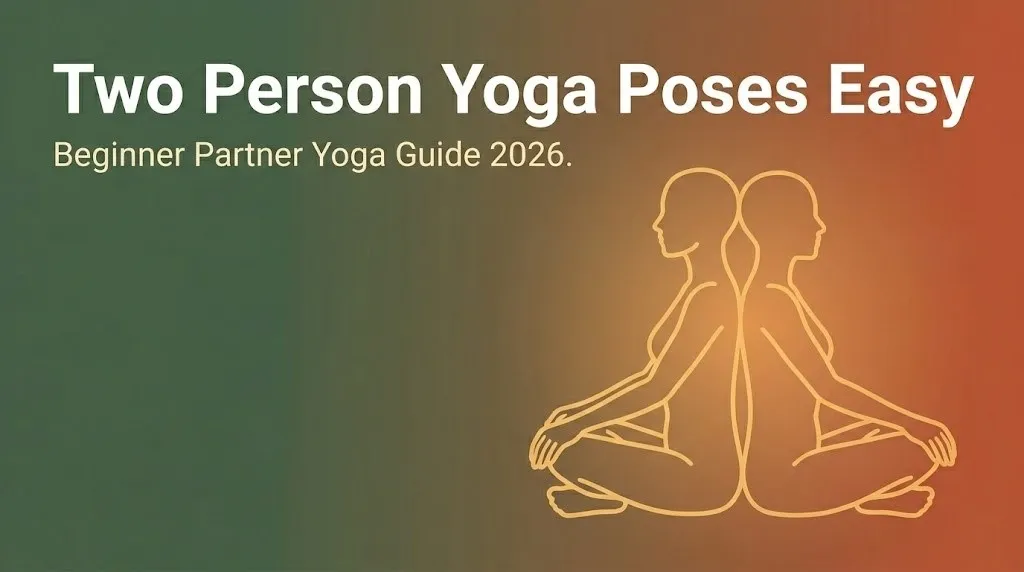
The most foundational seated partner shape is the back-to-back mountain pose, which uses spinal contact between partners to promote mutual postural awareness and spinal lengthening before any stretching begins.
To practice Back-to-Back Seated Mountain:
- Sit cross-legged facing away from each other, backs touching from sacrum to mid-upper back.
- Both partners press gently backward into each other without leaning or collapsing.
- Inhale to lengthen the spine upward together. Exhale to ground the sit bones together.
- Hold for 5 breath cycles, roughly 30 to 40 seconds.
- Notice where your spines do and do not align. This information is useful before moving into forward folds or twists.
The second key seated shape is partner seated twist:
- Sit cross-legged back to back, both partners in neutral spine.
- Both inhale to lengthen. On the exhale, both rotate to the right simultaneously.
- Each partner places their right hand on their own left knee and their left hand on their partner’s right knee.
- Hold for 4 to 6 breaths. Inhale to lengthen, exhale to deepen the rotation slightly.
- Release together on an exhale. Pause one breath, then repeat to the left.
Modification for tight hips in seated poses: place a folded blanket under each partner’s sit bones. This tips the pelvis forward and allows the lumbar spine to lengthen rather than round, which makes all seated partner poses more accessible and more beneficial.
Standing Partner Yoga Poses for Two Beginners
Standing partner yoga poses use mutual counterbalance to create stability that neither partner could achieve alone, making them genuinely useful for improving balance and building lower body strength in a supported context.
The most beginner-appropriate standing partner pose is partner standing forward fold, a counterbalance shape where both partners lean away from each other to create spinal traction.
To practice Partner Standing Forward Fold (counterbalance version):
- Stand facing each other at arm’s length apart.
- Both partners hinge forward at the hips until the torso is roughly parallel to the floor.
- Extend arms toward each other and clasp at the forearms, not the wrists or hands.
- Both partners gently lean back away from each other, creating length in the lumbar spine and hamstrings.
- Keep the knees slightly soft. Do not lock the knee joints.
- Hold for 5 to 8 breaths, approximately 30 to 50 seconds.
- Both bend the knees to come up simultaneously. Do not let one partner pull the other up.
The second beginner standing shape is Partner Virabhadrasana II (Warrior II) mirroring:
- Stand side by side, facing opposite directions, with one foot of distance between you.
- Both step the feet wide apart and turn the front foot outward.
- Both bend the front knee over the front ankle, arms extended in opposite directions.
- Partners’ extended front arms meet at the palms, pressing lightly against each other.
- Hold for 5 breaths each side.
Modification for balance-sensitive partners: practice near a wall so either partner can touch the wall if stability is lost. The modification does not reduce the hip-opening or leg-strengthening benefit.
Yoga Poses for Two Beginners: Step-by-Step Instructions
The partner seated forward fold is one of the most effective and commonly accessible two-person yoga poses, targeting the hamstrings, hip flexors, and lumbar spine simultaneously.
To practice Partner Paschimottanasana (Seated Forward Fold):
- Both partners sit facing each other with legs fully extended, feet touching or soles pressing together depending on flexibility.
- Partner A reaches forward, extending arms toward Partner B.
- Partner B holds Partner A’s forearms gently. Do not grip the wrists.
- Partner B slowly leans back, using their body weight to draw Partner A forward gently.
- Partner A lets the torso fold forward as far as comfortable, without rounding aggressively through the lumbar spine.
- Hold for 6 to 8 breaths, approximately 40 to 55 seconds.
- Partner B slowly reduces the backward lean. Partner A comes up on an inhale.
- Switch roles. Partner B folds forward while Partner A provides the backward traction.
To practice Partner Navasana (Double Boat Pose):
- Sit facing each other with knees bent, feet flat on the floor.
- Touch soles of feet together, toes pointing upward.
- Both partners hold each other’s hands or forearms.
- Lean back slightly to find balance on the sit bones.
- Both partners slowly lift feet, pressing soles together, until the shins are parallel to the floor.
- Straighten both legs fully if hamstring flexibility allows.
- Hold for 3 to 5 breaths. Return feet to floor together on an exhale.
Modification for tight hamstrings: keep knees bent throughout. The core engagement benefit is fully present without straight legs.
Key Takeaway: In partner forward folds, the pressing or traction partner should always move gradually over multiple breaths, never applying sudden force. Your partner’s hamstrings cannot tell you they have reached their limit; their breath and body tension can.
Simple Couples Yoga Poses: A Starter Sequence
Simple couples yoga poses work best when practiced as a connected sequence rather than isolated shapes, because the body opens progressively and the communication between partners deepens with each pose.
This starter sequence moves from seated grounding to standing balance to a shared forward fold, building from the most accessible shapes to slightly more demanding ones. It takes approximately 20 minutes total.
Starter sequence order:
- Back-to-Back Seated Mountain: 5 breaths, establish spinal contact and breath synchronization
- Partner Seated Twist: 5 breaths each side, warm up the thoracic spine and outer hips
- Partner Baddha Konasana (Bound Angle Pose) facing each other: Both seated, soles of feet together, knees wide; one partner gently presses down on the other’s thighs while the other breathes into the hip opening; 5 breaths each
- Partner Paschimottanasana (Seated Forward Fold): 6 breaths each direction as described in the previous section
- Standing counterbalance forward fold: 6 breaths, open the posterior chain together
- Partner Virabhadrasana II mirroring: 5 breaths each side, build lower body strength
- Back-to-Back Savasana (Corpse Pose): Both lie on backs, crowns of heads touching, arms extended; 2 to 3 minutes of shared stillness and breath awareness
The closing Savasana (Corpse Pose) with crowns touching is not decorative. Physical contact at the head combined with synchronized breath creates a grounding closure that completes the nervous system’s shift into parasympathetic rest.
Modification for the full sequence: any pose that creates discomfort in one partner can be replaced with seated back-to-back breathing. Staying connected while resting is still partner practice.
Partner Yoga for Different Body Types and Height Differences
Partner yoga works well for people with different body types, heights, and flexibility levels when poses are selected and adapted to accommodate those differences rather than forcing both partners into identical shapes.
Height differences affect standing partner poses most directly. In the counterbalance forward fold, a height difference of more than 12 inches between partners means the taller partner’s arm angle changes significantly, which can reduce the lumbar traction benefit for the shorter partner. The fix is simple: the taller partner bends their knees more, dropping their torso to match the shorter partner’s working height.
Flexibility differences affect forward fold assists most directly. The more flexible partner should never fold at full depth while assisting a less flexible partner, because doing so shifts their attention from the less flexible partner’s feedback to their own sensation. The assisting role requires full attention on the partner being stretched.
Practical adaptations for mixed body types:
- Height difference in seated poses: Place one or two folded blankets under the shorter partner’s sit bones to equalize hip height
- Weight difference in counterbalance poses: The heavier partner generates more counterbalance force; they should apply it more slowly and monitor the lighter partner’s response continuously
- Flexibility difference in forward folds: The less flexible partner always sets the depth limit; the assisting partner follows that limit, never pushes past it
- Arm length difference in double boat pose: Use a yoga strap between partners’ hands to bridge the reach gap without straining either partner’s shoulder girdle
The most important adaptation tool in partner yoga is not a prop. It is the verbal check-in: “Is this okay?” asked before increasing pressure, not after.
Advanced Yoga Poses for 2: When You Are Ready to Progress
Advanced yoga poses for 2 are appropriate after both partners have established comfort with foundational seated and standing partner shapes, developed reliable communication habits, and built baseline flexibility and core strength through regular practice.
“Advanced” in partner yoga context means increased weight-sharing, greater balance demands, or deeper ranges of motion, not acrobatic flight. True lifting acro yoga requires separate training. What follows here is accessible partner progression.
Partner Adho Mukha Svanasana (Double Downward-Facing Dog Pose):
- Partner A comes into Adho Mukha Svanasana (Downward-Facing Dog Pose): hands and feet on the mat, hips lifted, forming an inverted V shape.
- Partner B stands directly behind Partner A’s feet.
- Partner B places their hands on Partner A’s sacrum (not the lumbar spine), pressing gently downward and backward.
- Partner B walks their feet up Partner A’s lower back slowly, one step at a time.
- Partner B’s body forms a second inverted V, using Partner A’s back as a platform.
- Hold for 3 to 5 breaths. Partner B walks back down slowly.
Safety Note: Partner A should have a well-established solo Downward Dog before this variation. If wrist discomfort arises under the additional weight, come down immediately and use a forearm version.
Modification: Partner B can simply place hands on Partner A’s sacrum and apply gentle downward pressure without stepping up at all. This produces meaningful hip traction for Partner A with minimal weight-sharing risk.
Key Takeaway: Advanced partner poses require established communication habits and baseline strength before adding weight or height. Do not rush the progression. The benefit from intermediate partner shapes is just as real as the benefit from more demanding ones.
Partner Yoga Safety and Communication Rules
Partner yoga safety depends on four consistent practices: explicit verbal consent before contact, a clear stop signal, moving slowly through transitions, and building gradually rather than matching the deepest version of a pose on the first attempt.
The communication framework for partner yoga is simple and worth stating directly before your first practice together. These are not suggestions. They are the structure that makes the physical practice safe.
Non-negotiable partner yoga communication rules:
- Establish a stop signal before you begin: A word, a tap, or a squeeze that means “release immediately without question.” Both partners must know it and respect it without hesitation.
- Ask before applying pressure: “Ready?” before pressing on a partner’s back or providing traction. Wait for a verbal yes.
- Move in increments: Apply pressure or traction gradually over three to five breath cycles, not in one movement.
- Check in during holds: A brief “how is that?” after ten seconds in any sustained hold lets the passive partner communicate without breaking the pose entirely.
- Release slowly: Coming out of a partner assist rapidly can cause muscle strain. Both partners should return to neutral at the same pace.
Physical safety considerations:
- Do not practice partner yoga on a slippery surface. Non-slip mats are not optional.
- Never apply pressure to the lumbar spine directly. Target the sacrum or mid-thoracic back.
- Do not push a partner’s neck or head in any direction.
- If either partner has an acute injury, that person leads the session’s limitations. The healthy partner adapts.
Partner Yoga Breathing Techniques for Two
Partner yoga breathing techniques use synchronized breath between partners to deepen physical stretching, enhance nervous system co-regulation, and create the interpersonal attunement that makes partner practice more than just assisted stretching.
The foundational partner breathing practice is synchronized Ujjayi breath (victorious breath). Both partners breathe through the nose with a slight constriction at the back of the throat, creating an audible ocean-like sound. The sound makes each partner’s breath cycle audible to the other, which naturally synchronizes the rhythm without requiring either person to watch the other.
To practice synchronized partner breathing:
- Sit back-to-back in a comfortable position, spines touching from sacrum to mid-back.
- Both partners close their eyes.
- Begin Ujjayi breath individually, finding your own rhythm for two to three cycles.
- Listen for your partner’s breath. Gradually adjust your pace toward theirs.
- Without discussion, find a shared breath rate. This typically takes three to five cycles.
- Once synchronized, hold the shared breath rhythm for 10 full cycles before moving into any physical pose.
The second technique is call-and-response breathing, useful in assisted forward folds:
- The folding partner exhales deeply and the assisting partner uses that exhale to gently increase pressure.
- On the folding partner’s inhale, the assisting partner holds steady without adding or removing pressure.
- This breathing-linked assist allows the deepening to follow the natural rhythm of the body’s release rather than the assistant’s timing.
According to the National Center for Complementary and Integrative Health, synchronized breathing between individuals has been associated with increased vagal tone, a marker of parasympathetic nervous system activity linked to reduced anxiety and improved emotional regulation.
Partner Yoga for Seniors: Gentle Options for Older Adults
Partner yoga for seniors is accessible, beneficial, and in some ways more useful than solo practice because the partner provides stability support that reduces fall risk in balance poses and assists spinal mobility that seniors cannot achieve independently.
The American College of Sports Medicine recommends that older adults engage in activities that include balance training, flexibility work, and moderate cardiovascular effort. Partner yoga addresses all three, often within a single session, making it a time-efficient option for seniors with limited workout windows.
The most appropriate partner yoga formats for older adults are fully seated or chair-supported shapes with no weight-bearing between partners.
Gentle seated partner options for seniors:
| Pose | Position | Primary Benefit | Modification |
|---|---|---|---|
| Back-to-back seated breathing | Cross-legged or in chairs | Postural awareness, breath connection | Use chairs back-to-back if floor sitting is uncomfortable |
| Partner seated forward fold | Both seated, legs extended | Hamstring release, lumbar decompression | Keep knees bent; use strap instead of hand-to-hand contact |
| Partner seated twist | Cross-legged or in chairs | Thoracic and lumbar rotation | Reduce rotation range; keep movements small |
| Partner Baddha Konasana (Bound Angle Pose) | Facing each other, soles together | Hip external rotation, inner groin release | Place blankets under both partners’ knees |
| Partner Savasana (Corpse Pose) | Side by side or crowns touching | Parasympathetic activation, shared rest | Use blankets under knees and head for comfort |
Seniors with hip replacements should confirm safe hip flexion limits with their orthopedic surgeon before any seated partner pose that draws the knees toward the chest. The surgeon’s guidance on safe range of motion takes precedence over any general yoga instruction.
Two Person Yoga for Kids and Parents
Two person yoga for kids and parents is one of the most genuinely accessible forms of partner practice because children are naturally flexible, enthusiastic about novelty, and unbothered by imperfect technique.
Parent-child yoga works best when the parent approaches it as play rather than instruction. Children learn physical shapes through imitation, not explanation. Demonstrate a pose, name it in simple terms, and invite the child to try. Laughter when someone wobbles is not a problem. It is evidence that the nervous system is relaxed.
Safe and engaging parent-child partner poses:
- Back-to-back standing balance: Both stand back-to-back, pressing gently into each other, and try to lift one foot at a time. The child will likely balance better than the parent, which is a wonderful role reversal.
- Child as “flying airplane”: Parent lies on their back with knees bent. Child lies on parent’s shins, belly down, arms extended. Parent holds child’s hands. Parent slowly extends legs upward while child “flies.” Keep the extension gentle and the child low.
- Partner forward fold facing: Both sit with legs extended, soles touching, holding hands. Both lean forward gently together. The child’s natural flexibility will go further. The parent follows their own range without forcing to match.
- Back-to-back Savasana (Corpse Pose): Both lie on the floor with spines touching from head to tailbone. This is a shared rest that feels genuinely different from lying alone.
Safety Note: Children under 6 years old should not be lifted in any partner yoga variation where their full weight is supported by a parent’s limbs rather than the floor. “Flying” poses for young children should be done close to the ground with a spotter present.
Key Takeaway: Parent-child partner yoga works when the parent prioritizes playfulness over precision. Children learn through doing and laughing, not through verbal correction. Get on the floor, try the pose, wobble, and try again.
How to Build a Partner Yoga Sequence at Home
Building a partner yoga sequence at home requires a simple framework: start with grounding, move through progressive physical challenge, and close with shared stillness.
The home environment offers advantages a studio does not. You can take more time between poses, play music you actually like, repeat poses that feel good without a class schedule dictating the pace, and wear whatever you want. The disadvantage is that no teacher is present to correct form. This makes the communication rules more important, not less.
Framework for a 30-minute home partner yoga sequence:
- Opening (3 to 5 minutes): Sit back-to-back, synchronize breathing for ten cycles, allow the nervous systems to settle before asking the bodies to move.
- Warm-up (5 minutes): Partner seated twist both sides, back-to-back cat-cow (both in tabletop, backs touching, move through spinal flexion and extension together).
- Core seated poses (8 to 10 minutes): Partner forward fold, partner Bound Angle, double Boat Pose with knees bent.
- Standing poses (5 to 7 minutes): Counterbalance forward fold, Partner Warrior II mirroring.
- Cool-down (5 minutes): Return to seated, partner twist in the opposite direction from the warm-up, supported back-to-back seated forward fold.
- Closing Savasana (3 to 5 minutes): Both lie flat, crowns touching, synchronized breath, complete stillness.
Practical notes for home practice:
- Clear enough floor space for both mats placed end-to-end. Approximately 12 feet by 6 feet is sufficient for most partner poses.
- Keep a water bottle accessible for both partners.
- Agree on a total session length before starting. Knowing the endpoint reduces the mental restlessness that shortens home practice sessions.
- One partner can set a gentle timer so neither person needs to track time mentally.
Frequently Asked Questions About Two Person Yoga Poses
What are the easiest two person yoga poses for absolute beginners?
The easiest starting poses are back-to-back seated mountain, partner seated twist, and the counterbalance standing forward fold.
All three require no flexibility, no prior yoga experience, and minimal weight-sharing between partners.
Begin with the seated shapes before attempting standing poses, since both partners are on the ground and can adjust without balance concerns.
Is partner yoga safe if my partner and I have very different flexibility levels?
Yes, partner yoga is safe for partners with different flexibility levels when the less flexible partner always sets the depth limit and the assisting partner follows that limit without pushing past it.
Use a yoga strap to bridge reach differences in seated forward folds, and keep knees bent in any pose that requires straight legs if hamstring flexibility is limited.
The communication check-in before increasing any pressure is the primary safety tool when flexibility levels differ.
Do we need any props or equipment for partner yoga at home?
You need two yoga mats and approximately 12 feet by 6 feet of clear floor space as a minimum.
A yoga strap is the most useful optional prop, allowing partners to connect across reach differences without gripping each other’s joints.
Folded blankets under the sit bones in seated poses and under the knees in Savasana improve comfort significantly, especially for practitioners with limited hip flexibility.
What is the difference between partner yoga and acro yoga?
Partner yoga keeps both practitioners near the ground, using mutual resistance and support without lifting. Acro yoga involves one partner being fully lifted off the ground by the other.
Partner yoga is appropriate for beginners with no prior training. Acro yoga requires specific strength development and ideally the presence of a qualified teacher for the learning phase.
If you are brand new to shared practice, start with partner yoga. Build communication habits and physical awareness before considering any acro progression.
How long should we hold two person yoga poses as beginners?
Beginners should hold partner yoga poses for 3 to 6 breath cycles, roughly 20 to 40 seconds, in the first few sessions.
As communication and comfort improve, extend holds to 6 to 10 breaths in poses targeting flexibility, particularly hamstring and hip flexor shapes.
Shorter, well-communicated holds produce more benefit than longer holds where either partner is uncomfortable but not saying so.
Start With One Pose, Not the Whole Sequence
Pick the back-to-back seated breathing practice and do it for ten breath cycles with your partner today. That is the complete starting point.
Once you have felt what synchronized breath in physical contact actually feels like, the rest of the sequence becomes obvious. The poses are not the point. The attention you give each other while doing them is.
Add one new pose each session. By week four, you will have a full home practice without it ever feeling like a project