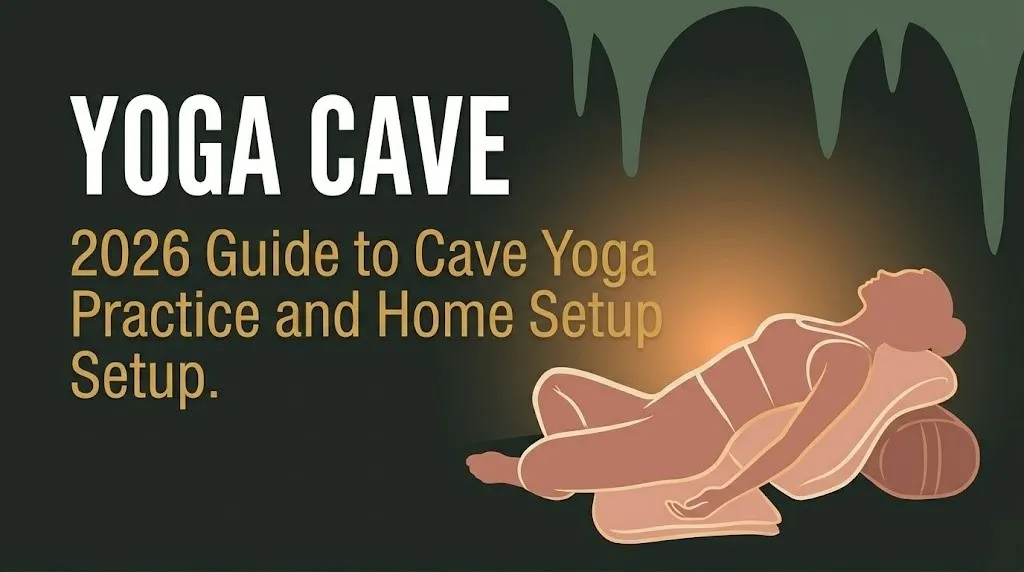
Yoga Cave: Your 2026 Guide to Cave Yoga and Home Setup
A yoga cave is a dedicated, sensory-reduced yoga and meditation practice space, characterized by low ambient light, acoustic dampening, controlled temperature, and an enclosed atmosphere designed to support the deepest possible inward focus during practice. Whether you’ve encountered this concept through the Yoga Cave Naperville studio or through a growing movement of home practitioners building cave-inspired spaces, the idea is the same: create an environment where the nervous system can fully let go.
The case for this approach is documented. According to the National Center for Complementary and Integrative Health (NCCIH), yoga practices that incorporate environmental support for relaxation, including reduced sensory stimulation, produce greater reductions in cortisol and self-reported stress than standard practice environments alone. The space where you practice shapes what the practice can do.
This guide covers what a yoga cave actually is, how the Yoga Cave Naperville studio works, the specific yoga styles best suited to cave environments, the neuroscience behind why it enhances practice, and a complete practical guide to building your own cave-inspired yoga space at home.
Yoga Cave: What It Is and Why It’s Different
A yoga cave is a practice environment intentionally designed to reduce external sensory input, creating the conditions for deeper nervous system relaxation, sustained inward attention, and more effective therapeutic yoga outcomes.
The concept draws on a principle as old as yoga itself. Ancient practitioners used literal caves, forest clearings, and quiet chambers for meditation and practice precisely because the absence of external stimulation supported inward awareness. The modern yoga cave recreates that quality in a studio or home setting using intentional design.
What distinguishes a yoga cave from a standard studio:
- Lighting: deliberately low, typically between 5 and 30 lux (compared to 200 to 500 lux in standard studios), using warm amber or red-spectrum light sources rather than overhead fluorescent or cool LED lighting
- Sound design: acoustic dampening through soft surfaces, textured walls, and intentional ambient sound (nature sounds, singing bowls, or silence) rather than the reflective hard surfaces of most studio environments
- Temperature: either mildly heated (for heated yoga cave formats) or maintained at comfortable ambient temperature (68 to 75 degrees for restorative formats), always controlled and consistent
- Enclosure: a sense of being held and contained, achieved through lower ceilings, curved walls, darker surfaces, or textured materials that absorb rather than reflect light
- Olfactory environment: often includes essential oils or subtle natural aromas that signal safety and relaxation to the olfactory system
This is not aesthetic preference. Each element has a neurological basis for practice enhancement.
What Is a Yoga Cave Studio?
A yoga cave studio is a purpose-built yoga facility designed around the cave aesthetic and sensory environment, using architectural and design elements to create a practice space that feels enclosed, warm, and sensory-reduced rather than open, bright, and visually stimulating.
Yoga cave studios exist on a spectrum. Some are heated yoga facilities that use cave aesthetics primarily as branding, with a darkened studio and mood lighting as the primary cave elements. Others are more thoroughly designed around sensory reduction, with padded walls, acoustic treatment, infrared heating panels rather than forced-air heating, and carefully curated ambient sound.
The most common class offerings at yoga cave studios:
| Class Type | Temperature | Primary Benefit | Best For |
|---|---|---|---|
| Heated flow / hot Vinyasa | 90 to 100 degrees | Cardiovascular, flexibility | Active practitioners |
| Warm Hatha | 80 to 88 degrees | Alignment, moderate warmth | Beginners, all levels |
| Yin yoga | 75 to 82 degrees | Connective tissue, joint health | Stress, anxiety, flexibility |
| Restorative yoga | 72 to 78 degrees | Nervous system reset, recovery | Seniors, chronic conditions |
| Yoga Nidra | 72 to 75 degrees | Deep rest, anxiety, sleep | All levels, sleep issues |
| Meditation | 68 to 74 degrees | Mental clarity, stress relief | All levels |
The cave environment enhances all of these formats but is particularly synergistic with the slower, more inward-facing styles. A heated flow class in a cave studio benefits from the atmospheric quality. A Yoga Nidra class in a cave studio operates at a level of depth that a standard studio environment cannot easily match.
Yoga Cave Naperville: What to Know About This Illinois Studio
Yoga Cave Naperville is a yoga studio located in Naperville, Illinois (DuPage County), offering heated yoga classes in a cave-inspired studio environment for practitioners at all experience levels, from complete beginners to established practitioners.
Naperville, as one of the Chicago metro area’s most active communities for health and wellness programming, supports a diverse yoga market. Yoga Cave Naperville’s distinction within that market is its environmental design: the cave-aesthetic studio creates a practice experience that differs from the area’s more conventional studio offerings.
What to know before visiting Yoga Cave Naperville:
- Class variety: typically includes heated Vinyasa, warm flow, Yin yoga, and restorative formats; confirm the current schedule directly with the studio as offerings evolve seasonally
- New student options: most independent yoga cave studios offer new student introductory pricing; ask specifically about first-class or first-week deals
- What to bring: a yoga mat, a mat towel (for heated classes), an insulated water bottle, and moisture-wicking clothing; the studio provides blocks and straps
- Instructor credentials: look for Yoga Alliance RYT 200 or RYT 500 designations on the instructor roster
- Arrive early: arriving 10 to 15 minutes before your first class allows time to tell the teacher your experience level and any health conditions, and to adjust to the cave atmosphere before practice begins
The cave environment can feel notably different from standard studios at first. The lower light and enclosed feeling are disorienting briefly for some first-time visitors. This passes quickly. Within a few minutes, most practitioners find the atmosphere deeply conducive to inward focus.
Key Takeaway: A yoga cave studio’s most defining feature is its intentional sensory environment; understanding this before your first class helps you arrive with the right expectations and the right preparation.
Why Does a Yoga Cave Environment Enhance Practice?
A yoga cave environment enhances yoga practice by reducing the external sensory demands on the nervous system, allowing the brain’s default mode network to quiet more quickly and the parasympathetic nervous system to activate more fully than in visually stimulating, acoustically reflective standard studio environments.
The neuroscience here is specific. In bright, visually rich environments, the brain’s visual cortex and attention networks remain partially active even during eyes-closed practice, processing ambient light through the eyelids and orienting toward sounds and movement. In a low-light, acoustically dampened cave environment, these processing demands drop significantly, freeing the nervous system to move more rapidly toward the deep relaxation states that restorative yoga and meditation are designed to produce.
Think of it like this: practicing yoga in a bright, busy environment is like trying to read a book in a coffee shop. You can do it, but part of your brain is always managing background noise. A yoga cave removes that background noise entirely, allowing the same practice to go deeper.
According to research published in the Journal of Alternative and Complementary Medicine, environmental factors including lighting, sound, and temperature significantly influence the depth of relaxation response achieved during yoga and meditation practices. Controlled low-stimulation environments consistently produced more pronounced reductions in heart rate and galvanic skin response than standard environments.
The enclosure sensation itself also plays a role. Research in environmental psychology documents that humans experience a degree of felt safety in enclosed, cave-like spaces that open, exposed spaces don’t provide. That felt safety is the neurological precondition for genuine parasympathetic activation during practice.
Yoga Cave Benefits for Mental Health and Stress
Yoga practiced in a cave environment produces measurable benefits for mental health and stress regulation by combining the physiological effects of the yoga practice itself with the neurological effects of a sensory-reduced, low-stimulation setting.
The two-layer effect is what makes yoga cave practice worth understanding. Standard yoga in a standard studio produces the well-documented cortisol-reduction and parasympathetic-activation benefits attributed to yoga. Yoga in a cave environment adds a second layer: the environment itself begins the nervous system downregulation before the first pose, reducing the physiological and psychological “warm-up time” needed to move from daily stress activation into genuine practice states.
According to the National Center for Complementary and Integrative Health, yoga practices that incorporate environmental support for relaxation, including reduced visual and auditory stimulation, produce greater self-reported reductions in anxiety and stress than physically identical practices in non-optimized environments. The space matters.
Specific mental health benefits documented for yoga cave-style practice:
- Faster onset of relaxation response: low-light environments signal the brain to reduce arousal before movement begins
- Greater depth of Savasana: the final rest pose in a cave environment reaches deeper physiological restoration than in bright, noisy environments
- Improved sleep quality: Yoga Nidra and Restorative yoga in cave settings show particularly strong correlations with improved sleep onset and duration
- Reduced rumination: the enclosed, contained quality of cave environments reduces the “open monitoring” anxiety that spacious, visually complex environments can produce
- Enhanced emotional processing: Yin yoga’s long holds in a cave environment allow emotional material to surface and resolve without the social performance pressure of a bright, visible studio
Yin Yoga in a Yoga Cave Setting
Yin yoga is the most naturally compatible yoga style with a cave environment, because both share the same fundamental goal: the systematic withdrawal of external engagement to access deeper layers of physical and psychological experience.
Yin yoga is a slow-paced style where poses are held passively for 3 to 7 minutes, targeting the body’s connective tissues, including fascia, ligaments, and joint capsules, rather than the muscles primarily targeted in active styles. Each long hold is a practice of staying present with sensation, discomfort, and the arising and passing of mental content. That’s exactly what the cave environment supports.
In a cave setting, Yin yoga’s characteristic poses deepen in a specific way. The absence of visual distraction and the acoustic containment of a cave studio make it easier to maintain the quality of inner attention that long holds require. Practitioners who find their minds wandering constantly in standard Yin classes often report dramatically improved stillness in cave environments.
Key Yin poses for a yoga cave practice:
| Pose Name | Hold Duration | Primary Area | Cave Benefit |
|---|---|---|---|
| Supta Baddha Konasana (Reclined Bound Angle) | 5 to 7 minutes | Inner groin, chest | Full body surrender supported by gravity |
| Balasana (Child’s Pose) | 3 to 5 minutes | Hips, lumbar spine | Safety and inwardness; cave amplifies containment |
| Supta Matsyendrasana (Supine Spinal Twist) | 3 to 5 minutes per side | Thoracic spine, hips | Ground contact supports proprioceptive settling |
| Dragon Pose (low lunge, Yin variation) | 3 to 5 minutes | Hip flexors, psoas | Psoas releases more completely in low-arousal states |
| Melting Heart Pose (Anahatasana) | 3 to 5 minutes | Thoracic spine, shoulders | Grief and emotional material surfaces more safely |
Modification for beginners: Support every Yin pose fully with props. Supta Baddha Konasana should have blocks under each outer thigh and a bolster under the spine. In a cave setting, the darkness may make it harder to see whether you’re in a safe position; set up your props before the lights are lowered.
Restorative Yoga in a Yoga Cave
Restorative yoga is the single most effective yoga style for a cave environment, because it requires the complete removal of muscular effort and environmental stimulation, conditions that a well-designed yoga cave provides at a level no standard studio can match.
In Restorative yoga, the body is completely supported by props in passive positions, allowing the nervous system to shift into parasympathetic dominance without any physical work. The poses are held for 5 to 20 minutes. The practitioner does nothing except breathe and remain present. The depth of rest achievable in this format is directly proportional to how completely the environment supports surrender.
A cave environment eliminates the primary obstacles to deep restorative practice: visual stimulation, ambient noise, temperature fluctuation, and the social awareness that comes from being visible to other practitioners. In darkness, with acoustic dampening and consistent warmth, the body lets go at a rate that bright, exposed environments simply don’t permit.
According to Complementary Therapies in Medicine, a 2020 study found that participants in a supportive-environment Restorative yoga program reported greater reductions in perceived stress and improved heart rate variability compared to those practicing in standard studio conditions. Environmental support was identified as a contributing variable.
Key Restorative poses for a yoga cave:
- Supta Baddha Konasana (Reclined Bound Angle Pose): bolster under the spine, blocks under outer thighs, eye pillow, blanket over body; 10 to 15 minutes
- Viparita Karani (Legs Up the Wall Pose): blanket under the sacrum, legs supported by the wall; 5 to 10 minutes; use folded blanket for lumbar support
- Supported Savasana (Corpse Pose): bolster under the knees, eye pillow, blanket over body; 10 to 20 minutes
- Supported forward fold with bolster on the lap: hips on folded blanket, forehead to bolster; 5 to 7 minutes
Safety caution: Those with glaucoma or unmanaged high blood pressure should skip Viparita Karani (Legs Up the Wall) and use a fully supported Savasana instead, as passive inversions can temporarily increase intraocular and intracranial pressure.
Key Takeaway: Yin and Restorative yoga achieve their deepest effects in cave environments because both styles require the same neurological conditions the environment provides: low arousal, sensory reduction, physical safety, and complete permission to be still.
Yoga Nidra in a Cave Environment
Yoga Nidra (Yogic Sleep) is a guided meditation practice performed in Savasana (Corpse Pose) that systematically moves awareness through the body and through layers of consciousness, and a yoga cave environment produces the ideal conditions for this practice to reach its maximum depth.
The practice involves lying completely still while following a guided instruction track through body scanning, breath awareness, pairs of opposites, visualization, and sankalpa (intention) planting. The practitioner maintains awareness throughout, moving into the threshold state between waking and sleep where the subconscious mind becomes maximally receptive. In a bright, noisy standard studio, maintaining this threshold state requires more effort. In a cave environment, the environment itself holds it.
Research published in the International Journal of Yoga documented that 45-minute Yoga Nidra sessions produced brainwave patterns consistent with early sleep stages (theta waves) in participants, with corresponding reductions in anxiety, cortisol, and subjective stress. The sensory environment was noted as a facilitating factor in achieving these states.
To practice Yoga Nidra in a cave setting:
- Set up a fully supported Savasana: bolster under knees, eye pillow over eyes, blanket over body, folded blanket under head.
- Lower the lighting to its lowest setting. Allow the cave atmosphere to settle around you.
- Set your sankalpa (intention) silently: one short, present-tense phrase that reflects what you are cultivating.
- Follow a guided Yoga Nidra audio track (30 to 45 minutes is standard for a full session).
- Allow drowsiness. In early practice, sleep is common and not a failure.
- At the close of the guidance, repeat your sankalpa three times silently before opening your eyes.
- Transition slowly: roll to one side, pause, and allow the nervous system to re-orient before sitting up.
Modification for beginners: Start with a 20-minute guided session rather than a full 45-minute practice. The shorter format is easier to stay conscious through and builds the skill base for longer sessions over weeks.
Yoga Cave Meditation Practice
Yoga cave meditation practice refers to formal seated or lying meditation conducted within a cave-inspired space, using the environmental conditions of low light, acoustic containment, and controlled temperature to deepen concentration and reduce the mental effort required to enter meditative states.
Meditation in a cave environment benefits from everything a cave provides: darkness signals the brain to reduce arousal (via melatonin pathway stimulation, even without sleep intent), acoustic containment reduces the orienting response to environmental sounds, and the enclosed space creates a felt sense of safety that allows the default mode network to quiet more readily.
The most accessible cave meditation techniques:
- Pranayama as entry point: begin seated with Nadi Shodhana (Alternate Nostril Breathing) for 5 minutes before transitioning to silent meditation; the bilateral breath pattern calms the nervous system and prepares the mind for stillness
- Body scan meditation: systematic attention from the feet upward, naming each body part without analysis; this is the active component of Yoga Nidra and can be practiced independently
- Breath awareness meditation: simple attention to the natural breath at the nostrils, returning gently when the mind wanders; 10 to 20 minutes in a cave environment produces rapid depth
- Mantra meditation: silent repetition of a word or phrase (a sankalpa or a traditional mantra); the cave’s acoustic containment makes the internal sound of the mantra more vivid
According to the Harvard T.H. Chan School of Public Health, regular meditation practice is associated with reduced amygdala activity (the brain’s threat-response center) and increased prefrontal cortex engagement over an 8-week period, producing measurable changes in emotional regulation and stress reactivity.
Modification for seniors: Seated meditation in a cave environment may require additional support for those with lumbar stiffness. A folded blanket or yoga block under the sit bones brings the pelvis into a more neutral position, reducing strain on the lumbar spine during longer sits.
How to Create a Yoga Cave at Home
A home yoga cave can be created in any enclosed room, basement, walk-in closet, or spare room using five essential elements: controlled low lighting, acoustic dampening, a clean practice surface, temperature control, and a curated sensory environment including sound and optional aromatherapy.
The minimum viable yoga cave requires less space and investment than most people expect. A 6-foot by 8-foot cleared space (the length of a yoga mat plus arm-reach width on each side) is sufficient for all restorative and meditation practices. A slightly larger space allows full Vinyasa flow if that is part of the practice.
Building a home yoga cave in order of priority:
- Choose your room: basements and interior rooms are ideal for acoustic containment; a room with no windows or blackout curtains for the existing windows is preferable
- Clear the space: remove all non-practice items; visual clutter activates the same processing load as environmental noise
- Install lighting: replace overhead lighting with warm-spectrum dimmable LED panels or salt lamps at 5 to 30 lux; avoid cool-white or blue-spectrum light sources
- Address acoustics: add soft furnishings: a thick yoga mat, wall hangings, curtains, cushions; these absorb reflected sound without requiring professional treatment
- Control temperature: a small space heater with a thermostat for heated practice; a fan for cooling during restorative formats; target 72 to 78 degrees for restorative and 80 to 88 degrees for warm Hatha
- Add sensory cues: a diffuser with lavender or eucalyptus essential oil (not synthetic fragrance); a Bluetooth speaker for guided practices or ambient sound
- Organize your props: keep all props accessible and visible so the transition into practice is frictionless
This setup requires no renovation and a modest equipment investment. Most practitioners report that using the space consistently, even for 15 minutes per day, strengthens the association between the cave environment and deep practice over time.
Yoga Cave Lighting: What Works and Why
Yoga cave lighting should be warm-spectrum, dimmable, and set between 5 and 30 lux for restorative and meditation practices, transitioning to 50 to 80 lux for active flow practices where alignment visibility matters.
The light spectrum and intensity interact with the nervous system in specific ways. Cool-white and blue-spectrum lighting (4000K to 6500K color temperature) suppresses melatonin production and maintains alertness. Warm amber lighting (2200K to 2700K) mimics firelight and sunset, activating the brain’s restful state associations. For a practice space designed around nervous system downregulation, warm-spectrum lighting is not a preference. It is the physiologically correct choice.
| Lighting Type | Color Temperature | Lux Range | Best Use in Yoga Cave |
|---|---|---|---|
| Overhead cool white LED | 4000 to 6500K | 200 to 500 lux | Not recommended |
| Warm white dimmable LED | 2700 to 3000K | Adjustable 5 to 200 | Best all-purpose cave lighting |
| Himalayan salt lamp | 2200K | 1 to 5 lux | Accent only; too dim for active practice |
| Candles | 1800 to 2000K | 1 to 3 lux per candle | Restorative and meditation only; fire safety required |
| Smart bulb (warm setting) | Programmable | Adjustable 0 to 800 | Most flexible; fully programmable |
| Red-spectrum light | 620 to 750nm | Adjustable | Deep relaxation; no melatonin suppression |
Blackout curtains or blinds are as important as the artificial light source. External light entering the space resets the nervous system’s arousal state. Complete light control makes the difference between a dimmed studio and a true cave environment.
Modification note: For practitioners with visual impairments who rely on ambient light for spatial orientation, slightly higher lux levels in the warm spectrum (50 to 80 lux) maintain the cave atmosphere while providing adequate visibility for safe movement during transitions between poses.
Yoga Cave Props and Equipment
The essential props for a yoga cave practice are a quality yoga mat, at least two yoga blocks, one yoga strap, two bolsters (or one bolster and two firm pillows), two yoga blankets, and an eye pillow, with the eye pillow being particularly important in a cave environment where its darkness-enhancing and oculocardiac reflex-activating properties are the most useful.
Props in a yoga cave are not optional accessories. They are the architecture of the practice. In Restorative and Yin yoga especially, the props create the supported positions that allow the nervous system to release without any effort from the practitioner. Without adequate prop support, even a cave environment can’t produce the depth of release these styles require.
Props and their specific roles in cave practice:
- Yoga mat: minimum 5mm thickness for floor practice; thicker mats (6mm) are preferable for restorative practice where extended contact with the floor creates pressure points
- Yoga blocks (two): cork or foam; cork provides firmer, more stable support; foam is lighter and softer; use under hands, hips, outer thighs, and forehead
- Yoga strap: used to bind poses where the arms or legs don’t reach each other; a 6-foot strap suits most bodies; an 8-foot strap provides more options for longer-limbed practitioners
- Bolster (one to two): the single most important prop for restorative practice; standard bolster dimensions are approximately 28 inches long by 10 inches in diameter; pranayama bolsters are slightly firmer and lower
- Yoga blankets (two): firm Mexican or wool blankets fold into precise thicknesses; more versatile than pillows for creating precise prop heights
- Eye pillow: a small weighted sachet (typically lavender-filled) that covers the eyes during Savasana and Yoga Nidra; the gentle pressure activates the oculocardiac reflex, which measurably reduces heart rate within minutes
Yoga Cave for Beginners and Seniors
A yoga cave environment is particularly well-suited to beginners and seniors because its low-stimulation, supported, and non-competitive atmosphere removes many of the social and physical performance pressures that make standard yoga studios intimidating or physically demanding for these populations.
For beginners, the cave’s darkness has a democratizing effect. In a dimly lit room, no one can easily observe your alignment or compare their form to yours. This removes the self-consciousness that causes beginners to modify poses based on what looks right rather than what feels right. The cave environment invites internal focus from the first moment.
What beginners and seniors can expect in a yoga cave:
| Population | Primary Benefit | Best Cave Style | Modification Notes |
|---|---|---|---|
| Complete beginners | Low-pressure, inward focus | Warm Hatha, gentle flow | Stay near props; use every modification offered |
| Beginners with anxiety | Rapid nervous system calming | Yin, Restorative | Arrive early; meet the teacher before class |
| Active seniors (60-75) | Joint mobility, balance | Warm Hatha, Yin | Chair support available on request |
| Seniors with limited mobility | Full-body supported rest | Restorative, Yoga Nidra | All poses adapted to mat level or chair |
| Seniors with sleep issues | Deep rest, improved sleep onset | Yoga Nidra | Eye pillow and blanket required |
| Seniors with osteoporosis | Gentle spinal mobility (safe poses) | Restorative, gentle Hatha | Avoid deep spinal flexion; use wall support |
The cave environment reduces one additional barrier for seniors: the temperature-controlled, enclosed space eliminates drafts and ambient chill that make floor practice uncomfortable in standard studios. Seniors often find the warm, contained cave atmosphere the most physically comfortable yoga environment they have encountered.
Safety caution for seniors with osteoporosis: Avoid forward fold poses that involve spinal rounding under load. Restorative forward folds with a bolster on the lap (rather than reaching toward the feet) are bone-safe alternatives that preserve the hip-opening benefit.
Yoga Cave for Anxiety and Back Pain
A yoga cave practice is one of the most evidence-supported approaches for managing anxiety and chronic back pain because it combines the therapeutic yoga practices most effective for these conditions with the sensory environment most conducive to nervous system relaxation and pain modulation.
For anxiety, the mechanism is well-established. The National Center for Complementary and Integrative Health has documented that yoga practices combining physical postures, breath regulation, and a low-stimulation environment produce consistent, measurable reductions in anxiety symptoms across clinical and non-clinical populations. A cave environment accelerates the entry into these states by reducing the ambient sensory processing load that keeps the anxious nervous system in a state of heightened monitoring.
For chronic back pain, the mechanism is different but equally specific. Long holds in supported postures decompress the lumbar spine, release the hip flexors and psoas that contribute to chronic low back tension, and reduce the muscular guarding response that perpetuates pain cycles. Cave environments make it easier to stay in these holds long enough to produce tissue release, because the darkness, warmth, and acoustic containment eliminate the restlessness that cuts long holds short.
Best yoga cave poses for anxiety and back pain:
- Viparita Karani (Legs Up the Wall Pose): decompresses the lumbar spine; reversal of blood flow reduces lower-body tension; 5 to 10 minutes in a cave setting produces rapid calm (modification: use a folded blanket under the sacrum if the lumbar spine is uncomfortable)
- Supta Baddha Konasana (Reclined Bound Angle Pose): opens the chest and hip adductors; completely passive with bolster and blocks; reduces anxiety through the combination of heart-opening and supported stillness
- Balasana (Child’s Pose): spinal decompression in flexion; the cave’s enclosure amplifies the felt sense of protection this pose provides (modification: a folded blanket between the thighs and calves reduces knee flexion depth for those with knee sensitivity)
- Supported Savasana (Corpse Pose) with bolster under the knees: neutral lumbar position; bolster under knees reduces lumbar lordosis and relieves back tension during extended rest
Key Takeaway: For beginners, seniors, people with anxiety, and those managing back pain, a yoga cave environment is not just atmospheric preference; it is a functional therapeutic support that changes what the practice can accomplish.
Frequently Asked Questions About Yoga Cave
What is a yoga cave studio and how is it different from a regular yoga studio?
A yoga cave studio is a purpose-built practice space designed with low ambient lighting, acoustic dampening, and controlled temperature to create a sensory-reduced environment for deep yoga and meditation practice.
Standard yoga studios prioritize visibility and instruction; yoga cave studios prioritize nervous system downregulation and inward focus, making them particularly suited to Yin, Restorative, and Yoga Nidra formats.
The cave environment isn’t just aesthetic: the reduced sensory input allows the parasympathetic nervous system to activate more quickly and deeply than in standard studio conditions.
What yoga styles are best for a yoga cave environment?
Yin yoga, Restorative yoga, and Yoga Nidra are the yoga styles most enhanced by a cave environment, because all three require the deep nervous system relaxation the cave setting naturally supports.
Warm Hatha yoga and heated Vinyasa flow also benefit from cave environments, particularly the atmospheric focus they provide during movement sequences.
Hot yoga formats like Bikram/26&2 are less commonly offered in cave studios, since the fixed sequence requires adequate lighting for teacher correction of alignment.
How do I set up a yoga cave at home?
Choose an enclosed room or basement, install warm-spectrum dimmable LED lighting at 5 to 30 lux, add acoustic dampening through soft furnishings, and set temperature to 72 to 78 degrees for restorative practice.
Essential props include a yoga mat, two blocks, a bolster, two blankets, a strap, and an eye pillow; the eye pillow is particularly important in a cave setting for activating the oculocardiac reflex during Savasana.
Begin using the space for 15 minutes daily to build a consistent neurological association between the cave environment and deep practice states.
Is Yoga Cave Naperville good for beginners?
Yoga Cave Naperville is generally well-suited to beginners because the cave atmosphere reduces the social performance pressure that makes standard studios intimidating.
Beginners should arrive 10 to 15 minutes early, inform the teacher of their experience level, and choose a warm Hatha or gentle flow class rather than a heated Vinyasa format for the first visit.
The dimly lit cave environment means you won’t feel watched or observed, which is specifically helpful for beginners still learning alignment and building confidence on the mat.
Can a yoga cave practice help with anxiety and back pain?
Yes, yoga cave practice is particularly effective for anxiety and back pain because it combines therapeutic yoga poses with an environment that accelerates nervous system relaxation.
According to the National Center for Complementary and Integrative Health, yoga in supportive, low-stimulation environments produces greater anxiety reduction than the same practice in standard studio conditions.
For back pain, the cave environment makes it easier to sustain the long holds in poses like Viparita Karani (Legs Up the Wall) and Supta Baddha Konasana (Reclined Bound Angle) that decompress the lumbar spine and release the hip flexors most associated with chronic lower back tension.
Build Your Cave and Go In
The simplest version of a yoga cave is a cleared corner, a dim light, a bolster, and an eye pillow. That’s enough to begin.
Set up your props before you dim the lights. Choose one practice: Supta Baddha Konasana for seven minutes, or a 20-minute Yoga Nidra recording. Let the darkness do some of the work.
Practice there three times this week. By the third session, your nervous system will start downregulating the moment you enter the space. That’s the cave working.