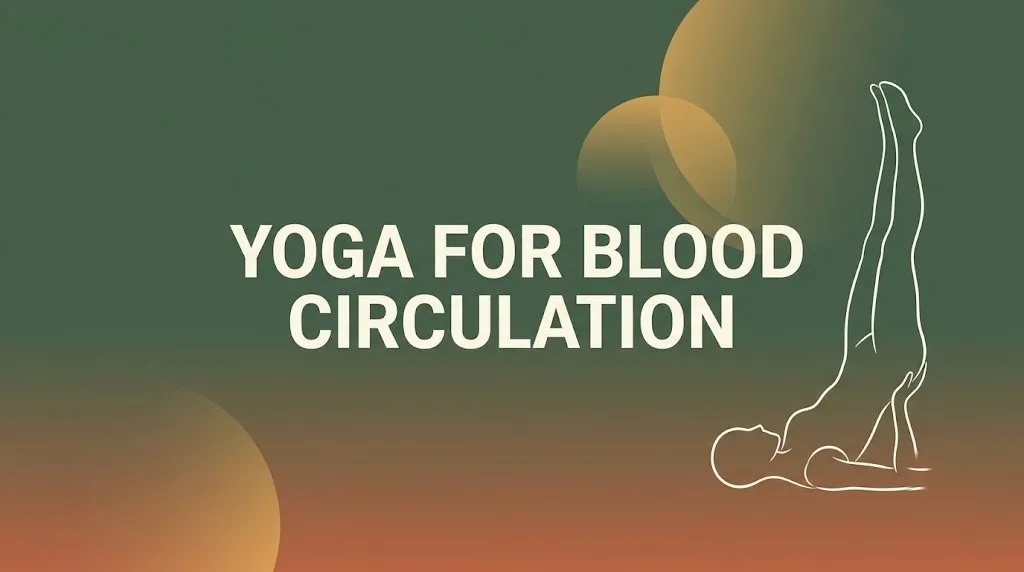
Yoga for Blood Circulation: Best Poses & Sequences
Yoga for blood circulation is one of the most evidence-supported applications of a regular yoga practice. Done consistently, yoga moves blood from the extremities back toward the heart, encourages capillary activity, and activates the body’s natural venous return system.
Research published in the European Journal of Preventive Cardiology found that yoga produced measurable improvements in cardiovascular risk markers, including circulation-related indicators, comparable to moderate aerobic exercise. That finding matters because it suggests yoga isn’t just a flexibility tool. It functions as a legitimate circulatory intervention.
This article covers the science behind yoga’s effect on blood flow, the best poses for full-body and leg circulation, specific guidance for seniors and people with varicose veins, a full 20-minute sequence, and breathing techniques that most yoga articles on this topic overlook entirely.
Yoga for Blood Circulation: What It Actually Does
Yoga improves blood circulation by combining physical movement, gravity-assisted blood redistribution, breath-driven pressure changes in the chest cavity, and nervous system regulation into one practice.
When you move through yoga poses, your muscles contract and release. That contraction squeezes blood through the veins in a process called the muscle pump effect. It’s the same mechanism your calves use when you walk. Yoga simply activates it in more muscle groups and body positions.
Inversions shift blood from pooled areas, usually the lower legs and feet, back toward the core and heart. Forward folds and twists compress and decompress abdominal organs, encouraging blood movement through the portal circulation and lymphatic channels.
The parasympathetic nervous system, the body’s rest-and-recover mode, is activated during slower yoga styles like Yin and Restorative yoga. This reduces arterial tension and allows more efficient blood flow to the periphery, including the hands and feet.
Key mechanisms yoga uses to support circulation:
- Muscle pump activation through contracting and releasing muscle groups
- Gravitational redistribution through inversions and elevation of the legs
- Diaphragmatic pressure changes that assist venous return to the heart
- Parasympathetic activation that reduces vascular resistance
- Capillary perfusion supported by sustained holds and deep breathing
Modification for beginners: If full inversions feel inaccessible, even lying on your back with legs elevated on a folded blanket activates gravitational venous drainage. You don’t need a headstand to start.
Does Yoga Improve Circulation? What the Research Says
Yes, yoga does improve circulation, and the research supporting this is more specific and credible than most wellness articles suggest.
A study published in the International Journal of Yoga found that a consistent yoga practice produced measurable reductions in resting heart rate and improvements in peripheral circulation markers. Participants who practiced three times per week for eight weeks showed notably better blood flow to the extremities compared to a sedentary control group.
The National Center for Complementary and Integrative Health (NCCIH) acknowledges yoga as a practice with documented cardiovascular benefits, noting its effects on blood pressure, heart rate variability, and vascular flexibility. Heart rate variability is a direct reflection of circulation quality and autonomic nervous system function.
According to research in Complementary Therapies in Medicine, yoga’s combination of movement, breath regulation, and relaxation response creates a compound effect on circulation that neither exercise alone nor relaxation alone replicates. The breath component is often the element that separates yoga from generic stretching when it comes to circulatory outcomes.
What the research confirms:
| Research Finding | Source |
|---|---|
| Improved peripheral circulation after 8-week practice | International Journal of Yoga |
| Reduced blood pressure and improved heart rate variability | NCCIH Review |
| Cardiovascular risk marker improvements comparable to moderate aerobic exercise | European Journal of Preventive Cardiology |
| Enhanced endothelial function with regular yoga practice | Journal of Alternative and Complementary Medicine |
Yoga is not a replacement for medical treatment of circulation disorders. If a healthcare provider has diagnosed a specific circulatory condition, practicing yoga alongside that treatment plan, rather than instead of it, is the appropriate approach.
How Does Yoga Improve Blood Flow in the Body?
Yoga improves blood flow through four distinct physiological pathways that work simultaneously during a well-designed practice.
Pathway 1: The Muscle Pump
Every time a muscle contracts in yoga, it compresses nearby veins. That compression pushes blood upward toward the heart. The calves are particularly important here. A 2021 paper in the Journal of Alternative and Complementary Medicine described the gastrocnemius and soleus muscles as the body’s “second heart” because of their role in returning venous blood from the lower body. Poses that actively engage and release these muscles, like Malasana (Garland Pose) or cycling ankle circles, are doing real circulatory work.
Pathway 2: Diaphragmatic Pressure Changes
Deep diaphragmatic breathing creates alternating pressure changes inside the chest cavity. When you inhale deeply, intrathoracic pressure drops. That drop creates a slight suction effect that draws venous blood from the inferior vena cava into the right side of the heart. Yoga’s emphasis on full, slow breathing makes this mechanism work harder and more consistently than shallow chest breathing.
Pathway 3: Postural Redistribution
Blood follows gravity. When you keep your legs below your heart for hours, blood pools in the lower extremities. Yoga poses that invert or elevate the legs reverse this pooling by using gravity in the opposite direction. The femoral vein and smaller leg veins drain more freely when the legs are elevated.
Pathway 4: Endothelial Stimulation
The endothelium is the thin inner lining of blood vessels. Regular physical movement, including yoga, stimulates endothelial cells to produce nitric oxide, a compound that relaxes vessel walls and improves blood flow. According to a study in the Journal of Alternative and Complementary Medicine, yoga practitioners showed higher levels of endothelial function markers compared to sedentary controls.
Key Takeaway: Yoga improves blood circulation through four mechanisms at once: muscle pumping, breath-driven venous return, gravity-assisted redistribution, and endothelial stimulation. No single mechanism explains the full effect.
Yoga for Blood Circulation in Legs: Why This Matters Most
Leg circulation is where most people feel the effects of poor blood flow first, and where yoga delivers some of its most immediate and noticeable results.
The lower legs sit at the furthest point from the heart in the body’s circulatory loop. Blood must travel upward against gravity through a network of valves inside the veins. When those valves weaken, when circulation slows due to prolonged sitting, or when the calf muscles stop contracting regularly, blood pools in the lower legs. The result is heaviness, swelling, cold feet, and over time, more serious concerns like chronic venous insufficiency.
The American College of Sports Medicine notes that prolonged sitting reduces lower limb blood flow by up to 50 percent compared to standing or walking. For office workers, drivers, or anyone sedentary for six or more hours daily, this is a daily reality.
Yoga targets this specific problem effectively because it combines leg muscle activation, inversion, and breath work in poses that can be held for meaningful durations. A Viparita Karani (Legs Up the Wall) hold of five to ten minutes provides gravitational drainage of the lower leg veins. That is the kind of sustained, targeted intervention that a quick walk does not replicate.
Conditions most affected by leg circulation issues:
- Chronic venous insufficiency (leaky venous valves)
- Peripheral edema (fluid accumulation in lower legs and ankles)
- Peripheral artery disease (reduced arterial flow to the legs)
- Restless leg syndrome (associated with circulation and nerve supply)
- Varicose veins (enlarged, pooled veins under skin surface)
People managing any of the above conditions should confirm with their treating provider whether specific yoga poses or inversions are appropriate before practicing.
Yoga for Leg Circulation: The Best Poses to Practice
The best yoga poses for leg circulation combine active muscle engagement, elevation, and pressure variation to move blood efficiently through the lower extremities.
The following poses are listed from most accessible to most physically demanding. All can be modified.
Top poses for leg circulation:
| Pose (Sanskrit + English) | Primary Action | Best For |
|---|---|---|
| Viparita Karani (Legs Up the Wall) | Gravitational drainage | Swelling, heaviness, tired legs |
| Setu Bandha Sarvangasana (Bridge Pose) | Calf and glute activation | Venous return, lower back tension |
| Adho Mukha Svanasana (Downward-Facing Dog) | Full leg stretch and partial inversion | Calf tightness, hamstrings, calf pump |
| Malasana (Garland Pose) | Deep calf and ankle activation | Ankle mobility, lower leg circulation |
| Uttanasana (Standing Forward Fold) | Leg inversion, hamstring release | Upper leg and hip circulation |
| Supta Padangusthasana (Reclining Hand-to-Big-Toe Pose) | Hamstring stretch, leg elevation | Gentle drainage, sciatica relief |
To practice Viparita Karani (Legs Up the Wall):
- Sit sideways with your right hip close to a wall.
- Swing your legs up as you lower your torso to the floor.
- Let your legs rest vertically against the wall.
- Place your arms alongside your body, palms up.
- Breathe slowly and deeply for 5 to 10 minutes.
- To release, bend your knees, roll to one side, and rest before rising.
Modification: If your hamstrings are tight, place a folded blanket under your hips. Keep a slight bend in your knees. The wall is your support, not your goal.
Safety caution: People with glaucoma, active blood clots, or unmanaged high blood pressure should avoid full leg elevation against the wall without first discussing it with their treating provider.
Yoga Poses for Poor Circulation in Feet: Targeted Relief
Poor circulation in the feet shows up as cold toes, numbness, tingling, or a persistent feeling of heaviness from the ankle down.
The feet are the most distal point in the circulatory system. Even when overall leg circulation is reasonable, blood flow to the feet can lag due to tight calf muscles, sedentary patterns, or compromised arterial supply. Yoga targets foot circulation through a combination of elevation, ankle mobility work, and calf activation.
Ankle circles are underrated. Performed lying flat with legs elevated, they activate the gastrocnemius and soleus through full ankle range of motion. This directly triggers the calf muscle pump. Five to ten slow circles in each direction, per foot, can be done daily.
Malasana (Garland Pose) brings the ankle into deep dorsiflexion, stretching the posterior calf chain while compressing and releasing the plantar foot structures. This position also encourages venous drainage from the foot’s plantar arch.
To practice Uttanasana (Standing Forward Fold) for foot circulation:
- Stand with feet hip-width apart.
- Exhale and hinge forward from the hips, not the waist.
- Let your head hang heavy.
- Bend your knees generously if your hamstrings are tight.
- Grip opposite elbows and let gravity do the work.
- Hold for 8 to 10 slow breaths before slowly rolling up.
This pose places the feet slightly above a neutral position relative to blood drainage and simultaneously activates calf muscle tension through passive stretching.
Modification for people with neuropathy or severe cold feet: Begin with seated ankle circles and foot flexion-extension sequences before progressing to standing or inverted poses.
Yoga for Varicose Veins: What Helps and What to Avoid
Yoga can support circulation in people with varicose veins, but the approach requires care. Certain poses help; others can increase pressure in already compromised veins.
Varicose veins develop when the one-way valves inside leg veins weaken or fail. Blood that should move upward toward the heart partially flows backward, pooling in the vein and stretching it. The result is the visible, enlarged, often aching veins visible under the skin.
Yoga helps by improving venous return through the muscle pump, reducing time spent with legs in dependent positions (hanging below the heart), and encouraging gentle compression and release of the calf muscles.
What helps with varicose veins:
- Viparita Karani (Legs Up the Wall): Drains pooled blood from varicosed veins using gravity
- Setu Bandha Sarvangasana (Bridge Pose): Activates glutes and calves without compressing the veins directly
- Gentle ankle circles: Stimulates calf pump without weight-bearing pressure
- Balasana (Child’s Pose): Reduces gravitational leg load in a rested position
What to approach carefully or avoid:
- Long-held standing poses like Virabhadrasana I and II (Warrior I and II): Static standing increases venous pooling in the legs
- Deep squatting with compression on the back of the knee: This can restrict venous outflow from the lower leg
- Hot yoga or Bikram/26&2 style: Heat causes vasodilation. In already weakened veins, this can increase pooling and discomfort
Pose Tip:
- Avoid holding standing poses statically for more than 30 seconds at a time if varicose veins are painful
- Always elevate legs after any standing sequence
- Compression socks worn during and after yoga practice can complement the circulatory effect of poses
Key Takeaway: For leg and foot circulation, Viparita Karani (Legs Up the Wall) is the single most evidence-aligned pose because it uses gravity to drain pooled blood from the veins, requires no fitness baseline, and can be held long enough to produce a real physiological effect.
Is Yoga Good for Circulation? Honest Expectations
Yes, yoga is good for circulation, but the effect is real and gradual, not instant or dramatic.
Yoga is not a pharmaceutical intervention. It does not unblock an artery or repair a damaged valve. What it does is consistently support the body’s natural circulatory mechanisms through movement, breath, and postural variety. Over weeks and months, that consistency produces measurable change.
A realistic expectation for someone practicing yoga three times per week for circulatory benefit:
Weeks 1 to 2: Reduced leg heaviness and foot coldness during and immediately after practice.
Weeks 3 to 6: Improved baseline circulation in the lower legs, better ankle mobility, and reduced morning swelling if that was present.
Months 2 to 4: More measurable change in heart rate variability and resting vascular tone, according to patterns documented in the International Journal of Yoga.
What yoga will not do on its own: correct structural venous valve disease, treat arterial blockage from atherosclerosis, or substitute for prescribed medical management of serious circulatory conditions.
Honest comparison by yoga style:
| Yoga Style | Circulatory Benefit | Best For |
|---|---|---|
| Yin Yoga | Moderate: sustained holds drain lymph and veins | Relaxation-focused practitioners |
| Restorative Yoga | Moderate: parasympathetic activation reduces vascular resistance | Stress-related circulation issues |
| Hatha Yoga | Good: balanced muscle activation and hold times | Most beginners and general use |
| Vinyasa Yoga | High: continuous movement maximizes muscle pump effect | Active people seeking cardiovascular benefit |
| Iyengar Yoga | High: prop-supported precision for inversions and leg elevation | People with limited mobility or specific conditions |
Yoga for Better Circulation: A Complete 20-Minute Sequence
This sequence is designed specifically for blood circulation. It combines gravitational drainage, muscle pump activation, and breath coordination in a logical order.
Practice this sequence three to four times per week for best results.
The 20-Minute Circulation Sequence:
| Order | Pose (Sanskrit + English) | Hold Time | Purpose |
|---|---|---|---|
| 1 | Tadasana (Mountain Pose) with ankle pumps | 1 min | Warm-up, calf activation |
| 2 | Uttanasana (Standing Forward Fold) | 1 min | Leg inversion, hamstring activation |
| 3 | Adho Mukha Svanasana (Downward-Facing Dog) | 5 breaths | Calf stretch, partial inversion |
| 4 | Malasana (Garland Pose) | 1 min | Deep ankle and calf activation |
| 5 | Setu Bandha Sarvangasana (Bridge Pose) | 5 reps | Glute and calf pump |
| 6 | Supta Padangusthasana (Reclining Hand-to-Big-Toe Pose) | 1 min per side | Hamstring and leg drainage |
| 7 | Viparita Karani (Legs Up the Wall) | 5 to 10 min | Deep venous drainage |
| 8 | Savasana (Corpse Pose) | 2 min | Parasympathetic recovery |
Notes on sequencing: Start standing to warm the calf muscles before moving to the floor. End with Viparita Karani (Legs Up the Wall) as the longest hold because it delivers the deepest gravitational drainage benefit when the body is already warmed.
Modification for beginners: Replace Malasana with seated ankle circles. Skip Adho Mukha Svanasana and substitute a standing calf raise sequence. All other poses remain accessible.
What Yoga Poses Are Good for Circulation? Full Pose Guide
The most effective yoga poses for circulation target the lower body, engage large muscle groups, or use inversion to shift blood toward the heart.
Here is a complete reference guide to circulation-supporting poses, with specifics on how each one works:
Full Pose Circulation Reference:
| Pose | How It Helps Circulation | Muscle Groups | Notes |
|---|---|---|---|
| Viparita Karani (Legs Up the Wall) | Gravitational venous drainage from legs | Passive hamstrings, passive calves | Best single pose for leg circulation |
| Setu Bandha Sarvangasana (Bridge Pose) | Calf and glute pump, elevates hips | Gluteus maximus, hamstrings, calves | Use a block under sacrum for support |
| Adho Mukha Svanasana (Downward-Facing Dog) | Partial inversion, calf engagement | Calves, hamstrings, shoulders | Bend knees if hamstrings are tight |
| Uttanasana (Standing Forward Fold) | Head-below-heart inversion, leg drainage | Hamstrings, calves, spine | Hold elbows, let neck fully release |
| Malasana (Garland Pose) | Deep ankle flexion, calf pump activation | Calves, ankles, hip adductors | Use blocks under heels if needed |
| Balasana (Child’s Pose) | Abdominal compression assists portal flow | Hips, lower back (passive) | Knees wider for comfort |
| Salamba Sarvangasana (Supported Shoulderstand) | Full inversion, maximum venous drainage | Core, shoulder girdle | Requires guidance; not for beginners without instruction |
To practice Setu Bandha Sarvangasana (Bridge Pose):
- Lie on your back with knees bent, feet flat on the floor, hip-width apart.
- Place arms alongside your body, palms facing down.
- Press through your feet and lift your hips toward the ceiling.
- Squeeze your glutes and inner thighs without letting knees splay outward.
- Hold for 5 to 8 breaths, then lower your hips slowly on an exhale.
- Repeat 3 to 5 times.
Modification: Place a yoga block under the sacrum for a supported, passive version that holds the elevation without muscular effort.
Inversions for Blood Flow: How They Work and Who Benefits
Inversions improve blood flow by reversing the gravitational direction of blood in the lower extremities and encouraging pooled venous blood to drain back toward the heart.
An inversion in yoga refers to any pose where the heart is above the head, or where the legs are elevated above the heart level. Full inversions like Salamba Sarvangasana (Supported Shoulderstand) are one end of the spectrum. A simple supine leg elevation is the other.
The physiological benefit is direct. Blood that has pooled in the lower leg veins during prolonged sitting or standing moves passively through the venous system toward the heart when the legs are elevated. This reduces the workload on the venous valves and gives swollen, heavy legs a genuine reset.
According to patterns documented in the NCCIH’s review of yoga and cardiovascular health, gentle inversions, particularly leg elevation poses, are among the most consistently safe and beneficial practices for people with circulatory concerns, including older adults and people with mild to moderate venous insufficiency.
Inversions by level and accessibility:
| Inversion | Difficulty | Who Benefits | Who Should Skip |
|---|---|---|---|
| Legs elevated on a chair or bolster | Beginner | Everyone, especially seniors | Almost no contraindications |
| Viparita Karani (Legs Up the Wall) | Beginner to Intermediate | Leg swelling, tired legs, desk workers | Glaucoma, active blood clots, uncontrolled hypertension |
| Uttanasana (Standing Forward Fold) | Beginner | General circulation, hamstring tightness | Severe vertigo, very high blood pressure |
| Adho Mukha Svanasana (Downward-Facing Dog) | Beginner to Intermediate | Calf and shoulder activation, partial inversion | Wrist injuries, high blood pressure (modify) |
| Salamba Sarvangasana (Supported Shoulderstand) | Intermediate to Advanced | Maximum leg drainage | Neck injuries, glaucoma, high blood pressure, beginners without instruction |
Start with the least demanding inversion that produces a noticeable effect. For most people, Viparita Karani held for 5 to 10 minutes is the most practical and high-return option in this entire category.
Key Takeaway: Inversions work because they use gravity as a tool in reverse. You don’t need a headstand to get circulatory benefit. Five minutes with your legs up the wall delivers real, measurable venous drainage.
Yoga Breathing for Circulation: The Missing Piece
Yoga breathing, specifically diaphragmatic breathing and pranayama techniques, is the most underrated component of yoga’s effect on blood circulation.
Most articles on yoga for blood circulation list poses and ignore the breath entirely. That’s a significant omission, because breath mechanics drive two of the four physiological mechanisms discussed earlier: intrathoracic pressure changes that assist venous return, and parasympathetic activation that reduces vascular resistance.
Diaphragmatic breathing works like a pump. On each deep inhale, the diaphragm descends and creates negative pressure in the chest. That pressure drop assists the flow of blood from the large veins (the inferior vena cava and superior vena cava) back into the right atrium of the heart. This mechanism is called the respiratory pump, and it operates independently of heart rate and muscle contraction.
Ujjayi breath (sometimes called victorious breath) adds a slight constriction at the back of the throat, extending the exhale and increasing respiratory efficiency. It keeps the breath slow, deliberate, and coordinated with movement.
Nadi Shodhana (alternate nostril breathing) has been studied specifically for its effects on blood pressure and autonomic nervous system balance. A study in the Journal of Alternative and Complementary Medicine found that 10 minutes of Nadi Shodhana reduced systolic blood pressure and heart rate, reflecting improved circulatory efficiency.
To practice basic diaphragmatic breathing for circulation:
- Sit comfortably or lie flat on your back.
- Place one hand on your chest, one on your belly.
- Inhale slowly through your nose for 4 counts. Your belly rises first, then your chest.
- Exhale slowly for 6 counts. Your belly falls first.
- Repeat for 5 to 10 minutes.
This breath pattern alone, practiced daily, improves the respiratory pump’s contribution to venous return without any physical yoga poses required.
Chair Yoga for Circulation: Accessible Options for Every Body
Chair yoga for circulation provides the same physiological circulatory benefits as mat-based yoga, adapted so that balance, mobility, or strength limitations are not barriers to practice.
Chair yoga is not a lesser version of yoga. It is a deliberate adaptation that keeps the core mechanisms intact: muscle activation, breath coordination, and postural variation. For people who cannot safely practice floor-based or standing poses, chair yoga is the primary option, not a compromise.
The most valuable chair yoga moves for circulation focus on the lower legs, because that is where gravity creates the most pooling in seated individuals.
Chair yoga circulation sequence:
| Move | Instructions | Duration |
|---|---|---|
| Seated ankle circles | Lift one foot, rotate slowly in full circles | 10 circles each direction, each foot |
| Heel-toe raises | Alternate lifting heels then toes while feet stay on floor | 20 repetitions |
| Seated Uttanasana (Forward Fold) | Hinge forward over thighs, let arms hang | Hold 8 breaths |
| Seated Setu Bandha variation (Supported Bridge) | Press through feet to tilt pelvis and lift slightly | 5 repetitions, hold 3 breaths each |
| Seated leg raises | Extend one leg parallel to floor, hold 5 breaths, switch | 3 per side |
These moves activate the gastrocnemius and soleus through their full range, which drives the calf muscle pump even in a seated position.
Modification for people with knee pain: Keep feet flat on the floor for ankle circles. Avoid full leg extensions and substitute gentle knee lifts instead.
According to patterns reviewed by the American College of Sports Medicine, even light lower-leg muscle activation, comparable to what chair yoga provides, is sufficient to meaningfully improve venous return when practiced consistently throughout the day.
Yoga for Circulation in Seniors: Safe and Effective Practices
Yoga for seniors improves circulation safely when the practice is matched to the individual’s current mobility, balance, and any existing cardiovascular or joint conditions.
Circulation typically becomes less efficient with age. The venous valves that push blood upward through the legs weaken over time. The autonomic nervous system becomes less responsive to positional changes. Arterial walls lose some elasticity. These changes do not mean yoga is off-limits. They mean the approach needs to be specific.
For older adults, the most important considerations are:
- Balance: Avoid unassisted standing inversions and one-legged poses unless a wall or chair is within reach
- Blood pressure response: Rising from floor poses slowly to prevent orthostatic hypotension (dizziness upon standing)
- Joint load: Modify kneeling poses with padding; avoid deep knee flexion if arthritis is present
- Breath: Prioritize diaphragmatic breathing; avoid extended breath retention (kumbhaka) without instruction
Best yoga practices for seniors focused on circulation:
| Practice | Why It Works for Seniors | Modification |
|---|---|---|
| Viparita Karani (Legs Up the Wall) | Maximum circulatory benefit, zero balance challenge | Place blanket under hips; bend knees slightly |
| Chair yoga calf pump sequence | No floor work, no balance risk | All performed seated |
| Gentle Vinyasa with wall support | Keeps blood moving without static standing | One hand on wall throughout standing poses |
| Yin Yoga | Long holds drain lymph and veins; deeply calming | Bolster under every pose for joint support |
| Nadi Shodhana (Alternate Nostril Breathing) | Supports autonomic balance and vascular tone | Can be done seated in a chair, no mat required |
Research published in Complementary Therapies in Medicine found that seniors who practiced yoga twice weekly for 12 weeks showed improved arterial flexibility, reduced resting blood pressure, and better self-reported lower limb comfort compared to a control group of non-practitioners.
How Long to Hold Yoga Poses for Circulation?
Hold time for yoga poses aimed at improving circulation ranges from 5 slow breaths to 10 full minutes, depending on the pose type and the circulatory goal.
The answer is not one-size-fits-all. Different pose types work through different timescales.
Active poses like Setu Bandha Sarvangasana (Bridge Pose) or calf raises in Tadasana (Mountain Pose) work through repeated short contractions. Hold each repetition for 3 to 5 breaths and perform 3 to 5 rounds. The benefit here comes from the rhythm of muscular contraction and release, not from duration.
Passive elevation poses like Viparita Karani (Legs Up the Wall) require sustained time to work. Gravity drains pooled blood from the lower leg veins, and this process is not complete in 60 seconds. A minimum of 5 minutes is where the drainage effect becomes meaningful. Ten minutes is optimal for people with noticeable leg swelling or heaviness.
Forward folds and partial inversions like Uttanasana (Standing Forward Fold) or Adho Mukha Svanasana (Downward-Facing Dog) are most effective at 5 to 10 slow breaths per hold, long enough to trigger venous pooling reversal without creating strain.
Hold time guide by pose type:
| Pose Type | Recommended Hold | Rationale |
|---|---|---|
| Active muscle pump poses (Bridge, calf raises) | 3 to 5 breaths, 3 to 5 rounds | Rhythmic contraction drives venous return |
| Standing forward folds | 8 to 10 slow breaths | Enough time for gravitational drainage |
| Passive leg elevation (Legs Up the Wall) | 5 to 10 minutes | Sustained gravity drainage for swollen legs |
| Yin or Restorative poses for circulation | 3 to 5 minutes | Parasympathetic activation, lymph drainage |
| Chair yoga moves (ankle circles, leg raises) | 10 to 20 repetitions | Repetition drives calf pump more than duration |
Yoga teachers and physical therapists generally recommend starting with shorter holds and extending gradually as your comfort and body awareness increase.
Modification for beginners: If 5 minutes feels too long in any pose, start with 2 minutes and add 30 seconds each week. Consistency over multiple sessions matters more than maximum hold time in a single session.
Key Takeaway: Hold time is not arbitrary. Passive drainage poses like Viparita Karani need at least 5 minutes to work, while active muscle pump poses work best in rhythmic short repetitions. Match your hold time to the mechanism you’re trying to activate.
Frequently Asked Questions About Yoga for Blood Circulation
Does yoga actually help with poor circulation?
Yes, yoga measurably improves circulation through muscle pump activation, diaphragmatic breathing, and gravitational blood redistribution.
Studies published in the International Journal of Yoga document improved peripheral circulation in people who practiced three times weekly for eight weeks.
The improvement is gradual and cumulative, not immediate, but it is real and supported by physiological evidence.
How often should I do yoga to improve blood circulation?
Most yoga teachers and physical therapists recommend practicing three to four times per week for meaningful circulatory benefit.
A single session produces temporary relief from leg heaviness or coldness in the extremities.
Sustained changes in vascular tone, venous return, and peripheral circulation emerge after four to eight weeks of consistent practice.
What is the best yoga pose for blood circulation in the legs?
Viparita Karani (Legs Up the Wall) is the single most effective pose for leg circulation because it uses gravity to drain pooled venous blood from the lower legs passively.
Hold it for 5 to 10 minutes for the best drainage effect.
If wall access is not available, elevating legs on a bolster or rolled blanket produces a similar, if slightly less steep, gravitational benefit.
Can yoga help with cold hands and feet from poor circulation?
Yes, yoga can help reduce chronic coldness in the extremities by improving peripheral circulation through consistent practice.
Nadi Shodhana (alternate nostril breathing) and gentle inversions have both been documented to improve autonomic balance and peripheral blood flow.
If cold extremities are severe or accompanied by numbness, pain, or color changes in the skin, a vascular specialist should evaluate the cause before relying on yoga as the primary intervention.
Is yoga safe for people with varicose veins or circulation conditions?
Yoga is generally safe for people with varicose veins and can support circulation management, but certain poses need modification.
Long-held static standing poses should be shortened or replaced with lying-down leg elevation.
Anyone with a diagnosed circulatory condition, including chronic venous insufficiency or peripheral artery disease, should confirm which pose categories are appropriate with their vascular care provider before starting an inversion-heavy practice.
Practicing Consistently Matters More Than Practicing Perfectly
The most effective circulation practice is the one you actually do regularly. Start with Viparita Karani (Legs Up the Wall) for five minutes after work. Add the seated calf pump sequence at your desk. Spend two minutes on diaphragmatic breathing before bed.
These small, consistent inputs compound. After four to six weeks, you will notice less leg heaviness, fewer cold feet, and a body that moves more freely. That’s not an accident. It’s anatomy responding to regular, deliberate practice.
Three sessions per week, even short ones built from the sequence in this article, will produce more benefit than one long session once a week. Begin today. Your circulatory system will respond.