Yoga Poses for 2: Hard & Challenging Partner Poses
Yoga poses for 2 range from gentle seated stretches to weight-bearing acrobatic holds that demand real strength, trust, and body awareness. Whether you want to try something new with a friend or push your practice into genuinely difficult territory, partner yoga offers a category of poses that solo practice simply cannot replicate.
Partner yoga has attracted growing attention in health and movement research. A study published in the International Journal of Yoga found that partner-based yoga practice increased perceived social connection and reduced self-reported stress markers more than solo practice in the same session duration. That is not a small detail when you are deciding whether to pull a friend onto the mat.
This article covers the full spectrum: what partner yoga actually is, how to approach it safely, which poses count as genuinely hard, step-by-step instructions for difficult and advanced two-person poses, how the base-flyer relationship works in acro yoga, and who should modify or skip certain poses entirely. You will leave with a real plan, not just a photo grid.
Yoga Poses for 2: What You Are Actually Getting Into
Yoga poses for 2 are paired postures where two practitioners work together using contact, counterbalance, or shared weight to create a shape neither person could achieve as efficiently alone.
This is not just about looking impressive in photos. The physical demands of partner poses are genuinely different from solo practice. Your nervous system has to process another person’s weight, movement, and balance simultaneously with your own. That adds a proprioceptive challenge that solo yoga does not replicate.
The range here is wide. Two people sitting back-to-back in a supported meditation seat technically counts. So does a full standing acrobatic pose where one person is airborne. Most searchers land somewhere in the middle: they want poses that look challenging, feel rewarding, and are approachable with some yoga or fitness background.
Here is a quick orientation to the main categories:
| Category | Description | Fitness Level Needed |
|---|---|---|
| Assisted stretching poses | One partner deepens another’s stretch | Beginner |
| Mirrored poses | Both partners do the same pose in sync | Beginner to intermediate |
| Counterbalance poses | Partners pull or push against each other to balance | Intermediate |
| Weight-sharing poses | One partner partially supports the other | Intermediate to advanced |
| Full acro yoga poses | Flyer is fully supported by base’s hands or feet | Advanced |
Start by identifying which category matches your current fitness and yoga experience. Then build from there.
Partner Yoga Explained: What It Is and How It Works
Partner yoga is a practice where two people move through yoga postures together, using physical contact, shared breath, and coordinated movement as the central tools. It draws from Hatha yoga alignment principles and, in its more advanced forms, from acro yoga and contact improvisation.
The term “partner yoga” covers a wide range of practices. At the foundational level, it means two people assisting each other in familiar poses. Vrksasana (Tree Pose) with hands joined at shoulder height is partner yoga. At the advanced level, it means one person acting as a living prop for another, creating shapes that require distributed load, precise alignment, and practiced communication.
Acro yoga is a specific subset of partner yoga. It blends yoga, acrobatics, and Thai massage. It is structured around defined roles: a base, a flyer, and often a spotter. Standard partner yoga does not require these defined roles or the acrobatic elements. The two practices share roots but are not interchangeable.
Understanding the difference matters practically. If you search for “hard two-person yoga poses” and land on acro yoga tutorials, you are looking at a discipline that typically takes months of structured practice to approach safely. Partner yoga at the hard level is more accessible but still requires preparation.
Partner Yoga Benefits for Body and Mind
Partner yoga builds flexibility, coordination, and muscular strength while also producing measurable effects on the nervous system and social bonding. That is a broader benefit profile than most people expect from what looks like a stretch session.
According to the National Center for Complementary and Integrative Health (NCCIH), yoga practice in general is associated with reduced cortisol levels, improved balance, and decreased lower back pain. Partner yoga adds a layer: synchronized breathing and physical contact between partners activates the parasympathetic nervous system, which is the body’s rest-and-digest mode.
A study published in Complementary Therapies in Medicine found that partner-based movement practices, including assisted yoga, were associated with greater improvements in mood and interpersonal trust than solo movement of similar intensity. The physical reasons are straightforward. When two people breathe together and hold physical contact, the body interprets that as a co-regulation signal.
The physical benefits are also specific and measurable:
- Hamstring flexibility: Assisted seated forward folds create a longer lever for passive stretching.
- Shoulder mobility: Counterbalance poses open the thoracic spine and anterior shoulder more effectively than wall-assisted solo versions.
- Core strength: Weight-sharing poses require sustained engagement of the transverse abdominis and lumbar stabilizers.
- Balance and proprioception: Counterbalance holds train the vestibular system under conditions of dynamic, unpredictable load.
- Communication and presence: Partner yoga requires you to be completely attentive to another person’s body, which trains focused attention.
Key Takeaway: Partner yoga works your body differently than solo yoga does, and the research suggests the co-regulation and social contact elements produce genuine nervous system benefits that you simply cannot replicate on a mat alone.
How to Do Partner Yoga Safely
Safe partner yoga practice starts before any pose begins, with honest conversations about physical limitations, injury history, and boundaries around touch and pressure.
The American College of Sports Medicine recommends that any partner-based physical practice include a clear verbal check-in before contact is established. This is especially relevant for harder poses where one person is bearing another’s weight. A simple “tell me if any pressure feels wrong” before each pose is not ceremonial. It is functional safety protocol.
Here are the core safety practices for any two-person yoga session:
- Choose a non-slip, adequately sized mat. Two standard yoga mats placed side by side work. A single 6-foot by 10-foot mat designed for partner practice is better.
- Always warm up first. Cold muscles are less resilient under counterbalance load.
- Establish a stop signal. A single word like “stop” or a double tap on the partner’s hand. Use it without hesitation.
- Learn the exit before the entry. Know how to come out of a hard pose before you go into it.
- Never add force to another person’s range of motion. In assisted stretching, you guide. You never push.
- Spotters are not optional for advanced poses. A third person watching for alignment breakdown prevents most injuries in acro yoga.
Weight-sharing poses specifically require knowledge of load distribution. Your partner is not a piece of furniture. Micro-shifts in their position change the load on your wrists, shoulders, and lumbar spine significantly.
Partner Yoga Communication and Trust
Clear, ongoing communication is the structural foundation of every hard two-person yoga pose. Without it, what looks like a yoga pose is actually a fall waiting to happen.
Trust in partner yoga is built incrementally. You do not start with a handstand. You start with poses where both partners remain grounded, learn how each other’s body responds to cues and contact, and develop a shared physical vocabulary. Yoga teachers and physical therapists who work with partner populations consistently recommend a minimum of two to three sessions of grounded poses before attempting any weight-sharing shape.
The physical mechanics of trust in partner yoga are practical, not philosophical:
- Give weight gradually. Never dump your full bodyweight onto a partner suddenly.
- Maintain continuous verbal contact. Check in by name during holds longer than five seconds.
- Agree on who leads each transition. Unclear leadership in a transition is the most common cause of falls.
- Match breath consciously. Synchronized ujjayi breath in partner poses is not decorative. It coordinates movement and creates a shared rhythm that both bodies can anticipate.
Body size and strength differences between partners matter but are not disqualifying. Many effective partner poses work across significant size differences, particularly counterbalance poses. Weight-bearing poses require closer attention to proportionality. A base partner supporting a flyer who is significantly heavier needs to assess wrist, shoulder, and lumbar capacity honestly before attempting the pose.
Two Person Yoga Warm-Up Poses to Do First
Warming up before hard partner yoga is non-negotiable. Cold connective tissue under partner load is a reliable route to strain.
A good two-person warm-up does four things: elevates heart rate slightly, mobilizes the spine and major joints, establishes physical contact at a low-stakes level, and synchronizes breath between partners. Here is an effective sequence:
- Back-to-back Seated Breathing: Sit back-to-back in Sukhasana (Easy Pose). Feel each other’s breath expanding into your spine. Ten breath cycles minimum.
- Seated Spinal Twist with Contact: From back-to-back position, both partners twist to the right. Right hand to partner’s left knee. Hold five breaths. Switch sides.
- Partner Standing Cat-Cow: Stand facing each other. Grip each other’s forearms. Hinge at the hips simultaneously, keeping arms extended, spine long. Move through five slow spinal waves.
- Supported Uttanasana (Standing Forward Fold): Stand side by side. Inner arms draped over each other’s lower back. Both fold forward. Hold ten breaths. Let gravity do the work.
- Partner Seated Forward Fold Assist: Sit facing each other with legs extended and feet touching. Hold wrists. One partner folds forward as the other sits tall as an anchor. Hold five breaths. Switch.
Each of these warm-ups also serves as a readiness check. If you or your partner feel discomfort, resistance, or coordination difficulty in the warm-up, that tells you something about what your bodies are ready for today.
Beginner Two Person Yoga Poses With Step-by-Step Instructions
Beginner two-person yoga poses use counterbalance and side-by-side positioning to build the physical and communicative foundation for harder work.
Partner Navasana (Double Boat Pose) is one of the best beginner partner poses because it trains core engagement, hip flexor strength, and communication simultaneously.
To practice Partner Navasana (Double Boat Pose):
- Sit facing your partner with knees bent, feet flat on the floor, toes touching.
- Hold each other’s wrists firmly, not by the hands. Wrist grip allows better control.
- Press your feet together, sole to sole.
- On an inhale together, both partners lean back slightly and lift feet off the floor.
- Straighten legs as far as your hamstring flexibility allows. Full extension is not required.
- Hold for five ujjayi breath cycles.
- On an exhale together, lower feet to the floor. Release wrists.
Modification: Keep knees bent at a 90-degree angle throughout. This reduces hamstring demand and keeps the lumbar spine safer.
Partner Vrksasana (Double Tree Pose) is ideal for early balance work.
To practice Partner Vrksasana (Double Tree Pose):
- Stand side by side, hips nearly touching.
- Inner hands join at shoulder height or overhead.
- Both partners lift the outer foot, placing the sole against the inner thigh or calf (never the knee joint).
- Gaze at a fixed point on the floor, two meters ahead.
- Hold eight breaths. Lower together on the exhale.
Modification: Inner feet remain on the floor. Outer foot rests on the ankle of the standing leg.
Key Takeaway: Warm-up quality and beginner pose selection determine how safely you progress to harder two-person work. Skipping either is the most common reason partner yoga sessions end in frustration or minor injury.
Difficult 2 Person Yoga Poses Hard: The Real List
Difficult two-person yoga poses require real upper body strength, active core engagement, substantial hip and hamstring flexibility, and the ability to maintain composed breath under physical challenge.
“Hard” in partner yoga is not purely about aesthetics. A pose is genuinely difficult when it demands strength, flexibility, balance, and communication skills simultaneously. Here are the poses that consistently challenge even experienced practitioners:
| Pose Name | Sanskrit | Primary Demand | What Makes It Hard |
|---|---|---|---|
| Double Crow | Bakasana | Wrist strength, core control | Both partners must balance simultaneously |
| Partner Wheel | Urdhva Dhanurasana | Spinal extension, shoulder strength | One partner must spot the backbend |
| Flying Warrior | Virabhadrasana III assisted | Hip stability, trust | Flyer is off the ground with one hip contact point |
| Double Standing Forward Fold Stack | Uttanasana | Hamstring flexibility, core | Upper partner’s hands must find secure contact |
| Partner Shoulder Stand | Salamba Sarvangasana | Neck safety, core | Weight distribution on cervical spine |
| Plank on Partner’s Back | Phalakasana | Core and shoulder endurance | Both partners must be steady simultaneously |
Each of these requires a specific set of physical prerequisites. Attempting any of them without the prerequisite strength or flexibility increases injury risk meaningfully. The sections below break down the hardest and most advanced of these individually.
Advanced Two Person Yoga Poses for Experienced Practitioners
Advanced two-person yoga poses move into full weight transfer, airborne positions, or extreme spinal positions that require months of preparatory practice.
Partner Urdhva Dhanurasana (Assisted Wheel Pose) is genuinely demanding. The base partner acts as a support structure while the flyer executes a full backbend.
To practice Assisted Urdhva Dhanurasana (Wheel Pose) with a spotter:
- The practitioner doing wheel lies on their back, knees bent, palms flat beside their ears.
- The spotter stands at their head, feet wide and stable.
- As the practitioner presses into wheel, the spotter places both hands on the practitioner’s lower ribcage.
- The spotter does not lift. They support and guide alignment. Palms are active, not gripping.
- The practitioner holds for five breaths.
- To release: spotter signals verbally. Practitioner lowers slowly. Spotter maintains hand contact throughout descent.
Modification: The practitioner uses a yoga wheel prop under their upper back. The spotter observes and coaches alignment only. No physical contact required at this level.
Safety note: Anyone with a cervical spine injury, acute lower back condition, or unmanaged hypertension should not attempt Wheel Pose with or without a partner.
A study published in the Journal of Alternative and Complementary Medicine found that assisted backbend practices produced greater thoracic spine mobility improvements than unassisted versions over an eight-week period, but also noted that the presence of an experienced spotter was a prerequisite for safe execution in all study participants.
Two Person Yoga Balance Poses
Two-person balance poses work by using each partner’s weight and position as a counterforce to the other. The physics is straightforward: two people leaning away from each other distribute load between them, making positions possible that neither could hold alone.
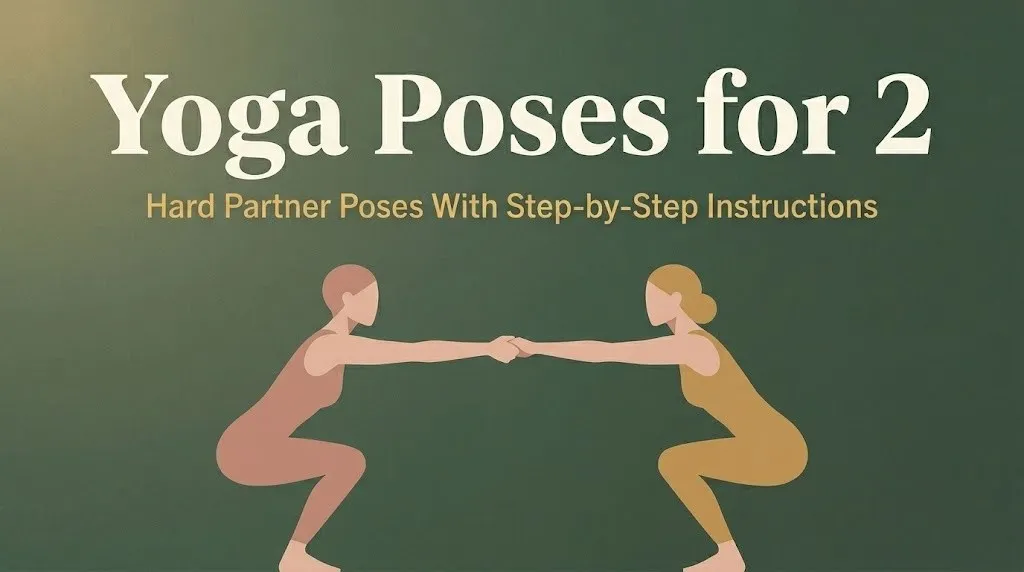
Partner Counterbalance Squat is the most foundational version of this concept. Both partners stand facing each other, feet about hip-distance apart, toes nearly touching. Each partner holds the other’s wrists. Both simultaneously lean back, extending their arms, and lower into a squat. The shared tension through the arms keeps both partners upright.
More advanced two-person balance poses involve one partner remaining fully grounded while the other creates an off-axis shape. Supported Virabhadrasana III (Warrior III) is a good example at the intermediate level.
To practice Supported Partner Virabhadrasana III (Warrior III):
- Partners face each other, standing one arm’s length apart.
- Partner A extends both arms forward and grips Partner B’s forearms.
- Partner A hinges forward at the hips, lifting one leg behind them.
- Partner B remains upright, providing a stable anchor point.
- Partner A finds full extension: torso parallel to the floor, lifted leg in line with the spine.
- Hold five breaths. Lower slowly. Switch roles.
Modification: Partner A keeps the lifted foot on a yoga block instead of extending fully. This reduces the balance demand while training the hip and core pattern.
Acro Yoga Base and Flyer Explained
In acro yoga, the base is the partner on the ground who provides the structural foundation, and the flyer is the partner who is lifted, balanced, or inverted above the base’s body.
The base typically lies on their back with legs extended vertically. They use the soles of their feet on the flyer’s hip bones, lower abdomen, or chest to create the support surface. The base’s core, hip flexors, and ankle stability are the primary physical factors. Their arms are often extended upward to provide hand-to-hand contact for guidance.
The flyer must have core control, upper body strength, and the ability to remain calm in an off-ground position. Flyers who grip or tense create instability for the base. A relaxed, engaged flyer is actually easier for the base to support than a frightened, stiff one.
A spotter is the third role. In any acro yoga practice at the learning stage, a spotter stands beside the base-flyer pair. They catch the flyer’s hips or torso if balance breaks. No acro yoga school or certified instructor recommends removing the spotter until both base and flyer have demonstrated the pose reliably at least ten times.
Pose Tip:
- Base: Keep ankles directly over hips. Bent knees create an unstable lever.
- Flyer: Engage your core like you are bracing for a slow, gentle punch. Stay active.
- Spotter: Stand at the flyer’s hip level, hands ready but not interfering.
Key Takeaway: Acro yoga’s base-flyer-spotter structure exists for a specific safety reason. Removing the spotter before both partners have reliable repetitions is how most acro yoga injuries happen.
Standing Partner Yoga Poses That Are Actually Hard
Standing two-person yoga poses that qualify as genuinely hard require single-leg balance, overhead extension, significant strength asymmetry management, or coordinated weight transfer between partners.
Double Adho Mukha Vrksasana (Handstand support) is one of the hardest standing-adjacent partner poses. This is where one partner is in a handstand while the other provides stabilization at the ankles.
Realistically, this pose requires the flyer to have an established solo handstand practice. Attempting a supported handstand without solo handstand competency adds full body weight to the supporting partner’s grip in an uncontrolled way.
Partner Standing Splits (Urdhva Prasarita Eka Padasana) is more accessible as a hard standing partner pose.
To practice Partner-Assisted Urdhva Prasarita Eka Padasana (Standing Splits):
- Partner A stands, weight on left foot. Hands on the floor, fingertips in line with the standing foot.
- Partner B stands at Partner A’s right hip.
- Partner B places one hand on Partner A’s right hip, one on the right ankle.
- Partner A lifts the right leg. Partner B assists by gently drawing the ankle upward.
- Both breathe. Partner A signals if assistance is too much.
- Hold five breaths. Lower slowly. Switch sides and switch roles.
Modification: Partner A uses two yoga blocks under the hands. This raises the floor and reduces hamstring and spinal demand significantly.
Two Person Yoga for Flexibility and Strength
Partner yoga is one of the most efficient tools for building both flexibility and functional strength at the same time, because the two demands occur within the same pose simultaneously.
For flexibility, the primary mechanism is assisted passive stretching. When a partner applies controlled external pressure or provides a stable counterforce, the muscle being stretched receives a longer, more sustained signal to lengthen. According to the American College of Sports Medicine, passive stretching held for 30 to 60 seconds produces the most consistent increases in joint range of motion in healthy adults. Partner yoga poses make this duration of stretch more achievable because the partner creates a stable anchor.
For strength, the mechanism is isometric and dynamic resistance. In counterbalance poses, both partners are resisting the pull of the other’s weight continuously. This activates the deep core stabilizers, the posterior chain, and the shoulder girdle in ways that passive stretching alone does not.
| Goal | Best Partner Pose Type | Primary Muscles Trained |
|---|---|---|
| Hamstring flexibility | Assisted Paschimottanasana | Hamstrings, lower back |
| Hip flexor lengthening | Partner Low Lunge assist | Iliopsoas, quadriceps |
| Shoulder mobility | Counterbalance Forward Fold | Rotator cuff, thoracic extensors |
| Core strength | Partner Boat Pose | Transverse abdominis, hip flexors |
| Posterior chain strength | Partner Warrior III | Glutes, hamstrings, spinal extensors |
| Wrist and forearm strength | Supported Crow | Wrist flexors, anterior forearm |
Two sessions per week of partner yoga is a practical starting point. The National Center for Complementary and Integrative Health notes that yoga practiced at this frequency shows measurable flexibility and strength improvements within six to eight weeks in previously sedentary adults.
Modifications for Hard Partner Yoga Poses
Every hard partner yoga pose has a version that reduces the load, the range of motion, or the complexity while preserving the fundamental benefit of the shape.
The principle behind modifications is simple: you are building toward the full pose, not settling for less. Using a block under the hands in a forward fold does not make you a beginner. It makes you someone with enough knowledge to protect their hamstrings while they develop the flexibility the full pose requires.
Here are modifications across the main categories of hard two-person poses:
- For wrist-bearing poses (Crow, Plank on Partner): Place a folded blanket under the heel of each hand to reduce wrist extension angle. This is specifically helpful for anyone with mild wrist instability or previous wrist strain.
- For backbend-based poses (Assisted Wheel): Use a yoga wheel under the upper back for the practitioner going into the backbend. The spotter provides observation and verbal cues only.
- For balance poses (Partner Tree, Warrior III): Both partners use a wall at arm’s length as a backup anchor point. One hand on the wall, one hand connected to the partner.
- For acro base work: The base begins with feet on the floor and thighs parallel to the ceiling. The flyer sits on the base’s feet in a seated position rather than standing or extending.
- For standing splits assist: Use yoga blocks under the forward-folding partner’s hands to raise the floor. The assisting partner uses one hand only, at the hip, rather than drawing the ankle skyward.
- For counterbalance squats: Both partners hold a looped yoga strap instead of direct wrist-to-wrist contact. The strap provides more give and reduces grip-related tension in the forearms.
Safety note: Modifications are not optional for practitioners with acute injuries. If one partner is managing an active lumbar, cervical, shoulder, or wrist issue, the modified version is the appropriate version for that session. Progressing to the full pose requires the injury to be fully resolved, with guidance from a physical therapist or sports medicine provider familiar with yoga biomechanics.
Key Takeaway: Modifications are built into hard partner yoga poses specifically because these poses load joints in non-standard ways. Using them is not a workaround. It is the correct technique for anyone building toward the full shape.
Who Should Avoid Hard Partner Yoga Poses
Hard partner yoga poses are contraindicated for specific populations and conditions, and being honest about this prevents real injuries.
The following individuals should avoid or significantly restrict hard two-person yoga poses:
- People with acute lumbar disc injuries or recent spinal surgery: Forward folds, backbends, and any pose requiring spinal loading under a partner’s weight create forces on the intervertebral discs that can worsen acute conditions.
- People with wrist fractures, sprains, or diagnosed ligament instability: Any pose placing weight on the wrists, including Crow, Plank variations, and most base-position acro yoga, requires full wrist integrity.
- People with cervical spine conditions: Partner Shoulder Stand and any inverted pose places compressive load on the cervical vertebrae. A history of herniated cervical disc, cervical stenosis, or neck surgery is a contraindication for these poses.
- People with unmanaged hypertension or cardiovascular conditions: Inversions raise intracranial pressure. Anyone with unmanaged high blood pressure should work with a cardiologist or internist familiar with exercise physiology before attempting any inverted two-person pose.
- Pregnant practitioners: Many hard partner poses involve abdominal compression, deep spinal extension, or inversion. These are generally contraindicated during pregnancy, particularly after the first trimester. A prenatal yoga specialist can identify the specific poses that remain accessible.
- Children and adolescents in unsupervised settings: Weight-bearing partner poses require developed proprioception and the ability to communicate clearly about discomfort. These skills are less reliable in younger practitioners. Adult supervision and modified pose selection are appropriate.
Anyone returning from injury who wants to practice partner yoga should have their physical therapist or orthopedic specialist review the specific poses they intend to attempt, particularly if those poses involve the affected body part as a load-bearing point.
Frequently Asked Questions About Yoga Poses for 2
What are the hardest yoga poses to do with a partner?
The hardest yoga poses for 2 include acro yoga inversions like the Flying Warrior (Virabhadrasana III airborne), Double Crow (Bakasana), and Assisted Handstand (Adho Mukha Vrksasana), all of which require significant baseline strength and balance.
These poses demand simultaneous strength, flexibility, trust, and communication skills that take months of preparatory work to develop.
Most yoga teachers recommend mastering solo versions of these poses before attempting partner variations.
Can beginners do difficult two person yoga poses?
Beginners should not start with the hardest two-person yoga poses, because most difficult partner poses have physical prerequisites that take weeks or months to build.
Beginners can work toward harder poses by starting with counterbalance and grounded partner poses, building strength and communication habits first.
The progression from Partner Navasana (Double Boat Pose) and Partner Vrksasana (Double Tree Pose) to more advanced shapes is the standard pathway yoga teachers recommend.
Is acro yoga the same as partner yoga?
Acro yoga is a specific subset of partner yoga that incorporates acrobatics, defined base-flyer-spotter roles, and structured progressions borrowed from gymnastics and contact improvisation.
Standard partner yoga does not require airborne elements or the formal base-flyer structure.
All acro yoga is partner yoga, but not all partner yoga is acro yoga.
What muscles do two person yoga poses work?
Two person yoga poses primarily engage the core stabilizers, hamstrings, hip flexors, glutes, shoulder girdle, and wrist flexors, depending on the specific pose and role each partner takes.
Counterbalance poses add a posterior chain demand that solo yoga poses at similar difficulty levels do not replicate.
Weight-bearing poses in the base position specifically train the quadriceps, deep hip stabilizers, and thoracic extensors under dynamic load.
How do you safely hold your partner’s weight in yoga?
Safe weight-holding in partner yoga starts with establishing a stable base position, communicating clearly about load distribution, and transferring weight gradually rather than suddenly.
The base partner should always engage the core fully before the flyer’s weight arrives, and both partners must agree on a stop signal before any weight-bearing shape begins.
If you are new to base work, practice with a spotter present and reduce the flyer’s weight progression over multiple sessions before attempting full weight transfer.
Hard two-person yoga poses reward patience more than ambition. The poses that look the most effortless in photos are usually the result of many sessions of grounded, communicative practice that happened well before the camera came out.
Start where your bodies actually are. Pick one pose from the beginner or intermediate list, learn the exit before the entry, and spend two sessions building the form before adding difficulty. Your nervous system, your joints, and your partner will all be better for it.
The most durable partner yoga practice is built one honest session at a time.